55 Flowers That Start With X: Names, Pictures & Growing Tips
Looking for flowers that start with X? Here is the honest truth first: X is the rarest letter in the plant kingdom, and any website promising you dozens of gorgeous, easy garden flowers beginning with X is stretching the truth. Many so-called “X flowers” are botanical curiosities rather than nursery plants — some are grown for their foliage, not their blooms, a few have flowers so small you will need a magnifying glass to appreciate them, and several only grow in very specific climates. This guide respects your intelligence instead: every one of the 55 entries below is a real, botanically verified plant, and where a bloom is insignificant or a plant is hard to grow, we say so plainly.
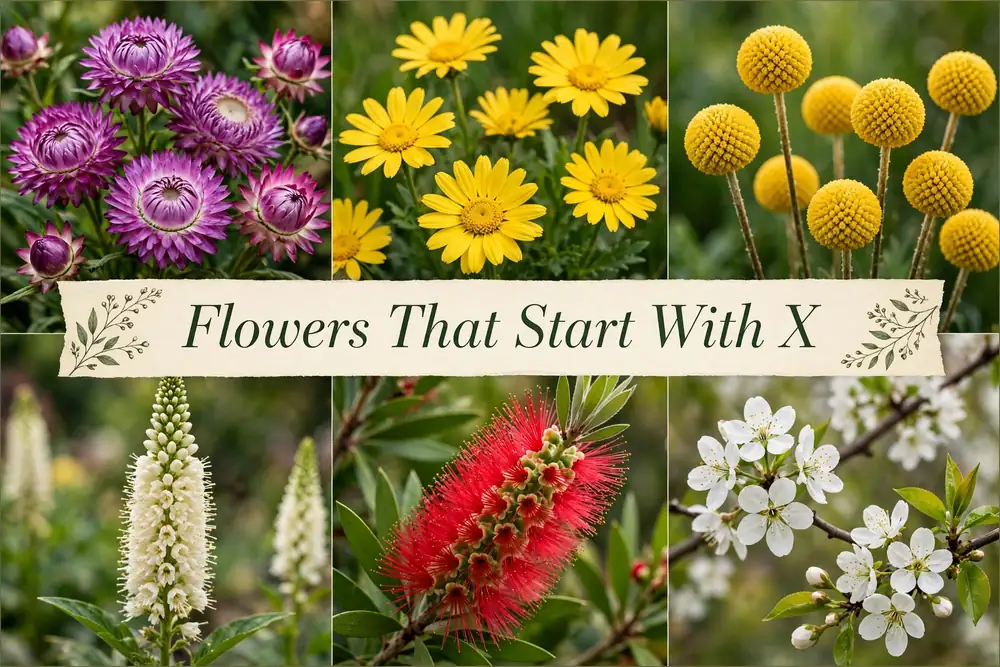
That said, the X-list has genuine stars. Xeranthemum — the papery “everlasting” strawflower — is a superb cut-and-dried flower you can grow from seed in any sunny garden. The Texas sleepy daisy (Xanthisma texanum) is a cheerful native wildflower. Yellowhorn (Xanthoceras sorbifolium) is a tough, beautiful flowering shrub for cold climates. Beargrass (Xerophyllum tenax) sends up breathtaking plumes of white flowers, the Poor Knights lily (Xeronema callistemon) produces one of the most dramatic red flower spikes in the plant world, and golden penda (Xanthostemon chrysanthus) covers itself in golden pom-poms. Whether you are planning an alphabet garden, hunting for unusual plants, or just settling a bet, this guide covers 55 real flowers that start with X — each with a vivid description, honest growing notes, bloom season, sun needs, and USDA hardiness zone.
Quick Answer
Yes — this page lists 55 flowers that start with X, from xeranthemum and yellowhorn to beargrass and golden penda. X is the rarest letter in the plant kingdom, so this list stays honest: several entries are botanical curiosities, foliage plants, or collector rarities rather than nursery staples, and each one says so plainly. Use the at-a-glance table to filter by your USDA zone, sun and bloom season before you buy.
Table of Contents
X-Flowers at a Glance
Use this table to compare all 55 flowers that start with X side by side, from botanical names to native regions. Entries marked honestly are foliage plants or rarities — read the full descriptions before you buy.
| # | Name | Scientific name | Bloom | Sun | Zone | Best for |
|---|---|---|---|---|---|---|
| 1 | Annual Everlasting | Xeranthemum annuum | Summer | Full sun | Grown as annual (hardy) | Dried flowers, cutting gardens, beginners |
| 2 | Xeranthemum cylindraceum | Xeranthemum cylindraceum | Summer | Full sun | Grown as annual (hardy) | Dried flowers, collectors |
| 3 | Xeranthemum inapertum | Xeranthemum inapertum | Summer | Full sun | Grown as annual (hardy) | Dried-flower texture, rock gardens |
| 4 | Texas Sleepy Daisy | Xanthisma texanum | Spring to early summer | Full sun | 7–10; annual elsewhere | Native wildflowers, xeriscaping, pollinators |
| 5 | Slender Goldenweed | Xanthisma gracile | Summer to fall | Full sun | 8–10; annual elsewhere | Desert natives, xeriscaping, native bees |
| 6 | Xylobium Orchid | Xylobium palmifolium | Winter | Bright indirect light | Houseplant (10–11 outdoors) | Fragrant orchids, collectors |
| 7 | Yellowhorn | Xanthoceras sorbifolium | Spring (May) | Full sun | 5–8 | Cold-climate flowering shrubs |
| 8 | Grass Tree | Xanthorrhoea spp. | Spring to summer (often after fire) | Full sun | 9–11 | Australian natives, architectural specimens |
| 9 | Beargrass | Xerophyllum tenax | Late spring to summer | Full sun to part shade | 5–8 | Native gardens, dramatic plumes |
| 10 | Eastern Turkeybeard | Xerophyllum asphodeloides | Late spring to early summer | Full sun to part shade | 5–8 | Eastern natives, woodland edges |
| 11 | Poor Knights Lily | Xeronema callistemon | Late spring to early summer | Full sun to part shade | 9–11 | Collector gardens, dramatic red spikes |
| 12 | Elephant’s Ear | Xanthosoma sagittifolium | Sporadic (insignificant) | Part shade to full sun | 9–11; lift tubers elsewhere | Tropical foliage, containers |
| 13 | Shiny Xylosma | Xylosma congestum | Fall (insignificant) | Full sun to part shade | 7–10 | Hedges, screens, glossy foliage |
| 14 | Resurrection Lily | Xerophyta retinervis | Spring to summer (after rains) | Full sun | 9–11 | Rock gardens, collectors |
| 15 | Golden Penda | Xanthostemon chrysanthus | Summer to fall | Full sun | 10–11 (frost tender) | Tropical gardens, nectar plants |
| 16 | Xylopia aromatica | Xylopia aromatica | Sporadic in tropics | Full sun | Tropical only (11–12) | Botanical collections |
| 17 | Woody Pear | Xylomelum pyriforme | Spring (Sept–Nov in Australia) | Full sun to part shade | 9–10 | Australian natives, unusual fruits |
| 18 | Xanthophytum fruticulosum | Xanthophytum fruticulosum | Sporadic in tropics | Part shade | Tropical only; not in cultivation | Botanical completeness |
| 19 | Xeranthemum squarrosum | Xeranthemum squarrosum | Summer | Full sun | Grown as annual | Dried flowers, collectors |
| 20 | Xeranthemum longepapposum | Xeranthemum longepapposum | Summer | Full sun | Grown as annual | Botanical completeness, dried flowers |
| 21 | Spiny Goldenweed | Xanthisma spinulosum | Late summer to fall | Full sun | 5–9 | Xeric natives, rock gardens |
| 22 | Saw-toothed Goldenweed | Xanthisma grindelioides | Spring to summer | Full sun | 4–8 | Rock gardens, native-plant collections |
| 23 | Sticky Everlasting | Xerochrysum viscosum | Spring to summer | Full sun | 8–10 | Cut flowers, native borders |
| 24 | Swamp Everlasting | Xerochrysum palustre | Summer to fall | Full sun | 9–10 | Bog gardens, conservation plantings |
| 25 | Southern Cross | Xanthosia rotundifolia | Spring | Full sun to part shade | 9–10 | Rock gardens, Australian natives |
| 26 | Nyala Tree | Xanthocercis zambesiaca | Early summer | Full sun | 10–11 | Botanical gardens, tropical shade trees |
| 27 | WA Grass Tree | Xanthorrhoea preissii | Rare (often after fire) | Full sun | 9–11 | Native gardens, collector specimens |
| 28 | Blue Grass Tree | Xanthorrhoea glauca | Rare (often after fire) | Full sun | 9–10 | Architectural specimens, native gardens |
| 29 | Austral Grass Tree | Xanthorrhoea australis | Rare (often after fire) | Full sun | 8–10 | Large native landscapes, specimens |
| 30 | Blue Taro | Xanthosoma violaceum | Rarely (grown for foliage) | Part shade | 9–11; houseplant elsewhere | Tropical foliage, large containers |
| 31 | Xanthosoma robustum | Xanthosoma robustum | Rarely (grown for foliage) | Part shade | 9–11; houseplant elsewhere | Bold tropical foliage, containers |
| 32 | Brush Holly | Xylosma flexuosa | Spring (tiny, inconspicuous) | Full sun to part shade | 9–11 | Hedges, screening shrubs |
| 33 | Sawtooth Logwood | Xylosma crenata | Spring (small, inconspicuous) | Full sun to part shade | 10–11 | Botanical collections (rare endemic) |
| 34 | Xylobium colleyi | Xylobium colleyi | Spring to summer | Bright indirect light | Houseplant/greenhouse | Orchid collections |
| 35 | Variegated Xylobium | Xylobium variegatum | Summer to fall | Bright indirect light | Houseplant/greenhouse | Orchid collections |
| 36 | Xeronema moorei | Xeronema moorei | Spring to summer | Full sun to part shade | 10–11 | Collector gardens (extreme rarity) |
| 37 | Xerophyta viscosa | Xerophyta viscosa | Summer | Full sun | 9–11 | Rock gardens, xeric containers |
| 38 | Xerophyta elegans | Xerophyta elegans | Summer | Part shade | 9–11 | Rock gardens, containers, collectors |
| 39 | Bridal Tree | Xanthostemon paradoxus | Summer | Full sun | 10–11 | Tropical gardens, street trees (frost-free) |
| 40 | Little Penda | Xanthostemon verticillatus | Spring to summer | Full sun to part shade | 9–10 | Containers, fragrant tropical shrubs |
| 41 | Ethiopian Pepper | Xylopia aethiopica | Spring (small, inconspicuous) | Full sun | 10–11 | Tropical spice gardens |
| 42 | Xylopia frutescens | Xylopia frutescens | Spring to summer (small, cream) | Full sun | 10–11 | Tropical collections |
| 43 | Western Woody Pear | Xylomelum occidentale | Spring | Full sun | 9–10 | Australian native gardens |
| 44 | Sandplain Woody Pear | Xylomelum angustifolium | Spring | Full sun | 9–10 | Native gardens, cut foliage |
| 45 | Tall Yellow-eye | Xyris operculata | Summer to fall | Full sun | 9–10 | Bog gardens, pond margins |
| 46 | Indian Yellow-eye | Xyris indica | Summer to fall | Full sun | 9–11 | Bog gardens, wet containers |
| 47 | Coastal Plain Yellow-eyed Grass | Xyris ambigua | Summer (May–Sep) | Full sun | 7–10 | Bog gardens, native wetlands |
| 48 | Baldwin’s Yellow-eyed Grass | Xyris baldwiniana | Late spring to fall | Full sun | 8–10 | Rain gardens, bog plantings |
| 49 | Hog Plum | Ximenia americana | Spring (small, fragrant) | Full sun | 9–11 | Tropical fruit gardens, hedges |
| 50 | Sour Plum | Ximenia caffra | Spring (small, fragrant) | Full sun | 9–11 | Tropical fruit gardens |
| 51 | Cannonball Mangrove | Xylocarpus granatum | Spring to summer (small, white) | Full sun | 10–11 | Coastal gardens (frost-free) |
| 52 | Xylocarpus moluccensis | Xylocarpus moluccensis | Spring to summer (small) | Full sun | 10–11 | Coastal collections |
| 53 | Xylocarpus rumphii | Xylocarpus rumphii | Spring (tiny, white-pink) | Full sun | 10–11 | Botanical collections (rare) |
| 54 | Xanadu Philodendron | Thaumatophyllum xanadu | Rarely indoors (grown for foliage) | Bright indirect light | 9–11; houseplant elsewhere | Houseplants, tropical borders |
| 55 | Xerographica Air Plant | Tillandsia xerographica | Rarely (once per rosette) | Bright indirect light | Houseplant | Air-plant displays, mounted specimens |
18 Flowers That Start With X: The Complete List
Here they are — 18 real, botanically verified plants beginning with X. Each entry tells you what the flowers actually look like, whether the plant is genuinely worth growing, and exactly how to grow it if it is.
1. Annual Everlasting (Xeranthemum annuum)
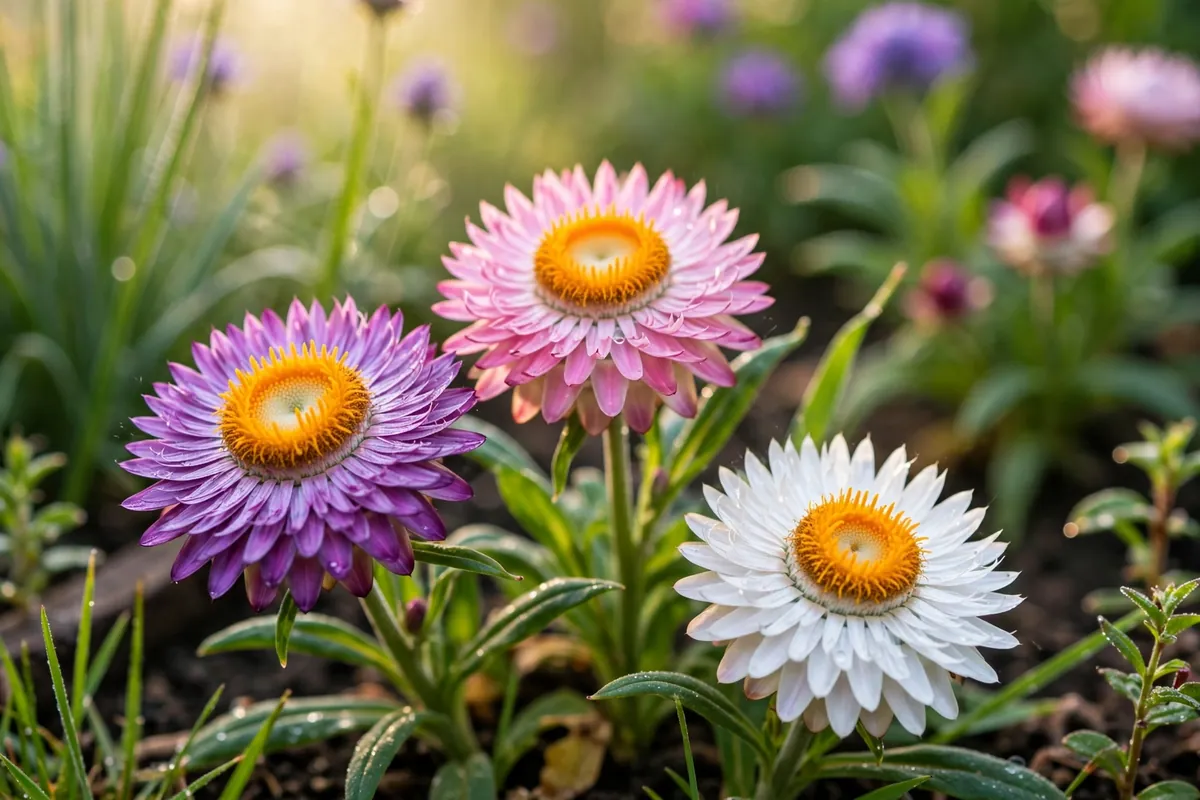
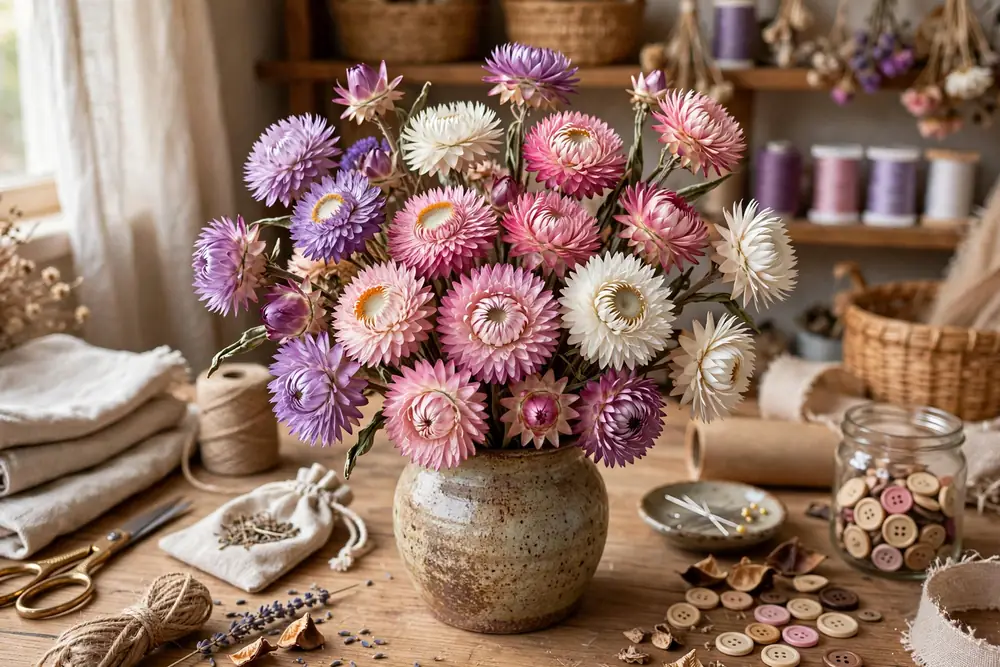
If you grow only one X-flower, make it this one. Xeranthemum annuum — the annual everlasting, or immortelle — is the undisputed star of the X-list: a hardy annual with papery, straw-like daisy blooms in purple, lilac, pink, and white around golden centers. The flowers feel dry to the touch even when fresh, which is exactly why they are legendary as dried flowers — cut them just as they open, hang them upside down, and they will hold their color for years. (Do not confuse it with the common garden “strawflower,” which is a different plant, Xerochrysum bracteatum.) Sow seeds directly outdoors in spring after the last frost — it dislikes transplanting — in full sun and average to poor, well-drained soil. It actually blooms best in lean soil and shrugs off drought. Deadhead for more flowers, or leave the heads to self-sow. Bees and butterflies visit the fresh blooms, and a single packet of seed gives you armloads of everlastings for crafts and winter bouquets.
Bloom: Summer | Sun: Full sun | Zone: Grown as annual (hardy) | Best for: Dried flowers, cutting gardens, beginner gardeners
2. Xeranthemum cylindraceum
Xeranthemum cylindraceum is the annual everlasting’s lesser-known sibling — a real species from southeastern Europe and western Asia that looks very much like X. annuum but with narrower, more cylindrical flower heads (hence the name) on wiry stems. Honest assessment: in the garden it is nearly interchangeable with the common everlasting, and it is much harder to find in the seed trade — you will likely only encounter it through specialist wildflower or botanical seed suppliers. Grow it exactly like X. annuum: direct-sow in spring in full sun and well-drained, lean soil, and use it the same way for dried arrangements. Choose this one if you are a plant collector who wants the complete Xeranthemum set or you love growing botanical rarities; everyone else should start with X. annuum.
Bloom: Summer | Sun: Full sun | Zone: Grown as annual (hardy) | Best for: Plant collectors, dried flowers, botanical completeness
3. Xeranthemum inapertum
Completing the Xeranthemum trio is X. inapertum, a Mediterranean species with smaller, paler pink-to-lilac papery heads that often stay half-closed — “inapertum” roughly means “unopened.” It is the daintiest of the three and arguably the prettiest in a dried arrangement, where its small heads add fine texture among bolder everlastings. Like its cousins it is a hardy annual for full sun and poor, well-drained soil, direct-sown in spring. Also like its cousins, it is scarce in commerce — check rock-garden and Mediterranean-plant seed exchanges rather than mainstream catalogs. If you can source all three Xeranthemums, a mixed drift of them in a sunny, gravelly bed is a genuinely beautiful and unusual planting that no neighbor will have.
Bloom: Summer | Sun: Full sun | Zone: Grown as annual (hardy) | Best for: Dried-flower texture, rock gardens, collectors
4. Texas Sleepy Daisy (Xanthisma texanum)
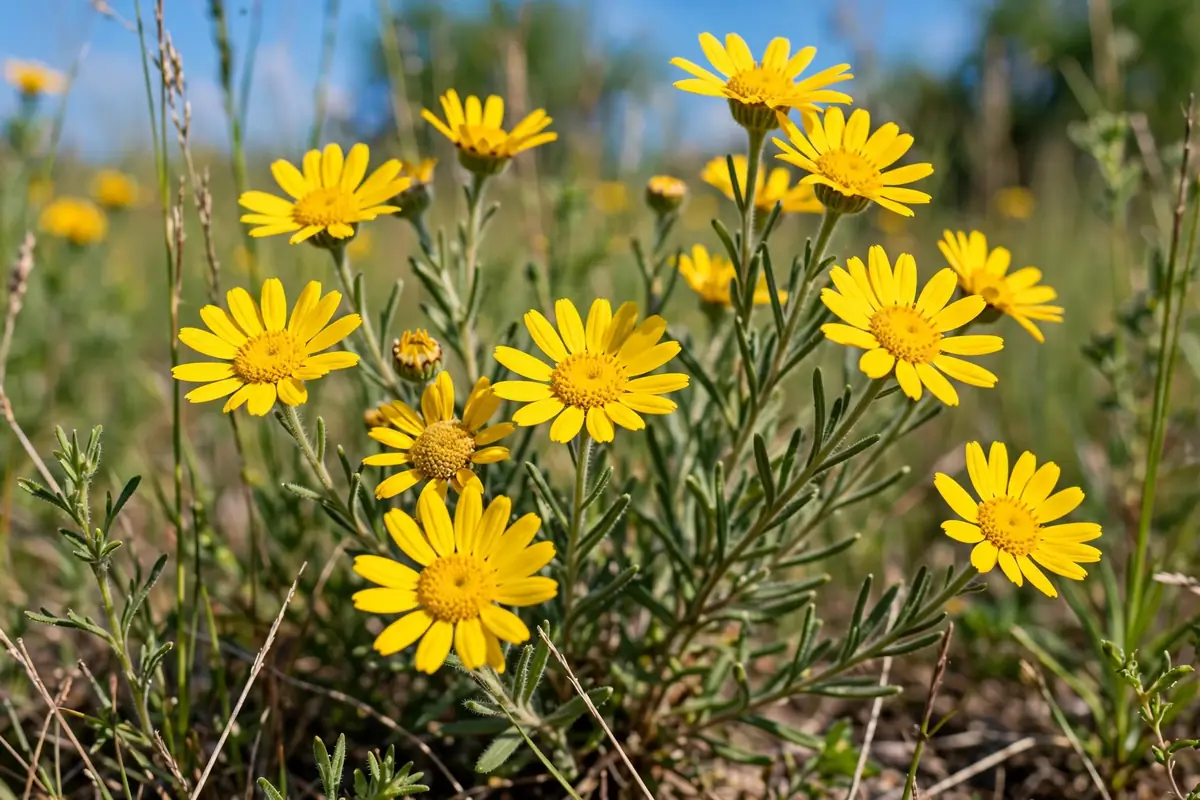
The Texas sleepy daisy is one of the few X-flowers with genuine garden merit in the United States. Xanthisma texanum — also called star-of-Texas — is a native annual (sometimes short-lived perennial) that covers itself in cheerful yellow daisies with golden centers from spring into early summer. The “sleepy” in its name comes from the flowers closing in the afternoon or on cloudy days. It is a true Texas tough plant: direct-sow seeds in fall or early spring in full sun and lean, well-drained soil, then basically leave it alone — it thrives on neglect, heat, and drought. It self-sows readily, so a single planting can return for years. Use it in native wildflower meadows, xeriscape borders, and pollinator plantings, where native bees work the blooms constantly. In zones colder than 7, grow it as a spring-sown annual.
Bloom: Spring to early summer | Sun: Full sun | Zone: 7–10; annual elsewhere | Best for: Native wildflowers, xeriscaping, pollinators
5. Slender Goldenweed (Xanthisma gracile)
Slender goldenweed is the Texas sleepy daisy’s desert cousin — a bristly annual wildflower of the southwestern US and northern Mexico, producing small bright-yellow daisies with up to 26 ray florets from summer into fall. Xanthisma gracile is a plant of roadsides, washes, and rocky slopes, not of gardens: it wants blazing sun, sharp drainage, and zero coddling. That said, it has real value in Southwestern native and xeriscape plantings, where its long bloom season feeds native bees (around 14 native bee species visit it, according to California native-plant records). Sow seed directly in warm soil in full sun and do not fertilize or overwater. Be honest with yourself about this one: it is a wildflower for naturalistic desert-style plantings, not a border plant — its charm is in its toughness and its service to pollinators.
Bloom: Summer to fall | Sun: Full sun | Zone: 8–10; annual elsewhere | Best for: Desert natives, xeriscaping, native-bee habitat
6. Xylobium Orchid (Xylobium palmifolium)
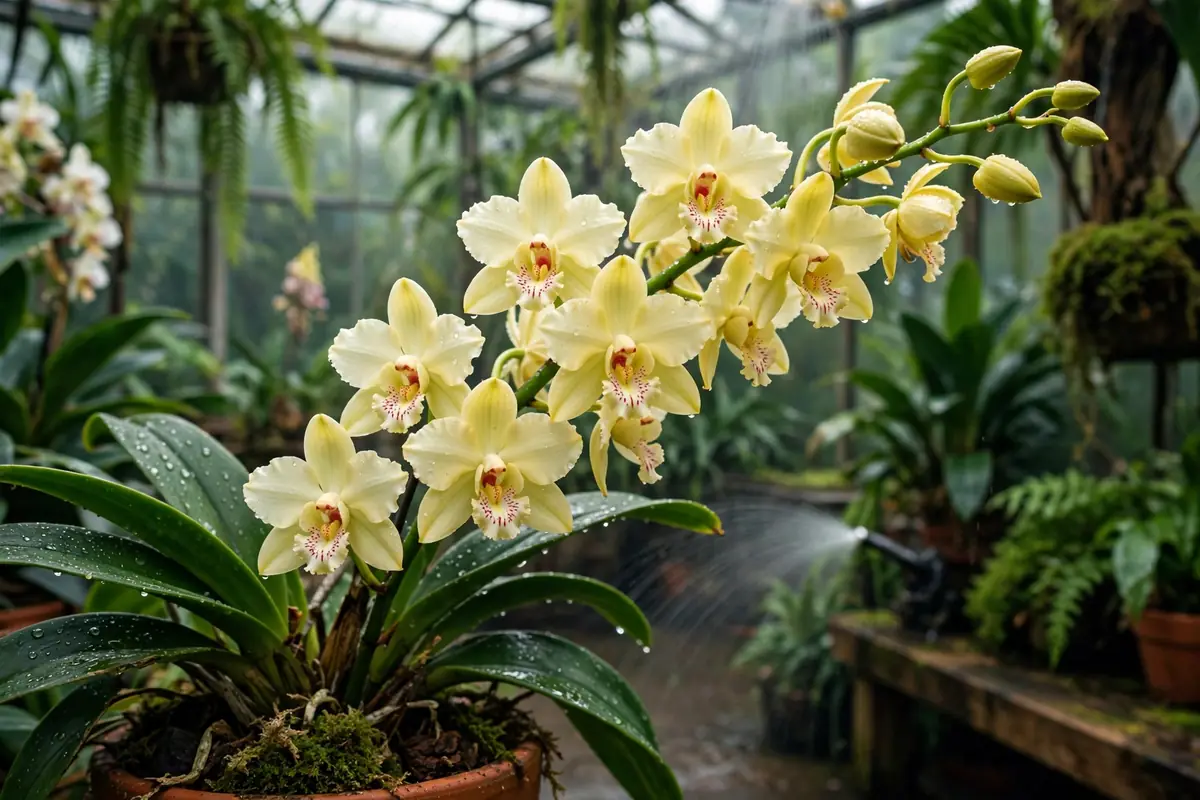
Xylobium is a genuine genus of about 35 orchid species from tropical America, and Xylobium palmifolium — found from the Caribbean into northern South America — is one of the most growable. It is a medium-sized epiphyte with ribbed, palm-like leaves and arching sprays of fragrant, waxy, creamy-yellow flowers about 1.5 inches across in winter. The fragrance is the real selling point: sweet and noticeable across a room. Give it bright indirect light, intermediate to warm temperatures, and a coarse bark mix, keeping it evenly moist while growing and a little drier in winter. It is strictly a houseplant or greenhouse orchid outside zones 10–11. Xylobiums are uncommon in the orchid trade compared to cattleyas and phalaenopsis, so expect to hunt through specialty orchid nurseries — but for a collector, a winter-fragrant X orchid is a genuine treasure.
Bloom: Winter | Sun: Bright indirect light | Zone: Houseplant (10–11 outdoors) | Best for: Fragrant orchids, collectors, winter blooms indoors
7. Yellowhorn (Xanthoceras sorbifolium)
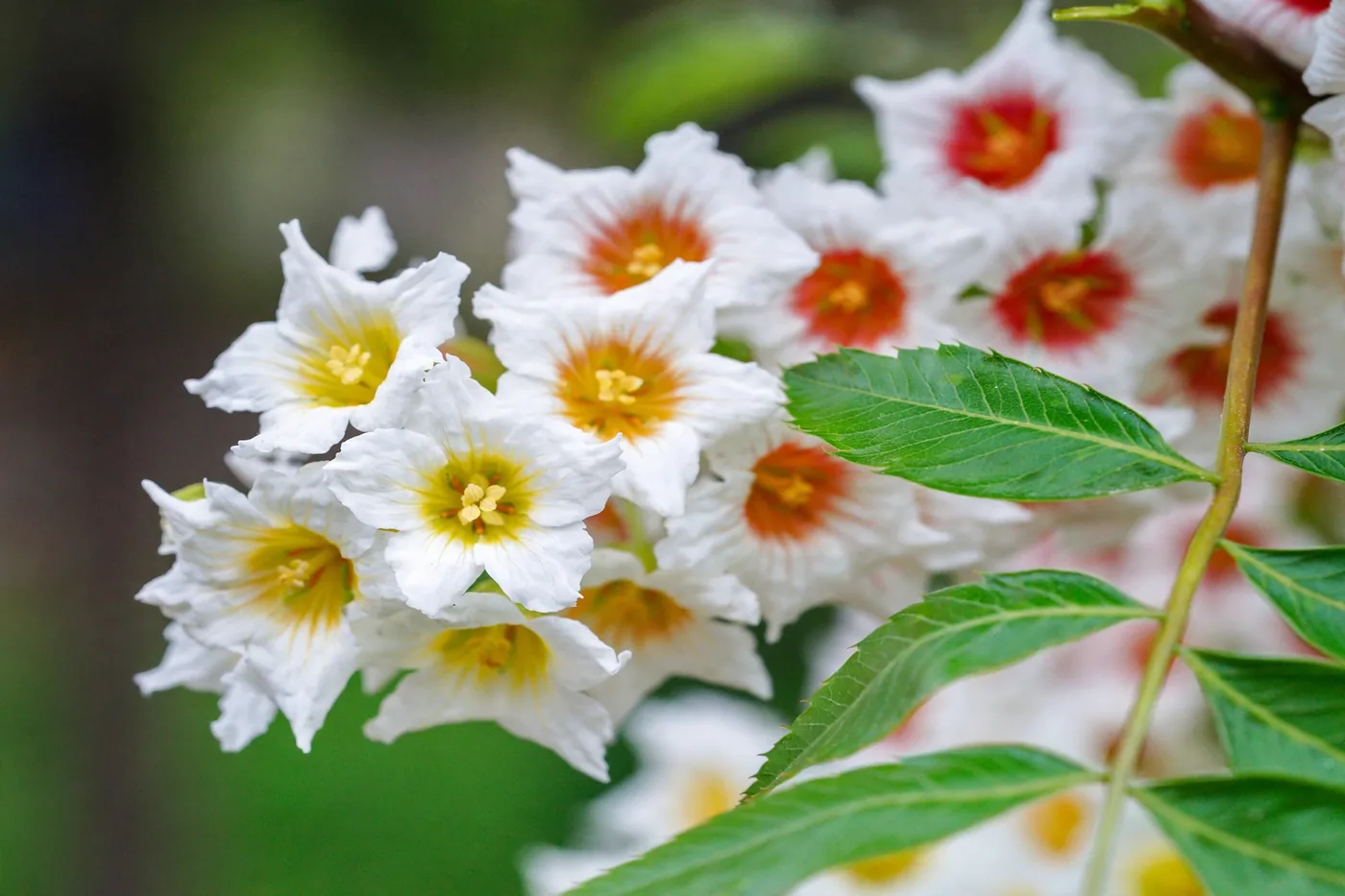
Yellowhorn may be the most underrated flowering shrub on this entire list. Xanthoceras sorbifolium is a deciduous shrub or small tree from northern China and Mongolia that erupts in spring with upright clusters of white, five-petaled flowers, each marked with a yellow center that ages to red — a two-tone effect that looks spectacular against the fresh green, ash-like foliage. It is extraordinarily tough: hardy to zone 5, drought-tolerant once established, tolerant of poor and even somewhat alkaline soils, and pest-free. Give it full sun and well-drained soil and it will reward you for decades, eventually reaching 10–20 feet. It is also grown in China for its oil-rich seeds. If you garden in a cold climate and want an X-flower with real landscape presence, yellowhorn is the one — it is increasingly available from nurseries specializing in hardy woody plants.
Bloom: Spring (May) | Sun: Full sun | Zone: 5–8 | Best for: Cold-hardy flowering shrubs, drought-tolerant landscapes, specimen planting
8. Grass Tree (Xanthorrhoea spp.)
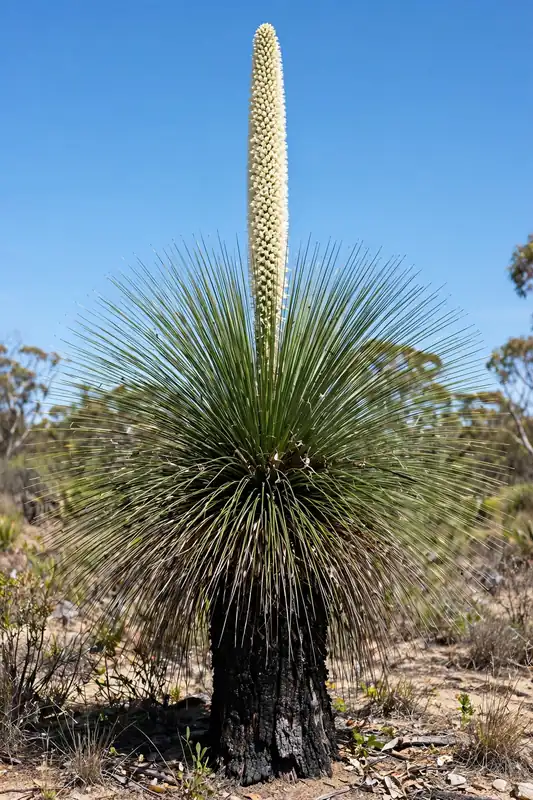
The Australian grass tree is less a garden plant than a living sculpture. Xanthorrhoea species form a trunk (sometimes slowly, over decades) topped with a fountain of stiff, grass-like leaves, and — the reason it is on this list — send up a spectacular flower spike that can tower 6–10 feet tall, densely packed with thousands of tiny creamy-white flowers. Flowering is erratic and often follows fire or a hot summer, which makes a blooming grass tree a genuine event. Honest caveats: grass trees are agonizingly slow-growing (a foot of trunk can take decades), expensive to buy as established plants, and need perfect drainage and full sun in zones 9–11. They resent root disturbance and overwatering. Grow one only if you garden in a warm, dry climate and can source a nursery-grown plant — never dig one from the wild, where many species are protected. As a once-in-a-decade floral spectacle in a xeric or Australian-native garden, nothing else looks like it.
Bloom: Spring to summer, often after fire | Sun: Full sun | Zone: 9–11 | Best for: Sculptural xeric gardens, Australian natives, patient gardeners
9. Beargrass (Xerophyllum tenax)
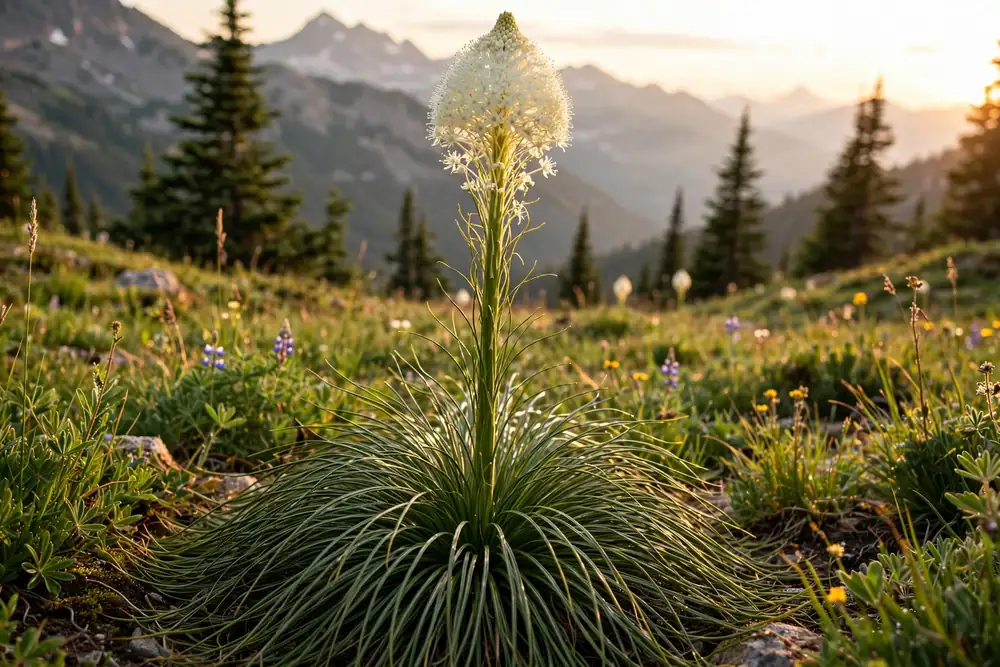
Beargrass is a western American native that earns its place among X-flowers with one of the most striking blooms of any native perennial: a dense, creamy-white plume of hundreds of tiny fragrant flowers atop a stalk that can reach 6 feet, rising from a fountain of wiry, grass-like evergreen leaves. In a good bloom year, mountain meadows full of beargrass are unforgettable. In the garden, give it full sun to part shade and well-drained, acidic soil in zones 5–8; it dislikes heavy clay and winter wet. Be warned that it is slow — plants grown from seed can take several years to flower — so buy the largest nursery plant you can find. It also blooms erratically, sometimes skipping years. For native-plant, meadow, and Pacific Northwest-style gardens, beargrass is a superb architectural perennial whose foliage looks good even when the flowers take a year off.
Bloom: Late spring to summer | Sun: Full sun to part shade | Zone: 5–8 | Best for: Native meadows, architectural foliage, western gardens
10. Eastern Turkeybeard (Xerophyllum asphodeloides)
Eastern turkeybeard is beargrass’s eastern twin — one of only two species in the genus Xerophyllum — and a genuinely beautiful native wildflower of the Appalachian Mountains and New Jersey Pine Barrens, with a tall raceme of small white flowers rising up to 5 feet above a tuft of wiry basal leaves in late spring. Here is the honest part: it is difficult to cultivate and seldom blooms in gardens. It demands strongly acidic, sandy, well-drained soil, resents disturbance, and is slow to establish. It is also a plant of conservation concern in parts of its range, threatened by habitat loss and fire suppression — so never collect it from the wild. If you garden within its native range on suitable acid soils, try nursery-propagated plants in a naturalistic setting and celebrate if it blooms. For most gardeners, this entry is here for botanical completeness: admire it on a hike, and grow beargrass instead if you are in the West.
Bloom: Late spring to early summer | Sun: Full sun to part shade | Zone: 5–8 | Best for: Native-plant enthusiasts within its range; admired in the wild
11. Poor Knights Lily (Xeronema callistemon)
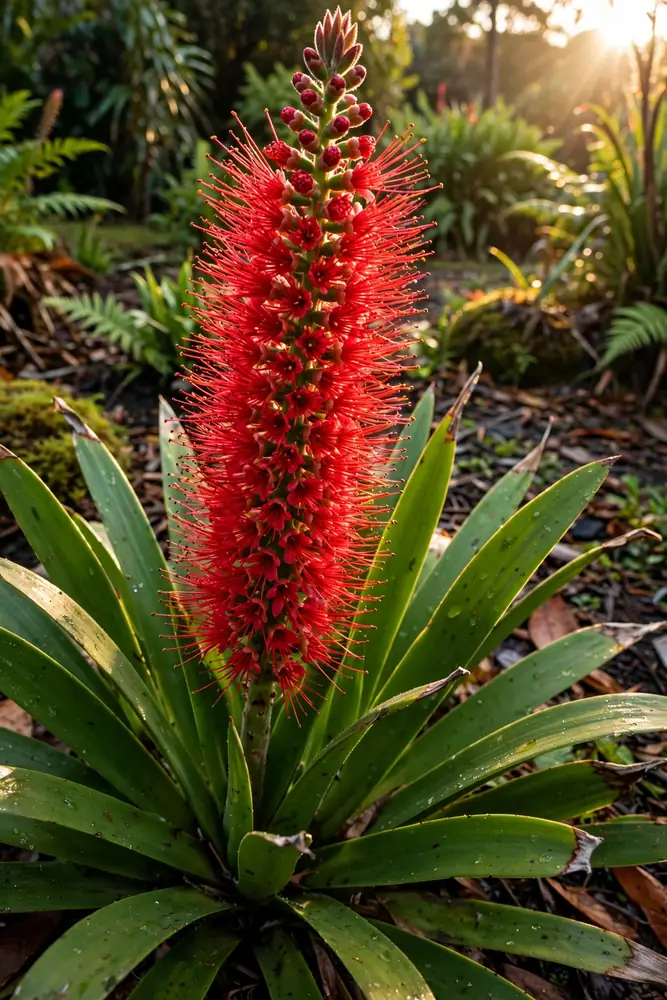
The Poor Knights lily produces arguably the single most spectacular flower on this list: a stout, upright, bottlebrush-like spike up to 3 feet tall, packed with hundreds of brilliant scarlet-red tubular flowers with exserted stamens, rising above bold fans of strap-like leaves. Xeronema callistemon is endemic to the Poor Knights Islands off New Zealand, where it clings to cliffs — which tells you everything about its needs: perfect drainage, full sun to part shade, and tolerance of wind and salt spray. It is hardy only in zones 9–11 and needs a frost-free or nearly frost-free climate; in marginal areas, grow it in a large pot you can shelter. It is slow to reach flowering size but extremely long-lived. For coastal California, the Gulf Coast, and other warm coastal gardens, it is a jaw-dropping specimen plant — a red exclamation point that hummingbirds will fight over.
Bloom: Late spring to early summer | Sun: Full sun to part shade | Zone: 9–11 | Best for: Coastal gardens, dramatic specimens, hummingbirds
12. Elephant’s Ear (Xanthosoma sagittifolium)
Time for full honesty: elephant’s ear is on X-lists everywhere, but nobody grows it for its flowers. Xanthosoma sagittifolium is a tropical perennial grown for its enormous, arrow-shaped leaves — up to 3 feet long — that bring instant jungle drama to warm gardens and containers. Its actual flowers are small, pale, arum-type spathes, like a modest calla lily, and they appear sporadically and insignificantly. We include it because the name genuinely starts with X and gardeners genuinely search for it — but set your expectations correctly. Grow it in zones 9–11 (or lift the tubers like dahlias elsewhere) in part shade to full sun with rich, consistently moist soil and regular feeding; the bigger the feed, the bigger the leaves. In cold climates it makes a spectacular summer container plant. Just do not buy it expecting a floral show — the foliage is the entire point.
Bloom: Sporadic, insignificant | Sun: Part shade to full sun | Zone: 9–11; lift tubers elsewhere | Best for: Bold tropical foliage, containers, shade drama
13. Shiny Xylosma (Xylosma congestum)
Another honest entry: shiny xylosma is a workhorse evergreen shrub, not a flower show. Xylosma congestum is prized for its glossy, bright-green foliage on gracefully arching branches — it makes one of the best fast-growing hedges and screens for zones 7–10, tolerating heat, drought, and pruning with ease. Its flowers? Tiny, yellowish-green, and utterly insignificant, appearing in fall and noticed by almost no one. So why is it here? Because it is a real, widely planted X plant that rounds out an honest list, and because “flowers that start with X” searchers deserve to know which results are foliage plants. Plant it in full sun to part shade in well-drained soil, shear it as a hedge or let it mound naturally to 8–10 feet, and enjoy the foliage — while looking to the Xeranthemums and Xanthismas on this list for actual flowers.
Bloom: Fall, insignificant | Sun: Full sun to part shade | Zone: 7–10 | Best for: Evergreen hedges, screens, glossy foliage (not flowers)
14. Resurrection Lily (Xerophyta retinervis)
Xerophyta retinervis is a plant with a superpower: it is a true resurrection plant, one of the rare flowering plants that can lose nearly all of its cellular water, sit apparently dead for months, and then revive within days of rain. Native to the rocky grasslands of South Africa, it forms tufts of narrow, grass-like leaves atop dark, fibrous, fire-blackened stems, and after rains produces small, starry, mauve-pink lily-like flowers. It needs full sun, extremely sharp drainage (gritty, rocky soil), and warm conditions in zones 9–11 — wet winter soil will kill it faster than any drought. It is very rare in cultivation, available only from specialist succulent and caudiciform nurseries, and slow-growing. Grow it as a conversation piece in a rock garden or alpine trough, and as a living demonstration of one of nature’s most extreme survival tricks. Do not confuse it with the unrelated “resurrection plant” Selaginella sold as a novelty.
Bloom: Spring to summer, after rains | Sun: Full sun | Zone: 9–11 | Best for: Rock gardens, collectors, botanical curiosities
15. Golden Penda (Xanthostemon chrysanthus)
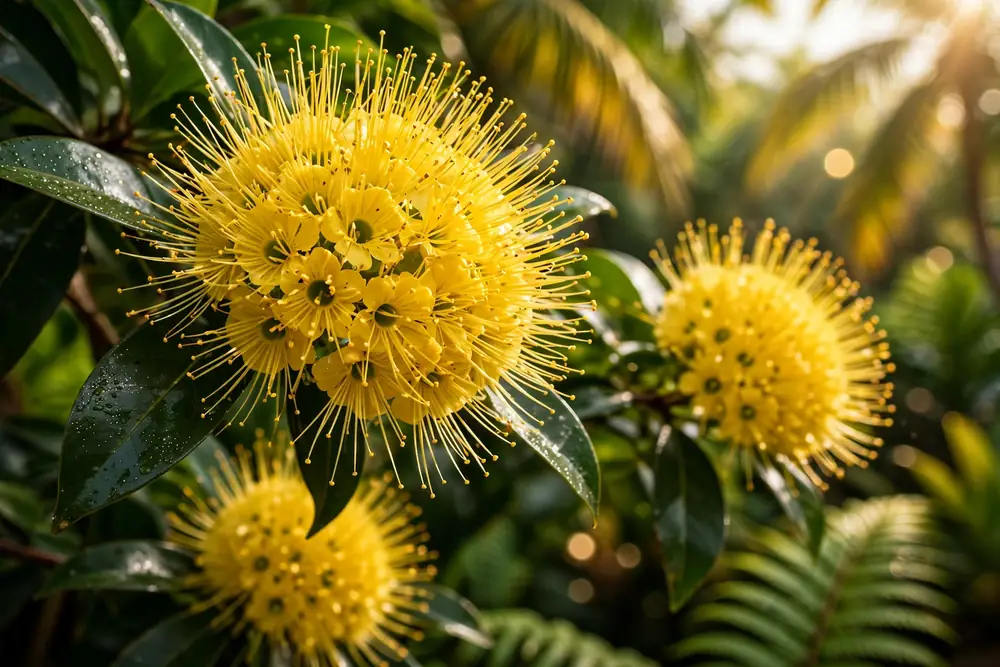
Golden penda is the floral emblem of Cairns, Australia, and one good look explains why: Xanthostemon chrysanthus covers itself in dense, pom-pom-like heads of golden-yellow, brush-like flowers — each bloom a burst of long golden stamens — that glow against glossy dark-green foliage from summer into fall. In its native Queensland it is a rainforest tree, but in cultivation it is often grown as a large shrub or small tree, and compact cultivars exist for smaller gardens. It needs full sun, moist but well-drained soil, and warmth — it is frost-tender, strictly for zones 10–11 outdoors in the US (think southern Florida, Hawaii, and frost-free coastal California). The nectar-rich blooms are magnets for lorikeets in Australia and hummingbirds and bees in American gardens. If you garden in the deep tropics and want the showiest yellow X-flower in existence, this is it.
Bloom: Summer to fall | Sun: Full sun | Zone: 10–11 (frost tender) | Best for: Tropical gardens, specimen trees, wildlife nectar
16. Xylopia aromatica
Xylopia is a large, real genus of about 200 species of tropical trees and shrubs in the custard-apple family (Annonaceae), and Xylopia aromatica is its type species, found in tropical South America and Africa. Its flowers are small, fragrant, yellowish-cream blooms — botanically interesting, ornamentally modest — and the genus is far better known for its aromatic fruits and seeds (the related Xylopia aethiopica is the “grains of Selim” spice of West Africa). This entry is included for botanical completeness: it is a genuine X flowering plant, but it is not a garden ornamental, it is not in the nursery trade, and it needs true tropical conditions. No honest “flowers that start with X” list should pretend otherwise. Plant geeks can admire it in botanical gardens with tropical houses; everyone else should scroll back up to the Xeranthemums.
Bloom: Sporadic in tropics | Sun: Full sun | Zone: Tropical only (11–12) | Best for: Botanical gardens, plant taxonomy enthusiasts
17. Woody Pear (Xylomelum pyriforme)
The woody pear is an Australian Proteaceae — a relative of banksias and grevilleas — and one of the oddest plants on this list. Xylomelum pyriforme grows as a large shrub or small tree with handsome, prominently veined leaves (juvenile leaves are dramatically toothed) and, in spring, rusty-haired spikes of small creamy-white flowers. But the flowers are honestly the opening act: the main event is the fruit — a large, woody, pear-shaped pod up to 9 cm long that splits after fire to release winged seeds. It needs full sun to part shade, very well-drained sandy soil, and warm conditions (zones 9–10); like most Proteaceae it hates phosphorus-rich fertilizers and wet feet. It is rarely cultivated even in Australia and can take many years to flower from seed. Grow it if you collect Australian natives and have patience; grow it for the extraordinary fruits as much as the flowers.
Bloom: Spring (Sept–Nov in Australia) | Sun: Full sun to part shade | Zone: 9–10 | Best for: Australian-native collections, unusual fruits, patient collectors
18. Xanthophytum fruticulosum
Our final entry is the most obscure — and we label it as such. Xanthophytum is a real genus of around 32 species of tropical shrubs in the coffee family (Rubiaceae), native from tropical Asia to the southwestern Pacific, and X. fruticulosum is its type species. These are understory shrubs bearing tiny, pale, tubular flowers packed into dense head-like clusters — the kind of plant known mostly from herbarium sheets and botanical papers (a new species was described as recently as 2024). It is not in cultivation, not available commercially, and not something you can grow at home. It earns its place here for one reason: completeness. When a letter has as few flowers as X does, an honest list includes the genuine botanical records with their caveats attached, rather than inventing prettier alternatives. Consider this entry a salute to the plant explorers and taxonomists who keep finding X plants in the world’s rainforests.
Bloom: Sporadic in tropics | Sun: Part shade | Zone: Tropical only; not in cultivation | Best for: Botanical completeness, taxonomy enthusiasts
19. Xeranthemum squarrosum (Xeranthemum squarrosum)
Xeranthemum squarrosum is a fourth everlasting for the Xeranthemum set — a real Mediterranean and west Asian annual with papery pink-purple heads whose bracts spread more stiffly than X. annuum’s (hence “squarrosum”). In the garden it behaves exactly like annual everlasting: direct-sow in spring, full sun, lean soil, cut for drying. Honest caveat: it is scarce in the seed trade, so this is a collector’s plant for completing the Xeranthemum group rather than a mainstream garden annual.
Bloom: Summer | Sun: Full sun | Zone: Grown as annual | Best for: Dried flowers, collectors
Note: Grow in the sun and zone shown in the table; check the plant label for the exact cultivar, as ranges vary by type. New entry — bloom, sun and zone NOT independently verified. Shares the Xeranthemum genus with live entries 1–3 — same genus, different species; like them, it is NOT the garden strawflower (Xerochrysum bracteatum).
20. Xeranthemum longepapposum (Xeranthemum longepapposum)
Xeranthemum longepapposum is a Kew-accepted everlasting from the Middle East to Central Asia, an annual of stony fields and mountain slopes with bright pink inner phyllaries and a notably long, feathery pappus. It is essentially unknown in cultivation — included here for botanical completeness of the Xeranthemum group, not as a plant you can buy. Treat it as a hardy annual; do not expect to find seed outside specialist exchanges.
Bloom: Summer | Sun: Full sun | Zone: Grown as annual | Best for: Botanical completeness, dried flowers
Note: Grow in the sun and zone shown in the table; check the plant label for the exact cultivar, as ranges vary by type. New entry — bloom, sun and zone NOT independently verified. Shares the Xeranthemum genus with live entries 1–3 — same genus, different species; Kew-accepted (POWO), confirmed real at draft time.
21. Spiny Goldenweed (Xanthisma spinulosum)
Spiny goldenweed is the Xanthisma for gardeners who like their wildflowers with an edge — a spiny-leaved, yellow-daisied perennial of the western US plains and deserts. It wants blazing sun, sharp drainage and zero coddling, and it earns its place in xeric native plantings and rock gardens where tougher is better. Like the slender goldenweed already on this page, it is a wildflower for naturalistic plantings rather than a border plant.
Bloom: Late summer to fall | Sun: Full sun | Zone: 5–9 | Best for: Xeric natives, rock gardens
Note: Grow in the sun and zone shown in the table; check the plant label for the exact cultivar, as ranges vary by type. New entry — bloom, sun and zone NOT independently verified. Shares the Xanthisma genus with live entries 4–5 — same genus, different species (syn. Machaeranthera pinnatifida).
22. Saw-toothed Goldenweed (Xanthisma grindelioides)
Saw-toothed goldenweed — also sold as rayless tansyaster — is the honest oddball of the Xanthisma group: its flower heads are rayless, meaning small yellow disc buttons with no showy petals, and its saw-toothed foliage arguably outshines the blooms. This is a rock-garden curiosity for native-plant enthusiasts, not a flower-show plant, and the entry is labeled accordingly. Give it lean, gritty soil and full sun; it is a tough little perennial of western plains and badlands.
Bloom: Spring to summer | Sun: Full sun | Zone: 4–8 | Best for: Rock gardens, native-plant collections
Note: Grow in the sun and zone shown in the table; check the plant label for the exact cultivar, as ranges vary by type. New entry — bloom, sun and zone NOT independently verified. Shares the Xanthisma genus with live entries 4–5 — same genus, different species; confirmed real at draft time (Flora of North America, accepted name; syn. Machaeranthera grindelioides).
23. Sticky Everlasting (Xerochrysum viscosum)
Sticky everlasting is an Australian paper daisy with slightly sticky foliage and papery white-to-yellow heads that dry well for arrangements. It is a distinct species from the garden strawflower, and the entry is explicit about that so no one confuses the two. Grow it like other everlastings — full sun, well-drained soil — and cut stems just as the heads open for the longest-lasting dried flowers.
Bloom: Spring to summer | Sun: Full sun | Zone: 8–10 | Best for: Cut flowers, native borders
Note: Grow in the sun and zone shown in the table; check the plant label for the exact cultivar, as ranges vary by type. New entry — bloom, sun and zone NOT independently verified. Shares the Xerochrysum genus with the strawflower/paper daisy on live E, H, P and S — same genus, DIFFERENT species: this is NOT the garden strawflower (Xerochrysum bracteatum).
24. Swamp Everlasting (Xerochrysum palustre)
Swamp everlasting is a golden-yellow paper daisy of southeastern Australian swamps — and a genuine conservation plant, listed as Vulnerable in Australia with only a few dozen known wild populations. It is included for completeness, not as a nursery plant: grow it only at a bog margin in a frost-free climate, from ethically sourced seed. Its story is a reminder that some X flowers are worth knowing about precisely because they are rare.
Bloom: Summer to fall | Sun: Full sun | Zone: 9–10 | Best for: Bog gardens, conservation plantings
Note: Grow in the sun and zone shown in the table; check the plant label for the exact cultivar, as ranges vary by type. New entry — bloom, sun and zone NOT independently verified. Shares the Xerochrysum genus with the strawflower/paper daisy on live E, H, P and S — same genus, DIFFERENT species; confirmed real at draft time (PlantNET NSW, listed Vulnerable in Australia).
25. Southern Cross (Xanthosia rotundifolia)
Southern cross is a small Western Australian native named for its tiny star-shaped white flower clusters, blooming in spring over fine-textured foliage. The flowers are modest — this is a rock-garden texture plant for Australian-native collections rather than a floral showpiece. Give it sharp drainage, full sun to light shade, and the lean soils it evolved in.
Bloom: Spring | Sun: Full sun to part shade | Zone: 9–10 | Best for: Rock gardens, Australian natives
Note: Grow in the sun and zone shown in the table; check the plant label for the exact cultivar, as ranges vary by type. New entry — bloom, sun and zone NOT independently verified.
26. Nyala Tree (Xanthocercis zambesiaca)
The nyala tree is one of southern Africa’s great riverine trees — up to 30 meters tall with a wide, dense crown, drooping glossy foliage, and sprays of small, rose-scented, creamy-white flowers in early summer, followed by plum-like fruits relished by wildlife. It is a phreatophyte of hot lowveld river valleys, frost-sensitive and far too big for any normal garden. Included for botanical completeness; admire it in botanical gardens, not catalogs.
Bloom: Early summer | Sun: Full sun | Zone: 10–11 | Best for: Botanical gardens, tropical shade trees
Note: Grow in the sun and zone shown in the table; check the plant label for the exact cultivar, as ranges vary by type. New entry — bloom, sun and zone NOT independently verified. Confirmed real at draft time (Wikipedia, Tree SA) — a massive, frost-sensitive African tree, not a home-garden plant.
27. WA Grass Tree (Xanthorrhoea preissii)
The Western Australian grass tree is the classic balga — a trunked grass tree crowned with long, grass-like leaves, sending up a towering creamy-white flower spike, often triggered by fire. The honest math: grass trees grow only a centimeter or two a year, so any trunked specimen represents decades. Give it perfect drainage, full sun, and never waterlog it; buy only nursery-propagated plants, never wild-collected.
Bloom: Rare (often after fire) | Sun: Full sun | Zone: 9–11 | Best for: Native gardens, collector specimens
Note: Grow in the sun and zone shown in the table; check the plant label for the exact cultivar, as ranges vary by type. New entry — bloom, sun and zone NOT independently verified. Shares the Xanthorrhoea genus with the live Grass Tree (entry 8) — same genus, different species; extremely slow-growing, buy nursery-propagated only.
28. Blue Grass Tree (Xanthorrhoea glauca)
Blue grass tree earns its name from striking blue-grey foliage — arguably the most architectural of the grass trees even when not in flower. Its tall flower spikes are spectacular but infrequent, often following fire. The same caveats as all grass trees apply: decades-slow, perfect drainage, full sun, and nursery-propagated stock only.
Bloom: Rare (often after fire) | Sun: Full sun | Zone: 9–10 | Best for: Architectural specimens, native gardens
Note: Grow in the sun and zone shown in the table; check the plant label for the exact cultivar, as ranges vary by type. New entry — bloom, sun and zone NOT independently verified. Shares the Xanthorrhoea genus with the live Grass Tree (entry 8) — same genus, different species; extremely slow-growing, buy nursery-propagated only.
29. Austral Grass Tree (Xanthorrhoea australis)
Austral grass tree is the most widely cultivated grass tree — which still means very slow, very specialist, and very spectacular. A mature trunked specimen with its skirt of old leaves and occasional towering flower spike is a genuine landscape monument. Hardy a touch further south than its cousins (zone 8 with perfect drainage), but the same rules hold: sun, grit, patience, and reputable nursery stock.
Bloom: Rare (often after fire) | Sun: Full sun | Zone: 8–10 | Best for: Large native landscapes, specimens
Note: Grow in the sun and zone shown in the table; check the plant label for the exact cultivar, as ranges vary by type. New entry — bloom, sun and zone NOT independently verified. Shares the Xanthorrhoea genus with the live Grass Tree (entry 8) — same genus, different species; extremely slow-growing, buy nursery-propagated only.
30. Blue Taro (Xanthosoma violaceum)
Blue taro is elephant’s ear with a moody streak — huge arrowhead leaves flushed purple-violet beneath, grown strictly for foliage since its pale spathe flowers are insignificant. It wants warmth, rich moist soil and part shade, and sulks below 50°F, so northern gardeners should treat it as a houseplant or lift the tubers. Buy it for drama and structure, exactly like the elephant’s ear already on this page.
Bloom: Rarely (grown for foliage) | Sun: Part shade | Zone: 9–11; houseplant elsewhere | Best for: Tropical foliage, large containers
Note: Grow in the sun and zone shown in the table; check the plant label for the exact cultivar, as ranges vary by type. New entry — bloom, sun and zone NOT independently verified. Shares the Xanthosoma genus with the live Elephant’s Ear (entry 12) — same genus, different species; a foliage plant with insignificant flowers.
31. Xanthosoma robustum (Xanthosoma robustum)
Xanthosoma robustum is the giant of the elephant’s ears — even bigger, bolder leaves than X. sagittifolium, on a plant that can dominate a tropical border in a single season. Flowers are an afterthought; this is pure foliage theater. Same culture as blue taro: warmth, moisture, part shade, and indoors or lifted tubers where winters freeze.
Bloom: Rarely (grown for foliage) | Sun: Part shade | Zone: 9–11; houseplant elsewhere | Best for: Bold tropical foliage, containers
Note: Grow in the sun and zone shown in the table; check the plant label for the exact cultivar, as ranges vary by type. New entry — bloom, sun and zone NOT independently verified. Shares the Xanthosoma genus with the live Elephant’s Ear (entry 12) — same genus, different species; a foliage plant with insignificant flowers.
32. Brush Holly (Xylosma flexuosa)
Brush holly is the Central American cousin of the shiny xylosma already on this page — an evergreen shrub with glossy foliage on arching, sometimes spiny branches, useful for hedges and screens in frost-free zones. Its spring flowers are tiny and greenish, noticed by no one. Plant it for structure and let the Xeranthemums handle the flower duties.
Bloom: Spring (tiny, inconspicuous) | Sun: Full sun to part shade | Zone: 9–11 | Best for: Hedges, screening shrubs
Note: Grow in the sun and zone shown in the table; check the plant label for the exact cultivar, as ranges vary by type. New entry — bloom, sun and zone NOT independently verified. Shares the Xylosma genus with the live Shiny Xylosma (entry 13) — same genus, different species; grown for glossy foliage, flowers tiny and insignificant.
33. Sawtooth Logwood (Xylosma crenata)
Sawtooth logwood is a tree found only on Kauaʻi, Hawaii — and one of the rarest plants on this entire list, assessed as Critically Endangered with only a handful of wild individuals. Its small flowers are botanically interesting and ornamentally negligible. It is included for completeness and as a conservation story, not as a plant anyone can or should try to grow.
Bloom: Spring (small, inconspicuous) | Sun: Full sun to part shade | Zone: 10–11 | Best for: Botanical collections (rare endemic)
Note: Grow in the sun and zone shown in the table; check the plant label for the exact cultivar, as ranges vary by type. New entry — bloom, sun and zone NOT independently verified. Shares the Xylosma genus with the live Shiny Xylosma (entry 13) — same genus, different species; confirmed real at draft time (Kew POWO, IUCN: Critically Endangered Kauaʻi endemic).
34. Xylobium colleyi (Xylobium colleyi)
Xylobium colleyi is another member of the small tropical-American Xylobium orchid genus — an epiphyte with ribbed foliage and arching sprays of waxy, fragrant flowers. Like X. palmifolium it is strictly a houseplant or greenhouse orchid outside the frost-free zones, wanting bright indirect light and coarse bark mix. Expect to hunt specialty orchid nurseries; the reward is a genuinely uncommon fragrant X orchid.
Bloom: Spring to summer | Sun: Bright indirect light | Zone: Houseplant/greenhouse | Best for: Orchid collections
Note: Grow in the sun and zone shown in the table; check the plant label for the exact cultivar, as ranges vary by type. New entry — bloom, sun and zone NOT independently verified. Shares the Xylobium genus with the live Xylobium Orchid (entry 6) — same genus, different species; a collector orchid, not a beginner plant.
35. Variegated Xylobium (Xylobium variegatum)
The variegated — or irregularly spotted — xylobium is a Kew-accepted orchid from Central and South America, with densely flowered racemes of flesh-toned, maroon-marked blooms in summer and fall. It is a robust epiphyte for the experienced orchid grower: bright indirect light, intermediate to warm temperatures, and patience. A third Xylobium makes this page the most complete X-orchid list anywhere.
Bloom: Summer to fall | Sun: Bright indirect light | Zone: Houseplant/greenhouse | Best for: Orchid collections
Note: Grow in the sun and zone shown in the table; check the plant label for the exact cultivar, as ranges vary by type. New entry — bloom, sun and zone NOT independently verified. Shares the Xylobium genus with the live Xylobium Orchid (entry 6) — same genus, different species; confirmed real at draft time (Kew-accepted; “irregularly spotted xylobium”).
36. Xeronema moorei (Xeronema moorei)
Xeronema moorei is the Poor Knights lily’s even rarer sibling — the genus Xeronema has only two species, and this one is confined to New Caledonia. It produces the same dramatic bottlebrush-style flower spikes as its famous relative. It is included for botanical completeness: you will almost certainly never see it for sale, and that is stated plainly here rather than hidden.
Bloom: Spring to summer | Sun: Full sun to part shade | Zone: 10–11 | Best for: Collector gardens (extreme rarity)
Note: Grow in the sun and zone shown in the table; check the plant label for the exact cultivar, as ranges vary by type. New entry — bloom, sun and zone NOT independently verified. Shares the Xeronema genus with the live Poor Knights Lily (entry 11) — same genus, different species; a New Caledonia endemic, essentially unavailable commercially.
37. Xerophyta viscosa (Xerophyta viscosa)
Xerophyta viscosa is another genuine resurrection plant from southern Africa — a tufted perennial whose grassy leaves can desiccate to apparent death and revive with rain, then produce small starry flowers. It demands the classic resurrection-plant treatment: full sun, extremely gritty soil, and a dry winter rest — wet cold kills faster than any drought. A conversation piece for rock gardens and alpine troughs, available only from specialist succulent nurseries.
Bloom: Summer | Sun: Full sun | Zone: 9–11 | Best for: Rock gardens, xeric containers
Note: Grow in the sun and zone shown in the table; check the plant label for the exact cultivar, as ranges vary by type. New entry — bloom, sun and zone NOT independently verified. Shares the Xerophyta genus with the live Resurrection Lily (entry 14) — same genus, different species; a true resurrection plant.
38. Xerophyta elegans (Xerophyta elegans)
Xerophyta elegans — the elegant resurrection plant — is a Drakensberg endemic with leathery, arching leaves and satin-white, star-shaped flowers with long yellow stamens, showier than most of its genus. Like all Xerophytas it tolerates extreme desiccation and revives with moisture, and it makes an excellent container plant in gritty mix. It is rare in cultivation but documented as growable from cuttings — a realistic collector’s plant, not a fantasy entry.
Bloom: Summer | Sun: Part shade | Zone: 9–11 | Best for: Rock gardens, containers, collectors
Note: Grow in the sun and zone shown in the table; check the plant label for the exact cultivar, as ranges vary by type. New entry — bloom, sun and zone NOT independently verified. Shares the Xerophyta genus with the live Resurrection Lily (entry 14) — same genus, different species; confirmed real at draft time (World Flora Online, SANBI Red List: South African endemic).
39. Bridal Tree (Xanthostemon paradoxus)
Bridal tree is northern Australia’s other great Xanthostemon — a tree smothered in showy yellow brush-blossoms in summer, a near-equal of golden penda in floral impact. It is strictly frost-free (zones 10–11), wanting full sun and warmth, and is used as a street and park tree in tropical Australia. If you garden where frost never comes and want a second golden Xanthostemon, this is it.
Bloom: Summer | Sun: Full sun | Zone: 10–11 | Best for: Tropical gardens, street trees (frost-free)
Note: Grow in the sun and zone shown in the table; check the plant label for the exact cultivar, as ranges vary by type. New entry — bloom, sun and zone NOT independently verified. Shares the Xanthostemon genus with the live Golden Penda (entry 15) — same genus, different species.
40. Little Penda (Xanthostemon verticillatus)
Little penda is the container-sized Xanthostemon — a slow-growing Queensland rainforest shrub with glossy dark-green foliage, coppery new growth, and profuse clusters of fragrant, creamy-white brush flowers from spring into summer. Uniquely in its genus, its leaves are arranged in whorls. It is vulnerable in the wild and very slow, so treat it as a precious patio or courtyard specimen in zones 9–10, and buy nursery stock.
Bloom: Spring to summer | Sun: Full sun to part shade | Zone: 9–10 | Best for: Containers, fragrant tropical shrubs
Note: Grow in the sun and zone shown in the table; check the plant label for the exact cultivar, as ranges vary by type. New entry — bloom, sun and zone NOT independently verified. Shares the Xanthostemon genus with the live Golden Penda (entry 15) — same genus, different species; confirmed real at draft time (Australian National Botanic Gardens, Wikipedia).
41. Ethiopian Pepper (Xylopia aethiopica)
Ethiopian pepper — grains of Selim — is West Africa’s native pepper: a forest tree whose aromatic dried fruits are the actual crop, used as a spice for centuries. Its flowers are small and unshowy, so this entry is honest about being a spice plant rather than an ornamental. Included because the live page’s Xylopia entry already name-checks it, and an X-list with any claim to completeness should carry it properly.
Bloom: Spring (small, inconspicuous) | Sun: Full sun | Zone: 10–11 | Best for: Tropical spice gardens
Note: Grow in the sun and zone shown in the table; check the plant label for the exact cultivar, as ranges vary by type. New entry — bloom, sun and zone NOT independently verified. Shares the Xylopia genus with the live Xylopia aromatica (entry 16) — same genus, different species; grown for its fruits, not its flowers.
42. Xylopia frutescens (Xylopia frutescens)
Xylopia frutescens is a small tropical-American tree with narrow leaves, small cream flowers in spring and summer, and aromatic fruits used locally as a pepper substitute. Like its cousin X. aromatica it is a botanical-collection tree rather than a garden ornamental — real, documented, and not in the nursery trade. The Xylopia trio on this page now covers the genus’s type species, its famous spice, and its New World representative.
Bloom: Spring to summer (small, cream) | Sun: Full sun | Zone: 10–11 | Best for: Tropical collections
Note: Grow in the sun and zone shown in the table; check the plant label for the exact cultivar, as ranges vary by type. New entry — bloom, sun and zone NOT independently verified. Shares the Xylopia genus with the live Xylopia aromatica (entry 16) — same genus, different species; confirmed real at draft time (Kew POWO, Wikipedia: tropical Americas).
43. Western Woody Pear (Xylomelum occidentale)
Western woody pear is the Western Australian member of the woody-pear group — a protea relative with cream flower spikes and the signature large, woody, pear-shaped fruits that split after fire. Like all Proteaceae it demands extremely well-drained sandy soil and hates phosphorus fertilizers. A patient collector’s shrub for Australian-native gardens; allow many years from seed to first flowering.
Bloom: Spring | Sun: Full sun | Zone: 9–10 | Best for: Australian native gardens
Note: Grow in the sun and zone shown in the table; check the plant label for the exact cultivar, as ranges vary by type. New entry — bloom, sun and zone NOT independently verified. Shares the Xylomelum genus with the live Woody Pear (entry 17) — same genus, different species.
44. Sandplain Woody Pear (Xylomelum angustifolium)
Sandplain woody pear carries narrower leaves than its cousins but the same dramatic script: cream flower spikes, then big woody pear fruits that need fire heat to release their winged seeds. Its handsome foliage also cuts well for arrangements. Same protea rules — sand, sun, no phosphorus, no wet feet — and the same collector’s patience.
Bloom: Spring | Sun: Full sun | Zone: 9–10 | Best for: Native gardens, cut foliage
Note: Grow in the sun and zone shown in the table; check the plant label for the exact cultivar, as ranges vary by type. New entry — bloom, sun and zone NOT independently verified. Shares the Xylomelum genus with the live Woody Pear (entry 17) — same genus, different species.
45. Tall Yellow-eye (Xyris operculata)
Tall yellow-eye is an Australian bog plant — grass-like clumps sending up slender stems topped with small, bright-yellow, three-petaled flowers through summer and fall. Xyris are wetland obligates: give them constantly moist to boggy soil, full sun, and a pond margin or bog container, and they are easy. A genuine, growable X flower for water gardeners.
Bloom: Summer to fall | Sun: Full sun | Zone: 9–10 | Best for: Bog gardens, pond margins
Note: Grow in the sun and zone shown in the table; check the plant label for the exact cultivar, as ranges vary by type. New entry — bloom, sun and zone NOT independently verified. Shares the Xyris genus with entries 46–48 — same genus, different species.
46. Indian Yellow-eye (Xyris indica)
Indian yellow-eye brings the Xyris charm to tropical Asia’s wetlands — the same grass-like foliage and sunny yellow blooms, on a plant of monsoon marshes and rice-field margins. In cultivation it wants what all yellow-eyes want: wet feet, full sun, and warmth. Grow it in a bog container or pond margin where winters stay frost-free.
Bloom: Summer to fall | Sun: Full sun | Zone: 9–11 | Best for: Bog gardens, wet containers
Note: Grow in the sun and zone shown in the table; check the plant label for the exact cultivar, as ranges vary by type. New entry — bloom, sun and zone NOT independently verified. Shares the Xyris genus with entries 45, 47–48 — same genus, different species.
47. Coastal Plain Yellow-eyed Grass (Xyris ambigua)
Coastal plain yellow-eyed grass is the Xyris American gardeners can actually grow — a native perennial of southeastern wetlands, pine savannas and pond margins, with bright-yellow blooms opening in the morning through summer. It is a true bog plant for rain gardens and pond edges in zones 7–10, and a fine native alternative to exotic water-margin plants. Full sun and wet soil are non-negotiable.
Bloom: Summer (May–Sep) | Sun: Full sun | Zone: 7–10 | Best for: Bog gardens, native wetlands
Note: Grow in the sun and zone shown in the table; check the plant label for the exact cultivar, as ranges vary by type. New entry — bloom, sun and zone NOT independently verified. Shares the Xyris genus with entries 45–46 and 48 — same genus, different species; confirmed real at draft time (Wikipedia, Lady Bird Johnson Wildflower Center: US native).
48. Baldwin’s Yellow-eyed Grass (Xyris baldwiniana)
Baldwin’s yellow-eyed grass is a smaller southeastern US native — delicate grass-like tufts with tiny yellow flowers from late spring into fall, at home in bogs, wet savannas and ditches. It is the daintiest of the four Xyris on this page and a lovely rain-garden subject where soils stay moist. Like all yellow-eyes, it will not tolerate drying out.
Bloom: Late spring to fall | Sun: Full sun | Zone: 8–10 | Best for: Rain gardens, bog plantings
Note: Grow in the sun and zone shown in the table; check the plant label for the exact cultivar, as ranges vary by type. New entry — bloom, sun and zone NOT independently verified. Shares the Xyris genus with entries 45–47 — same genus, different species; confirmed real at draft time (Wikipedia, Lady Bird Johnson Wildflower Center: US native).
49. Hog Plum (Ximenia americana)
Hog plum — also called yellow plum — is a thorny tropical shrub or small tree with small, sweetly fragrant white flowers in spring, followed by edible yellow plums eaten fresh across the tropics. The flowers are modest; the fruits and the plant’s toughness (drought-tolerant, good for defensive hedges) are the point. Full sun and warmth; thorny, so site it away from paths.
Bloom: Spring (small, fragrant) | Sun: Full sun | Zone: 9–11 | Best for: Tropical fruit gardens, hedges
Note: Grow in the sun and zone shown in the table; check the plant label for the exact cultivar, as ranges vary by type. New entry — bloom, sun and zone NOT independently verified.
50. Sour Plum (Ximenia caffra)
Sour plum is southern Africa’s Ximenia — a spiny shrub with fragrant small flowers and tart red fruits prized for jams and fresh eating. Like hog plum it is a fruit plant first and a flower entry second, and the entry says so. Drought-hardy once established, full sun, frost-free; a genuine tropical food plant carrying the X banner.
Bloom: Spring (small, fragrant) | Sun: Full sun | Zone: 9–11 | Best for: Tropical fruit gardens
Note: Grow in the sun and zone shown in the table; check the plant label for the exact cultivar, as ranges vary by type. New entry — bloom, sun and zone NOT independently verified. Shares the Ximenia genus with entry 49 — same genus, different species.
51. Cannonball Mangrove (Xylocarpus granatum)
Cannonball mangrove is the best-known Xylocarpus — a mahogany-family tree of Indo-Pacific mangroves and back-mangroves, with small white flowers and the famous round, cannonball-sized woody fruits. It is a coastal tropical tree, not a home-garden plant for almost any reader, and the entry is upfront about that. Included because a mangrove genus starting with X is too good — and too real — to leave out.
Bloom: Spring to summer (small, white) | Sun: Full sun | Zone: 10–11 | Best for: Coastal gardens (frost-free)
Note: Grow in the sun and zone shown in the table; check the plant label for the exact cultivar, as ranges vary by type. New entry — bloom, sun and zone NOT independently verified. Shares the Xylocarpus genus with entries 52–53 — same genus, different species.
52. Xylocarpus moluccensis (Xylocarpus moluccensis)
Xylocarpus moluccensis is the cannonball mangrove’s close cousin — another mahogany-family coastal tree of South and Southeast Asia to northern Australia, with small flowers and woody fruits. Same story: a real, documented species for coastal botanical collections in the deep tropics, not a garden-center plant. The Xylocarpus trio completes the only mangrove genus in the mahogany family.
Bloom: Spring to summer (small) | Sun: Full sun | Zone: 10–11 | Best for: Coastal collections
Note: Grow in the sun and zone shown in the table; check the plant label for the exact cultivar, as ranges vary by type. New entry — bloom, sun and zone NOT independently verified. Shares the Xylocarpus genus with entries 51 and 53 — same genus, different species.
53. Xylocarpus rumphii (Xylocarpus rumphii)
Xylocarpus rumphii grows on rocky shores and cliffs rather than muddy mangroves — a coastal tree with tiny white-to-pinkish flowers in hanging clusters and small round fruits. It is critically endangered in Singapore, where only a handful of trees remain. A conservation entry, not a planting recommendation: know it, protect it, don’t try to buy it.
Bloom: Spring (tiny, white-pink) | Sun: Full sun | Zone: 10–11 | Best for: Botanical collections (rare)
Note: Grow in the sun and zone shown in the table; check the plant label for the exact cultivar, as ranges vary by type. New entry — bloom, sun and zone NOT independently verified. Shares the Xylocarpus genus with entries 51–52 — same genus, different species; confirmed real at draft time (NParks Singapore, Wikipedia: 3rd Xylocarpus species).
54. Xanadu Philodendron (Thaumatophyllum xanadu)
Xanadu is one of the few X-names every houseplant lover already knows — a compact, deeply lobed philodendron-relative that makes a lush, low-maintenance indoor plant. Its flowers are an insignificant aroid spathe, rarely seen indoors, and the entry is honest about that: this is a foliage plant carrying the X flag by common name. Bright indirect light, chunky aroid mix, and it will thrive for years.
Bloom: Rarely indoors (grown for foliage) | Sun: Bright indirect light | Zone: 9–11; houseplant elsewhere | Best for: Houseplants, tropical borders
Note: Grow in the sun and zone shown in the table; check the plant label for the exact cultivar, as ranges vary by type. New entry — bloom, sun and zone NOT independently verified. The X here is the common name — the scientific name is Thaumatophyllum xanadu (formerly Philodendron xanadu); a foliage plant with insignificant flowers.
55. Xerographica Air Plant (Tillandsia xerographica)
Xerographica — the self-declared king of air plants — is a silvery, sculptural Tillandsia whose wide, curling leaves form a living rosette that needs no pot and no soil. Each rosette blooms just once, sending up a tall blush-pink spike, then produces pups to continue the colony. Give it bright indirect light, strong air movement, and regular misting or soaking; it is the easiest dramatic X plant a beginner can actually own.
Bloom: Rarely (once per rosette) | Sun: Bright indirect light | Zone: Houseplant | Best for: Air-plant displays, mounted specimens
Note: Grow in the sun and zone shown in the table; check the plant label for the exact cultivar, as ranges vary by type. New entry — bloom, sun and zone NOT independently verified. An epiphyte — it grows with no soil at all; the “flowers” are a once-per-rosette event, and it is grown for its silvery sculptural form.
Growing Tips for X-Flowers
With a list this eclectic — desert annuals, tropical orchids, Australian trees, and resurrection plants — a few guiding principles will keep you out of trouble.
Match the plant to your climate before you fall in love. This is the golden rule of the X-list. The genuinely easy, widely growable X-flowers are the Xeranthemums (hardy annuals for everyone), the Xanthisma daisies (warm-climate annuals or wildflowers), yellowhorn (zones 5–8), and beargrass (zones 5–8). Everything else — grass trees, Poor Knights lily, golden penda, the Xylobium orchid, resurrection lily — is a warm-climate, greenhouse, or specialist plant. Check the hardiness zones in the table above before you buy, and be skeptical of any seller offering you a “hardy” golden penda.
Start Xeranthemums from seed — it is easy and cheap. The everlastings are the only X-flowers you can grow like ordinary garden annuals. Direct-sow after the last frost in full sun and lean, well-drained soil; they resent transplanting and rich soil. For dried flowers, cut stems just as the blooms open and hang them upside down in a dark, airy spot — the papery heads hold their color for years. One packet of X. annuum seed outperforms a flat of bedding plants for sheer usefulness.
Give the specialists what they actually want. The fussy X plants fail for predictable reasons: grass trees and resurrection lilies die in wet winter soil (give them gritty, sharply drained soil and keep them dry when dormant); the Xylobium orchid rots in dense potting mix (use coarse bark); yellowhorn sulks in shade and soggy ground (full sun, drainage); eastern turkeybeard needs strongly acidic sand. When a plant evolved on a cliff, in a desert wash, or in a fire-prone savanna, replicate those conditions instead of treating it like a petunia.
Be honest about foliage plants. If you plant elephant’s ear or shiny xylosma expecting flowers, you will be disappointed through no fault of the plant — both are outstanding foliage plants doing exactly what they are meant to do. Buy them for leaves and structure, and get your X-letter flowers from the Xeranthemums, Xanthismas, yellowhorn, and beargrass on this list.
Source rarities responsibly. Several plants here — grass trees, eastern turkeybeard, Poor Knights lily, resurrection lily — are protected, slow-growing, or of conservation concern in the wild. Buy only nursery-propagated plants from reputable specialists, never wild-collected specimens, and never dig plants from natural habitats. The rarest X-flowers deserve to stay where they evolved.
Additional growing tips for the new entries
- Respect the rarities and the slow growers. Grass trees (entries 27–29) take decades to form a trunk and bloom rarely — buy only nursery-propagated specimens, never wild-collected. The same goes for resurrection plants (entries 37–38), which need gritty soil and a dry winter rest, and for conservation entries like sawtooth logwood (entry 33), swamp everlasting (entry 24) and Xylocarpus rumphii (entry 53), which are included to be known and protected, not planted.
- Match the new entries to your climate honestly. Most of entries 19–55 are tropical, subtropical or Australian — zones 9–11, greenhouse, or houseplant culture. The genuinely growable additions for ordinary gardens are the two new Xeranthemums (entries 19–20, hardy annuals), the two new Xanthismas (entries 21–22), and the two US-native Xyris (entries 47–48) for boggy spots. Everything else is a specialist, conservatory or collector plant.
- Buy the foliage plants for their leaves. Blue taro (entry 30), Xanthosoma robustum (entry 31), brush holly (entry 32) and Xanadu philodendron (entry 54) are foliage plants with insignificant flowers — outstanding at what they do, disappointing if bought for blooms. Get your X-letter flowers from the everlastings, the Xanthisma daisies, the yellow-eyes and the penda trees on this list.
Which X-Flowers Will You Grow?
X may be the rarest letter in the flower world, but it still delivers: the papery everlastings of Xeranthemum for drying and crafting, the sunny native daisies of Xanthisma, the tough spring beauty of yellowhorn, the architectural plumes of beargrass, the once-in-a-decade spectacle of a grass tree in bloom, the scarlet drama of the Poor Knights lily, and the golden pom-poms of golden penda — alongside a few honest foliage plants and botanical curiosities for the completists. Start with what suits your climate: Xeranthemum seed for every sunny garden, Xanthisma for warm-climate wildflower plantings, yellowhorn or beargrass for temperate landscapes, and the tropical showboats if you garden where frost never comes. Pick two or three, give them the conditions they evolved for, and the alphabet’s scarcest letter will still fill your garden with genuinely unusual beauty.
Frequently Asked Questions
What flowers start with X?
Far fewer than most alphabet lists admit — but they are real. This guide covers 55 botanically verified entries: Xeranthemum everlastings, Xanthisma daisies, yellowhorn, beargrass, grass trees, Poor Knights lily, golden penda, Xyris yellow-eyes, Xylobium orchids, Xanthostemon pendas, woody pears, and more. X is the rarest letter in the plant kingdom, so several entries are botanical curiosities, foliage plants or collector rarities rather than nursery staples — and each one says so plainly.
What are the most popular flower names that start with X?
The most searched X flower names are xeranthemum (annual everlasting), yellowhorn, beargrass, Poor Knights lily, golden penda, and Texas sleepy daisy. Xeranthemum leads as the only X-flower most gardeners can actually grow well from seed; yellowhorn and beargrass follow for cold-climate gardeners, while Poor Knights lily and golden penda are the tropical showboats.
What yellow flowers start with X?
Genuine yellow X-flowers include the Texas sleepy daisy and slender goldenweed (cheerful yellow daisies), golden penda’s golden pom-poms, yellowhorn’s yellow-centered white blooms, and the fragrant creamy-yellow Xylobium orchid. The new entries add bridal tree’s golden brush flowers, little penda’s cream blooms, and four Xyris yellow-eyes with sunny three-petaled flowers.
What white flowers start with X?
White X-flowers include yellowhorn’s white spring blossoms, beargrass’s creamy plumes, white forms of Xeranthemum, and the satin-white star flowers of Xerophyta elegans. The new entries add little penda’s fragrant cream clusters, the nyala tree’s rose-scented creamy sprays, and Xylopia frutescens’s small cream blooms. Note that several “white X flowers” — elephant’s ear spathes, xylosma’s tiny blooms — are insignificant; the list above names the genuinely showy ones.
Which perennial flowers start with X?
Reliable perennial X-flowers include yellowhorn (zones 5–8), beargrass and eastern turkeybeard (zones 5–8), grass trees, Poor Knights lily, resurrection plants, and golden penda (all warm zones). The new entries add the two new Xanthismas, both Xerochrysum everlastings, Xerophyta elegans and Xerophyta viscosa, and four perennial Xyris yellow-eyes — the two US natives (entries 47–48) being the most garden-practical of the bunch.
What flowers that start with X bloom in spring?
Spring X-bloomers include yellowhorn, Texas sleepy daisy, beargrass, eastern turkeybeard, woody pear, and southern cross among the new entries. The new entries also add saw-toothed goldenweed, the Ximenia plums’ fragrant spring flowers, Xylopia frutescens, and the woody pears. For the earliest color, yellowhorn (May) and Texas sleepy daisy are the most reliable temperate choices.
What flowers beginning with X grow well in shade?
Honest answer: very few — X is a sun-lover’s letter. The workable shade options are elephant’s ear and Xanadu philodendron (both foliage plants for part shade), Xerophyta elegans (part shade), the Xylobium orchids (bright indirect light indoors), and eastern turkeybeard and beargrass (which tolerate part shade). Everything else on this list demands full sun.
Which flowers starting with X are best for beginners?
Xeranthemum annuum — sow seed in spring, full sun, lean soil, done — is the runaway winner and the only X-flower most beginners should start with. In warm zones, Texas sleepy daisy is nearly as easy. As houseplants, Xanadu philodendron and the xerographica air plant are forgiving and dramatic. The two new Xeranthemums (entries 19–20) grow exactly like annual everlasting if you can find the seed. Everything else on this list is a specialist plant.
What flowers that start with X attract hummingbirds and butterflies?
Golden penda’s nectar-rich pom-poms draw hummingbirds and bees; Xeranthemum and Xanthisma daisies feed native bees and butterflies all summer; beargrass plumes host a crowd of pollinators. The new entries add little penda (fragrant, butterfly-visited), bridal tree, and the Xyris yellow-eyes for wetland pollinators. Plant the daisies in drifts for the biggest pollinator payoff.
Are there fragrant flowers that start with X?
Yes — a small but real set. The Xylobium palmifolium orchid is sweetly fragrant in winter; Xylopia aromatica’s blooms are fragrant (though small); little penda’s cream brush flowers are sweetly scented; the nyala tree’s sprays smell of roses; and both Ximenia plums carry fragrant spring flowers. The new entries roughly double the fragrant X-list.
What flowers that start with the letter X make good cut flowers?
Xeranthemum annuum is the dried-flower king — papery heads that hold color for years. The new entries add sticky everlasting (entry 23) for the same purpose, plus the two new Xeranthemums (entries 19–20). For fresh arrangements, woody pear foliage and fruits are striking, beargrass plumes are dramatic but short-lived, and Xyris stems suit small wildflower posies.
Which flowers that start with X are native to North America?
Native X-flowers include Texas sleepy daisy, slender goldenweed and the two new Xanthismas (spiny and saw-toothed goldenweeds), beargrass, eastern turkeybeard, and the two new US-native Xyris — coastal plain yellow-eyed grass (entry 47) and Baldwin’s yellow-eyed grass (entry 48). That is eight genuinely native X plants, the strongest native showing of any rare letter — excellent for native wildflower, xeriscape and rain-garden plantings.
Explore More
- Flowers A
- Flowers B
- Flowers C
- Flowers D
- Flowers E
- Flowers F
- Flowers G
- Flowers H
- Flowers I
- Flowers J
- Flowers K
- Flowers L
- Flowers M
- Flowers N
- Flowers O
- Flowers P
- Flowers R
- Flowers S
- Flowers V
- Flowers W
- Flowers Z
- Plants T