55 Flowers That Start With V: Names, Pictures & Growing Tips
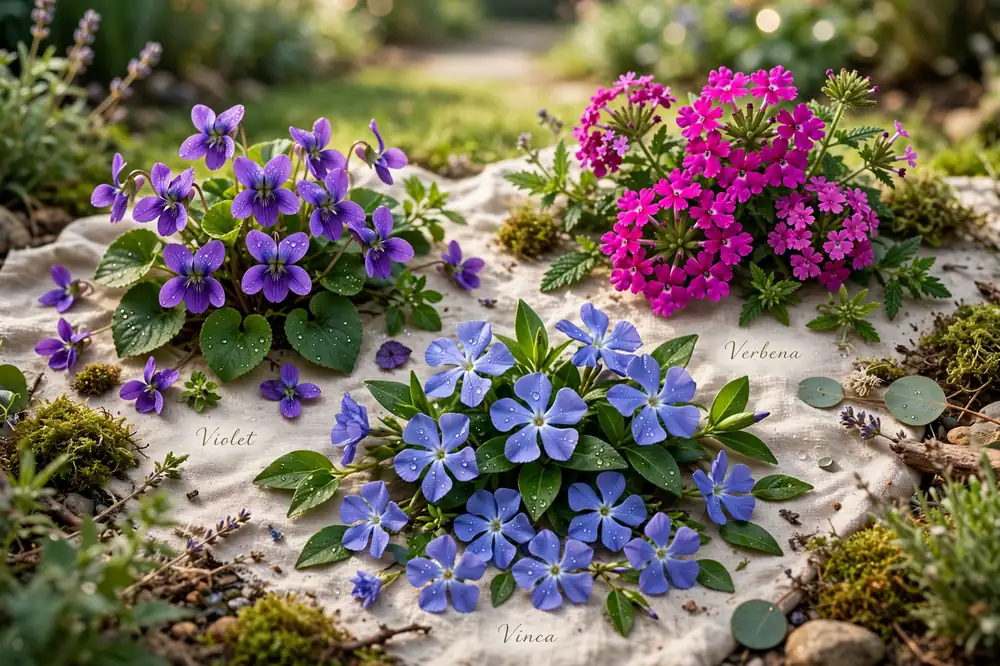
Searching for flowers that start with V? You have found the right place. V-flowers range from the fragrant spring violets and butterfly-magnet verbenas to the shade-loving vinca groundcover, the wildflower charm of Virginia bluebells, and the drama of voodoo lilies. Whether you are planning a pollinator garden, filling shady corners, or just collecting flower names for an alphabet project, this guide gives you 55 real flowers that start with V — each with a vivid description, scientific name, bloom season, sun needs, and USDA hardiness zone.
Below you will find a quick-answer summary, a quick comparison table covering all 55 flowers, individual growing notes for every flower on the list, practical V-flower growing tips, and answers to the most common questions gardeners ask. Every entry was checked for botanical accuracy, so you can plant with confidence.
Quick Answer
Yes — this page lists 55 flowers that start with V, from violets and verbenas to viburnums and vanda orchids. Use the at-a-glance table to filter by your USDA zone, sun and bloom season before you buy.
Table of Contents
V-Flowers at a Glance
| # | Name | Scientific name | Bloom | Sun | Zone | Best for |
|---|---|---|---|---|---|---|
| 1 | Violet | Viola odorata | Spring | Part shade | 4–8 | Fragrant groundcover, woodland edges, cottage gardens |
| 2 | Garden Verbena | Verbena hybrids | Summer to fall | Full sun | 7–11; annual elsewhere | Containers, hanging baskets, pollinator borders |
| 3 | Vinca (Periwinkle) | Vinca minor | Spring | Part to full shade | 4–9 | Shady groundcover, slopes, under trees |
| 4 | Veronica (Speedwell) | Veronica spicata | Summer | Full sun to part shade | 3–8 | Perennial borders, cut flowers, bee gardens |
| 5 | Viburnum (European Cranberrybush) | Viburnum opulus | Spring | Full sun to part shade | 3–8 | Hedges, bird gardens, fall color |
| 6 | Virginia Bluebell | Mertensia virginica | Spring | Part to full shade | 3–8 | Native woodland gardens, spring ephemerals |
| 7 | Vanda Orchid | Vanda spp. | Year-round (indoors) | Bright indirect light | 10–12; houseplant elsewhere | Orchid collectors, humid sunrooms |
| 8 | Valerian | Valeriana officinalis | Early to midsummer | Full sun to part shade | 4–8 | Herb gardens, pollinator plantings, cottage borders |
| 9 | Vetch | Vicia spp. | Spring to summer | Full sun | Annual; reseeds freely | Cover cropping, wildflower meadows, soil building |
| 10 | Venus’s Looking Glass | Triodanis perfoliata | Late spring to summer | Full sun to part shade | Annual; self-sows | Native meadows, cottage gardens, children’s gardens |
| 11 | Virginia Spiderwort | Tradescantia virginiana | Late spring to summer | Part shade | 4–9 | Native borders, rain gardens, easy-care perennials |
| 12 | Voodoo Lily | Amorphophallus konjac | Late spring | Part shade | 6–10 | Novelty plantings, tropical-look borders, conversation pieces |
| 13 | Pansy | Viola × wittrockiana | Fall to spring | Full sun to part shade | Grown as annual | Fall containers, window boxes, edging |
| 14 | Johnny Jump Up | Viola tricolor | Spring to fall | Full sun to part shade | 3–9; often grown as annual | Self-sowing groundcover, edging, edible flowers |
| 15 | Horned Violet | Viola cornuta | Spring to fall | Part shade | 5–9 | Edging, rock gardens, long-season color |
| 16 | Tall Verbena | Verbena bonariensis | Summer to fall | Full sun | 7–11 | Pollinator gardens, back of border, meadow plantings |
| 17 | Homestead Purple Verbena | Verbena ‘Homestead Purple’ | Summer to fall | Full sun | 7–11 | Groundcover, containers, spilling over walls |
| 18 | Big Periwinkle | Vinca major | Spring | Part shade | 7–9 | Large-scale groundcover, banks, mild-climate gardens |
| 19 | Georgia Blue Veronica | Veronica umbrosa ‘Georgia Blue’ | Spring | Full sun to part shade | 5–9 | Path edges, rock gardens, front-of-border filler |
| 20 | Koreanspice Viburnum | Viburnum carlesii | Spring | Full sun to part shade | 4–8 | Fragrant foundation plantings, entry gardens, spring borders |
| 21 | Doublefile Viburnum | Viburnum plicatum | Spring | Full sun to part shade | 5–8 | Specimen shrub, layered borders, bird gardens |
| 22 | Virginia Sweetspire | Itea virginica | Late spring to summer | Full sun to shade | 5–9 | Rain gardens, native plantings, fall color |
| 23 | Vanilla Orchid | Vanilla planifolia | Spring (mature plants) | Bright indirect light | 10–12; greenhouse elsewhere | Tropical greenhouses, orchid enthusiasts |
| 24 | Vriesea Bromeliad | Vriesea spp. | Year-round (indoors) | Bright indirect light | 10–12; houseplant elsewhere | Houseplants, offices, long-lasting indoor color |
| 25 | Velvet Sage | Salvia leucantha | Late summer to fall | Full sun | 8–11 | Fall color, hummingbird gardens, cutting |
| 26 | Victoria Blue Salvia | Salvia farinacea ‘Victoria Blue’ | Summer to fall | Full sun | 8–10; annual elsewhere | Mass bedding, containers, heat-proof color |
| 27 | Vitex (Chaste Tree) | Vitex agnus-castus | Summer | Full sun | 6–9 | Heat-tolerant screens, pollinator shrubs, low-water gardens |
| 28 | Blue Vervain | Verbena hastata | Summer | Full sun to part shade | 3–9 | Rain gardens, native meadows, pollinator habitat |
| 29 | Longleaf Speedwell | Veronica longifolia | Summer | Full sun | 4–8 | Cottage borders, cut flowers, vertical accents |
| 30 | Illumination Vinca | Vinca minor ‘Illumination’ | Spring | Part shade | 4–9 | Brightening dark shade, under trees, small-space groundcover |
| 31 | Sorbet Viola | Viola ‘Sorbet’ series | Spring to fall | Full sun to part shade | Grown as annual | Containers, edging, succession planting |
| 32 | Freckles Violet | Viola sororia ‘Freckles’ | Spring | Part shade | 3–8 | Native groundcover, butterfly host plants, woodland edges |
| 33 | Slender Verbena | Verbena rigida | Summer to fall | Full sun | 7–10 | Sunny banks, mass plantings, drought-tolerant borders |
| 34 | Arrowwood Viburnum | Viburnum dentatum | Late spring | Full sun to part shade | 3–8 | Native hedges, wildlife gardens, erosion control |
| 35 | Virginia Mountain Mint | Pycnanthemum virginianum | Summer | Full sun to part shade | 3–7 | Pollinator gardens, native meadows, deer-resistant plantings |
| 36 | Purple Mullein | Verbascum phoeniceum | Summer | Full sun | 5–8 | Rock gardens, drought-tolerant borders, cottage gardens |
| 37 | Hoary Vervain | Verbena stricta | Summer to fall | Full sun | 4–8 | Native meadows, pollinators, dry borders |
| 38 | White Vervain | Verbena urticifolia | Summer to fall | Full sun to part shade | 3–9 | Rain gardens, native borders, moon gardens |
| 39 | Brazilian Verbena | Verbena brasiliensis | Summer to fall | Full sun | 7–11 | Pollinator gardens, bedding — plant with caution (invasive in some states) |
| 40 | David Viburnum | Viburnum davidii | Spring | Full sun to part shade | 7–9 | Evergreen screening, foundation plantings, winter interest |
| 41 | Possumhaw Viburnum | Viburnum nudum | Spring | Full sun to part shade | 5–8 | Native shrubs, wildlife hedges, fall berries |
| 42 | Cedros Island Verbena | Verbena lilacina | Spring to fall | Full sun | 9–11; annual elsewhere | Containers, rock gardens, long-season color |
| 43 | Culver’s Root | Veronicastrum virginicum | Summer | Full sun to part shade | 3–8 | Native borders, rain gardens, vertical accents |
| 44 | Gravelweed | Verbesina helianthoides | Summer to fall | Full sun | 5–9 | Native meadows, pollinators, naturalized areas |
| 45 | Bird’s Foot Violet | Viola pedata | Spring | Full sun to part shade | 4–8 | Rock gardens, native wildflowers, edging |
| 46 | Canada Violet | Viola canadensis | Spring | Part to full shade | 3–8 | Woodland gardens, native groundcover, shade |
| 47 | ‘Atropurpurea’ Periwinkle | Vinca minor ‘Atropurpurea’ | Spring | Part to full shade | 4–9 | Shady groundcover, purple accents, under trees |
| 48 | Wayfaring Tree | Viburnum lantana | Spring | Full sun to part shade | 3–7 | Hedges, wildlife gardens — plant with caution (invasive in some states) |
| 49 | Green False Hellebore | Veratrum viride | Late spring | Part to full shade | 3–7 | Woodland gardens, bold foliage, native plants |
| 50 | Wingstem | Verbesina alternifolia | Late summer to fall | Full sun to part shade | 4–9 | Back of borders, rain gardens, pollinator plantings |
| 51 | King of the Bromeliads | Vriesea hieroglyphica | Colorful bracts last for months | Bright indirect light | 10–11; houseplant elsewhere | Statement houseplants, collectors, tropical interiors |
| 52 | Scarborough Lily | Vallota speciosa | Late summer to fall | Full sun | 9–11; pot/tender elsewhere | Indoor bulbs, summer patios, collectors |
| 53 | Downy Yellow Violet | Viola pubescens | Spring | Full sun to part shade | 3–8 | Rock gardens, woodland edges, native wildflowers |
| 54 | Texas Vervain | Glandularia bipinnatifida | Spring to fall | Full sun | 8–11 | Native meadows, groundcover, pollinators |
| 55 | Blue Orchid | Vanda coerulea | Fall to winter | Bright indirect light | Houseplant (10–12 outdoors) | Orchid collectors, blue flowers, humid sunrooms |
55 Flowers That Start With V: The Complete List
Here are all 35 flowers, with vivid descriptions and the growing details that matter most — sun, soil, water, and hardiness. Look for the “Best for” note at the end of each entry for quick planting ideas.
1. Violet (Viola odorata)
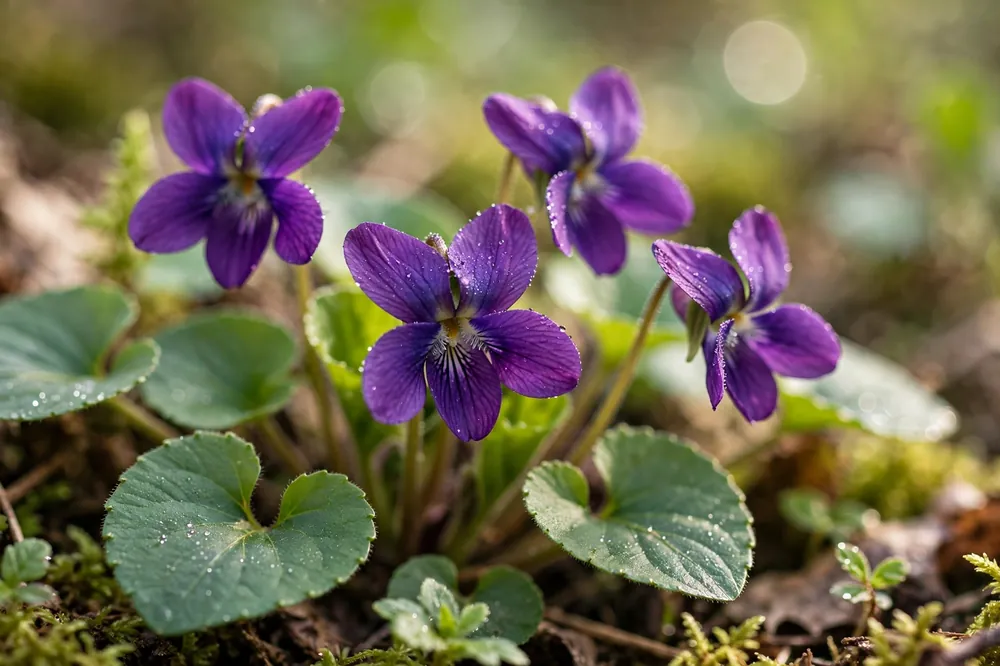
Sweet violet is the classic V-flower: tiny, deep-purple blooms with an unforgettable perfume, tucked among heart-shaped leaves in early spring. Unlike showier pansies, its charm is quiet — it naturalizes into fragrant carpets under trees and along paths. Plant crowns in fall or early spring in humus-rich, moist soil in part shade; it self-sows gently. Leaves and flowers are edible and have been used in candies and syrups for centuries.
Bloom: Spring | Sun: Part shade | Zone: 4–8 | Best for: Fragrant groundcover, woodland edges, cottage gardens
2. Garden Verbena (Verbena hybrids)
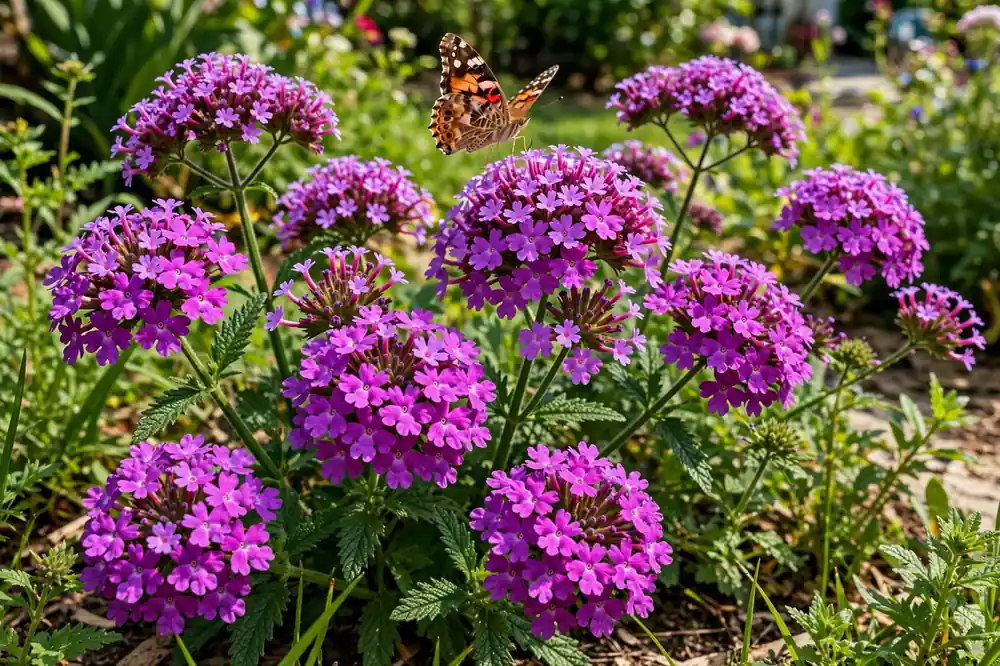
Garden verbena delivers nonstop flat-topped clusters in red, pink, purple, and white from summer until frost — a butterfly favorite that never takes a day off. Modern series resist powdery mildew far better than older types. Give it full sun and well-drained soil, and deadhead or shear back by a third mid-season for a fresh flush. In zones 7–11 it returns as a perennial; farther north, grow it as an annual or root cuttings indoors for winter.
Bloom: Summer to fall | Sun: Full sun | Zone: 7–11; annual elsewhere | Best for: Containers, hanging baskets, pollinator borders
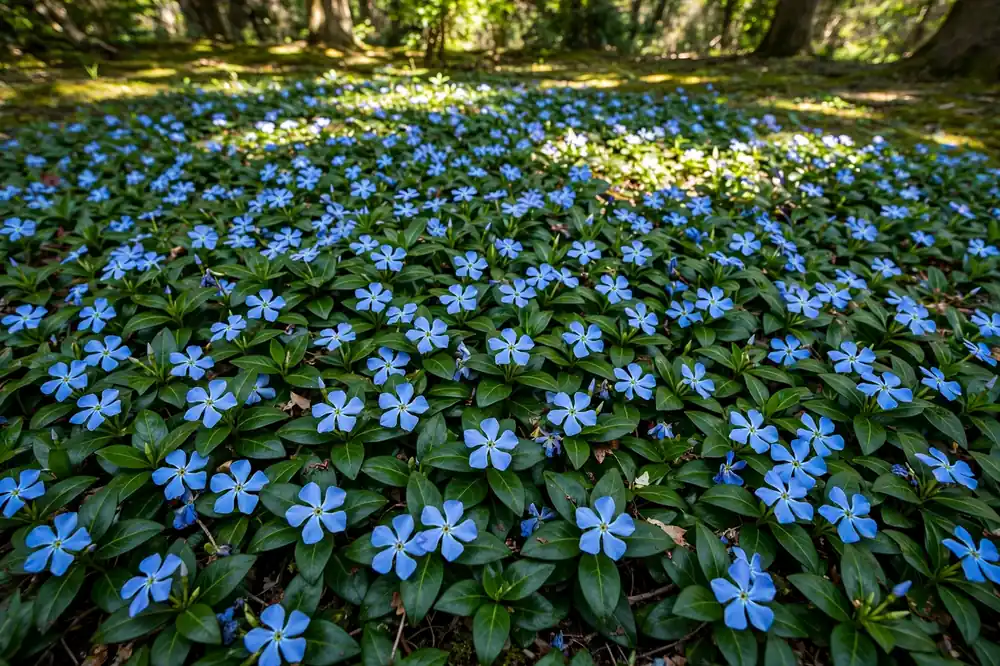
3. Vinca / Periwinkle (Vinca minor)
Lesser periwinkle is the problem-solver for shady spots where grass refuses to grow: glossy evergreen foliage starred with sky-blue flowers each spring. It spreads steadily by rooting stems, suppressing weeds under trees and on banks. Plant 6 inches apart in part to full shade; it tolerates dry shade once established. Note: it can be aggressive in the Southeast — choose native groundcovers if you garden near natural areas.
Bloom: Spring | Sun: Part to full shade | Zone: 4–9 | Best for: Shady groundcover, slopes, under trees
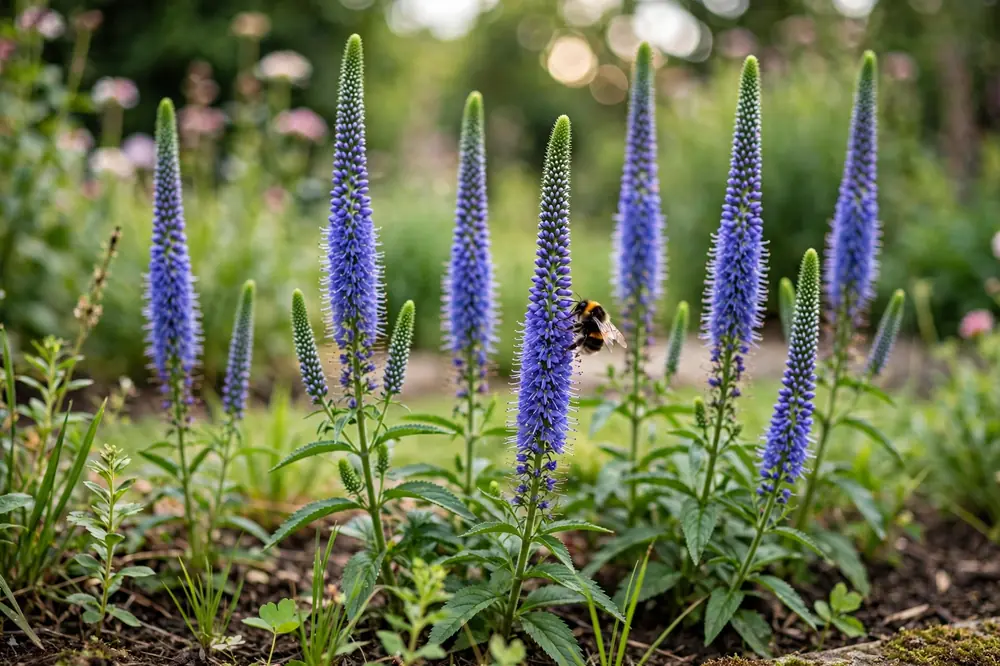
4. Veronica / Speedwell (Veronica spicata)
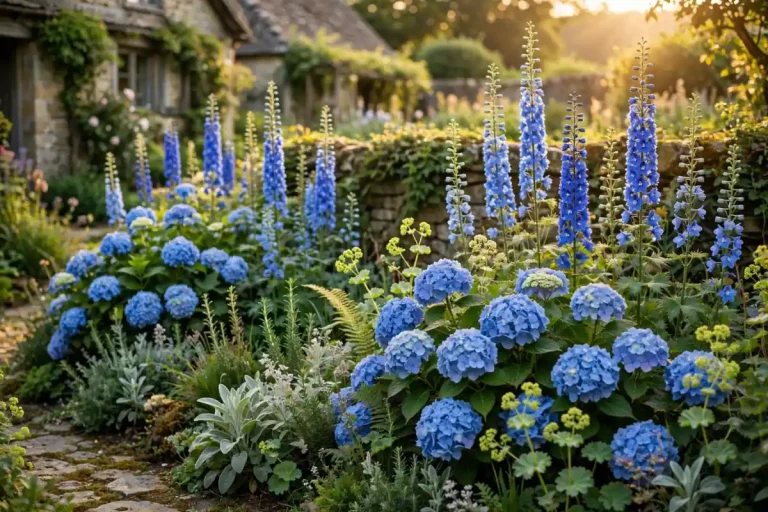
Spike speedwell sends up stiff wands of densely packed blue, purple, pink, or white flowers in midsummer, adding vertical structure to borders. Bees work the spikes from bottom to top. Plant in full sun to light shade in average, well-drained soil; shear spent spikes to the foliage for rebloom. Clumps stay tidy and rarely need dividing — a genuinely low-maintenance perennial.
Bloom: Summer | Sun: Full sun to part shade | Zone: 3–8 | Best for: Perennial borders, cut flowers, bee gardens
5. Viburnum (Viburnum opulus)
The European cranberrybush offers three seasons of interest: lacecap white flower clusters in spring, glossy red berry-like fruit in fall (inedible to humans but beloved by birds), and crimson foliage. It grows 8–12 feet tall, making it a strong screening shrub. Give it sun to part shade and average soil; it tolerates wet ground. Choose the compact ‘Compactum’ or the native American cranberrybush for smaller gardens.
Bloom: Spring | Sun: Full sun to part shade | Zone: 3–8 | Best for: Hedges, bird gardens, fall color
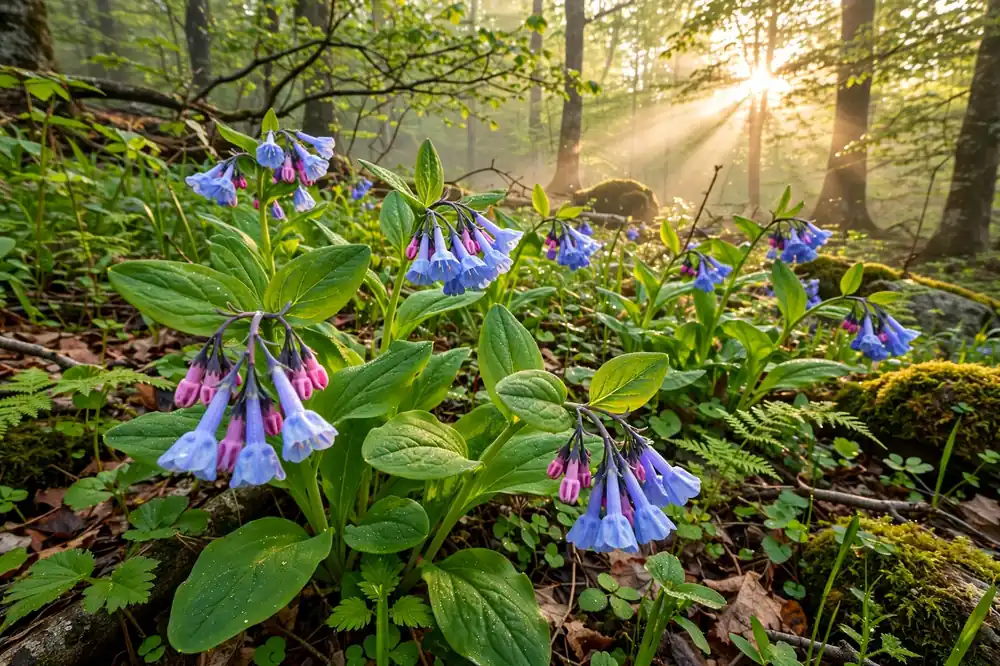
6. Virginia Bluebell (Mertensia virginica)
Virginia bluebells are among the most enchanting native wildflowers in America: pink buds open into nodding, trumpet-shaped sky-blue flowers each April and May. They carpet moist woodlands and go dormant by midsummer, so plant them among ferns or hostas that fill the later gap. Buy nursery-propagated plants (never dig wild ones) and give them rich, moist soil in part to full shade. Established colonies self-sow into drifts.
Bloom: Spring | Sun: Part to full shade | Zone: 3–8 | Best for: Native woodland gardens, spring ephemerals
7. Vanda Orchid (Vanda spp.)
Vanda orchids are the showstoppers of the orchid world, famous for producing true-blue flowers — a color almost no other orchid offers. They grow without pots, their thick silvery roots dangling in humid air. They demand bright light, warm temperatures, and daily misting or dunking of the roots. Grow them in a hanging basket in a bright bathroom or greenhouse in zones 10–12; elsewhere, they make spectacular but high-maintenance houseplants.
Bloom: Year-round (indoors) | Sun: Bright indirect light | Zone: 10–12; houseplant elsewhere | Best for: Orchid collectors, humid sunrooms
8. Valerian (Valeriana officinalis)
Garden valerian is a tall, old-fashioned herb with clouds of sweetly scented white-to-blush flower clusters in early summer — a magnet for butterflies and beneficial insects. The roots are the source of the famous herbal sleep aid. Give it sun to part shade and moist, rich soil; it reaches 4–5 feet and self-sows readily. Cut flower heads before they set seed if you want to limit its spread.
Bloom: Early to midsummer | Sun: Full sun to part shade | Zone: 4–8 | Best for: Herb gardens, pollinator plantings, cottage borders
9. Vetch (Vicia spp.)
Vetches are climbing annuals with pea-like purple, pink, or blue flowers — hairy vetch (Vicia villosa) is widely sown as a nitrogen-fixing cover crop, while common vetch brightens wildflower mixes. They scramble 3–6 feet up supports or through other plants. Sow seed directly in spring in full sun; as legumes they enrich the soil. Let some plants set seed and they will return on their own each year.
Bloom: Spring to summer | Sun: Full sun | Zone: Annual; reseeds freely | Best for: Cover cropping, wildflower meadows, soil building
10. Venus’s Looking Glass (Triodanis perfoliata)
This delightful native annual hides cup-shaped violet-blue flowers in the leaf axils of its stem — the round, clasping leaves inspired the “looking glass” name. It pops up in meadows, field edges, and sunny garden corners, blooming from late spring into summer. Scatter seed in fall or early spring on bare, well-drained soil in sun to part shade; it self-sows where happy. A charming, zero-maintenance addition to native plantings.
Bloom: Late spring to summer | Sun: Full sun to part shade | Zone: Annual; self-sows | Best for: Native meadows, cottage gardens, children’s gardens
11. Virginia Spiderwort (Tradescantia virginiana)
Virginia spiderwort opens three-petaled blue-purple flowers each morning that melt by afternoon — but new buds appear daily for weeks in late spring and summer. The grassy foliage forms fountain-like clumps about 2 feet tall. It thrives in part shade and moist soil but adapts to sun with enough water. Cut the whole plant back by half after the first flush to keep it tidy and encourage rebloom.
Bloom: Late spring to summer | Sun: Part shade | Zone: 4–9 | Best for: Native borders, rain gardens, easy-care perennials
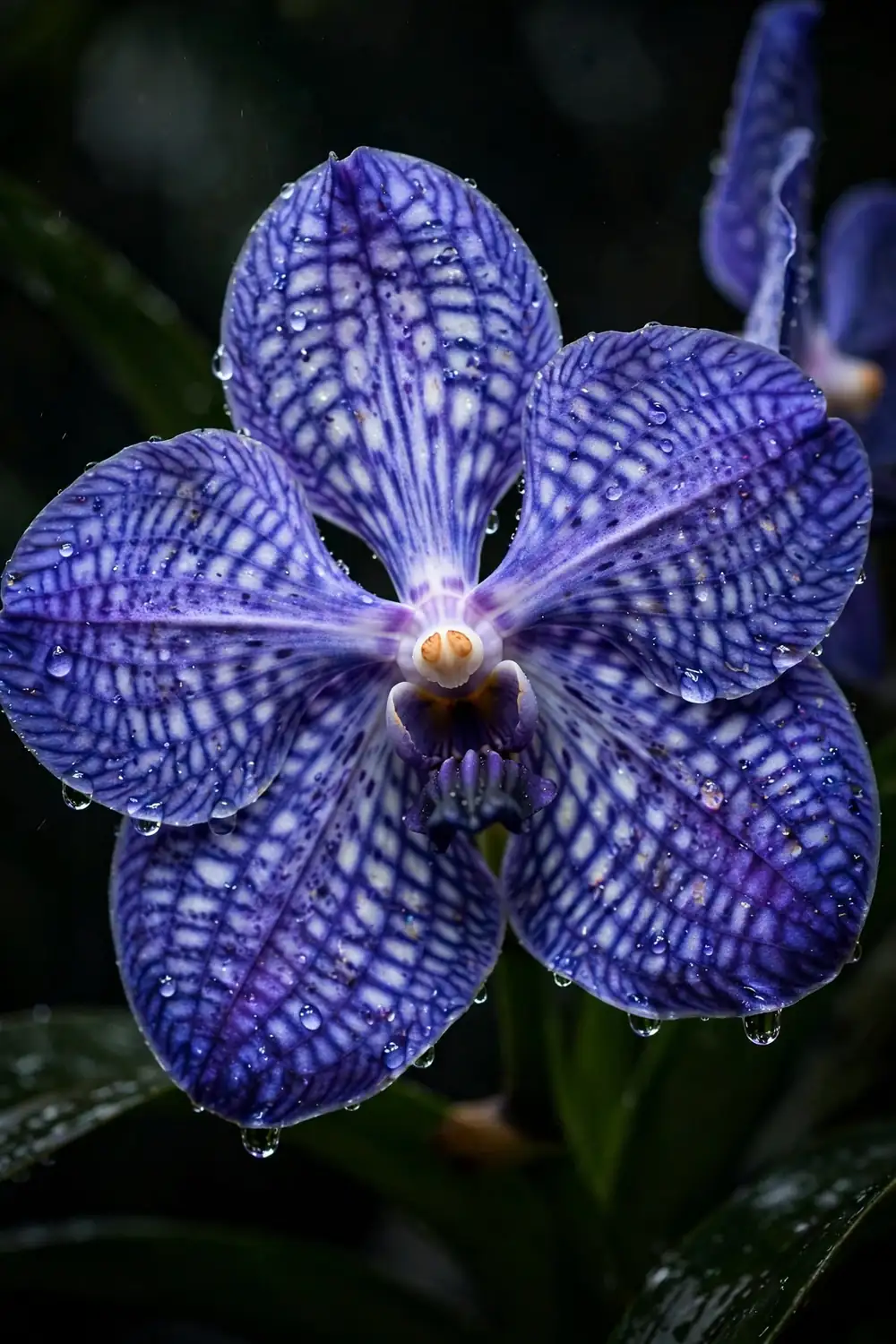
12. Voodoo Lily (Amorphophallus konjac)
Voodoo lily is pure garden theater: a maroon-purple hooded spathe up to 2 feet tall that unfurls in late spring — accompanied by a famously foul carrion smell that lasts a day or two and attracts pollinating flies. The single umbrella-like leaf that follows is architectural. Plant the corm 4–6 inches deep in part shade and rich, well-drained soil; it is hardy to zone 6 with mulch. Grow it where its brief stink is a conversation piece, not a nuisance.
Bloom: Late spring | Sun: Part shade | Zone: 6–10 | Best for: Novelty plantings, tropical-look borders, conversation pieces
13. Pansy (Viola × wittrockiana)
Pansies are the cheerful faces of cool-season gardening, with velvety blooms in nearly every color, often marked with dark “faces” or blotches. They shrug off light frosts, making them ideal for fall planting in mild climates and early-spring color everywhere else. Plant in sun to part shade in rich, moist soil; deadhead regularly and they bloom for months. In the South they flower all winter; in the North, mulch fall-planted pansies for spring return.
Bloom: Fall to spring | Sun: Full sun to part shade | Zone: Grown as annual | Best for: Fall containers, window boxes, edging
14. Johnny Jump Up (Viola tricolor)
Johnny jump ups are the wild ancestors of the pansy — petite purple, yellow, and white faces on plants barely 6 inches tall. True to their name, they jump up wherever they please, self-sowing freely in lawns, paths, and beds. They bloom from spring to fall in cool weather, pausing in summer heat. Plant in sun to part shade; let them seed and you will never buy them again. Flowers are edible and lovely on salads and cakes.
Bloom: Spring to fall | Sun: Full sun to part shade | Zone: 3–9; often grown as annual | Best for: Self-sowing groundcover, edging, edible flowers
15. Horned Violet (Viola cornuta)
Horned violets bridge the gap between pansies and wild violets: small, fragrant flowers with a distinctive curved “horn” spur, in violet, yellow, and white, on tufted evergreen mounds. They bloom from spring through fall where summers stay cool. Give them part shade and humus-rich, well-drained soil; they are longer-lived perennials than pansies in zones 5–9. Excellent for edging, rock gardens, and underplanting roses.
Bloom: Spring to fall | Sun: Part shade | Zone: 5–9 | Best for: Edging, rock gardens, long-season color
16. Tall Verbena (Verbena bonariensis)
Tall verbena is a pollinator magnet like no other: wiry 4–6 foot stems topped with clusters of small purple flowers that float above the border from summer to frost. Butterflies, bees, and hummingbirds queue up for it. Despite its height it never flops and needs no staking — plant it through lower perennials for a see-through effect. It self-sows generously; in zones 7–11 it is perennial, elsewhere an annual. Deadhead or leave seed heads for goldfinches.
Bloom: Summer to fall | Sun: Full sun | Zone: 7–11 | Best for: Pollinator gardens, back of border, meadow plantings
17. Homestead Purple Verbena (Verbena ‘Homestead Purple’)
‘Homestead Purple’ is the trailing verbena by which all others are judged: intense violet-purple flower clusters on stems that spill 2–3 feet, blooming from summer until hard frost. Bred at the University of Georgia, it handles Southern heat and humidity better than most. Plant in full sun and sharp drainage; it is evergreen in mild winters and perennial in zones 7–11. Superb spilling from walls, containers, and the front of sunny borders.
Bloom: Summer to fall | Sun: Full sun | Zone: 7–11 | Best for: Groundcover, containers, spilling over walls
18. Big Periwinkle (Vinca major)
Big periwinkle is vinca minor’s bolder sibling: larger blue-violet flowers and 2–3 inch glossy leaves on vigorous trailing stems. It covers ground fast in part shade, making it ideal for large banks and tough spots — but that vigor means it can overwhelm small beds, so site it carefully. Hardy in zones 7–9, it is evergreen where winters are mild. The variegated form brightens dark corners.
Bloom: Spring | Sun: Part shade | Zone: 7–9 | Best for: Large-scale groundcover, banks, mild-climate gardens
19. Georgia Blue Veronica (Veronica umbrosa ‘Georgia Blue’)
‘Georgia Blue’ veronica forms a low mat of tiny cobalt-blue flowers in early spring, with foliage that turns bronze-purple in fall and winter for bonus interest. It spreads gently to fill gaps between stepping stones or at the front of borders. Plant in sun to part shade in well-drained soil; it tolerates light foot traffic. A refined groundcover that behaves far better than most creeping veronicas.
Bloom: Spring | Sun: Full sun to part shade | Zone: 5–9 | Best for: Path edges, rock gardens, front-of-border filler
20. Koreanspice Viburnum (Viburnum carlesii)
Koreanspice viburnum is grown for one unforgettable trait: pink buds opening to white flower clusters with a spicy-sweet fragrance that perfumes the whole spring garden. The rounded 4–6 foot shrub also offers red fall color. Plant it near a path or window in sun to part shade and well-drained soil. It is slow-growing but worth the wait — one of the finest fragrant shrubs for zones 4–8.
Bloom: Spring | Sun: Full sun to part shade | Zone: 4–8 | Best for: Fragrant foundation plantings, entry gardens, spring borders
21. Doublefile Viburnum (Viburnum plicatum)
Doublefile viburnum carries its white flower clusters in two neat horizontal rows along layered branches — a tiered effect no other shrub matches. The species form has lacecap blooms; ‘Shasta’ and ‘Mariesii’ are the most floriferous selections. It grows 8–10 feet wide, so give it room in sun to part shade. Red fall berries follow the flowers, feeding birds into winter.
Bloom: Spring | Sun: Full sun to part shade | Zone: 5–8 | Best for: Specimen shrub, layered borders, bird gardens
22. Virginia Sweetspire (Itea virginica)
Virginia sweetspire is a native shrub that earns its keep twice: fragrant white bottlebrush flowers in early summer, then some of the best red-purple fall foliage of any native shrub. It suckers into colonies, making it excellent for naturalizing in moist areas, rain gardens, and stream banks — yet it also adapts to drier spots and deep shade. The compact ‘Henry’s Garnet’ fits smaller gardens. Zones 5–9.
Bloom: Late spring to summer | Sun: Full sun to shade | Zone: 5–9 | Best for: Rain gardens, native plantings, fall color
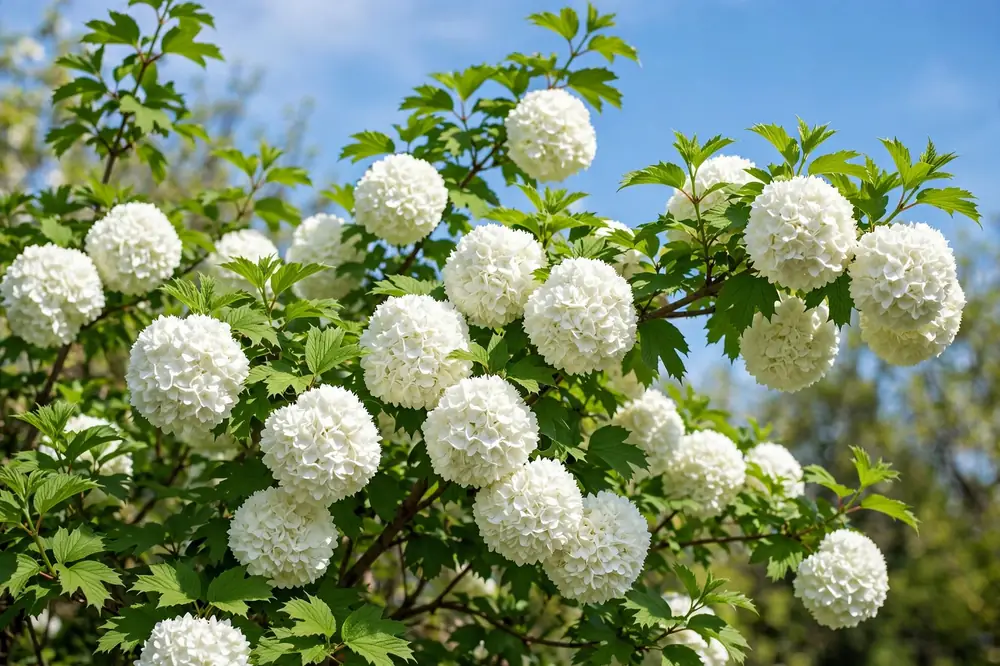
23. Vanilla Orchid (Vanilla planifolia)
Yes, real vanilla comes from an orchid — a climbing vine whose pale yellow-green flowers last a single day. In the wild, tiny melipona bees pollinate them; in cultivation each flower is hand-pollinated, which is why true vanilla is so precious. Home growers in zones 10–12 (or a warm greenhouse) can train the vine up a moss pole in bright indirect light with high humidity. Even without beans, the thick fleshy vine is an attractive tropical specimen.
Bloom: Spring (mature plants) | Sun: Bright indirect light | Zone: 10–12; greenhouse elsewhere | Best for: Tropical greenhouses, orchid enthusiasts
24. Vriesea Bromeliad (Vriesea spp.)
Vriesea bromeliads — the “flaming sword” plants — produce spectacular flattened spikes of red, orange, or yellow bracts that last for months, rising from rosettes of often banded or patterned leaves. They are epiphytes that absorb water through a central cup, making them ideal low-maintenance houseplants. Keep the cup filled with fresh water, give bright indirect light, and enjoy a bloom that outlasts almost any cut flower. Pup offsets at the base become new plants.
Bloom: Year-round (indoors) | Sun: Bright indirect light | Zone: 10–12; houseplant elsewhere | Best for: Houseplants, offices, long-lasting indoor color
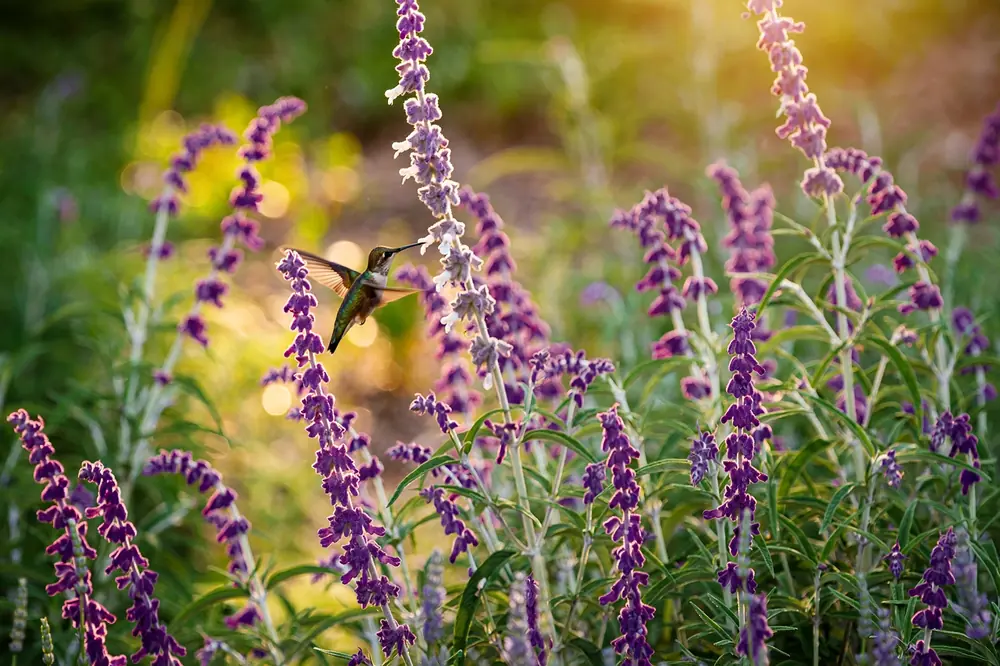
25. Velvet Sage (Salvia leucantha)
Mexican bush sage lives up to its name: 3–4 foot arching stems lined with velvety purple calyxes and white flower tips from late summer into fall, when most perennials are fading. Hummingbirds adore it. Give it full sun and well-drained soil in zones 8–11; north of there, grow it as an annual or overwinter cuttings indoors. Cut stems back hard in late winter — it blooms on new growth.
Bloom: Late summer to fall | Sun: Full sun | Zone: 8–11 | Best for: Fall color, hummingbird gardens, cutting
26. Victoria Blue Salvia (Salvia farinacea ‘Victoria Blue’)
‘Victoria Blue’ mealy-cup sage is the workhorse blue annual of Southern gardens: dense spikes of true violet-blue flowers on compact 18-inch plants, blooming from summer until frost without deadheading. It shrugs off heat, humidity, and drought once established. Plant in full sun in zones 8–10 as a perennial, or everywhere else as a fast, cheap annual. Pair with yellow marigolds or pink zinnias for classic contrast.
Bloom: Summer to fall | Sun: Full sun | Zone: 8–10; annual elsewhere | Best for: Mass bedding, containers, heat-proof color
27. Vitex / Chaste Tree (Vitex agnus-castus)
Chaste tree is a large deciduous shrub (or small multi-stemmed tree) that covers itself in fragrant lavender-blue flower spikes each summer — a Southern garden staple that thrives on heat and neglect. Butterflies and bees swarm it. Plant in full sun in zones 6–9; it is remarkably drought-tolerant once established and can be pruned hard each spring to keep it shrub-sized, since it blooms on new wood. ‘Shoal Creek’ is a top cultivar.
Bloom: Summer | Sun: Full sun | Zone: 6–9 | Best for: Heat-tolerant screens, pollinator shrubs, low-water gardens
28. Blue Vervain (Verbena hastata)
Blue vervain is the wild native cousin of garden verbena: candelabra-like spikes of tiny blue-violet flowers atop 3–5 foot stems, blooming through summer in moist meadows and rain gardens. It is a host plant for the common buckeye butterfly and a favorite of native bees. Sow seed in fall (it needs cold stratification) in sun to part shade and consistently moist soil. Self-sows freely — deadhead if you want to contain it.
Bloom: Summer | Sun: Full sun to part shade | Zone: 3–9 | Best for: Rain gardens, native meadows, pollinator habitat
29. Longleaf Speedwell (Veronica longifolia)
Longleaf speedwell is the tallest of the border veronicas, sending dense blue or purple spikes 2–3 feet high in midsummer — a cool-colored exclamation point among warm-toned echinacea and daylilies. It prefers full sun and consistently moist, fertile soil; mulch to keep roots cool. Stake in windy sites. Shear after flowering for a possible second flush. A cottage-garden classic that pairs beautifully with roses.
Bloom: Summer | Sun: Full sun | Zone: 4–8 | Best for: Cottage borders, cut flowers, vertical accents
30. Illumination Vinca (Vinca minor ‘Illumination’)
‘Illumination’ takes periwinkle’s shade-tolerance and adds year-round interest: gold-splashed variegated foliage that glows in dark corners, with the classic blue spring flowers on top. It spreads more slowly than the green form, making it better behaved in small gardens. Plant in part shade — too much sun scorches the gold variegation. Evergreen in zones 4–9, it is one of the prettiest groundcovers for dry shade under trees.
Bloom: Spring | Sun: Part shade | Zone: 4–9 | Best for: Brightening dark shade, under trees, small-space groundcover
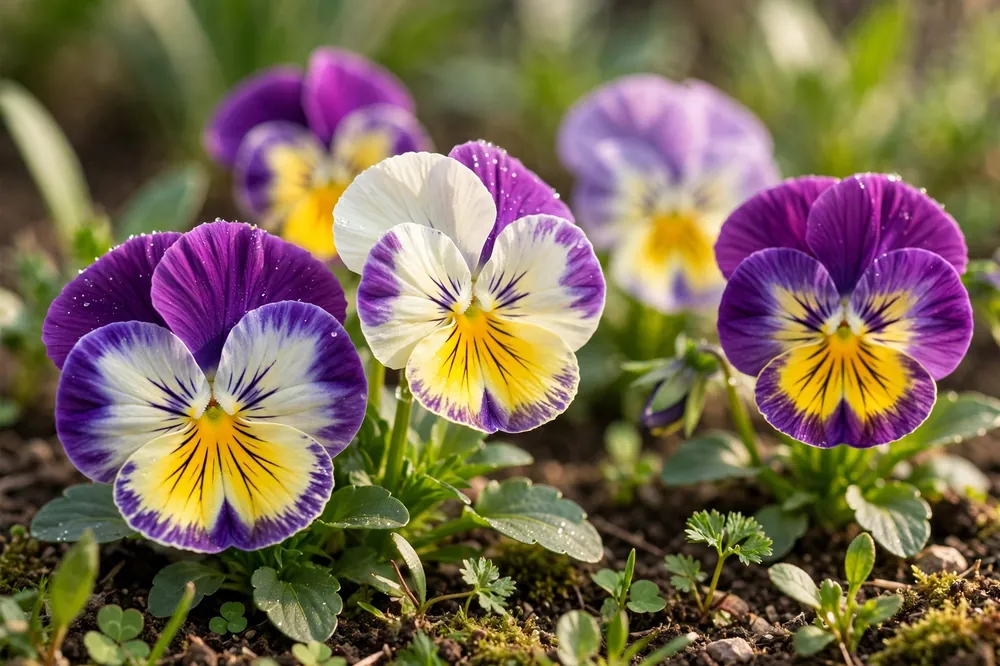
31. Sorbet Viola (Viola ‘Sorbet’ series)
The Sorbet series violas are the small-flowered, big-performance cousins of pansies: hundreds of 1-inch blooms in solids, bicolors, and “faces” on compact mounds that bloom from spring into summer and again in fall. They handle heat better than most violas and bounce back after shearing. Plant in sun to part shade as a cool-season annual; tuck them into containers, window boxes, and front-of-border gaps for months of cheerful color.
Bloom: Spring to fall | Sun: Full sun to part shade | Zone: Grown as annual | Best for: Containers, edging, succession planting
32. Freckles Violet (Viola sororia ‘Freckles’)
‘Freckles’ is a charmer among native violets: white petals heavily speckled and streaked with violet-blue, each flower uniquely patterned. Like all common blue violets, it is tough, shade-loving, and spreads by seed and rhizomes — welcome it as a living mulch under shrubs or in lawn edges, where it blooms each spring. It is also a host plant for fritillary butterflies. Give it part shade and average soil in zones 3–8; it asks for nothing more.
Bloom: Spring | Sun: Part shade | Zone: 3–8 | Best for: Native groundcover, butterfly host plants, woodland edges
33. Slender Verbena (Verbena rigida)
Slender verbena forms tuberous-rooted clumps topped with flat clusters of vivid magenta-purple flowers from summer to fall. It spreads by underground stems to make generous drifts — excellent for filling sunny banks and the middle of borders. Hardy in zones 7–10, it dies back in winter and resprouts from its tuberous roots. Provide full sun and good drainage; it tolerates poor soil and drought.
Bloom: Summer to fall | Sun: Full sun | Zone: 7–10 | Best for: Sunny banks, mass plantings, drought-tolerant borders
34. Arrowwood Viburnum (Viburnum dentatum)
Arrowwood viburnum is a rugged native shrub with flat-topped clusters of creamy-white flowers in late spring, followed by blue-black berries that birds devour and glossy green foliage that turns burgundy-red in fall. It grows 6–10 feet tall and suckers into thickets — perfect for naturalized hedges and wildlife corridors. Adaptable to sun or shade and wet or dry soil in zones 3–8, it is one of the toughest native shrubs you can plant.
Bloom: Late spring | Sun: Full sun to part shade | Zone: 3–8 | Best for: Native hedges, wildlife gardens, erosion control
35. Virginia Mountain Mint (Pycnanthemum virginianum)
Virginia mountain mint may be the single best pollinator plant on this list: in midsummer its flat white flower clusters swarm with more bees, wasps, and butterflies than almost any other native. The mint-scented foliage is unpalatable to deer and rabbits. It spreads by rhizomes in sun to part shade and average to moist soil in zones 3–7 — give it room or divide every few years. The dried seed heads add winter interest and feed birds.
Bloom: Summer | Sun: Full sun to part shade | Zone: 3–7 | Best for: Pollinator gardens, native meadows, deer-resistant plantings
36. Purple Mullein (Verbascum phoeniceum)
- Bloom: Summer | Sun: Full sun | Zone: 5–8 | Best for: Rock gardens, drought-tolerant borders, cottage gardens
- Note: Grow in the sun and zone shown in the table; check the plant label for the exact cultivar, as ranges vary by type. New entry — bloom, sun and zone NOT independently verified. Self-seeds where happy — deadhead after bloom if you want to keep it in bounds. Shares the Verbascum genus with the common mullein used in the G and M drafts — same genus, different species.
Purple mullein is the elegant mullein — slender 2- to 3-foot spires of flat, saucer-shaped flowers in dusky purple, rose, or copper, unlike the coarse yellow spikes of common mullein. This short-lived perennial from southern Europe wants full sun and lean, fast-draining soil. It self-sows politely where happy, so a colony returns year after year with no effort.
37. Hoary Vervain (Verbena stricta)
- Bloom: Summer to fall | Sun: Full sun | Zone: 4–8 | Best for: Native meadows, pollinators, dry borders
- Note: Grow in the sun and zone shown in the table; check the plant label for the exact cultivar, as ranges vary by type. New entry — bloom, sun and zone NOT independently verified. Self-seeds readily — deadhead if you want to contain it. Shares the Verbena genus with the live entries (Garden Verbena, Tall Verbena, Homestead Purple, Slender Verbena, Blue Vervain) — same genus, different species.
Hoary vervain is the prairie’s answer to blue vervain — dense, showy spikes of deep purple-blue flowers on silvery-hairy 2- to 3-foot stems. This North American native thrives in poor, dry soil where fussier flowers fail, and native bees and butterflies visit constantly. Give it full sun and no coddling; it resents rich soil and wet feet.
38. White Vervain (Verbena urticifolia)
- Bloom: Summer to fall | Sun: Full sun to part shade | Zone: 3–9 | Best for: Rain gardens, native borders, moon gardens
- Note: Grow in the sun and zone shown in the table; check the plant label for the exact cultivar, as ranges vary by type. New entry — bloom, sun and zone NOT independently verified. Shares the Verbena genus with the live entries (Garden Verbena, Tall Verbena, Homestead Purple, Slender Verbena, Blue Vervain) — same genus, different species.
White vervain brings quiet white candles to the native garden — tall, branching stems topped with airy spikes of tiny white flowers from midsummer into fall. This eastern North American native of moist meadows and stream banks feeds late-season pollinators. Give it sun to part shade with average to moist soil; it self-sows lightly.
39. Brazilian Verbena (Verbena brasiliensis)
- Bloom: Summer to fall | Sun: Full sun | Zone: 7–11 | Best for: Pollinator gardens, bedding — plant with caution (invasive in some states)
- Note: Grow in the sun and zone shown in the table; check the plant label for the exact cultivar, as ranges vary by type. New entry — bloom, sun and zone NOT independently verified. Invasive in some southeastern states and self-seeds aggressively — check local guidance before planting and deadhead to prevent spread. Shares the Verbena genus with the live entries (Garden Verbena, Tall Verbena, Homestead Purple, Slender Verbena, Blue Vervain) — same genus, different species.
Brazilian verbena is tall verbena’s pushier cousin — wiry 4- to 6-foot stems with flat-topped clusters of lilac-purple flowers that butterflies mob from summer to frost. It blooms young from seed and shrugs off heat, drought, and poor soil. Because it self-seeds aggressively and has naturalized invasively in parts of the Southeast, plant it only where it is welcome and deadhead spent blooms.
40. David Viburnum (Viburnum davidii)
- Bloom: Spring | Sun: Full sun to part shade | Zone: 7–9 | Best for: Evergreen screening, foundation plantings, winter interest
- Note: Grow in the sun and zone shown in the table; check the plant label for the exact cultivar, as ranges vary by type. New entry — bloom, sun and zone NOT independently verified. Shares the Viburnum genus with the live entries (European Cranberrybush, Koreanspice, Doublefile, Arrowwood) — same genus, different species.
David viburnum is the evergreen viburnum for mild climates — handsome mounds of deeply veined, leathery blue-green foliage, flat white flower clusters in spring, and metallic turquoise-blue berries in fall if both male and female plants are nearby. It grows slowly to 3–4 feet and makes a refined foundation shrub. Give it sun to part shade and well-drained soil.
41. Possumhaw Viburnum (Viburnum nudum)
- Bloom: Spring | Sun: Full sun to part shade | Zone: 5–8 | Best for: Native shrubs, wildlife hedges, fall berries
- Note: Grow in the sun and zone shown in the table; check the plant label for the exact cultivar, as ranges vary by type. New entry — bloom, sun and zone NOT independently verified. Shares the Viburnum genus with the live entries (European Cranberrybush, Koreanspice, Doublefile, Arrowwood) — same genus, different species.
Possumhaw viburnum is a native shrub that puts on a two-act show — creamy-white flat flower clusters in spring, then berries that ripen from pink to red to deep blue-black on the same cluster, a favorite of migrating birds. This southeastern native tolerates wet soil and part shade, suckering gently into wildlife thickets. Give it room to form a natural hedge.
42. Cedros Island Verbena (Verbena lilacina)
- Bloom: Spring to fall | Sun: Full sun | Zone: 9–11; annual elsewhere | Best for: Containers, rock gardens, long-season color
- Note: Grow in the sun and zone shown in the table; check the plant label for the exact cultivar, as ranges vary by type. New entry — bloom, sun and zone NOT independently verified. Tender — grow as an annual or in pots in cold zones. Shares the Verbena genus with the live entries (Garden Verbena, Tall Verbena, Homestead Purple, Slender Verbena, Blue Vervain) — same genus, different species.
Cedros Island verbena is the desert verbena that blooms nearly year-round — fragrant lilac-purple flower clusters over finely cut, silvery-green foliage on a low, spreading plant. Native to Cedros Island off Baja California, it thrives in heat, drought, and lean soil. In warm zones it is a long-lived perennial; everywhere else, treat it as a fast-blooming annual or bring pots indoors.
43. Culver’s Root (Veronicastrum virginicum)
- Bloom: Summer | Sun: Full sun to part shade | Zone: 3–8 | Best for: Native borders, rain gardens, vertical accents
- Note: Grow in the sun and zone shown in the table; check the plant label for the exact cultivar, as ranges vary by type. New entry — bloom, sun and zone NOT independently verified.
Culver’s root is the native answer to the border veronicas — tall candelabra spires of tiny white or pale pink flowers rising 4–6 feet above whorled foliage in midsummer. This eastern and central North American native wants rich, consistently moist soil; it sulks in drought. Plant it with Joe Pye weed and ironweed for a classic native meadow display.
44. Gravelweed (Verbesina helianthoides)
- Bloom: Summer to fall | Sun: Full sun | Zone: 5–9 | Best for: Native meadows, pollinators, naturalized areas
- Note: Grow in the sun and zone shown in the table; check the plant label for the exact cultivar, as ranges vary by type. New entry — bloom, sun and zone NOT independently verified. Self-seeds in rich soil — deadhead or site where it can naturalize.
Gravelweed is a prairie sunflower cousin — bright yellow daisy-like blooms on 3- to 5-foot stems from midsummer into fall, feeding bees and butterflies late into the season. Native to the central US, it handles heat, drought, and poor soil with ease. Give it full sun and room to spread; in rich gardens it self-sows and should be edged back.
45. Bird’s Foot Violet (Viola pedata)
- Bloom: Spring | Sun: Full sun to part shade | Zone: 4–8 | Best for: Rock gardens, native wildflowers, edging
- Note: Grow in the sun and zone shown in the table; check the plant label for the exact cultivar, as ranges vary by type. New entry — bloom, sun and zone NOT independently verified. Shares the Viola genus with the live entries (Violet, Pansy, Johnny Jump Up, Horned Violet, Sorbet Viola, Freckles Violet) — same genus, different species.
Bird’s foot violet is the most distinctive native violet — large, pansy-like purple flowers on plants with deeply divided, bird’s-foot-shaped leaves, blooming in spring and often again in fall. Native to eastern North American prairies and open woods, it wants full sun to part shade with well-drained, lean soil. It dislikes rich, wet ground and heavy mulch.
46. Canada Violet (Viola canadensis)
- Bloom: Spring | Sun: Part to full shade | Zone: 3–8 | Best for: Woodland gardens, native groundcover, shade
- Note: Grow in the sun and zone shown in the table; check the plant label for the exact cultivar, as ranges vary by type. New entry — bloom, sun and zone NOT independently verified. Spreads by runners and self-sows — welcome it as a living mulch or edge it back. Shares the Viola genus with the live entries (Violet, Pansy, Johnny Jump Up, Horned Violet, Sorbet Viola, Freckles Violet) — same genus, different species.
Canada violet is the woodland violet for cool gardens — white, purple-backed blooms with a yellow throat over heart-shaped leaves, flowering through spring in part to full shade. This North American native forms generous colonies by runners and seed, making a lovely living mulch under shrubs. Give it humus-rich, moist soil; it is one of the hardiest violets.
47. ‘Atropurpurea’ Periwinkle (Vinca minor ‘Atropurpurea’)
- Bloom: Spring | Sun: Part to full shade | Zone: 4–9 | Best for: Shady groundcover, purple accents, under trees
- Note: Grow in the sun and zone shown in the table; check the plant label for the exact cultivar, as ranges vary by type. New entry — bloom, sun and zone NOT independently verified. Same species as Vinca minor (live entry 3), a purple-flowered cultivar — spreads by creeping stems and can be aggressive; check local guidance before planting near natural areas.
‘Atropurpurea’ periwinkle trades the classic blue for deep reddish-purple — star-shaped plum-colored flowers over the same glossy evergreen foliage as common periwinkle. It makes the same tough, weed-suppressing groundcover for dry shade under trees. Like the species, it spreads steadily by rooting stems, so site it carefully near woodlands.
48. Wayfaring Tree (Viburnum lantana)
- Bloom: Spring | Sun: Full sun to part shade | Zone: 3–7 | Best for: Hedges, wildlife gardens — plant with caution (invasive in some states)
- Note: Grow in the sun and zone shown in the table; check the plant label for the exact cultivar, as ranges vary by type. New entry — bloom, sun and zone NOT independently verified. Invasive in some states — check local guidance before planting; native alternatives like arrowwood viburnum (live entry 34) offer the same structure without the risk. Shares the Viburnum genus with the live entries (European Cranberrybush, Koreanspice, Doublefile, Arrowwood) — same genus, different species.
Wayfaring tree is an old-world hedgerow shrub — creamy-white flat flower clusters in spring, red berries ripening to black, and felted gray-green foliage that turns wine-red in fall. It is extremely tough, tolerating drought, alkaline soil, and neglect. Because it has escaped cultivation in parts of the Midwest and Northeast, plant it only where local guidance allows.
49. Green False Hellebore (Veratrum viride)
- Bloom: Late spring | Sun: Part to full shade | Zone: 3–7 | Best for: Woodland gardens, bold foliage, native plants
- Note: Grow in the sun and zone shown in the table; check the plant label for the exact cultivar, as ranges vary by type. New entry — bloom, sun and zone NOT independently verified. All parts are toxic if eaten — site where children, pets, and livestock will not be tempted.
Green false hellebore is grown for architecture — huge, pleated, corn-like leaves erupting 3–5 feet tall, topped by branching panicles of small greenish flowers in late spring. This North American native of wet meadows and stream banks wants part to full shade with rich, constantly moist soil. The foliage is spectacular; the entire plant is poisonous, so admire it from a respectful distance.
50. Wingstem (Verbesina alternifolia)
- Bloom: Late summer to fall | Sun: Full sun to part shade | Zone: 4–9 | Best for: Back of borders, rain gardens, pollinator plantings
- Note: Grow in the sun and zone shown in the table; check the plant label for the exact cultivar, as ranges vary by type. New entry — bloom, sun and zone NOT independently verified. Spreads aggressively in rich, moist soil — site where it can roam or divide regularly.
Wingstem is a back-of-the-border giant for tough spots — 6- to 8-foot stems (winged with leafy flanges, hence the name) topped with clusters of golden-yellow daisies from late summer into fall. This eastern North American native feeds bees, butterflies, and goldfinches, and tolerates clay, wet soil, and shade. Give it room; it colonizes where happy.
51. King of the Bromeliads (Vriesea hieroglyphica)
- Bloom: Colorful bracts last for months | Sun: Bright indirect light | Zone: 10–11; houseplant elsewhere | Best for: Statement houseplants, collectors, tropical interiors
- Note: Grow in the sun and zone shown in the table; check the plant label for the exact cultivar, as ranges vary by type. New entry — bloom, sun and zone NOT independently verified. Tropical — not hardy outdoors in most US zones; grow as a houseplant. Shares the Vriesea genus with the live Vriesea Bromeliad (entry 24) — same genus, different species.
King of the bromeliads earns its name — a huge rosette of broad, arching leaves banded and mottled in dark green like ancient hieroglyphs, sending up a tall branched spike of yellow flowers. This Brazilian native is a collector’s centerpiece for bright indoor spots. Keep the central cup filled with fresh water and give it bright indirect light.
52. Scarborough Lily (Vallota speciosa)
- Bloom: Late summer to fall | Sun: Full sun | Zone: 9–11; pot/tender elsewhere | Best for: Indoor bulbs, summer patios, collectors
- Note: Grow in the sun and zone shown in the table; check the plant label for the exact cultivar, as ranges vary by type. New entry — bloom, sun and zone NOT independently verified. Tender bulb — grow in pots you can move indoors in cold zones.
Scarborough lily is the amaryllis for late summer — a South African bulb that sends up sturdy stems topped with umbels of brilliant scarlet trumpet flowers when most bulbs are resting. It blooms best when pot-bound, making it an ideal container bulb for sunny patios. In frost-free zones it naturalizes; elsewhere, overwinter the pots frost-free and dry.
53. Downy Yellow Violet (Viola pubescens)
- Bloom: Spring | Sun: Full sun to part shade | Zone: 3–8 | Best for: Rock gardens, woodland edges, native wildflowers
- Note: Grow in the sun and zone shown in the table; check the plant label for the exact cultivar, as ranges vary by type. New entry — bloom, sun and zone NOT independently verified. Shares the Viola genus with the live entries (Violet, Pansy, Johnny Jump Up, Horned Violet, Sorbet Viola, Freckles Violet) — same genus, different species.
Downy yellow violet is the sunny violet — cheerful yellow faces on soft, downy stems and leaves, blooming through spring in open woods and meadow edges. This eastern North American native handles more sun than most violets and forms tidy clumps. Plant it at woodland edges and in rock gardens where its spring color shines.
54. Texas Vervain (Glandularia bipinnatifida)
- Bloom: Spring to fall | Sun: Full sun | Zone: 8–11 | Best for: Native meadows, groundcover, pollinators
- Note: Grow in the sun and zone shown in the table; check the plant label for the exact cultivar, as ranges vary by type. New entry — bloom, sun and zone NOT independently verified. Shares the Glandularia genus with Rose Verbena (live Flowers R entry 25) — same genus, different species.
Texas vervain — prairie verbena — is a low, spreading native that carpets Texas roadsides in rosy-purple from spring into fall. This tough wildflower thrives in heat, drought, and poor soil, feeding butterflies for months. Give it full sun and sharp drainage; it resents rich soil and heavy watering. In warm zones it is a long-lived perennial groundcover.
55. Blue Orchid (Vanda coerulea)
- Bloom: Fall to winter | Sun: Bright indirect light | Zone: Houseplant (10–12 outdoors) | Best for: Orchid collectors, blue flowers, humid sunrooms
- Note: Grow in the sun and zone shown in the table; check the plant label for the exact cultivar, as ranges vary by type. New entry — bloom, sun and zone NOT independently verified. Tropical — not hardy outdoors in most US zones; grow as a houseplant. Shares the Vanda genus with the live Vanda Orchid (entry 7) — same genus, different species.
The blue orchid is the species behind the vanda hybrids’ famous blue — Vanda coerulea from the cool Himalayan foothills produces flat, tessellated sky-blue flowers with darker veining on tall spikes. It prefers cooler nights than most vandas, making it the easiest blue vanda for home growers. Grow it like other vandas: bright indirect light, high humidity, and bare-root basket culture.
Growing Tips for V-Flowers
With 55 different V-flowers on this list, a few universal rules will set you up for success no matter which ones you choose.
Match the plant to your zone first. Check the hardiness zones in the table above before you buy. Tropical V-flowers — vanda orchid, vanilla orchid, and vriesea bromeliad — cannot survive frost outdoors, so grow them as houseplants in most of the US. Hardy natives like Virginia bluebell, blue vervain, arrowwood viburnum, and Virginia mountain mint sail through cold winters with no help.
Respect the shade lovers. Many V-flowers evolved in woodlands: violet, vinca, Virginia bluebell, Virginia spiderwort, and ‘Freckles’ violet all want part to full shade and humus-rich soil. Planting them in hot afternoon sun is the most common reason they fail. Conversely, the verbena family — garden verbena, tall verbena, ‘Homestead Purple’, slender verbena — demands full sun and sharp drainage; soggy soil kills them faster than cold.
Manage the spreaders. Several V-flowers are enthusiastic self-sowers or creepers: vinca minor, Johnny jump up, tall verbena, blue vervain, and Virginia mountain mint. Deadhead before seed sets if you want to limit them, or let them roam in naturalized areas. Big periwinkle and vinca minor can be invasive in some regions — check your local extension office before planting near woodlands.
Deadhead the heavy bloomers. Snipping spent flowers off garden verbena, pansies, Sorbet violas, and veronica spikes redirects energy into new buds, stretching the show by weeks or months. Leave seed heads standing on tall verbena and Virginia mountain mint if you want to feed goldfinches and other seed-eating birds through fall and winter.
Feed pollinators with intention. If your goal is butterflies and bees, prioritize tall verbena, blue vervain, Virginia mountain mint, velvet sage, vitex, and valerian — these are documented pollinator magnets. Plant at least three different V-flowers with staggered bloom times so something is always flowering from spring through fall.
Additional growing tips for the new entries
- Watch the self-sowers and spreaders. Purple mullein, Brazilian verbena, hoary vervain, wingstem, and gravelweed all self-sow — deadhead to keep them in bounds. Vinca minor (live entry 3), big periwinkle (live entry 18), and ‘Atropurpurea’ periwinkle spread by creeping stems and can be invasive in some regions — check your local extension office before planting near woodlands.
- Match tender plants to your zone. Cedros Island verbena, Texas vervain, king of the bromeliads, Scarborough lily, and the blue orchid need frost-free conditions — grow them as annuals, liftable bulbs, or houseplants, like the vanda orchid, vanilla orchid, and vriesea bromeliad already on this page.
- Give the new natives room. Culver’s root, Canada violet, wingstem, and gravelweed spread by seed or rhizomes — site them where they can naturalize, like the Virginia mountain mint and arrowwood viburnum already on this page.
Which V-Flowers Will You Grow?
From the fragrant spring carpets of sweet violet to the late-season fireworks of velvet sage, flowers that start with V cover nearly every garden need: shade groundcovers, pollinator powerhouses, fragrant shrubs, cool-season annuals, and even houseplant orchids. Start with three that match your sun and zone — say, vinca for shade, verbena for sun, and a viburnum for structure — and you will have V-flowers blooming from April to October. Then come back for the alphabet: there is a whole garden of letters waiting.
Frequently Asked Questions
What flowers start with V?
Dozens of garden favorites start with V, including violet, verbena, vinca (periwinkle), veronica (speedwell), viburnum, Virginia bluebell, vanda orchid, valerian, vetch, pansy, Johnny jump up, velvet sage, vitex, and Virginia mountain mint. This guide covers 55 entries in total, each with its scientific name, bloom season, sun needs and hardiness zone.
What are the most popular flower names that start with V?
The most searched flower names that start with V are violet, verbena, vinca, veronica, viburnum, Virginia bluebell, vanda orchid, pansy, Johnny jump up, and velvet sage. Violets lead as the classic fragrant V-flower, followed by butterfly-magnet verbenas and the shade-solving vinca.
What purple flowers start with V?
Beautiful purple V-flowers include violet, verbena, tall verbena, ‘Homestead Purple’ verbena, slender verbena, veronica (speedwell), velvet sage, ‘Victoria Blue’ salvia, vitex, blue vervain, vanda orchid, Johnny jump up, and horned violet. The new entries add hoary vervain’s deep purple-blue spikes, purple mullein’s dusky spires, and the blue orchid’s sky-blue blooms.
What white flowers start with V?
White V-flowers include viburnum (European cranberrybush, doublefile, arrowwood, Koreanspice), Virginia sweetspire, valerian, Virginia mountain mint, white forms of violet and pansy, and ‘Freckles’ violet. The new entries add white vervain’s airy candles and culver’s root’s white candelabra spires. A white V-flower border glows beautifully at dusk.
Which perennial flowers start with V?
Reliable perennial V-flowers include violet, vinca, veronica (speedwell), viburnum, Virginia bluebell, Virginia spiderwort, valerian, tall verbena, velvet sage, vitex, blue vervain, longleaf speedwell, horned violet, ‘Freckles’ violet, and Virginia mountain mint. Most return bigger and better each year with minimal care. The new entries add purple mullein, hoary vervain, white vervain, David viburnum, possumhaw viburnum, culver’s root, bird’s foot violet, Canada violet, ‘Atropurpurea’ periwinkle, wingstem, and downy yellow violet to the perennial ranks.
What flowers that start with V bloom in spring?
Spring bloomers include violet, vinca, Virginia bluebell, viburnum (European cranberrybush, Koreanspice, doublefile, arrowwood), valerian, pansy, Johnny jump up, horned violet, ‘Georgia Blue’ veronica, big periwinkle, ‘Illumination’ vinca, and ‘Freckles’ violet. The new entries add David viburnum, possumhaw viburnum, bird’s foot violet, Canada violet, ‘Atropurpurea’ periwinkle, downy yellow violet, and Texas vervain. Plant a mix for continuous spring color from March through June.
What flowers beginning with V grow well in shade?
Shade-tolerant V-flowers include violet, vinca minor, Virginia bluebell, Virginia spiderwort, ‘Freckles’ violet, ‘Illumination’ vinca, Georgia Blue veronica, and big periwinkle. Vanda orchid, vanilla orchid, and vriesea bromeliad thrive as indoor plants in bright indirect light. The new entries add Canada violet and ‘Atropurpurea’ periwinkle for shade, plus the blue orchid and king of the bromeliads as shade-tolerant houseplants.
Which flowers starting with V are best for beginners?
Pansies, Johnny jump ups, garden verbena, ‘Victoria Blue’ salvia, and vinca minor are nearly foolproof — they germinate or transplant easily, bloom for months, and forgive missed waterings. For shrubs, arrowwood viburnum and Virginia sweetspire are nearly indestructible once established. The new entries add hoary vervain and Texas vervain for easy native color.
What flowers that start with V attract hummingbirds and butterflies?
Tall verbena, garden verbena, blue vervain, Virginia mountain mint, velvet sage, vitex, valerian, veronica, and ‘Victoria Blue’ salvia are documented pollinator magnets. The new entries add hoary vervain, Brazilian verbena, gravelweed, wingstem, Texas vervain, and Cedros Island verbena for season-long pollinator action. Plant several together with staggered bloom times for continuous support.
Are there fragrant flowers that start with V?
Yes! Sweet violet is famously perfumed in spring, Koreanspice viburnum fills the garden with spicy-sweet scent, valerian has sweet flower clusters, Virginia sweetspire is honey-scented, and vitex flowers carry a light fragrance. Vanilla orchid produces the vanilla bean — the world’s most famous floral fragrance source. The new entries add Cedros Island verbena’s lilac scent.
What flowers that start with the letter V make good cut flowers?
Veronica (speedwell), longleaf speedwell, tall verbena, garden verbena, velvet sage, and ‘Victoria Blue’ salvia all make excellent, long-lasting cut flowers. Pansies and violas add cheerful faces to small arrangements. The new entries add culver’s root’s white spires and hoary vervain’s purple spikes. Cut stems early in the morning for longest vase life.
Which flowers that start with V are native to North America?
Native V-flowers include Virginia bluebell, Virginia spiderwort, Virginia sweetspire, blue vervain, arrowwood viburnum, Virginia mountain mint, Venus’s looking glass, and ‘Freckles’ violet — excellent choices for native and pollinator gardens. The new entries add hoary vervain, white vervain, possumhaw viburnum, culver’s root, gravelweed, bird’s foot violet, Canada violet, wingstem, green false hellebore, and downy yellow violet.
Explore More Flowers
- Flowers That Start With A
- Flowers That Start With B
- Flowers That Start With C
- Flowers That Start With D
- Flowers That Start With E
- Flowers That Start With F
- Flowers That Start With G
- Flowers That Start With H
- Flowers That Start With I
- Flowers That Start With J
- Flowers That Start With K
- Flowers That Start With L
- Flowers That Start With M
- Flowers That Start With N
- Flowers That Start With O
- Flowers That Start With P
- Flowers That Start With R
- Flowers That Start With S
- Flowers That Start With W
- Flowers That Start With Z
- Plants That Start With T (TO-VERIFY at publish — was live 2026-10-27)