Star of Bethlehem Flower: Meaning, Types and Growing Guide
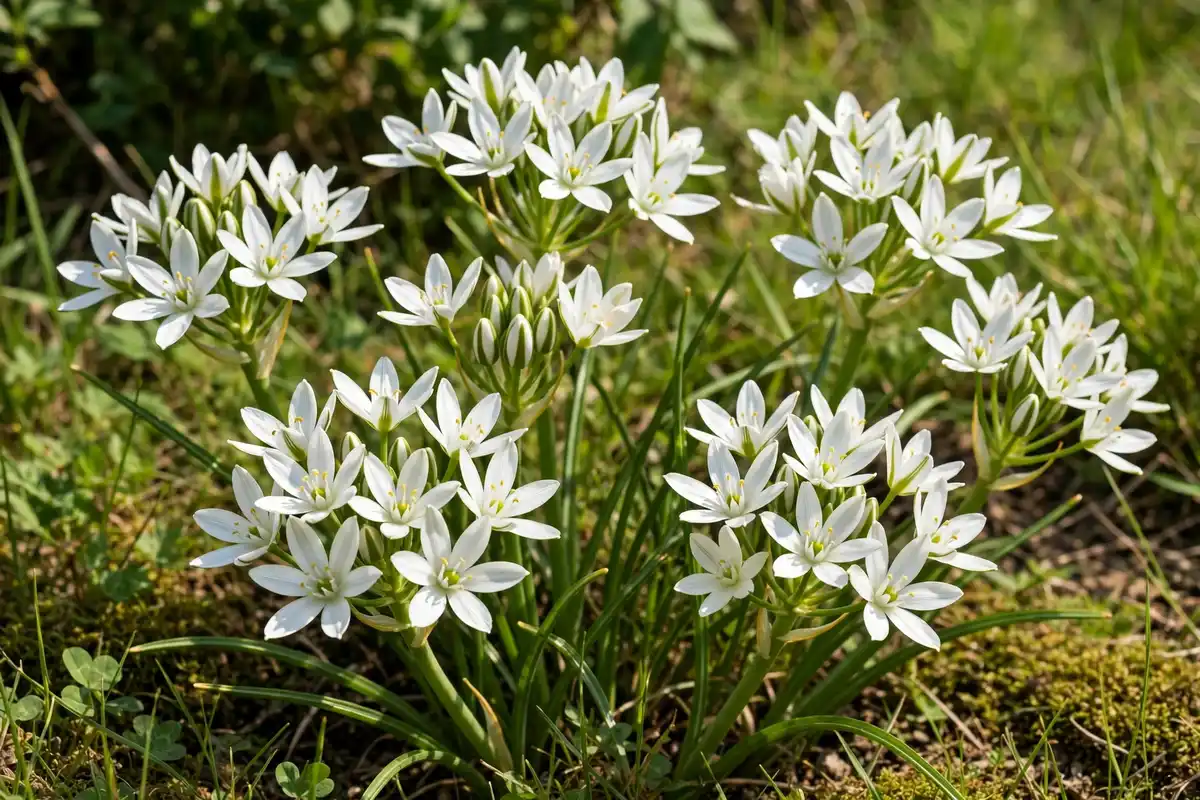
At noon on a sunny late-spring day it is a constellation at ground level: dozens of pure white six-pointed stars, green-striped underneath, open flat to the sun — and by dusk, or on a cloudy morning, they have folded themselves away like the sky closing. Star of Bethlehem is the spring bulb with heaven in its name, a famine legend in its past, and a quiet double life as both beloved wildflower and pushy garden escapee.
This guide covers the true species and its five florist cousins (including the orange sun star and the long-lasting chincherinchee), what the flower means (purity, hope and reconciliation), how to grow it without letting it take the lawn, and the frank safety note its beautiful bulbs require.
Quick Answer
Star of Bethlehem is Ornithogalum umbellatum, a spring bulb in the asparagus family whose clusters of white, green-backed star flowers open only in sunshine, in late spring. It grows 6 to 12 inches tall in USDA zones 5 to 9, spreads eagerly by bulb offsets (and is a listed escape in parts of North America), and means purity, hope and reconciliation. Two honest cautions come with the beauty: all parts — especially the bulbs — are poisonous (cardiac compounds, like its cousin lily of the valley), and it self-seeds and offsets its way across lawns, so plant it where a white constellation is welcome or contained.
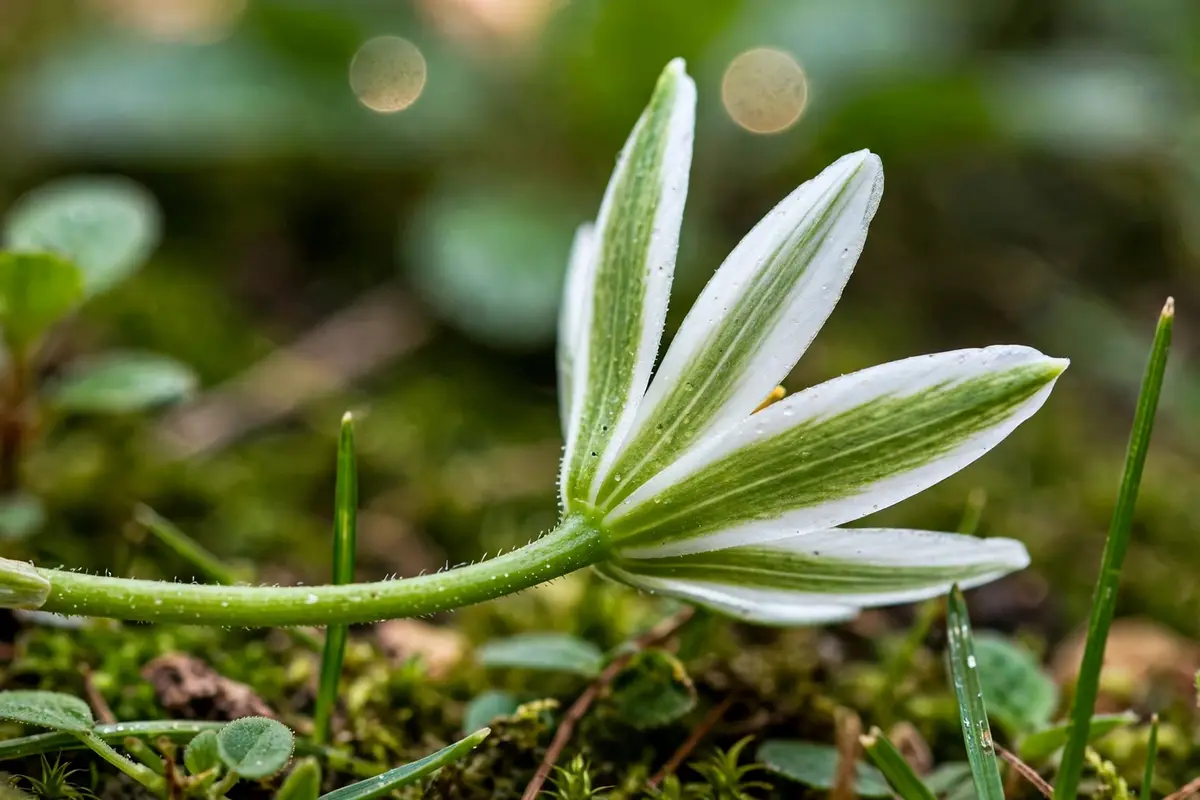
Table of Contents
- What Is a Star of Bethlehem Flower?
- Types of Star of Bethlehem and 6 Kinds Worth Knowing
- Star of Bethlehem Flower Meaning and Symbolism
- Star of Bethlehem Flower Colours and Their Meanings
- How to Grow Star of Bethlehem
- Common Mistakes When Growing Star of Bethlehem
- Star of Bethlehem vs Chincherinchee
- Frequently Asked Questions
What Is a Star of Bethlehem Flower?
Ornithogalum umbellatum is a bulbous perennial native around the Mediterranean and naturalised across Europe and North America. The genus name is Greek for “bird’s milk” — an old idiom for something marvellous and rare — and the flower earns it: each bloom is a perfect six-tepalled star, porcelain white above with a green stripe down the back of every point, carried in a flat-topped cluster over grass-like leaves with a silvery midrib. The flowers are strict sun-worshippers: they open mid-morning on bright days, close at night and sulk shut under cloud, which is why its old country names are “sleepydick” and “nap-at-noon” — a bulb with office hours. You can read more on the Ornithogalum umbellatum page on Wikipedia.
The name carries the Nativity story (the star that guided the Magi) and an older piece of folklore: that the star, its work done, fell to earth and shattered into these flowers — or, in the Crusader version, that the bulbs were dug and eaten on the march to Bethlehem, when the plant was called “dove’s dung” (a name that appears, remarkably, in the Bible as a famine food sold at a great price in besieged Samaria). That history is why the bulbs were once considered edible in extremis — and it is exactly where a modern guide must be careful: the plant contains cardiac glycosides and the bulbs are the most concentrated part. Its family, Asparagaceae, is the same one as our lily of the valley flower, and the two share the household rule: admire freely, eat never. Bach flower remedies use Star of Bethlehem as the remedy for shock and grief — “the comforter” — which folds neatly into its floriography below.
Star of Bethlehem Flower Quick Facts
- Botanical name: Ornithogalum umbellatum.
- Family: Asparagaceae, the asparagus family.
- Hardiness: USDA zones 5 to 9.
- Height: 6 to 12 inches.
- Bloom time: late spring (April to May).
- Sun and soil: full sun for open stars; any well-drained soil.
- Good to know: poisonous bulbs; vigorous spreader — contain it; flowers open only in sunshine.
Types of Star of Bethlehem and 6 Kinds Worth Knowing
One wild species and a whole florist family: the genus Ornithogalum runs to some 200 species, from Bethlehem’s white star to South Africa’s vase-life champion. The table separates them; the profiles follow. For the full list of flower names, see our flower names A to Z guide.
| Type | Flowers | Hardiness | Height | Best use |
|---|---|---|---|---|
| Common star of Bethlehem (O. umbellatum) | White stars, green-backed | Zones 5–9 | 6–12 in | Naturalising, rock gardens |
| Arabian starflower (O. arabicum) | White cups, black centre eye | Zones 8–10 | 18–24 in | Cutting, pots in mild gardens |
| Sun star (O. dubium) | Orange, yellow or cream stars | Tender (houseplant) | 8–12 in | Winter pots indoors |
| Chincherinchee (O. thyrsoides) | Dense white pyramids | Zones 7–10 | 12–24 in | Longest-lasting cut flower |
| Drooping star (O. nutans) | Silvery-white nodding bells | Zones 6–9 | 12–18 in | Shade edges, old gardens |
| Giant chincherinchee (O. saundersiae) | Big flat white heads | Zones 7–10 | 24–36 in | Floristry, bold borders |
1. Common Star of Bethlehem — the Original
The wild species itself: a hardy little bulb for sunny banks, rock gardens and (where its spread is acceptable) rough grass, flowering as the tulips fade. It is the flower of the legend and the Bach remedy, and the one to grow in a contained bed or a wild corner rather than a prized lawn — its bulb offsets multiply with real enthusiasm, and removing it later is a sieving job.
2. Arabian Starflower — the Black-Eyed Cousin
Ornithogalum arabicum trades the green-backed star for a taller, more formal flower: ivory cups around a glossy black ovary that reads as a jet eye — one of the most graphic flowers in the florist’s repertoire. Tender by Bethlehem standards (zones 8–10), it is grown in pots or lifted like a gladiolus elsewhere, and its stems are wedding-grade architecture.
3. Sun Star — the Orange Houseplant
Ornithogalum dubium is the family’s extrovert: clusters of tangerine, yellow or cream stars from a squat bulb, sold everywhere as a flowering winter houseplant. It breaks the genus’s white rule entirely. Give it a bright sill, let it dry between waterings, and rest it dry and dormant in summer — treated like the South African bulb it is, it reflowers for years.
4. Chincherinchee — the Vase-Life Champion
Ornithogalum thyrsoides, from South Africa, carries dense pyramids of white stars that open in sequence up the stem — which is why a cut spike stays fresh for two to three weeks, outlasting nearly every flower in the trade (exported by the million from the Cape). It is the comparison partner below: same genus, same stars, an entirely different league of cut flower.
5. Drooping Star of Bethlehem — the Silvery Shade-Dweller
Ornithogalum nutans nods where its cousin faces the sky: one-sided spikes of silvery-white, green-veined bells with a translucent, mother-of-pearl quality, happy in light shade under trees where the common species would thin out. An old cottage plant, naturalised in many historic gardens — plant it where spring shade needs a gleam.
6. Giant Chincherinchee — the Florist’s Statement
Ornithogalum saundersiae scales the chincherinchee up: three-foot stems crowned with broad flat heads of creamy stars with dark centres, bold enough to anchor a border or a bridal arrangement alone. Summer-flowering and tender-ish (zones 7–10, mulched), it is the genus at full theatrical size.
Star of Bethlehem Flower Meaning and Symbolism
Star of Bethlehem means purity, hope and reconciliation — innocence after trouble, the promise that guidance exists, and peace made after a quarrel. In the Victorian language of flowers it was given specifically as reconciliation, a white star sent to say the fight is over; in Christian symbolism it is the Nativity star itself, which is why it appears in Christmas arrangements and church flowers alongside the December birth flower story of the season. The Bach remedy tradition adds the tenderest layer: Star of Bethlehem is the comforter flower, for shock, loss and bad news — hope administered, literally, as a remedy.
Give it for apologies that mean it, for hope in a hard season, for Christenings and white weddings and Easter. A small bunch of stars says what a paragraph struggles to: something bright survived, and here it is, open in the sun.
Star of Bethlehem Flower Colours and Their Meanings
- White — purity, hope and reconciliation: the species and its legend, first among our white flowers.
- White with a black eye — truth and clarity: the arabicum flower’s striking signature.
- Orange and yellow — warmth and cheer: the sun star’s houseplant sunshine.
- Silvery green-white — calm and consolation: the drooping star’s shade gleam.
How to Grow Star of Bethlehem
Easy to grow, easier to spread — so the craft is in the siting. Gardeners on r/gardening on Reddit tell the two-part truth in every thread: “prettiest spring star I own” and “it is in the lawn now, forever” — both from the same gardeners.
Planting
Plant the small bulbs in autumn, 3 inches deep and 3–4 inches apart, point up, in full sun and any well-drained soil — a rock garden, a sunny bank, the front of a border, or containers, which are the intelligent default for small gardens. They flower the first spring and build from there: offsets crowd around each mother bulb (that is the whole spreading story), and the grass-like foliage dies back by early summer, leaving the bed free. Mark the spot — summer digging through a sleeping colony is how bulbs get scattered into the lawn in the first place.
Keeping It Where You Put It
Deadhead before seed sets if spread worries you (seed spreads it further than offsets do), lift and thin congested clumps every few years in summer dormancy, and never dump surplus bulbs in garden waste or wild ground — in parts of North America this species is an escaped invader of lawns and woodland edges, and responsible containment is part of growing it. The florist species are mostly tender and stay put by climate: grow arabicum and thyrsoides as pot or cut-flower crops, and the sun star indoors year-round.
Common Mistakes When Growing Star of Bethlehem
The classic mistake is planting it in a manicured lawn or a choice border and discovering, five springs later, that the constellation has annexed both. Choose wild ground, rock or pots from day one. The second is shade: the stars literally will not open without sun, and a shaded planting is a patch of green straps. The third is mowing or tidying the foliage before it dies back naturally — the bulb’s only recharge window.
The fourth mistake is the safety one: treating the bulbs as the famine food of legend. They are poisonous, full stop, and should be stored and planted with the same care as any toxic bulb — labelled, away from the onion basket, and out of the reach of digging dogs. Legend is literature, not a recipe.
Star of Bethlehem vs Chincherinchee
One genus, two careers. Star of Bethlehem (O. umbellatum): a low, hardy spring bulb (zones 5–9) whose flat cluster of green-backed white stars opens and shuts with the sun; a wildflower to naturalise carefully, blooming April–May, cut-flower value modest (the stars close indoors and the stems are short). Chincherinchee (O. thyrsoides): a half-hardy summer bulb (zones 7–10) whose tall pyramidal spikes open star after star upward for weeks — the florist’s export flower, two-to-three-week vase life, no green backing, no sun-closing habit worth mentioning. If you want the legend in the ground, plant umbellatum (in a pot or a wild bank). If you want white stars in a vase for a fortnight, buy or grow thyrsoides. The names get swapped at market constantly; the spike shape — flat cluster versus tall pyramid — tells them apart at a glance.
Frequently Asked Questions
Is Star of Bethlehem poisonous?
Yes — all parts, the bulbs most of all, contain cardiac glycosides, and livestock and pet poisonings are documented. The famine-food stories are ancient history, not guidance. Plant the bulbs labelled and stored away from anything edible, wash hands after handling, and keep them from digging pets. If your question is not answered here, the questions about the Star of Bethlehem flower on Quora cover most of the rest.
Is Star of Bethlehem invasive?
It can be, locally: it spreads by offsets and seed, persists for decades, and is a recognised lawn and garden escape in parts of North America. It is not banned in most places, but the responsible way to grow it is contained — pots, rock gardens, wild corners — with deadheading and no dumping of surplus bulbs.
When does Star of Bethlehem bloom?
Late spring — April into May — for about three weeks, each flower opening only in sunshine (roughly mid-morning to mid-afternoon) and closing at night and under cloud. A patch in bloom is a fair-weather clock.
Can Star of Bethlehem grow in pots?
Yes, and pots are the smart way to grow the common species in a small garden: a 3-inch planting depth, gritty compost, full sun, and a dry summer rest. The tender florist species (arabicum, thyrsoides, dubium) are pot plants by nature in cold climates.
Why are my Star of Bethlehem flowers closed?
Almost certainly the weather or the hour: they open only in direct sun. Check again at noon on a bright day before suspecting the plant — the same patch that looked like green straps at 9 a.m. under cloud is a constellation by lunch.
What is the Star of Bethlehem Bach remedy for?
In Bach flower remedy practice it is the remedy for shock, grief and the after-effects of bad news — Dr Bach called it the “comforter and soother of pains and sorrows”. It is a traditional practice rather than a medicine, but it is a large part of why the flower’s name means consolation to so many people. For more flowers under the same letter, see our guide to flowers that start with S.