40 Flowers That Start With E: Names, Pictures & Growing Tips
40 Flowers That Start With E: Names, Pictures & Growing Tips
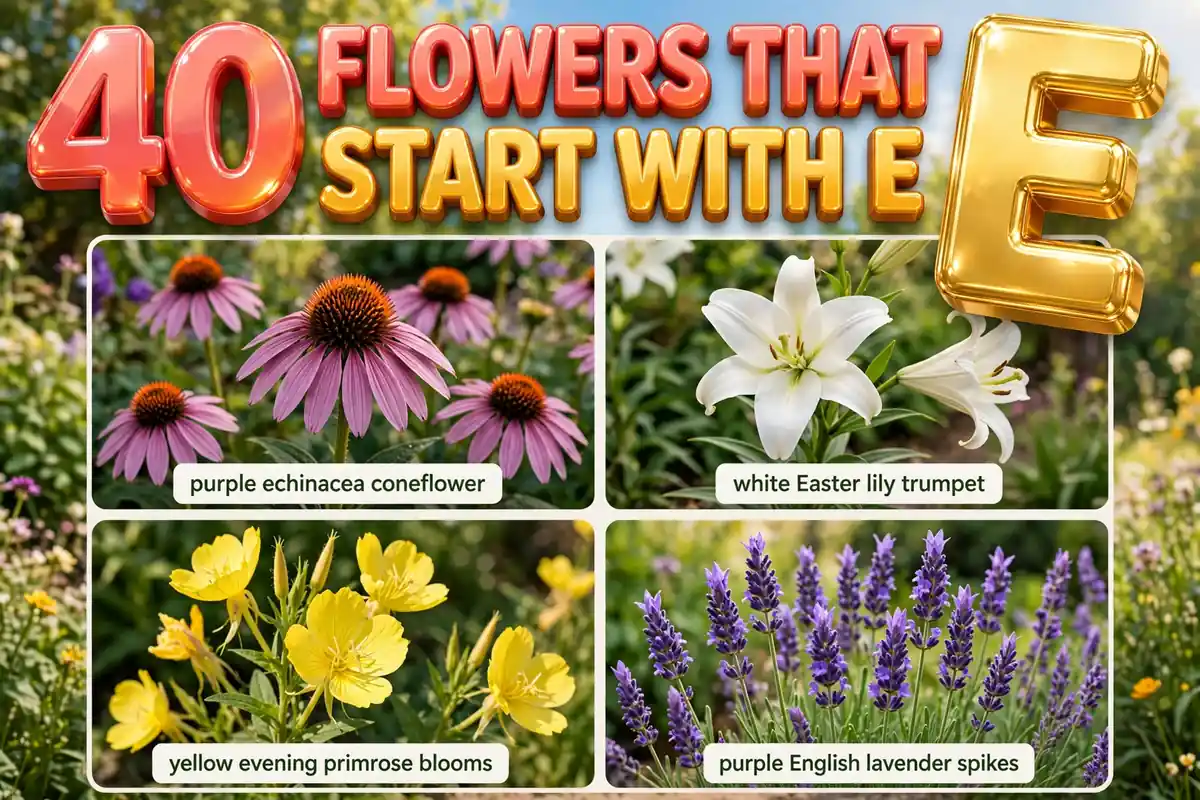
Looking for flower names that start with E? You have come to the right place. The letter E delivers some of the most useful and beautiful blooms in American gardens, from the pollinator-magnet cones of echinacea to the fragrant spikes of English lavender and the pure white trumpets of Easter lilies. Whether you are planning a sunny perennial border, hunting for a flower with evening fragrance, or helping a child with an alphabet garden project, this guide covers 40 real flowers that start with E, each with a photo-worthy description and practical growing advice.
Every entry below includes the flower’s scientific name, bloom season, sun needs, and USDA hardiness zone, so you can tell at a glance which E-flowers will thrive in your yard. You will also find two quick comparison tables, beginner-friendly growing tips, and answers to the most common questions gardeners ask about flowers beginning with E. Let’s dig in.
Quick Answer
Popular flowers that start with E include Echinacea, English Lavender, Easter Lily, Evening Primrose, Eustoma (Lisianthus), Edelweiss, English Bluebell, Sea Holly, California Poppy, and Strawflower. They range from spring bulbs and summer perennials to fragrant annuals and tropical houseplants, covering USDA zones 3–11, so there is an E-flower for nearly every US garden.
Table of Contents
E-Flowers at a Glance
Use this table to compare all 40 flowers that start with E side by side, from botanical names to native regions.
| Flower name | Scientific name | Type | Color | Native region |
|---|---|---|---|---|
| English Lavender | Lavandula angustifolia | Evergreen subshrub | Purple, blue, pink, white | Mediterranean |
| Echinacea | Echinacea purpurea | Herbaceous perennial | Purple, pink, white, orange | Central and eastern North America |
| Easter Lily | Lilium longiflorum | Bulb | White | Japan (Ryukyu Islands) |
| Evening Primrose | Oenothera biennis | Biennial | Yellow | North America |
| Eustoma | Eustoma grandiflorum | Tender perennial (grown as annual) | Purple, pink, white, blue | Southern US, Mexico |
| Winter Heath | Erica carnea | Evergreen shrub | Pink, white, red | Central and southern Europe |
| Edelweiss | Leontopodium alpinum | Alpine perennial | White and silver | European Alps |
| English Bluebell | Hyacinthoides non-scripta | Bulb | Blue-violet, white, pink | Western Europe |
| Joe Pye Weed | Eutrochium purpureum | Herbaceous perennial | Mauve-pink | Eastern North America |
| Elderberry Blossom | Sambucus nigra | Deciduous shrub | Creamy white | Europe, western Asia |
| English Daisy | Bellis perennis | Herbaceous perennial | White, pink, red | Europe |
| Epimedium | Epimedium grandiflorum | Herbaceous perennial | Pink, white, yellow, purple | Japan, China, Korea |
| Fleabane Daisy | Erigeron speciosus | Herbaceous perennial | Blue-violet, pink, white | Western North America |
| Sea Holly | Eryngium planum | Herbaceous perennial | Steel blue and silver | Central and eastern Europe |
| California Poppy | Eschscholzia californica | Annual (perennial in warm zones) | Orange, yellow, white | Western North America |
| Evening Stock | Matthiola longipetala | Annual | Pale lilac, white | Southern Europe, Middle East |
| Strawflower | Xerochrysum bracteatum | Tender perennial (grown as annual) | Red, pink, orange, yellow, white | Australia |
| English Primrose | Primula vulgaris | Herbaceous perennial | Pale yellow, white, pink | Western and southern Europe |
| Euryops Daisy | Euryops pectinatus | Evergreen shrub | Yellow | South Africa |
| Foxtail Lily | Eremurus robustus | Herbaceous perennial | Pink, white, yellow | Central Asia |
| Chilean Glory Flower | Eccremocarpus scaber | Tender perennial vine | Orange-red, yellow | Chile |
| Empress Tree Blossom | Paulownia tomentosa | Deciduous tree | Lavender-purple | China |
| White Snakeroot | Ageratina altissima | Herbaceous perennial | White | Eastern and central North America |
| Eastern Redbud Blossom | Cercis canadensis | Deciduous tree | Magenta-pink | Eastern North America |
| Eglantine | Rosa rubiginosa | Deciduous shrub | Pink | Europe, western Asia |
| Elephant’s Ears | Bergenia cordifolia | Evergreen perennial | Pink, magenta, white | Central Asia |
| Globe Thistle | Echinops ritro | Herbaceous perennial | Blue, silver | Southern Europe, central Asia |
| Evening Campion | Silene latifolia | Biennial/short-lived perennial | White | Europe |
| Everlasting Pea | Lathyrus latifolius | Herbaceous perennial vine | Pink, white, red | Southern Europe |
| Egyptian Starflower | Pentas lanceolata | Tender perennial | Red, pink, white, lavender | East Africa, Arabia |
| Echeveria | Echeveria elegans | Succulent | Pink-orange and yellow blooms | Mexico |
| Easter Cactus | Hatiora × graeseri | Tropical houseplant | Red, pink, white, orange | Brazil (hybrid origin) |
| English Wallflower | Erysimum cheiri | Biennial/short-lived perennial | Yellow, orange, red, bronze | Southern Europe |
| English Iris | Iris latifolia | Bulb | Blue, purple, white | Pyrenees (Spain, France) |
| Blue Mistflower | Conoclinium coelestinum | Herbaceous perennial | Blue-violet | Eastern and central North America |
| Trout Lily | Erythronium americanum | Spring-ephemeral bulb | Yellow | Eastern North America |
| Winter Aconite | Eranthis hyemalis | Tuberous perennial | Yellow | Southern Europe, western Asia |
| Trailing Arbutus | Epigaea repens | Evergreen groundcover | Pink and white | Eastern North America |
| Early Crocus | Crocus tommasinianus | Corm | Lilac-purple, white | Balkans |
| Common Boneset | Eupatorium perfoliatum | Herbaceous perennial | White | Eastern and central North America |
Bloom Season, Sun Needs & Hardiness Zones
Planning your garden calendar? This second table shows when each E-flower blooms, how much sun it wants, and the USDA zones where it grows outdoors year-round.
| Flower name | Bloom season | Sun needs | Hardiness zone |
|---|---|---|---|
| English Lavender | Summer | Full sun | 5–9 |
| Echinacea | Summer to fall | Full sun | 3–9 |
| Easter Lily | Spring (potted); early summer (garden) | Full sun to part shade | 7–10; potted elsewhere |
| Evening Primrose | Summer | Full sun to part shade | 4–9 |
| Eustoma | Summer to fall | Full sun | 9–11; annual elsewhere |
| Winter Heath | Late winter to spring | Full sun to part shade | 5–8 |
| Edelweiss | Summer | Full sun | 4–7 |
| English Bluebell | Spring | Part shade | 4–9 |
| Joe Pye Weed | Late summer to fall | Full sun to part shade | 4–9 |
| Elderberry Blossom | Early summer | Full sun to part shade | 5–8 |
| English Daisy | Spring to early summer | Full sun to part shade | 4–8 |
| Epimedium | Spring | Part to full shade | 5–9 |
| Fleabane Daisy | Summer to fall | Full sun | 5–8 |
| Sea Holly | Summer | Full sun | 5–9 |
| California Poppy | Spring to summer | Full sun | Grown as annual; perennial 8–10 |
| Evening Stock | Summer | Full sun to part shade | Grown as annual |
| Strawflower | Summer to fall | Full sun | 9–11; annual elsewhere |
| English Primrose | Early spring | Part shade | 4–8 |
| Euryops Daisy | Fall to spring (mild climates) | Full sun | 9–11 |
| Foxtail Lily | Early summer | Full sun | 5–8 |
| Chilean Glory Flower | Summer to fall | Full sun | 8–10; annual elsewhere |
| Empress Tree Blossom | Spring | Full sun | 5–9 |
| White Snakeroot | Late summer to fall | Part shade to full shade | 3–8 |
| Eastern Redbud Blossom | Early spring | Full sun to part shade | 4–9 |
| Eglantine | Early summer | Full sun | 4–9 |
| Elephant’s Ears | Spring | Part shade | 3–8 |
| Globe Thistle | Summer | Full sun | 3–9 |
| Evening Campion | Summer | Full sun to part shade | 4–8 |
| Everlasting Pea | Summer | Full sun | 4–8 |
| Egyptian Starflower | Summer to fall | Full sun to part shade | 10–11; annual elsewhere |
| Echeveria | Spring to summer | Full sun to bright indirect | 9–11; houseplant elsewhere |
| Easter Cactus | Spring | Bright indirect light | Houseplant (10–11 outdoors) |
| English Wallflower | Spring | Full sun | 7–10; biennial elsewhere |
| English Iris | Early summer | Full sun | 5–9 |
| Blue Mistflower | Late summer to fall | Full sun to part shade | 5–10 |
| Trout Lily | Early spring | Part to full shade | 3–8 |
| Winter Aconite | Late winter | Part shade | 4–9 |
| Trailing Arbutus | Early spring | Part shade | 3–7 |
| Early Crocus | Late winter to early spring | Full sun to part shade | 3–8 |
| Common Boneset | Late summer to fall | Full sun to part shade | 3–8 |
40 Flowers That Start With E: The Complete List
Here they are — 40 beautiful, real flowers beginning with E, each with growing notes so you can pick the right ones for your garden.
1. English Lavender (Lavandula angustifolia)
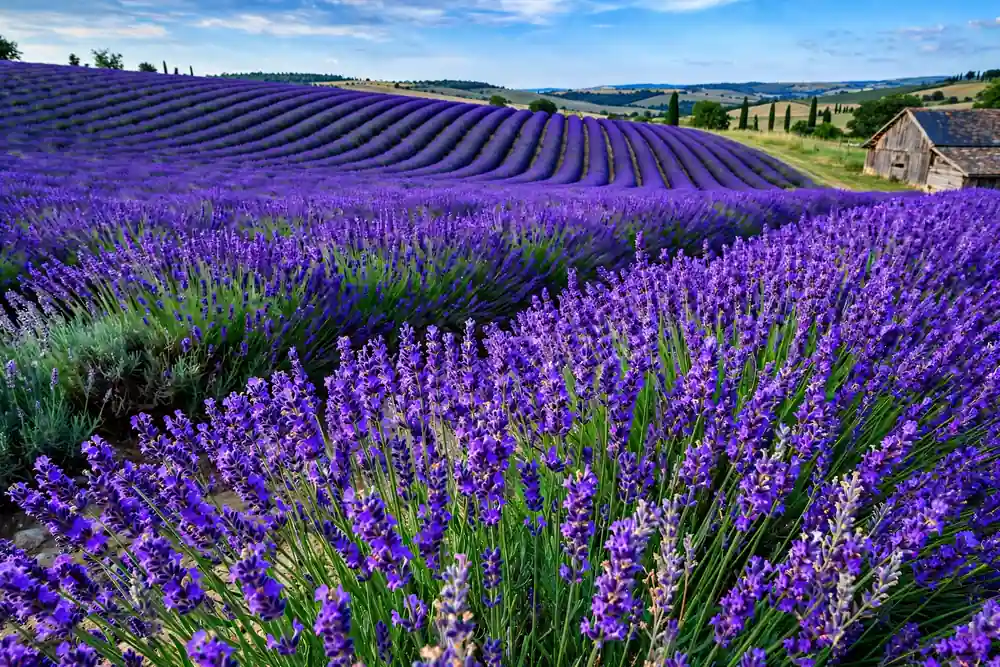
English lavender is the classic fragrant herb of cottage gardens, sending up dense purple spikes over silvery evergreen foliage in summer. Bees and butterflies adore it, and dried bundles scent closets for months. It demands sharp drainage and full sun — soggy winter soil kills more lavender than cold does. Plant ‘Hidcote’ for compact hedges or ‘Munstead’ for colder zones, and shear spent blooms to encourage a second flush.
Bloom: Summer | Sun: Full sun | Zone: 5–9 | Best for: Fragrant borders, pollinators, drying
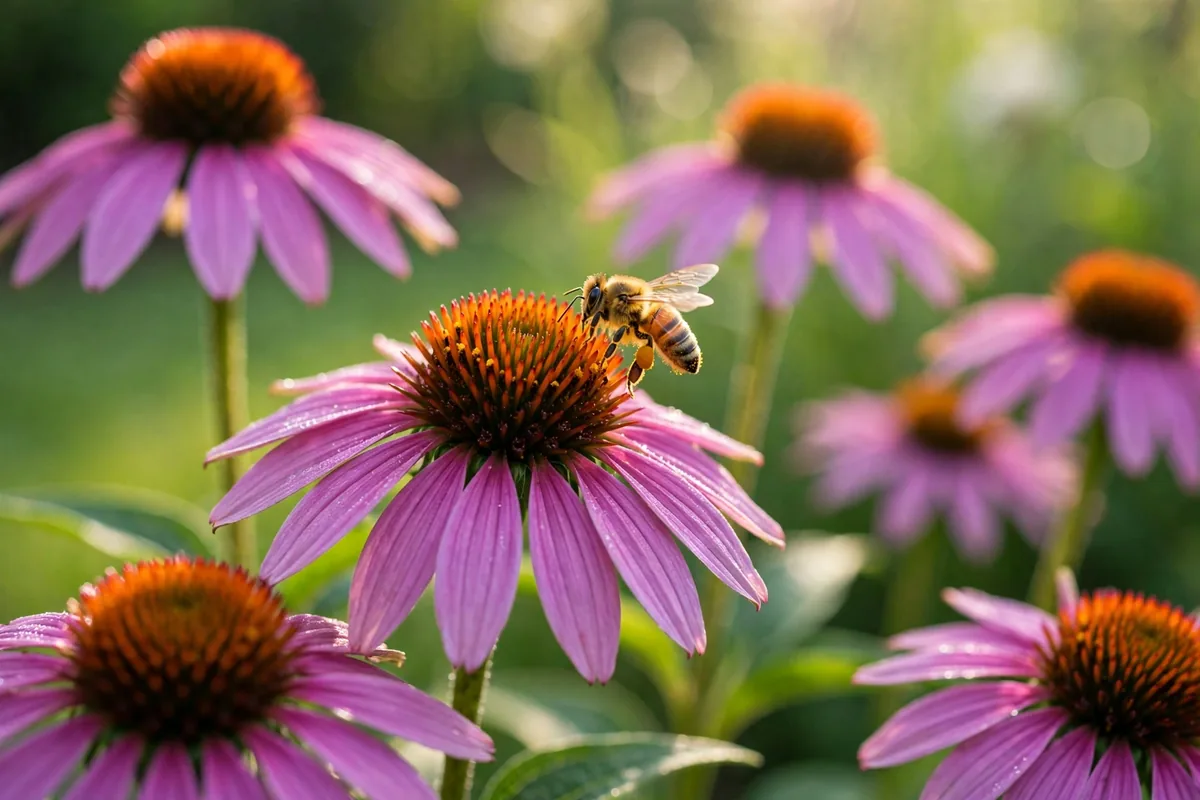
2. Echinacea (Echinacea purpurea)
Purple coneflower is a workhorse of the American perennial border, with daisy-like blooms and spiky orange cones on sturdy 2- to 3-foot stems. It shrugs off heat, drought, and poor soil while feeding bees, butterflies, and goldfinches that feast on the seeds. Deadhead for rebloom or leave the cones standing for winter interest and birds. Modern hybrids add white, orange, and double-flowered forms.
Bloom: Summer to fall | Sun: Full sun | Zone: 3–9 | Best for: Pollinator gardens, beginner perennials
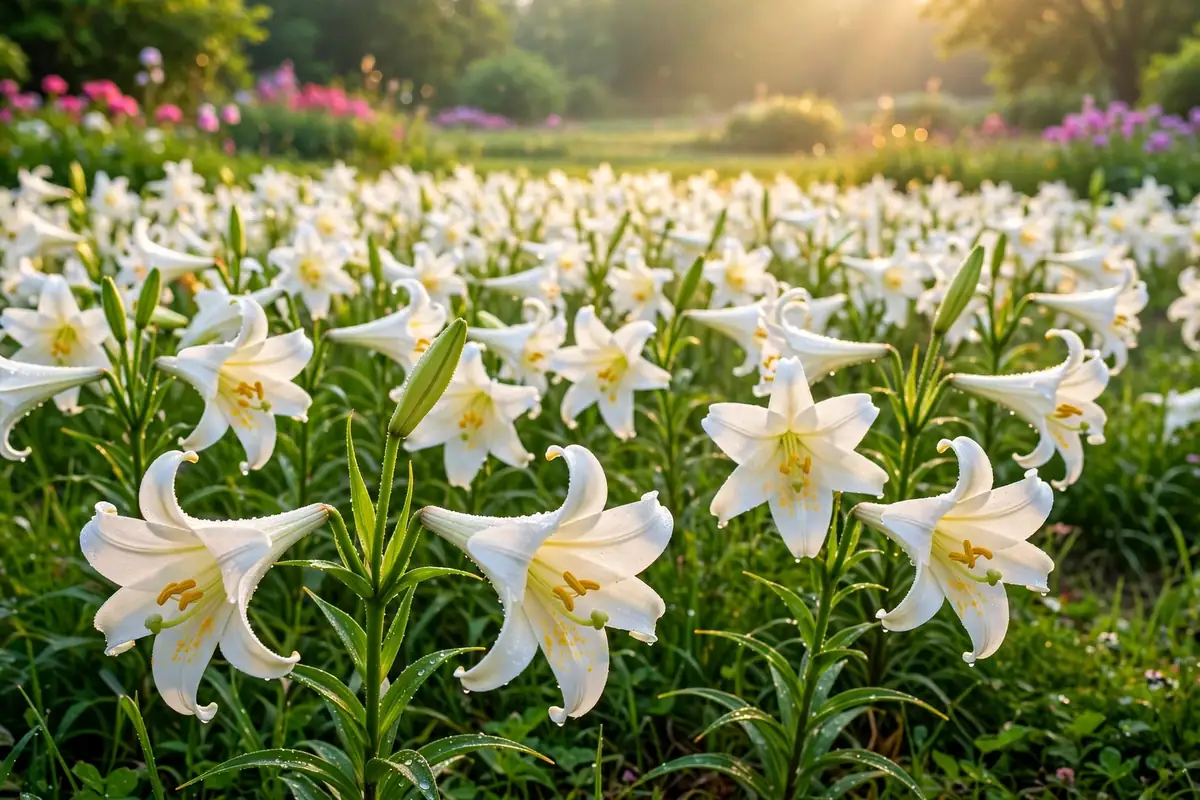
3. Easter Lily (Lilium longiflorum)
The Easter lily’s pure white trumpet, often 6 inches long and sweetly fragrant, is the signature flower of spring celebrations. Most gardeners buy it as a potted holiday plant, but the bulbs can go outdoors in zones 7–10, where they bloom in early summer. Give it rich, well-drained soil and morning sun. Note: all true lilies are highly toxic to cats, so keep indoor plants out of their reach.
Bloom: Spring (potted); early summer (garden) | Sun: Full sun to part shade | Zone: 7–10; potted elsewhere | Best for: Holiday displays, fragrant gardens
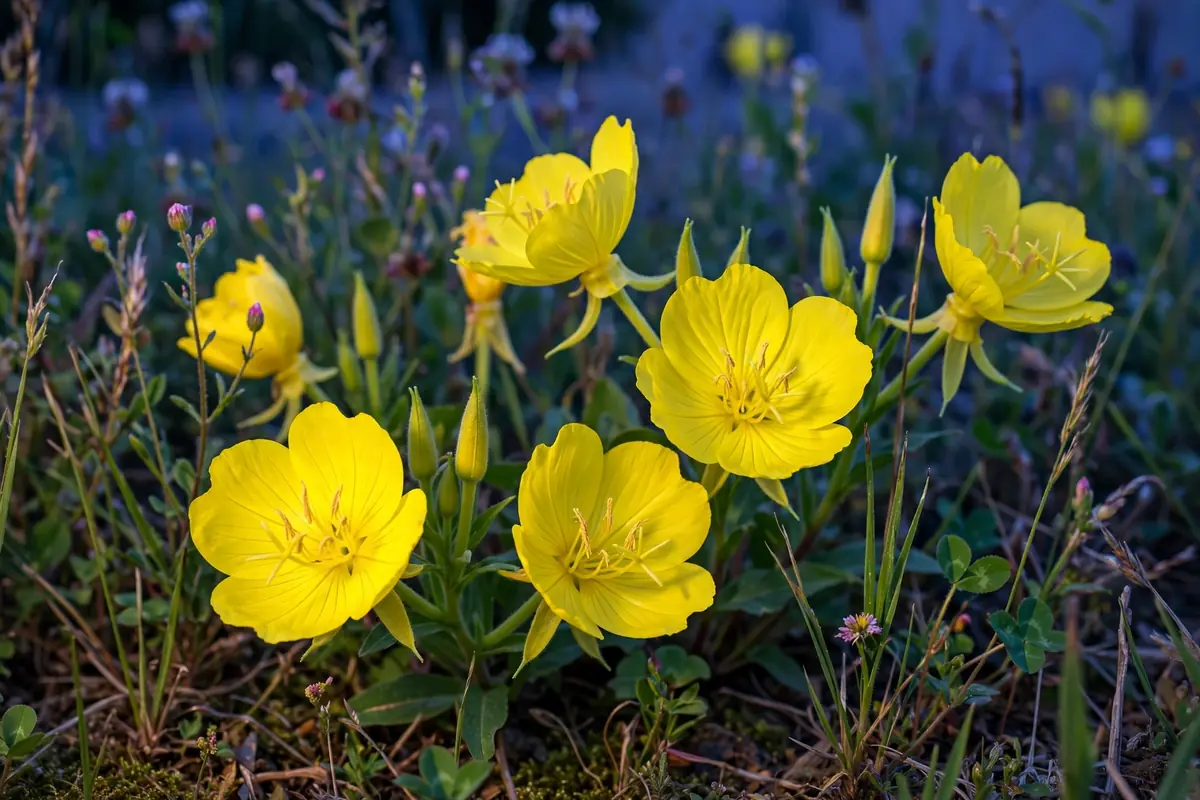
4. Evening Primrose (Oenothera biennis)
Evening primrose puts on a nightly show: its lemon-yellow cups open at dusk and glow against the evening garden, perfuming the air with a light, sweet scent. This tough biennial self-sows freely, so one planting returns for years. It tolerates poor, sandy soil and drought, making it ideal for wildflower meadows and cottage borders. The flowers also attract night-flying moths and hummingbirds at dusk.
Bloom: Summer | Sun: Full sun to part shade | Zone: 4–9 | Best for: Evening gardens, wildflower meadows
5. Eustoma (Eustoma grandiflorum)
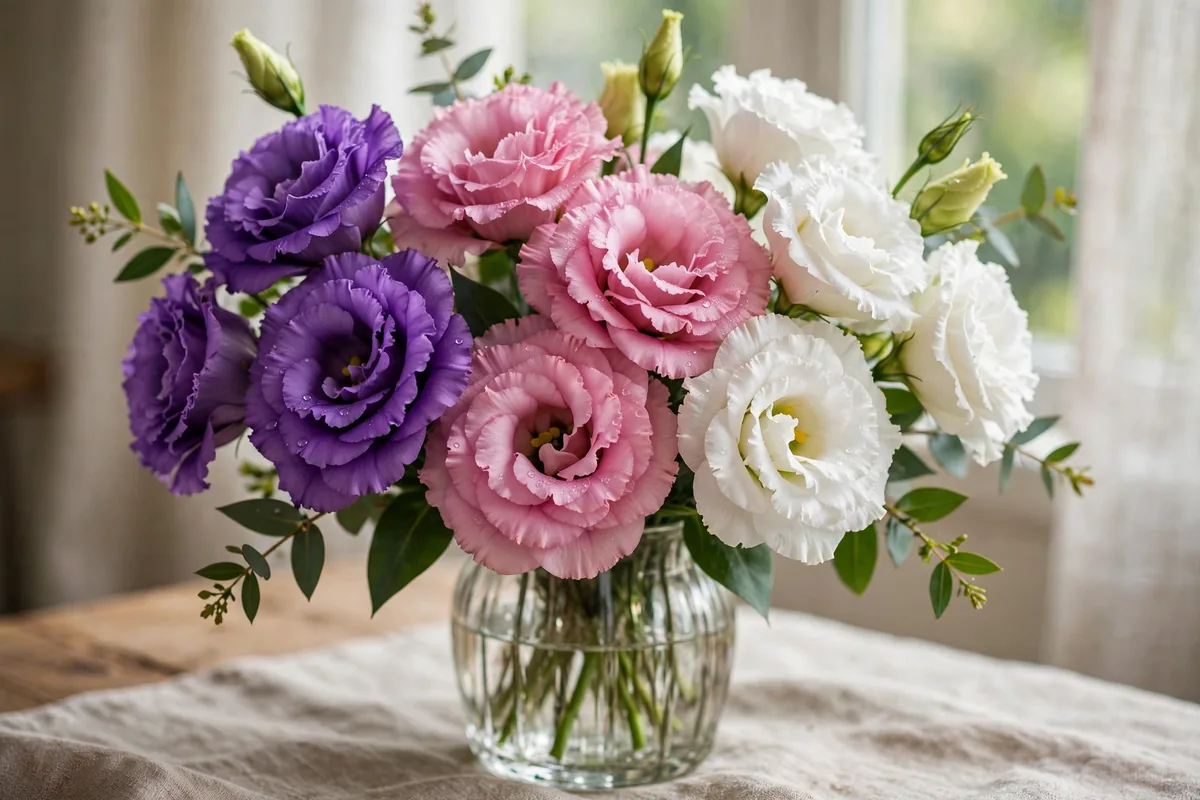
Better known as lisianthus, eustoma produces rose-like, ruffled blooms in purple, pink, white, and bicolors on 2- to 3-foot stems. Florists prize it for a vase life of up to three weeks — among the longest of any cut flower. Slow from seed, so buy transplants for full sun, rich soil, and steady moisture. In zones 9–11 it behaves as a short-lived perennial; elsewhere grow it as an annual.
Bloom: Summer to fall | Sun: Full sun | Zone: 9–11; annual elsewhere | Best for: Cut flowers, bouquets
6. Winter Heath (Erica carnea)
Winter heath is one of the few shrubs that bloom through winter, covering low evergreen mounds with tiny pink, white, or red bells from January to April. It thrives in poor, acidic soil and full sun, making it perfect for rock gardens and edging paths. Unlike its fussier cousins, Erica carnea tolerates alkaline soil better than most heaths. Shear lightly after flowering to keep plants dense and floriferous.
Bloom: Late winter to spring | Sun: Full sun to part shade | Zone: 5–8 | Best for: Winter color, rock gardens
7. Edelweiss (Leontopodium alpinum)
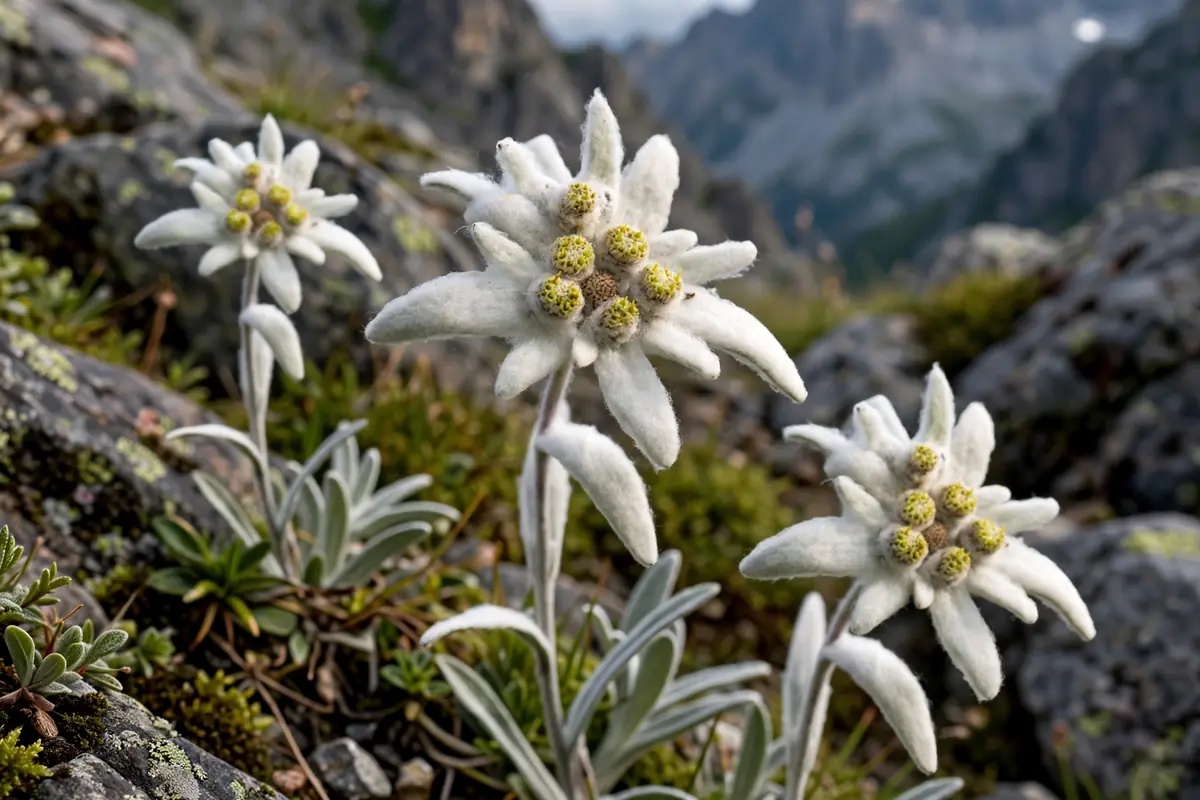
Edelweiss is the legendary flower of the Alps — fuzzy white star-shaped blooms with silvery woolly leaves that shrug off harsh mountain weather. In the garden it needs lean, gritty, well-drained soil and full sun — rich soil and overwatering are its enemies. Grow it in rock gardens or alpine troughs where its compact 6- to 12-inch form shines. Hardy to zone 4, it is easy once drainage is right.
Bloom: Summer | Sun: Full sun | Zone: 4–7 | Best for: Rock gardens, alpine troughs
8. English Bluebell (Hyacinthoides non-scripta)
Nothing says spring woodland like a carpet of nodding English bluebells, their violet-blue bells arching gracefully over glossy strap leaves with a sweet, hyacinth-like scent. Plant bulbs in fall under deciduous trees where they get spring sun and summer shade. They naturalize beautifully and return for decades — but buy from reputable growers, as wild collection is restricted in Britain. Let foliage die back naturally to feed next year’s blooms.
Bloom: Spring | Sun: Part shade | Zone: 4–9 | Best for: Woodland gardens, naturalizing
9. Joe Pye Weed (Eutrochium purpureum)
Despite its weedy name, Joe Pye weed is a stately native perennial, topping 5 to 7 feet with huge domes of mauve-pink flowers in late summer. Butterflies — especially swallowtails — swarm it, and it tolerates the moist soils that defeat fussier perennials. Give it room at the back of the border and cut stems to the ground in late fall. ‘Gateway’ is a compact 5-foot cultivar for smaller gardens.
Bloom: Late summer to fall | Sun: Full sun to part shade | Zone: 4–9 | Best for: Back borders, butterfly gardens
10. Elderberry Blossom (Sambucus nigra)
Before the berries come the blossoms: elderberry shrubs erupt in early summer with flat, lacy clusters of tiny creamy-white, sweetly scented flowers. The blooms make classic elderflower cordial and champagne, and pollinators love them. This fast-growing deciduous shrub reaches 10 to 20 feet and fruits best with a second variety nearby for cross-pollination. Prune hard in late winter to keep it productive and manageable.
Bloom: Early summer | Sun: Full sun to part shade | Zone: 5–8 | Best for: Edible landscaping, wildlife shrubs
11. English Daisy (Bellis perennis)
The humble English daisy carpets lawns and cottage borders with cheerful white, pink, or red pompon blooms in spring. Modern cultivars like ‘Tasso’ offer fully double flowers on compact 4- to 6-inch plants that thrive in cool weather. It prefers moist, fertile soil and fades in summer heat — in warm regions, treat it as a fall-planted annual. Deadhead spent blooms to keep the flowers coming through the cool season.
Bloom: Spring to early summer | Sun: Full sun to part shade | Zone: 4–8 | Best for: Edging, spring containers
12. Epimedium (Epimedium grandiflorum)
Epimedium, sometimes called barrenwort or bishop’s hat, is the answer to dry shade under trees, where its delicate spider-like spring flowers dance above heart-shaped leaves. It spreads slowly into a weed-proof groundcover and tolerates the root competition that defeats most perennials. Cut the old foliage to the ground in late winter so the new flowers show clearly. Once established, it needs almost no care.
Bloom: Spring | Sun: Part to full shade | Zone: 5–9 | Best for: Dry shade, groundcover
13. Fleabane Daisy (Erigeron speciosus)
Showy fleabane looks like a refined wild aster, with 2-inch lavender-blue daisies — each with up to 100 narrow petals — blooming for weeks in summer. It is a tough western native that handles poor soil, drought, and neglect while feeding native bees. Cut plants back by half after the first flush for a second round of blooms. It self-sows gently, filling gaps in sunny borders without becoming a nuisance.
Bloom: Summer to fall | Sun: Full sun | Zone: 5–8 | Best for: Native gardens, cottage borders
14. Sea Holly (Eryngium planum)
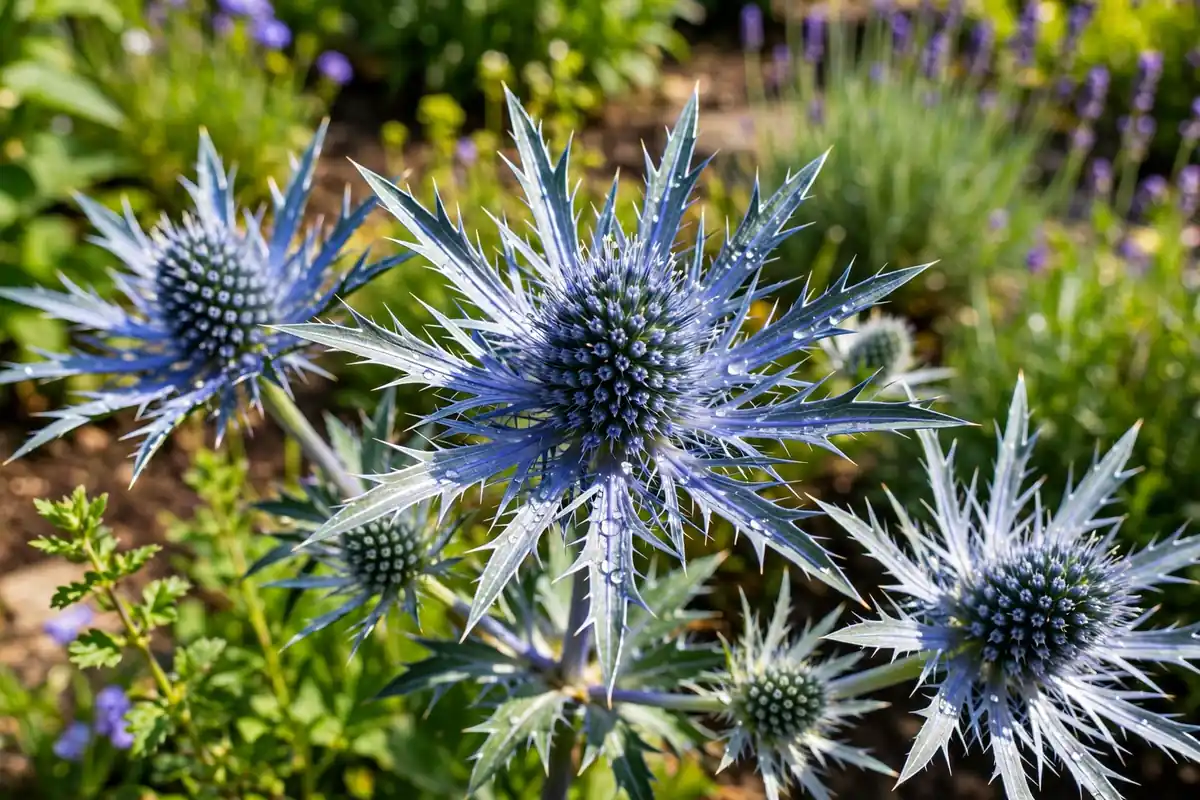
Sea holly brings architecture to the summer border with spiky, metallic steel-blue flower heads ringed by silver bracts. It loves poor, sandy soil and full sun — the leaner the conditions, the better the color. Bees adore it, and the dried heads are superb in winter arrangements. Choose a permanent spot at planting time; like many taprooted perennials, sea holly resents being moved once established.
Bloom: Summer | Sun: Full sun | Zone: 5–9 | Best for: Dried arrangements, coastal gardens
15. California Poppy (Eschscholzia californica)
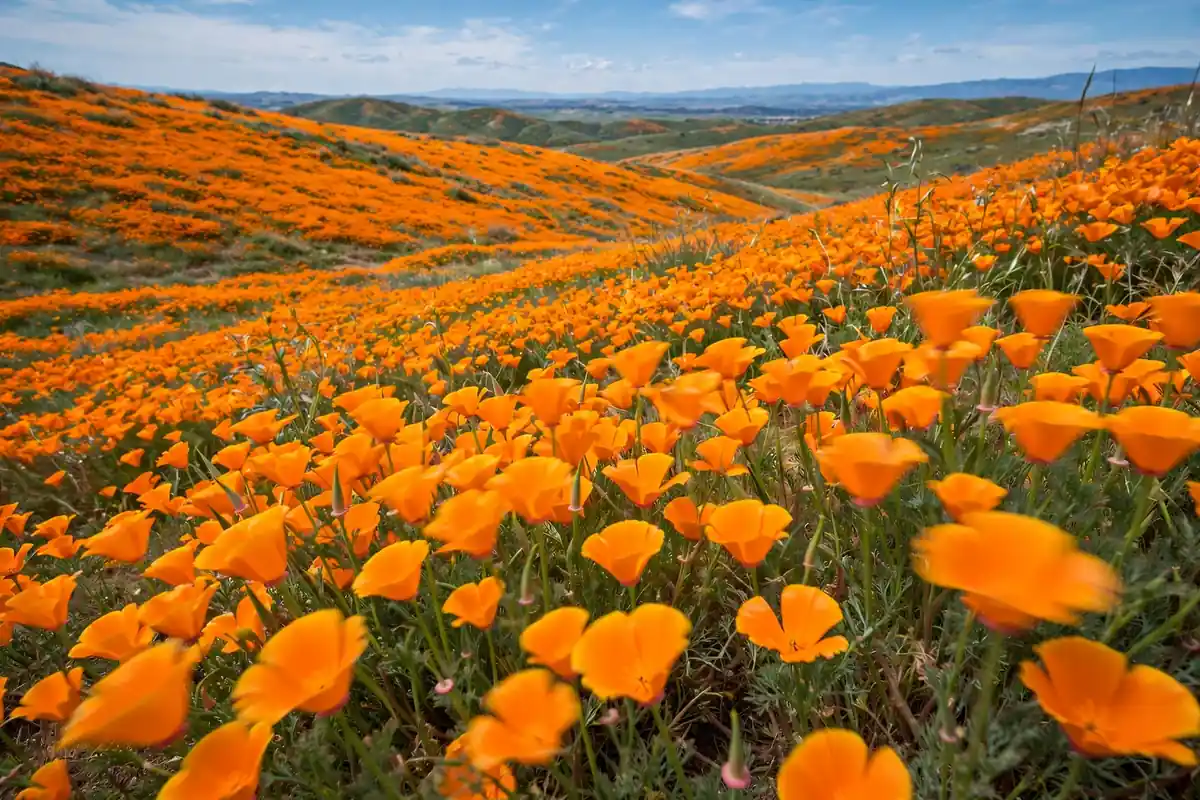
California’s state flower turns spring hillsides gold with silky orange cups that open in sunshine and close at night. It is one of the easiest wildflowers to grow — scatter seeds in fall or early spring on bare, sunny soil and let nature take over. Plants reseed freely, returning year after year. Deadhead to extend bloom, or let pods form for next year’s show. No fertilizer and little water needed.
Bloom: Spring to summer | Sun: Full sun | Zone: Grown as annual; perennial 8–10 | Best for: Wildflower meadows, easy color
16. Evening Stock (Matthiola longipetala)
Evening stock, or night-scented stock, is grown for one reason: its intoxicating perfume. The small pale-lilac flowers look unremarkable by day, but at dusk they release a sweet, spicy fragrance that carries across the whole garden. Sow seeds directly where you want them in spring — near patios, bedroom windows, or evening seating areas. It blooms in about 8 weeks and self-sows for encore performances.
Bloom: Summer | Sun: Full sun to part shade | Zone: Grown as annual | Best for: Night fragrance, patios
17. Strawflower (Xerochrysum bracteatum)
Strawflower’s papery, petal-like bracts in red, pink, orange, yellow, and white look freshly cut even when fully dried — hence the name everlasting. It blooms nonstop from summer to frost in full sun with only decent drainage needed. Cut stems for drying just as the centers open, then hang them upside down.
Bloom: Summer to fall | Sun: Full sun | Zone: 9–11; annual elsewhere | Best for: Dried flowers, cutting gardens
18. English Primrose (Primula vulgaris)
The English primrose is spring’s gentle opener, with clusters of pale-yellow, sweetly scented flowers nestled in rosettes of crinkled green leaves. It thrives in the cool, moist, partly shaded spots where many flowers struggle — under deciduous shrubs or along stream banks. Plant it where you will see it up close, such as path edges. Divide clumps every few years after flowering to keep plants vigorous.
Bloom: Early spring | Sun: Part shade | Zone: 4–8 | Best for: Woodland edges, spring containers
19. Euryops Daisy (Euryops pectinatus)
Euryops daisy is a South African evergreen shrub that pumps out cheerful yellow daisies almost year-round in frost-free climates. Its finely divided gray-green foliage looks good even when flowers pause. In zones 9–11 it forms a rounded 3- to 5-foot shrub for sunny borders and foundation plantings; in colder areas, grow it in pots and overwinter indoors. Shear lightly after heavy bloom cycles to keep it tidy.
Bloom: Fall to spring (mild climates) | Sun: Full sun | Zone: 9–11 | Best for: Warm-climate borders, containers
20. Foxtail Lily (Eremurus robustus)
Foxtail lily is pure garden drama: a 6- to 8-foot spike packed with hundreds of small pink or white starry flowers, rising from a crown of strappy leaves in early summer. The brittle, octopus-like roots must be planted shallowly in autumn in deeply worked, well-drained soil. Once settled, it dislikes disturbance. Pair it with lower perennials that hide its fading foliage after bloom.
Bloom: Early summer | Sun: Full sun | Zone: 5–8 | Best for: Statement plantings, back borders
21. Chilean Glory Flower (Eccremocarpus scaber)
Chilean glory flower is a fast, flamboyant vine that races up trellises and obelisks, dangling tubular orange-red blooms all summer. From seed sown indoors in spring, it can climb 10 feet in a single season, flowering the first year. In zones 8–10 it survives winter as a perennial; elsewhere, treat it as an annual or lift the tuberous roots for winter storage. Give it something sturdy to climb.
Bloom: Summer to fall | Sun: Full sun | Zone: 8–10; annual elsewhere | Best for: Trellises, quick vertical color
22. Empress Tree Blossom (Paulownia tomentosa)
Before its huge leaves unfurl, the empress tree covers its branches in upright clusters of fragrant lavender-purple, foxglove-like blossoms — one of spring’s most spectacular tree displays. It grows astonishingly fast, often 10 feet a year when young. Note: it self-seeds aggressively and is invasive in parts of the eastern US — check local guidance before planting.
Bloom: Spring | Sun: Full sun | Zone: 5–9 | Best for: Fast shade, spring spectacle
23. White Snakeroot (Ageratina altissima)
White snakeroot lights up shady corners in late summer with fluffy clusters of bright white flowers on 3- to 5-foot stems. It is one of the few perennials that blooms generously in shade, and butterflies flock to it. It self-sows readily — deadhead if you want to limit its spread. Important: all parts are toxic if eaten, so site it away from vegetable gardens and grazing animals.
Bloom: Late summer to fall | Sun: Part shade to full shade | Zone: 3–8 | Best for: Shade gardens, late-season nectar
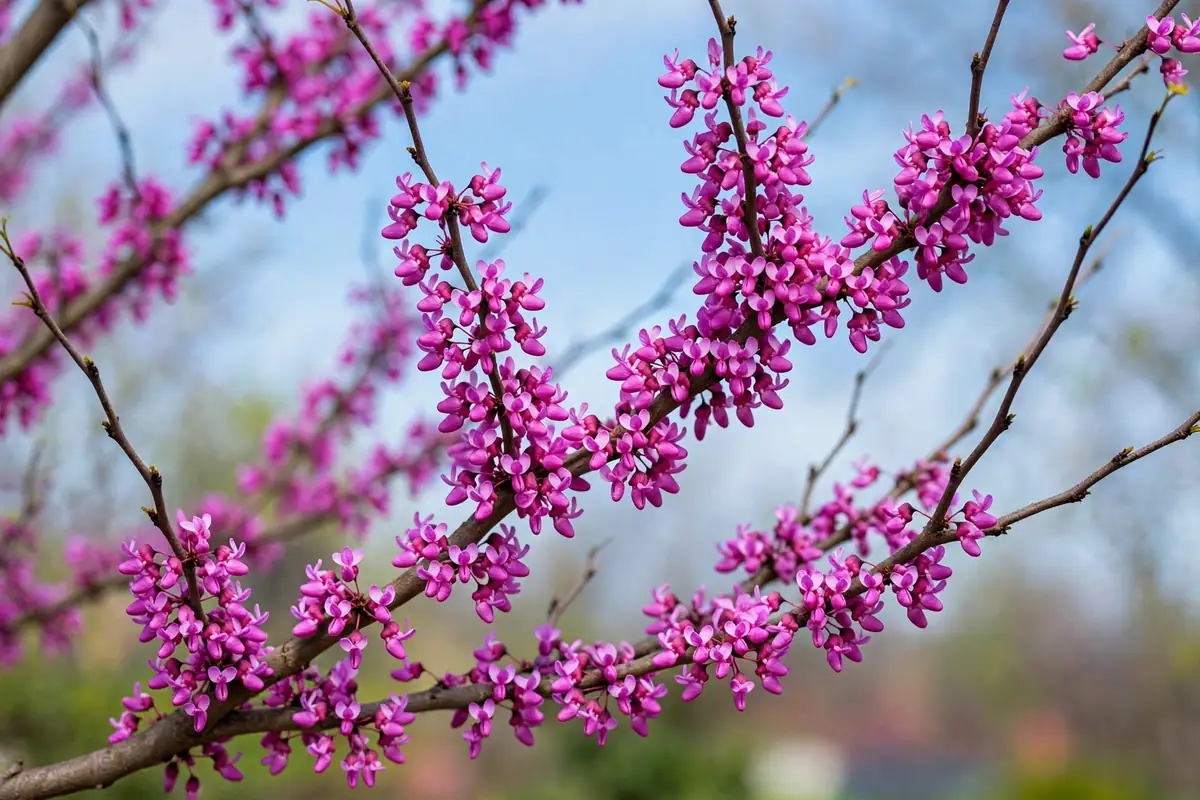
24. Eastern Redbud Blossom (Cercis canadensis)
Eastern redbud announces spring with magenta-pink, pea-like blossoms that burst directly from bare branches and even the trunk — a phenomenon called cauliflory. The heart-shaped leaves that follow turn golden in fall. This native small tree reaches 20 to 30 feet and thrives in a wide range of soils. Plant it where you can admire the spring show up close, and enjoy the edible blossoms in salads.
Bloom: Early spring | Sun: Full sun to part shade | Zone: 4–9 | Best for: Spring flowering trees, native gardens
25. Eglantine (Rosa rubiginosa)
Eglantine, or sweetbriar rose, is a heritage shrub rose with single pink blossoms and apple-scented foliage — rub the leaves on a warm day and the whole bush smells like a cider orchard. In fall it produces abundant orange-red hips prized for tea and wildlife. This tough, disease-resistant rose grows 6 to 10 feet tall and makes a superb informal hedge. Prune lightly after flowering to shape it.
Bloom: Early summer | Sun: Full sun | Zone: 4–9 | Best for: Fragrant hedges, heritage gardens
26. Elephant’s Ears (Bergenia cordifolia)
Bergenia earns its common name from big, leathery, rounded leaves that stay evergreen through winter, often turning bronze-red in the cold. In spring, clusters of magenta-pink bell flowers rise on stout stems. It is nearly indestructible in part shade with average soil, shrugging off neglect that kills fussier perennials. Divide congested clumps every 4 to 5 years in spring to rejuvenate them.
Bloom: Spring | Sun: Part shade | Zone: 3–8 | Best for: Tough groundcover, winter foliage
27. Globe Thistle (Echinops ritro)
Globe thistle tops 3- to 4-foot silver stems with perfectly round, steely-blue flower heads that look like botanical sculptures. Bees and butterflies mob the blooms, and goldfinches strip the seed heads in fall. It demands full sun and lean, well-drained soil — rich, wet ground makes it floppy. Leave the dried globes standing for winter structure or cut them for striking dried arrangements.
Bloom: Summer | Sun: Full sun | Zone: 3–9 | Best for: Pollinators, dried arrangements
28. Evening Campion (Silene latifolia)
Evening campion, also called white campion, opens its white, deeply notched flowers at dusk and perfumes the night air to attract moths. This easy biennial or short-lived perennial self-sows in sunny to partly shaded spots with well-drained soil. Plant it near evening gathering spots alongside evening primrose and night-scented stock for a moon garden that comes alive after dark.
Bloom: Summer | Sun: Full sun to part shade | Zone: 4–8 | Best for: Moon gardens, night fragrance
29. Everlasting Pea (Lathyrus latifolius)
Everlasting pea is the perennial cousin of the sweet pea, climbing 6 to 9 feet with clusters of pink, white, or red pea-flowers all summer. Unlike annual sweet peas it has no scent, but it returns reliably for years with zero fuss. Give it a trellis or let it scramble through shrubs. Warning: the seeds are toxic if eaten, so this is a look-but-don’t-taste plant despite the family resemblance.
Bloom: Summer | Sun: Full sun | Zone: 4–8 | Best for: Cottage fences, low-maintenance vines
30. Egyptian Starflower (Pentas lanceolata)
Pentas produces dense clusters of star-shaped flowers in red, pink, white, and lavender from summer until frost, and it is one of the very best butterfly plants for hot climates. In zones 10–11 it grows as a 3-foot perennial shrub; elsewhere, plant it as a summer annual in beds and containers. Deadhead regularly and feed monthly for the heaviest bloom. Hummingbirds visit the tubular flowers daily.
Bloom: Summer to fall | Sun: Full sun to part shade | Zone: 10–11; annual elsewhere | Best for: Butterfly gardens, containers
31. Echeveria (Echeveria elegans)
Echeveria is grown for its perfect rosettes of powdery blue-green leaves, but mature plants also send up arching stalks of pink-orange, bell-shaped flowers in spring. It needs gritty, fast-draining cactus soil and bright light — indoors, a sunny windowsill; outdoors in zones 9–11, a rock garden or container. Water deeply but infrequently, letting soil dry completely between waterings. Overwatering is the number one killer.
Bloom: Spring to summer | Sun: Full sun to bright indirect | Zone: 9–11; houseplant elsewhere | Best for: Succulent gardens, windowsills
32. Easter Cactus (Hatiora × graeseri)
Easter cactus bursts into bloom each spring with starry red, pink, white, or orange flowers at the tips of its segmented, arching stems. Unlike desert cacti, it comes from Brazilian forests and likes bright indirect light, regular watering, and humidity. To set buds, give it 12 to 14 hours of uninterrupted darkness nightly for about a month in late winter. It thrives for decades with minimal care.
Bloom: Spring | Sun: Bright indirect light | Zone: Houseplant (10–11 outdoors) | Best for: Indoor spring color, hanging baskets
33. English Wallflower (Erysimum cheiri)
English wallflower perfumes the spring garden with clusters of velvety flowers in yellow, orange, red, and bronze, each with a sweet, clove-like scent. Sow seeds in summer for blooms next spring, or buy bedding plants in fall in mild climates. It loves full sun and well-drained, even chalky, soil. In cold zones, grow it as a biennial; where winters are mild (zones 7–10), it behaves as a short-lived perennial.
Bloom: Spring | Sun: Full sun | Zone: 7–10; biennial elsewhere | Best for: Spring fragrance, cottage borders
34. English Iris (Iris latifolia)
English iris sends up elegant, slender-stemmed flowers in blue, purple, and white in early summer, each bloom like a butterfly poised above narrow grass-like foliage. Plant the bulbs 4 inches deep in fall in full sun with well-drained soil, and they will return reliably for years. It pairs beautifully with roses and peonies. Unlike bearded irises, it prefers soil that stays lightly moist through spring.
Bloom: Early summer | Sun: Full sun | Zone: 5–9 | Best for: Cut flowers, perennial borders
35. Blue Mistflower (Conoclinium coelestinum)
Blue mistflower, also sold as hardy ageratum, covers itself in fluffy blue-violet flower clusters from late summer into fall — a rare true-blue for the autumn garden. It spreads by rhizomes to form generous colonies, excellent for naturalizing in moist meadows and rain gardens. Butterflies, especially monarchs fueling up for migration, rely on its late nectar. Cut it back hard in early summer for bushier plants and more blooms.
Bloom: Late summer to fall | Sun: Full sun to part shade | Zone: 5–10 | Best for: Fall color, monarch waystations
36. Trout Lily (Erythronium americanum)
Trout lily is a spring ephemeral of eastern woodlands, with nodding yellow flowers and mottled leaves that look like a brook trout’s flank. The foliage appears in early spring and vanishes by summer as the plant goes dormant — a completely normal cycle. Plant bulbs in fall in rich, humusy shade and never disturb them; colonies take years to build but then persist for decades.
Bloom: Early spring | Sun: Part to full shade | Zone: 3–8 | Best for: Woodland gardens, spring ephemerals
37. Winter Aconite (Eranthis hyemalis)
Winter aconite is often the very first flower of the year, pushing golden buttercup-like blooms through late-winter snow above a ruff of green leaves. Plant the small tubers in fall, 2 to 3 inches deep, in humus-rich soil under deciduous trees. It naturalizes into glowing drifts that return for decades. Toxic if eaten, like all buttercup relatives — admire the early color and let the bees have the nectar.
Bloom: Late winter | Sun: Part shade | Zone: 4–9 | Best for: Earliest spring color, naturalizing
38. Trailing Arbutus (Epigaea repens)
Trailing arbutus, the mayflower of Pilgrim fame, creeps along woodland floors with leathery evergreen leaves and clusters of waxy pink-white flowers with an exquisite spicy-sweet scent. It is famously fussy about transplanting — buy nursery-grown plants, never wild-dug — and demands acidic, humusy, well-drained soil in part shade. Once settled, leave it alone and it will slowly form fragrant evergreen mats.
Bloom: Early spring | Sun: Part shade | Zone: 3–7 | Best for: Native woodland gardens, fragrance
39. Early Crocus (Crocus tommasinianus)
Early crocus, often called tommies, opens slender lilac-purple goblets in late winter, sometimes while snow still patches the ground. It naturalizes better than most crocuses, multiplying into drifts that squirrels tend to leave alone. Plant corms 3 inches deep in fall in lawns, under shrubs, or along paths — anywhere with winter sun. Let the grass grow until the foliage yellows so the corms recharge.
Bloom: Late winter to early spring | Sun: Full sun to part shade | Zone: 3–8 | Best for: Lawns, earliest bulbs
40. Common Boneset (Eupatorium perfoliatum)
Common boneset is a sturdy native perennial with an unusual signature: its wrinkled leaves join around the stem, which appears to pierce straight through them. In late summer, flat-topped clusters of small white flowers attract butterflies, bees, and beneficial wasps. It thrives in moist to wet soils where many perennials sulk, making it ideal for rain gardens and pond edges. Cut back in late fall after seeds feed the birds.
Bloom: Late summer to fall | Sun: Full sun to part shade | Zone: 3–8 | Best for: Rain gardens, native pollinator plantings
Growing Tips for E-Flowers
With 40 different E-flowers on this list, a few universal rules will set you up for success no matter which ones you choose.
Match the plant to your zone first. Check the hardiness zones in the tables above before you buy. Tropical E-flowers like Egyptian starflower, euryops daisy, and echeveria cannot survive a freezing winter outdoors — grow them in pots you can move inside, or treat them as annuals. Cold-hardy natives like echinacea, Joe Pye weed, and boneset sail through zone 3 winters.
Give sun-lovers real sun. Lavender, California poppy, strawflower, sea holly, and globe thistle all want 6+ hours of direct sun to bloom well. Shade is not the enemy of every E-flower, though — epimedium, trout lily, English bluebell, and white snakeroot actually prefer it. Watch your garden for a day and map the sunny and shady pockets before planting.
Drainage beats fertilizer. More E-flowers die from soggy roots than from hunger. Edelweiss, lavender, foxtail lily, and echeveria demand sharp drainage — mix grit or perlite into heavy clay and never let pots sit in saucers of water. When planting bulbs and corms like early crocus and English iris, plant at the recommended depth and water in well.
Lean into self-sowers. Evening primrose, California poppy, evening stock, and blue mistflower reseed themselves generously. Let a few seed heads mature and you will get free plants next year — just deadhead the rest if you want to keep them in bounds. For cut-flower types like eustoma and strawflower, regular harvesting actually encourages more blooms.
Feed the pollinators in every season. Plan for continuous bloom: winter aconite and early crocus for the first bees, bluebell and redbud in spring, echinacea in summer, and Joe Pye weed, blue mistflower, and boneset for fall migrants.
Explore More Flowers
Which E-Flowers Will You Grow?
From the late-winter gold of winter aconite to the fall blue of mistflower, flowers that start with E cover every season, every sun level, and every USDA zone from 3 to 11. Start with easy winners matched to your conditions — perhaps echinacea and California poppy for a sunny border, epimedium and trout lily for shade, or an Easter cactus for the windowsill. Pick three or four favorites from this list, give them the right spot, and you will be amazed how quickly the letter E fills your garden with color.
Frequently Asked Questions
What flower starts with E?
Dozens of garden favorites start with E. The most popular include echinacea (purple coneflower), English lavender, Easter lily, evening primrose, eustoma (lisianthus), edelweiss, English bluebell, sea holly, California poppy, and strawflower. This guide lists 40 real flowers that start with E, covering spring bulbs, summer perennials, fragrant annuals, shrubs, trees, and houseplants for USDA zones 3–11.
What are some purple flowers that start with E?
Beautiful purple flowers that start with E include English lavender, echinacea (in purple and magenta shades), empress tree blossom, early crocus, eustoma (lisianthus) in purple varieties, and English iris. For blue-purple tones, try sea holly, globe thistle, and blue mistflower. Winter heath adds pinkish-purple blooms in late winter when little else flowers.
Which perennial flowers that start with E come back every year?
Reliable perennial flowers that start with E include echinacea (zones 3–9), English lavender (5–9), Joe Pye weed (4–9), sea holly (5–9), globe thistle (3–9), blue mistflower (5–10), epimedium (5–9), English primrose (4–8), and everlasting pea (4–8). Plant them once in the right zone and sun, and they will return bigger and better each year with minimal care.
Are there fragrant flowers that start with E?
Yes! English lavender is famously fragrant, and evening stock releases an intoxicating perfume after dusk. Evening primrose, English wallflower, and trailing arbutus are all sweetly scented, while elderberry blossom and empress tree flowers carry a lovely spring fragrance. For indoor scent, Easter lilies fill a room with perfume when in bloom.
What flowers that start with E grow well in shade?
Shade-tolerant E-flowers include epimedium (the champion of dry shade), trout lily, English bluebell, white snakeroot, trailing arbutus, winter aconite, and early crocus (which blooms before trees leaf out). English primrose and elephant’s ears also prefer part shade. For bright indoor spots, Easter cactus and echeveria thrive in indirect light.
Which E-flowers are best for beginners?
California poppy, echinacea, evening primrose, strawflower, and English daisy are nearly foolproof — they germinate or transplant easily, bloom for months, and forgive missed waterings. For perennials, try blue mistflower, globe thistle, or elephant’s ears. New gardeners in warm zones will also find Egyptian starflower and euryops daisy very forgiving.
What flowers that start with E make good cut flowers?
Eustoma (lisianthus) is the star, lasting up to three weeks in a vase. Also excellent: English lavender (fresh or dried), strawflower (fresh or dried), sea holly, globe thistle, echinacea, and English iris. Cut stems early in the morning, strip lower leaves, and condition them in cool water for the longest vase life.
Which flowers starting with E attract butterflies and bees?
Echinacea, Joe Pye weed, blue mistflower, common boneset, Egyptian starflower, and English lavender are pollinator magnets. Evening primrose and evening campion attract night-flying moths, while globe thistle and sea holly draw bees by the dozen. Planting several together creates a nectar buffet from spring through fall.
Can I grow flowers that start with E indoors?
Absolutely. Easter cactus blooms reliably on a bright windowsill each spring, and echeveria thrives as a sunny-sill succulent. Easter lilies make spectacular temporary indoor displays, while eustoma can be grown in large pots on a sunny patio. Just match each plant’s light needs — bright indirect light for the cactus, full sun for echeveria.
What is the easiest flower that begins with E to grow from seed?
California poppy is the easiest — scatter seeds on bare soil in fall or early spring and ignore them. Evening primrose, evening stock, strawflower, and everlasting pea are also simple from seed sown directly outdoors. Start eustoma and Chilean glory flower indoors 8–10 weeks before the last frost for a head start on the season.
Which flowers that start with the letter E bloom in spring?
Spring-blooming E-flowers include English bluebell, English primrose, trout lily, winter aconite, early crocus, trailing arbutus, Eastern redbud blossom, empress tree blossom, English wallflower, Easter cactus, and elephant’s ears. Plant a mix of bulbs (crocus, bluebell), perennials (primrose, wallflower), and the redbud tree for continuous spring color.