Snapdragon Flower: Meaning, Types and How to Grow Antirrhinum
Every child who has ever met a snapdragon remembers the trick: squeeze the sides of the flower gently, and the dragon’s mouth pops open; release, and it snaps shut. It is the most interactive flower in the garden, and it has been delighting and slightly unnerving people for centuries — unnerving because when the petals fall, the seed pod left behind dries into a tiny, perfect skull. A flower with a dragon’s face and a skeleton’s souvenir.
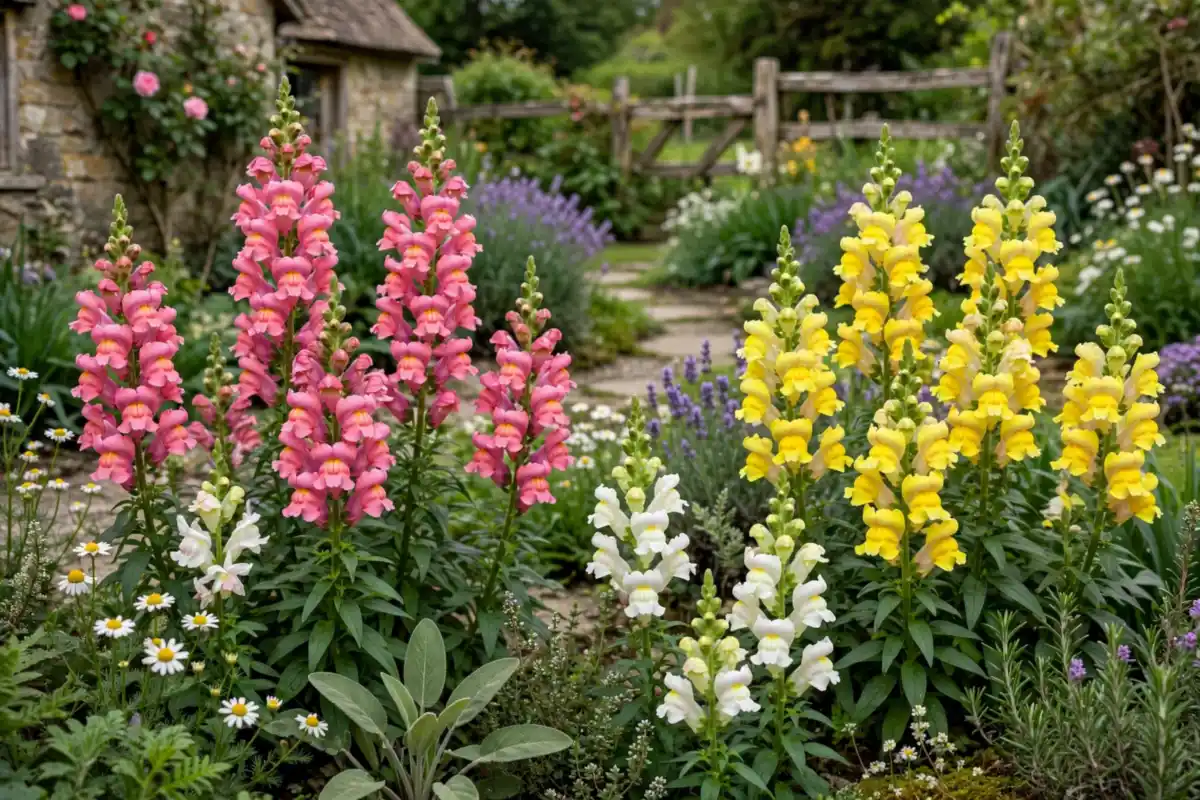
Between the party trick and the skull, snapdragons are also serious garden plants: cool-season spikes in almost every colour except blue, superb in the vase, and among the longest-blooming annuals you can grow. This guide covers what a snapdragon flower is, the types by height and use, what it means (it has a double-edged reputation), and how to grow spikes worth cutting.
Quick Answer
A snapdragon flower is Antirrhinum majus, a Mediterranean plant in the plantain family grown for its spikes of two-lipped, dragon-mouth blooms that open when squeezed. It is a short-lived perennial in USDA zones 7 to 10 and a cool-season annual everywhere else, flowering best in spring and autumn rather than high summer. Heights run from 6-inch dwarfs to 3-foot cutting types. Snapdragons want full sun, rich and sharply drained soil, and a pinch when young to branch; the main enemy is rust disease. The flowers are not considered toxic and are sometimes used as edible garnish, though they are grown for looks, not flavour.
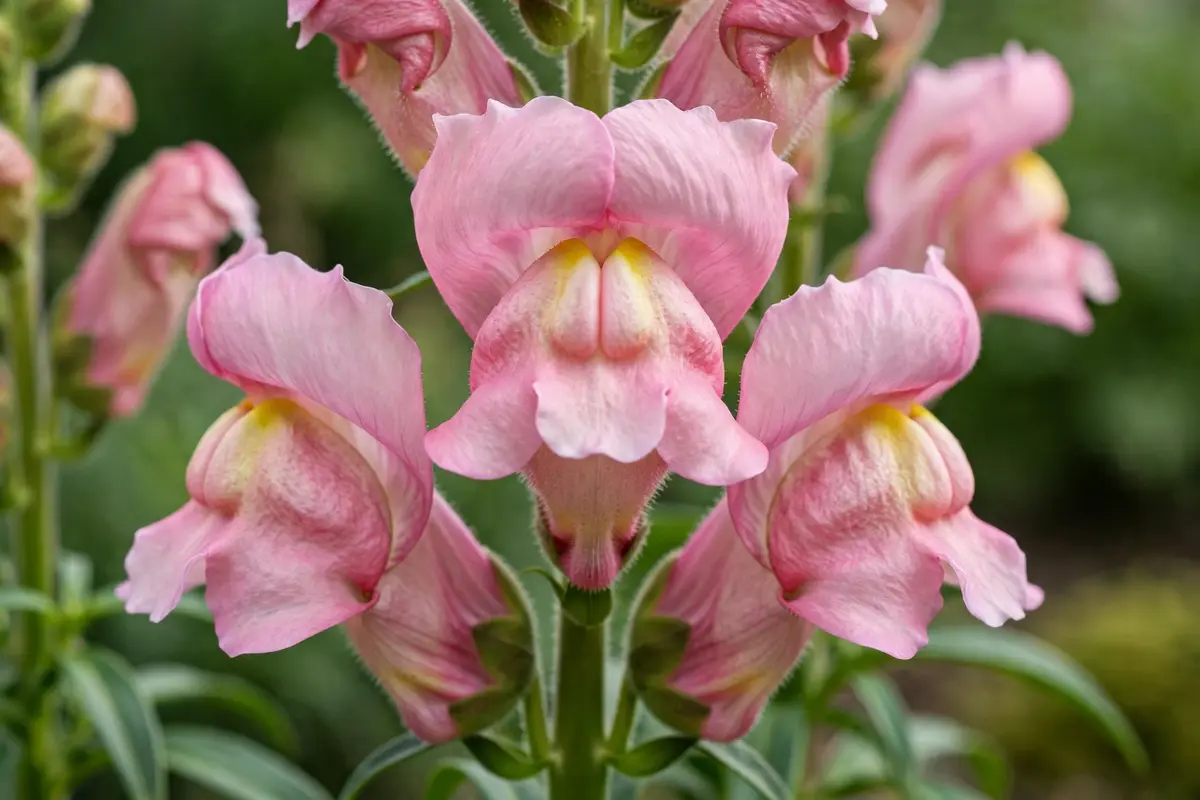
Table of Contents
- What Is a Snapdragon Flower?
- Types of Snapdragon and 6 Groups Worth Growing
- Snapdragon Flower Meaning and Symbolism
- Snapdragon Flower Colours and Their Meanings
- How to Grow Snapdragons
- Common Mistakes When Growing Snapdragons
- Snapdragon Seed Pods and the Skull Story
- Frequently Asked Questions
What Is a Snapdragon Flower?
The garden snapdragon, Antirrhinum majus, belongs to the plantain family, Plantaginaceae (botanists moved it out of the old figwort family), and is native to the rocky Mediterranean — southern France, Spain, Italy and North Africa — where it still colonises old walls and dry banks. The Greek name antirrhinon means “like a nose”, and every European language has its own animal for the flower: dragon’s mouth in English, lion’s mouth (Löwenmaul) in German, wolf’s mouth (gueule de loup) in French. You can read more on the Antirrhinum majus page on Wikipedia.
The flower is a piece of engineering. Its two lips are fused shut, which keeps out all but the strongest bees — a big bumblebee can force the mouth open, climb in, and back out dusted with pollen, which is why snapdragons set seed so much better in bumblebee country. The spike opens from the bottom upward over weeks, and the plant has a geneticist’s fame too: Antirrhinum is a classic model organism in plant science, one of the flowers in which the ABC model of flower development and jumping genes (transposons) were worked out. In the garden, that same flower is simpler: a cool-weather bloomer that sulks in summer heat, rests, and often returns triumphantly in autumn — a two-act performance few annuals match.
Snapdragon Flower Quick Facts
- Botanical name: Antirrhinum majus.
- Family: Plantaginaceae, the plantain family.
- Hardiness: short-lived perennial USDA zones 7 to 10; cool-season annual elsewhere.
- Height: 6 inches (dwarf) to 36 inches (tall cutting types).
- Bloom time: spring and autumn peaks; pauses in hot summers, revives as nights cool.
- Sun and soil: full sun; fertile, sharply drained soil, neutral to slightly alkaline preferred.
- Good to know: deadhead for repeat spikes; watch for rust (orange pustules under leaves) — the plant’s one serious disease.
Types of Snapdragon and 6 Groups Worth Growing
Snapdragons are sold by height first and flower form second — choose the group that fits the job, then the colour. The table covers the six groups gardeners actually meet; the profiles follow. For the full list of flower names, see our flower names A to Z guide.
| Group | Example series | Height | Flower form | Best use |
|---|---|---|---|---|
| Tall (cutting) | ‘Rocket’, ‘Potomac’ | 30–36 in | Classic dragon mouth | Cut flowers, back of border |
| Intermediate | ‘Liberty’, ‘Sonnet’ | 18–24 in | Classic dragon mouth | Borders, mixed plantings |
| Dwarf | ‘Floral Showers’, ‘Snapshot’ | 6–10 in | Classic, compact | Edging, pots, window boxes |
| Trailing | ‘Candy Showers’ | 8–12 in, trailing | Classic, cascading | Hanging baskets, walls |
| Open-faced (“butterfly”) | ‘Madame Butterfly’, ‘Chantilly’ | 24–36 in | Open, azalea-like double | Cutting, cottage gardens |
| Double / azalea-flowered | ‘Twinny’, ‘Madame Butterfly’ | 10–30 in | Ruffled doubles, no mouth | Novelty, cutting, fragrance |
1. Tall Snapdragons — the Cutting Spikes (‘Rocket’, ‘Potomac’)
The florist’s snapdragon: yard-tall spikes bred to be cut, shipped and arranged, with the classic closed dragon mouths in every colour from white through bronze to near-black crimson. In the garden they stand at the back of the border like exclamation marks, need staking in wind, and pay for it with vases of flowers from spring into autumn. Professional growers time them by day length and temperature into “groups” for year-round production — home gardeners can simply sow early and let the seasons sort it out.
2. Intermediate Snapdragons (‘Liberty’, ‘Sonnet’)
The border workhorses at 18 to 24 inches: tall enough to read as spikes, short enough to stand without a stake in most gardens. This is the group for mixed cottage plantings, where they thread colour vertically through mounds of other flowers, and the group most often sold in garden centres in mixed trays. Deadhead the main spike and intermediates branch into a second and third flush with real generosity.
3. Dwarf Snapdragons (‘Floral Showers’, ‘Snapshot’)
The edging and container group, 6 to 10 inches of dense, branching colour. Dwarfs are the snapdragons of window boxes, path edges and children’s gardens — where the mouth trick can be performed at eye level, which is the correct level. They flower fast from seed, shrug off light frost, and in mild climates overwinter as small, tidy mounds that burst again in spring.
4. Trailing Snapdragons (‘Candy Showers’)
A newer branch of the family: genuinely trailing plants bred from seed (a first for snapdragons, which were long propagated from cuttings in trailing forms), made for hanging baskets and the tops of walls. They flower in the cool shoulders of the year when most basket plants are either unstarted or exhausted, making them the secret of good spring and autumn baskets.
5. Open-Faced Snapdragons (‘Madame Butterfly’, ‘Chantilly’)
Not every snapdragon snaps. The butterfly types carry open, frilled, azalea-like flowers — doubled and mouthless — which bees can work freely and florists love for their peony-like texture in arrangements. ‘Madame Butterfly’ is the famous one, tall and ruffled in mixed jewel colours; ‘Chantilly’ adds a light fragrance, another rarity in this genus. Choose them when you want the spike habit without the dragon.
6. The Wild and Wall Snapdragons
Worth knowing even if you never plant one: the Mediterranean species and old cottage forms that seed themselves into walls, steps and gravel in mild climates, in magenta, yellow and white. They are tougher and more perennial than the bred hybrids, smaller-flowered, and beloved by the bumblebees. In an informal or gravel garden, letting a few self-sown snapdragons stay where they land is the lowest-effort spike you will ever own. They are also the living link to the plant’s companion in the summer border, the gladiolus — together the two give a border its verticals from June to October.
Snapdragon Flower Meaning and Symbolism
The snapdragon has the most double-edged reputation in the language of flowers. On one side: strength and grace under pressure — a flower that grows out of rocky walls and dry ground, holding its dragon head high, became a natural emblem of resilience and of graciousness in hard circumstances. On the other side, Victorian floriography also assigned it deception and presumption, supposedly from the flower’s two-faced nature: a charming face that conceals, and a mouth that opens only for the strong. Folklore ran further with it — concealing a snapdragon was said to make a person appear gracious and fascinating, and the flowers had a folk reputation for protection against falsehood and witchcraft.
Modern gifting keeps the good side: snapdragons are given for strength, for grace, and for admiration of someone who flourishes where they are planted, however stony the ground. They are also listed among the July birth flowers, alongside the larkspur — two spires for the height of summer — as our July birth flower guide explains. And the seed-pod skull has added a final modern meaning all its own: in tattoo and gothic-garden symbolism, the snapdragon stands for beauty that leaves something haunting behind.
Snapdragon Flower Colours and Their Meanings
Snapdragons come in nearly the whole palette — everything but true blue — often in bicolours with a contrasting throat:
- Red and crimson snapdragon — passion and strength: the deepest ‘Black Prince’ types are almost maroon, and read as the dragon at full fire.
- Pink snapdragon — grace and admiration: the classic cottage colour, and the prettiest in mixed spring bouquets.
- Yellow snapdragon — joy and friendship: the wild wall colour, sunshine in spike form.
- White snapdragon — purity and truth: the florists’ wedding spike, and the colour whose dried pods make the most ghostly skulls.
- Purple and bronze snapdragon — mystery and creativity: bronze is the connoisseur’s colour, shifting between orange and copper as the light changes.
How to Grow Snapdragons
Snapdragons are cool-season aristocrats: the whole method is timing them into the cool shoulders of the year and out of the furnace. Gardeners on r/gardening on Reddit call them “the plant that teaches you your climate” — in the cool north they flower all summer, in the hot south they are a winter flower, and in between they perform twice.
Sowing: Early, Light, and Patient
The seed is dust-fine and needs light to germinate, so sow on the surface of the compost and do not cover it. Sow indoors eight to ten weeks before the last frost and expect slow, small beginnings — snapdragons take their time as seedlings and then accelerate. In mild-winter climates (zones 8 to 10), an autumn sowing, overwintered as small rosettes, produces the mightiest spring spikes of all. Transplant after hardening off; young snapdragons tolerate frosts that would kill a tomato, so they can go out weeks before tender annuals.
The Pinch That Makes the Plant
When seedlings have six true leaves, pinch out the growing tip. This single act converts one spindly spike into a branched plant carrying four to eight — it is the difference between a flower and a display. Skip the pinch only for tall cutting types where one giant spike is the goal, and even there, many growers pinch half the row for succession.
Sun, Soil and Feeding
Full sun produces the straightest, strongest spikes. The soil should be fertile and, above all, drained: snapdragons rot sulkily in wet winter ground, and a raised bed or grit-amended border keeps them happiest. They prefer neutral to slightly alkaline soil and reward it — a little lime on very acid ground is traditional. Feed moderately during active growth; overfed snapdragons grow leaves and mildew in equal measure.
Deadheading, the Summer Rest and Rust
Cut each spike as it finishes, down to a strong side shoot, and the plant will replace it — in cool weather, almost endlessly. When summer heat arrives, flowering pauses and the plants rest; do not dig them out. Keep them watered, and as nights cool they will rebuild for an autumn show that many gardeners prefer to spring’s. The one disease to scout weekly is rust: orange-brown pustules under the leaves. Remove infected leaves at first sight, water at the base, space for air, and choose resistant series where rust is known — it is the only problem that can end a planting outright.
Common Mistakes When Growing Snapdragons
The most common mistake is sowing too late: snapdragons planted out as the weather warms flower once, weakly, and fry — they must be established while it is still cold. The second is covering the seed, which needs light; a tray of buried snapdragon seed is a tray of nothing. The third is skipping the pinch and getting one lonely spike per plant.
The fourth mistake is giving up in July: the summer pause is the plant resting, not dying, and the autumn flush is the reward for patience. And the fifth is wet winter soil for overwintering plants — more snapdragons are lost to winter rot than to winter cold. Sharp drainage, or a pot moved to a sheltered wall, brings them through.
Snapdragon Seed Pods and the Skull Story
Leave a spike un-deadheaded and you will see the famous ending. Each pollinated flower leaves a small oval pod, and as the pod dries it splits at the top into an uncanny shape: two dark eye sockets and a nasal cavity — a miniature skull, grinning on the stem. Photographs of snapdragon “skulls” circle the internet every autumn, usually captioned as a mystery; the reality, that it is simply the seed capsule of Antirrhinum majus, makes it no less striking. Shake a ripe pod and the dust-fine seeds pour from the “mouth” by the thousand — one spike can seed a wall. Gothic gardeners plant snapdragons for this second act alone, and a stem of dried skulls is the strangest bouquet a cottage garden produces.
Frequently Asked Questions
Are snapdragons annuals or perennials?
They are short-lived perennials (USDA zones 7 to 10) that are usually grown as cool-season annuals in colder climates. In mild areas a plant can live two to three years and even self-seed; in cold areas they are replanted each year, with autumn-sown plants overwintering under protection in zone 7. If your question is not answered here, the questions about the snapdragon flower on Quora cover most of the rest.
When do snapdragons bloom?
In spring and autumn, with a pause in hot weather. In cool-summer climates they can flower from late spring to frost with barely a break; in hot-summer climates they peak in spring, rest through summer, and flower again in autumn; in the warmest zones they are winter and spring flowers. Timing your sowing to put established plants into cool weather is the whole game.
Are snapdragons poisonous?
Snapdragons are not considered toxic to people, cats or dogs, and the flowers are occasionally used as edible garnish by chefs — though they taste of very little and are grown for the eye. As with any ornamental, eat only plants you know were grown without sprays, and treat them as decoration first.
Why do my snapdragons stop flowering in summer?
Heat. Snapdragon flowering is switched off by hot nights; the plant rests, holding its leaves, until cooler weather returns. Keep watering, cut back the spent spikes, and do not dig the plants out — the autumn flush is usually stronger than spring’s. In very hot climates, treat them as the winter-spring annual they want to be.
How do I make snapdragons branch and flower more?
Pinch the seedling’s tip at six true leaves, deadhead every finished spike to a side shoot, and feed moderately. Each pinch and each cut multiplies the stems. Tall cutting types grown for single spikes are the exception — leave those unpinched.
Do snapdragons come back from seed?
Freely, in mild climates and light soils: self-sown snapdragons appear in gravel, wall bases and pot tops, usually in the species’ wall colours (magenta, yellow, white) rather than the parent hybrids’ exact shades. For more flowers under the same letter, see our guide to flowers that start with S.