24 Flowers That Start With Q: Names, Pictures & Growing Tips
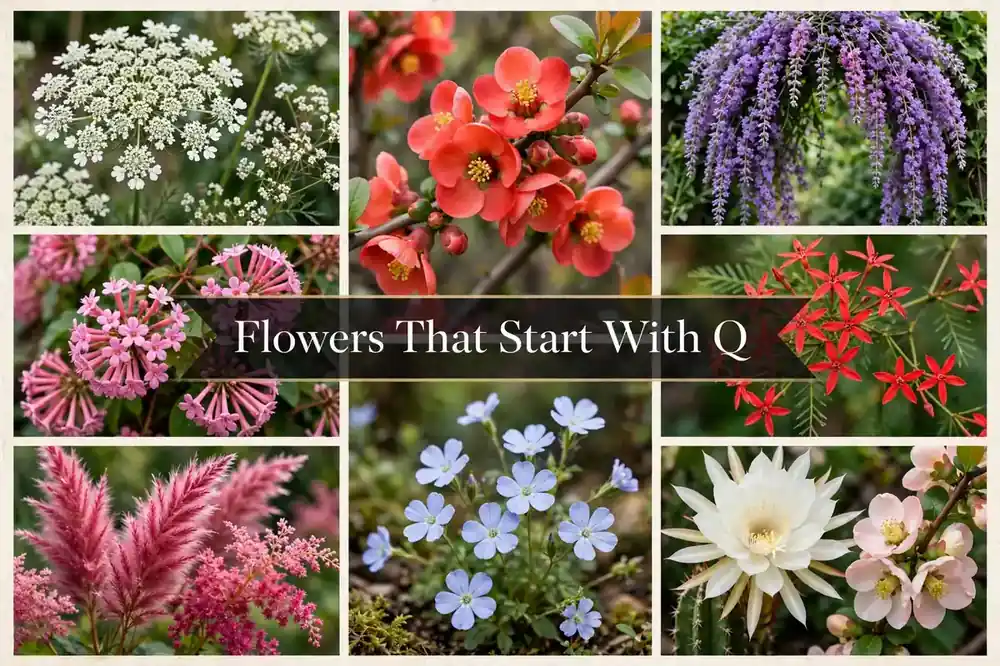
Looking for flowers that start with Q? Q is one of the rarest initials in the plant kingdom, which makes this list a treasure hunt — but the rewards are genuine standouts. Queen Anne’s lace drifts its white parasols over summer meadows, flowering quince sets bare branches ablaze in the first weeks of spring, quaker ladies carpet woodland edges in pale blue, and queen of the prairie sends up cotton-candy pink plumes taller than a person. From tropical vines like queen’s wreath and rangoon creeper to the one-night-only spectacle of queen of the night, this guide covers 55 real flowers that start with Q — every one a verified plant, with honest notes wherever a plant’s fame outruns its flowers.
Every entry below lists the flower’s scientific name, bloom season, sun needs, and USDA hardiness zone, so you can tell at a glance which Q-flowers fit your yard. You will also find a quick comparison table, practical growing tips, and answers to the questions gardeners ask most about flowers starting with Q. Let’s dig in.
Yes — this page lists 55 flowers that start with Q, from Queen Anne’s lace and flowering quince to quaker ladies and queen of the prairie. Use the at-a-glance table to filter by your USDA zone, sun and bloom season before you buy.
Table of Contents
Q-Flowers at a Glance
| # | Name | Scientific name | Bloom | Sun | Zone | Best for |
|---|---|---|---|---|---|---|
| 1 | Queen Anne’s Lace | Daucus carota | Summer | Full sun | 3–9 (biennial) | Meadows, cottage gardens, cut flowers |
| 2 | Flowering Quince | Chaenomeles speciosa | Early spring | Full sun to part shade | 4–8 | Early spring color, barrier hedges, forced branches |
| 3 | Quaker Ladies | Houstonia caerulea | Spring | Part shade | 3–8 | Woodland edges, native groundcover, spring lawns |
| 4 | Queen of the Meadow | Filipendula ulmaria | Summer | Full sun to part shade | 3–8 | Rain gardens, pond margins, fragrant summer plumes |
| 5 | Queen of the Prairie | Filipendula rubra | Early to midsummer | Full sun to part shade | 3–9 | Wet soils, tall pink backdrops, native gardens |
| 6 | Queen’s Wreath | Petrea volubilis | Spring, often repeating | Full sun | 10–11 | Tropical arbors, conservatories, dramatic spring vines |
| 7 | Rangoon Creeper | Combretum indicum | Summer to fall | Full sun | 10–11 | Fragrant tropical vines, pergolas, evening gardens |
| 8 | Cypress Vine | Ipomoea quamoclit | Summer to frost | Full sun | Grown as annual; perennial 9–11 | Hummingbirds, fast summer screens, trellises |
| 9 | Queen of the Night | Epiphyllum oxypetalum | Summer, one night per flower | Bright indirect light | Houseplant (10–11 outdoors) | Night gardens, collectors, unforgettable blooms |
| 10 | Queen’s Tears | Billbergia nutans | Spring | Bright indirect light | Houseplant (9b–11 outdoors) | Easy houseplants, gifts, beginners |
| 11 | Queen Anne’s Lace ‘Dara’ | Daucus carota ‘Dara’ | Summer to fall | Full sun | Grown as annual or biennial | Cut flowers, wedding bouquets, cottage borders |
| 12 | Quamash | Camassia quamash | Spring | Full sun to part shade | 3–8 | Native meadows, naturalizing bulbs, spring blue |
| 13 | Queen Fabiola | Triteleia laxa ‘Queen Fabiola’ | Late spring | Full sun | 6–10 | California natives, rock gardens, drought-tolerant borders |
| 14 | Japanese Flowering Quince | Chaenomeles japonica | Early spring | Full sun to part shade | 4–8 | Low hedges, banks, small gardens |
| 15 | Flowering Quince ‘Cameo’ | Chaenomeles × superba ‘Cameo’ | Mid-spring | Full sun to part shade | 4–8 | Small spaces, foundation plantings, soft pink spring color |
| 16 | Quince | Cydonia oblonga | Spring | Full sun | 5–9 | Edible landscaping, fragrant fruit, jelly making |
| 17 | Queen’s Cup | Clintonia uniflora | Late spring to early summer | Part to full shade | 4–7 | Woodland gardens, deep shade, native plantings |
| 18 | Quesnelia | Quesnelia marmorata | Spring to summer | Bright indirect light | Houseplant (10–11 outdoors) | Statement houseplants, tropical containers |
| 19 | Quassia | Quassia amara | Year-round in the tropics | Full sun to part shade | 10–11 | Tropical collections, botanical curiosities, conservatories |
| 20 | Quiver Tree | Aloidendron dichotomum | Winter | Full sun | 9–11 | Succulent specimens, xeriscaping, architectural plants |
| 21 | Queensland Bottle Tree | Brachychiton rupestris | Spring, irregular | Full sun | 9–11 | Living sculpture, drought-tolerant landscapes, collectors |
| 22 | Queen Palm | Syagrus romanzoffiana | Spring to summer | Full sun | 9b–11 | Tropical canopy, streetscapes, fast shade |
| 23 | Quaking Aspen | Populus tremuloides | Early spring, catkins (inconspicuous) | Full sun | 1–6 | Fall color, groves, cool climates |
| 24 | Queen of Sheba | Thelymitra variegata | Late winter to spring | Full sun | Not in cultivation (wild only) | Admiring from afar, botanical bucket lists |
| 25 | Great Camas | Camassia leichtlinii | Late spring | Full sun to part shade | 4–8 | Native meadows, naturalizing bulbs, tall blue spikes |
| 26 | Cusick’s Camas | Camassia cusickii | Late spring | Full sun to part shade | 5–8 | Native bulbs, rock gardens, pale-blue drifts |
| 27 | Atlantic Camas | Camassia scilloides | Spring | Full sun to part shade | 4–8 | Eastern native meadows, woodland edges |
| 28 | White Brodiaea | Triteleia hyacinthina | Late spring | Full sun | 7–10 | California natives, rock gardens, white drifts |
| 29 | Prettyface | Triteleia ixioides | Late spring to early summer | Full sun | 6–10 | Rock gardens, drought-tolerant borders, cut flowers |
| 30 | Bluebead | Clintonia borealis | Late spring to early summer | Part to full shade | 3–7 | Woodland gardens, shade groundcover, blue berries |
| 31 | Quesnelia arvensis | Quesnelia arvensis | Summer | Bright indirect light to part shade | 10–11; houseplant elsewhere | Tropical containers, statement houseplants |
| 32 | Queen of the Night Cactus | Selenicereus grandiflorus | Summer (opens at night) | Bright indirect light | Houseplant (10–11 outdoors) | Night gardens, collectors, one-night blooms |
| 33 | Arizona Queen of the Night | Peniocereus greggii | Summer (opens at night) | Full sun to part shade | 9–11 | Desert gardens, night blooms, collectors |
| 34 | Sandpaper Vine | Petrea kohautiana | Spring | Full sun | 10–11 | Tropical arbors, conservatories, lavender blooms |
| 35 | White Queen’s Wreath | Petrea volubilis ‘Alba’ | Spring | Full sun | 10–11 | White tropical vines, conservatories, arbors |
| 36 | Japanese Meadowsweet | Filipendula purpurea | Summer | Full sun to part shade | 4–8 | Moist borders, pink plumes, rain gardens |
| 37 | Siberian Meadowsweet | Filipendula palmata | Summer | Full sun to part shade | 3–8 | Moist borders, pink-white plumes, damp gardens |
| 38 | Flowering Quince ‘Texas Scarlet’ | Chaenomeles × superba ‘Texas Scarlet’ | Early spring | Full sun to part shade | 5–8 | Red spring color, low hedges, foundation plantings |
| 39 | Flowering Quince ‘Toyo-Nishiki’ | Chaenomeles × superba ‘Toyo-Nishiki’ | Early spring | Full sun to part shade | 5–8 | Multi-colored blooms, specimen shrubs, collectors |
| 40 | Orange Flame Vine | Combretum fruticosum | Summer to fall | Full sun | 10–11 | Tropical pergolas, hummingbirds, orange blooms |
| 41 | Pyramid Bromeliad | Billbergia pyramidalis | Spring to summer | Bright indirect light | Houseplant (10–11 outdoors) | Easy houseplants, tropical containers |
| 42 | Blue Lady Orchid | Thelymitra crinita | Spring | Full sun | Not in cultivation (wild only) | Admiring from afar, botanical bucket lists |
| 43 | Rabbit Ears | Thelymitra antennifera | Spring | Full sun | Not in cultivation (wild only) | Admiring from afar, Australian wildflowers |
| 44 | Common Quaking Grass | Briza media | Summer | Full sun | 4–8 | Meadow gardens, dried arrangements, cottage borders |
| 45 | Greater Quaking Grass | Briza maxima | Summer | Full sun | 7–10 | Annual meadows, dried flowers, containers |
| 46 | Queen’s Slipper | Cypripedium reginae | Early summer | Part shade | 3–7 | Woodland gardens, native plantings (nursery-propagated only) |
| 47 | Quinchamali | Quinchamalium chilense | Summer | Full sun | 8–10 | Rock gardens, collectors, South American natives |
| 48 | Quito Orange | Solanum quitoense | Summer (flowers); fruit in fall | Part shade | 10–11; houseplant elsewhere | Tropical foliage, edible fruit, conservatories |
| 49 | Queen’s Crape Myrtle | Lagerstroemia speciosa | Summer | Full sun | 10–11 | Tropical trees, summer color, streetscapes |
| 50 | Tulip ‘Queen of Night’ | Tulipa ‘Queen of Night’ | Mid-spring | Full sun | 3–8 | Near-black tulips, dramatic spring borders, cut flowers |
| 51 | Daffodil ‘Quail’ | Narcissus ‘Quail’ | Mid-spring | Full sun to part shade | 4–8 | Fragrant daffodils, naturalizing, cut flowers |
| 52 | Queensland Firewheel Tree | Stenocarpus sinuatus | Spring to summer | Full sun | 10–11 | Spectacular red blooms, tropical trees, collectors |
| 53 | Queensland Umbrella Tree | Schefflera actinophylla | Rarely indoors (grown for foliage) | Bright indirect light | Houseplant (10–11 outdoors) | Houseplants, tropical foliage, large containers |
| 54 | Queen’s Wreath Vine | Antigonon leptopus | Summer to fall | Full sun | 9–11 | Fast tropical vines, pollinators, pink blooms |
| 55 | Queensland Lace | Aponogeton madagascariensis | Rarely indoors (grown for foliage) | Bright indirect light | Aquarium/houseplant | Aquariums, collectors, lace-like leaves |
24 Flowers That Start With Q: The Complete List
Here they are — 24 beautiful, real flowers beginning with Q, each with growing notes so you can pick the right ones for your garden.
1. Queen Anne’s Lace (Daucus carota)
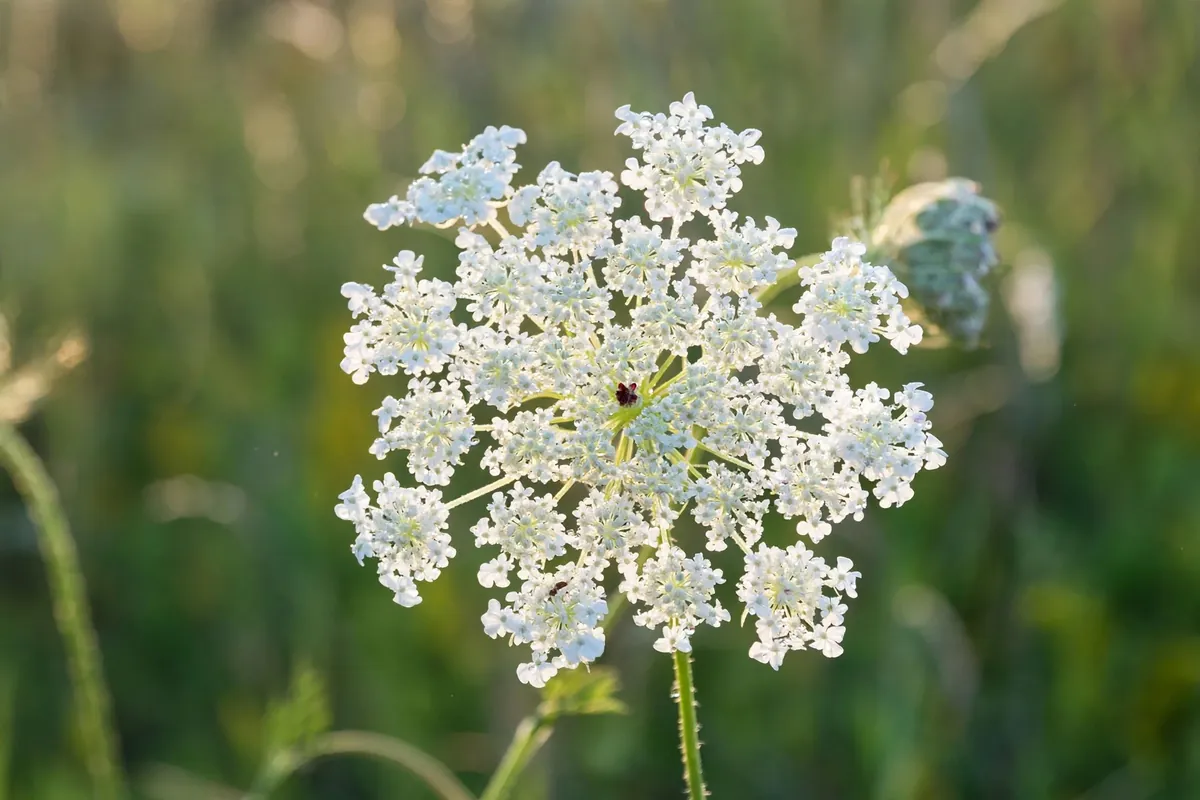
Queen Anne’s lace is the wildflower that lines country roads with lacy white parasols all summer — flat-topped umbels three to five inches across, made of hundreds of tiny white flowers, often with a single dark reddish-purple floret sitting in the center like a drop of blood (legend says Queen Anne pricked her finger while making the lace). It is a true biennial: a ferny rosette the first year, flowers the second, then it dies after setting seed. The taproot smells distinctly of carrot — this is wild carrot, after all. Two cautions matter. First, it closely resembles deadly poison hemlock: remember that Queen Anne’s lace has hairy green stems (“the queen has hairy legs”) while hemlock has smooth, purple-spotted stems. Second, one plant can make thousands of seeds, so deadhead if you do not want a meadow full of it, and check whether it is listed as invasive in your area.
Bloom: Summer | Sun: Full sun | Zone: 3–9 (biennial) | Best for: Meadows, cottage gardens, cut flowers
2. Flowering Quince (Chaenomeles speciosa)
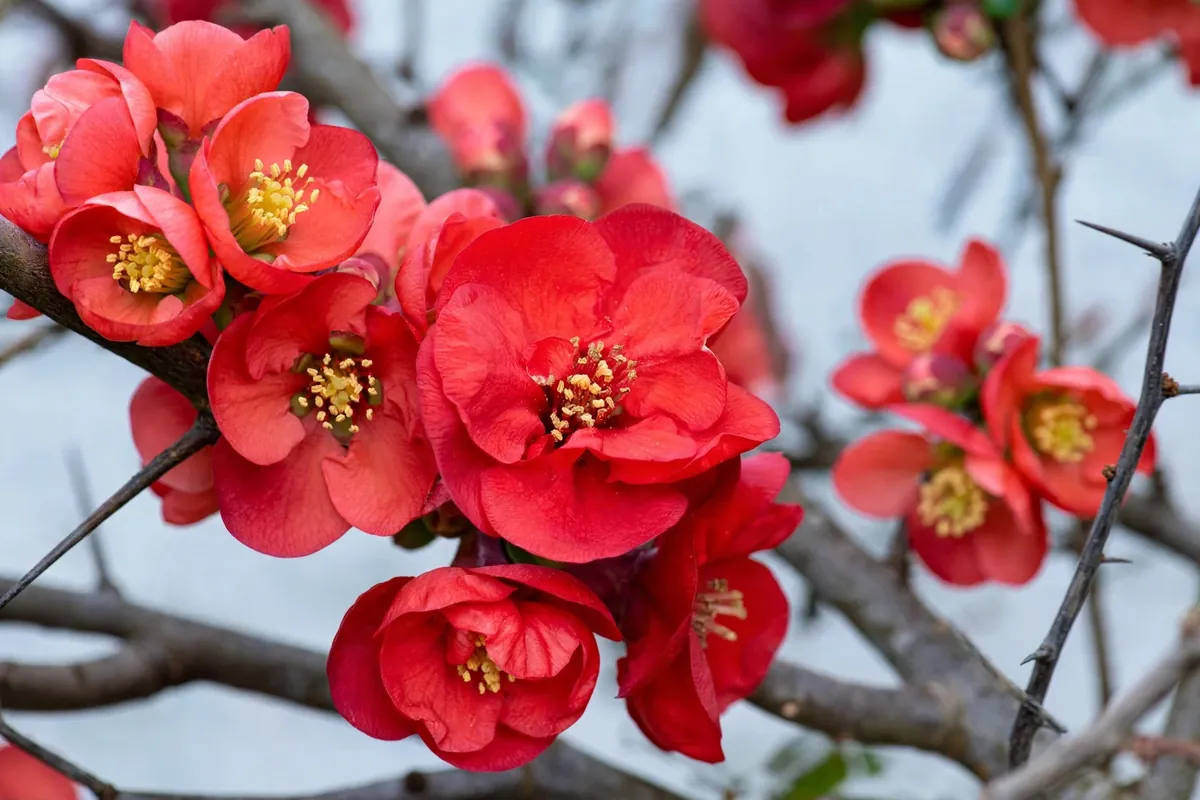
Flowering quince is one of the first shrubs to shout that spring has arrived — cupped, two-inch flowers in coral-red, scarlet, pink, orange, or white opening on bare, thorny branches in late winter to early spring, weeks before the leaves. The classic species forms a tangled, spreading shrub six to ten feet tall that doubles as an informal barrier hedge. It blooms on old wood, so prune right after flowering to encourage next year’s buds; shearing it in fall simply removes the spring show. The flowers give way to fragrant, hard yellow-green fruits that make superb jelly. Give it full sun for the heaviest bloom, average well-drained soil, and almost no fuss thereafter — established plants are remarkably drought-tolerant.
Bloom: Early spring | Sun: Full sun to part shade | Zone: 4–8 | Best for: Early spring color, barrier hedges, forced branches
3. Quaker Ladies (Houstonia caerulea)
Quaker ladies, also called bluets, are among the sweetest small wildflowers in North America — dainty four-petaled blossoms of palest blue with a sunny yellow eye, nodding on stems just three to six inches tall. In spring they can carpet woodland edges, moist lawns, and stream banks in a blue haze. This eastern native perennial forms low tufted mats and asks for little: part shade, consistently moist but not soggy soil, and to be left alone. Do not mow them while they are blooming, and resist the urge to “tidy” their patch — they naturalize best when the foliage is allowed to ripen. A perfect plant for the front of a shade border or a mossy corner where bigger flowers would look clumsy.
Bloom: Spring | Sun: Part shade | Zone: 3–8 | Best for: Woodland edges, native groundcover, spring lawns
4. Queen of the Meadow (Filipendula ulmaria)
Queen of the meadow — better known as meadowsweet — sends up frothy plumes of tiny creamy-white, almond-scented flowers above handsome pinnate foliage in summer, reaching three to six feet in rich, damp soil. This European native of wet meadows and stream banks has a famous past: its flowers were an original source of salicylic compounds, the chemical ancestors of aspirin. In the garden it wants what it had in the wild — consistently moist soil and full sun to part shade. It sulks in dry ground, so site it near downspouts, rain gardens, or pond margins. Deadhead the plumes for a possible second flush, and divide congested clumps every few years in spring or fall.
Bloom: Summer | Sun: Full sun to part shade | Zone: 3–8 | Best for: Rain gardens, pond margins, fragrant summer plumes
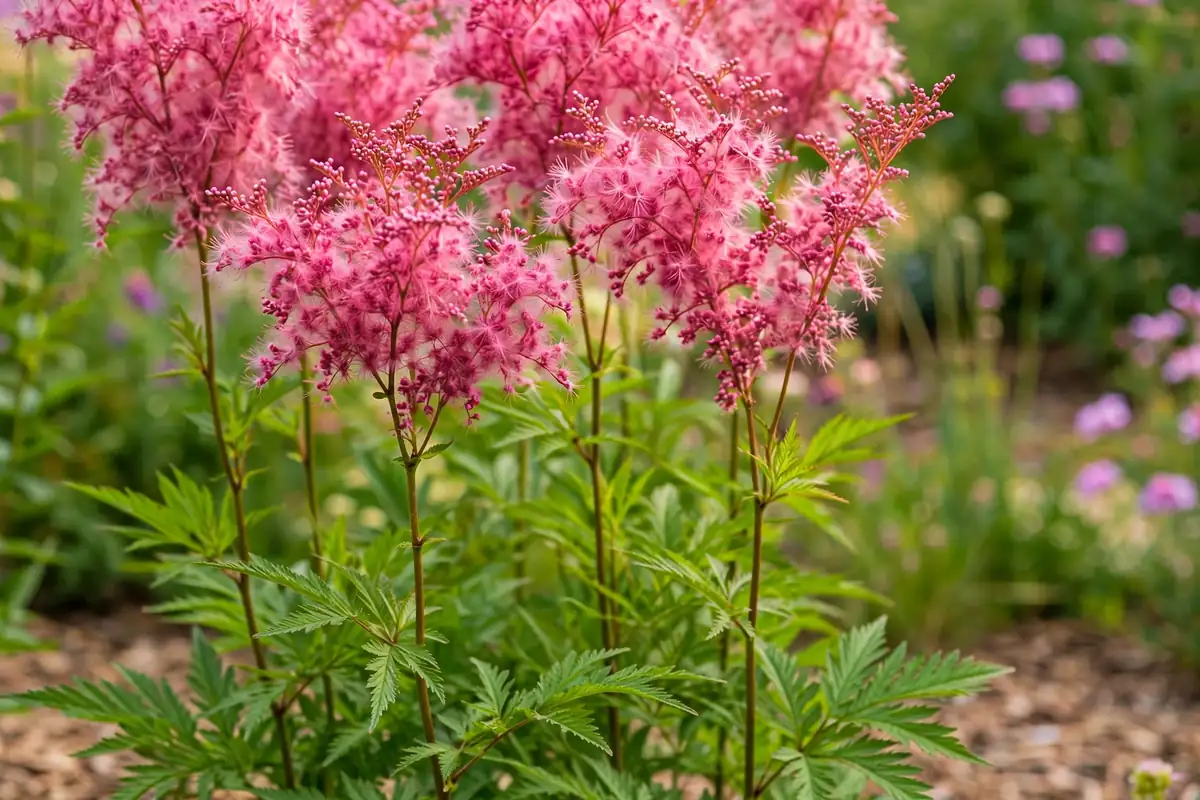
5. Queen of the Prairie (Filipendula rubra)
Queen of the prairie is the North American answer to meadowsweet, and it is pure drama — six- to eight-foot stems topped with fluffy, cotton-candy pink plumes in early to midsummer that look good enough to eat. Native to wet prairies and fens of the central and eastern US, it demands moisture: give it damp, even boggy soil and it will reward you with one of the tallest pink displays in the perennial border. The popular cultivar ‘Venusta’ offers an even deeper pink. Full sun to part shade suits it, and it is hardy from zones 3 to 9. Pair it with Joe Pye weed, ironweed, and ornamental grasses for a tall, late-spring-to-summer native composition.
Bloom: Early to midsummer | Sun: Full sun to part shade | Zone: 3–9 | Best for: Wet soils, tall pink backdrops, native gardens
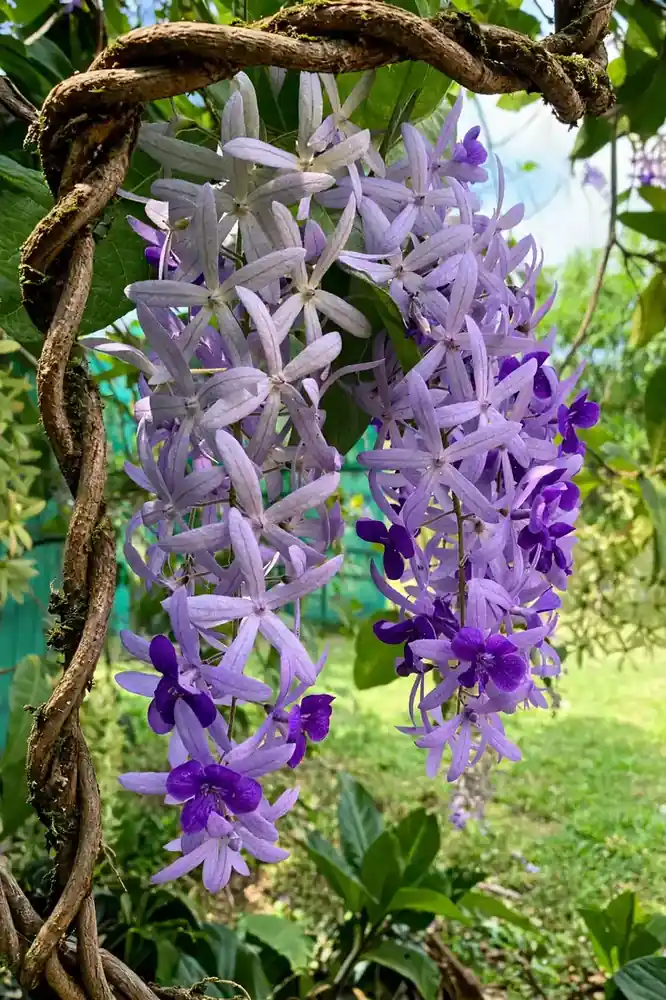
6. Queen’s Wreath (Petrea volubilis)
Queen’s wreath is a tropical showstopper — a vigorous woody vine that drapes itself in long, cascading racemes of starry lavender-purple flowers each spring, often repeating through the year in warm climates. Each blossom is really a two-part display: a lavender calyx that persists after the deeper purple corolla falls, so the show lasts for weeks. It is also called sandpaper vine for its rough-textured leaves. Give it full sun, a very sturdy support (mature vines get heavy), and room to roam — it can reach thirty feet. Hardy only in zones 10–11, so northern gardeners must grow it in a conservatory or large greenhouse. Prune after the main bloom to keep it in bounds.
Bloom: Spring, often repeating | Sun: Full sun | Zone: 10–11 | Best for: Tropical arbors, conservatories, dramatic spring vines
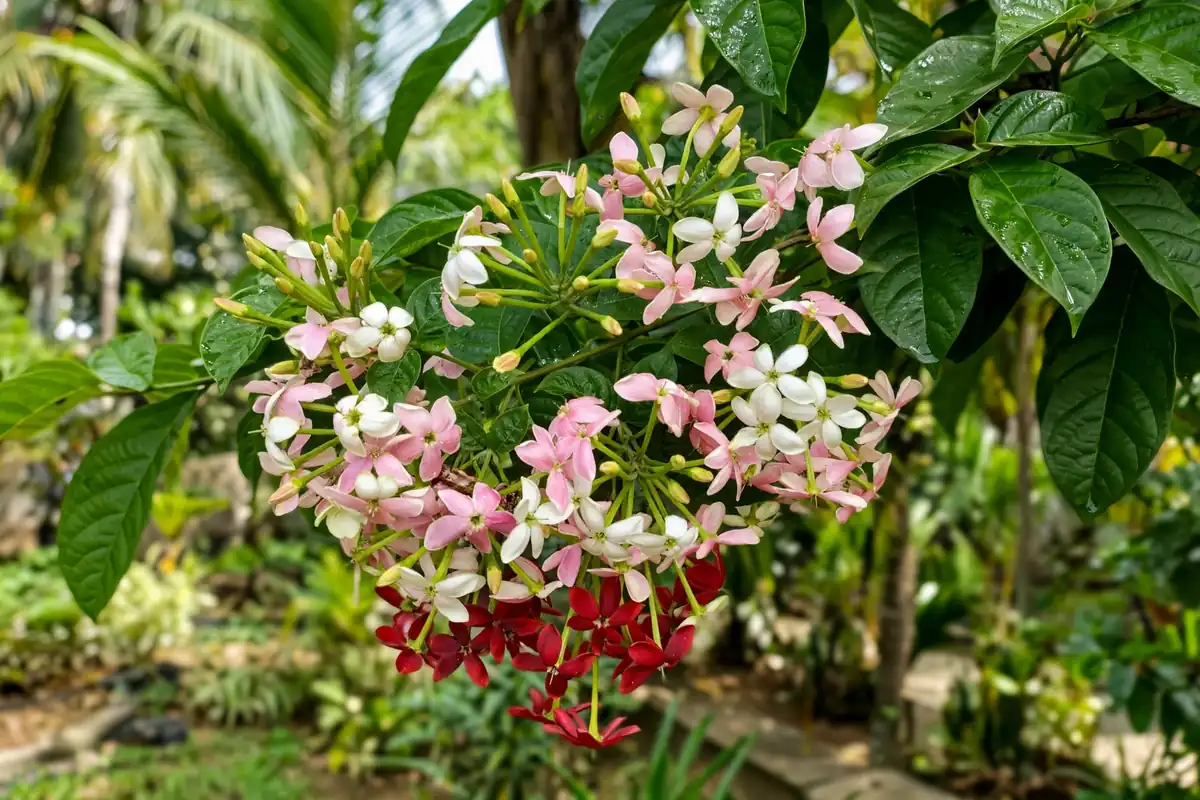
7. Rangoon Creeper (Combretum indicum, syn. Quisqualis indica)
Rangoon creeper pulls a color-changing trick no other vine on this list can match: its fragrant, tubular, star-shaped flowers open white in the evening, blush pink the next day, and deepen to rich red by the third — so a single hanging cluster displays all three colors at once. This vigorous tropical woody vine from Asia blooms from summer into fall and can climb twenty feet or more over pergolas and fences. The evening fragrance is sweet and strong, a bonus for patios. It needs full sun, warmth (zones 10–11), and a firm hand on the pruners — it suckers and sprawls enthusiastically. In colder climates, grow it in a large pot and overwinter it frost-free.
Bloom: Summer to fall | Sun: Full sun | Zone: 10–11 | Best for: Fragrant tropical vines, pergolas, evening gardens
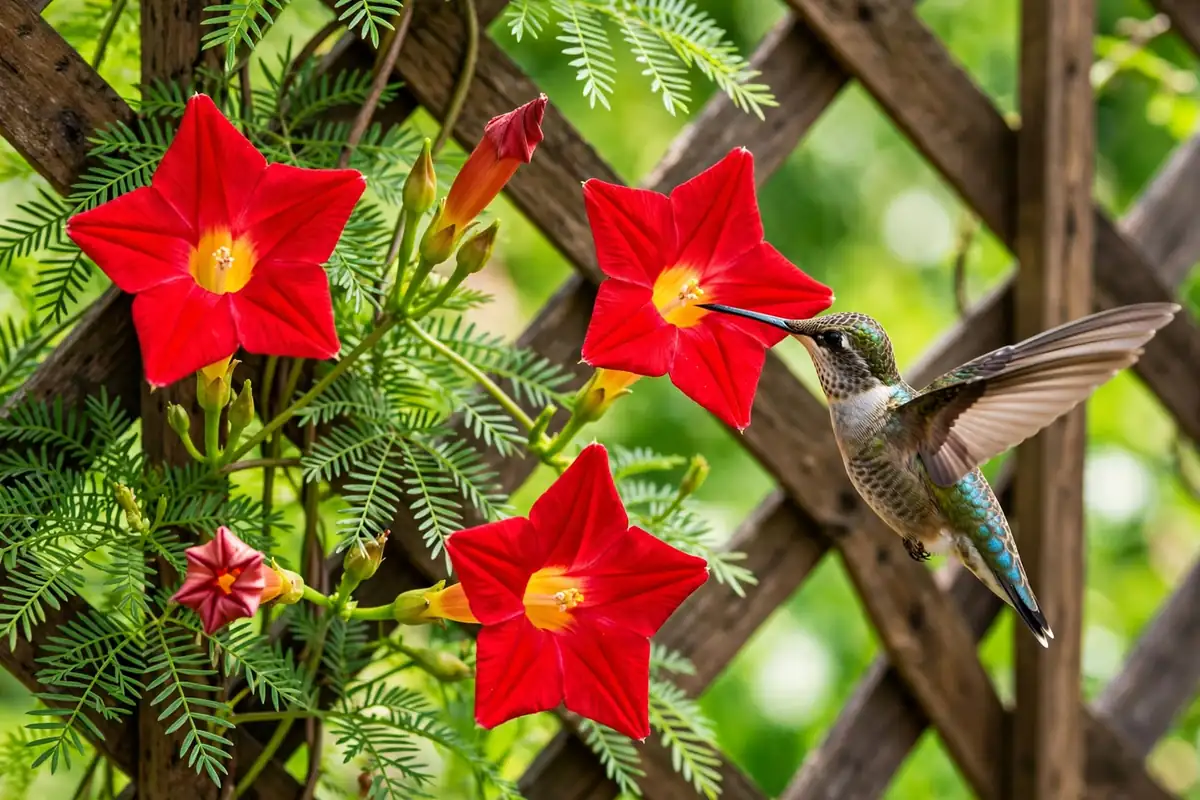
8. Cypress Vine (Ipomoea quamoclit)
Cypress vine is the hummingbird gardener’s secret weapon — an annual vine with the finest, most feathery foliage of any morning glory relative, studded all summer with brilliant scarlet-red, star-shaped tubular flowers with golden throats. Hummingbirds find it irresistible, and it climbs ten to twenty feet in a single season from seed sown after the soil warms. Give it full sun and a trellis, fence, or mailbox post to climb. One honest warning: it self-sows with abandon and is considered weedy or invasive in the Southeast, so deadhead spent flowers if you do not want volunteers everywhere next year. In zones 9–11 it may return as a short-lived perennial.
Bloom: Summer to frost | Sun: Full sun | Zone: Grown as annual; perennial 9–11 | Best for: Hummingbirds, fast summer screens, trellises
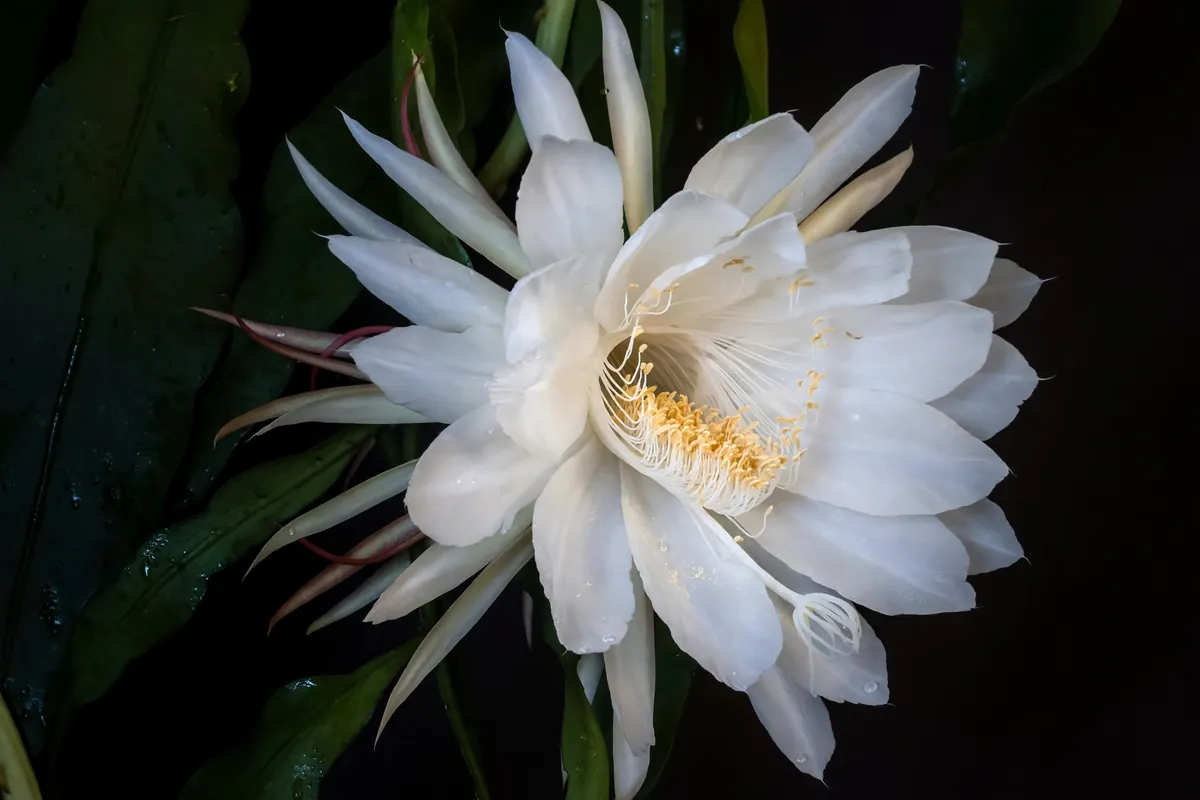
9. Queen of the Night (Epiphyllum oxypetalum)
Queen of the night, the famous night-blooming cereus, produces one of the most spectacular flowers in the plant kingdom — a luminous white bloom up to ten inches across, intensely fragrant, that opens after dark and collapses by dawn. One flower, one night, once or twice a summer: growers throw “bloom parties” to stay up and watch. This epiphytic cactus from Central and South America grows as a houseplant in most climates: bright indirect light, a coarse fast-draining mix, water when nearly dry, and a cool dry winter rest to set buds. Do not overpot it — slightly root-bound plants bloom best. Outdoors year-round only in zones 10–11.
Bloom: Summer, one night per flower | Sun: Bright indirect light | Zone: Houseplant (10–11 outdoors) | Best for: Night gardens, collectors, unforgettable blooms
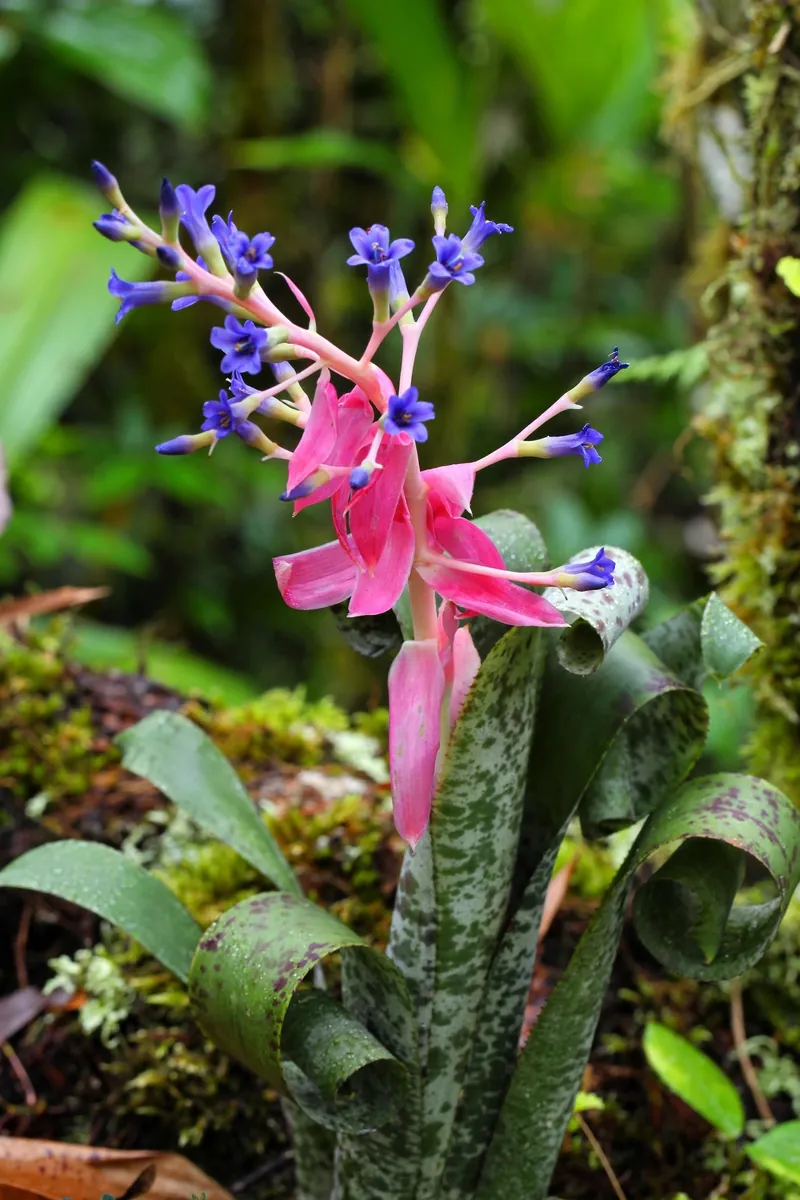
10. Queen’s Tears (Billbergia nutans)
Queen’s tears, nicknamed the friendship plant because it pups so freely you will always have one to give away, is one of the easiest bromeliads to grow. In spring, arching stems dangle clusters of rosy-pink bracts tipped with petals of blue-edged green surrounding a burst of yellow stamens — an exotic color combination on a plant that tolerates real neglect. It thrives in bright indirect light with water kept in its central cup, and it is far more cold-tolerant than most bromeliads, surviving outdoors in zones 9b–11. Let the pups reach a third the size of the mother plant before dividing, and you will never buy another one.
Bloom: Spring | Sun: Bright indirect light | Zone: Houseplant (9b–11 outdoors) | Best for: Easy houseplants, gifts, beginners
11. Queen Anne’s Lace ‘Dara’ (Daucus carota ‘Dara’)
‘Dara’ takes the wildflower charm of Queen Anne’s lace and runs it through a florist’s color palette — the lacy umbels open soft blush pink and age through rose to deep burgundy-chocolate, giving each stem a gradient no dye could match. Bred for cutting, it has become a staple of wedding bouquets and farmers’ market bunches. Grow it like an annual for the longest season: sow successionally from spring to midsummer in full sun, or let it behave as a biennial from a fall sowing. It reaches three to four feet and appreciates support in windy spots. Deadhead ruthlessly unless you want it seeding through the whole garden like its wild parent.
Bloom: Summer to fall | Sun: Full sun | Zone: Grown as annual or biennial | Best for: Cut flowers, wedding bouquets, cottage borders
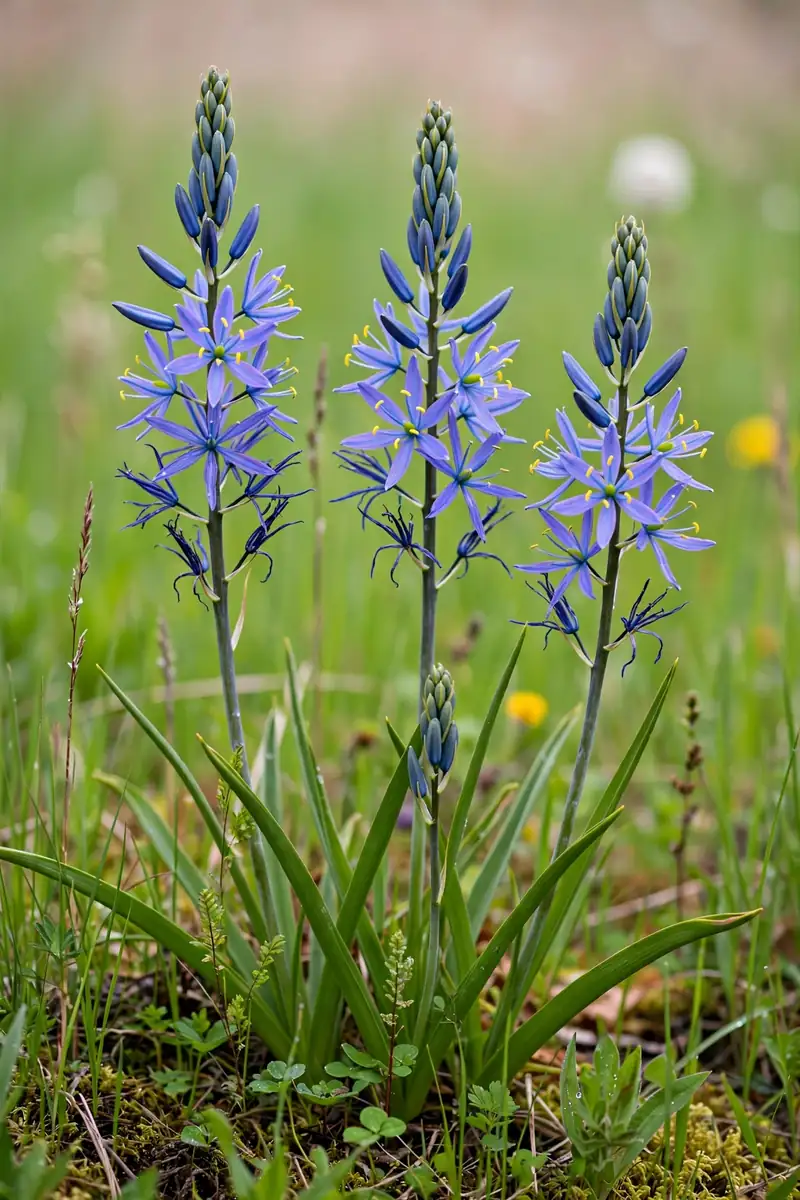
12. Quamash (Camassia quamash)
Quamash, or common camas, is the blue soul of the Pacific Northwest spring — spikes of starry blue-violet flowers rising one to two feet above grass-like foliage in moist meadows. This native bulb was a staple food of Indigenous peoples, who pit-roasted its bulbs. In the garden, plant bulbs four inches deep in fall, in full sun to part shade with soil that stays moist through spring and dries in summer — exactly what a meadow does naturally. It naturalizes beautifully and needs no care once established. One critical caution: quamash foliage resembles the deadly toxic death camas, so buy bulbs only from reputable native-plant nurseries and never dig wild bulbs.
Bloom: Spring | Sun: Full sun to part shade | Zone: 3–8 | Best for: Native meadows, naturalizing bulbs, spring blue
13. Queen Fabiola (Triteleia laxa ‘Queen Fabiola’)
‘Queen Fabiola’ is the best-known cultivar of the triplet lily, a California native bulb that sends up umbels of starry, violet-blue funnel flowers in late spring above slender grass-like foliage. Each stem carries a loose cluster of up to twenty blooms, and the effect in a drift is a haze of blue just as the spring garden peaks. Like most California bulbs, it wants full sun, sharp drainage, and a dry summer dormancy — plant corms three to four inches deep in fall and then leave them alone. Hardy in zones 6–10, it is superb in rock gardens, gravel beds, and the front of drought-tolerant borders, and the flowers last well when cut.
Bloom: Late spring | Sun: Full sun | Zone: 6–10 | Best for: California natives, rock gardens, drought-tolerant borders
14. Japanese Flowering Quince (Chaenomeles japonica)
Japanese flowering quince is the low, spreading cousin of the common flowering quince — a dense mound two to three feet tall and up to six feet wide, smothered in orange-red to scarlet cupped flowers in early spring. It brings the same bare-branch spring fireworks as its taller relative in a package suited to smaller gardens: low hedges, bank covers, and foundation plantings. The care is identical — full sun for best bloom, prune after flowering since it blooms on old wood, and enjoy the small fragrant fruits for jelly. Hardy in zones 4–8, thorny enough to deter foot traffic, and nearly indestructible once established.
Bloom: Early spring | Sun: Full sun to part shade | Zone: 4–8 | Best for: Low hedges, banks, small gardens
15. Flowering Quince ‘Cameo’ (Chaenomeles × superba ‘Cameo’)
‘Cameo’ is the refined member of the flowering quince family — a compact hybrid shrub just three to four feet tall, carrying double peach-pink flowers in mid-spring, slightly later than the species quinces. The Missouri Botanical Garden’s Plant Finder notes it specifically for those soft double blooms and its tidy, broad-rounded habit. It fits where the big species would overwhelm: mixed shrub borders, foundation plantings, and even large containers. Like all flowering quinces, it blooms on old wood (prune after flowering), tolerates drought and clay once established, and produces small edible fruits for preserves. Hardy in zones 4–8.
Bloom: Mid-spring | Sun: Full sun to part shade | Zone: 4–8 | Best for: Small spaces, foundation plantings, soft pink spring color
16. Quince (Cydonia oblonga)
True quince — the fruiting tree, not the ornamental shrub — earns its place here with lovely pale pink blossoms shaped like single apple flowers, opening in spring after most fruit trees have finished. The flowers are lightly fragrant and self-fertile, so a single tree will set its crop of big, golden, intensely aromatic fruits that ripen in fall. Quinces are too astringent to eat raw but make the finest jelly and membrillo you will ever taste. The tree stays a manageable ten to fifteen feet, tolerates a wide range of soils, and is hardy in zones 5–9. Plant it in full sun, prune lightly in winter, and let one ripe fruit scent a whole room.
Bloom: Spring | Sun: Full sun | Zone: 5–9 | Best for: Edible landscaping, fragrant fruit, jelly making
17. Queen’s Cup (Clintonia uniflora)
Queen’s cup, also called bride’s bonnet, is a jewel of Pacific Northwest woodlands — a single pristine white lily-like bloom, up to two inches across, nodding above a pair of glossy basal leaves on a six-inch stem in late spring. By late summer the flower is replaced by a single porcelain-blue berry, equally beautiful. This rhizomatous perennial demands deep shade, cool moist humus-rich acidic soil, and to be left completely undisturbed — it resents transplanting and division. Hardy in zones 4–7, it is a plant for established woodland gardens and shaded native plantings, where it rewards patience with one of the most elegant small flowers in North America.
Bloom: Late spring to early summer | Sun: Part to full shade | Zone: 4–7 | Best for: Woodland gardens, deep shade, native plantings
18. Quesnelia (Quesnelia marmorata)
Quesnelia is a Brazilian bromeliad that looks sculptural even out of bloom — a rosette of stiff, arching leaves marbled and banded in silver-green. In spring or summer it sends up a tall, stout spike of waxy red-pink bracts studded with violet-blue tubular flowers, a display that lasts for weeks. It is tougher and more cold-tolerant than many showy bromeliads, thriving in bright indirect light as a houseplant or outdoors year-round in zones 10–11. Water the central cup and let the potting mix dry slightly between waterings. Mature plants pup at the base, so one purchase becomes a colony — share the extras.
Bloom: Spring to summer | Sun: Bright indirect light | Zone: Houseplant (10–11 outdoors) | Best for: Statement houseplants, tropical containers
19. Quassia (Quassia amara)
Quassia, or Surinam quassia, is a tropical shrub to small tree grown as much for curiosity as for beauty — its claim to fame is intensely bitter bark containing quassin, once used as a traditional tonic and natural insecticide. But the flowers deserve their own applause: long, hanging panicles of slender, bright red tubular blooms that dangle like ornaments. In the tropics it can bloom nearly year-round. It needs warmth (zones 10–11), full sun to part shade, and rich, moist, well-drained soil. Northern gardeners can grow it in a heated greenhouse or large conservatory, where its unusual flowers always draw questions.
Bloom: Year-round in the tropics | Sun: Full sun to part shade | Zone: 10–11 | Best for: Tropical collections, botanical curiosities, conservatories
20. Quiver Tree (Aloidendron dichotomum, syn. Aloe dichotoma)
The quiver tree is one of Africa’s most sculptural plants — a giant branching succulent tree up to thirty feet tall, with smooth bark, rosettes of blue-green leaves, and a forked silhouette named for the quivers San bushmen fashioned from its branches. In winter, mature trees produce upright spikes of bright yellow tubular flowers that glow against the desert sky and feed sunbirds. It is achingly slow-growing and demands perfect drainage, blazing sun, and restraint with the watering can; wet winter soil kills it. Hardy in zones 9–11, it is a lifetime specimen for succulent collectors and frost-free xeriscape gardens.
Bloom: Winter | Sun: Full sun | Zone: 9–11 | Best for: Succulent specimens, xeriscaping, architectural plants
21. Queensland Bottle Tree (Brachychiton rupestris)
The Queensland bottle tree is grown for its extraordinary trunk — a massively swollen, bottle-shaped water reservoir that lets this Australian native survive brutal droughts. Honest note: the flowers are a bonus, not the reason to plant it. Mature trees produce clusters of small bell-shaped cream flowers with pink-red markings, usually appearing when the tree is leafless, and young trees may not bloom for many years. Give it full sun, extremely sharp drainage, and zones 9–11; it is remarkably drought-tolerant once established. Plant it as a living sculpture and consider any flowering year a special event.
Bloom: Spring, irregular | Sun: Full sun | Zone: 9–11 | Best for: Living sculpture, drought-tolerant landscapes, collectors
22. Queen Palm (Syagrus romanzoffiana)
Queen palm is the fast-growing feather palm that defines tropical streetscapes — graceful arching fronds on a smooth gray trunk, reaching fifty feet in warm climates. Honest note: its flowers are modest. In spring and summer it produces large branched inflorescences of small creamy-white blooms tucked among the fronds, followed by clusters of orange date-like fruits that birds love. You plant a queen palm for the canopy, not the blossoms. It wants full sun, regular water while establishing, and zones 9b–11; feed it palm fertilizer to prevent the potassium deficiency that yellows older fronds.
Bloom: Spring to summer | Sun: Full sun | Zone: 9b–11 | Best for: Tropical canopy, streetscapes, fast shade
23. Quaking Aspen (Populus tremuloides)
Quaking aspen technically flowers — male trees produce small reddish catkins in early spring before the leaves emerge — but let’s be honest: nobody plants an aspen for its blooms. You plant it for the white bark, the leaves that tremble and shimmer in the slightest breeze, and the legendary golden fall color that sets whole mountainsides ablaze. It is one of the most widely distributed trees in North America and famously grows in clonal colonies, some among the oldest living organisms on earth. Hardy in zones 1–6, it wants full sun and cool summers; give it room, because it suckers freely into groves.
Bloom: Early spring, catkins (inconspicuous) | Sun: Full sun | Zone: 1–6 | Best for: Fall color, groves, cool climates
24. Queen of Sheba (Thelymitra variegata)
The Queen of Sheba is the rarest bloom on this list — a Western Australian terrestrial orchid with glossy, variegated flowers in purple, violet, pink, and yellow, each one uniquely patterned, opening only in warm sunlight. Honest note: this one is for admiring, not growing. It is critically endangered, protected in the wild, blooms irregularly (sometimes years apart), and exists only in a few pockets of southwestern Australia. No nursery sells it and it cannot be cultivated. It earns its place here as proof that the letter Q hides at least one true floral treasure — best appreciated in photographs and in the wildflower reserves that protect it.
Bloom: Late winter to spring | Sun: Full sun | Zone: Not in cultivation (wild only) | Best for: Admiring from afar, botanical bucket lists
25. Great Camas (Camassia leichtlinii)
Bloom: Late spring | Sun: Full sun to part shade | Zone: 4–8 | Best for: Native meadows, naturalizing bulbs, tall blue spikes
– Note: Grow in the sun and zone shown in the table; check the plant label for the exact cultivar, as ranges vary by type. New entry — bloom, sun and zone NOT independently verified. Shares the Camassia genus with the live Quamash (entry 12) — same genus, different species.
Great camas is the tallest of the camas clan — sturdy two- to four-foot spikes crowded with starry blue-violet flowers in late spring, each petal twisted just enough to catch the light. Like quamash it is a western North American native bulb that wants moisture in spring and a dry summer rest, and it naturalizes into bigger drifts every year. Plant bulbs four inches deep in fall and never dig wild bulbs — buy from reputable native nurseries only.
26. Cusick’s Camas (Camassia cusickii)
Bloom: Late spring | Sun: Full sun to part shade | Zone: 5–8 | Best for: Native bulbs, rock gardens, pale-blue drifts
– Note: Grow in the sun and zone shown in the table; check the plant label for the exact cultivar, as ranges vary by type. New entry — bloom, sun and zone NOT independently verified. Shares the Camassia genus with the live Quamash (entry 12) — same genus, different species.
Cusick’s camas brings the palest blue to the camas family — icy, star-shaped blooms on two-foot stems in late spring, opening over several weeks. This Pacific Northwest native is a touch less hardy than its cousins but just as easy, asking only for spring moisture and summer dryness. It shines in rock gardens and gravel beds where its cool color contrasts with warm-toned stones, and it pairs beautifully with the deeper blue of quamash.
27. Atlantic Camas (Camassia scilloides)
Bloom: Spring | Sun: Full sun to part shade | Zone: 4–8 | Best for: Eastern native meadows, woodland edges
– Note: Grow in the sun and zone shown in the table; check the plant label for the exact cultivar, as ranges vary by type. New entry — bloom, sun and zone NOT independently verified. Shares the Camassia genus with the live Quamash (entry 12) — same genus, different species.
Atlantic camas is the eastern answer to the western camas bulbs — delicate pale-blue to white starry flowers on slender stems in mid-spring, native from Texas to Pennsylvania. It naturalizes in moist meadows and open woodland edges, where its grass-like foliage disappears neatly after bloom. Give it the classic camas treatment: moist spring soil, dry summer rest, and bulbs planted in fall.
28. White Brodiaea (Triteleia hyacinthina)
Bloom: Late spring | Sun: Full sun | Zone: 7–10 | Best for: California natives, rock gardens, white drifts
– Note: Grow in the sun and zone shown in the table; check the plant label for the exact cultivar, as ranges vary by type. New entry — bloom, sun and zone NOT independently verified. Shares the Triteleia genus with the live Queen Fabiola (entry 13) — same genus, different species.
White brodiaea is the moonlit cousin of queen fabiola — loose umbels of pure-white, funnel-shaped flowers on wiry stems in late spring, glowing against the fading green of a California spring garden. Like all triplet lilies it demands sharp drainage and a completely dry summer dormancy, and rewards neglect with bigger drifts each year. Plant corms in fall in rock gardens or gravel mulch and then leave them alone.
29. Prettyface (Triteleia ixioides)
Bloom: Late spring to early summer | Sun: Full sun | Zone: 6–10 | Best for: Rock gardens, drought-tolerant borders, cut flowers
– Note: Grow in the sun and zone shown in the table; check the plant label for the exact cultivar, as ranges vary by type. New entry — bloom, sun and zone NOT independently verified. Shares the Triteleia genus with the live Queen Fabiola (entry 13) — same genus, different species.
Prettyface earns its name — starry golden-yellow flowers, each petal striped with a darker central vein, carried in airy umbels above grass-like foliage in late spring. This California and Oregon native bulb thrives in the same lean, fast-draining soil and dry summers as its cousins, and its long stems make surprisingly good cut flowers. It is one of the toughest and most floriferous of the brodiaea clan, shrugging off drought that would finish lesser bulbs.
30. Bluebead (Clintonia borealis)
Bloom: Late spring to early summer | Sun: Part to full shade | Zone: 3–7 | Best for: Woodland gardens, shade groundcover, blue berries
– Note: Grow in the sun and zone shown in the table; check the plant label for the exact cultivar, as ranges vary by type. New entry — bloom, sun and zone NOT independently verified. Shares the Clintonia genus with the live Queen’s Cup (entry 17) — same genus, different species.
Bluebead is the eastern woodland cousin of queen’s cup — nodding clusters of small yellow lily-like flowers in late spring, followed by the plant’s real show: striking porcelain-blue berries that glow in deep shade through summer. This rhizomatous perennial of cool northern forests wants exactly what queen’s cup wants — deep shade, humus-rich acidic soil, and to be left undisturbed once planted. Hardy to zone 3, it is one of the few plants that brings true blue to the darkest garden corner.
31. Quesnelia arvensis (Quesnelia arvensis)
Bloom: Summer | Sun: Bright indirect light to part shade | Zone: 10–11; houseplant elsewhere | Best for: Tropical containers, statement houseplants
– Note: Grow in the sun and zone shown in the table; check the plant label for the exact cultivar, as ranges vary by type. New entry — bloom, sun and zone NOT independently verified. Shares the Quesnelia genus with the live Quesnelia (entry 18) — same genus, different species.
Quesnelia arvensis is the quieter Brazilian cousin of the showy quesnelia already on this page — a stiff rosette of arching green leaves that sends up a spike of red bracts and violet-blue tubular flowers in summer. It is less common in cultivation than *Q. marmorata* but just as tough, tolerating the same bright-indirect-light houseplant treatment and pupping freely at the base. Water the central cup, let the mix dry between waterings, and one plant becomes a colony.
32. Queen of the Night Cactus (Selenicereus grandiflorus)
Bloom: Summer (opens at night) | Sun: Bright indirect light | Zone: Houseplant (10–11 outdoors) | Best for: Night gardens, collectors, one-night blooms
– Note: Grow in the sun and zone shown in the table; check the plant label for the exact cultivar, as ranges vary by type. New entry — bloom, sun and zone NOT independently verified. The “queen of the night” common name is shared by several night-blooming cacti, including the live Queen of the Night (entry 9, *Epiphyllum oxypetalum*) — this is a different species in a different genus.
The queen of the night cactus produces one of the largest flowers in the cactus family — a dinner-plate-sized, intensely fragrant white bloom, up to a foot across, that opens after dark and is gone by morning. This sprawling Central American epiphyte grows as a houseplant in most climates: bright indirect light, coarse fast-draining mix, and a cool dry winter rest to set buds. Like its famous cousin on this page, it blooms rarely and unpredictably — which is exactly why growers stay up to watch.
33. Arizona Queen of the Night (Peniocereus greggii)
Bloom: Summer (opens at night) | Sun: Full sun to part shade | Zone: 9–11 | Best for: Desert gardens, night blooms, collectors
– Note: Grow in the sun and zone shown in the table; check the plant label for the exact cultivar, as ranges vary by type. New entry — bloom, sun and zone NOT independently verified. Another bearer of the “queen of the night” name — a desert cactus, distinct from the live Queen of the Night (entry 9) and entry 32.
The Arizona queen of the night is the desert’s answer to the night-blooming cereus — slender, almost invisible gray stems that erupt each summer with huge, fragrant white flowers up to eight inches across, opening at dusk and fading by dawn. This Sonoran Desert native grows from a massive underground tuber and wants blazing sun, perfect drainage, and almost no summer water. It is a plant for patient desert gardeners: young plants may take years to bloom, but the one-night show is unforgettable.
34. Sandpaper Vine (Petrea kohautiana)
Bloom: Spring | Sun: Full sun | Zone: 10–11 | Best for: Tropical arbors, conservatories, lavender blooms
– Note: Grow in the sun and zone shown in the table; check the plant label for the exact cultivar, as ranges vary by type. New entry — bloom, sun and zone NOT independently verified. Shares the Petrea genus with the live Queen’s Wreath (entry 6) — same genus, different species.
Sandpaper vine is queen’s wreath’s close Caribbean cousin — the same cascading racemes of starry lavender-purple flowers and the same rough, sandpapery leaves, on a slightly more compact vine. It blooms in spring with the same two-stage display: the deeper purple corolla falls while the lavender calyx lingers for weeks. Give it full sun, a sturdy support, and zones 10–11; northern gardeners keep it as a conservatory specimen and prune after flowering.
35. White Queen’s Wreath (Petrea volubilis ‘Alba’)
Bloom: Spring | Sun: Full sun | Zone: 10–11 | Best for: White tropical vines, conservatories, arbors
– Note: Grow in the sun and zone shown in the table; check the plant label for the exact cultivar, as ranges vary by type. New entry — bloom, sun and zone NOT independently verified. A white-flowered cultivar of the live Queen’s Wreath (entry 6) — same species, different color form.
White queen’s wreath is exactly what the name promises — all the drama of queen’s wreath’s cascading racemes, rendered in pure white with a whisper of green at the throat. This cultivar of the live entry 6 blooms in spring with the same long-lasting two-stage flowers, and it glows beautifully against dark evergreen foliage or after dusk. Culture is identical: full sun, heavy-duty support, zones 10–11, prune after the main bloom.
36. Japanese Meadowsweet (Filipendula purpurea)
Bloom: Summer | Sun: Full sun to part shade | Zone: 4–8 | Best for: Moist borders, pink plumes, rain gardens
– Note: Grow in the sun and zone shown in the table; check the plant label for the exact cultivar, as ranges vary by type. New entry — bloom, sun and zone NOT independently verified. Shares the Filipendula genus with the live Queen of the Meadow (entry 4) and Queen of the Prairie (entry 5) — same genus, different species.
Japanese meadowsweet brings the deepest pink to the meadowsweet family — dense, fluffy plumes of carmine-rose flowers on three- to four-foot stems in summer, above deeply cut palmate foliage. This Japanese native wants the same deal as its cousins: consistently moist soil and full sun to part shade, and it sulks in dry ground. Site it in rain gardens and pond margins, and deadhead for a possible second flush.
37. Siberian Meadowsweet (Filipendula palmata)
Bloom: Summer | Sun: Full sun to part shade | Zone: 3–8 | Best for: Moist borders, pink-white plumes, damp gardens
– Note: Grow in the sun and zone shown in the table; check the plant label for the exact cultivar, as ranges vary by type. New entry — bloom, sun and zone NOT independently verified. Shares the Filipendula genus with the live Queen of the Meadow (entry 4) and Queen of the Prairie (entry 5) — same genus, different species.
Siberian meadowsweet is the hardiest of the pink meadowsweets — airy plumes of pale pink to white flowers over bold, hand-shaped leaves, thriving in the coldest damp gardens where fussier perennials fail. This Siberian and northern Asian native is hardy to zone 3 and asks only for moisture-retentive soil and room to spread. Like its cousins, it is happiest with wet feet and makes a superb companion for ligularia and rodgersia in the damp border.
38. Flowering Quince ‘Texas Scarlet’ (Chaenomeles × superba ‘Texas Scarlet’)
Bloom: Early spring | Sun: Full sun to part shade | Zone: 5–8 | Best for: Red spring color, low hedges, foundation plantings
– Note: Grow in the sun and zone shown in the table; check the plant label for the exact cultivar, as ranges vary by type. New entry — bloom, sun and zone NOT independently verified. Shares the Chaenomeles genus with the live Flowering Quince (entry 2), Japanese Flowering Quince (entry 14) and ‘Cameo’ (entry 15) — same genus, hybrid cultivar.
‘Texas Scarlet’ is the compact red workhorse of the flowering quince world — a three- to four-foot hybrid shrub smothered in brilliant scarlet-red single flowers on bare branches in early spring. Bred for a tidy, spreading habit, it fits foundation plantings and low hedges where the species quinces would sprawl. Like all flowering quinces it blooms on old wood, so prune right after flowering, and enjoy the small fragrant fruits for jelly in fall.
39. Flowering Quince ‘Toyo-Nishiki’ (Chaenomeles × superba ‘Toyo-Nishiki’)
Bloom: Early spring | Sun: Full sun to part shade | Zone: 5–8 | Best for: Multi-colored blooms, specimen shrubs, collectors
– Note: Grow in the sun and zone shown in the table; check the plant label for the exact cultivar, as ranges vary by type. New entry — bloom, sun and zone NOT independently verified. Shares the Chaenomeles genus with the live Flowering Quince (entry 2), Japanese Flowering Quince (entry 14) and ‘Cameo’ (entry 15) — same genus, hybrid cultivar.
‘Toyo-Nishiki’ is the show-off of the quince family — a single shrub that opens red, pink, white, and striped flowers all at once on bare early-spring branches, as if three different plants were grafted together. This Japanese hybrid grows into a broad, twiggy mound six to eight feet tall and makes a superb specimen where its spring fireworks can be admired up close. Culture matches the other quinces: full sun, prune after bloom, drought-tolerant once established.
40. Orange Flame Vine (Combretum fruticosum)
Bloom: Summer to fall | Sun: Full sun | Zone: 10–11 | Best for: Tropical pergolas, hummingbirds, orange blooms
– Note: Grow in the sun and zone shown in the table; check the plant label for the exact cultivar, as ranges vary by type. New entry — bloom, sun and zone NOT independently verified. Shares the Combretum genus with the live Rangoon Creeper (entry 7) — same genus, different species.
Orange flame vine is rangoon creeper’s flamboyant New World cousin — a vigorous tropical vine that drapes pergolas in dense spikes of fiery orange-red tubular flowers from summer into fall, absolutely mobbed by hummingbirds and butterflies. This Central and South American native climbs twenty feet or more and needs full sun, warmth, and firm pruning to stay in bounds. In cold climates, grow it in a large pot and overwinter it frost-free, like its famous relative.
41. Pyramid Bromeliad (Billbergia pyramidalis)
Bloom: Spring to summer | Sun: Bright indirect light | Zone: Houseplant (10–11 outdoors) | Best for: Easy houseplants, tropical containers
– Note: Grow in the sun and zone shown in the table; check the plant label for the exact cultivar, as ranges vary by type. New entry — bloom, sun and zone NOT independently verified. Shares the Billbergia genus with the live Queen’s Tears (entry 10) — same genus, different species.
Pyramid bromeliad is the bolder Brazilian cousin of queen’s tears — an upright rosette of stiff green leaves that sends up a stout spike of glowing red bracts studded with violet-blue flowers in a pyramid-shaped inflorescence. It is every bit as easy as its famous relative: bright indirect light, water in the central cup, and pups at the base that multiply your collection. Outdoors year-round only in zones 10–11; everywhere else it is a forgiving, long-lived houseplant.
42. Blue Lady Orchid (Thelymitra crinita)
Bloom: Spring | Sun: Full sun | Zone: Not in cultivation (wild only) | Best for: Admiring from afar, botanical bucket lists
– Note: Grow in the sun and zone shown in the table; check the plant label for the exact cultivar, as ranges vary by type. New entry — bloom, sun and zone NOT independently verified. Shares the Thelymitra genus with the live Queen of Sheba (entry 24) — same genus, different species.
The blue lady orchid is one of Western Australia’s most beautiful sun orchids — large, rich-blue flowers with a fringed, brush-like column, opening only in warm spring sunlight. Honest note: like the Queen of Sheba already on this page, it is a wild terrestrial orchid that cannot be cultivated and is protected in its native habitat. It earns its place here as proof that the letter Q hides more than one floral treasure — best appreciated in photographs and in the wildflower reserves of southwestern Australia.
43. Rabbit Ears (Thelymitra antennifera)
Bloom: Spring | Sun: Full sun | Zone: Not in cultivation (wild only) | Best for: Admiring from afar, Australian wildflowers
– Note: Grow in the sun and zone shown in the table; check the plant label for the exact cultivar, as ranges vary by type. New entry — bloom, sun and zone NOT independently verified. Shares the Thelymitra genus with the live Queen of Sheba (entry 24) — same genus, different species.
Rabbit ears is the most widespread of the sun orchids — small yellow flowers whose dark, upright column arms really do look like a rabbit’s ears, opening on warm spring days across southern Australia. Honest note: this is a wild terrestrial orchid, not a garden plant — it cannot be cultivated and exists only in native bushland. It joins the Queen of Sheba and the blue lady orchid on this page as a reminder that some Q-flowers are for the bucket list, not the border.
44. Common Quaking Grass (Briza media)
Bloom: Summer | Sun: Full sun | Zone: 4–8 | Best for: Meadow gardens, dried arrangements, cottage borders
– Note: Grow in the sun and zone shown in the table; check the plant label for the exact cultivar, as ranges vary by type. New entry — bloom, sun and zone NOT independently verified.
Common quaking grass is the meadow plant that moves — delicate, nodding spikelets like tiny trembling hearts, dangling from wiry stems and shivering in the slightest breeze all summer. This European native perennial is easy from seed, asks only for full sun and average soil, and its papery seed heads are superb in dried arrangements. Let it self-sow in meadow plantings and cottage borders, where its motion adds life to still summer days.
45. Greater Quaking Grass (Briza maxima)
Bloom: Summer | Sun: Full sun | Zone: 7–10 | Best for: Annual meadows, dried flowers, containers
– Note: Grow in the sun and zone shown in the table; check the plant label for the exact cultivar, as ranges vary by type. New entry — bloom, sun and zone NOT independently verified. Shares the Briza genus with entry 44 — same genus, different species (this one is grown as an annual).
Greater quaking grass supersizes the quaking effect — plump, rattlesnake-like spikelets an inch across, dangling and trembling on eighteen-inch stems, the classic filler of dried flower arrangements. This Mediterranean native is grown as a hardy annual: sow in fall or early spring in full sun, and it will flower, set seed, and return from self-sown seedlings. Its bold texture makes it the better choice for containers and cutting gardens, where common quaking grass can look lost.
46. Queen’s Slipper (Cypripedium reginae)
Bloom: Early summer | Sun: Part shade | Zone: 3–7 | Best for: Woodland gardens, native plantings (nursery-propagated only)
– Note: Grow in the sun and zone shown in the table; check the plant label for the exact cultivar, as ranges vary by type. New entry — bloom, sun and zone NOT independently verified. Shares the Cypripedium genus with Pink Lady’s Slipper in the P draft (C. acaule) and Lady’s Slipper in the L draft (C. parviflorum) — same genus, different species.
Queen’s slipper — the showy lady’s slipper — is North America’s grandest native orchid: two- to four-inch pouches of rose-pink and white, like tiny ballerina slippers, nodding above pleated leaves in early summer. It is the state flower of Minnesota and one of the most cold-hardy orchids in the world, thriving in moist, limey woodland soil in zones 3–7. Critical honesty: never dig wild plants — buy only nursery-propagated stock, and never move an established clump, which resents disturbance.
47. Quinchamali (Quinchamalium chilense)
Bloom: Summer | Sun: Full sun | Zone: 8–10 | Best for: Rock gardens, collectors, South American natives
– Note: Grow in the sun and zone shown in the table; check the plant label for the exact cultivar, as ranges vary by type. New entry — bloom, sun and zone NOT independently verified.
Quinchamali is a true Q-rarity — a Chilean native herb with wiry stems topped by small clusters of bright yellow-orange tubular flowers in summer, thriving in the thin soils of the Andean foothills. In the garden it wants what it had in the wild: full sun, sharp drainage, and lean soil, making it a natural for rock gardens and alpine troughs. You will not find it at the garden center; it is a plant for collectors and South American native enthusiasts who enjoy the hunt.
48. Quito Orange (Solanum quitoense)
Bloom: Summer (flowers); fruit in fall | Sun: Part shade | Zone: 10–11; houseplant elsewhere | Best for: Tropical foliage, edible fruit, conservatories
– Note: Grow in the sun and zone shown in the table; check the plant label for the exact cultivar, as ranges vary by type. New entry — bloom, sun and zone NOT independently verified. Honest note: grown as much for its spectacular foliage and fruit as for its flowers — the stems are spiny, so site and handle with care.
Quito orange, or naranjilla, is a tropical showpiece — huge, velvety, purple-veined leaves up to two feet across, fragrant white star-shaped flowers in summer, and bright orange fruits that make one of the world’s best juices. This Ecuadorian shrub is strictly zones 10–11 outdoors; northern gardeners grow it as a dramatic conservatory or houseplant. Give it part shade, rich moist soil, and respect for its spines, and it will be the most talked-about plant in the room.
49. Queen’s Crape Myrtle (Lagerstroemia speciosa)
Bloom: Summer | Sun: Full sun | Zone: 10–11 | Best for: Tropical trees, summer color, streetscapes
– Note: Grow in the sun and zone shown in the table; check the plant label for the exact cultivar, as ranges vary by type. New entry — bloom, sun and zone NOT independently verified. Honest note: this is a tropical tree (to 60 feet in the wild), hardy only in zones 10–11 — not the hardy crape myrtles of southern US gardens.
Queen’s crape myrtle is the tropical giant of the crape myrtle family — a large tree that erupts in summer with huge panicles of ruffled pink to purple crepe-paper flowers, followed by woody seed capsules. Native to Southeast Asia, it needs full sun, heat, and zones 10–11, where it makes a magnificent street or park tree. Do not confuse it with the hardy *Lagerstroemia indica* cultivars — this one is strictly for frost-free climates.
50. Tulip ‘Queen of Night’ (Tulipa ‘Queen of Night’)
Bloom: Mid-spring | Sun: Full sun | Zone: 3–8 | Best for: Near-black tulips, dramatic spring borders, cut flowers
– Note: Grow in the sun and zone shown in the table; check the plant label for the exact cultivar, as ranges vary by type. New entry — bloom, sun and zone NOT independently verified. A named cultivar — the famous near-black single late tulip.
‘Queen of Night’ is the darkest tulip in commerce — velvety, single blooms of such deep maroon they read as black, opening in mid-spring on strong two-foot stems. Plant it in drifts through silver or lime-green companions for maximum drama, or cut it for arrangements where its Gothic color steals the show. Like all Darwin-hybrid-type tulips it wants full sun, well-drained soil, and to be treated as an annual in warm climates or a short-lived perennial where winters are cold.
51. Daffodil ‘Quail’ (Narcissus ‘Quail’)
Bloom: Mid-spring | Sun: Full sun to part shade | Zone: 4–8 | Best for: Fragrant daffodils, naturalizing, cut flowers
– Note: Grow in the sun and zone shown in the table; check the plant label for the exact cultivar, as ranges vary by type. New entry — bloom, sun and zone NOT independently verified. A named cultivar — a classic fragrant jonquil-type daffodil.
‘Quail’ is a beloved old jonquil daffodil — clusters of two or three rich golden-yellow, sweetly fragrant blooms per stem in mid-spring, on a plant that naturalizes with abandon. Bred for perfume as much as looks, it is a favorite for cutting and for planting where its scent can be enjoyed along a path. Give it full sun to part shade, plant bulbs three times their depth in fall, and let the foliage ripen naturally for decades of return.
52. Queensland Firewheel Tree (Stenocarpus sinuatus)
Bloom: Spring to summer | Sun: Full sun | Zone: 10–11 | Best for: Spectacular red blooms, tropical trees, collectors
– Note: Grow in the sun and zone shown in the table; check the plant label for the exact cultivar, as ranges vary by type. New entry — bloom, sun and zone NOT independently verified. Honest note: a tree (to 100 feet in the wild), hardy only in zones 10–11.
The Queensland firewheel tree produces one of the most extraordinary flowers on this list — wheel-shaped heads of tubular scarlet blooms arranged in a perfect circle, glowing against glossy dark foliage from spring into summer. This Australian rainforest tree is strictly for frost-free climates, where it makes a breathtaking specimen or street tree. Young trees take years to bloom, so buy the largest specimen you can — the wait is worth it.
53. Queensland Umbrella Tree (Schefflera actinophylla)
Bloom: Rarely indoors (grown for foliage) | Sun: Bright indirect light | Zone: Houseplant (10–11 outdoors) | Best for: Houseplants, tropical foliage, large containers
– Note: Grow in the sun and zone shown in the table; check the plant label for the exact cultivar, as ranges vary by type. New entry — bloom, sun and zone NOT independently verified. Honest note: grown for its bold umbrella-like foliage, not its flowers — it rarely blooms indoors, and it can be weedy or invasive in frost-free landscapes (notably Florida and Hawaii).
Queensland umbrella tree is the classic big-leafed houseplant — radiating spokes of glossy green leaflets like the ribs of an umbrella, on a plant that tolerates the neglect of offices and living rooms. Outdoors in zones 10–11 it becomes a large tree with spectacular red flower spikes, but indoors it is pure foliage. Give it bright indirect light and water when the top inch of soil dries; in frost-free gardens, check local guidance before planting, as it self-seeds aggressively.
54. Queen’s Wreath Vine (Antigonon leptopus)
Bloom: Summer to fall | Sun: Full sun | Zone: 9–11 | Best for: Fast tropical vines, pollinators, pink blooms
– Note: Grow in the sun and zone shown in the table; check the plant label for the exact cultivar, as ranges vary by type. New entry — bloom, sun and zone NOT independently verified. Honest note: its “queen’s wreath” common name is also used for Petrea volubilis (live entry 6) — a different plant in a different family (this one is a buckwheat relative). Vigorous and can be weedy in frost-free climates — deadhead to limit self-seeding.
Queen’s wreath vine — also sold as coral vine — is a speed demon: a tendril-climbing vine that can cover a fence in a single season with cascading sprays of bright pink, heart-shaped flower clusters from summer to fall. Bees and butterflies mob it, and it thrives on heat, poor soil, and neglect. The trade-off is vigor: in zones 9–11 it self-seeds freely and resprouts from tuberous roots, so deadhead spent sprays and think twice before planting near natural areas.
55. Queensland Lace (Aponogeton madagascariensis)
Bloom: Rarely indoors (grown for foliage) | Sun: Bright indirect light | Zone: Aquarium/houseplant | Best for: Aquariums, collectors, lace-like leaves
– Note: Grow in the sun and zone shown in the table; check the plant label for the exact cultivar, as ranges vary by type. New entry — bloom, sun and zone NOT independently verified. Honest note: an aquarium plant grown for its extraordinary latticed leaves — it rarely flowers indoors. Shares the Aponogeton genus with the Water Hawthorn in the W draft (Aponogeton distachyos) — same genus, different species.
Queensland lace — the Madagascar lace plant — has the most architectural foliage of any aquarium plant: long, rippling leaves reduced to a delicate lattice of veins, like green lace held to the light. It grows from a rhizome in cool, soft aquarium water and needs no CO2 injection, just patience — it rests periodically and resprouts. Flowering indoors is rare (a modest spike of tiny white blooms), so grow it for the leaves, which no other plant imitates.
Growing Tips for Q-Flowers
With 55 very different Q-flowers on this list, a few targeted rules will set you up for success no matter which ones you choose.
Learn the dangerous lookalikes before you plant. Two Q-flowers have toxic twins: Queen Anne’s lace resembles deadly poison hemlock (hairy green stems mean carrot; smooth purple-spotted stems mean hemlock — when in doubt, do not touch), and quamash foliage looks like toxic death camas. Buy quamash bulbs from reputable native nurseries, and teach children the hemlock difference before any meadow walk.
Contain the enthusiastic self-seeders. Queen Anne’s lace, ‘Dara’, and cypress vine all seed with abandon — one Queen Anne’s lace plant can produce tens of thousands of seeds. Deadhead before seed sets if you want them as guests rather than landlords, and check local invasive lists: Queen Anne’s lace is restricted in some areas, and cypress vine is weedy in the Southeast.
Prune spring bloomers right after flowering. Flowering quince, Japanese flowering quince, and ‘Cameo’ all bloom on old wood — the buds for next spring form on this year’s growth. Prune immediately after the flowers fade. Prune in fall or winter and you will cut off next year’s show.
Match water to the plant’s wild home. The filipendulas (queen of the meadow, queen of the prairie), quamash, and queen’s cup all evolved in damp ground — they sulk in dry soil, so give them moisture-retentive spots, rain gardens, or pond edges. At the other extreme, quiver tree, queen fabiola, and the Queensland bottle tree demand sharp drainage and resent wet feet, especially in winter.
Give tropical Q-flowers an honest zone check. Queen’s wreath, rangoon creeper, and quassia are strictly zones 10–11 outdoors. If you garden farther north, grow them in large pots you can move to a bright frost-free spot for winter, or enjoy them as conservatory specimens — do not plant them in the ground and hope.
Plant bulbs in fall, divide perennials in spring. Quamash and queen fabiola bulbs go in the ground in autumn, four inches deep. The clump-forming perennials — quaker ladies, the filipendulas — are best divided in early spring or fall every few years to keep them vigorous and floriferous.
Additional growing tips for the new entries
- Give the new bulbs the same fall-planting treatment. Great camas, Cusick’s camas, Atlantic camas, white brodiaea, prettyface, tulip ‘Queen of Night’, and daffodil ‘Quail’ all go in the ground in autumn — camas and brodiaeas four inches deep, tulips and daffodils three times their bulb height. Mark the spots, because their foliage disappears completely by midsummer.
- Match the tender newcomers to their winters. Queen’s wreath ‘Alba’, sandpaper vine, orange flame vine, pyramid bromeliad, Quito orange, and both night-blooming cacti are strictly frost-tender — grow them in large pots you can move to a bright frost-free spot for winter, like the queen’s wreath and rangoon creeper already on this page. Queensland umbrella tree and Queensland lace are houseplants everywhere winters freeze.
- Respect the wild-only and wild-collect rules. Blue lady orchid, rabbit ears, and the live Queen of Sheba are wild Australian orchids that cannot be cultivated — admire them in photographs, never try to buy or dig them. Queen’s slipper is nursery-propagated only: never wild-collect, and buy from reputable native-plant nurseries like you would for quamash.
Which Q-Flowers Will You Grow?
From the roadside lace of Queen Anne’s lace to the spring fireworks of flowering quince, the blue haze of quaker ladies, the cotton-candy plumes of queen of the prairie, and the one-night magic of queen of the night, flowers that start with Q span every season, every sun level, and USDA zones 1 through 11. Start with easy winners matched to your conditions — perhaps flowering quince for early spring, ‘Dara’ for cutting, quamash or queen fabiola for spring bulbs, cypress vine for hummingbirds, or queen’s tears for the windowsill. Pick three or four favorites from this list, give them the right spot, and the rarest letter in the plant alphabet will fill your garden with color from late winter to frost.
Frequently Asked Questions
What flowers start with Q?
Real flowers that start with Q include Queen Anne’s lace, flowering quince, quaker ladies, queen of the meadow, queen of the prairie, queen’s wreath, rangoon creeper, cypress vine, queen of the night, quamash, queen fabiola, queen’s cup, and quince blossom. This guide covers 55 entries in total, each with its scientific name, bloom season, sun needs and hardiness zone.
What is the most popular flower that starts with Q?
Queen Anne’s lace is the most widely recognized Q-flower — its lacy white umbels are familiar across North America and Europe, and the ‘Dara’ cultivar is a cut-flower industry staple. Flowering quince runs a close second as one of the most beloved early-spring shrubs, followed by quaker ladies among native-plant gardeners and tulip ‘Queen of Night’ among bulb lovers.
What white flowers start with Q?
White Q-flowers include Queen Anne’s lace, queen of the meadow, queen’s cup, white brodiaea, white queen’s wreath, and the night-blooming queen of the night cacti — plus quince blossom and flowering quince in their white forms. The new entries add white brodiaea’s moonlit drifts and the one-night white blooms of the queen of the night cactus and Arizona queen of the night.
What pink flowers start with Q?
Pink Q-flowers include queen of the prairie (deep pink plumes), flowering quince in pink and coral forms, ‘Cameo’ (double peach-pink), rangoon creeper (blooms aging white through pink to red), quince blossom (pale pink), queen’s tears (pink bracts), and Queen Anne’s lace ‘Dara’ (pink aging to burgundy). The new entries add Japanese meadowsweet’s carmine plumes, Siberian meadowsweet’s pink-white flowers, queen’s slipper’s pink-and-white pouches, and queen’s wreath vine’s bright pink sprays.
What purple flowers start with Q?
Purple Q-flowers include queen’s wreath (lavender-purple racemes), quamash and great camas (blue-violet spikes), queen fabiola (violet-blue), quesnelia (violet-blue tubular flowers), and queen of Sheba (purple-violet orchid). The new entries add Cusick’s camas’s pale blue, sandpaper vine’s lavender racemes, and the rich blue of the blue lady orchid — plus queen’s crape myrtle’s purple-pink summer panicles in warm climates.
Which perennial flowers start with Q?
Reliable perennial Q-flowers include quaker ladies, queen of the meadow, queen of the prairie, quamash, queen’s cup, bluebead, and queen’s slipper — most return bigger each year with minimal care. Quaking grasses are perennial (common) or self-sowing annuals (greater). The new entries add great camas, Cusick’s camas, Atlantic camas, Japanese and Siberian meadowsweet, and bluebead to the perennial ranks.
What flowers that start with Q bloom in spring?
Spring Q-bloomers include flowering quince and its cultivars, Japanese flowering quince, quaker ladies, quamash, queen fabiola, queen’s cup, and queen’s wreath. The new entries add great camas, Cusick’s camas, Atlantic camas, white brodiaea, prettyface, bluebead, blue lady orchid, rabbit ears, tulip ‘Queen of Night’, daffodil ‘Quail’, and the ‘Texas Scarlet’ and ‘Toyo-Nishiki’ quinces — plant a mix for continuous spring color from March through June.
Which flowers starting with Q grow well in shade?
Shade-tolerant Q-flowers include quaker ladies (part shade), queen’s cup (part to full shade woodland), queen of the meadow and queen of the prairie (both tolerate part shade in moist soil), and queen’s slipper (part shade). Indoors, queen of the night, queen’s tears, quesnelia, and pyramid bromeliad all thrive in bright indirect light. The new entries add bluebead for deep shade and queen’s slipper for woodland gardens.
Which flowers that start with Q are best for beginners?
Queen’s tears and pyramid bromeliad are nearly indestructible houseplants, quaker ladies and bluebead ask for almost nothing in shade, and common quaking grass grows easily from seed. For sun, try daffodil ‘Quail’ or tulip ‘Queen of Night’ — plant the bulbs in fall and forget them. The new entries add prettyface and greater quaking grass, both easy from seed or corms, and ‘Quail’, which naturalizes for decades.
What flowers that start with Q attract hummingbirds and butterflies?
Cypress vine is the top hummingbird magnet among Q-flowers, with its scarlet tubular blooms. Rangoon creeper, quassia, and queen’s wreath also draw hummingbirds (and butterflies) in warm climates, while queen of the prairie and Queen Anne’s lace attract a wide range of bees and butterflies. The new entries add orange flame vine — absolutely mobbed by hummingbirds — plus queen’s wreath vine and prettyface for pollinator gardens.
Are there fragrant flowers that start with Q?
Yes! Rangoon creeper’s evening fragrance is sweet and strong, flowering quince blossoms are lightly fragrant, the queen of the night cacti perfume the whole garden on their one-night bloom, and daffodil ‘Quail’ is famously sweet-scented. Quince fruits are intensely aromatic in fall. The new entries add the night fragrance of the queen of the night cactus and Arizona queen of the night, plus ‘Quail’s jonquil perfume.
Which flowers that start with Q are native to North America?
Native Q-flowers include Queen Anne’s lace (naturalized), quaker ladies, queen of the prairie, quamash, queen’s cup, bluebead, queen’s slipper, and quaking aspen — excellent choices for native and pollinator gardens. The new entries add great camas, Cusick’s camas, Atlantic camas, white brodiaea, prettyface, Arizona queen of the night, and quinchamali (South American) to the native and near-native ranks.
Explore More
- Flowers A
- Flowers B
- Flowers C
- Flowers D
- Flowers E
- Flowers F
- Flowers G
- Flowers H
- Flowers I
- Flowers J
- Flowers K
- Flowers L
- Flowers M
- Flowers N
- Flowers O
- Flowers P
- Flowers R
- Flowers S
- Flowers V
- Flowers W
- Flowers Z
- Flowers X
- Plants T
References
- Gardening Know How — Queen Anne’s Lace Plant Info
- Gardening Know How — Growing Cypress Vines
- The Old Farmer’s Almanac — Unusual Fruit Trees (Quince)
- Missouri Botanical Garden — Flowering Quince ‘Cameo’ Plant Finder
- Missouri Botanical Garden — Plant Finder
- Royal Horticultural Society — Quince Plant Search