
Gladiolus Flower: Types, Meaning, Symbolism and How to Grow Gladioli
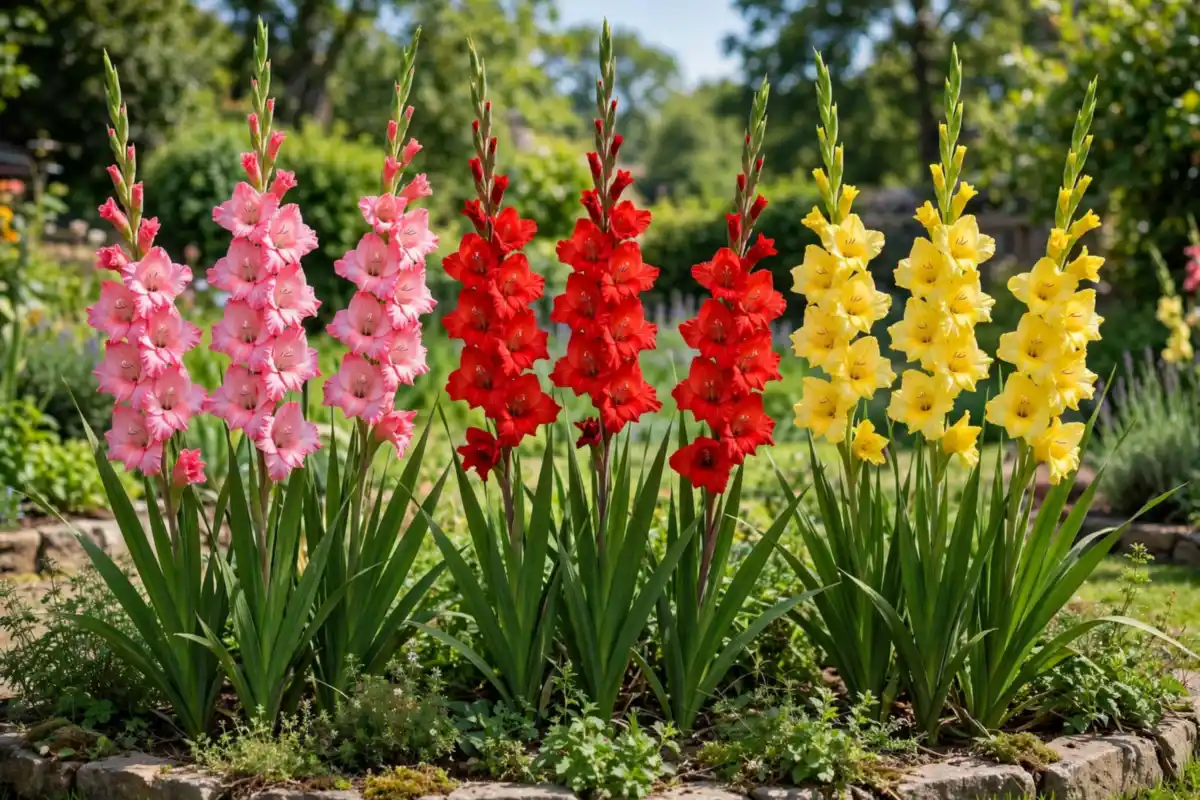
A gladiolus does not creep into a garden quietly. It arrives as a tall spike of colour, three to five feet high, with flowers opening one by one from the bottom up, like a slow firework. The plant is named for a sword — gladius in Latin — and the long, pointed leaves really do look like blades. But the flowers themselves are soft, ruffled and bright, and they have made the gladiolus one of the most popular cut flowers in the world, as well as a proud summer plant for the back of a sunny border.
The gladiolus flower is also the birth flower for August, a flower of strength and sincerity, and a plant that rewards a little planning: plant the corms in spring, stake the tall spikes before they flop, and you get weeks of blooms from midsummer into autumn. This guide covers the main types of gladiolus flower, what each colour means, and how to grow them from corms — including the one job gardeners in cold climates must not skip, lifting the corms before the first hard frost.
Quick Answer
A gladiolus flower is a tall summer bloom from the genus Gladiolus, in the iris family Iridaceae. The garden kind is usually a grandiflora hybrid, a plant grown from a corm that reaches 3 to 6 feet tall and carries a spike of large, funnel-shaped flowers in almost every colour except true blue. Plant corms in spring, after the last frost, 4 to 6 inches deep and 6 inches apart in full sun and well-drained soil, and flowers appear about 70 to 100 days later. Gladioli are hardy perennials in USDA zones 7 to 10; in colder zones the corms are lifted in autumn and stored indoors over winter. The corms are toxic if eaten and are listed as toxic to dogs, cats and horses, so they are not edible for people or pets.
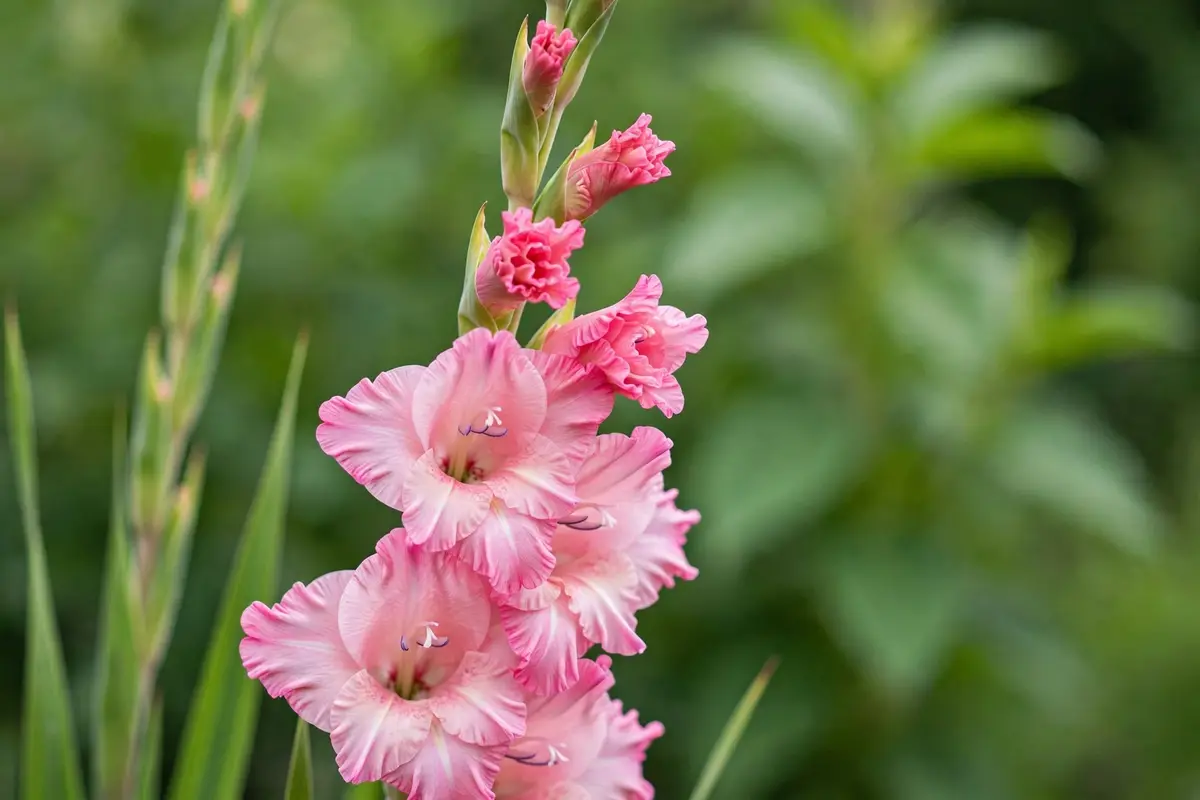
Table of Contents
- What Is a Gladiolus Flower?
- Types of Gladiolus and 6 Popular Varieties
- Gladiolus Flower Meaning and Symbolism
- What Each Gladiolus Colour Means
- How to Grow Gladioli
- Common Mistakes When Growing Gladioli
- Gladioli in Gardens, Cut Flowers and Bouquets
- Frequently Asked Questions
What Is a Gladiolus Flower?
A gladiolus belongs to the genus Gladiolus, in the family Iridaceae — the iris family. The genus holds around 260 species, most of them native to sub-Saharan Africa, with South Africa as its centre of diversity, and a smaller number native to the Mediterranean, Europe and western Asia. The name comes from the Latin gladius, a sword, because the long, narrow leaves rise from the base like blades. You can read more on the Gladiolus page on Wikipedia.
The flower most people picture is a garden hybrid, bred over the last century from African species — above all Gladiolus dalenii, Gladiolus papilio and Gladiolus oppositiflorus — into the tall grandiflora types sold today. Each plant grows from a corm, a swollen underground stem that stores food for the season, and not from a true bulb. In spring the corm sends up sword-shaped leaves and then a single flower spike, and the buds open from the bottom of the spike upwards, so one stem can stay in flower for two weeks or more. A single spike carries 12 to 20 florets, each one funnel-shaped with six petals, and the top buds are still closed when the bottom flowers are fully open.
Gladioli flower in summer, usually from July to September, and they like the conditions many summer flowers ask for: full sun, warm soil and ground that drains freely. They are at their best at the back of a border, where their height can rise above lower plants, or in a dedicated cutting bed, where they can be picked without leaving a hole in the display. In cool, wet, shady spots they grow tall and weak and flower poorly — which is why gardeners in cold climates often treat them as a summer bulb to be planted fresh each spring, rather than a permanent perennial.
Types of Gladiolus and 6 Popular Varieties
Most garden gladioli are one of a few hybrid groups, plus a handful of species kinds that suit a more natural style of planting. The table below gives a quick way to tell them apart, and the profiles that follow explain where each one grows best. For the full list of flower names, see our flower names A to Z guide.
| Variety | Group | Height | Best spot | Flower colour |
|---|---|---|---|---|
| Grandiflora hybrids | Gladiolus × grandiflorus | 3–6 ft | Back of border, cutting beds | Almost every colour |
| Primulinus hybrids | Primulinus group | 2–3 ft | Middle of border, pots | Soft yellows, pinks, oranges |
| Nanus / butterfly gladiolus | Nanus group | 1.5–2 ft | Front of border, containers | White, pink, red, purple |
| Abyssinian gladiolus | Gladiolus murielae | 2–3 ft | Sunny beds, scented gardens | White with maroon centre |
| ‘Priscilla’ grandiflora | Grandiflora cultivar | 4–5 ft | Cutting beds, tall displays | White, pink-edged, ruffled |
| ‘Green Star’ grandiflora | Grandiflora cultivar | 3–4 ft | Modern bouquets, cutting beds | Lime green |
1. Grandiflora Hybrids
This is the classic garden gladiolus and the one in most corm packets. Grandiflora hybrids grow 3 to 6 feet tall, with large florets — often 4 to 5 inches across — packed tightly along a strong spike. They come in almost every colour a flower can be: red, pink, orange, yellow, white, purple and near-black, with bicolours and picotee edges as well, and only true blue is missing. They need full sun, rich soil and staking, and they are the best choice for cutting, because one spike fills a tall vase on its own. If you only grow one gladiolus, grow a grandiflora mix.
2. Primulinus Hybrids
Primulinus gladioli are a smaller, softer group, bred from Gladiolus primulinus and its relatives. They grow 2 to 3 feet tall, with smaller, hooded flowers held more loosely along the spike, in gentle shades of yellow, apricot, pink and orange. The flowers look less formal than the grandiflora kinds, and the plants are sturdier in wind, so they suit the middle of a mixed border rather than a cutting bed. They flower a little earlier than grandifloras, and they are a good choice where a tall spike would look out of place.
3. Nanus / Butterfly Gladiolus
The nanus group, also sold as butterfly gladioli, is the compact cousin of the family, only 18 to 24 inches tall. The flowers are smaller and daintier, in white, pink, red and purple, often with a contrasting throat, and the plants need no staking at all. They are the best gladiolus for the front of a border, for edging a path, or for pots on a sunny patio, and they are hardier than the tall hybrids — in mild areas they can be left in the ground over winter with a mulch. Their short stems make them poor cut flowers, but they are the easiest gladioli to grow well.
4. Abyssinian Gladiolus (Gladiolus murielae)
The Abyssinian gladiolus is a species plant, not a hybrid, and it is the most fragrant of all gladioli. It grows 2 to 3 feet tall, with graceful, arching stems carrying white, star-shaped flowers, each one marked with a deep maroon blotch at its centre, and the scent is sweet and strongest in the evening. It comes from the mountains of eastern Africa and was once sold as Acidanthera, a name many gardeners still use. Plant it in a sunny, sheltered spot near a path or a seating area, where the evening scent can be enjoyed, and lift the corms in autumn in cold climates, just like the hybrids.
5. ‘Priscilla’ Grandiflora
‘Priscilla’ is one of the most loved grandiflora cultivars, and it shows why the group is so popular for cutting. It grows 4 to 5 feet tall, with large, ruffled florets in white, flushed and edged with soft pink, so each flower looks hand-painted. The spikes are long and straight, the flowers open evenly from the bottom up, and a single stem lasts a long time in water. Grow it in a cutting bed in full sun, stake it early, and cut the stems when the bottom one or two florets have opened for the longest vase life.
6. ‘Green Star’ Grandiflora
‘Green Star’ is a grandiflora cultivar with a colour no other common cut flower offers: a clear, lime green. It grows 3 to 4 feet tall, with large florets in a fresh green shade that deepens slightly as the flowers age, and it is grown mainly for florists and modern bouquets, where it adds a cool, architectural note among pinks and whites. It grows like any other grandiflora — full sun, rich soil, staking — and it is a good reminder that gladioli are not only red and pink. Plant a few corms among white and purple varieties and the green flowers will make the whole bed look brighter.
Gladiolus Flower Meaning and Symbolism
No flower means strength more plainly than the gladiolus, and the meaning starts with its name. The Roman sword, the gladius, gave the plant its name and its tall, blade-like leaves, and the flower was linked in Roman times with the gladiators who fought with that sword — with courage, honour and the strength to face a challenge. A gladiolus given to someone says, in the language of flowers, that you admire their strength of character.
In the modern world, the gladiolus is above all the August birth flower, shared with the poppy, and it is the flower for a 40th wedding anniversary. It stands for strength, sincerity, integrity and moral character, and for the kind of faithfulness that does not bend under pressure. It is also a flower of remembrance in some traditions, planted in memory gardens and laid at memorials, because its tall spike rises straight and unbowed. Given to a friend who is facing a difficult time, or to someone celebrating a milestone, it says something no softer flower says as clearly: I believe in your strength.
The flower’s other meanings follow from the same idea. It stands for infatuation and admiration — the Victorian language of flowers gave it the meaning “you pierce my heart”, a play on the sword shape — and for calm, generosity and a clear, honest character. A bunch of gladioli at a graduation, a new job or a recovery carries that message without needing any words at all, which is why it turns up so often at celebrations and farewells alike.
What Each Gladiolus Colour Means
Red is the colour most people think of first, and it carries the flower’s strongest meaning: love, passion and strength of feeling. Red gladioli are the ones given to someone you admire deeply, and they are the colour most often chosen for a bold, romantic bouquet. Pink gladioli mean gentleness, admiration and a softer kind of love — the sort you give a close friend, a sister or a mother — and they look best in mixed summer borders, where their warm colour softens the green of the foliage around them.
White gladioli, like ‘Priscilla’ and ‘White Prosperity’, mean purity, innocence and sincerity, and they are the colour most often chosen for weddings, memorials and sympathy bouquets. Yellow gladioli mean friendship, cheerfulness and joy, and they are the colour to give a friend who needs cheering up. Purple gladioli mean grace, charm and admiration, and the deep, almost-black varieties mean mystery and quiet strength. Orange gladioli mean enthusiasm and energy, and the unusual green kinds, like ‘Green Star’, mean youth, renewal and good health. A mixed planting of several colours reads as a whole message — strength, love and friendship together — and it is the easiest way to grow them, since mixed corms are cheaper than separate colours. If you want more ideas for cool-coloured garden flowers, see our blue flowers guide, and if you are choosing by birth month, gladiolus is one of the two flowers in our August birth flower guide.
How to Grow Gladioli
Gladioli are easy plants if you plant them at the right time and give them sun and support. The whole method fits in a few steps, and the corms will handle the rest themselves. Gardeners on r/gardening on Reddit often recommend them as one of the simplest tall summer flowers, and that reputation is earned — as long as you remember to stake them.
When to Plant
Plant corms in spring, after the last frost and once the soil has warmed to about 55°F (13°C). In most temperate gardens that means April to May, and in warm climates March is early enough. For a longer display, plant a few corms every two weeks from spring into early summer — each batch flowers about 70 to 100 days after planting, so succession planting stretches the season from midsummer into autumn. Choose large, firm corms, about 1.5 inches across, and discard any that are soft, mouldy or shrivelled. Soaking is not needed; plant them dry, straight from the packet.
Planting Depth and Spacing
Plant each corm 4 to 6 inches deep, with the pointed end facing up, and space the corms about 6 inches apart. In a cutting bed, plant them in rows 12 inches apart so you can reach the stems easily. The depth matters: corms planted too shallowly fall over as soon as the spike grows tall, while corms planted very deep flower late. In heavy clay soil, plant a little shallower and add grit or compost to improve drainage, because corms sitting in wet soil will rot before they sprout. Water the bed after planting, then water only when the soil dries out until the shoots appear.
Light and Soil
Give gladioli full sun — at least six hours a day — and soil that drains freely and is rich in compost or well-rotted manure. They will take light shade, but they grow taller and weaker there and flower less, so a sunny, sheltered spot is worth finding. The soil should be slightly acidic to neutral, and a mulch of compost in spring helps on both counts: it feeds the plants and keeps the soil moist. A sheltered spot also matters, because a tall spike in an exposed, windy place will snap or lean, even when staked.
Watering and Feeding
Water during dry spells, especially while the flower spike is forming, and keep the soil evenly moist rather than soaking it and then letting it dry out. Feed lightly: a handful of balanced fertiliser or a liquid feed every two to three weeks from the time the shoots are 6 inches tall until flowering is enough. Too much nitrogen produces soft, leafy plants with few flowers, and it makes the spikes more likely to flop. Good air circulation helps too: do not crowd them, and thin out weak shoots so the leaves dry after rain.
Staking
This is the step that decides whether a gladiolus looks splendid or ends up lying on the ground. Put a stake or a cane beside each tall variety when the plant is about 12 inches high, and tie the stem loosely to it as it grows, or run a grid of string between stakes around a whole bed. Do not wait until the spike is already leaning — by then the stem is often bent for good. The dwarf nanus kinds need no staking, which is one reason they are so popular for small gardens.
After Flowering and Lifting Corms
After flowering, cut the flower spike off but leave the leaves alone. The leaves feed the new corm forming at the base, and cutting them early means small corms next year. Leave the foliage until it yellows, usually six to eight weeks after flowering. In zones 7 to 10, the corms can stay in the ground over winter with a thick mulch. In colder zones, lift the corms before the first hard frost: dig them up carefully, cut the stem to about 2 inches, let them dry in a warm, airy place for two to three weeks, then remove the old, shrivelled corm from underneath and store the new ones in a paper bag or a mesh sack in a cool, dry, frost-free place at about 35 to 45°F (2 to 7°C). Label the bags, so you know which colour is which in spring.
Common Mistakes When Growing Gladioli
The first mistake is planting the corms too early, into cold, wet soil. Corms planted before the soil has warmed will rot rather than sprout, and a late frost can kill the young shoots. Wait until the soil is warm and the last frost has passed. The second mistake is planting too shallowly. A corm only 2 inches deep will produce a plant that falls over at the first wind, so plant 4 to 6 inches deep and stake the tall kinds.
The third mistake is skipping the staking, or staking too late. A grandiflora spike in full flower is heavy, and one rainy, windy night is enough to flatten an unstaked bed. Stake when the plants are a foot tall. The fourth mistake is cutting the leaves off after flowering. The leaves are feeding next year’s corm, and removing them leaves you with tiny corms that may not flower at all. The fifth mistake is leaving the corms in the ground in a cold climate. In zones 6 and below, a hard frost will kill them, so lift and store them every autumn. Finally, do not plant gladioli in the same spot year after year: the soil builds up disease, especially fusarium, which rots the corms. Move them to a fresh bed each year, and buy fresh corms every two or three years rather than replanting the same tired stock forever.
Gladioli in Gardens, Cut Flowers and Bouquets
In the garden, gladioli are at their best at the back of a sunny border, where their height can rise above dahlias, zinnias and other summer flowers, or in a dedicated cutting bed where they can be picked freely. Plant them in groups of seven or more of one colour for a strong block of colour, rather than dotting single corms around the garden, where they look lost. They also suit a sunny wall or fence, which shelters them from wind and shows off the flowers, and the tall kinds pair well with other summer cut flowers — the sunflower varieties guide, for example, covers another tall summer flower that shares the same sunny bed and the same cutting season.
As a cut flower, the gladiolus is one of the longest-lasting and most useful stems a gardener can grow. Cut the spike in the morning, when the bottom one or two florets have opened and the rest are still in bud, and stand it in deep water straight away. Remove the bottom leaves, recut the stem under water, and change the water every two days; the buds will keep opening from the bottom up for a week to ten days. In bouquets, gladioli are used as a tall, architectural line flower, with roses, lilies or dahlias as the round flowers around them. And if you are choosing flowers by letter for a summer display, you will find gladiolus in our flowers that start with G guide.
Frequently Asked Questions
Are gladioli perennial?
It depends on where you live. In USDA zones 7 to 10, gladioli are perennial and the corms can stay in the ground over winter with a mulch. In zones 3 to 6, they are grown as tender summer bulbs: the corms are planted in spring, lifted in autumn before the first hard frost, and stored indoors over winter. Even in warm zones, many gardeners replant fresh corms every year or two, because the flowers are bigger on new corms.
When should I plant gladiolus corms?
Plant in spring, after the last frost, once the soil has warmed to about 55°F (13°C) — usually April to May in temperate gardens, March in warm climates. Plant a few corms every two weeks into early summer for flowers from midsummer into autumn, since each batch blooms about 70 to 100 days after planting.
How long do gladiolus flowers last?
One spike stays in flower for about two weeks in the garden, with the buds opening from the bottom up. As a cut flower, a spike cut when the bottom one or two florets have opened lasts 7 to 10 days in a vase if the water is changed regularly and the stem is recut. Remove the spent florets from the bottom as they fade to keep the stem looking fresh.
Are gladioli toxic?
Yes. Gladiolus corms are toxic if eaten, and the plant is listed as toxic to dogs, cats and horses, with the corms the most dangerous part. Eating a corm can cause drooling, vomiting, diarrhoea and abdominal pain in pets, and it can cause stomach upset in people. Gladioli are not edible and should never be planted where pets or children are likely to dig up and eat the corms — and you can read more in the questions about the gladiolus flower on Quora.
Is gladiolus the August birth flower?
Yes. Gladiolus is one of the two birth flowers for August, along with the poppy. It was chosen for the month because it flowers in high summer and because its meaning — strength, sincerity and integrity — suits the season. It is also the flower for a 40th wedding anniversary.
Why do my gladioli keep falling over?
Almost always because the corms were planted too shallowly, the plants were never staked, or they were grown in shade. Plant corms 4 to 6 inches deep in full sun, put a stake beside each tall plant when it is about 12 inches high, and tie the stem loosely as it grows. A sheltered spot and a grid of string around a bed will also help, and the dwarf nanus kinds need no staking at all.

One Comment