Forget-Me-Not Flower: Types, Meaning, Symbolism and How to Grow Forget-Me-Nots
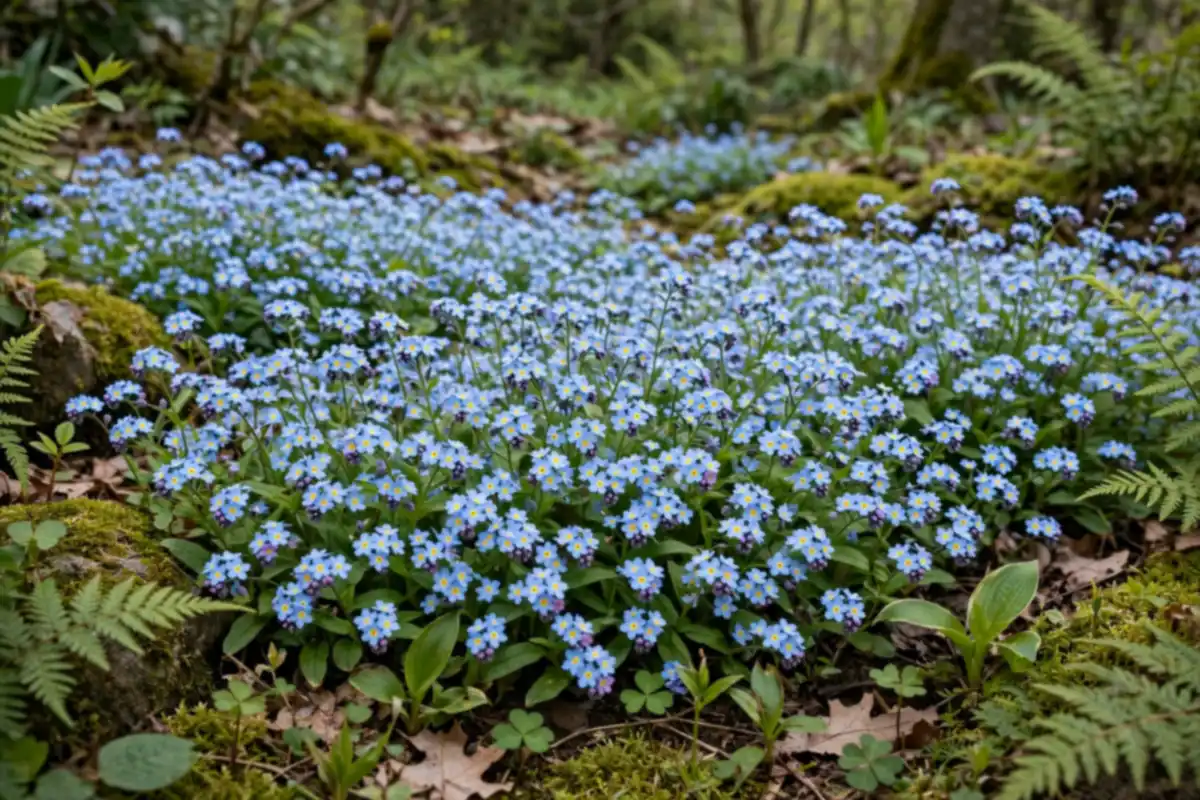
A forget-me-not is a small flower with a very large job: it asks to be remembered. Five sky-blue petals, each no wider than a fingernail, open around a yellow eye, and together they make a carpet of colour in the shadiest, dampest corner of the garden — exactly where most flowers give up. Gardeners plant them under trees, along streams and at the front of borders, and then the plants do the rest, coming back year after year from self-sown seed.
The forget-me-not flower is also one of the most symbolic flowers in the world. It is the state flower of Alaska, a remembrance flower for fallen soldiers, and the emblem of memory for Alzheimer’s charities. This guide covers the main types of forget-me-not flower, what each colour means, and how to grow them from seed, including the one habit — enthusiastic self-seeding — that every grower should plan for.
Quick Answer
A forget-me-not flower is a small five-petalled bloom from the genus Myosotis, in the borage family Boraginaceae. The garden kind is usually the wood forget-me-not (Myosotis sylvatica), a spring flower with sky-blue petals and a yellow centre. It grows 6 to 12 inches tall, prefers part shade and moist, rich soil, and blooms from mid-spring to early summer. It is a short-lived perennial or biennial in USDA zones 3 to 8, and it self-seeds freely, so one planting often returns for years. True forget-me-nots (Myosotis) are widely listed as non-toxic to dogs and cats, but they are not edible for people — and the Chinese forget-me-not, a different plant, is toxic if eaten, so the two should never be confused.
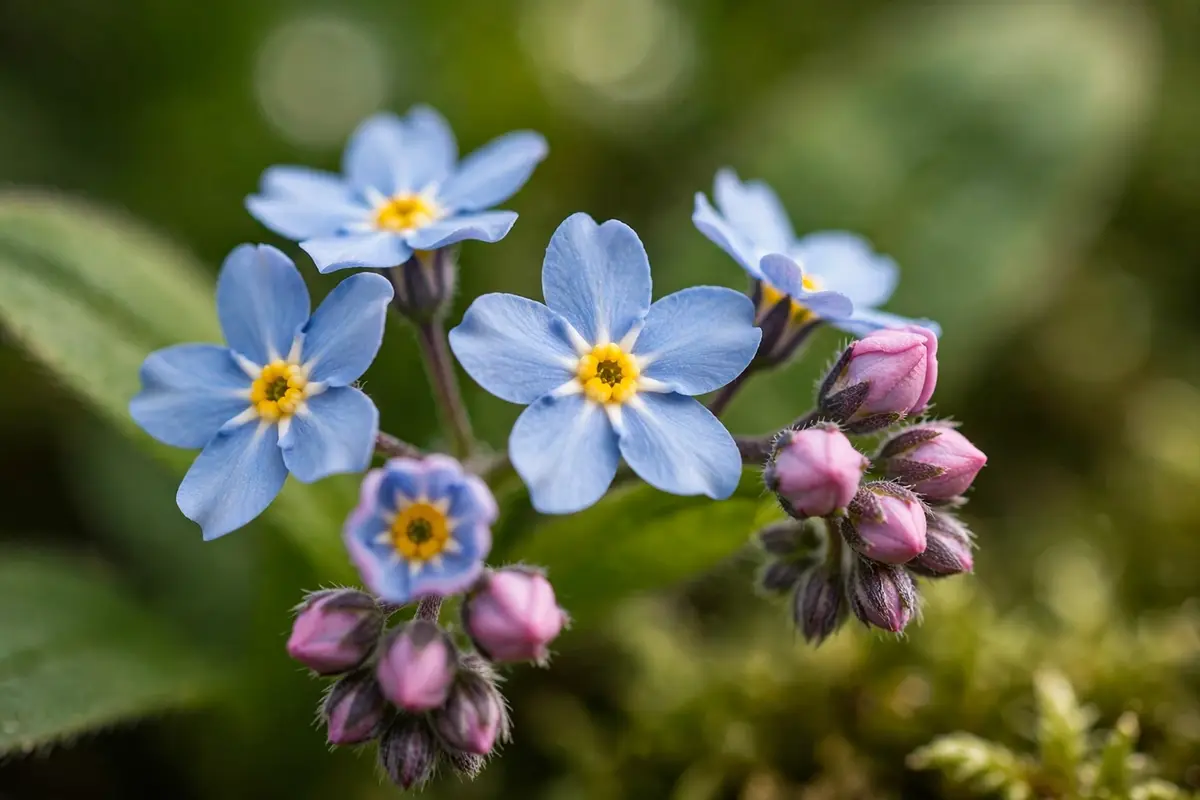
Table of Contents
- What Is a Forget-Me-Not Flower?
- Types of Forget-Me-Not and 6 Popular Varieties
- Forget-Me-Not Flower Meaning and Symbolism
- What Each Forget-Me-Not Colour Means
- How to Grow Forget-Me-Nots
- Common Mistakes When Growing Forget-Me-Nots
- Forget-Me-Nots in Gardens, Memorials and Bouquets
- Frequently Asked Questions
What Is a Forget-Me-Not Flower?
A forget-me-not belongs to the genus Myosotis, in the family Boraginaceae — the borage family. The genus holds around 70 to 100 species, most of them small plants with soft, hairy leaves and clusters of tiny five-petalled flowers. The name comes from the Greek mys (mouse) and ous (ear): the small, rounded leaves were thought to look like a mouse’s ear. You can read more on the Myosotis page on Wikipedia.
The flower most people picture is the wood forget-me-not, Myosotis sylvatica, a native of European woodlands that has been grown in gardens for centuries. Each flower is only about a quarter of an inch across, but the plants carry them in loose sprays, dozens at a time, so the effect is a wash of blue at ankle height. The flowers open pink in bud and turn blue as they mature, which is why a single plant often shows pink buds and blue open flowers side by side. That colour change is a real feature of the flower, not a trick of the light, and it is one of the easiest ways to tell a forget-me-not from other small blue flowers.
Forget-me-nots flower in spring, usually from April to June, and they like the conditions other garden plants complain about: cool weather, dappled shade and soil that stays a little damp. They are at their best at the edge of a woodland bed, beside a pond, or under deciduous shrubs that leaf out late and let the spring sun through. In hot, dry, sunny spots they sulk, flower briefly and disappear — which is why gardeners in warm climates often grow them as a cool-season annual rather than a perennial.
Types of Forget-Me-Not and 6 Popular Varieties
Most garden forget-me-nots are one of a handful of Myosotis species, plus one famous lookalike from another genus. The table below gives a quick way to tell them apart, and the profiles that follow explain where each one grows best. For the full list of flower names, see our flower names A to Z guide.
| Variety | Botanical name | Height | Best spot | Flower colour |
|---|---|---|---|---|
| Wood forget-me-not | Myosotis sylvatica | 6–12 in | Part shade, moist borders | Blue, pink, white |
| Water forget-me-not | Myosotis scorpioides | 6–18 in | Pond edges, wet soil | Blue |
| Alpine forget-me-not | Myosotis alpestris | 4–8 in | Rock gardens, cool mountains | Deep blue |
| Field forget-me-not | Myosotis arvensis | 6–16 in | Meadows, wildflower mixes | Pale blue |
| Chinese forget-me-not | Cynoglossum amabile | 18–24 in | Sunny cottage beds | Blue, pink, white |
| ‘Victoria’ dwarf mix | Myosotis sylvatica cultivar | 6–8 in | Edging, pots, front of border | Blue, pink, white |
1. Wood Forget-Me-Not (Myosotis sylvatica)
This is the classic garden forget-me-not and the one in most seed packets. It is a short-lived perennial or biennial that grows 6 to 12 inches tall, with soft grey-green leaves and sprays of sky-blue flowers with a yellow eye. It thrives in part shade and moist, humus-rich soil, and it self-seeds so generously that a single packet can fill a bed within two years. The pink form ‘Rosylva’ and the white form ‘Snowsylva’ are the same species in different colours, and they are often sold mixed with the blue as a ‘Sylva’ series. If you only grow one forget-me-not, grow this one.
2. Water Forget-Me-Not (Myosotis scorpioides)
Also called the true forget-me-not, this is the species that grows wild along streams and pond margins across Europe and Asia. It is a true perennial with creeping stems that root where they touch wet soil, reaching 6 to 18 inches tall. The flowers are a clear, bright blue, slightly larger than the woodland kind, and they bloom from late spring into summer. Plant it at the edge of a pond, in a bog garden, or anywhere the soil never quite dries out. It will not be happy in a dry border, and it spreads by runners as well as seed, so give it room or a container sunk into the ground.
3. Alpine Forget-Me-Not (Myosotis alpestris)
The alpine forget-me-not is a compact mountain plant, only 4 to 8 inches tall, with intense, deep-blue flowers. It is the state flower of Alaska, where it grows wild in the mountains, and it needs the conditions its name promises: cool summers, sharp drainage and full sun in a cold climate. In a warm garden it is short-lived and best treated as an alpine for a rock garden, a trough or a raised bed with gritty soil. Do not plant it in rich, wet soil — it will rot before it flowers.
4. Field Forget-Me-Not (Myosotis arvensis)
The field forget-me-not is the wild one, a slender annual of meadows, hedgerows and field edges with small, pale-blue flowers. It is less showy than the garden kinds — the flowers are tiny and the plant is airy rather than bushy — but it is the best choice for a wildflower meadow or a naturalised area, where it self-seeds among grasses without any help. It is an annual, so it relies entirely on seed to return, which means leaving the plants to set seed in early summer instead of cutting them down.
5. Chinese Forget-Me-Not (Cynoglossum amabile)
The Chinese forget-me-not looks like a forget-me-not but is not one: it belongs to the genus Cynoglossum, not Myosotis. It is a taller, bushier plant, 18 to 24 inches high, with sprays of blue, pink or white flowers on branching stems, and it grows as a biennial or short-lived perennial in full sun. Gardeners love it for cottage beds and cutting, but it must be handled differently: unlike true forget-me-nots, it contains pyrrolizidine alkaloids and is toxic if eaten, so it should never be planted where children or pets graze, and it should never be used as a garnish. Its seed also clings to clothing and fur, which is how it spreads.
6. ‘Victoria’ Dwarf Mix (Myosotis sylvatica cultivar)
‘Victoria’ is a compact, uniform strain of the wood forget-me-not, bred for neat, ball-shaped plants 6 to 8 inches tall with masses of flowers in blue, pink or white. It is the best choice for edging a path, filling a pot, or planting in a formal spring display with tulips, because every plant flowers at the same height at the same time. Grow it from seed sown in summer for flowers the following spring, and deadhead or pull it after flowering if you want a tidy bed — or leave it, and it will seed itself into every crack nearby.
Forget-Me-Not Flower Meaning and Symbolism
No flower means “remember me” more directly than the forget-me-not. The meaning comes from an old German legend: a knight walking by the Danube with his lady bent to pick her a bunch of the blue flowers, fell into the river in his heavy armour, and threw the flowers to her with the words “Vergiss mein nicht” — forget me not. The story spread across Europe, and by the 15th century the flower was a recognised symbol of faithful love and remembrance. Henry IV of England adopted it as his emblem while in exile in 1398, and it has been linked to loyalty ever since.
In the modern world, the forget-me-not is above all a remembrance flower. In Newfoundland and Labrador, it is worn on July 1 to remember the soldiers of the Royal Newfoundland Regiment who fell at Beaumont-Hamel in 1916. In the United Kingdom, the Alzheimer’s Society uses the forget-me-not as its symbol, because it speaks for memory itself — for the people living with dementia and for the memories families hold on to. In Germany, the small blue flower was also worn quietly as a symbol of remembrance and resistance in the 1930s and 40s. Given to a friend or a loved one, it says something no other flower says as plainly: I remember you, and I will not forget.
The flower’s other meanings follow from the same idea. It stands for true love that survives distance and time, for friendship that does not fade, and for hope after loss. A sprig tucked into a letter, a card or a memorial arrangement carries that message without needing any words at all, which is why it turns up so often at funerals, anniversaries and farewells.
What Each Forget-Me-Not Colour Means
Blue is the colour everyone thinks of first, and it carries the flower’s main meaning: remembrance, loyalty and true love. Blue forget-me-nots are the ones planted in memorial gardens and given to someone who is missed. If you want the classic message, blue is the colour to choose — and for more blue garden ideas, see our blue flowers guide.
Pink forget-me-nots mean gentleness, affection and a softer kind of love — the sort you give a close friend, a sister or a mother. They look best in cottage beds and mixed spring borders, where their warm colour softens the cool blue of their neighbours. White forget-me-nots, like the ‘Snowsylva’ form, mean purity, innocence and sympathy, and they are the colour most often chosen for memorial plantings and sympathy bouquets. For white garden companions, see our white flowers guide. A mixed planting of all three colours reads as a whole message — remembrance, affection and peace together — and it is the easiest way to grow them, since mixed seed is cheaper than separate colours.
How to Grow Forget-Me-Nots
Forget-me-nots are easy plants if you give them what they want and leave them alone afterwards. The whole method fits in a few steps, and the plants will handle the rest themselves. Gardeners on r/gardening on Reddit often recommend them as one of the simplest spring flowers for a shady spot, and that reputation is earned.
When to Sow
Sow seed in late summer or early autumn for flowers the following spring — that is how the plants grow in nature, and it gives the strongest display. In mild climates you can also sow in early spring, but the plants will be smaller and flower later. Scatter the seed where you want the plants to grow and press it lightly into the soil; forget-me-not seed needs light to germinate, so do not bury it. Germination takes 14 to 21 days in cool, moist soil. Alternatively, buy young plants in autumn and set them out 6 to 9 inches apart.
Light and Soil
Give wood forget-me-nots part shade and soil that stays moist and rich in leaf mould or compost. They will take full sun in cool climates if the soil never dries out, but in warm areas sun scorches them and shortens flowering to a few weeks. The soil should drain — they hate sitting in puddles — but it should not dry out either. A mulch of leaf mould in autumn helps on both counts. Water forget-me-nots need genuinely wet soil or shallow water at a pond edge, and alpine forget-me-nots need the opposite: gritty, sharply drained soil in a rock garden.
Watering and Feeding
Water during dry spells in spring, when the plants are in flower, and feed very lightly if at all — a handful of compost in autumn is enough. Too much fertiliser produces soft, leafy plants with few flowers, and it encourages the mildew that is the plant’s main enemy. Good air circulation helps: do not crowd them, and thin seedlings to about 6 inches apart so the leaves dry after rain.
After Flowering
This is the step that decides whether they come back. If you want forget-me-nots again next year, leave the plants alone after flowering until the seed has ripened and scattered — usually by midsummer. The plants will look scruffy by then, and many gardeners cut them down, but cutting too early ends the display for good. If you want a tidy bed instead, pull the plants after they have set seed and shake them over the bed so the seed falls where you want it. Either way, one planting usually seeds itself for years, which is why forget-me-nots are often described as a plant you sow once and keep forever.
Growing in Pots
Dwarf kinds like ‘Victoria’ grow well in pots and window boxes in a mix of compost and leaf mould, kept moist and out of hot afternoon sun. Pots dry out faster than beds, so check them in dry spring weather. After flowering, either leave the pot in a shady corner to self-seed or shake the seed into the bed and start again with fresh plants in autumn.
Common Mistakes When Growing Forget-Me-Nots
The first mistake is planting them in hot, dry sun. Forget-me-nots are cool-weather woodland plants, and a sunny, dry border will give you a few weeks of thin flowers and then nothing. Part shade and moist soil are not optional extras — they are the whole secret. The second mistake is sowing the seed too deep. The seed needs light, so seed buried under soil will simply not come up; scatter it on the surface and press it in gently.
The third mistake is cutting the plants down right after flowering, before the seed has ripened. The plants look untidy in early summer, but that scruffy stage is when next year’s flowers are being made. The fourth mistake is overfeeding: rich fertiliser makes leafy plants with few flowers and invites powdery mildew, which shows as a white coating on the leaves in humid weather. Give them compost, not fertiliser, and space them so air can move. The fifth mistake is planting the Chinese forget-me-not as if it were a true forget-me-not — it is a different, taller plant that needs full sun and must never be eaten. Finally, do not expect them to behave like a tidy perennial: they are short-lived, they wander by seed, and a bed of forget-me-nots is a living carpet, not a formal arrangement. If you want neat rows, grow the dwarf ‘Victoria’ strain and deadhead it.
Forget-Me-Nots in Gardens, Memorials and Bouquets
In the garden, forget-me-nots are at their best as a groundcover under spring bulbs. Plant them under tulips and daffodils and they will flower at the same time, hiding the bulbs’ bare stems and filling the gaps between them. They also suit woodland edges, shady banks and the front of a shrub border, and they pair well with other shade lovers — the columbine flower, for example, flowers at the same season in the same light and grows to a similar scale. Along a pond, the water forget-me-not does the same job at the water’s edge. And because they self-seed, they are one of the cheapest ways to fill a shady bed: a single packet of seed, left alone for two years, can cover a surprising amount of ground.
As a memorial flower, the forget-me-not is planted in remembrance gardens and given at funerals and anniversaries of loss. A small pot of blue forget-me-nots is a quiet, living gift for someone who is grieving, and it keeps flowering long after cut flowers have faded. In bouquets, forget-me-nots are used as a filler rather than a feature flower — a few sprigs tucked around roses or tulips add a soft blue haze and carry the message of remembrance without overpowering the arrangement. They last only a few days as cut flowers, so pick them in bud and change the water daily. And if you are choosing flowers by letter for a spring display, you will find forget-me-not in our flowers that start with F guide.
Frequently Asked Questions
Are forget-me-nots perennial?
It depends on the kind. The wood forget-me-not is a short-lived perennial or biennial in zones 3 to 8, and the water forget-me-not is a true perennial in wet soil. In practice, most gardeners treat them as self-seeding biennials: the plants flower in spring, set seed, and die, and the seedlings take their place. As long as you let them set seed, the display returns every year without replanting.
Are forget-me-nots edible?
No. True forget-me-nots (Myosotis) are widely listed as non-toxic to dogs and cats, but they are not food for people and should not be eaten or used as a garnish. The Chinese forget-me-not (Cynoglossum amabile) is a different plant and is toxic if eaten. If you are not certain which plant you have, do not eat it — and you can read more in the questions about the forget-me-not flower on Quora.
Why are they called forget-me-not?
The name comes from the German “Vergissmeinnicht” and the legend of a knight who threw the flowers to his lady as he drowned in the Danube, calling “forget me not”. The name was taken into English in the 16th century, and the flower has meant remembrance and faithful love ever since.
Is the forget-me-not the Alaska state flower?
Yes. The alpine forget-me-not (Myosotis alpestris) is the state flower of Alaska. It was adopted as the territorial flower in 1917 and became the state flower when Alaska joined the Union in 1959. It grows wild in the Alaskan mountains, which is why it suits cool, well-drained rock gardens.
Do forget-me-nots spread too much?
They can. A happy planting self-seeds freely and will pop up in paths, pots and neighbouring beds. It is easy to control: deadhead the flowers before seed sets, pull unwanted seedlings while they are small, or grow the dwarf ‘Victoria’ strain and remove it after flowering. The seedlings are shallow-rooted and simple to weed out, so the plant is enthusiastic rather than truly invasive in most gardens.
Can I grow forget-me-nots indoors?
Not well for long. They need a cold period to flower properly and they prefer cool, humid air, so a warm room makes them leggy and short-lived. They grow much better outside, even in a pot on a shaded balcony. If you want them indoors, grow a pot outside through winter and bring it in just as the buds open for a week or two of flowers, then put it back out to set seed.