30 Plants That Start With J: Names, Pictures and Useful Facts
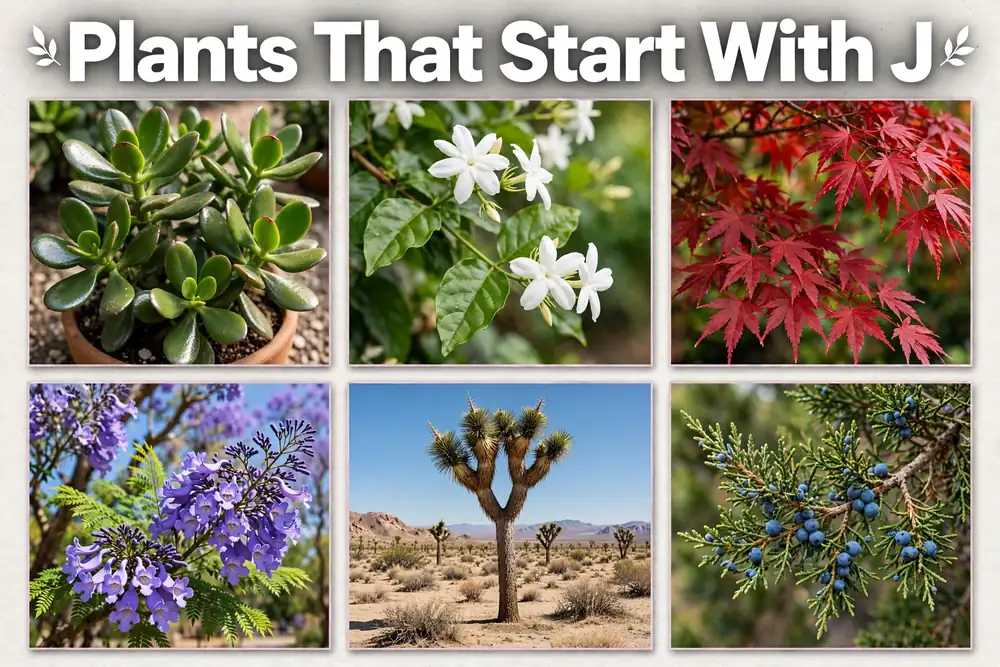
Looking for plants that start with J? The letter J delivers some of the plant world’s biggest personalities: the jade plant thriving on neglect, jasmine perfuming summer nights, the Japanese maple painting autumn red, jacaranda turning streets violet, and the Joshua tree standing like a sculpture in the desert. From houseplants and fragrant vines to fruit trees, native wildflowers, and edible tubers, this guide covers 30 real plants that start with J, each with its botanical name, native region, bloom season, and practical growing advice. If you are mainly after blooms, see also our companion guide to flowers that start with J.
Every entry below lists the plant’s scientific name, light and water needs, and USDA hardiness zone, so you can tell at a glance which J-plants suit your home or garden. You will also find two comparison tables, hands-on growing tips, and answers to the questions gardeners ask most about plants starting with J.
Quick Answer
Popular plants that start with J include Jade Plant, Jasmine, Juniper, Japanese Maple, Jacaranda, Joshua Tree, Japanese Iris, Jicama, Jujube, Jerusalem Artichoke, Joe Pye Weed, Jack-in-the-Pulpit, Japanese Camellia, and Jonquil. They span succulents, fragrant vines, flowering trees, desert icons, edible crops, and woodland wildflowers — covering USDA zones 3–11, so there is a J-plant for nearly every garden and windowsill.
Table of Contents
J-Plants at a Glance
Use this table to compare all 30 plants that start with J side by side, from botanical names to native regions.
| Plant name | Scientific name | Type | Light | Native region |
|---|---|---|---|---|
| Jade Plant | Crassula ovata | Succulent houseplant | Bright light | South Africa (Eastern Cape) |
| Common Jasmine | Jasminum officinale | Fragrant vine | Full sun | Himalayas, China |
| Common Juniper | Juniperus communis | Evergreen conifer | Full sun | Circumboreal (N. Hemisphere) |
| Japanese Maple | Acer palmatum | Ornamental tree | Full sun to part shade | Japan, Korea, China |
| Jerusalem Cherry | Solanum pseudocapsicum | Ornamental houseplant | Bright light | Peru, Ecuador |
| Jacob’s Ladder | Polemonium caeruleum | Perennial | Part shade | Europe, Asia |
| Japanese Iris | Iris ensata | Perennial | Full sun | Japan, China, Korea |
| Jicama | Pachyrhizus erosus | Root vegetable | Full sun | Mexico, Central America |
| Joshua Tree | Yucca brevifolia | Desert tree | Full sun | Mojave Desert, USA |
| Jacaranda | Jacaranda mimosifolia | Flowering tree | Full sun | Argentina, Bolivia |
| Jewel Orchid | Ludisia discolor | Orchid houseplant | Low to medium light | Southeast Asia |
| Japanese Camellia | Camellia japonica | Evergreen shrub | Part shade | Japan, Korea, China |
| Japanese Cedar (Cryptomeria) | Cryptomeria japonica | Evergreen conifer | Full sun | Japan, China |
| Japanese Stewartia | Stewartia pseudocamellia | Ornamental tree | Full sun to part shade | Japan, Korea |
| Japanese Holly | Ilex crenata | Evergreen shrub | Full sun to part shade | Japan, Korea, China |
| Japanese Yew | Taxus cuspidata | Evergreen shrub/tree | Full sun to shade | Japan, Korea, China |
| Carolina Jessamine | Gelsemium sempervirens | Evergreen vine | Full sun to part shade | Southeastern USA |
| Japanese Pieris | Pieris japonica | Evergreen shrub | Part shade | Japan, China, Taiwan |
| Japanese Spirea | Spiraea japonica | Deciduous shrub | Full sun | Japan, Korea, China |
| Joe Pye Weed | Eutrochium purpureum | Native perennial | Full sun to part shade | Eastern North America |
| Jack-in-the-Pulpit | Arisaema triphyllum | Native wildflower | Part to full shade | Eastern North America |
| Japanese Blood Grass | Imperata cylindrica ‘Red Baron’ | Ornamental grass | Full sun | Japan (cultivar origin) |
| Japanese Painted Fern | Athyrium niponicum ‘Pictum’ | Fern | Part to full shade | Japan, China, Korea |
| Japanese Forest Grass | Hakonechloa macra | Ornamental grass | Part shade | Japan |
| Jupiter’s Beard | Centranthus ruber | Perennial | Full sun | Mediterranean region |
| Jonquil | Narcissus jonquilla | Spring bulb | Full sun to part shade | Spain, Portugal |
| Japanese Anemone | Anemone hupehensis | Perennial | Part shade | China |
| Jerusalem Artichoke | Helianthus tuberosus | Edible tuber | Full sun | Central North America |
| Jujube | Ziziphus jujuba | Fruit tree | Full sun | China |
| Japanese Barberry | Berberis thunbergii | Deciduous shrub | Full sun to part shade | Japan |
Bloom Season, Water Needs & Hardiness Zones
This second table focuses on practical care: when each J-plant blooms, how much water it wants, and the USDA zones where it survives winter outdoors.
| Plant name | Bloom season | Water needs | USDA hardiness |
|---|---|---|---|
| Jade Plant | Winter (mature plants, indoors) | Low — let soil dry out | 10–11 |
| Common Jasmine | Summer to early fall | Medium — evenly moist | 7–10 |
| Common Juniper | Non-flowering (conifer) | Low — drought tolerant | 3–7 |
| Japanese Maple | Spring (inconspicuous) | Medium — dislikes drought | 5–8 |
| Jerusalem Cherry | Summer (flowers), fall (berries) | Medium — evenly moist | 9–11 (houseplant elsewhere) |
| Jacob’s Ladder | Late spring to early summer | Medium — moist soil | 4–8 |
| Japanese Iris | Early to midsummer | High — loves wet soil | 4–9 |
| Jicama | Summer (grown for tubers) | Medium — consistent | Grown as annual (9–11 perennial) |
| Joshua Tree | Spring (mature trees) | Very low — desert plant | 6–10 |
| Jacaranda | Late spring to early summer | Low-medium once established | 9b–11 |
| Jewel Orchid | Winter (small white flowers) | Medium — humid, never soggy | 10–11 (houseplant elsewhere) |
| Japanese Camellia | Late winter to spring | Medium — evenly moist | 7–9 |
| Japanese Cedar (Cryptomeria) | Non-flowering (conifer) | Medium — tolerates wet soil | 5–9 |
| Japanese Stewartia | Summer | Medium — evenly moist | 5–8 |
| Japanese Holly | Spring (inconspicuous) | Medium | 5–9 |
| Japanese Yew | Non-flowering (conifer) | Medium | 4–7 |
| Carolina Jessamine | Late winter to early spring | Medium | 7–10 |
| Japanese Pieris | Early spring | Medium — evenly moist | 5–8 |
| Japanese Spirea | Summer | Medium | 3–8 |
| Joe Pye Weed | Late summer to early fall | Medium-high — likes moisture | 4–9 |
| Jack-in-the-Pulpit | Spring (spathe), fall (berries) | Medium-high — moist shade | 4–9 |
| Japanese Blood Grass | Grown for foliage | Medium | 5–9 |
| Japanese Painted Fern | Non-flowering (fern) | Medium-high — moist shade | 4–8 |
| Japanese Forest Grass | Late summer (inconspicuous) | Medium — consistently moist | 5–9 |
| Jupiter’s Beard | Late spring to summer | Low-medium — drought tolerant | 5–9 |
| Jonquil | Spring | Medium — dry summer dormancy | 4–9 |
| Japanese Anemone | Late summer to fall | Medium | 4–8 |
| Jerusalem Artichoke | Late summer (flowers) | Medium | 3–8 |
| Jujube | Summer (flowers), fall (fruit) | Low-medium — very drought tolerant | 6–9 |
| Japanese Barberry | Spring (inconspicuous) | Low-medium once established | 4–8 |
30 Plants That Start With J: The Complete List
Below is the full rundown — houseplants, trees, shrubs, perennials, fruits, and vegetables — with the growing details that matter for each one.
1. Jade Plant (Crassula ovata)
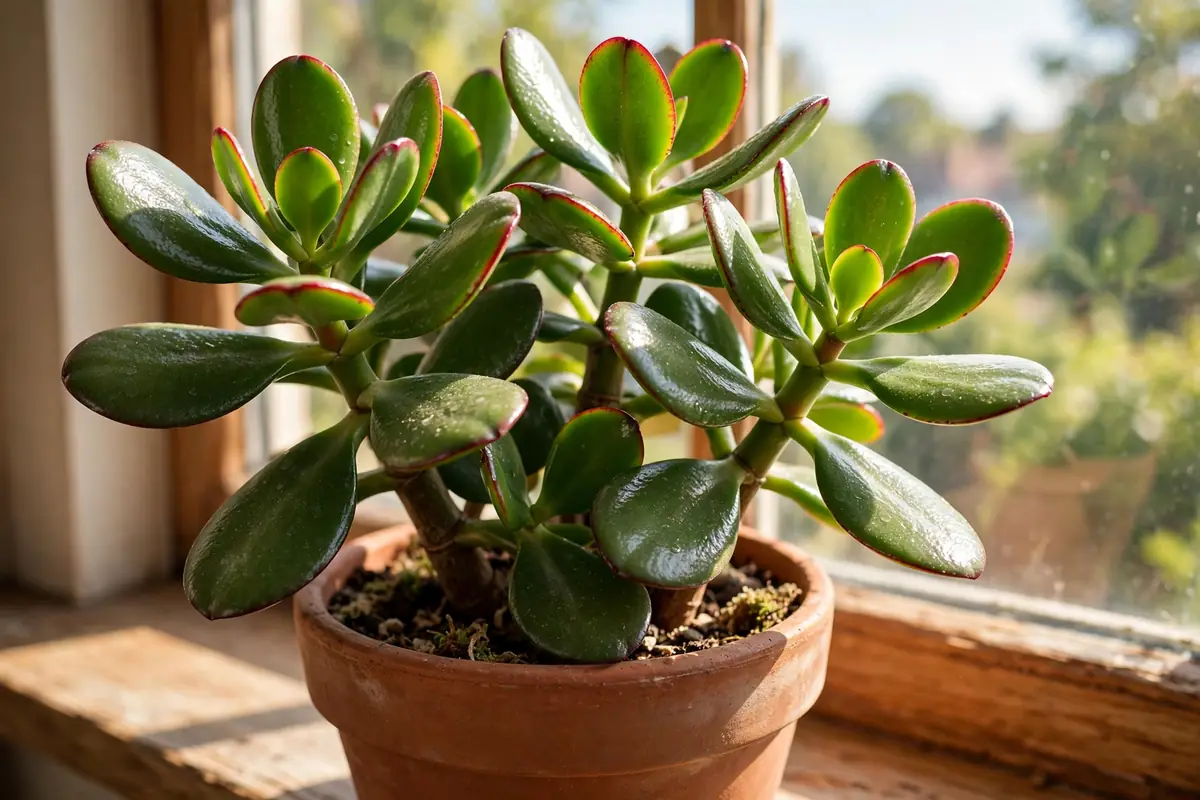
The jade plant is the succulent that made succulents mainstream: thick, glossy, oval leaves on stout woody stems, often blushed red at the edges in strong light. Native to the Eastern Cape of South Africa, it is a genuine survivor — mature plants shrug off weeks of drought and, given age and a cool winter rest, reward growers with clusters of small starry white to pink flowers. In feng shui it is called the money plant, a symbol of prosperity, which explains its popularity as a housewarming gift. Outdoors it is hardy only in zones 10–11; everywhere else it lives on a sunny windowsill.
Give it the brightest light you have and a gritty, fast-draining cactus mix. Water deeply, then wait until the soil is completely dry before watering again — in winter, barely at all. Overwatering is the only common way to kill it; soft, translucent leaves mean too much water. It propagates effortlessly from a single leaf laid on soil. Note that jade plants are mildly toxic to cats and dogs. For a detailed care reference, see the Gardening Know How jade plant guide.
2. Common Jasmine (Jasminum officinale)
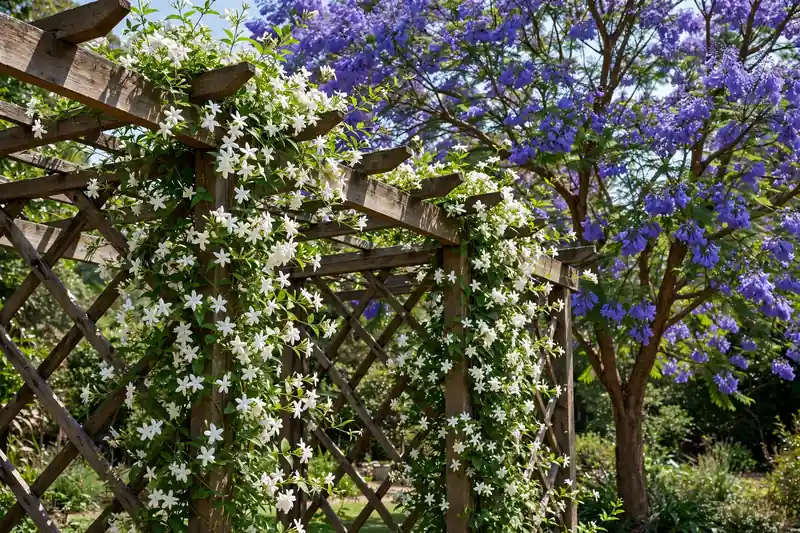
Few plants earn their place in a garden on scent alone, but common jasmine does. Native to the Himalayas and western China, this vigorous deciduous to semi-evergreen vine carries clusters of intensely fragrant white flowers from summer into fall — the perfume that flavors jasmine tea and countless perfumes. Given a trellis, arbor, or sunny wall, it scrambles 15–30 feet in a season. Hardy in zones 7–10, it is a classic cottage-garden climber.
Plant in full sun with fertile, well-drained soil and give it sturdy support from day one. Water consistently the first year; established plants handle short dry spells. Prune hard right after flowering to keep it from turning into a tangle — it blooms on new growth, so late-winter pruning also works in mild climates. In cold zones, grow it in a large pot and overwinter indoors. Do not confuse it with Carolina jessamine (entry 17), an unrelated and highly toxic vine that merely shares the name.
3. Common Juniper (Juniperus communis)
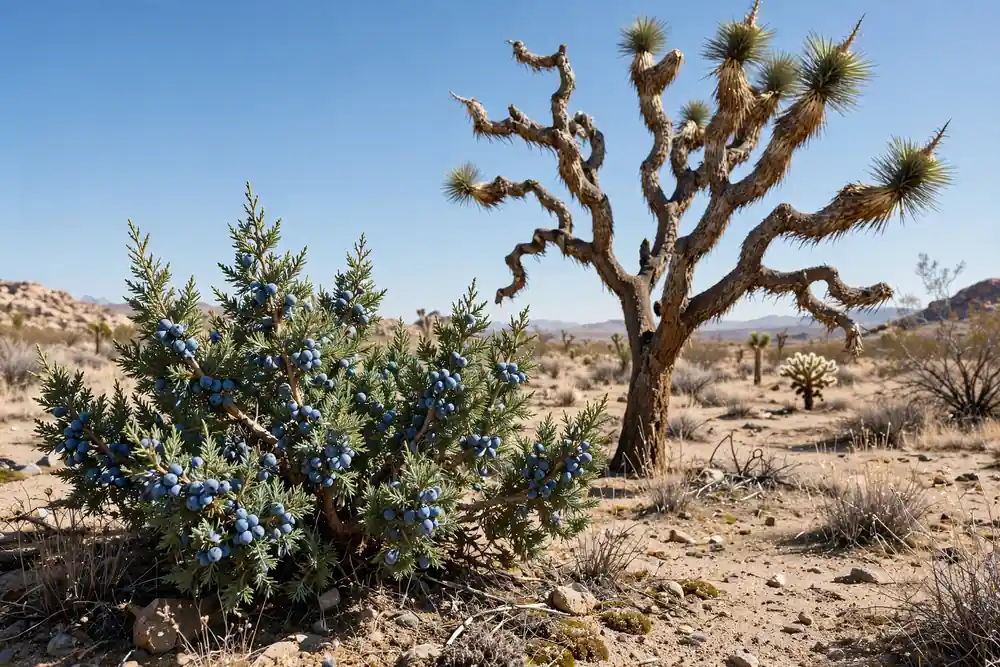
The common juniper has the widest natural range of any woody plant on earth — it grows wild across the entire Northern Hemisphere, from Arctic tundra to mountain slopes. This tough evergreen conifer takes many forms, from prostrate groundcovers to upright 15-foot shrubs, all with sharp, prickly needles and dusty blue “berries” (actually fleshy cones) that flavor gin. Hardy in zones 3–7, it is one of the most cold-tolerant evergreens you can plant and asks almost nothing once established.
Give it full sun and lean, well-drained soil — it actually prefers poor ground and resents rich, wet beds. Drought, wind, salt, and deer all bounce off it. Prune lightly in spring if shaping is needed, but never cut into old brown wood; junipers do not regrow from leafless stems. Most plants are dioecious, so plant several if you want the ornamental berries. It is an excellent choice for erosion control on sunny slopes.
4. Japanese Maple (Acer palmatum)
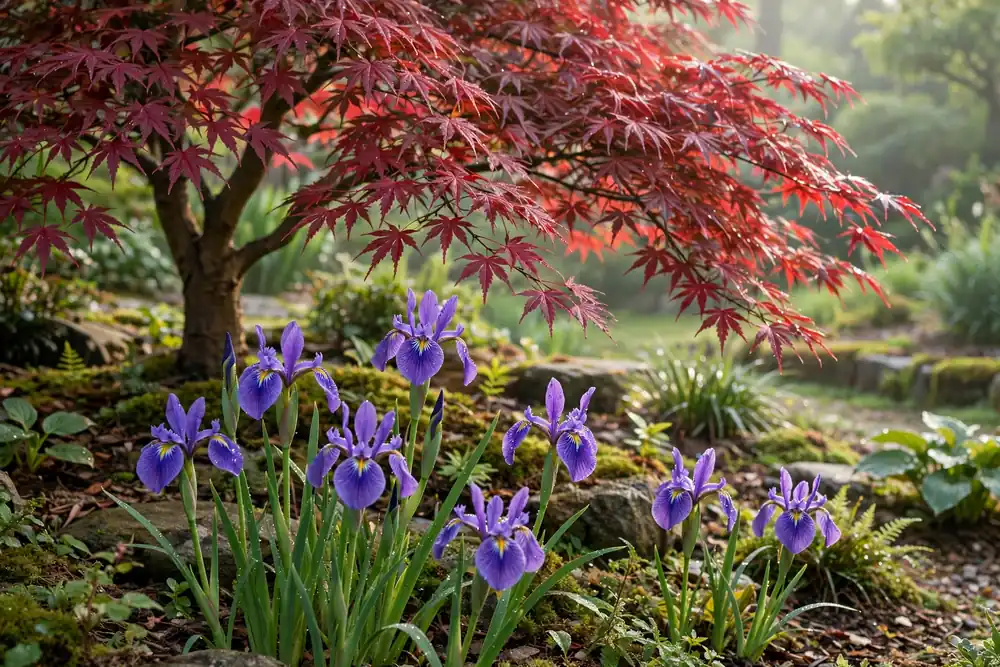
No ornamental tree has been bred into more beautiful forms than the Japanese maple. Native to Japan, Korea, and China, the species has produced hundreds of cultivars — from the fine-cut laceleaf dissectums to upright forms like ‘Bloodgood’ with deep burgundy summer foliage. Spring brings small red flowers, summer brings layered, sculptural canopies, and fall brings the famous crimson, orange, and gold display. Hardy in zones 5–8, even a small cultivar transforms a patio or entry garden.
Site it in full sun to part shade with shelter from harsh afternoon sun and drying winds, which scorch the delicate leaves — morning sun and afternoon shade is ideal in hot climates. It needs consistently moist, well-drained, slightly acidic soil; mulch to keep roots cool. Prune only in summer or late fall to avoid heavy sap bleeding, removing crossing branches to reveal the branch structure. The NC State Extension Japanese maple plant profile is an excellent cultivar reference.
5. Jerusalem Cherry (Solanum pseudocapsicum)
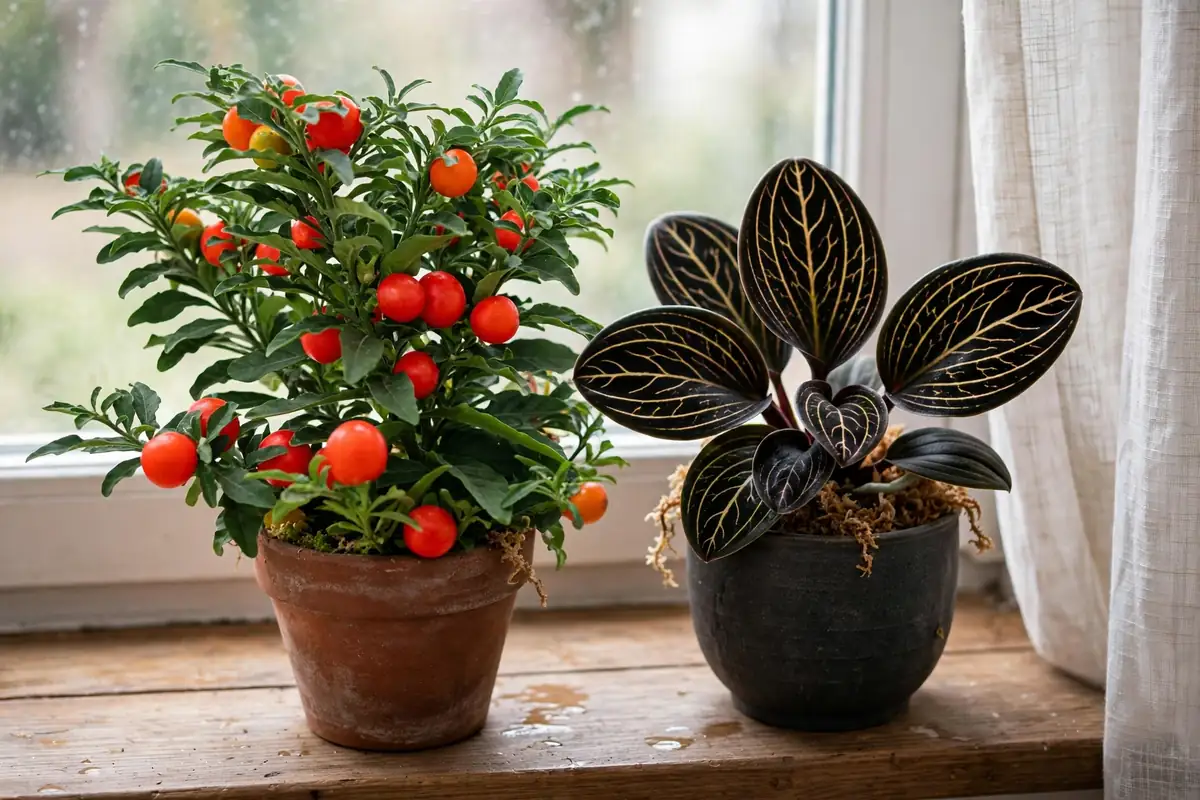
Do not let the name fool you: the Jerusalem cherry is neither from Jerusalem nor a true cherry. This South American nightshade (native to Peru and Ecuador) is grown as a winter houseplant for its cheerful display of round orange-red berries that ripen just as holiday decorating begins. Small white star-shaped flowers in summer give way to the long-lasting fruit, and the compact, bushy plants fit perfectly on a bright windowsill. Outdoors it survives only in zones 9–11.
Grow it in bright light with evenly moist, well-drained soil; it dislikes both soggy roots and full drought. Keep it cool (around 60–65°F / 16–18°C) through winter and the berries will persist for months. Pinch growing tips in spring to keep plants bushy. Important safety note: all parts, especially the berries, contain solanine and are toxic if eaten — keep it away from children and pets, and do not be tempted by the cherry look.
6. Jacob’s Ladder (Polemonium caeruleum)
Jacob’s ladder gets its biblical name from its leaves: neat pairs of oval leaflets climb the stem like rungs of a ladder. In late spring to early summer, the European and Asian native tops 1–2-foot stems with loose clusters of cup-shaped sky-blue flowers with golden stamens — a cool color rare in the early border. Hardy in zones 4–8, it is a refined woodland-edge perennial that pairs beautifully with ferns and hostas.
Plant in part shade with rich, consistently moist soil; it wilts in dry shade and fades in full hot sun. Deadhead after the first flush and it often reblooms. The variegated cultivar ‘Brise d’Anjou’ lights up dark corners even when not flowering. It self-sows gently — welcome in a cottage garden, easy to edit elsewhere. Divide crowded clumps in early spring every few years.
7. Japanese Iris (Iris ensata)
Where most irises demand sharp drainage, the Japanese iris wants its feet wet. Native to marshes and wet meadows of Japan, China, and Korea, it produces enormous flat blooms — up to 8 inches across — in early to midsummer, in shades of violet, blue, pink, and white, many with intricate veining. Hardy in zones 4–9, it is the showpiece of the pond edge and rain garden, blooming after the bearded irises have finished.
Plant in full sun with rich, acidic, moisture-retentive soil; it thrives at the edge of ponds and in boggy spots where other perennials rot. Keep it consistently moist through bloom season — this is one plant you almost cannot overwater in summer. Divide congested clumps in late summer or early fall, replanting divisions promptly so roots never dry out. Remove spent flower stalks but leave the foliage standing for the season.
8. Jicama (Pachyrhizus erosus)
Jicama is the crunchiest vegetable most gardeners have never grown: a leggy Mexican vine that produces large, turnip-shaped tubers with thin brown skin and crisp, sweet, apple-like flesh, eaten raw in salads or with lime and chili. One plant can yield several pounds of tubers, each rich in fiber and low in calories. It needs a long, warm growing season — 5–9 months from seed — so northern gardeners should start it indoors. Perennial in zones 9–11, it is grown as an annual everywhere else.
Sow after all frost danger in full sun with well-drained soil, and provide a trellis — the vines run 15 feet or more. Keep water consistent; drought makes tubers woody. Pinch off the pretty blue-purple flowers to redirect energy into tuber formation. Harvest before the first frost, when tubers are fist to football sized. Critical: only the tuber is edible — the seeds, pods, leaves, and stems contain rotenone and are toxic.
9. Joshua Tree (Yucca brevifolia)
The Joshua tree is less a plant than a landmark — the twisted, branching silhouette that defines California’s Mojave Desert. This giant yucca grows agonizingly slowly, often just a few inches a year, eventually reaching 20–40 feet with dagger-like blue-green leaves and, in good years, spectacular spring panicles of creamy white flowers. Hardy in zones 6–10, it is a true desert specialist with one of nature’s most famous partnerships: it is pollinated exclusively by the yucca moth. Few sights match a Joshua tree forest at sunset, and it ranks among our most unusual and beautiful plants for sheer presence.
Grow it only where summers are hot and dry and winters bring sharp drainage — it rots in humid, wet-winter climates. Full sun and extremely well-drained, even gravelly soil are mandatory. Once established, never water it; supplemental irrigation kills more Joshua trees than drought. It is not a plant for small gardens or impatient gardeners, but in the right desert landscape nothing substitutes for it. Wear gloves: the leaf tips are needle-sharp.
10. Jacaranda (Jacaranda mimosifolia)
In late spring, the jacaranda does something no other street tree does: it drops its fern-like foliage and covers every branch in clouds of violet-blue trumpet flowers, then carpets the ground beneath in a lavender snowfall. Native to Argentina and Bolivia and hardy in zones 9b–11, it grows fast into a broad, spreading 25–50-foot tree that defines the spring streetscapes of Los Angeles, Pretoria, and Buenos Aires. Few flowering trees are more photographed.
Plant in full sun with well-drained soil and give it room — surface roots and falling flowers make it a poor choice near pools and patios. Water deeply while young; established trees are quite drought-tolerant. It blooms best with a dry winter rest, so ease off irrigation in the cool season. Prune young trees to a strong single trunk, then leave them alone — jacarandas resent hard pruning. Expect spectacular bloom on mature trees; young ones may take several years to flower.
11. Jewel Orchid (Ludisia discolor)
Most orchids are grown for flowers; the jewel orchid is grown for leaves. Native to the forest floors of Southeast Asia, it produces rosettes of velvety, near-black leaves traced with glowing red and gold veins — like botanical stained glass. The small white winter flowers are a bonus, not the point. Hardy only in zones 10–11, it is otherwise one of the easiest orchids to grow as a houseplant, thriving in the same conditions as ferns.
Give it low to medium indirect light — direct sun bleaches the dark foliage — with high humidity and a loose, bark-based orchid mix kept lightly moist but never soggy. It is a natural for terrariums and bottle gardens; see our guide to the best terrarium plants for companions. Propagate by stem cuttings in spring, and repot only when the mix breaks down.
12. Japanese Camellia (Camellia japonica)
When the winter garden looks dead, the Japanese camellia disagrees — loudly. Native to Japan, Korea, and China, this glossy evergreen shrub opens rose-like blooms from late winter into spring in reds, pinks, whites, and bicolors, some as wide as your hand. Cultivars number in the thousands, from formal doubles to anemone forms. Hardy in zones 7–9, it is the backbone of Southern and coastal gardens, handsome even when not in flower.
Plant in part shade with rich, acidic, well-drained soil — camellias share the rhododendron’s love of acid ground and its hatred of wet feet. Mulch deeply and water during dry spells; bud drop usually means drought stress. Prune right after flowering only to shape. Site it where you will see the blooms from a window in February, when they matter most.
13. Japanese Cedar / Cryptomeria (Cryptomeria japonica)
Japan’s national tree is a conifer of quiet grandeur: fast-growing, with soft feathery foliage that turns bronze in winter and a straight trunk with reddish, peeling bark. Native to Japan and China and hardy in zones 5–9, cryptomeria makes a superb screen or specimen — the cultivar ‘Yoshino’ is a favorite for its rapid growth and handsome form, while dwarf forms like ‘Globosa Nana’ suit small gardens. Unlike many conifers, it tolerates wet soil and even brief flooding.
Plant in full sun with moist, well-drained to wet soil; it sulks in drought. Give it room — ‘Yoshino’ can reach 30–40 feet — and let it keep its lower branches for the full pyramidal effect. It needs almost no pruning. A reliable, low-drama evergreen that outperforms Leyland cypress in both beauty and disease resistance.
14. Japanese Stewartia (Stewartia pseudocamellia)
If you could plant only one tree for four seasons of interest, the Japanese stewartia would be a strong candidate. Native to Japan and Korea and hardy in zones 5–8, it offers white, camellia-like flowers with golden centers in early summer, rich orange-red fall foliage, and bark that exfoliates in patches of cinnamon, gray, and cream all winter. It grows slowly into an elegant 20–40-foot tree with layered branching.
Plant in full sun to part shade with moist, acidic, well-drained soil rich in organic matter — it dislikes drought and alkaline ground. Mulch to keep roots cool and water young trees through dry spells. It needs virtually no pruning; just remove dead wood. Slow to establish but spectacularly long-lived, it rewards the patient gardener.
15. Japanese Holly (Ilex crenata)
Japanese holly is the boxwood impersonator — small, scalloped evergreen leaves on dense twiggy branches that shear into crisp hedges, globes, and foundation plantings. Native to Japan, Korea, and China and hardy in zones 5–9, it has one advantage over true boxwood: no boxwood blight. Female plants produce small black berries that birds enjoy. Cultivars like ‘Compacta’ and ‘Helleri’ stay naturally mounded with minimal clipping.
Plant in full sun to part shade with moist, well-drained, slightly acidic soil. Water during establishment and dry spells — like boxwood, it dies of drought more often than cold. Shear in late spring after new growth hardens; avoid late-summer pruning that invites winter damage. Give it good air circulation to discourage leaf spot.
16. Japanese Yew (Taxus cuspidata)
The Japanese yew is the shade-tolerant workhorse of the evergreen world. Native to Japan, Korea, China, and Russia and hardy in zones 4–7, it grows as a broad shrub or small tree with dark, glossy needles and, on female plants, bright red fleshy arils in fall. It takes shearing beautifully, making it a top choice for hedges and topiary in shade where boxwood struggles. The spreading cultivar ‘Capitata’ is a landscape staple.
Plant in full sun to full shade with well-drained soil — it tolerates shade and urban conditions but not waterlogged ground. Prune in early spring; it regenerates from old wood better than most conifers. Critical safety note: all parts except the red aril flesh are highly toxic if eaten, so site it away from livestock and teach children never to chew the seeds inside the arils.
17. Carolina Jessamine (Gelsemium sempervirens)
South Carolina’s state flower announces spring earlier than almost anything: this native evergreen vine drapes fences and arbors in fragrant, trumpet-shaped yellow flowers from late winter into spring, backed by glossy leaves that turn bronze-purple in cold weather. Hardy in zones 7–10, it climbs 10–20 feet by twining and needs no coaxing once established — one of the great native vines of the Southeast.
Plant in full sun to part shade with average, well-drained soil and provide a trellis, fence, or arbor. Prune after flowering to control size; it blooms on old wood. It is deer-resistant and nearly pest-free. Non-negotiable warning: all parts are highly toxic if ingested — plant it high on a structure, away from children, pets, and livestock, and never near vegetable gardens where its roots could intermingle.
18. Japanese Pieris (Pieris japonica)
Japanese pieris is a shrub of two seasons: in early spring, long cascading clusters of white (sometimes pink) bell-shaped flowers hang like bridal garlands, and as they fade, the new foliage emerges in brilliant red-bronze before maturing to glossy green. Native to Japan, China, and Taiwan and hardy in zones 5–8, it is a refined evergreen for the part-shade border, growing 6–10 feet with a naturally layered habit.
Give it part shade and rich, acidic, well-drained soil — the same conditions rhododendrons love. Shelter from winter wind, which browns the foliage, and mulch to keep roots cool. Prune only to remove spent flower clusters or wayward branches, right after blooming. Note: the leaves and nectar contain grayanotoxins, toxic to pets and livestock, so avoid planting it in pastures or where dogs chew shrubs.
19. Japanese Spirea (Spiraea japonica)
Japanese spirea is the pink workhorse of the summer shrub border: from early to midsummer, flat-topped clusters of tiny pink flowers cover its mounded 2–4-foot frame, and cultivars like ‘Goldflame’ and ‘Little Princess’ add gold or lime foliage to the show. Native to Japan, Korea, and China and hardy in zones 3–8, it is nearly indestructible — drought-tolerant, deer-resistant, and forgiving of poor soil.
Plant in full sun for the heaviest bloom and shear or cut back by a third in late winter — it flowers on new wood, so hard spring pruning only increases flowers. Deadhead after the first flush for a lighter rebloom. One caution: it self-seeds enthusiastically and is considered invasive in parts of the eastern US, so deadhead reliably and check local guidance before planting near natural areas.
20. Joe Pye Weed (Eutrochium purpureum)
Do not let the “weed” in the name fool you — Joe Pye weed is one of the great native perennials of eastern North America. From late summer into fall, towering 5–7-foot stems carry huge domed clusters of dusky mauve-pink flowers that butterflies, especially swallowtails and monarchs, mob for weeks. Hardy in zones 4–9, it brings vertical drama and late-season nectar to rain gardens and meadow plantings.
Plant in full sun to part shade with moist, even wet soil — it sulks in dry ground. Give it room at the back of the border and resist staking; sturdy stems stand on their own in decent soil. Cut back to 6 inches in late fall or leave the seed heads standing for winter birds and cut back in spring. The compact cultivar ‘Little Joe’ fits smaller gardens at 3–4 feet.
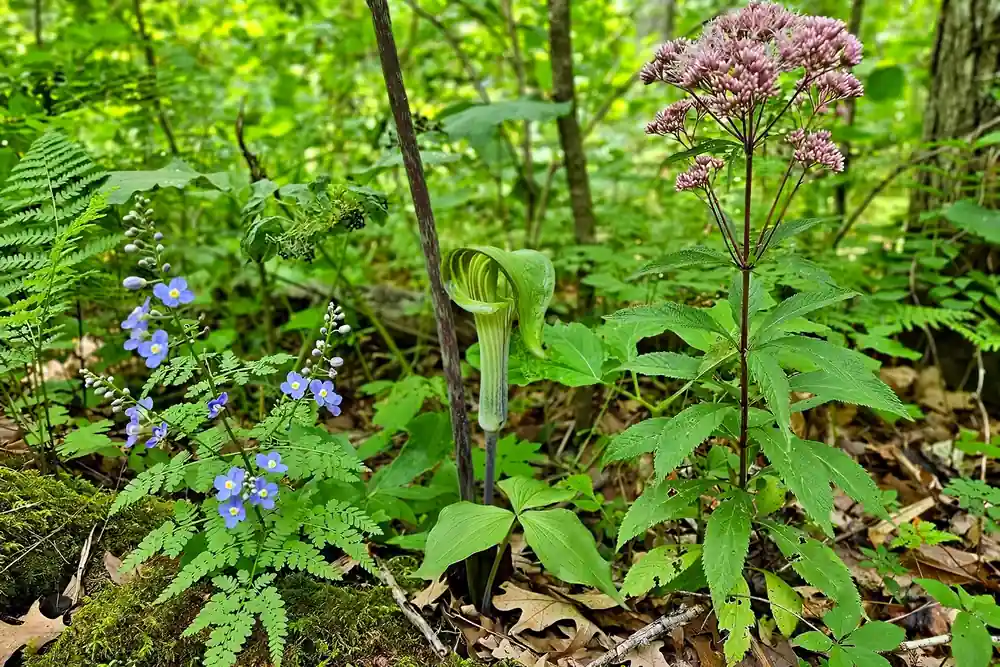
21. Jack-in-the-Pulpit (Arisaema triphyllum)
One of the woodland’s great characters, Jack-in-the-pulpit hides its tiny flowers inside a hooded green-and-purple striped spathe — “Jack” (the spadix) preaching from his “pulpit.” Native to the forests of eastern North America and hardy in zones 4–9, it emerges in spring, and by fall the pollinated females carry a striking cluster of bright red berries. It even changes sex with age: young plants are male, maturing into females as their corms grow large enough to support fruit.
Plant corms in part to full shade with rich, moist, humus-heavy soil, mimicking the forest floor. It goes dormant by midsummer in dry years — mark the spot so you do not dig it up. Leave the berries for wildlife. Warning: all parts contain calcium oxalate crystals and are intensely irritating raw; admire, do not taste.
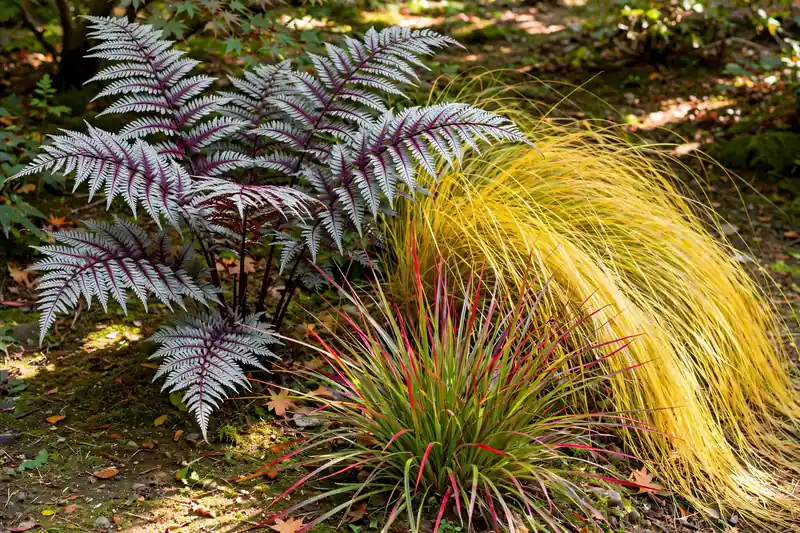
22. Japanese Blood Grass (Imperata cylindrica ‘Red Baron’)
Few ornamental grasses make a bolder statement: Japanese blood grass sends up upright blades that emerge green and bleed to vivid crimson from the tips down, brightest in full sun and cool fall weather. The cultivar ‘Red Baron’ (also sold as ‘Rubra’) is the garden-safe form — unlike the straight species, which is a federally listed noxious weed in the US, ‘Red Baron’ rarely flowers and does not set viable seed. Hardy in zones 5–9, it grows in slowly expanding clumps about 18 inches tall.
Plant in full sun for the deepest red color; in shade it stays mostly green. Give it average, well-drained soil and water regularly the first season. Cut the whole clump to a few inches in late winter before new growth starts. Divide in spring if the center thins. Buy only named ‘Red Baron’ stock from reputable nurseries — never the species.
23. Japanese Painted Fern (Athyrium niponicum ‘Pictum’)
The Japanese painted fern looks airbrushed: arching fronds in silvery gray-green, each with a burgundy-purple midrib and a soft metallic sheen. Native to Japan, China, and Korea and hardy in zones 4–8, it is widely considered the most beautiful hardy fern for shade — a 12–18-inch mound that glows in dark corners where little else has color. It was even named Perennial Plant of the Year in 2004.
Plant in part to full shade with rich, consistently moist soil high in organic matter; it crisps in dry or sunny spots. It emerges late in spring, so mark its location and be patient. Cut back tattered fronds in late fall or early spring. It pairs perfectly with hostas, astilbes, and the Japanese forest grass below.
24. Japanese Forest Grass (Hakonechloa macra)
Japanese forest grass moves like water. Native to the mountains of Japan and hardy in zones 5–9, it forms cascading mounds of arching blades — the cultivar ‘Aureola’ in gold variegated with green, ‘All Gold’ in pure gold — that ripple in the slightest breeze and turn tawny in fall. At 18–24 inches it is one of the few ornamental grasses that genuinely prefers shade, making it invaluable for brightening dark beds and woodland paths.
Plant in part shade with rich, consistently moist, well-drained soil; it struggles in drought and full hot sun. It is slow to establish — expect a modest first year, then a glorious second — so buy good-sized plants and mulch well. Cut back old foliage in late winter. Deer generally leave it alone.
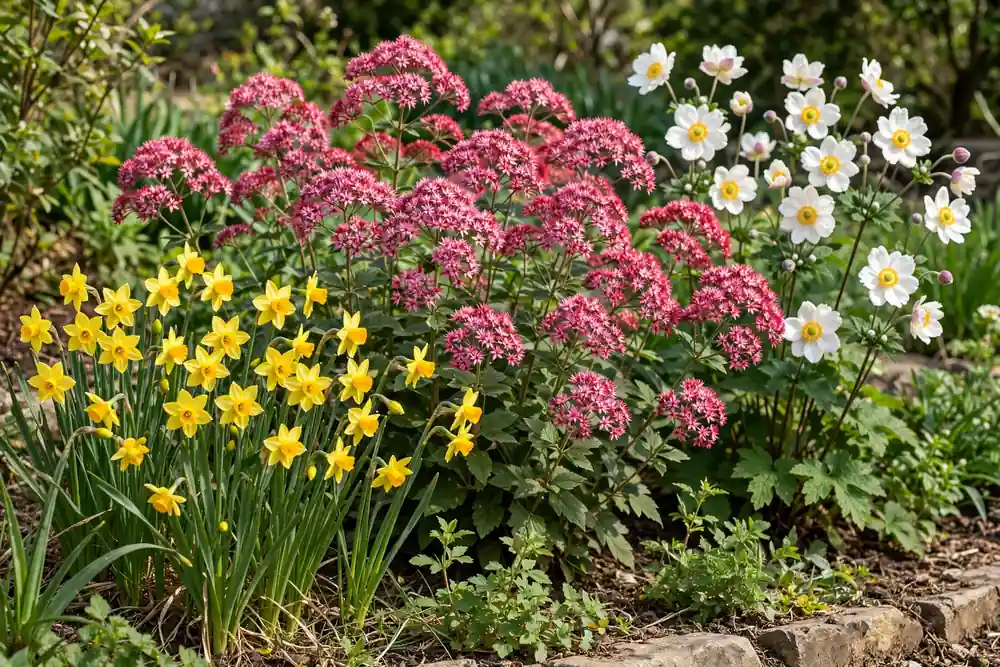
25. Jupiter’s Beard (Centranthus ruber)
Named for the Roman god’s beard, Jupiter’s beard is a Mediterranean tough guy: blue-green fleshy foliage and dense clusters of tiny deep-pink to red (sometimes white) flowers from late spring through summer, absolutely beloved by butterflies and hummingbirds. Hardy in zones 5–9, it thrives in poor, dry, even chalky soil where fussier perennials fail — a classic cottage-garden and coastal plant that asks for neglect.
Plant in full sun with well-drained, even poor soil; rich ground makes it floppy. Deadhead after the first flush for rebloom into fall, and cut back hard in midsummer if it sprawls. It self-sows freely — deadhead if you want to limit volunteers, or let it naturalize in walls and gravel where it looks most at home. The white form ‘Albus’ is elegant in moon gardens.
26. Jonquil (Narcissus jonquilla)
The jonquil is the daffodil family’s perfume specialist. Native to Spain and Portugal and hardy in zones 4–9, it carries clusters of small, richly fragrant golden-yellow flowers — several per stem — on rush-like cylindrical leaves in mid to late spring, after the big trumpet daffodils fade. The scent is sweet and powerful, and a few stems perfume a whole room. Deer, rabbits, and rodents all avoid it.
Plant bulbs in fall, 4–6 inches deep, in full sun to part shade with well-drained soil; they rot in winter-wet ground. Let the foliage ripen naturally for six weeks after bloom — no braiding or early mowing — so bulbs recharge. They naturalize beautifully and can go decades undisturbed. Like all narcissus, bulbs and foliage are toxic if eaten.
27. Japanese Anemone (Anemone hupehensis)
When the summer border is winding down, the Japanese anemone takes the stage. Native to China and hardy in zones 4–8, it sends up 2–4-foot branching stems of single pink (or white in ‘Honorine Jobert’) flowers with golden centers from late summer into fall, floating above handsome dark foliage. It is one of the few perennials that peaks in September and October, when pollinators are desperate for late nectar.
Plant in part shade with rich, moist, well-drained soil; it wilts in dry shade. Give it room — it spreads by underground rhizomes into generous colonies, which is a feature in a woodland border but needs edging near small plants. Cut back spent stems in late fall. Established clumps resent moving, so choose the site carefully.
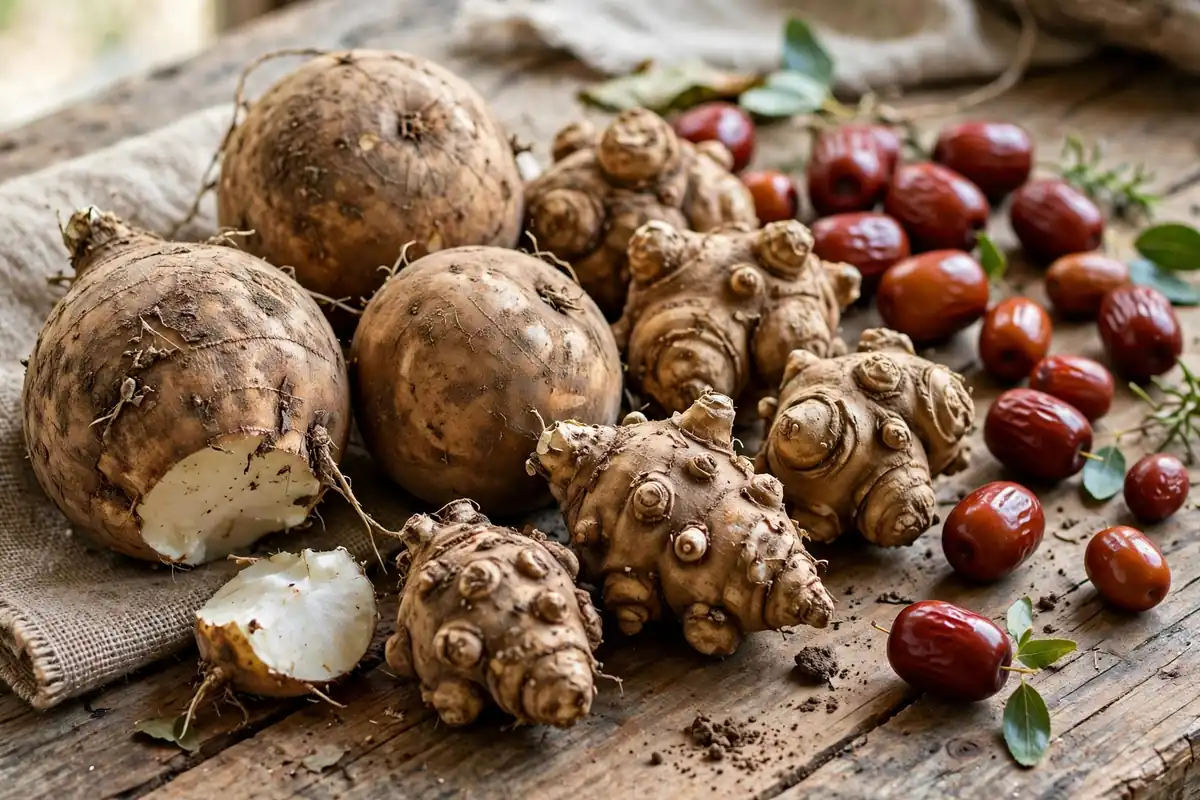
28. Jerusalem Artichoke (Helianthus tuberosus)
Another misnamed J-plant: the Jerusalem artichoke is neither from Jerusalem (the name is a corruption of the Italian girasole, sunflower) nor an artichoke. It is a North American native sunflower, hardy in zones 3–8, grown for crisp, nutty, knobby tubers that taste like a cross between water chestnut and artichoke heart. In late summer it also produces cheerful yellow sunflower blooms on 6–10-foot stems. The tubers are rich in inulin, a prebiotic fiber — which also explains their famously windy reputation.
Plant tubers in early spring in full sun with any decent soil, but contain it: dedicate a bed or bury a bottomless barrier, because any tuber fragment left behind becomes next year’s plant. Harvest after the first frosts, when flavor is sweetest, and leave some in the ground as next year’s seed. The Old Farmer’s Almanac Jerusalem artichoke growing guide covers varieties and storage.
29. Jujube (Ziziphus jujuba)
The jujube — Chinese date — is one of the toughest fruit trees you can grow. Native to China and hardy in zones 6–9, it produces sweet, date-like fruits that ripen from green to mahogany red in fall, delicious fresh when crisp or dried when chewy. It laughs at heat, drought, and poor soil, is largely pest-free, and its glossy leaves and gnarled, sometimes thorny branches have real ornamental character. Cultivars like ‘Li’ (large, round fruit) and ‘Lang’ (pear-shaped) are widely available.
Plant in full sun with well-drained soil and give it room — trees reach 15–25 feet. It leafs out very late in spring, so do not assume a bare May tree is dead. Most cultivars are self-fertile, but planting two improves crops. Water young trees; established ones need almost nothing. Harvest when fruits are fully colored but still crisp, or leave them to dry on the tree.
30. Japanese Barberry (Berberis thunbergii)
Japanese barberry is the J-list’s cautionary tale. Native to Japan and hardy in zones 4–8, it is undeniably handsome — dense, thorny mounds of small leaves in green, gold, or deep burgundy (‘Crimson Pygmy’, ‘Rose Glow’), with tiny yellow spring flowers and red winter berries. It tolerates drought, shade, pollution, and deer. But in much of the eastern United States it has escaped gardens to invade forests, where it also creates ideal humid habitat for black-legged ticks.
Honest expert advice: check your state’s regulations before planting — it is banned or restricted in several states, and sterile cultivars are not reliably sterile. Where it is problematic, plant alternatives with similar color and toughness: ninebark (Physocarpus), purple smokebush, or dwarf Japanese maple cultivars. If you already grow it, deadhead or remove female plants near natural areas. The Royal Horticultural Society’s Berberis thunbergii plant profile notes its vigorous, suckering habit.
Growing Tips for J-Plants
Match the zone before you fall in love. The J-list spans zones 3 to 11, and the tropical stars — jacaranda, jewel orchid, Jerusalem cherry, jade plant — will not survive a frost. In cold climates, grow them in containers and overwinter indoors, or enjoy them as houseplants year-round. Conversely, common juniper, Jack-in-the-pulpit, and Jerusalem artichoke demand winter chill and sulk in zone 10 heat.
Drainage decides more fates than fertilizer. Joshua tree, jade plant, Jupiter’s beard, and jujube die in winter-wet soil long before cold gets them. When in doubt, plant high — mound the soil, use raised beds, or add grit. Jade plants and other succulents want a cactus mix, not potting soil, and a pot with a drainage hole is mandatory. At the opposite extreme, Japanese iris and Joe Pye weed want their feet moist — site them where water lingers.
Feed the edibles, starve the desert plants. Jicama, Jerusalem artichoke, and jujube are hungry or at least appreciative plants that reward fertile soil and regular water with bigger harvests. Joshua tree and juniper are the opposite: rich soil and extra water make them weak, floppy, or rotten. Read every label through the plant’s eyes, not the garden center’s.
Prune on the plant’s schedule. Spring bloomers on old wood — Carolina jessamine, Japanese pieris, Japanese camellia — get pruned right after flowering. Summer bloomers on new wood — Japanese spirea, Jupiter’s beard, jacaranda (minimal) — get cut back in late winter or deadheaded through the season. Prune a spring bloomer in fall and you have removed next year’s flowers. Conifers like juniper, cryptomeria, and yew get only light shaping, never hard cutbacks into bare wood.
Plan for all four seasons. J-plants make this easy: Carolina jessamine and Japanese pieris open spring, jacaranda and Japanese iris carry early summer, Japanese anemone and Joe Pye weed take fall, Japanese camellia blooms in winter, and Jerusalem cherry berries indoors through the holidays. For autumn container color after the summer perennials fade, our mum care guide pairs well with this list.
Which J-Plants Will You Grow?
Thirty plants, one letter — and the range is remarkable. Start indoors with a jade plant or jewel orchid if you are new to houseplants; plant a Japanese maple or jacaranda if you want a tree that stops traffic; sow jicama or Jerusalem artichoke if you want dinner. The J-list rewards every kind of gardener, from windowsill to acreage.
Keep exploring the alphabet with our guides to plants that start with H, plants that start with M, plants that start with N, and plants that start with P — or browse flowers that start with J if blooms are your main pursuit. Pick three J-plants that fit your light and zone, get them in the ground this season, and watch the letter J earn its keep. Happy planting!
Frequently Asked Questions
What are the most popular plants that start with J?
The most popular J-plants are jade plant, jasmine, juniper, Japanese maple, jacaranda, Joshua tree, Japanese iris, jicama, jujube, Jerusalem artichoke, Joe Pye weed, Jack-in-the-pulpit, Japanese camellia, and jonquil. Together they cover houseplants, fragrant vines, flowering trees, desert icons, edibles, and native wildflowers, and most are widely available at garden centers and nurseries.
Which plants starting with J are good for beginners?
Jade plant is nearly indestructible for beginners, common juniper and Japanese spirea are forgiving landscape shrubs, Japanese forest grass and Jupiter’s beard tolerate imperfect conditions outdoors, and jicama and Jerusalem artichoke are easy edible projects. Start with plants matched to your light and hardiness zone and most of this list is easy.
Which J-plants are safe for pets?
Relatively pet-safe choices include Japanese painted fern, Japanese forest grass, Jupiter’s beard, and jonquil foliage in normal garden contexts, plus the edible tubers and fruits (jicama tuber, jujube fruit) as foods. Avoid jade plant, Jerusalem cherry (toxic berries), Carolina jessamine (highly toxic), Japanese yew (highly toxic seeds), Japanese pieris, and Jacob’s ladder relatives around cats and dogs that chew plants.
What plants that start with J grow in shade?
Japanese painted fern, Japanese forest grass, and Jack-in-the-pulpit all prefer shade, Jacob’s ladder and Japanese anemone thrive in part shade, and indoors jewel orchid actively prefers low to medium light. Japanese yew and Japanese holly tolerate shade too. Most “shade” plants still perform best with bright indirect light rather than deep darkness.
Can I grow a Joshua tree outside the desert?
Only in climates with hot, dry summers and sharp winter drainage — it is hardy to zone 6 but rots in humid, wet-winter regions. Full sun and gravelly, fast-draining soil are mandatory, and established trees should never be irrigated. In humid climates it will not survive outdoors; admire it in botanical gardens instead.
Is Japanese barberry invasive?
Yes, in much of the eastern United States Japanese barberry has escaped cultivation and invades forests and natural areas, where it also creates favorable habitat for ticks. It is banned or restricted in several states. Check local regulations before planting, and consider alternatives like ninebark or purple smokebush for similar color without the ecological cost.