23 Plants That Start With Z: Names, Pictures & Growing Tips
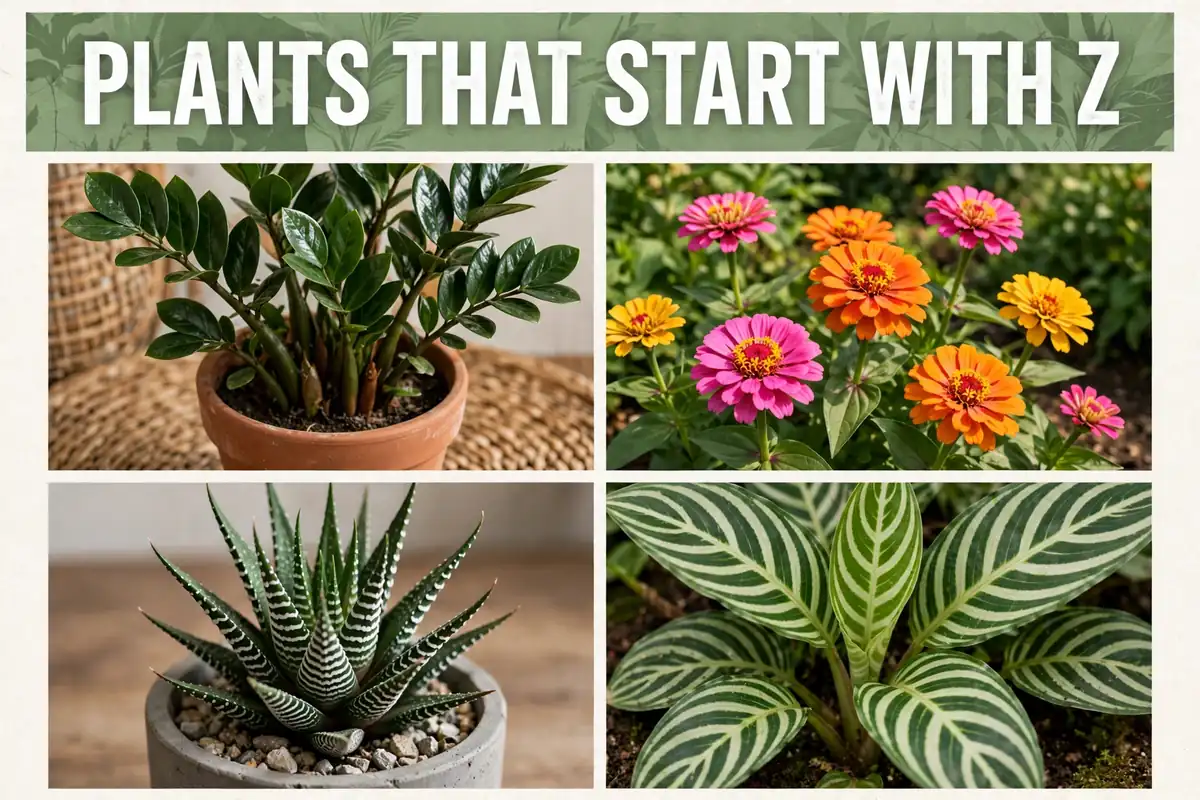
Looking for plants that start with Z? You have picked the rarest letter in the plant kingdom — and that makes this list a genuine treasure hunt. Z gives us the nearly indestructible ZZ plant, the butterfly-magnet zinnia, the striped zebra haworthia, the architectural zebra grass, the elegant calla lily, the ancient jujube tree, and the fragrant zygopetalum orchid. This guide covers 23 real plants that start with Z, each with its botanical name, native region, bloom season, and practical growing advice. Every entry is a verified, real plant — where a common name covers two different plants or a cultivar, we say so honestly rather than padding the list. If you are mainly after blooms, see also our companion guide to flowers that start with Z.
Every entry below lists the plant’s scientific name, light and water needs, and USDA hardiness zone, so you can tell at a glance which Z-plants suit your home or garden. You will also find two comparison tables, hands-on growing tips, and answers to the questions gardeners ask most about plants starting with Z.
Quick Answer
Popular plants that start with Z include ZZ Plant (Zanzibar Gem), Zinnia, Zebra Haworthia, Zebra Plant, Rain Lily (Zephyranthes), Zonal Geranium, Zebra Grass, Calla Lily (Zantedeschia), Jujube, Japanese Zelkova, Ginger, and Zucchini. They span indestructible houseplants, striped succulents, summer annuals, ornamental grasses, fruit trees, and vegetables — covering USDA zones 4–11, so there is a Z-plant for nearly every garden and windowsill.
Table of Contents
Z-Plants at a Glance
Use this table to compare all 23 plants that start with Z side by side, from botanical names to native regions.
| Plant name | Scientific name | Type | Light | Native region |
|---|---|---|---|---|
| ZZ Plant (Zanzibar Gem) | Zamioculcas zamiifolia | Houseplant | Low to bright indirect | Eastern and southern Africa |
| Zinnia | Zinnia elegans | Annual flower | Full sun | Mexico |
| Zebra Plant (Calathea) | Goeppertia zebrina (syn. Calathea zebrina) | Houseplant | Bright indirect | Brazil |
| Zebra Plant (Aphelandra) | Aphelandra squarrosa | Houseplant / tropical shrub | Bright indirect | Brazil |
| Zebra Haworthia (Zebra Cactus) | Haworthiopsis attenuata | Succulent | Bright light | South Africa |
| Rain Lily | Zephyranthes spp. | Bulb perennial | Full sun to part shade | Americas (southern USA to South America) |
| Zonal Geranium | Pelargonium × hortorum | Bedding plant / houseplant | Full sun | Garden hybrid (South African parentage) |
| Zebra Grass | Miscanthus sinensis ‘Zebrinus’ | Ornamental grass | Full sun | Japan, Korea, China |
| Zebra Basket Vine | Aeschynanthus marmoratus | Trailing houseplant | Bright indirect | Myanmar, Thailand, Malaysia |
| Zebrina (Silver Inch Plant) | Tradescantia zebrina | Trailing houseplant | Bright indirect | Mexico, Central America |
| Calla Lily | Zantedeschia aethiopica | Rhizomatous perennial | Full sun to part shade | South Africa |
| Japanese Zelkova | Zelkova serrata | Shade tree | Full sun | Japan, Korea, China, Taiwan |
| Jujube | Ziziphus jujuba | Fruit tree | Full sun | China |
| Zenobia (Honeycup) | Zenobia pulverulenta | Evergreen shrub | Full sun to part shade | Southeastern USA |
| Cardboard Palm | Zamia furfuracea | Cycad | Full sun to part shade | Mexico (Veracruz) |
| Coontie | Zamia integrifolia | Cycad | Part shade | Florida, southeastern USA |
| Ginger | Zingiber officinale | Tropical herb / vegetable | Part shade | Southeast Asia |
| California Fuchsia | Epilobium canum (syn. Zauschneria californica) | Perennial | Full sun | Western USA, Mexico |
| Zygopetalum Orchid | Zygopetalum spp. | Orchid | Bright indirect | Brazil and South America |
| Zucchini | Cucurbita pepo | Vegetable | Full sun | Americas (modern form from Italy) |
| Green Zebra Tomato | Solanum lycopersicum ‘Green Zebra’ | Vegetable (cultivar) | Full sun | Garden cultivar (USA) |
| Zebra Mallow | Malva sylvestris var. mauritiana ‘Zebrina’ | Perennial flower (cultivar) | Full sun | Garden cultivar (European parentage) |
| Zigzag Plant | Euphorbia tithymaloides | Tropical shrub / houseplant | Bright light | Tropical Americas |
Bloom Season, Water Needs & Hardiness Zones
This second table focuses on practical care: when each Z-plant blooms, how much water it wants, and the USDA zones where it survives winter outdoors.
| Plant name | Bloom season | Water needs | USDA hardiness |
|---|---|---|---|
| ZZ Plant (Zanzibar Gem) | Rarely indoors (inconspicuous) | Low — let soil dry out | 9–10 |
| Zinnia | Summer to frost | Medium — consistent, at soil level | Grown as annual |
| Zebra Plant (Calathea) | Rarely indoors (purple flowers) | Medium-high — keep moist | 11–12 |
| Zebra Plant (Aphelandra) | Summer to fall (yellow spikes) | Medium-high — keep moist | 11–12 |
| Zebra Haworthia (Zebra Cactus) | Rarely (white tubular flowers) | Low — drought tolerant | 9–11 |
| Rain Lily | Summer to fall (after rains) | Medium — likes rain pulses | 7–10 |
| Zonal Geranium | Late spring to frost | Medium — let surface dry | 10–11 |
| Zebra Grass | Late summer to fall (plumes) | Medium — tolerates some drought | 5–9 |
| Zebra Basket Vine | Sporadic (tubular flowers) | Medium — evenly moist | 10–11 |
| Zebrina (Silver Inch Plant) | Sporadic (small pink flowers) | Medium — evenly moist | 9–11 |
| Calla Lily | Late spring to summer | High — likes wet soil | 8–10 |
| Japanese Zelkova | Spring (inconspicuous) | Medium | 5–8 |
| Jujube | Summer (small yellow flowers) | Low — very drought tolerant | 6–9 |
| Zenobia (Honeycup) | Late spring to early summer | Medium — moist, acidic soil | 5–9 |
| Cardboard Palm | Non-flowering (cycad) | Low-medium — well drained | 9–11 |
| Coontie | Non-flowering (cycad) | Low-medium — well drained | 8–10 |
| Ginger | Rarely (when mature, tropical) | Medium-high — consistently moist | 8–10 |
| California Fuchsia | Late summer to fall | Low once established | 8–10 |
| Zygopetalum Orchid | Fall to winter | Medium — bark mix, humid | 10–11 |
| Zucchini | Summer (yellow flowers) | High — consistent moisture | Grown as annual |
| Green Zebra Tomato | Summer (yellow flowers) | High — consistent moisture | Grown as annual |
| Zebra Mallow | Summer to fall | Medium | 4–8 |
| Zigzag Plant | Sporadic (small red bracts) | Low-medium — let dry | 9–11 |
23 Plants That Start With Z: The Complete List
Below is the full rundown — houseplants, succulents, annuals, grasses, trees, orchids, fruits, and vegetables — with the growing details that matter for each one.
1. ZZ Plant / Zanzibar Gem (Zamioculcas zamiifolia)
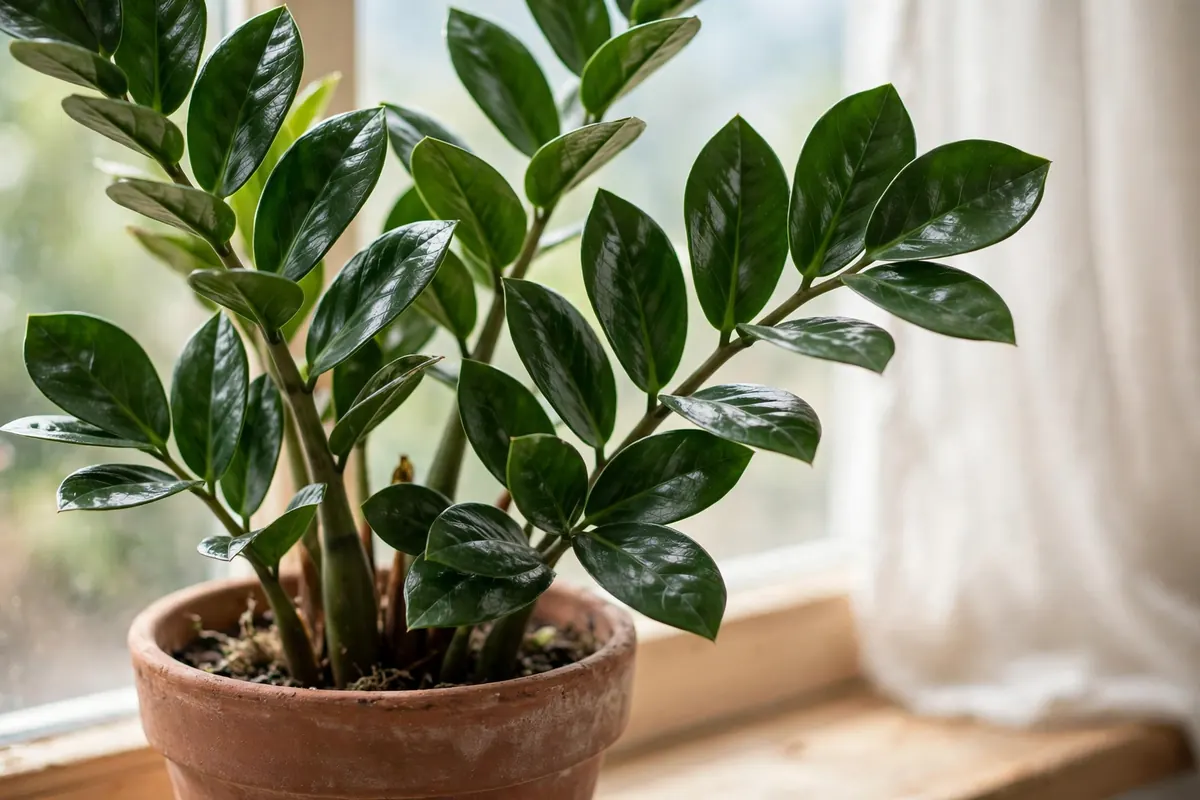
Here is an honest start to the list: “ZZ plant” and “Zanzibar gem” are not two plants — they are two common names for the same species, Zamioculcas zamiifolia, a rhizomatous evergreen perennial from eastern and southern Africa. Its upright stems carry pairs of glossy, dark-green oval leaflets that look polished even in a dim office corner. Thick underground rhizomes store water, which is why this is one of the most forgiving houseplants ever sold — it tolerates low light, irregular watering, and general neglect better than almost anything else with leaves. Outdoors it is hardy only in zones 9–10.
Treat it like a succulent: bright indirect light is ideal (it survives low light but grows slowly), and water only when the soil is completely dry — monthly in winter is plenty. Overwatering is the one reliable way to kill it. Feed once or twice a year at most. One caution from the NC State Extension ZZ plant profile: it has medium toxicity to cats and dogs, so keep it away from pets that chew. The near-black cultivar ‘Raven’ is the same species with dramatic dark foliage if you want a twist on the classic.
2. Zinnia (Zinnia elegans)
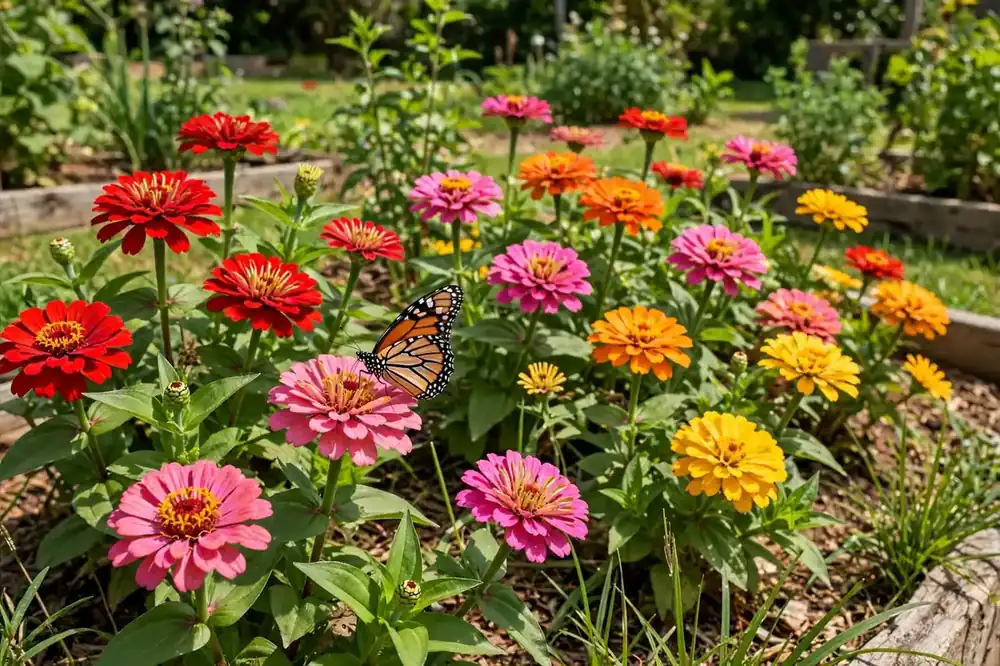
Named for the German botanist Johann Zinn, the zinnia is a Mexican native that became one of the world’s easiest and most generous annual flowers. Modern Zinnia elegans varieties range from dainty single daisies to giant dahlia-like doubles in every hot color — red, orange, pink, yellow, purple, lime, and white — blooming nonstop from summer until frost. They are butterfly and hummingbird magnets, superb cut flowers, and famously forgiving for beginners. Every garden with full sun deserves a row.
Sow seeds directly outdoors after all frost danger has passed and soil reaches about 70°F — zinnias germinate in 4–7 days and resent transplanting. Sow 1/4 inch deep, space 12 inches apart for airflow, and water at the base rather than overhead to discourage powdery mildew. The more you cut for bouquets, the more they branch and bloom. The Old Farmer’s Almanac zinnia growing guide covers varieties, succession sowing, and mildew-resistant types in detail. Save seeds from your favorites for next year.
3. Zebra Plant — Calathea (Goeppertia zebrina, syn. Calathea zebrina)
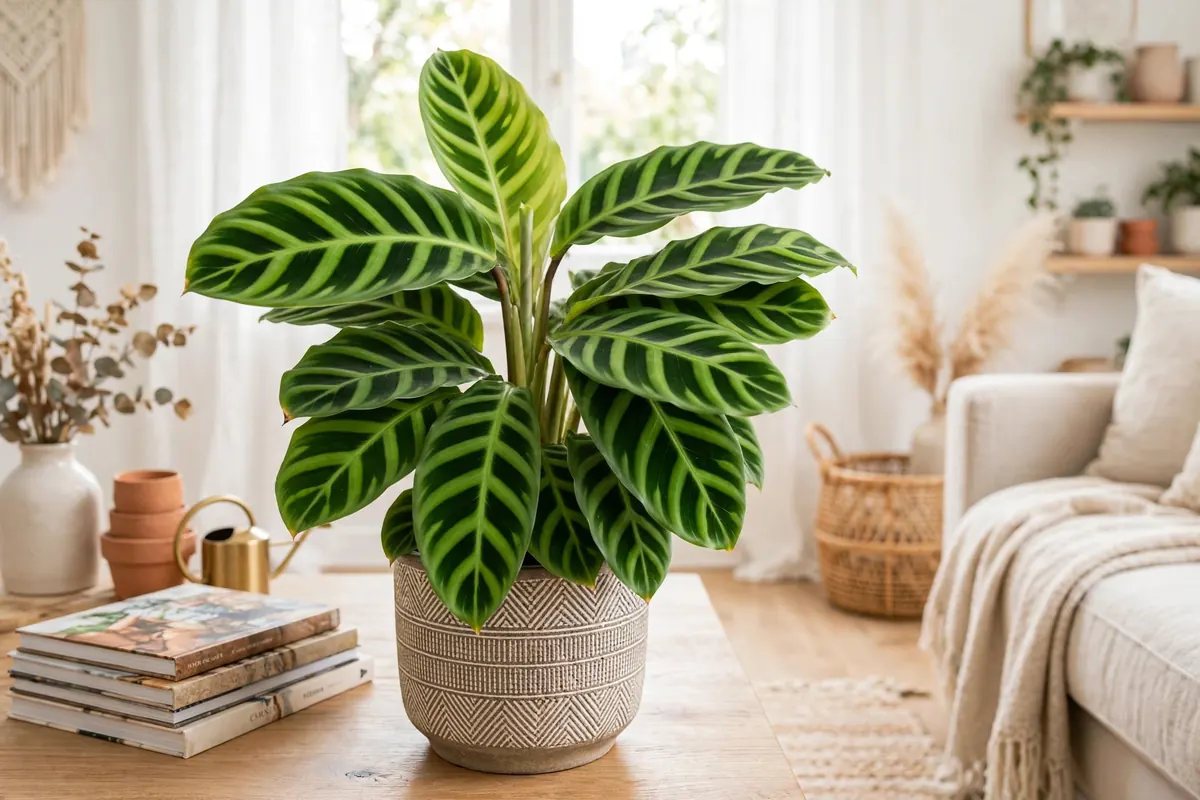
An important clarification: two completely different plants are sold as “zebra plant.” This one is the prayer-plant relative from Brazil, still widely labeled Calathea zebrina though botanists have moved it to Goeppertia. Its large, velvety, oval leaves are striped with alternating bands of light and dark green — the most literal zebra pattern of any houseplant — on long stems that rise from a central crown. It is a foliage plant first and last; the small purple flowers it produces indoors are a bonus, not the point.
Like all prayer plants, it wants bright indirect light (direct sun bleaches the stripes), consistently moist but not soggy soil, and high humidity — brown leaf edges are the classic complaint of dry indoor air. Use rainwater or distilled water if your tap water is hard, since mineral salts spot the leaves. It is non-toxic to pets, which makes it a safe statement plant for animal households. Hardy outdoors only in zones 11–12, it also shines in a large enclosed planter — see our picks for the best terrarium plants for companions that love the same steamy conditions.
4. Zebra Plant — Aphelandra (Aphelandra squarrosa)
The other “zebra plant” is Aphelandra squarrosa, also from Brazil but a totally different beast: stiff, glossy, dark-green leaves boldly veined in creamy white, growing upright on woody stems to about two feet indoors. Where the calathea is soft and velvety, the aphelandra is architectural and high-contrast. It also earns its keep with bright yellow, cone-like flower spikes tipped with tiny white blooms — a genuinely showy display most striped houseplants never attempt.
This is the fussier of the two zebra plants. It demands bright indirect light, warm temperatures above 60°F, high humidity, and soil that stays evenly moist — let it dry out and the lower leaves drop, a one-way trip. Feed through spring and summer, and cut the spent flower spike back to encourage branching. It is really a tropical shrub masquerading as a houseplant (zones 11–12), so in most climates it lives indoors year-round. When buying, check the botanical name on the tag so you know which zebra you are taking home.
5. Zebra Haworthia / Zebra Cactus (Haworthiopsis attenuata)
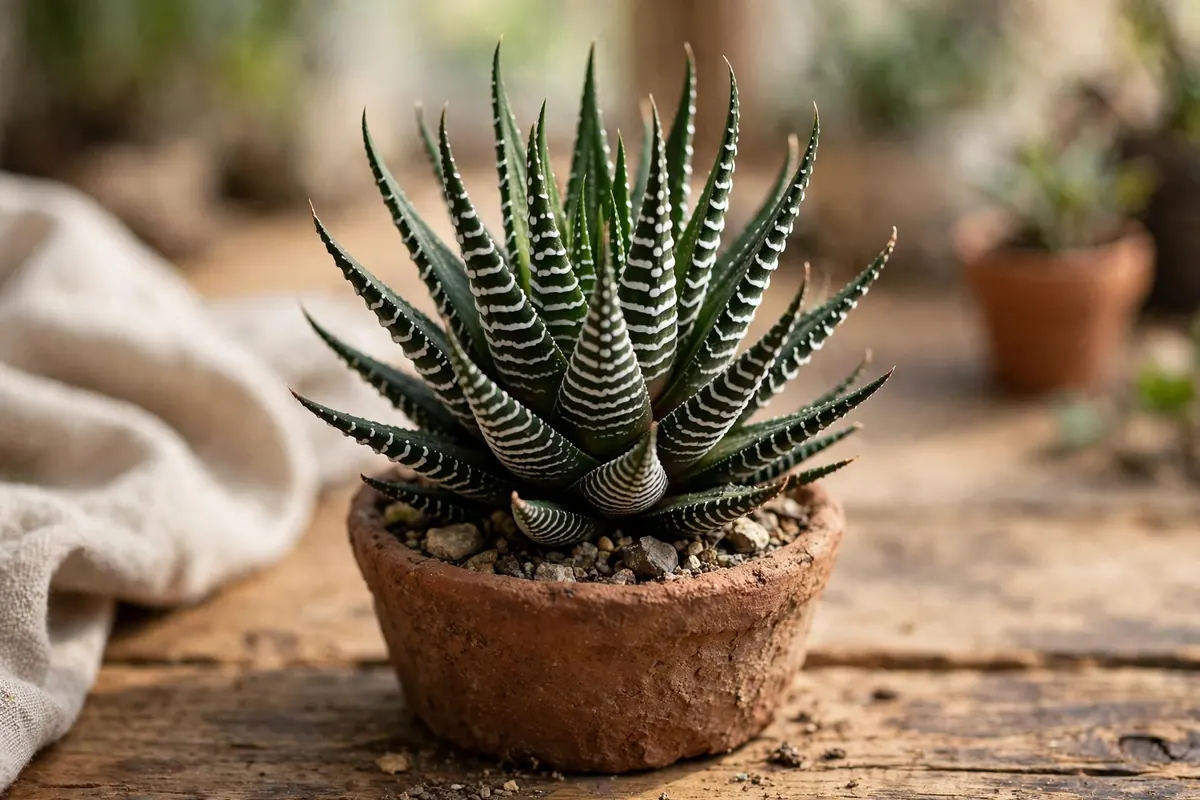
Another honest naming note: the “zebra cactus” is not a cactus at all — it is a South African succulent, Haworthiopsis attenuata (long sold as Haworthia attenuata), and “zebra haworthia” is the more accurate name. The dark-green, pointed leaves grow in a tight rosette and are studded with raised white tubercles that form horizontal zebra-like bands. It stays compact — rarely over six inches — which makes it perfect for windowsills, desks, and succulent arrangements. Mature clumps offset freely, so one plant becomes many.
Give it the brightest light you have indoors (an east or south window is ideal), gritty fast-draining cactus soil, and water only when the soil is completely dry — then water thoroughly. In zones 9–11 it can live outdoors year-round in rock gardens and containers, but everywhere else it is strictly a houseplant that must come inside before frost. It is slow-growing and nearly pest-free; the main killer is rot from overwatering or a pot without drainage. Do not confuse it with Haworthiopsis fasciata, a similar species whose white bands appear only on the leaf undersides.
6. Rain Lily (Zephyranthes spp.)
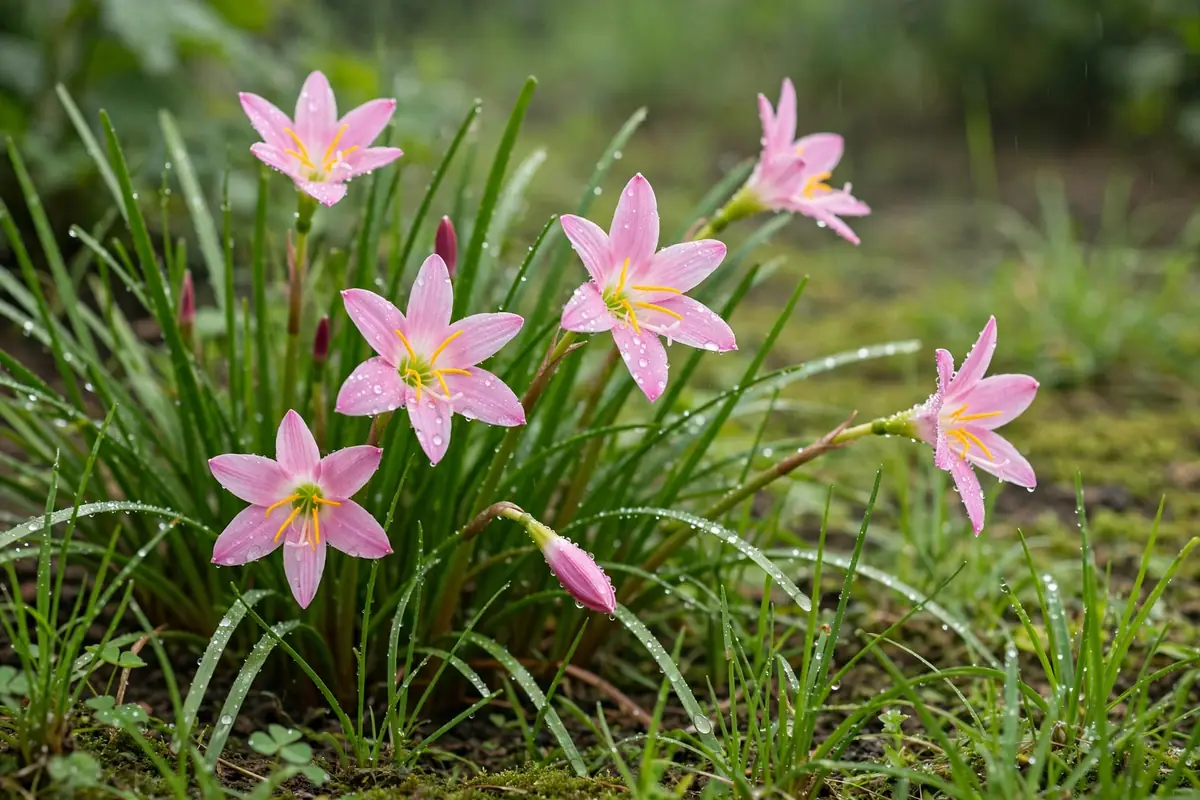
Zephyranthes — from Greek for “flower of the west wind” — is a genus of small bulbous plants from the southern USA through Central and South America, and the common name tells you everything about their charm: weeks after a summer downpour, grass-like clumps suddenly push up crocus-like blooms in white, pink, or yellow that last only a few days. The show is brief but magical, and a colony in bloom after rain is one of gardening’s great small pleasures. The most commonly grown are Z. candida (white), Z. grandiflora (pink), and Z. citrina (yellow).
Plant bulbs in spring, about 2 inches deep, in full sun to part shade with well-drained soil. They are remarkably adaptable — happy in rock gardens, along paths, in lawns (they survive mowing when dormant), and in containers. Most species are hardy in zones 7–10, with some tolerating zone 6 with mulch. Water normally through the growing season; the “rain” trigger is real but they bloom on a seasonal rhythm too. Clumps multiply on their own and can be divided in spring. Note: all parts contain alkaloids and are toxic if eaten, so they are not for the vegetable bed.
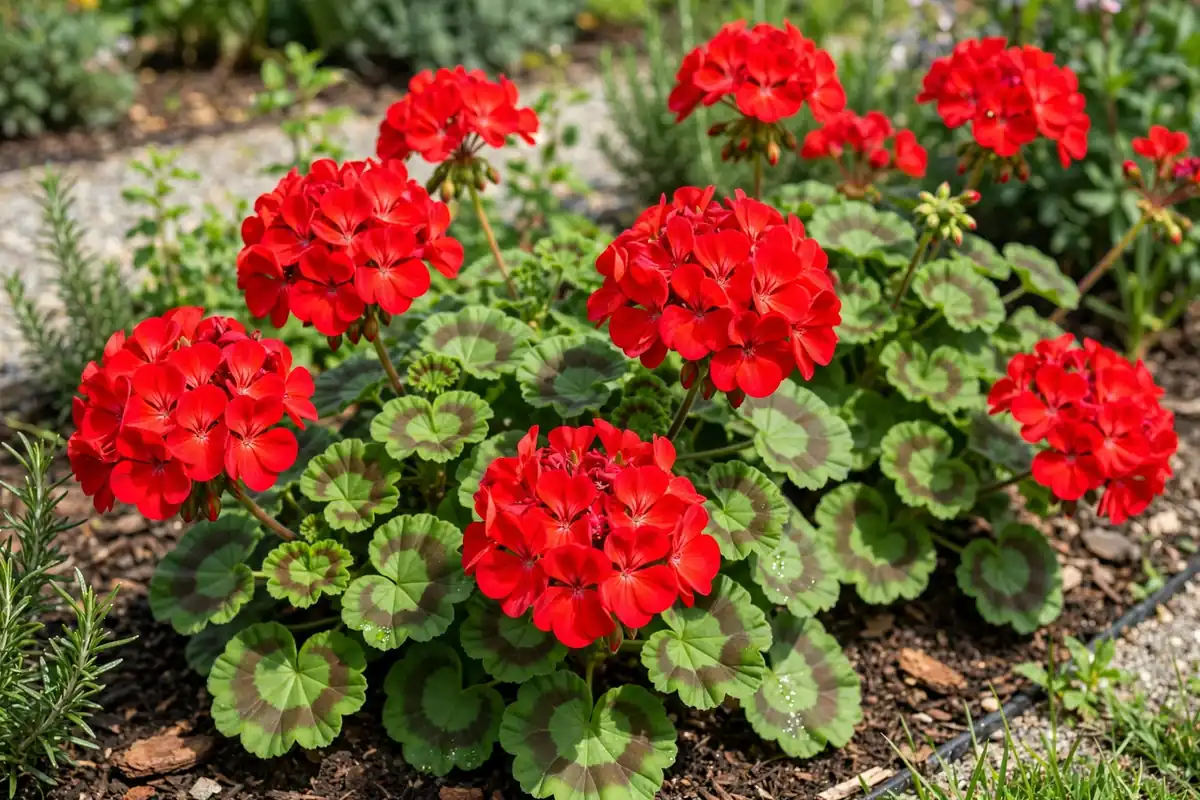
7. Zonal Geranium (Pelargonium × hortorum)
The “geraniums” of window boxes and summer bedding are not true geraniums at all — they are pelargoniums, and the zonal geranium is the hybrid workhorse of the group, bred from South African species. The name comes from the darker horseshoe-shaped “zone” marking on each rounded leaf. From late spring to frost it carries big rounded clusters of red, pink, salmon, orange, or white single or double flowers above the foliage, asking for almost nothing in return. Few bedding plants deliver this much color per dollar.
Plant in full sun after frost danger, in average well-drained soil or containers. Let the soil surface dry between waterings — zonal geraniums hate wet feet — and deadhead spent clusters to keep the show going. Hardy only in zones 10–11, so in cold climates they are grown as annuals, though you can overwinter prized plants indoors in a bright window. They pair beautifully with fall mums in late-season containers; for autumn color that takes over when summer annuals fade, our mum care guide has the full playbook.
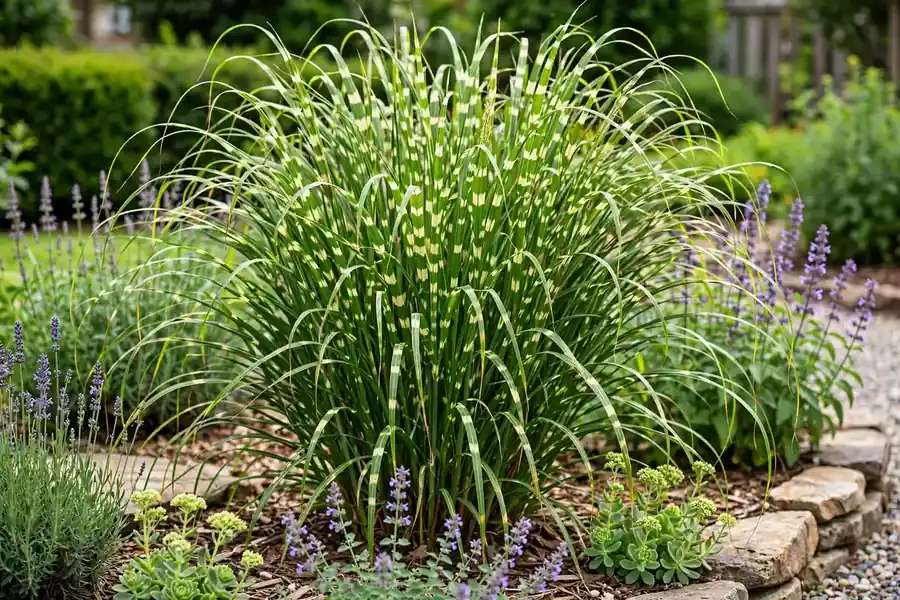
8. Zebra Grass (Miscanthus sinensis ‘Zebrinus’)
Zebra grass is one of the most recognizable ornamental grasses in the world: a fountain-like clump of arching blades 6–8 feet tall, each banded with horizontal creamy-yellow stripes that look hand-painted. The species Miscanthus sinensis is native to Japan, Korea, and China; ‘Zebrinus’ is the classic striped cultivar, and the variegation is most vivid on young growth in full sun. In late summer it adds feathery plumes, and the dried clump stands through winter as garden architecture.
Plant in full sun with average soil — it tolerates clay and some drought once established — and give it room, because mature clumps reach 4–5 feet wide. Cut the whole clump to a few inches in late winter before new growth starts; never cut in fall, since the winter silhouette is half the value. One honest caution: Miscanthus sinensis self-seeds and is considered invasive in parts of the eastern USA, so check local guidance and deadhead plumes if seeding is a concern in your area. Hardy in zones 5–9.
9. Zebra Basket Vine (Aeschynanthus marmoratus)
A relative of the lipstick plant, the zebra basket vine is a trailing epiphyte from the humid forests of Myanmar, Thailand, and Malaysia, and it earns its common name honestly: the oval, leathery leaves are marbled in dark green, lime, and bronze with purple undersides — a living camouflage pattern. Stems cascade two to three feet, making it a superb hanging plant for a bright bathroom or kitchen shelf. Tubular yellow-green flowers appear occasionally, but the foliage is the entire show.
Mimic its tree-perch origins: bright indirect light, warm temperatures, high humidity, and a chunky, fast-draining mix of bark, perlite, and potting soil rather than dense potting mix. Water when the top inch dries and never let the pot sit in water. It is non-toxic to pets, a real advantage among trailing houseplants. Hardy only in zones 10–11 outdoors. Note that it is sometimes labeled Aeschynanthus longicaulis in the trade — same plant, taxonomic reshuffling.
10. Zebrina / Silver Inch Plant (Tradescantia zebrina)
Time for a naming confession: the Z in this plant is its former genus name. Long sold as Zebrina pendula, it is now classified as Tradescantia zebrina, a trailing plant from Mexico and Central America whose fleshy leaves are striped silver, green, and purple — zebra bands on the top, solid royal purple beneath. It is usually sold as “inch plant,” “silver inch plant,” or “wandering dude,” and “zebra vine” is a loose trade label rather than a standard common name. Whatever you call it, it is one of the fastest, easiest trailing houseplants you can grow.
Give it bright indirect light — too little light and the purple fades to plain green — and keep the soil lightly moist. Pinch stem tips regularly to keep it bushy; unpinched stems get leggy fast. It roots in water in days, so one plant becomes gifts for everyone you know. Outdoors it is hardy in zones 9–11, where it makes a colorful groundcover in shade, but contain it — in frost-free climates it can spread aggressively. Non-toxic to people, though the sap can irritate sensitive skin.
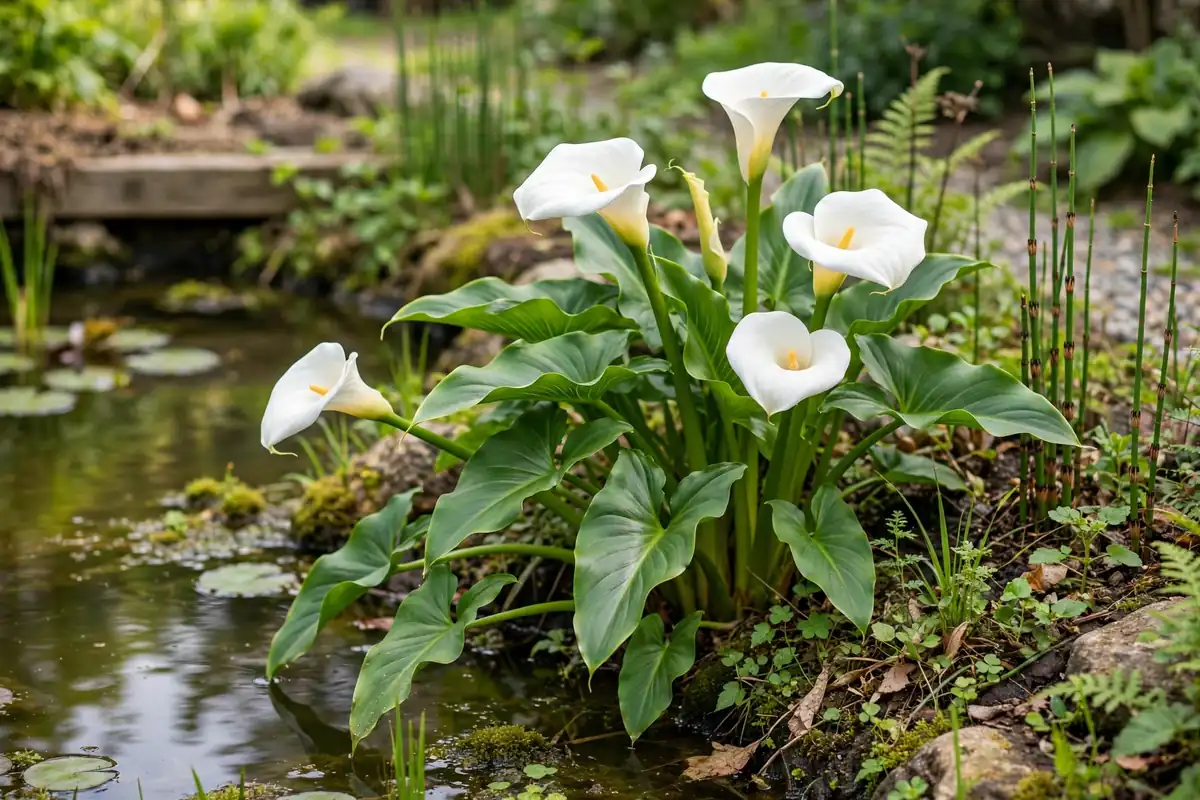
11. Calla Lily (Zantedeschia aethiopica)
Despite the name, the calla lily is neither a true lily nor — in the common white form — a calla at all in the strict sense; it is Zantedeschia aethiopica, a rhizomatous perennial from South Africa’s marshy regions. The “flower” is a sculptural white spathe wrapped around a yellow spadix, rising above bold, arrow-shaped, glossy green leaves. It is a classic of wedding bouquets and Easter displays, and in the garden it brings an almost tropical elegance to pond edges and damp borders. Colored hybrids in pink, yellow, purple, and near-black extend the range.
Unlike most bulbs, it loves moisture — plant rhizomes 3–4 inches deep in rich, consistently damp soil in full sun to part shade. Hardy in zones 8–10; in colder zones, lift the rhizomes in fall and store dry for winter, or grow in containers. Feed during the growing season for the biggest spathes. All parts contain calcium oxalate crystals and are toxic if eaten, so site it away from grazing pets and curious toddlers.
12. Japanese Zelkova (Zelkova serrata)
If you need a tough, handsome shade tree, the Japanese zelkova deserves more fame. A close relative of the elms native to Japan, Korea, China, and Taiwan, it grows into a broad, vase-shaped tree 50–80 feet tall with a short trunk, graceful ascending branches, exfoliating gray-brown bark, and clean serrated leaves that turn russet-red in fall. Crucially, it resists Dutch elm disease, which is why cities plant it as the elm’s modern replacement along streets.
Plant in full sun with well-drained soil and give it space — this is a large tree, not a foundation planting. It tolerates urban pollution, drought, and compacted soil better than most shade trees once established. Prune when young to establish a strong central structure; mature trees need little care. Hardy in zones 5–8. For smaller gardens, look for narrow cultivars such as ‘Musashino’ or ‘Green Vase’, which keep the vase shape in a tighter footprint.
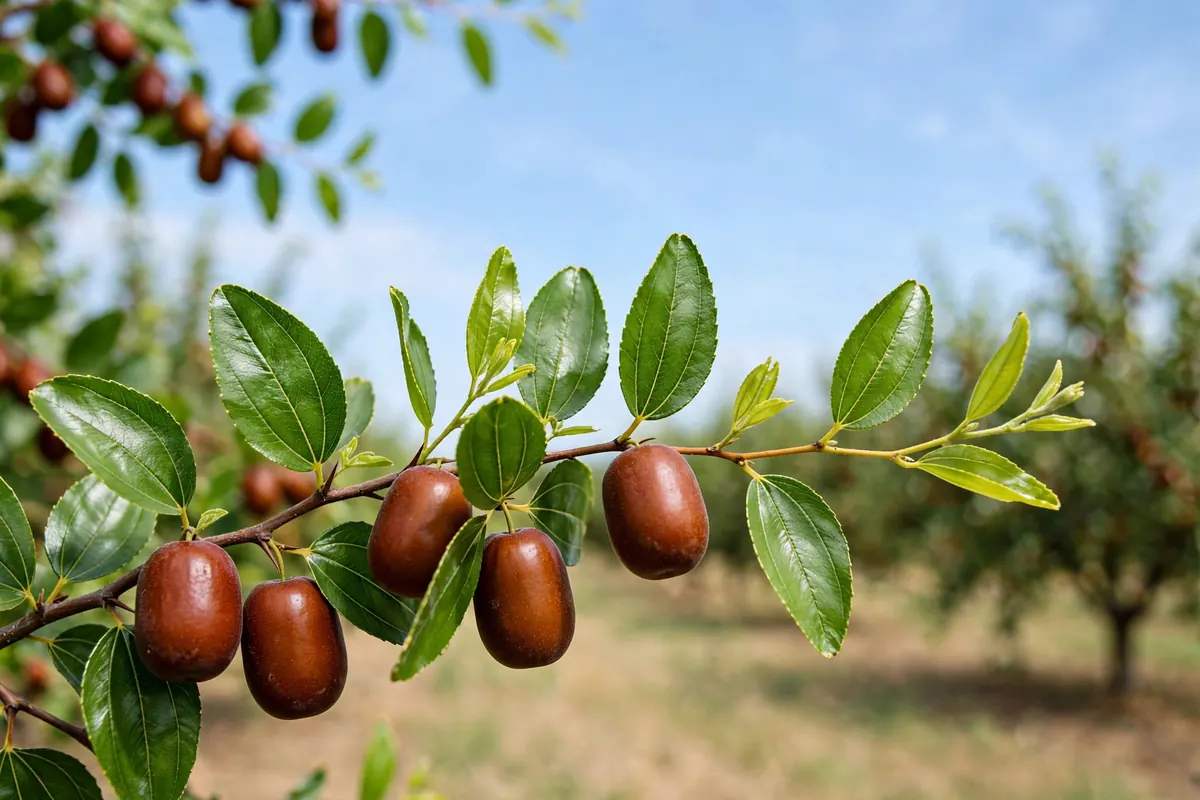
13. Jujube (Ziziphus jujuba)
The jujube — also called Chinese date or red date — is one of the oldest cultivated fruit trees on earth, grown in China for over 4,000 years. The small tree produces olive-sized fruits that ripen from green to mahogany red; eaten fresh they are crisp and apple-like, and dried they turn sweet and chewy, like dates. It is a nutritional standout too, rich in vitamin C and traditionally used in Chinese medicine. The tree itself is handsome, with glossy leaves, zigzag branches, and vicious thorns that make it a natural security hedge.
Plant in full sun with well-drained soil — jujubes tolerate heat, drought, and poor soil that would defeat most fruit trees. Hardy in zones 6–9 (some cultivars to zone 5). Trees are partially self-fertile, but planting two different cultivars noticeably improves crops. Fruit ripens in late summer to fall; harvest when fully red for fresh eating, or leave to wrinkle on the tree for drying. Patience required: grafted trees can take a few years to settle into heavy bearing.
14. Zenobia / Honeycup (Zenobia pulverulenta)
Zenobia is the underused native shrub this list needed. Zenobia pulverulenta grows wild in the boggy coastal plain of the southeastern USA, where its dusty blue-green leaves — coated in a powdery bloom that gives the species its name — and nodding clusters of fragrant white bells light up the late-spring woods. The flowers smell faintly of anise, hence “honeycup,” and the new growth often emerges in striking blue-white tones. It is evergreen to semi-evergreen and slowly forms a 4–6-foot thicket.
Give it what it wants and it is easy: acidic, moist, well-drained soil rich in organic matter, in full sun to part shade. It sulks in alkaline or droughty soil, so amend with composted pine bark and mulch well. Hardy in zones 5–9. Little pruning is needed beyond removing dead wood; the natural layered form is the charm. If you garden for pollinators and native plants, zenobia belongs on your shortlist.
15. Cardboard Palm (Zamia furfuracea)
Neither a palm nor made of cardboard — the common name describes the texture. Cardboard palm is a Mexican cycad whose stiff, leathery leaflets feel thick and rough like corrugated board. It forms a symmetrical rosette of upright, feather-like fronds from a mostly underground trunk, slowly reaching 3–4 feet tall and wide. As a cycad, it belongs to a plant lineage older than the dinosaurs, and it looks it — prehistoric, sculptural, and utterly unbothered by heat.
Plant in full sun to part shade with excellent drainage; it tolerates drought and poor, sandy soil once established. Hardy in zones 9–11; elsewhere it is a striking container plant for a sunny patio in summer. Growth is slow — a flush of new fronds once or twice a year — so buy the size you want. All cycads are toxic if eaten, with the bright orange-red seeds the most dangerous part; keep it away from dogs that chew plants and from small children.
16. Coontie (Zamia integrifolia)
Coontie is cardboard palm’s Florida cousin and a genuine American native — in fact, it is the only cycad native to the continental United States, growing wild in Florida’s pinelands and hammocks. Seminole and early settler communities processed its starchy roots into flour (the name comes from the Seminole word for the plant), though raw plant parts are toxic and the processing was elaborate. In the garden it forms a tidy, fern-like mound of stiff, dark-green fronds 2–3 feet tall, perfect for foundation plantings where nothing else wants to grow.
Plant in part shade with well-drained, even sandy soil; established coonties are extremely drought-tolerant. Hardy in zones 8–10. It is the essential host plant for the atala butterfly — plant coontie and the spectacular black-and-red butterflies will find it. Like all zamias, it is slow-growing and long-lived; the seeds are toxic, so teach children to look but not touch. A tough, historic, wildlife-friendly native that earns its place.
17. Ginger (Zingiber officinale)
The ginger of stir-fries and gingerbread is the underground rhizome of Zingiber officinale, a tropical reed-like herb from Southeast Asia. Above ground it is ornamental in its own right: 3–4-foot bamboo-like stems clothed in narrow, glossy leaves, occasionally topped with cone-like flower spikes in warm climates. But most gardeners grow it for the harvest — fresh, homegrown ginger is juicier and more fragrant than anything from the store, and you can grow it from a grocery-store rhizome.
Start indoors in late winter: plant a plump rhizome with visible buds just below the surface of rich, moist potting mix, and keep it warm — ginger sulks below 50°F. Move outdoors to part shade after frost danger. It needs a long, warm season (8–10 months) to size up, so in cold climates grow it in a container you can bring inside. Harvest pieces as needed once stems are established, or dig the whole clump in fall. Hardy outdoors only in zones 8–10.
18. California Fuchsia (Epilobium canum, syn. Zauschneria californica)
Here is the Z hiding in plain sight: this western native was long known as Zauschneria californica before botanists folded the genus into Epilobium — but “zauschneria” persists in nurseries and on old plant tags. Whatever the label, it is a superb late-season perennial: mounding gray-green foliage and a blaze of scarlet-orange trumpet flowers from late summer into fall, exactly when hummingbirds are fueling up for migration and most perennials are finished. It is a California native-plant garden staple for good reason.
Plant in full sun with very well-drained soil; once established it is genuinely drought-tolerant and resents summer water in humid climates. Hardy in zones 8–10. Cut stems to the ground in late winter — it blooms on new growth — and divide or take cuttings to renew aging clumps. It spreads by rhizomes into a handsome colony; site it where it has room or be ready to edit the edges. In the right spot it is close to indestructible.
19. Zygopetalum Orchid (Zygopetalum spp.)
Pronounced zy-go-PET-a-lum, this South American orchid genus produces some of the most intoxicating flowers in the orchid world: waxy, 3-inch blooms in green, purple, and white, often heavily spotted and scented like hyacinth or pepper. They bloom in fall and winter on arching spikes — the off-season for most orchids — and a single spike perfumes a room. If you want an orchid that stops visitors mid-sentence, this is it, and it ranks among the most unusual and beautiful flowers a windowsill grower can attempt.
Zygopetalums are cool growers that dislike heat — ideal temperatures are 60–75°F days with cooler nights. Give bright indirect light (an east window is perfect), a coarse bark mix that dries slightly between waterings, and humidity above 50 percent. They are heavier feeders than many orchids during active growth. Hardy outdoors only in zones 10–11 in frost-free, humid climates; everywhere else they are houseplants. Repot when the bark breaks down, typically every two years.
20. Zucchini (Cucurbita pepo)
Every vegetable gardener knows the zucchini paradox: in June you fret over your plants, and by August you are sneaking squash onto neighbors’ porches. Cucurbita pepo is native to the Americas, but the long green zucchini as we know it was developed in Italy — “zucchini” is Italian for little squash. The plants are vigorous bushy producers of mild, versatile fruits, plus edible golden blossoms that are a delicacy stuffed and fried. Two or three plants feed a family; six plants feed the neighborhood.
Direct-sow after all frost danger in full sun and the richest soil you have — zucchini are hungry. Give each plant 3 feet of space and water deeply and consistently; uneven watering invites blossom-end rot. Harvest at 6–8 inches for the best texture; oversized fruits are watery and seedy. Watch for squash vine borers (wrap stems or use row covers) and powdery mildew late in the season. For continuous harvest, succession-sow every 3–4 weeks until midsummer.
21. Green Zebra Tomato (Solanum lycopersicum ‘Green Zebra’)
A cultivar caveat, stated plainly: ‘Green Zebra’ is not a species — it is a tomato variety bred by Tom Wagner and introduced in the 1980s, included here because it is a genuinely famous “zebra” plant. The 2–3-inch fruits ripen to amber-green with darker green stripes and deliver a bright, tangy-sweet flavor that slices beautifully into salads. It remains one of the most popular heirloom-style tomatoes at farmers’ markets, and the stripes make ripeness easy to judge: wait for the green to warm toward yellow-amber.
Grow it like any indeterminate tomato: full sun, rich well-drained soil, and a tall stake or cage — vines reach 5–6 feet. Start seeds indoors 6–8 weeks before last frost and transplant into warm soil. Water consistently at the base to prevent cracking and blossom-end rot, and mulch to keep soil evenly moist. Expect 75–80 days from transplant to first ripe fruit. Because it is open-pollinated, you can save seeds and they will come true.
22. Zebra Mallow (Malva sylvestris var. mauritiana ‘Zebrina’)
Another honest cultivar entry: ‘Zebrina’ is a selected form of common mallow, Malva sylvestris var. mauritiana, a European wildflower. The flowers are the attraction — 2-inch, five-petaled blooms in pale pink to lavender, each etched with bold raspberry-purple veins radiating from the center like pinstripes. In a cottage border the effect is unmistakable, and bees work the flowers relentlessly. Plants grow 2–4 feet tall with an upright, branching habit.
Sow seeds in spring in full sun to part shade with average, well-drained soil — it is not fussy. Treat it as a short-lived perennial or biennial in zones 4–8; it self-seeds readily, so one planting often becomes a permanent colony (deadhead if you want to limit volunteers). Cut back after the first flush for rebloom into fall. Watch for hollyhock rust in humid regions, the one disease that troubles the mallow family. The flowers are excellent for cutting.
23. Zigzag Plant (Euphorbia tithymaloides)
We close with a plant that earns its name structurally: the zigzag plant (sometimes still sold under its old name, Pedilanthus tithymaloides) grows on green stems that bend sharply at every leaf node, creating a living lightning bolt. The tropical American species is usually grown in its variegated form, with cream-edged leaves that flush pink in bright light, and it occasionally produces small red slipper-shaped bracts. It makes a sculptural, nearly unkillable houseplant or a quirky landscape shrub where hardy.
Give it bright light — the variegation fades in dim conditions — and treat it like a succulent: gritty soil, thorough watering only when dry. Hardy outdoors in zones 9–11, where it can reach 6 feet and works as an informal hedge in frost-free climates. Handle with care: like all euphorbias, it exudes a milky latex sap that irritates skin and eyes, so wear gloves when pruning and keep it away from face-rubbing pets and children.
Growing Tips for Z-Plants
Respect the two tribes: tropicals and hardies. The Z-list splits cleanly. ZZ plant, both zebra plants, zebra haworthia, zebra basket vine, zebrina, zygopetalum, cardboard palm, zigzag plant, and ginger are tropicals that die in frost — grow them as houseplants or summer patio plants in cold climates. Zebra grass, Japanese zelkova, jujube, zenobia, coontie, California fuchsia, and zebra mallow are genuinely hardy landscape plants. Match the plant to your zone before you buy, not after.
Drainage decides more fates than fertilizer. The succulents and cycads on this list — zebra haworthia, ZZ plant, cardboard palm, coontie, zigzag plant — die in wet winter soil long before cold gets them. Plant them high in gritty, fast-draining mixes, and use pots with drainage holes. Conversely, calla lily and rain lily actively like moisture; do not put them on the same watering schedule as your succulents.
Know which names are shared. Z is the letter of confusing common names: two unrelated plants are both called “zebra plant,” “zebra cactus” is not a cactus, “zanzibar gem” is just a ZZ plant, “zebrina” is a former genus name, and zonal “geraniums” are pelargoniums. Always check the botanical name on the tag — it is the only name that cannot lie to you.
Feed the producers, starve the minimalists. Zucchini, tomatoes, zinnias, and zonal geraniums are hungry plants that bloom and fruit harder with regular feeding. Zebra haworthia, California fuchsia, jujube, and the cycads want lean conditions — rich soil and heavy fertilizer make them floppy or rot-prone. Read every label through the plant’s eyes, not the garden center’s.
Plan for all four seasons. Z-plants make this easy: zygopetalum and rain lily carry late-season interest, zebra grass stands through winter, Japanese zelkova and jujube give fall color and bark interest, and the tropicals keep your windowsills green in the dead of winter. For autumn container color after the summer annuals fade, our mum care guide pairs beautifully with this list.
Which Z-Plants Will You Grow?
Twenty-three plants, one rare letter — and the range is remarkable. Start indoors with a ZZ plant or zebra haworthia if you want the unkillable end of the spectrum; sow zinnias and zucchini if you want fast summer rewards; plant a Japanese zelkova or jujube if you are thinking in decades. The Z-list proves that the scarcest letter still rewards every kind of gardener, from windowsill to acreage.
Keep exploring the alphabet with our guides to plants that start with X, plants that start with Y, and plants that start with A — or browse flowers that start with Z if blooms are your main pursuit. Pick three Z-plants that fit your light and zone, get them in the ground this season, and watch the rarest letter earn its keep. Happy planting!
Frequently Asked Questions
What are the most popular plants that start with Z?
The most popular Z-plants are ZZ plant (Zanzibar gem), zinnia, zebra haworthia, zebra plant, rain lily, zonal geranium, zebra grass, calla lily, jujube, Japanese zelkova, ginger, and zucchini. Together they cover indestructible houseplants, striped succulents, summer annuals, ornamental grasses, fruit trees, and vegetables, and all are widely available at garden centers and nurseries.
Is a ZZ plant the same as a Zanzibar gem?
Yes. Zanzibar gem, ZZ plant, eternity plant, and aroid palm are all common names for the single species Zamioculcas zamiifolia. Nurseries use the names interchangeably, so if you already own a ZZ plant, you do not need a “Zanzibar gem” too — you would be buying the same plant twice. The dark-leaved cultivar ‘Raven’ is the same species with different foliage color.
Which plants starting with Z are best for beginners?
ZZ plant and zebra haworthia are nearly indestructible houseplants, zebrina roots in water and grows fast, and outdoors zinnias, zucchini, and zonal geraniums are among the easiest plants a beginner can grow. Start with plants matched to your light and hardiness zone and most of this list is forgiving.
Which Z-plants are safe for pets?
Pet-safe choices include both zebra plants (calathea and aphelandra are non-toxic), zebra basket vine, and the edibles (zucchini, ginger, jujube fruit) in normal garden contexts. Keep ZZ plant, rain lily bulbs, calla lily, cardboard palm, coontie (especially the seeds), and zigzag plant sap away from cats and dogs that chew plants.
Is zebra grass invasive?
Miscanthus sinensis ‘Zebrinus’ can self-seed, and the species is considered invasive in parts of the eastern United States. The risk varies by region — in many western and northern areas it rarely escapes. To be safe, deadhead the plumes before seeds mature, or choose a sterile cultivar. Check your local extension guidance before planting near natural areas.
Can I grow ginger from a grocery store rhizome?
Yes — it is one of the easiest kitchen-garden projects. Choose a plump, firm rhizome with visible buds, plant it just below the surface of rich potting mix, and keep it warm (above 70°F is ideal for sprouting). It needs a long warm season of 8–10 months to size up, so start indoors in late winter and move the pot outside after frost danger. Harvest pieces as needed once the plant is established.