Best Terrarium Plants: 25 Easy Picks for Open & Closed Terrariums
A terrarium is a whole garden shrunk into glass — a miniature landscape you can keep on a desk, windowsill, or bookshelf. But the plants that thrive in a sealed, steamy jar are completely different from the ones that love a wide-open bowl, and that single distinction decides whether your terrarium becomes a thriving tiny ecosystem or a sad glass coffin. The best plants for terrariums are small, slow-growing, and matched to the humidity their container creates.
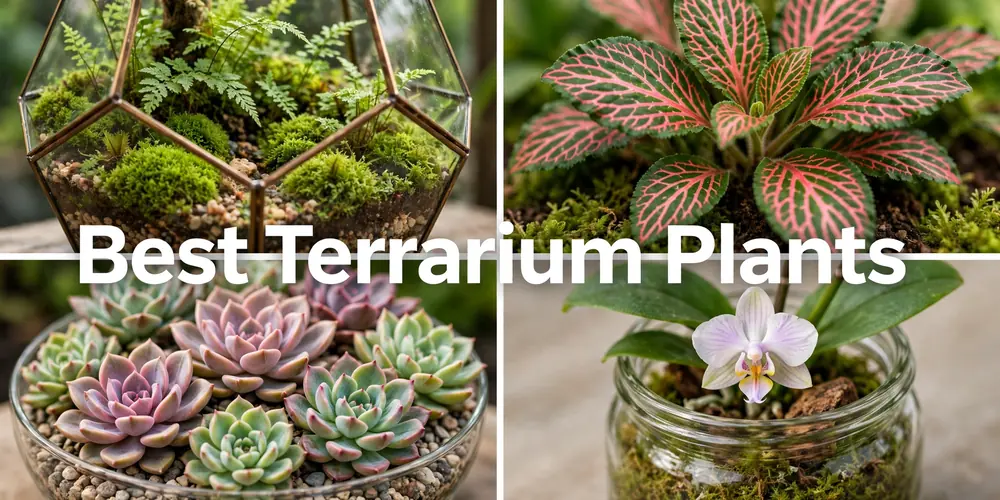
This guide covers 25 of the best terrarium plants, split between closed-terrarium humidity lovers (nerve plant, baby’s tears, ferns, mosses, miniature orchids) and open-terrarium sun lovers (echeveria, haworthia, string of pearls, air plants, dwarf cacti). You will find an open-vs-closed comparison table, a humidity-and-light cheat sheet for all 25 plants, real care tips for every entry, step-by-step planting advice, and answers to the questions terrarium gardeners ask most.
Quick Answer
The best plants for closed terrariums are humidity-loving tropicals: nerve plant (Fittonia), baby’s tears, string of turtles, polka dot plant, maidenhair and button ferns, spike moss, cushion moss, miniature orchids, rex begonias, and Venus flytraps. The best plants for open terrariums are drought-tolerant species: echeveria, haworthia, burro’s tail, string of pearls, air plants (Tillandsia), panda plant, dwarf jade, pincushion cactus, tiger tooth aloe, and hens and chicks. For a deeper dive into the trailing varieties, see our guide to plants that start with S. The golden rule: never mix succulents and tropicals in the same container — their water needs are opposites.
Table of Contents
Open vs Closed Terrariums: Which Plants Suit Each
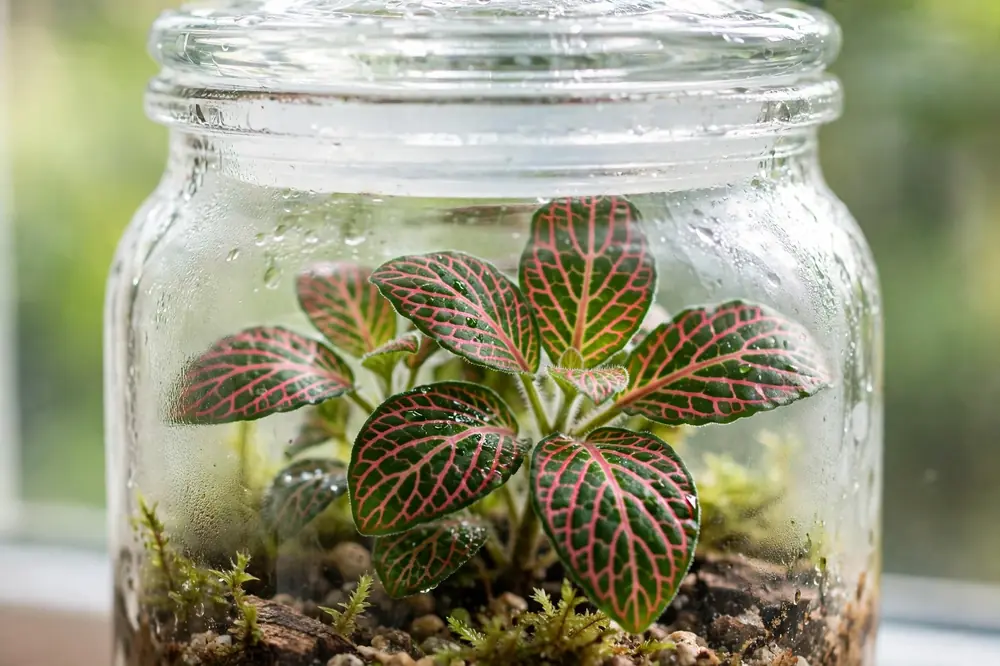
Before you pick a single plant, pick your container style, because it dictates everything that follows. A closed terrarium — a jar, bottle, or vessel with a lid — traps moisture inside and runs its own water cycle: water evaporates from the soil, condenses on the glass, and rains back down. Humidity sits at 70–100%, the air stays still, and tropical plants that would crisp up on a dry windowsill flourish. Closed terrariums need watering only every few weeks or even months once balanced.
An open terrarium — a bowl, wide vase, or dish with a large opening — behaves like a regular houseplant pot with glass walls. Moisture escapes freely, humidity stays near room level, and air circulates. That makes it the right home for succulents, cacti, and air plants, which rot in the soggy stillness of a sealed jar. Open terrariums need watering roughly as often as ordinary potted plants.
The tables below make the comparison concrete. Use the first to choose your terrarium style, and the second as a quick reference for every plant in this guide.
| Feature | Open terrarium | Closed terrarium |
|---|---|---|
| Humidity level | Room-level (30–50%) | High (70–100%) |
| Airflow | Free air circulation | Still, enclosed air |
| Watering frequency | Every 1–2 weeks, like houseplants | Rarely — every few weeks to months |
| Best plants | Succulents, cacti, air plants | Tropicals, ferns, mosses, carnivorous plants |
| Light needs | Bright indirect to some direct sun | Bright indirect light only — no direct sun |
| Maintenance | Moderate; regular light watering | Low once balanced; occasional pruning and venting |
| Main risk | Underwatering; plants drying out | Overwatering; mold and root rot |
| Best container | Wide bowl, vase, or dish with a large opening | Jar, bottle, or apothecary vessel with a lid or cork |
| Plants to avoid | Moisture-loving ferns and mosses (they dry out) | Succulents and cacti (they rot in constant moisture) |
Humidity & Light Needs at a Glance
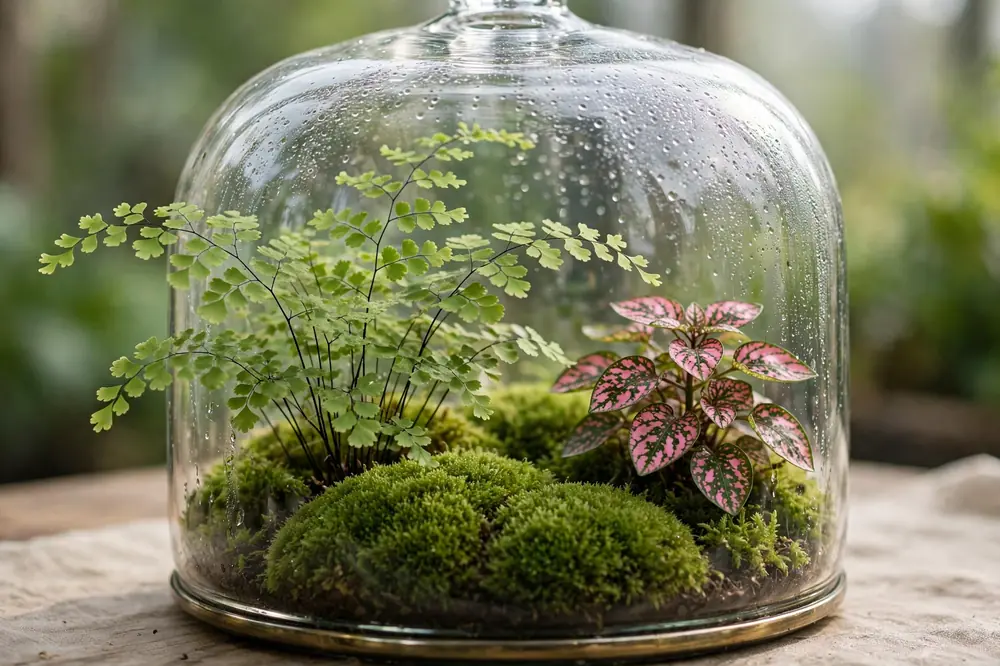
Every plant in this guide is small enough for a desktop container and slow-growing enough not to outgrow it in a season. Scan the table to match plants to the terrarium you are building — then read the full entries below for planting depth, watering, and troubleshooting per species.
| Plant | Best for | Humidity | Light |
|---|---|---|---|
| Nerve plant | Closed | High (70–90%) | Bright indirect |
| Baby’s tears | Closed | High (70–90%) | Bright indirect |
| String of turtles | Closed or open | Medium–high | Bright indirect |
| Polka dot plant | Closed or open | Medium–high | Bright indirect |
| Maidenhair fern | Closed | Very high (80–100%) | Bright indirect to low |
| Button fern | Closed or open | Medium–high | Bright indirect |
| Spike moss | Closed | Very high (80–100%) | Bright indirect to low |
| Cushion moss | Closed | Very high (80–100%) | Indirect to low |
| Miniature orchid | Closed | High (70–90%) | Bright indirect |
| Rex begonia | Closed | High (70–90%) | Bright indirect |
| Friendship plant | Closed | High (70–90%) | Bright indirect |
| Peacock spikemoss | Closed | Very high (80–100%) | Bright indirect to low |
| Earth star | Closed or open | Medium–high | Bright indirect |
| Venus flytrap | Closed | High (70–90%) | Bright indirect to bright |
| Aluminum plant | Closed | High (70–90%) | Bright indirect |
| Haworthia | Open | Low (30–50%) | Bright indirect to some sun |
| Echeveria | Open | Low (30–50%) | Bright; some direct sun |
| Burro’s tail | Open | Low (30–50%) | Bright indirect to sun |
| String of pearls | Open | Low–medium | Bright indirect |
| Air plant | Open | Medium (mist regularly) | Bright indirect |
| Panda plant | Open | Low (30–50%) | Bright; some direct sun |
| Dwarf jade | Open | Low (30–50%) | Bright; some direct sun |
| Pincushion cactus | Open | Low (30–50%) | Bright; direct sun |
| Tiger tooth aloe | Open | Low (30–50%) | Bright indirect to sun |
| Hens and chicks | Open | Low (30–50%) | Bright; direct sun |
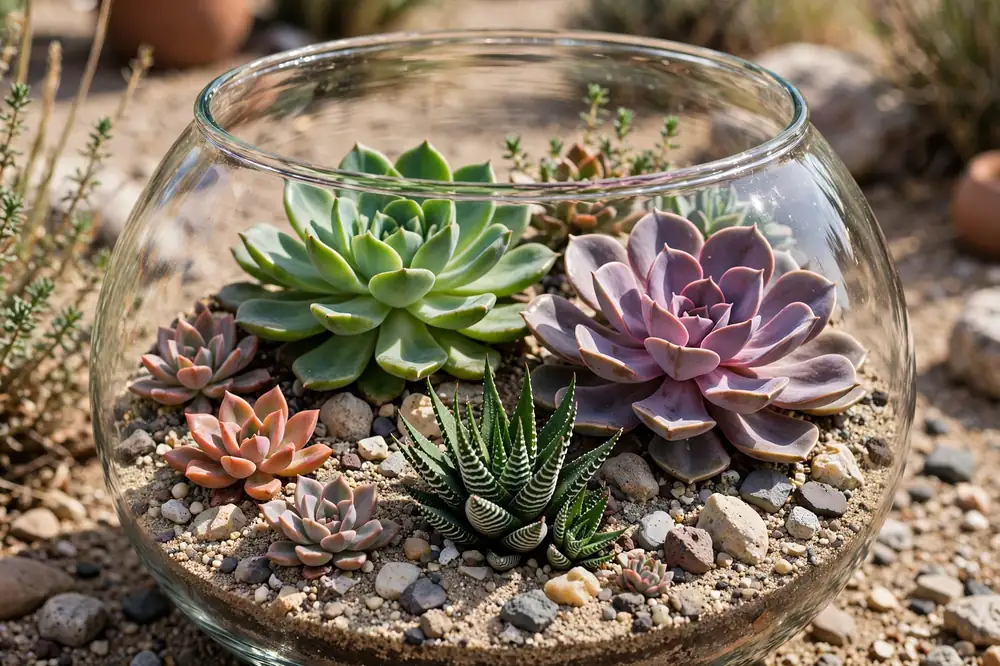
The 25 Best Plants for Terrariums
Here is the full list, starting with the closed-terrarium champions and moving to the open-terrarium stars. Each entry tells you exactly what the plant wants and how to keep it alive under glass.
1. Nerve Plant (Fittonia albivenis)
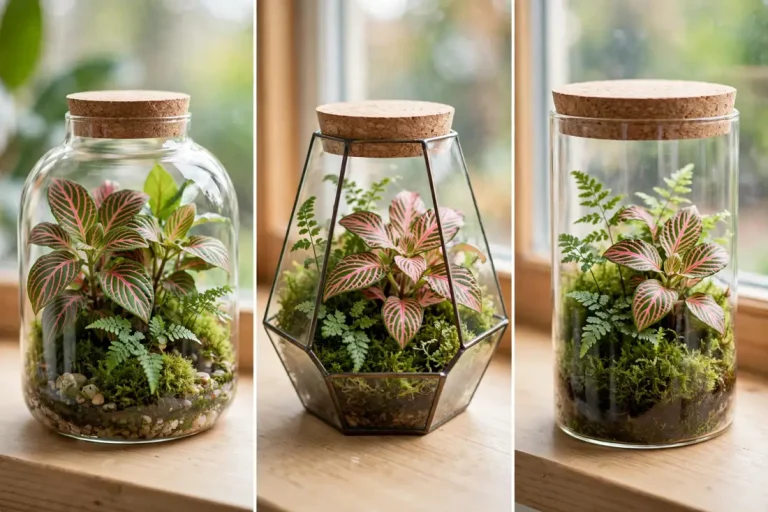
If there is one plant that defines the closed terrarium, it is the nerve plant. Its small, oval leaves are etched with a network of vivid veins in white, pink, or deep red, looking like a tiny botanical map. In the dry air of a normal room, fittonia sulks and crisps at the edges; inside a sealed jar, where the humidity rarely drops below 70%, it grows lush and compact — which is why terrarium growers consider it the single most reliable closed-terrarium plant.
Fittonia is also the famous “fainting plant”: when thirsty, its leaves dramatically collapse, then perk back up within hours of watering. That makes it a perfect moisture gauge for your terrarium — if the fittonia faints, mist the soil lightly. Keep it in bright indirect light (direct sun cooks a sealed terrarium) and pinch the growing tips regularly, because an unpruned fittonia will race for the lid. Remove its small flower spikes when they appear; they drain energy and add nothing to the display.
2. Baby’s Tears (Soleirolia soleirolii)
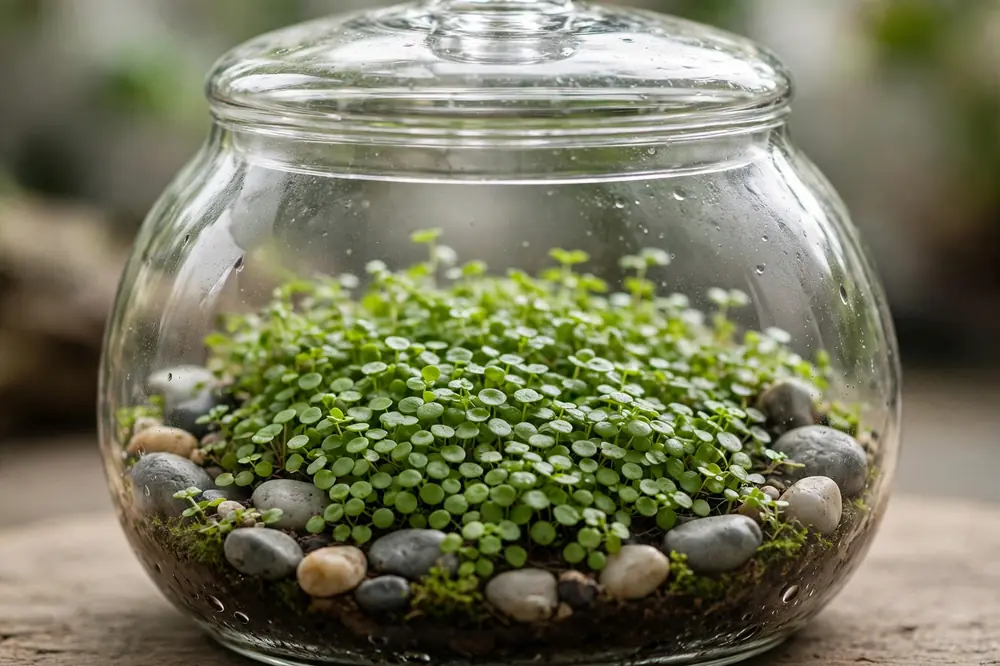
Baby’s tears forms the living carpet of the terrarium world: thousands of tiny, round, lime-green leaves on creeping stems that knit into a dense, moss-like mat. It spills beautifully over rocks and fills every gap between larger plants, giving a closed terrarium that finished, forest-floor look within weeks. In the wild it grows in damp, shady spots around the Mediterranean, so a humid glass jar feels like home.
The catch is its thirst — baby’s tears is one of the few closed-terrarium plants that can still dry out, because its roots are shallow. Keep the soil surface consistently moist but not waterlogged, and mist whenever the top looks dry. It grows fast, so trim it back with small scissors every few weeks to keep it from smothering its neighbors. Plant it toward the front of the terrarium where its fine texture shows best against bolder leaves like fittonia or pilea.
3. String of Turtles (Peperomia prostrata)
String of turtles earns its name from its leaves: small, round, and patterned with silvery veins on dark green, exactly like miniature turtle shells. The thin trailing stems cascade over the edge of a container or drape down the inside of tall glass, making it one of the most photogenic terrarium plants you can grow. As a peperomia, it is a slow grower, which is a virtue under glass — a strand that reaches the lid in a year is about right.
This peperomia is unusually flexible: it does well in a closed terrarium’s humidity but also survives in an open bowl as long as it is watered a little more often. Give it bright indirect light, a well-draining potting mix with extra perlite, and let the top of the soil dry slightly between waterings — its succulent-like leaves store water, so it forgives the occasional missed watering better than most tropicals. One caution: the delicate stems bruise easily, so handle it with tweezers or chopsticks when planting.
4. Polka Dot Plant (Hypoestes phyllostachya)
The polka dot plant brings the confetti. Its soft green leaves are splashed and spotted with pink, red, or white, and in the bright, filtered light of a terrarium the colors stay vivid for months. It grows fast — almost too fast — filling a small jar with cheerful color in a single season, which makes it a favorite for kids’ first terrariums and quick gift projects.
Speed is also its challenge: pinch the growing tips every week or two, or it will bolt upward, get leggy, and flower (the small lilac flowers signal the plant is stressed and should be pinched off). It loves the humidity of a closed terrarium but adapts to an open container with regular watering. Keep the soil evenly moist and never let it dry out completely, or the lower leaves drop. In a closed terrarium, place it toward the back as a colorful backdrop for lower plants like moss and fittonia.
5. Maidenhair Fern (Adiantum raddianum)
The maidenhair fern is the most elegant plant you can put under glass: arching black wiry stems hung with delicate, fan-shaped green leaflets that tremble in the slightest air movement. Nothing else creates that lacy, woodland-spring feeling inside a jar. But it is also the fussiest plant on this list — in normal indoor air its leaflets brown and crisp within days.
A closed terrarium solves that completely. Sealed inside with near-100% humidity, a dwarf maidenhair fern stays flawless with almost no care. Give it bright indirect light, keep the soil evenly moist, and trim off any fronds that brown at the edges. Choose a small or dwarf cultivar (standard maidenhair ferns can reach 2 feet — far too big for most jars) and plant it as the tall centerpiece with moss and fittonia around its base. Never mist the fronds directly with hard tap water; the mineral spots show on the delicate leaflets.
6. Button Fern (Pellaea rotundifolia)
The button fern is the easygoing alternative to the maidenhair: round, leathery, button-like leaflets lined up along arching stems, forming a tidy 6–12 inch mound. It looks like a fern but behaves like a tough houseplant, shrugging off the occasional dry spell that would kill a maidenhair. That forgiveness makes it one of the best ferns for beginners and for open terrariums, where humidity is lower.
Plant it in either a closed or open terrarium in bright indirect light, in a gritty, well-draining mix. In a sealed jar it grows lush and deep green; in an open bowl it stays a bit more compact but still healthy — just water it a little more often. It dislikes soggy soil, so let the surface dry slightly between waterings even in a closed setup. Divide congested clumps in spring, and remove spent fronds at the base to keep the mound tidy.
7. Spike Moss (Selaginella kraussiana)
Despite the name, spike moss is not a true moss — it is a primitive vascular plant that forms dense, feathery mats of bright green, scale-like foliage. It spreads into a soft carpet that looks like a miniature pine forest floor, and it thrives in the saturated air of a closed terrarium where true mosses sometimes struggle with warmth. A patch of spike moss makes any jar look instantly ancient and wild.
Spike moss demands constant moisture and high humidity; let it dry out once and whole sections turn brown and crisp. Plant it on consistently moist soil in a sealed container, in bright indirect to low light, and mist whenever the surface looks dry. It spreads steadily, so trim the edges with scissors to keep it within its allotted patch. Because it loves wet conditions, plant it slightly away from succulent neighbors — in a closed tropical terrarium, it is in its element.
8. Cushion Moss (Leucobryum glaucum)
No closed terrarium looks finished without moss, and cushion moss is the showiest of the bunch: plump, silvery-green mounds that look like tiny velvet hills. Sheet moss (Hypnum) and star moss work too, but cushion moss’s sculptural clumps create the most striking miniature landscape. Moss has no roots — it anchors with tiny rhizoids and drinks through its leaves — so it responds to surface moisture, not soil moisture.
Press moss clumps gently onto damp soil or over a rock and mist them directly; they establish in a week or two. Moss wants high humidity and indirect or even low light — bright sun through glass overheats and dries it. Never fertilize moss; nutrients burn it. If your moss turns brown, it is usually too dry or too warm — mist more often and move the terrarium away from heat sources. Harvested responsibly from your own shady garden corners, moss is free, but never collect from parks or protected land.
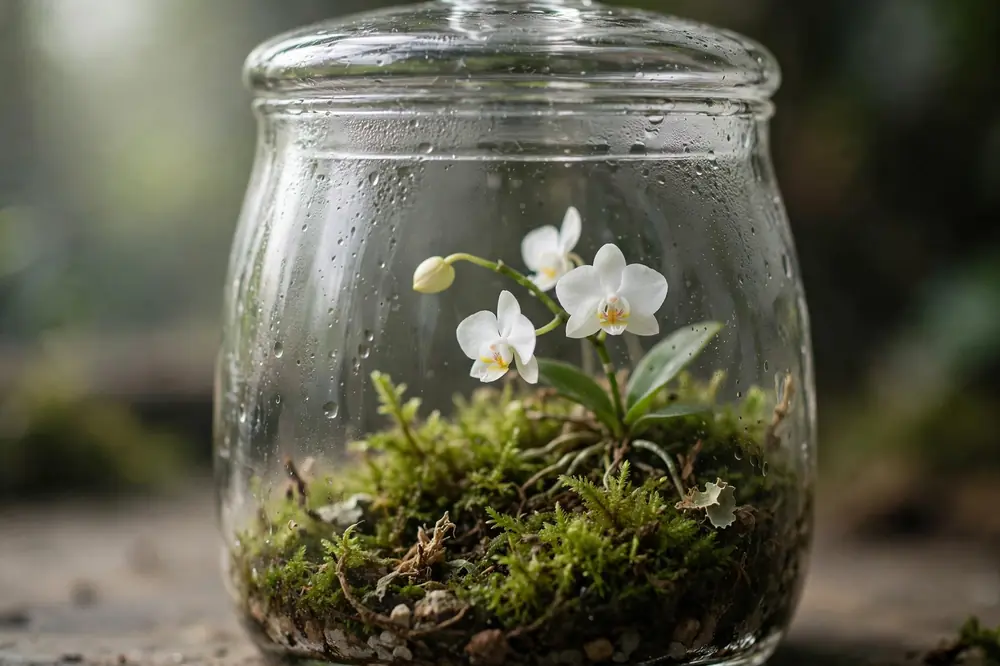
9. Miniature Orchid (Phalaenopsis hybrids)
A miniature moth orchid blooming inside a glass terrarium is pure magic: arching sprays of white, pink, or purple flowers hovering over moss, like a florist’s arrangement that waters itself. Dwarf phalaenopsis varieties stay under 8 inches tall including the flower spike, and their thick, silvery roots grip bark or moss happily inside a humid jar. The sealed environment mimics the tropical canopy air orchids evolved for.
Plant the orchid in coarse bark chips or sphagnum moss — never regular potting soil, which suffocates the roots. It wants bright indirect light and high humidity but good air movement around the roots, so vent the lid for an hour every few days. Water by misting the bark when it feels dry, and let excess water drain — standing water rots orchid roots fast. After the flowers fade, cut the spike above a node and it may rebloom from the same stem within months.
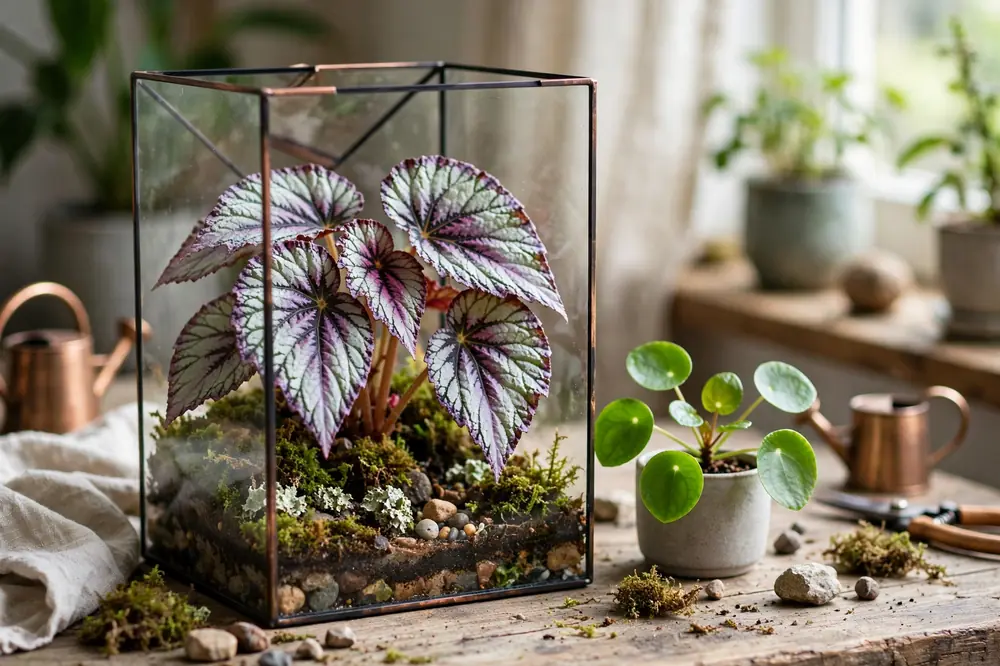
10. Rex Begonia (Begonia rex-cultorum)
Rex begonias are grown for foliage that looks hand-painted: swirling patterns of silver, burgundy, purple, and deep green, often with a metallic sheen. Choose a dwarf or miniature cultivar (standard rex begonias outgrow jars quickly) and you get the most dramatic leaves of any closed-terrarium plant. In the humid, still air of a sealed container, the colors deepen and the leaves stay flawless — rex begonias despise the dry air and drafts of open rooms.
Keep the soil lightly moist and water at the base, never overhead — wet rex leaves in still air invite powdery mildew and rot. Give it bright indirect light; too little light dulls the patterns, too much sun scorches them through glass. Vent the terrarium briefly each week to prevent fungal problems, and remove any leaf that shows spots immediately. Dwarf varieties like ‘Dew Drop’ or ‘Fireworks’ stay under 6 inches and are ideal for jar culture.
11. Friendship Plant (Pilea involucrata)
The friendship plant (a cousin of the aluminum plant) has deeply quilted, bronze-green leaves with a texture like tiny craters — it looks almost sculpted rather than grown. It stays compact at 6–12 inches, spreads slowly by creeping stems, and its unusual foliage contrasts beautifully with smooth-leaved neighbors like fittonia or peperomia. The common name comes from how easily it shares: stem cuttings root in days.
It is a classic closed-terrarium plant, wanting high humidity, bright indirect light, and consistently moist (not soggy) soil. Pinch the stem tips regularly to keep it bushy rather than straggly, and root the pinched cuttings right back into the terrarium to fill gaps — free plants. Watch for mealybugs hiding in the textured leaves; dab them off with a cotton swab dipped in rubbing alcohol at the first sign.
12. Peacock Spikemoss (Selaginella uncinata)
Peacock spikemoss is spike moss’s glamorous sibling: the same feathery, fern-like mats, but with an iridescent blue-green sheen that shifts in the light like a peacock feather. In a closed terrarium under bright indirect light, the metallic shimmer is genuinely startling — visitors always ask what it is. It spreads into a low, dense carpet that makes an unforgettable groundcover.
Care is identical to its cousin: constant moisture, very high humidity, and bright indirect to low light. It is even less forgiving of drought than S. kraussiana — a single dry weekend can crisp the edges. Plant it in a sealed jar on moisture-retentive soil, mist the surface regularly, and trim wandering stems with scissors. The blue iridescence is strongest in bright (but indirect) light and fades in deep shade, so site it near the glass, not buried under taller plants.
13. Earth Star (Cryptanthus bivittatus)
Earth stars are terrestrial bromeliads that grow as flat rosettes of wavy, striped leaves — pink, red, cream, and green banding that looks like a starfish pressed into the soil. At just 4–6 inches across, a single earth star is a perfect terrarium focal point, and its stiff, architectural form contrasts wonderfully with soft mosses and ferns. Unlike most bromeliads it needs no mounting; it roots happily in soil.
Earth star is one of the few plants genuinely happy in either terrarium style: it loves humidity but tolerates open air if watered a bit more. Give it bright indirect light for the strongest striping, a loose well-draining mix, and water into the central “cup” of the rosette as well as the soil — but empty any standing water in the cup every week or two to prevent rot. It produces offsets (“pups”) around its base; separate and replant them to multiply your stock for free.
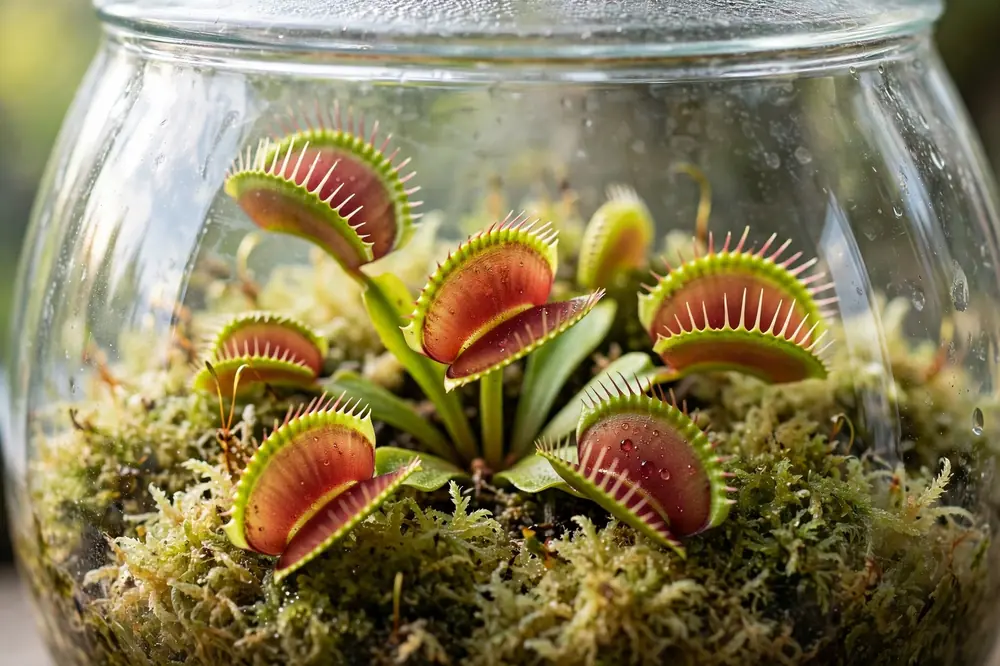
14. Venus Flytrap (Dionaea muscipula)
A Venus flytrap in a terrarium is a conversation piece like no other — those hinged, tooth-edged traps snapping shut are endlessly fascinating, especially to kids. Native to the bogs of the Carolinas, it actually prefers the humid, still air of a closed terrarium over a dry windowsill, and a jar keeps curious fingers from triggering every trap. A small flytrap makes a brilliant “carnivorous corner” alongside moss and sundews.
Flytraps have strict needs that differ from every other plant here: plant them in pure sphagnum moss or a peat-and-sand mix with zero fertilizer, and water only with distilled water, rainwater, or reverse-osmosis water — tap water minerals kill them. Keep the moss constantly damp and give the plant as much bright indirect light as possible. Never “feed” the traps by hand; each trap only closes a few times before dying, and the plant catches its own gnats. In winter it wants a cool dormancy (around 50°F) — move the jar to an unheated room for 2–3 months.
15. Aluminum Plant (Pilea cadierei)
The aluminum plant looks futuristic: quilted dark-green leaves splashed with raised silver patches, as if dabbed with metallic paint. It grows upright to about 12 inches but stays smaller in the confines of a jar, and the silver markings catch the light beautifully through glass. It is one of the toughest closed-terrarium plants — tolerant of the occasional missed misting that would stress a fittonia.
Give it high humidity, bright indirect light, and evenly moist soil; it is more forgiving of brief dry spells than most pileas but still rots in soggy mix. Pinch growing tips to keep it compact and bushy, since unpruned stems get leggy and flop. It roots effortlessly from cuttings, so share pinched stems with friends (the pilea family is generous that way). Keep it away from cold drafts — below 55°F the leaves blacken.
16. Haworthia (Haworthia attenuata)
We cross now into open-terrarium territory, and the zebra haworthia is the perfect bridge plant for succulent beginners. Its stubby, upright rosette of dark-green leaves banded with white ridges looks like a tiny aloe crossed with a zebra — architectural, slow-growing, and nearly indestructible. Unlike most succulents it tolerates lower light, so it thrives in the bright-indirect conditions of an indoor glass bowl.
Plant haworthia in a very gritty, fast-draining cactus mix in an OPEN container only — sealed humidity rots its roots. Water deeply but infrequently: soak the soil, then wait until it is completely dry before watering again (every 2–3 weeks indoors). A top dressing of fine gravel keeps the leaves off damp soil and completes the desert look. It offsets freely, producing pups you can separate to fill the bowl or start new terrariums.
17. Echeveria (Echeveria elegans and hybrids)
Echeveria rosettes are the supermodels of the succulent world: perfect geometric spirals of fleshy leaves in blue-green, blush pink, and lavender-gray, often with a powdery farina coating that looks dusted with frost. A trio of small echeverias in an open glass bowl is the classic terrarium look for a reason — nothing photographs better. They stay compact for years if given enough light.
Light is the whole game with echeveria: give them the brightest spot you have, including a few hours of direct sun, or they stretch into leggy, pale caricatures of themselves (a stretched echeveria can be beheaded and rerooted). Use gritty cactus soil in an open container with drainage, water deeply then let the soil dry fully, and never let water sit in the rosette. In winter, cut watering to nearly nothing — most echeverias rest and need only a sip a month.
18. Burro’s Tail (Sedum morganianum)
Burro’s tail (also sold as donkey tail) is made for the edge of an open terrarium: thick ropes of blue-green, bead-like leaves that cascade over the rim of a bowl like a living waterfall. A mature plant can trail 2–3 feet, so it is best in a wide, shallow container where the stems can spill freely. The plump leaves store water, making it one of the most drought-forgiving terrarium plants.
Handle it as little as possible — the leaves detach at a touch (each fallen leaf can be laid on soil to grow a new plant, so nothing is wasted). Give it bright light with some direct sun, gritty fast-draining soil, and the classic succulent soak-and-dry watering rhythm. In an open terrarium, plant it at the rim so new growth trails outward rather than tangling with its neighbors. It blooms in summer with small pink-red flowers on mature plants given enough light.
19. String of Pearls (Curio rowleyanus)
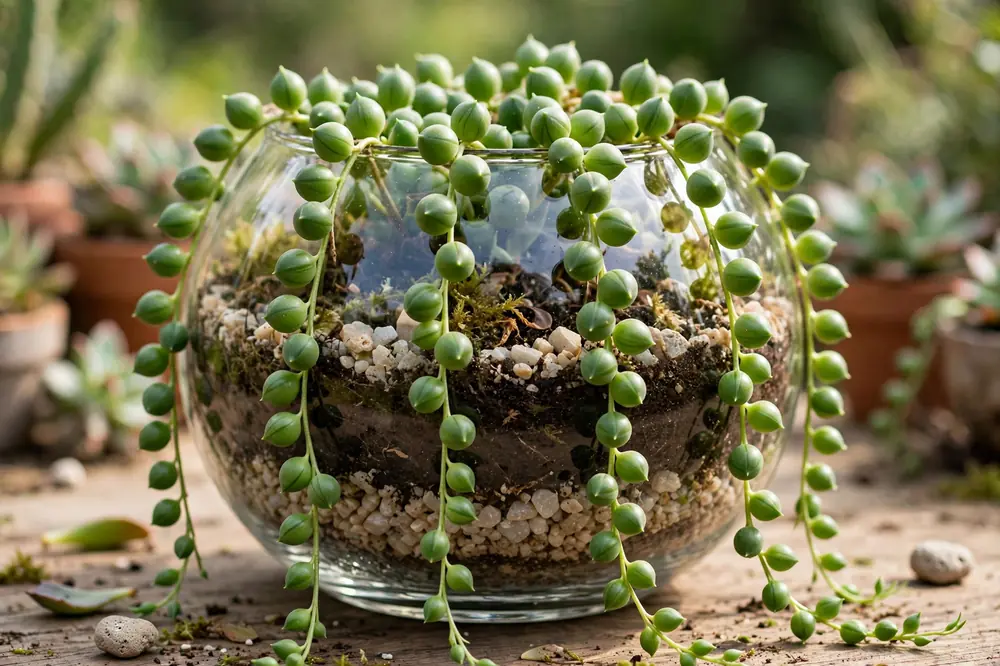
String of pearls is pure whimsy: slender stems strung with perfect green spheres, like a botanical necklace. Draped over the side of an open glass bowl or hanging orb, it is irresistible — and its unusual form makes it the most-requested trailing plant for terrarium designs. A related variety, string of dolphins, has leaves shaped like tiny leaping dolphins for even more novelty.
Pearls want bright indirect light (a little direct morning sun is fine) and careful watering: the bead leaves are thin-skinned and rot quickly in wet soil, but the shallow roots dry out fast in a small container. Water when the top inch of soil is dry, and make sure the top of the plant — not just the trailing strands — gets light, or the crown thins out. Keep it in an open container with excellent drainage; sealed humidity turns the pearls to mush. Trim long strands to encourage branching.
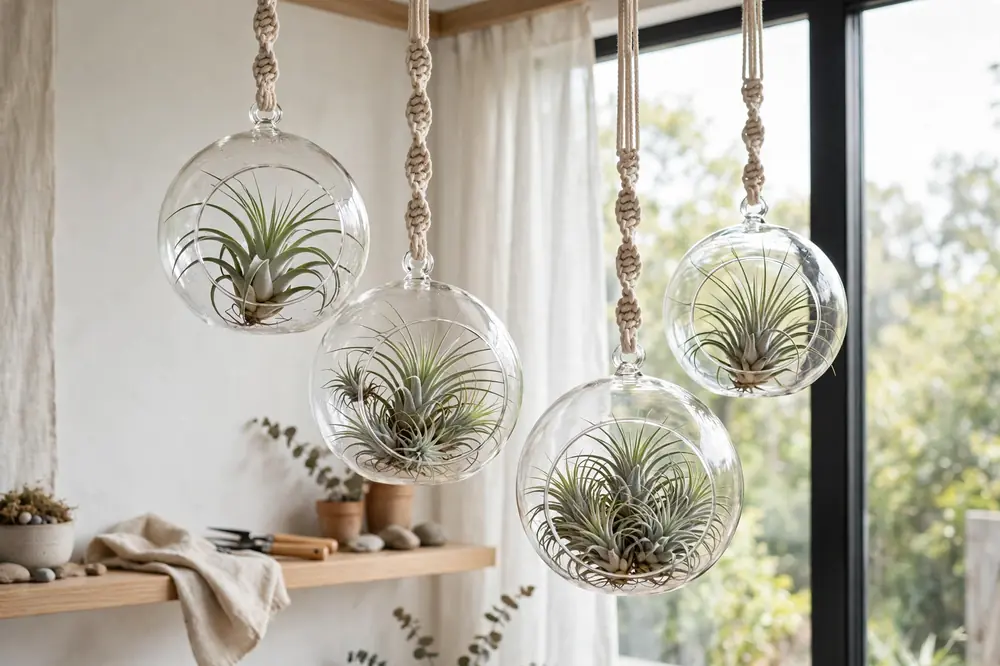
20. Air Plant (Tillandsia ionantha and others)
Air plants break every rule: they need no soil at all. These silvery, spiky bromeliads absorb water and nutrients through tiny scales on their leaves, so they can live perched on driftwood, nestled in sand, or glued to a stone inside an open glass orb. Tillandsia ionantha is the classic starter — small, tough, and blushing red when it blooms — while T. xerographica makes a stunning silvery centerpiece in larger bowls.
Because they have no roots to rot, air plants suit open terrariums beautifully — but “no soil” does not mean “no water.” Mist them 2–3 times a week, or dunk them in room-temperature water for 20–30 minutes weekly, then shake off every drop and let them dry upside down. Trapped water in the leaf bases causes rot, which is why closed, humid jars kill them. Give bright indirect light and good air movement; a terrarium placed where a ceiling fan stirs the air is ideal. After blooming, the mother plant produces pups — leave them attached for a clump, or separate them once they are a third of her size.
21. Panda Plant (Kalanchoe tomentosa)
The panda plant is the succulent you want to pet: thick, upright leaves covered in silvery-white fuzz with chocolate-brown spots along the edges, like a panda’s ears. It grows slowly into a handsome 1–2 foot shrub (staying much smaller in a bowl), and its soft texture contrasts beautifully with the hard geometry of echeverias and haworthias. Kids love it; cats should not chew it.
Give it bright light with some direct sun for the darkest edge spots, gritty well-draining soil, and water only when the soil is fully dry — the fuzzy leaves trap moisture and rot if watered overhead. Plant it in an open terrarium only; humidity mats the fuzz and invites fungus. Note that kalanchoes are toxic to cats and dogs, so keep a panda-plant terrarium out of pets’ reach. A mature, slightly stressed plant (bright sun, tight pot) rewards you with small tubular flowers.
22. Dwarf Jade (Crassula ovata ‘Minima’)
The dwarf jade is a miniature version of the classic jade plant: the same glossy, oval green leaves and stout, tree-like stems, but on a plant that stays under 8 inches for years. It brings a bonsai-like, woody structure to an open terrarium that soft rosette succulents cannot — a tiny tree among the cushions. With age the stems develop attractive bark-like texture.
Plant it in gritty cactus mix in an open bowl, give it bright light with some direct sun, and water deeply only when the soil is completely dry — wrinkled, soft leaves mean it is thirsty; yellow, dropping leaves mean it is overwatered. It tolerates pruning beautifully: pinch stem tips to encourage branching and a tree-like form. In very bright light the leaf edges blush red. Keep it warm; jade drops leaves below 50°F.
23. Pincushion Cactus (Mammillaria gracilis and others)
Small pincushion cacti are the exclamation points of an open desert terrarium: round, ribbed bodies covered in neat white spines, often clustering into charming mounds. Mammillaria gracilis stays under 4 inches and offsets freely, while tiny Rebutia species add shocking orange-red flowers in spring. A cactus or two gives an open bowl the authentic desert-diorama look.
Cacti demand the brightest, sunniest spot you have — a south-facing windowsill is ideal — and the grittiest, fastest-draining soil of any plant here (at least half perlite, pumice, or coarse sand). Water sparingly: a deep soak every 3–4 weeks in summer, almost nothing in winter. Handle with folded newspaper or tongs, not fingers. Never put cacti in a closed terrarium; trapped humidity rots them within weeks. One cactus per bowl is usually enough — they are accents, not the main planting.
24. Tiger Tooth Aloe (Aloe juvenna)
Tiger tooth aloe is a dwarf aloe with a fierce look and a gentle nature: stacked rosettes of triangular green leaves edged with white “teeth,” forming dense clumps under 12 inches. It looks like a miniature agave but grows far slower and tolerates indoor conditions better, making it one of the most practical structural succulents for an open terrarium. In strong light the leaves flush bronze-red.
Give it bright light with some direct sun, a gritty fast-draining mix, and the standard succulent soak-and-dry cycle — it stores water in its leaves and forgives missed waterings. Plant it in an open container only, and keep water out of the leaf crowns. It pups generously around its base; twist off offsets with roots attached to propagate. Like all aloes, the sap can irritate skin and is toxic to pets, so site the bowl thoughtfully.
25. Hens and Chicks (Sempervivum tectorum)
Hens and chicks close our list with old-world charm: tight rosettes of pointed leaves in green, red, and purple tones, each mother rosette (“hen”) ringed by baby offsets (“chicks”). They are among the hardiest succulents on Earth — surviving freezing winters outdoors — yet they look perfectly at home in a sunny open terrarium, where their geometric rosettes echo echeverias at a fraction of the fuss.
They want what all open-terrarium succulents want, turned up a notch: maximum light, extremely gritty soil, and very little water. Indoors, give them your sunniest windowsill or they stretch and lose their tight form. Water only when the soil is bone dry; in winter, barely water at all. The “chicks” root wherever they touch soil — tuck them into gaps to carpet the bowl. After several years a hen flowers once and dies, but by then it has left a ring of chicks to carry on.
Planting and Maintenance Tips
Layer your container like a pro. Every terrarium needs the same foundation: 1–2 inches of pebbles or gravel for drainage, a thin layer of activated charcoal to keep water fresh, then 2–3 inches of appropriate soil — moisture-retentive potting mix for closed tropical terrariums, gritty cactus mix for open succulent ones. The charcoal layer is the difference between a terrarium that smells fresh for years and one that goes sour in months.
Plant small and plant sparsely. Choose the smallest nursery pots you can find (2-inch pots are ideal) and space plants with room to grow — a terrarium planted “full” on day one is overcrowded by month three. Tall plants go at the back, low carpets like moss and baby’s tears at the front, and trailers like string of pearls at the rim.
Water with a mister, not a can. Closed terrariums usually need only a light misting every few weeks — if the glass fogs heavily all day, vent the lid for a few hours. Open succulent terrariums want a deep soak followed by complete drying; a turkey baster or syringe delivers water precisely to the soil without wetting leaves.
Light is bright but never direct for closed jars. Direct sun through glass becomes a magnifying oven that cooks plants in under an hour. Bright indirect light — near an east or north window, or under a grow light — is the sweet spot for closed terrariums. Open succulent terrariums can take more sun, including a few morning hours of direct rays.
Prune early and often. Fast growers like polka dot plant and baby’s tears need pinching every couple of weeks; remove dead leaves promptly since decaying matter in a sealed jar breeds mold. If a plant outgrows the container, move it to a pot and replace it with a fresh small start — terrariums are living arrangements, not permanent plantings.
Watch for mold and pests. White fuzzy mold on soil means too much moisture — vent the lid, skip a watering, and sprinkle cinnamon on the soil surface as a natural antifungal. For pests like fungus gnats or mealybugs, remove affected leaves, let the soil surface dry, and use sticky traps before reaching for any spray inside an enclosed space.
Which Terrarium Will You Build?
The 25 plants in this guide cover every style of glass garden: the steamy jungle jar with nerve plant, ferns, and moss; the jewel-box orchid terrarium; the sun-baked desert bowl of echeveria, haworthia, and cacti. The secret was never a magic plant — it is matching the plant to the container. Humidity lovers go sealed, sun lovers stay open, and the two worlds never mix.
If this is your first terrarium, start simple: a closed jar with fittonia, a fern, and cushion moss is nearly foolproof, while an open bowl of haworthia, echeveria, and gravel is the easiest possible entry into succulents. Build one this weekend, set it where you will see it every day, and enjoy the smallest garden you will ever own.
Frequently Asked Questions
What are the easiest plants for a beginner terrarium?
Nerve plant (fittonia), pothos cuttings, cushion moss, button fern, and haworthia are the most forgiving choices. Fittonia and moss suit closed jars; haworthia suits open bowls. All five tolerate the small mistakes beginners make while learning the watering rhythm.
Can succulents live in a closed terrarium?
No — this is the most common terrarium mistake. Succulents and cacti need airflow and dry cycles; sealed inside a humid jar, their roots rot within weeks. Keep succulents, cacti, and air plants in open terrariums only, and reserve closed containers for tropicals, ferns, and mosses.
How often should I water a closed terrarium?
Far less than you think. A balanced closed terrarium recycles its own moisture and may need water only every few weeks or months. Mist lightly when the soil surface looks dry and there is no condensation on the glass in the morning. Constant heavy fogging means it is too wet — vent the lid for a few hours.
Do terrariums need direct sunlight?
No, and direct sun is actively dangerous for closed terrariums — glass magnifies sunlight and can cook the plants in under an hour. Bright indirect light is ideal for closed jars. Open succulent terrariums appreciate brighter conditions, including a few hours of gentle morning sun.
Why is my terrarium getting moldy?
Mold means excess moisture plus decaying organic matter. Vent the lid to release humidity, remove any dead leaves, skip the next watering, and dust the soil surface with ground cinnamon, a natural antifungal. Adding springtails — tiny harmless cleanup insects — prevents mold permanently in closed terrariums.
How long do terrarium plants live?
With the right plant-container match, years. Sealed tropical terrariums have famously survived a decade or more with minimal care. Expect to prune fast growers regularly and replace any plant that outgrows the space — think of a terrarium as a living arrangement you curate, not a plant-it-and-forget-it pot.
References
- Royal Horticultural Society — Terrariums and Bottle Gardens
- Royal Horticultural Society — How to Grow Hypoestes (Polka Dot Plant)
- Gardening Know How — Open vs. Closed Terrariums
- Gardening Know How — How to Make a Terrarium in a Jar
- The Old Farmer’s Almanac — How to Make a Terrarium
- Missouri Botanical Garden — Plant Finder