28 Plants That Start With H: Names, Pictures & Growing Tips
Looking for plants that start with H? The letter H punches well above its weight in the gardening world. From the dinner-plate blooms of hibiscus to the shade-loving foliage of hosta, the old-fashioned charm of hollyhocks, and the sculptural ease of haworthia on a windowsill, H plants cover nearly every garden situation: deep shade, blazing sun, drought, soggy clay, tiny apartments, and sprawling borders.
This guide lists 28 real plants that start with H — every one botanically verified, with its scientific name, hardiness zones, light and water needs, and a practical growing tip you can actually use. Whether you are filling a shady corner, hunting for a low-maintenance houseplant, or working through the alphabet garden-style, you will find an H plant that fits. If you are collecting the whole set, take a look at our guides to plants that start with A and plants that start with P next.
One quick note before we dig in: common names can be slippery. “Amaryllis” sold at Christmas is usually Hippeastrum, and “hardy geranium” is not the same plant as the red geraniums in window boxes (those are Pelargonium). Each entry below gives the accepted botanical name so you buy exactly the plant you mean.
Quick Answer: The best plants that start with H
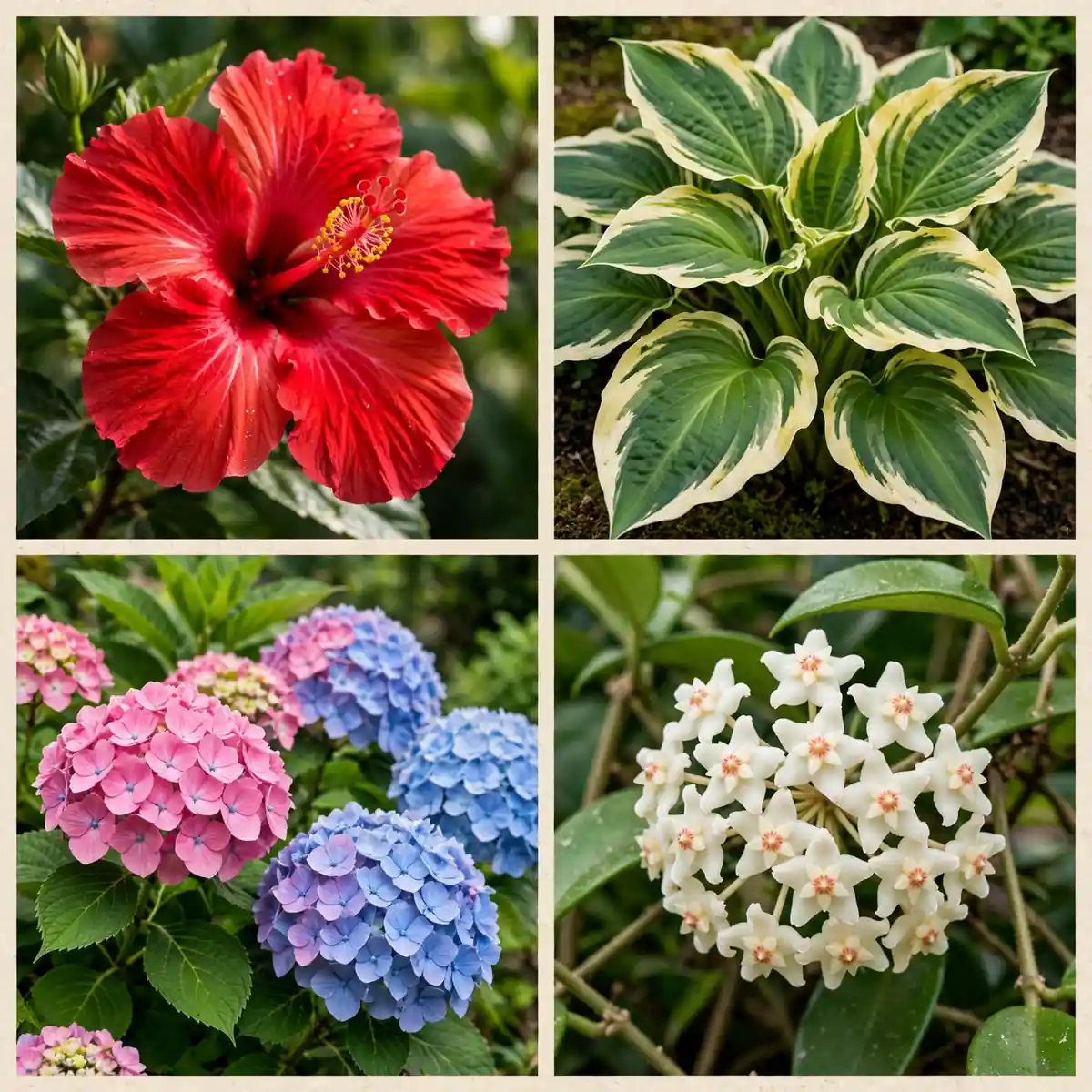
Short on time? These are the standout H plants worth knowing: Hibiscus for huge tropical-looking blooms, Hosta for unbeatable shade foliage, Hydrangea for big mophead flowers that shift color with soil pH, Hoya for a fragrant, forgiving houseplant, Haworthia for a tiny sun-loving succulent, Holly for evergreen winter structure and berries, Heather for low, acid-soil groundcover, Hellebore for flowers in late winter, Honeysuckle for sweet fragrance on a trellis, and Hyacinth for powerfully scented spring bulbs. The full list below adds 18 more, each with growing tips.
Table of Contents
- H Plants at a Glance: Match the Plant to Your Spot
- 1. Hibiscus
- 2. Hosta
- 3. Hydrangea
- 4. Hoya (Wax Plant)
- 5. Haworthia
- 6. Holly
- 7. Heather
- 8. Heuchera (Coral Bells)
- 9. Honeysuckle
- 10. Hyacinth
- 11. Hellebore (Lenten Rose)
- 12. Hens and Chicks
- 13. Hollyhock
- 14. Hebe
- 15. Heliotrope
- 16. Heliopsis (False Sunflower)
- 17. Hyssop
- 18. Hippeastrum (Amaryllis)
- 19. Helenium (Sneezeweed)
- 20. Hesperaloe (Red Yucca)
- 21. Heartleaf Philodendron
- 22. Hops
- 23. Heavenly Bamboo
- 24. Hylotelephium (Stonecrop)
- 25. Hawthorn
- 26. Hardy Geranium
- 27. Himalayan Honeysuckle
- 28. Hakone Grass
- Care Cheat Sheet: 12 Popular H Plants
- How to Choose the Right H Plant
- Frequently Asked Questions
- References
H Plants at a Glance: Match the Plant to Your Spot
Not sure where to start among 28 options? This table matches common garden situations to the H plants that handle them best.
| If you want… | Best H plants | Why it works |
|---|---|---|
| Bold color in full sun | Hibiscus, Heliopsis, Helenium | All three bloom for months in 6+ hours of sun and shrug off heat. |
| Something for deep shade | Hosta, Hellebore, Hakone Grass | Foliage stars that look better the less sun they get; hellebore even flowers in late winter. |
| An easy houseplant | Hoya, Haworthia, Heartleaf Philodendron | Forgiving of missed waterings and average indoor light. |
| Drought tolerance | Hesperaloe, Hens and Chicks, Hylotelephium | Succulent or succulent-like water storage; thrive on neglect once established. |
| Fragrance | Hyacinth, Honeysuckle, Heliotrope | Three of the strongest scents in the garden, from spring bulbs to summer vines. |
| Pollinator magnet | Hyssop, Heliopsis, Hebe | Bees and butterflies work these flowers from midsummer into fall. |
| Winter interest | Holly, Heather, Heavenly Bamboo | Evergreen foliage plus red berries or winter blooms when little else shows color. |
| Fast vertical coverage | Hops, Honeysuckle, Hollyhock | Vines and tall spires that can cover a trellis or fence in a single season. |
1. Hibiscus
Hibiscus rosa-sinensis (tropical) and Hibiscus syriacus (hardy / rose of Sharon) — Zones 9–11 tropical, Zones 5–9 hardy
Hibiscus is the show-off of the H list. Tropical hibiscus produces dinner-plate flowers up to 8 inches across in red, pink, orange, and yellow, blooming almost continuously in warm weather. If you live somewhere with real winters, grow the hardy rose of Sharon instead: a deciduous shrub that flowers from midsummer into fall on new wood, completely unbothered by frost.
Growing tips: Give hibiscus full sun and rich, consistently moist soil. Tropical types need winter protection below about 40°F (4°C) — bring pots indoors. For rose of Sharon, prune in late winter to shape it; it blooms on the current season’s growth, so hard pruning only increases flowers. Watch for aphids and Japanese beetles, and deadhead tropical blooms to keep new buds coming. For even more H-letter blooms, browse our list of flowers that start with H.
2. Hosta
Hosta spp. — Zones 3–9
If you have shade, you have a hosta spot. These perennials are grown almost entirely for their foliage: heart-shaped to lance-shaped leaves in greens, blues, golds, and variegated patterns, ranging from tiny 4-inch miniatures to 4-foot giants like ‘Empress Wu’. Tall spikes of lavender or white flowers appear in summer, but the leaves are the main event.
Growing tips: Morning sun with afternoon shade is the sweet spot; blue-leaved types need the most shade to keep their color. Plant in humus-rich, moisture-retentive soil and mulch to hold water. The number-one enemy is slugs and snails — use iron-phosphate bait, copper barriers, or simply choose thick-leaved, slug-resistant varieties like ‘Halcyon’ or ‘Blue Angel’. Divide crowded clumps in spring every 3–4 years.
3. Hydrangea
Hydrangea macrophylla (bigleaf) — Zones 5–9
Few shrubs deliver hydrangea’s flower power: giant mophead or lacecap blooms from early summer into fall. The famous party trick is real — bigleaf hydrangea flowers turn blue in acidic soil (pH below ~5.5) and pink in alkaline soil, because aluminum availability changes with pH. White varieties stay white regardless.
Growing tips: Plant in morning sun and afternoon shade, especially in hot climates; wilting afternoon leaves usually mean thirst, not disease. Water deeply and mulch well. Most bigleaf types bloom on old wood, so prune right after flowering, never in spring — spring pruning cuts off the buds. To push blooms blue, apply aluminum sulfate; for pink, add garden lime. Panicle hydrangeas (H. paniculata) are a tougher, sun-loving alternative for cold zones.
4. Hoya (Wax Plant)
Hoya carnosa — Houseplant (Zones 10–11 outdoors)
Hoya earns its keep twice: thick, waxy trailing leaves that look good year-round, and clusters of star-shaped, porcelain-like flowers with a sweet evening fragrance. It is famously long-lived — specimens passed down through families are common — and it tolerates the kind of neglect that kills fussier houseplants.
Growing tips: Bright indirect light is ideal; a little direct morning sun encourages blooming. Let the soil dry out between waterings — hoyas rot faster from overwatering than from drought. They bloom best when slightly root-bound, so don’t rush to repot. Never cut off the bare flower stalks (peduncles) after blooming; new flowers form on the same stalks year after year. Along with haworthia, hoya ranks among our best terrarium plants for enclosed glass gardens.
5. Haworthia
Haworthia attenuata, H. cooperi — Houseplant (Zones 9–11 outdoors)
Often mistaken for a miniature aloe, haworthia forms tight rosettes of fleshy, patterned leaves — zebra-striped, windowed, or pearl-dotted depending on the species. It stays small (rarely over 6 inches), making it perfect for desks, shelves, and small pots where a big succulent would overwhelm.
Growing tips: Bright indirect light keeps the rosettes compact; too little light stretches them, too much harsh sun scorches the leaves brown. Use a gritty cactus mix and water only when the soil is completely dry — in winter, that can mean once a month. Terracotta pots help by wicking away excess moisture. Offsets (“pups”) around the base can be separated in spring to make new plants for free.
6. Holly
Ilex aquifolium (English holly) — Zones 5–9
Holly is winter structure in plant form: glossy, spiny evergreen leaves and — on female plants — clusters of bright red berries that persist for months. It works as a specimen shrub, a clipped hedge, or a small tree, and the berries feed birds through the leanest part of the year.
Growing tips: Hollies are dioecious, meaning male and female flowers grow on separate plants — you need one male within about 50 feet of your females for berries. They tolerate shade but berry best in full sun. Plant in well-drained, slightly acidic soil and avoid waterlogged spots. Prune in late winter, and wear gloves: those spines are serious. Note that all parts, especially berries, are mildly toxic to people and pets, so site fruiting hollies away from play areas.
7. Heather
Calluna vulgaris (Scotch heather) — Zones 4–6
Heather turns poor, acidic ground into a flowering carpet. Low evergreen mounds — some cultivars with gold, bronze, or silver foliage — erupt in tiny bell flowers from midsummer into fall in shades of pink, purple, red, and white. It is a genuine four-season plant: foliage color often intensifies in winter.
Growing tips: This is the non-negotiable one: heather demands acidic soil (pH 4.5–5.5) and sharp drainage. In alkaline regions, grow it in containers of ericaceous compost. Full sun gives the densest flowering. Shear lightly right after blooming to keep mounds compact — never cut into old bare wood, which won’t resprout. Related heaths (Erica) extend the season with winter and spring flowers.
8. Heuchera (Coral Bells)
Heuchera spp. and hybrids — Zones 4–9
Coral bells are the foliage workhorses of the shade and part-shade garden. Modern hybrids offer leaves in near-black purple, caramel, lime, peach, and silver-veined patterns that hold their color all season — something few shade perennials manage. Delicate wands of tiny bell flowers rise above the foliage in early summer.
Growing tips: Part shade with protection from hot afternoon sun; dark-leaved varieties take more sun than light ones. They need good drainage — crown rot in soggy winter soil is the main killer, so plant the crown slightly high and amend heavy clay. In cold zones, frost heaving can push crowns out of the ground; check in spring and re-firm. Divide every 3–4 years to keep centers vigorous.
9. Honeysuckle
Lonicera spp. — Zones 4–9 depending on species
Honeysuckle’s tubular flowers deliver one of the great garden fragrances, sweetest in the evening. The catch: Japanese honeysuckle (L. japonica) is aggressively invasive in much of North America. Choose the well-behaved alternatives instead — trumpet honeysuckle (L. sempervirens), a native with coral-red trumpets that hummingbirds fight over, or fragrant woodbine types.
Growing tips: Give vines a sturdy trellis, arbor, or fence in full sun to part shade. Trumpet honeysuckle blooms on new wood, so prune in late winter. Keep the roots cool and shaded with mulch or a low companion plant — honeysuckles like their heads in the sun and feet in the shade. Deadhead spent flowers to extend the display, and check your local invasive list before planting any Lonicera.
10. Hyacinth
Hyacinthus orientalis — Zones 4–8
One hyacinth bulb can perfume an entire spring border. Dense spikes of waxy florets in blue, pink, white, purple, and yellow rise on stiff stems in early to mid-spring, each floret packed with fragrance. They are also among the easiest bulbs to force indoors for winter color.
Growing tips: Plant bulbs in fall, 6 inches deep and 4–5 inches apart, in well-drained soil — wet winter soil rots them. Full sun to light shade. After flowering, leave the foliage until it yellows completely so the bulb recharges; the flower display naturally diminishes after the second or third year, so many gardeners treat them as short-lived and replant fresh bulbs every few falls. For indoor forcing, chill bulbs 10–12 weeks, then bring into warmth.
11. Hellebore (Lenten Rose)
Helleborus orientalis hybrids — Zones 4–9
Hellebores bloom when almost nothing else dares: nodding, cup-shaped flowers in dusky pinks, purples, whites, and near-blacks push up through late-winter snow, often starting in February. The leathery evergreen foliage looks good the other eleven months, and deer and rabbits leave them strictly alone.
Growing tips: Part to full shade in rich, well-drained soil with plenty of organic matter. Once established, hellebores resent disturbance — choose the spot carefully. Cut back last year’s tattered leaves in late winter just as flower buds emerge; it shows off the blooms and reduces disease. All parts are toxic if eaten, so wear gloves when handling and keep away from curious pets. Self-sown seedlings appear freely; move them while small.
12. Hens and Chicks
Sempervivum tectorum — Zones 3–8
The name says it all: a mother rosette (“hen”) ringed by baby offsets (“chicks”) that root where they touch soil. These ultra-hardy succulents form evergreen mats in rock gardens, wall crevices, troughs, and the tops of hypertufa planters — places too hot, dry, and poor for almost anything else.
Growing tips: Full sun and extremely sharp drainage are the only real requirements; a gritty, sandy mix suits them better than rich potting soil. Water sparingly — rainfall is usually enough outdoors. Each rosette is monocarpic, meaning it flowers once (on a tall, odd-looking stalk) and then dies, but the chicks replace it many times over. Separate offsets in spring or simply let the colony spread.
13. Hollyhock
Alcea rosea — Zones 3–8
Hollyhocks are cottage-garden skyscrapers: 6- to 9-foot spires packed with saucer-sized single or double flowers in every warm color plus near-black ‘Nigra’. They are technically biennial or short-lived perennials — foliage the first year, towering bloom the second — but they self-seed so reliably that a patch becomes effectively permanent.
Growing tips: Full sun and decent air circulation; cramped, damp conditions invite hollyhock rust, the orange-spotted disease that is their main weakness. Stake tall varieties in windy sites. Let a few seed heads ripen each fall for next year’s volunteers, or collect seed and sow directly where you want them — they dislike transplanting. Cutting the main spike after flowering often triggers shorter side shoots for a second flush.
14. Hebe
Hebe spp. (shrubby veronica) — Zones 7–10
New Zealand’s gift to mild-climate gardens: neat evergreen shrubs with opposite pairs of glossy leaves and summer spikes of white, pink, purple, or blue flowers that bees mob. Sizes range from 1-foot dwarfs for edging to 4-foot rounded shrubs, and variegated forms add year-round foliage interest.
Growing tips: Full sun to part shade in well-drained soil; hebes hate waterlogged winter roots. They are not fully hardy, so in zone 6 and colder, treat them as container plants to overwinter indoors or choose the hardiest cultivars. Lightly trim after flowering to keep them bushy, but avoid cutting into old wood. In coastal gardens they tolerate salt wind remarkably well.
15. Heliotrope
Heliotropium arborescens — Zones 10–11 (grown as an annual elsewhere)
Heliotrope’s old-fashioned nickname is “cherry pie plant,” and one sniff explains why: clusters of deep purple flowers release a rich vanilla-cherry perfume, strongest on warm evenings. It is a tender perennial usually grown as a summer annual in most climates, forming neat 1- to 2-foot mounds.
Growing tips: Full sun to part shade in rich, moist soil. Start from nursery plants after all frost danger — seed-grown plants are slow. Keep it deadheaded and evenly watered for continuous bloom until frost; it pairs beautifully with purple annual flowers and silver foliage plants. Where winters stay above freezing, cut it back in late winter and it returns as a woody subshrub. Note: all parts are toxic if ingested, so it is not a plant for the vegetable bed.
16. Heliopsis (False Sunflower)
Heliopsis helianthoides — Zones 3–9
Don’t confuse it with true sunflowers: false sunflower is a clump-forming perennial with golden-yellow daisies from midsummer into fall. Unlike its annual cousins it comes back bigger every year, needs no staking in most soils, and feeds bees and butterflies for months. Cultivars like ‘Summer Sun’ and ‘Tuscan Sun’ bloom the first year from seed.
Growing tips: Full sun and average, well-drained soil — too-rich soil makes it floppy. It tolerates clay and drought once established, which is rare among long-blooming perennials. Deadhead to prolong flowering, or leave the seed heads standing for goldfinches in fall. Divide congested clumps in spring every 3 years. Cut stems back to basal foliage in late fall or leave for winter structure.
17. Hyssop
Hyssopus officinalis — Zones 3–9
A semi-evergreen herb with real garden merit: aromatic narrow leaves and dense spikes of blue (sometimes pink or white) flowers that bloom for weeks in midsummer. Bees rank it among their favorite herbs, and it doubles as a compact, informal edging plant for herb gardens and borders.
Growing tips: Full sun and lean, well-drained soil — hyssop sulks in rich, wet ground. Shear plants back by a third after the first flush to trigger rebloom, and give a harder cut in spring to prevent woodiness. Harvest leaves before flowering for the strongest flavor; the minty-bitter taste suits teas and stews. It self-seeds modestly — weed out volunteers or let it naturalize in a wild corner.
18. Hippeastrum (Amaryllis)
Hippeastrum hybrids — Houseplant / Zones 8–10 outdoors
The giant “amaryllis” bulbs sold for Christmas forcing are botanically Hippeastrum, and the performance is spectacular: a single bulb sends up one or two thick stalks carrying four to six trumpet flowers up to 8 inches wide. With minimal care, a bulb reblooms for decades.
Growing tips: Plant with the top third of the bulb above the soil in a pot only slightly wider than the bulb — cramped quarters trigger blooming. Water sparingly until growth starts, then keep evenly moist in bright light. After flowering, cut the stalk but keep the leaves growing all summer (this is when the bulb recharges). In fall, stop watering, let foliage die back, and rest the bulb cool and dry for 8–10 weeks before starting again.
19. Helenium (Sneezeweed)
Helenium autumnale hybrids — Zones 3–8
Despite the unfortunate name (it refers to old snuff-making, not allergies), sneezeweed is one of the finest late-summer perennials: masses of daisies in burnt orange, mahogany, gold, and yellow from August into October, exactly when the border needs rescuing. Modern hybrids like ‘Mardi Gras’ and ‘Sahin’s Early Flowerer’ are compact and long-blooming.
Growing tips: Full sun and moisture-retentive soil — helenium is one of the few sun perennials that genuinely likes damp ground. Pinch or cut back by half in late May to keep plants bushy and delay bloom. Deadhead for continuous flowers, and divide every 2–3 years in spring, as clumps decline in the center. It pairs naturally with ornamental grasses and fall asters — and with late mums (see our mum care guide) for an autumn border that carries into October.
20. Hesperaloe (Red Yucca)
Hesperaloe parviflora — Zones 5–11
Not a true yucca despite the name, red yucca is a sculptural desert accent: fountain-like clumps of narrow, evergreen leaves sending up 5-foot spikes of coral-red tubular flowers all summer. Hummingbirds visit constantly, and established plants survive on rainfall alone in the Southwest.
Growing tips: Full sun and excellent drainage — the crown rots in winter-wet soil, so plant on a slope or in a raised bed in marginal zones. It is remarkably cold-hardy for a desert plant (to around -20°F once established) but needs that drainage to survive cold. Remove spent flower stalks at the base; the evergreen foliage needs no other care. Give it room — clumps slowly widen to 4 feet.
21. Heartleaf Philodendron
Philodendron hederaceum — Houseplant (Zones 10–11 outdoors)
The classic trailing houseplant: glossy heart-shaped leaves on vines that happily cascade from shelves or climb a moss pole. It tolerates low light, irregular watering, and general inattention better than almost any other indoor plant, which is why it has survived decades of decorating trends.
Growing tips: Bright indirect light is ideal, but it survives in low light (growth just slows). Water when the top inch of soil dries; yellow leaves usually mean too much water, not too little. Pinch growing tips to encourage bushiness, and root the cuttings in water — they root in weeks. Wipe leaves occasionally to keep them dust-free and photosynthesizing. All parts are toxic if chewed, so keep it away from pets that nibble.
22. Hops
Humulus lupulus — Zones 3–8
Yes, the beer plant — but hops deserve a garden spot even if you never brew. Fast-growing bines (they climb by twining stems, not tendrils) can shoot 15–25 feet in a single season, covering a trellis, pergola, or ugly fence with lush green foliage and dangling papery cones in late summer. ‘Aureus’ offers brilliant golden foliage for purely ornamental use.
Growing tips: Full sun and a seriously sturdy support — mature bines are heavy. Provide rich, well-drained soil and deep, consistent water the first year. Cut all growth to the ground in late winter; new shoots emerge each spring. Harvest cones when they feel papery and spring back after squeezing, usually late August to September. Give hops room: they spread by rhizomes and will colonize neighboring beds if not contained.
23. Heavenly Bamboo
Nandina domestica — Zones 6–9
Neither bamboo nor from heaven, but a genuinely useful evergreen shrub: airy, bamboo-like foliage that turns fiery red and bronze in fall and winter, white spring flower clusters, and bright red berries that persist for months. Compact cultivars like ‘Fire Power’ and ‘Gulf Stream’ fit foundation plantings at 2–3 feet.
Growing tips: Full sun to part shade; the best fall color develops in sun. Adaptable to most soils as long as drainage is decent. Prune selectively in late winter — cut the oldest canes to the ground rather than shearing, which ruins its layered form. Two cautions: it self-seeds aggressively in the Southeast (choose sterile cultivars like ‘Fire Power’ there, and check local invasive lists), and the berries contain compounds toxic to birds in large quantities and to pets.
24. Hylotelephium (Stonecrop)
Hylotelephium spectabile ‘Autumn Joy’ — Zones 3–9
Formerly classified as Sedum, ‘Autumn Joy’ stonecrop is the backbone of the fall border: fleshy blue-green rosettes all summer, then flat-topped clusters of tiny buds that open dusty pink and age to copper-red just as everything else fades. Butterflies cover it in September, and the dried seed heads look sculptural under frost.
Growing tips: Full sun and average to poor, well-drained soil — rich soil and shade make it flop. It needs almost no water once established and no fertilizer at all. Leave the stems standing through winter for structure and cut them down in early spring as new growth emerges. Divide in spring every few years if the center thins. It also roots absurdly easily from stem cuttings stuck straight into soil.
25. Hawthorn
Crataegus spp. — Zones 3–7
A small, tough flowering tree for big impact in small gardens: clouds of white (sometimes pink) blossoms in late spring, followed by clusters of red fruits (“haws”) that birds strip by midwinter. Thorny branches make it a superb wildlife hedge and a natural security barrier.
Growing tips: Full sun and almost any soil, including clay and urban conditions — hawthorns are famously unfussy. Plant container-grown trees in fall or early spring and water the first year. Prune in late winter to shape; wear serious gloves against the thorns. Choose disease-resistant selections (hawthorns can suffer leaf spot and fire blight) and site them where falling fruit won’t stain patios.
26. Hardy Geranium
Geranium ‘Rozanne’ and other cranesbills — Zones 5–8
Not the red window-box geranium (that’s Pelargonium) — hardy geraniums, or cranesbills, are tough perennials with five-petaled flowers in blue, pink, and purple. ‘Rozanne’, with violet-blue blooms from June to frost, is one of the longest-flowering perennials ever trialed. They weave beautifully through roses and shrubs, softening edges all season.
Growing tips: Full sun to part shade in average, well-drained soil. Shear plants back by half after the first heavy flush and they rebound with fresh foliage and more flowers. Most spread politely by rhizomes — divide in spring if they outgrow their spot. For collectors of the truly odd, our roundup of unusual and beautiful flowers has companions with the same cottage-garden spirit.
27. Himalayan Honeysuckle
Leycesteria formosa — Zones 7–9
An architectural shrub unlike any other honeysuckle: hollow bamboo-like stems, then in late summer, drooping clusters of white flowers wrapped in claret-purple bracts, followed by dark purple berries birds love. It looks exotic but grows with weedy enthusiasm in mild climates.
Growing tips: Full sun to part shade in moist, well-drained soil. It is borderline hardy — in zone 7, mulch the crown heavily and expect it to die back and resprout. Cut all stems to the ground in late winter each year; it flowers on new growth, so hard pruning only improves the display. Deadhead before berries ripen if you want to limit self-seeding, because it seeds around freely in favorable spots.
28. Hakone Grass
Hakonechloa macra — Zones 5–9
The rare ornamental grass that prefers shade. Hakone grass forms cascading mounds of arching blades — brilliant gold in ‘Aureola’, striped green-and-cream in ‘Alboaurea’ — that move beautifully in the breeze and turn tawny in fall. It is slow to establish but eventually forms weed-smothering colonies.
Growing tips: Part to full shade in consistently moist, humus-rich soil; the golden forms scorch in afternoon sun. Unlike most grasses, it dislikes drought — mulch and water during dry spells. Cut old foliage to the ground in late winter before new blades emerge. Be patient: it often sits nearly still the first year, then takes off in year two or three. Combine with hostas and hellebores for a layered shade planting.
Care Cheat Sheet: 12 Popular H Plants
Pin this table: the essentials for the dozen H plants gardeners ask about most.
| Plant | Light | Water | Hardiness zones |
|---|---|---|---|
| Hibiscus (hardy) | Full sun | Average to moist | 5–9 |
| Hosta | Part to full shade | Evenly moist | 3–9 |
| Hydrangea (bigleaf) | Morning sun, afternoon shade | Evenly moist | 5–9 |
| Hoya | Bright indirect (indoors) | Let dry between waterings | 10–11 outdoors |
| Haworthia | Bright indirect (indoors) | Sparse; drought tolerant | 9–11 outdoors |
| Holly | Full sun to part shade | Average | 5–9 |
| Heather | Full sun | Average; needs acidic soil | 4–6 |
| Hellebore | Part to full shade | Evenly moist | 4–9 |
| Hyacinth | Full sun to part shade | Average; no wet winter soil | 4–8 |
| Hollyhock | Full sun | Average | 3–8 |
| Hesperaloe | Full sun | Very low once established | 5–11 |
| Hakone Grass | Part to full shade | Consistently moist | 5–9 |
How to Choose the Right H Plant
Start with your light. It is the one condition you cannot negotiate: a sun-lover like hibiscus or heliopsis will never thrive in the shade where hosta, hellebore, and hakone grass excel, and vice versa. Walk your garden at midday and be honest about how many hours of direct sun each spot really gets.
Next, match the plant to your maintenance style. If you travel or simply forget to water, lean on the forgiving end of the list — hoya, haworthia, hesperaloe, hens and chicks, and hylotelephium all tolerate neglect. If you enjoy daily garden time, thirstier beauties like hydrangea, hibiscus, and hyacinth reward the attention with spectacular bloom.
Finally, think in layers and seasons. Hellebore and hyacinth open the year, hibiscus and heliopsis carry summer, helenium and hylotelephium close out fall, and holly, heather, and heavenly bamboo hold the garden through winter. A border that combines three or four H plants across seasons looks intentional — and gives you flowers or foliage interest nearly year-round.
Frequently Asked Questions
What are the most popular plants that start with H?
Hibiscus, hosta, hydrangea, hoya, holly, and hyacinth are the best-known H plants worldwide. Hibiscus and hydrangea lead for flowers, hosta dominates shade gardening, hoya is a top-10 houseplant, holly is the classic winter evergreen, and hyacinth is the most fragrant common spring bulb.
Which plants that start with H grow best in shade?
Hosta is the undisputed shade champion, joined by hellebore (which flowers in late winter), heuchera for colorful foliage, hakone grass for texture, and heartleaf philodendron indoors. All five prefer part to full shade and many actually look worse in strong sun.
Are there any easy houseplants that start with H?
Yes — hoya, haworthia, and heartleaf philodendron are three of the most forgiving houseplants you can grow. All tolerate missed waterings and average indoor light. Hoya and heartleaf philodendron trail nicely from shelves, while haworthia stays compact on a sunny windowsill.
What H plants are drought tolerant?
Hesperaloe (red yucca), hens and chicks, hylotelephium (Autumn Joy stonecrop), and haworthia handle drought best thanks to succulent water-storing tissue. Hyssop and heliopsis are also notably drought tolerant once established, and mature holly needs little supplemental water.
Do hydrangeas really change color based on soil?
Yes — but only bigleaf hydrangeas (Hydrangea macrophylla). Acidic soil (pH below about 5.5) makes aluminum available to the plant and turns flowers blue; alkaline soil locks aluminum away and flowers turn pink. White hydrangeas and other species like panicle hydrangea do not change color.
Which plants that start with H are good for pollinators?
Hyssop, heliopsis, hebe, and trumpet honeysuckle are outstanding bee and butterfly plants, while hesperaloe and hibiscus draw hummingbirds. Planting several together gives pollinators nectar from midsummer through fall.
References
- Missouri Botanical Garden — Plant Finder: detailed growing information for hundreds of ornamental plants.
- Royal Horticultural Society — Find a Plant: expert plant profiles with hardiness and cultivation advice.
- The Old Farmer’s Almanac — Planting Calendar: frost dates and planting times by ZIP/postal code.
- Gardening Know How: practical how-to articles on planting, pruning, and plant care.
- USDA PLANTS Database: authoritative taxonomy, distribution, and native-status data.