Plants That Start With N: Names, Pictures and Useful Facts
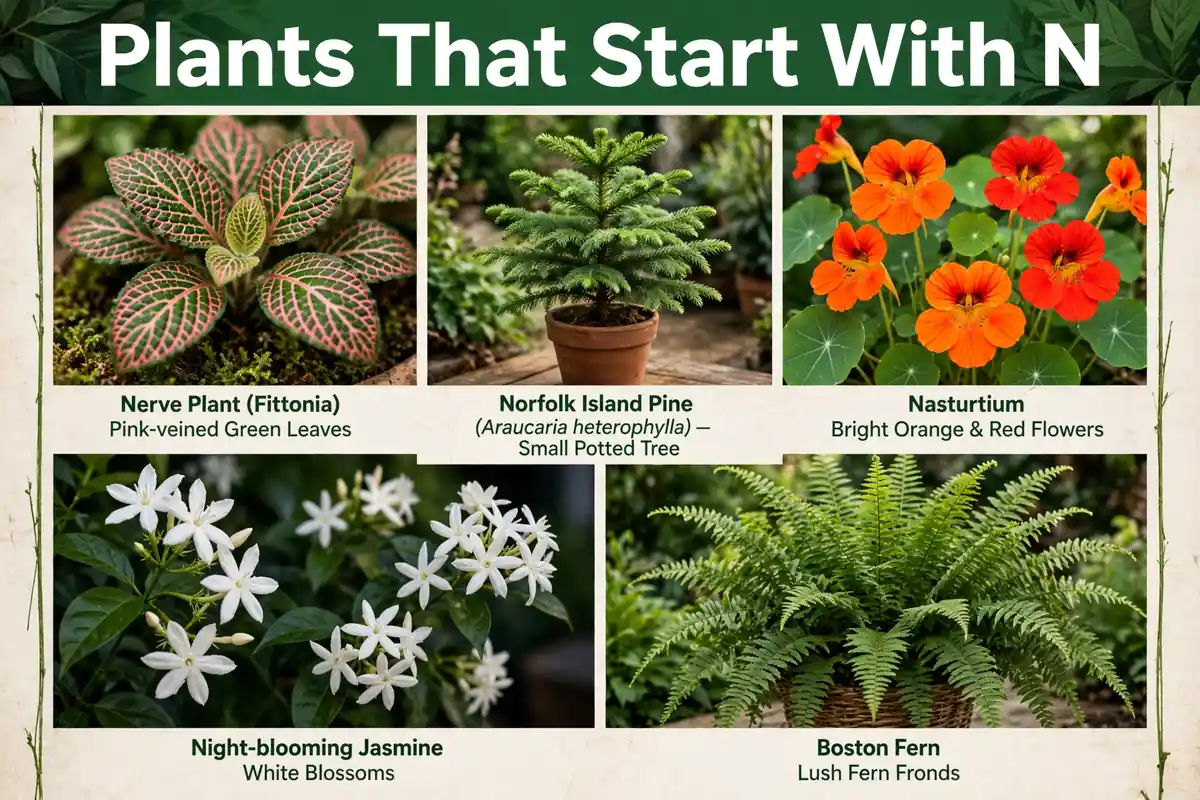
Looking for plants that start with N? You have come to the right place. The letter N is a quieter letter in the gardening alphabet than D or S, but it hides some genuine treasures: the veined foliage of the nerve plant, the soft symmetry of the Norfolk Island pine, the peppery punch of nasturtiums, and the intoxicating evening perfume of night-blooming jasmine. Whether you are building an alphabet garden, filling a tricky shady corner, or just curious about plant names that begin with N, this guide covers 30 real plants that start with N, each with a vivid description and practical growing advice.
A quick, honest note before we start: N is a thinner letter, so toward the end of the list you will meet a few botanical curiosities — wild herbs, aquatic beauties, and lesser-known annuals — alongside the famous houseplants and garden staples. Every plant here is real and verifiable, and I have flagged the marginal ones so you know exactly what you are getting. Every entry lists the plant’s scientific name, bloom season, light needs, water needs, and USDA hardiness zone, so you can tell at a glance which N-plants fit your garden. You will also find two handy comparison tables, practical growing tips, and answers to the questions gardeners ask most about plants starting with N. If you are collecting the whole gardening alphabet, our plants that start with A and plants that start with P guides are ready when you are. Let’s dig in.
Quick Answer
Popular plants that start with N include Nerve Plant, Norfolk Island Pine, Boston Fern, Nasturtium, Night-blooming Jasmine, Natal Plum, Ponytail Palm, New Guinea Impatiens, Heavenly Bamboo, and New England Aster. They span fragrant shrubs, tropical houseplants, summer annuals, fall perennials, native shrubs, and even aquatic plants — covering USDA zones 2–12, so there is an N-plant for nearly every garden on Earth.
Table of Contents
N-Plants at a Glance
Use this table to compare all 30 plants that start with N side by side, from botanical names to native regions.
| Plant name | Scientific name | Type | Light | Native region |
|---|---|---|---|---|
| Nerve Plant | Fittonia albivenis | Tropical houseplant | Bright indirect light | Peru and tropical South America |
| Norfolk Island Pine | Araucaria heterophylla | Evergreen conifer / houseplant | Bright indirect light | Norfolk Island (South Pacific) |
| Boston Fern | Nephrolepis exaltata ‘Bostoniensis’ | Evergreen fern / houseplant | Bright indirect light | Tropical Americas (cultivar, Boston origin) |
| Nasturtium | Tropaeolum majus | Summer annual | Full sun | Andes (Peru, Bolivia, Colombia) |
| Night-blooming Jasmine | Cestrum nocturnum | Evergreen shrub | Full sun to part shade | West Indies, Central America |
| Natal Plum | Carissa macrocarpa | Evergreen shrub | Full sun | South Africa (Natal coast) |
| Ponytail Palm | Beaucarnea recurvata (syn. Nolina recurvata) | Semi-succulent houseplant / small tree | Bright direct to indirect light | Eastern Mexico |
| New Guinea Impatiens | Impatiens hawkeri hybrids | Tender perennial grown as annual | Part shade | Papua New Guinea (hybrid breeding) |
| Heavenly Bamboo | Nandina domestica | Evergreen shrub | Full sun to part shade | China, Japan |
| New England Aster | Symphyotrichum novae-angliae | Herbaceous perennial | Full sun | Eastern and central North America |
| Ninebark | Physocarpus opulifolius | Deciduous shrub | Full sun to part shade | North America |
| Night-blooming Cereus | Epiphyllum oxypetalum | Epiphytic cactus / houseplant | Bright indirect light | Central and South America |
| Water Lily | Nymphaea spp. and hybrids | Aquatic perennial | Full sun | Worldwide (temperate and tropical) |
| Sacred Lotus | Nelumbo nucifera | Aquatic perennial | Full sun | Asia, northern Australia |
| Flowering Tobacco | Nicotiana sylvestris | Annual / short-lived perennial | Full sun to part shade | Argentina, Bolivia |
| Catmint | Nepeta × faassenii | Herbaceous perennial | Full sun | Hybrid (European parentage) |
| New York Aster | Symphyotrichum novi-belgii | Herbaceous perennial | Full sun | Eastern North America |
| New Zealand Flax | Phormium tenax | Evergreen architectural perennial | Full sun to part shade | New Zealand |
| New Zealand Tea Tree | Leptospermum scoparium | Evergreen shrub | Full sun | New Zealand, southeastern Australia |
| Northern Sea Oats | Chasmanthium latifolium | Ornamental grass | Part shade | Eastern and central North America |
| Love-in-a-Mist | Nigella damascena | Hardy annual | Full sun | Southern Europe, North Africa, West Asia |
| Nemesia | Nemesia strumosa hybrids | Tender annual | Full sun to part shade | South Africa (hybrid breeding) |
| Night Phlox | Zaluzianskya capensis | Tender annual | Full sun | South Africa |
| Naked Ladies | Amaryllis belladonna | Summer-dormant bulb | Full sun | South Africa (Western Cape) |
| Nannyberry | Viburnum lentago | Deciduous shrub / small tree | Full sun to part shade | Eastern North America |
| Northern Maidenhair Fern | Adiantum pedatum | Deciduous fern | Part to full shade | Eastern North America, East Asia |
| Cupflower | Nierembergia hippomanica | Tender annual | Full sun | South America (Argentina, Uruguay) |
| Chilean Bellflower | Nolana paradoxa | Tender annual | Full sun | Chile, Peru (coastal deserts) |
| Nun’s Orchid | Phaius tankervilleae | Terrestrial orchid / houseplant | Bright indirect light | Asia, Australia, Pacific islands |
| Stinging Nettle | Urtica dioica | Herbaceous perennial (wild herb) | Full sun to part shade | Europe, Asia, North America |
Bloom Season, Water Needs & Hardiness Zones
Planning your garden calendar? This second table shows when each N-plant blooms, how much water it wants, and the USDA zones where it grows outdoors year-round.
| Plant name | Bloom season | Water needs | Hardiness zone | Mature size |
|---|---|---|---|---|
| Nerve Plant | Rarely indoors (grown for foliage) | High; keep evenly moist | Houseplant (11–12 outdoors) | 6–12 in tall |
| Norfolk Island Pine | Non-flowering conifer | Average; even moisture | Houseplant (9–11 outdoors) | 3–6 ft indoors; 200 ft wild |
| Boston Fern | Non-flowering fern | High; keep moist, loves humidity | Houseplant (9–11 outdoors) | 2–3 ft tall and wide |
| Nasturtium | Summer to fall | Low to average; drought tolerant | Grown as annual | 1–2 ft bush; 6–10 ft trailing |
| Night-blooming Jasmine | Summer to fall (nightly) | Average; regular watering | 9–11 (annual/greenhouse elsewhere) | 8–12 ft tall |
| Natal Plum | Spring to fall (fragrant white flowers) | Low; drought tolerant | 9–11 | 4–8 ft tall and wide |
| Ponytail Palm | Rarely indoors | Very low; drought tolerant | Houseplant (9–11 outdoors) | 3–4 ft indoors; 30 ft wild |
| New Guinea Impatiens | Late spring to frost | High; never let dry out | Grown as annual (10–11 perennial) | 1–2 ft tall |
| Heavenly Bamboo | Late spring (white flowers, red berries) | Average; drought tolerant once established | 6–9 | 4–8 ft tall |
| New England Aster | Late summer to fall | Average to moist | 4–8 | 3–6 ft tall |
| Ninebark | Late spring to early summer | Average; tolerates drought and wet soil | 2–8 | 5–8 ft tall |
| Night-blooming Cereus | Summer nights (one night per bloom) | Average; let dry slightly | Houseplant (10–11 outdoors) | 6–10 ft sprawling stems |
| Water Lily | Summer to early fall | Aquatic; planted in pond soil | 4–10 (hardy types); tropical types 10–11 | 3–6 ft spread per plant |
| Sacred Lotus | Summer | Aquatic; large container or pond | 5–10 | 3–5 ft tall, 3–6 ft spread |
| Flowering Tobacco | Summer to fall (evening fragrant) | Average | Grown as annual | 3–5 ft tall |
| Catmint | Late spring to fall (reblooms if sheared) | Low; drought tolerant | 3–8 | 1–3 ft tall |
| New York Aster | Late summer to fall | Average | 4–8 | 1–4 ft tall |
| New Zealand Flax | Summer (tall red flower spikes) | Average; tolerates drought and wet | 8–10 | 6–10 ft tall |
| New Zealand Tea Tree | Late spring to early summer | Average; good drainage | 8–10 | 6–10 ft tall |
| Northern Sea Oats | Late summer (oat-like seed heads) | Average; tolerates dry shade | 5–9 | 2–5 ft tall |
| Love-in-a-Mist | Early to midsummer | Average | Grown as annual | 18–24 in tall |
| Nemesia | Spring to early summer (fall in cool climates) | Average; consistent moisture | Grown as annual | 6–18 in tall |
| Night Phlox | Summer to fall (evening fragrant) | Average | Grown as annual | 12–18 in tall |
| Naked Ladies | Late summer (leafless pink trumpets) | Low; dry summer dormancy | 7–10 | 2–3 ft flower stalks |
| Nannyberry | Late spring (white flower clusters) | Average to moist | 2–8 | 10–18 ft tall |
| Northern Maidenhair Fern | Non-flowering fern | Average to moist; humus-rich soil | 3–8 | 1–2 ft tall |
| Cupflower | Summer to frost | Average | Grown as annual | 6–12 in tall |
| Chilean Bellflower | Summer | Average; tolerates poor soil | Grown as annual | 6–10 in tall, trailing |
| Nun’s Orchid | Late winter to spring | Average; even moisture in growth | Houseplant (9–11 outdoors) | 2–4 ft tall |
| Stinging Nettle | Summer (inconspicuous green flowers) | Average to moist | 3–10 | 3–6 ft tall |
30 Plants That Start With N: The Complete List
Here is the full rundown of N-plants, ordered from the most popular to the most curious, with real growing advice for each one.
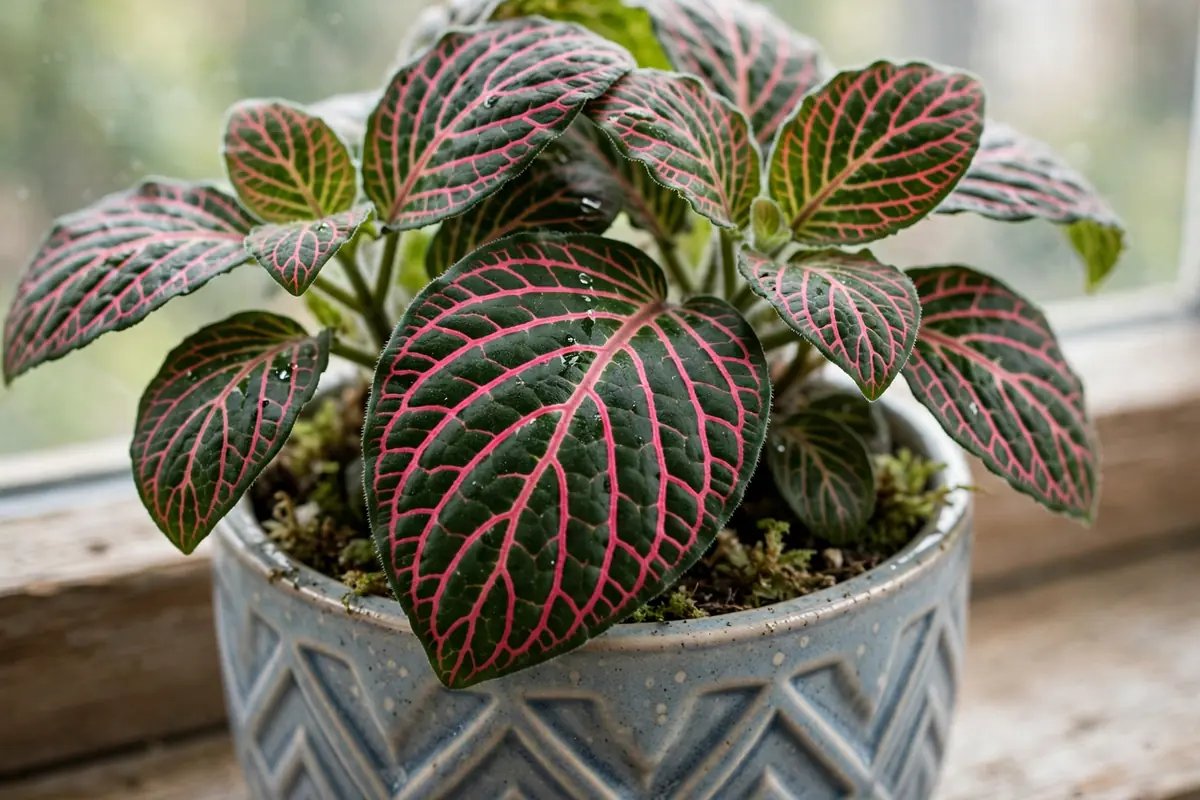
1. Nerve Plant (Fittonia albivenis)
The nerve plant is the houseplant world’s best miniature: a low, spreading mound of small oval leaves laced with a vivid network of veins in white, pink, or deep red — looking like a botanical circuit board. Native to the rainforest floors of Peru, it is one of the most forgiving small plants you can grow indoors, and it practically talks to you: the leaves visibly droop when thirsty, then perk up within hours of watering.
Give it bright indirect light and keep the soil consistently moist but never soggy — a peat-based mix with good drainage works best. It loves humidity, so a bathroom, terrarium, or pebble tray keeps it happiest. In fact, it ranks among the best terrarium plants you can grow, thriving in the humid, enclosed air that fussier houseplants dislike. It is hardy outdoors only in zones 11–12, but as a houseplant it stays a tidy 6–12 inches. Pinch stem tips to keep it bushy, and it is completely non-toxic to pets — a rare virtue among showy houseplants.
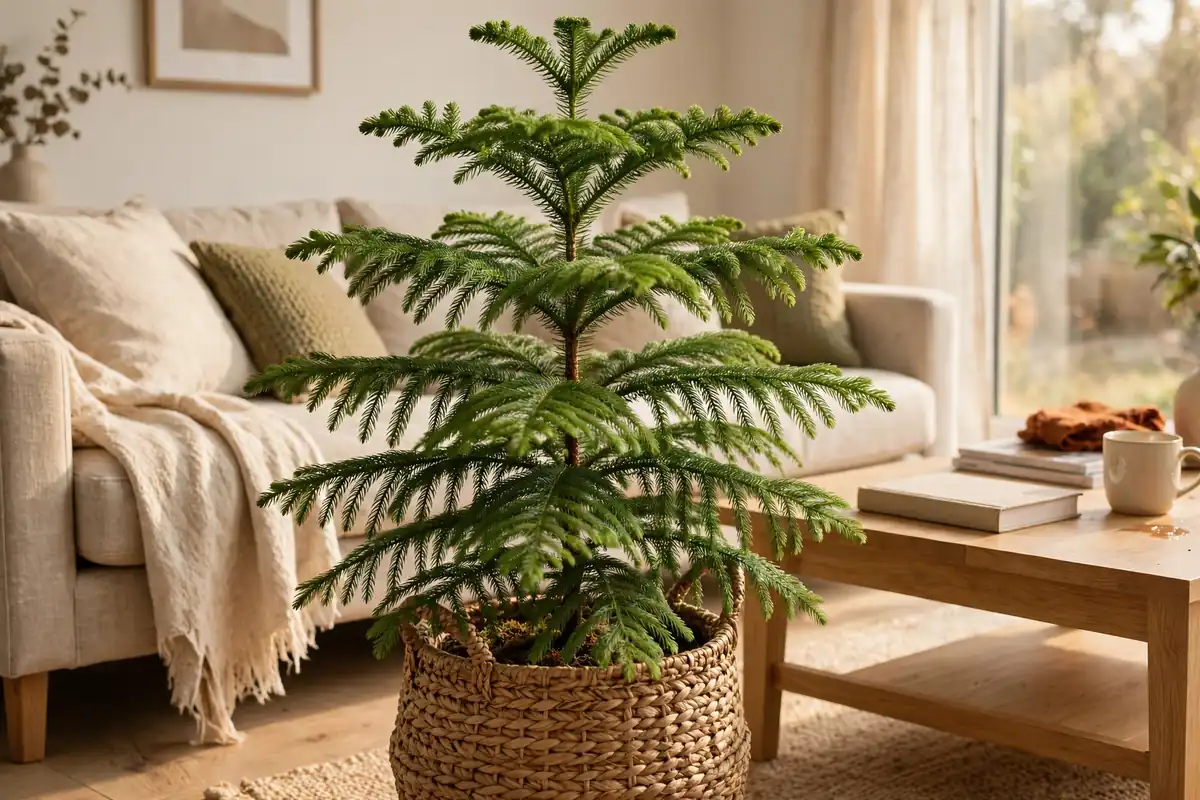
2. Norfolk Island Pine (Araucaria heterophylla)
Despite its name, the Norfolk Island pine is not a true pine — it is a prehistoric-looking conifer from tiny Norfolk Island in the South Pacific, with perfectly symmetrical tiers of soft, feathery branches. Indoors it makes a sculptural 3–6 foot accent plant, and every December it doubles as the most elegant living Christmas tree you will ever own, dressed in miniature ornaments.
It wants bright indirect light and even moisture — never let it dry out completely, and never leave it sitting in water. Turn the pot regularly so all sides get light and the symmetry stays perfect. It hates dry heated air and cold drafts; keep it above 50°F and mist it in winter. Outdoors it is hardy only in zones 9–11, where in frost-free climates it can soar to 200 feet — a true giant in its homeland.
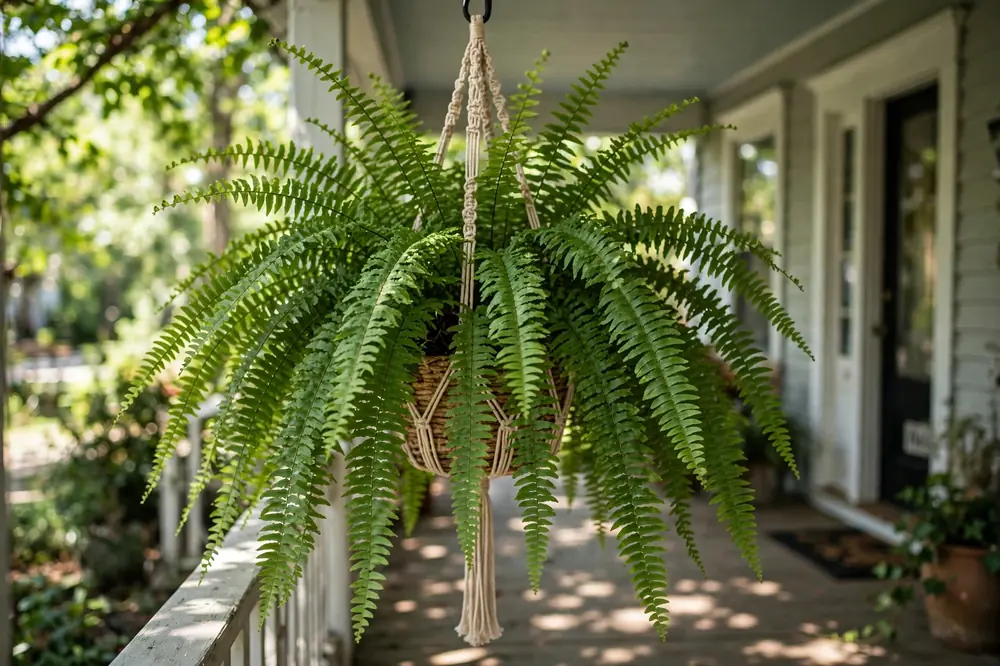
3. Boston Fern (Nephrolepis exaltata ‘Bostoniensis’)
The Boston fern is the classic that launched a million hanging baskets: graceful arching fronds up to 3 feet long, finely divided into hundreds of tiny leaflets, cascading from a pot like a green waterfall. Discovered as a natural mutation in a Boston fern shipment in the 1890s, it became the Victorian era’s most beloved houseplant and never really left — it still outsells almost every other fern.
Bright indirect light and constant moisture are the whole secret. Boston ferns despise dry air and dry soil; a daily misting or a humid room keeps the fronds lush instead of crispy. Water when the top inch of soil dries, feed lightly through the growing season, and cut off any brown fronds at the base. Outdoors it is hardy in zones 9–11, where it naturalizes in humid climates — sometimes a bit too enthusiastically.
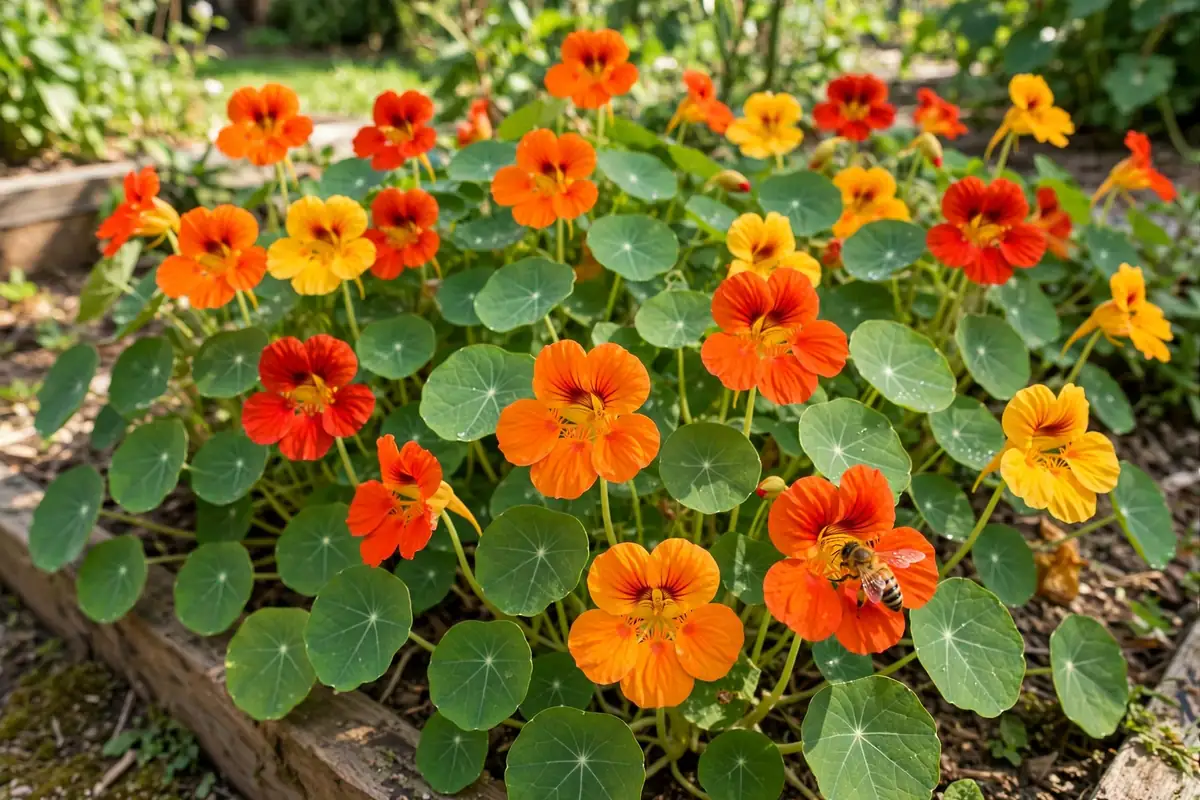
4. Nasturtium (Tropaeolum majus)
Nasturtiums are the cheerful workhorses of the summer garden: round, lily-pad leaves and trumpet-shaped flowers in blazing orange, red, yellow, and cream, blooming nonstop from summer to fall. But they are more than pretty — every part is edible, with a peppery, watercress-like bite that elevates salads, and the green seedpods can be pickled as poor-man’s capers. Gardeners also plant them as trap crops, sacrificing the nasturtiums to lure aphids away from vegetables.
Sow the large seeds directly in the garden after the last frost, half an inch deep — they hate transplanting. The counterintuitive secret: give them POOR soil. Rich soil produces a jungle of leaves with almost no flowers, while lean, well-drained soil in full sun triggers a flower explosion. Water moderately, deadhead for more blooms, and let a few pods ripen if you want free plants next year — they self-sow readily. For more blooming beauties under this letter, browse our guide to flowers that start with N.
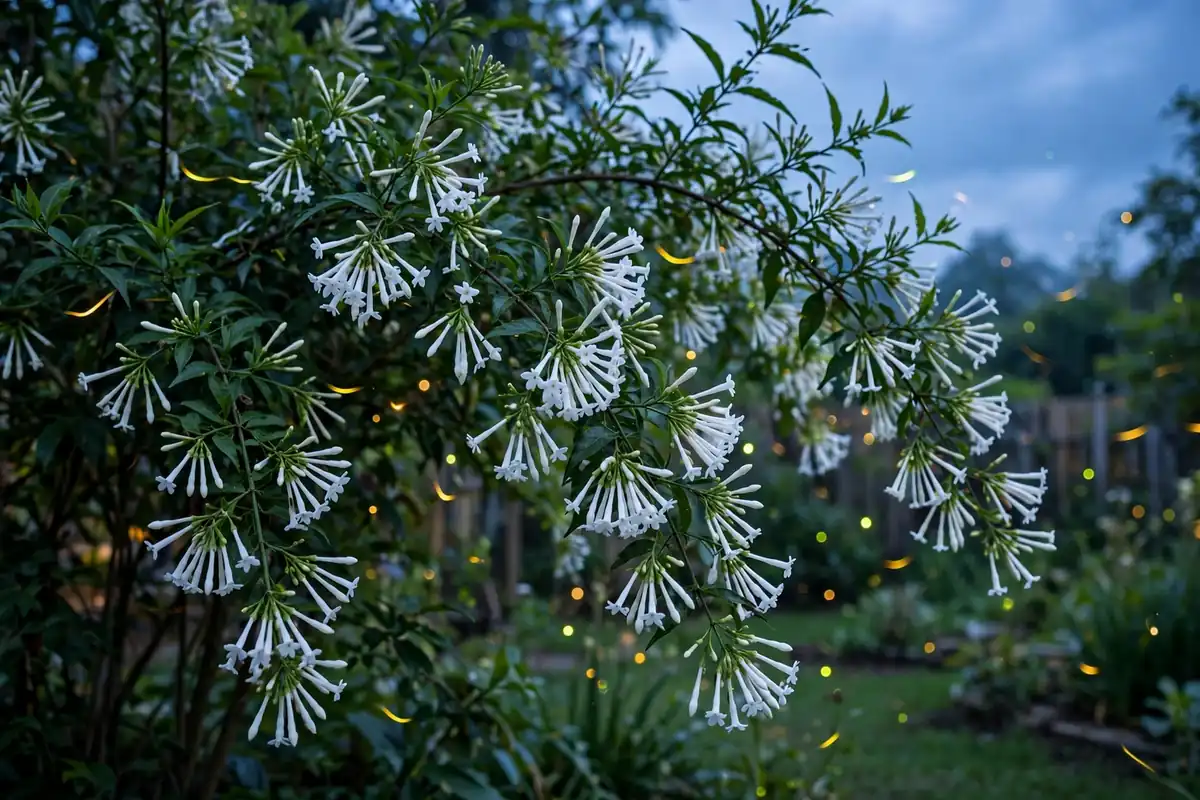
5. Night-blooming Jasmine (Cestrum nocturnum)
Night-blooming jasmine is grown for one unforgettable trick: on warm summer evenings, its unassuming clusters of greenish-white tubular flowers release a perfume so powerful that a single shrub can scent an entire garden — and drift through open windows. It is widely considered the most fragrant night-blooming plant in cultivation, which is why it is a staple of moon gardens and tropical patios worldwide.
Plant it in full sun to part shade in zones 9–11, in any reasonably fertile, well-drained soil, and give it room — it reaches 8–12 feet and grows fast. It blooms on new wood, so prune hard in late winter to control size and boost flowering. In colder climates, grow it in a large pot and bring it indoors before frost; it will perfume a sunroom beautifully. Note: all parts, especially the berries, are toxic if eaten, so keep it away from curious children and pets.
6. Natal Plum (Carissa macrocarpa)
The Natal plum is the toughest pretty shrub you have never heard of: glossy dark-green leaves, starry white jasmine-scented flowers through much of the year, and large red plum-like fruits that taste like a cranberry crossed with a strawberry. Native to the coastal dunes of South Africa’s Natal region, it shrugs off salt spray, drought, heat, and poor sandy soil — and its forked thorns make it an impenetrable, beautiful security hedge.
Give it full sun and sharp drainage in zones 9–11; once established, it needs almost no water. It tolerates shearing into formal hedges or can be left loose and natural at 4–8 feet. The fruits are edible when fully ripe and deep red — unripe fruit is milky and should be avoided. Thornless cultivars like ‘Fancy’ and ‘Torulosa’ exist if you want the looks without the spikes.
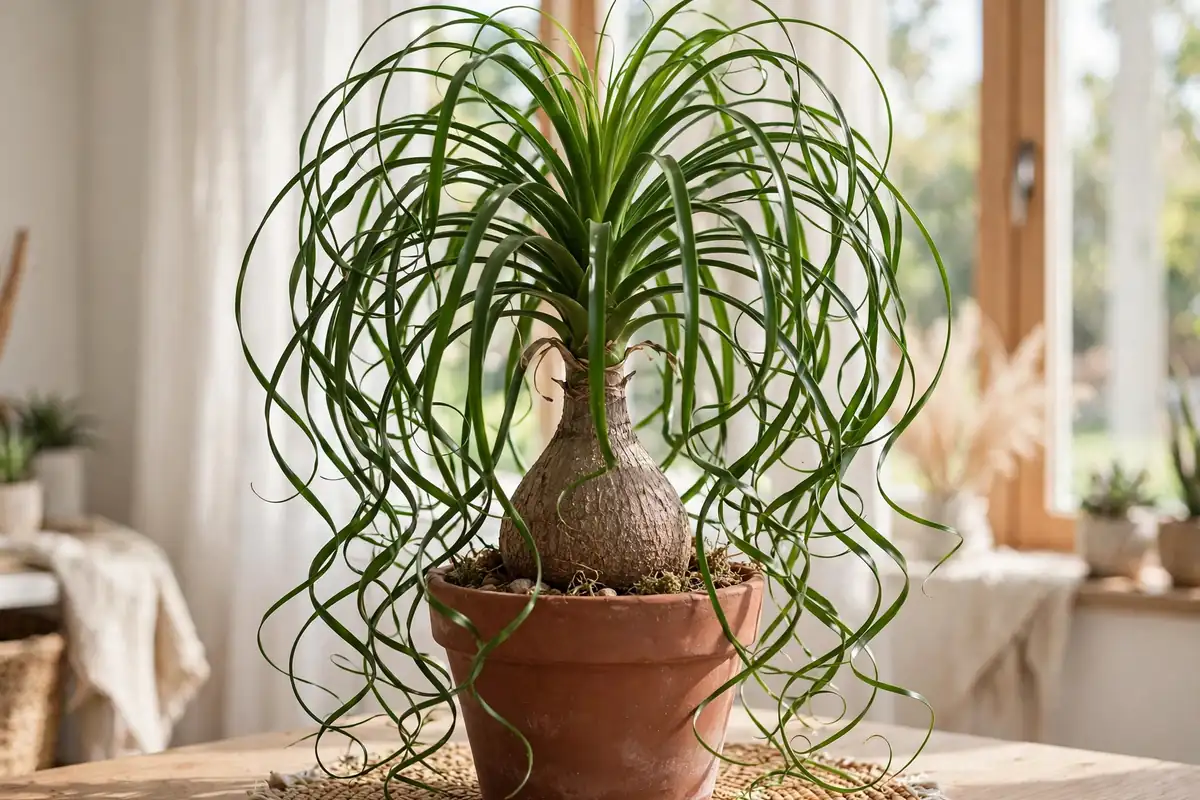
7. Ponytail Palm (Beaucarnea recurvata, syn. Nolina recurvata)
The ponytail palm looks like a plant designed by a cartoonist: a massively swollen, bottle-shaped trunk base that stores water, erupting into a fountain of long, curly, grass-like leaves. Despite the common name it is neither a true palm nor closely related to palms — and the “Nolina” in its synonym is why it earns a spot on this N-list. It is one of the most drought-proof houseplants on Earth, easily surviving weeks of neglect.
Give it the brightest spot you have and a strict hands-off watering policy: drench it, then let the soil dry out completely before watering again — in winter, once a month is plenty. Overwatering rots the swollen caudex, which is the one real way to kill it. Use a fast-draining cactus mix in a pot with drainage holes. It grows slowly to 3–4 feet indoors; outdoors in zones 9–11 it can become a 30-foot tree over many decades.
8. New Guinea Impatiens (Impatiens hawkeri hybrids)
New Guinea impatiens solved the impatiens problem. Where old-fashioned bedding impatiens melted in sun and succumbed to downy mildew, these hybrids — bred from a species collected in Papua New Guinea in the 1970s — take more sun, resist disease far better, and produce bigger, bolder flowers in electric shades of orange, pink, red, and lavender, often with striking variegated or bronze foliage.
They still want what all impatiens want: rich, moist soil that never fully dries out, and shelter from harsh afternoon sun — part shade is ideal. Plant after all frost danger in spring, spacing 8–12 inches apart, and mulch to hold moisture. Feed container plants every two weeks. They are grown as annuals in most climates but are perennial in zones 10–11, where they can be overwintered indoors as houseplants. Among flowers that start with I, few deliver this much color in deep shade.
9. Heavenly Bamboo (Nandina domestica)
Heavenly bamboo is neither heavenly nor bamboo — it is a refined evergreen shrub from China and Japan with delicate, lacy foliage that emerges pinkish in spring, matures to blue-green, and ignites in crimson and purple in winter. Late-spring clusters of white flowers give way to brilliant red berries that persist for months, making it a four-season shrub that looks good in every month of the year.
Plant it in full sun for the best fall color (it tolerates part shade) in zones 6–9, in average well-drained soil. It is remarkably tough: drought tolerant once established, pest-free, and unfazed by heat. One caution: the berries contain cyanogenic compounds toxic to birds in large quantities and to pets, so the sterile, berry-free cultivars like ‘Firepower’ are the responsible choice where wildlife or pets are a concern.
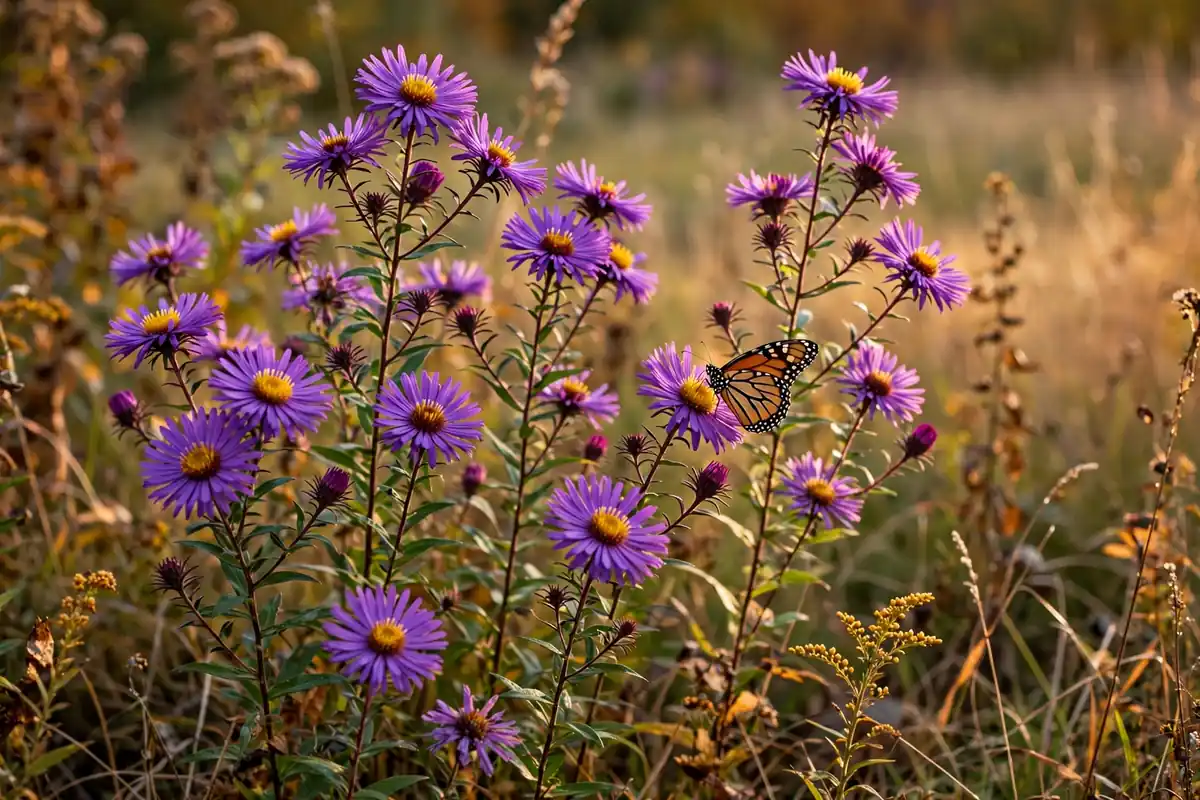
10. New England Aster (Symphyotrichum novae-angliae)
The New England aster is fall’s grand finale: 3–6 foot clouds of vivid purple (sometimes pink or white) daisies with golden centers, blooming from late summer deep into autumn when almost everything else has quit. It is a pollinator magnet of the highest order — migrating monarch butterflies fuel up on its nectar, and native bees work the flowers until frost.
Plant it in full sun in zones 4–8, in average to moist soil — it tolerates clay and even wet spots. Pinch the stems back by half in early summer (around the Fourth of July) to keep plants bushy and prevent flopping; this also delays bloom slightly for a longer season. Divide every 2–3 years to maintain vigor. Leave the seed heads standing through winter for birds, then cut back in spring.
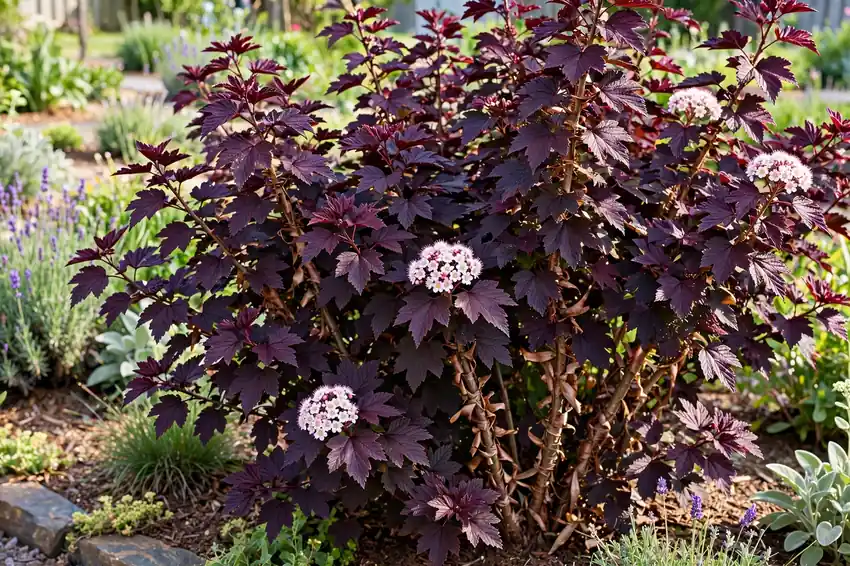
11. Ninebark (Physocarpus opulifolius)
Ninebark is the native shrub that landscape designers reach for when they want drama without fuss. The straight species has green foliage and white spring flower clusters, but the purple-leafed cultivars — ‘Diabolo’ and ‘Summer Wine’ — are the stars: deep burgundy leaves that make pinkish-white flower clusters glow, followed by red seed heads. Year-round, the bark peels away in papery strips (the “nine barks”), giving winter interest too.
It is absurdly adaptable: full sun to part shade, zones 2–8, tolerating drought, clay, wet soil, and road salt. Prune right after flowering since it blooms on old wood, and cut the oldest stems to the ground every few years to renew the plant. At 5–8 feet it works as a specimen, screen, or hedge — one of the toughest ornamental shrubs for cold climates.
12. Night-blooming Cereus (Epiphyllum oxypetalum)
The night-blooming cereus stages the most dramatic one-night show in the plant kingdom. For most of the year it is an unassuming cluster of flat, leaf-like stems — then on a summer night, huge white flowers up to a foot across unfurl after dark, flooding the air with perfume, and wilt by dawn. Enthusiasts throw “cereus parties,” staying up to watch the bloom open in real time.
Grow it as a houseplant in bright indirect light in a coarse, fast-draining epiphytic mix. Water when the top inch dries out, ease off in winter, and — counterintuitively — keep it slightly pot-bound and give it a cool, dryish winter rest to trigger blooming. Mature plants bloom more reliably, so patience pays. Outdoors it is hardy only in zones 10–11, where it can climb trees as an epiphyte.
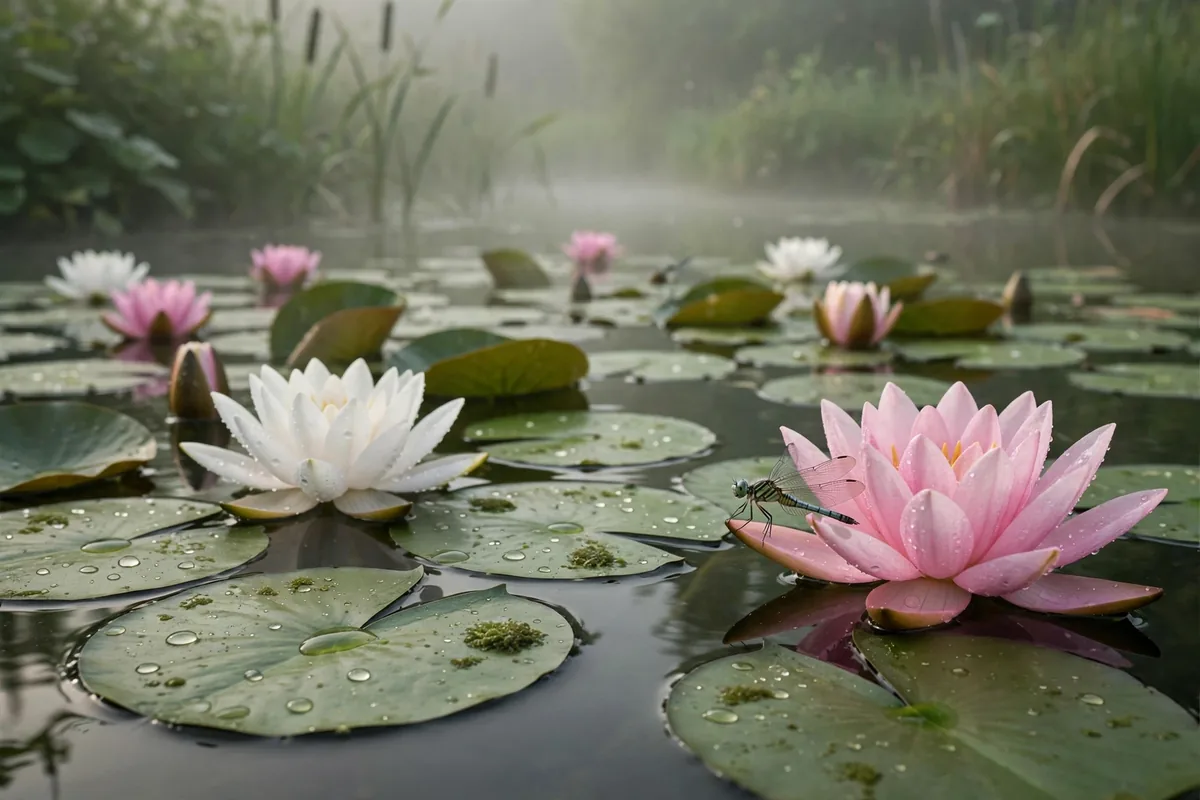
13. Water Lily (Nymphaea spp.)
No pond is complete without water lilies: round floating pads and exquisite cup-shaped flowers in white, pink, yellow, red, and blue, opening each morning and closing each afternoon through summer. Beyond their beauty, they are pond workhorses — the pads shade the water, suppressing algae and keeping fish cool. Monet painted his garden’s water lilies more than 250 times, which tells you everything about their hold on the imagination.
Plant the rhizome in a wide, shallow aquatic pot of heavy garden soil (no potting mix — it floats), top with gravel, and sink it 6–18 inches deep in full sun. Hardy water lilies survive zones 4–10 left in the pond; tropical types (zones 10–11) bloom bigger and more exotically but must overwinter indoors. Give each plant 3–6 square feet of surface, and feed monthly with aquatic fertilizer tablets pushed into the soil. They rank among the most beloved flowers that start with W.
14. Sacred Lotus (Nelumbo nucifera)
The sacred lotus is water gardening’s holy grail: enormous blue-green leaves that rise above the water on tall stalks, shedding every drop — the famous “lotus effect” that inspired self-cleaning surfaces — and magnificent pink or white flowers the size of dinner plates, opening at dawn in summer. Revered across Asia for millennia as a symbol of purity, its seeds can remain viable for over a thousand years.
Lotus needs full blazing sun and a big commitment: a pond or a container at least 2 feet wide and deep, since it spreads aggressively by rhizomes. Plant tubers horizontally just under the soil surface in spring after the water warms. It is hardy in zones 5–10 if the rhizomes sit below the ice line; in colder spots, store tubers frost-free over winter. Feed heavily — lotus are hungry plants.
15. Flowering Tobacco (Nicotiana sylvestris)
Flowering tobacco is the moon garden’s secret weapon: by day, a statuesque 3–5 foot plant with big soft leaves; at dusk, clusters of long white trumpet flowers swing open and release one of the sweetest evening perfumes in the garden, drawing in hummingbird moths like tiny hovering ghosts. It self-sows politely, returning each year without becoming a nuisance.
Sow seeds on the soil surface in spring (they need light to germinate) in full sun to part shade, in any average soil. It is grown as an annual everywhere frost occurs, though it may survive mild winters. Give it room and do not deadhead everything — leaving some seed heads guarantees next year’s volunteers. All parts contain nicotine and are toxic if eaten, so this is a look-and-smell plant, not a tasting one.
16. Catmint (Nepeta × faassenii)
Catmint is the perennial that does everything: clouds of lavender-blue flowers from late spring to fall, aromatic gray-green foliage deer will not touch, and a toughness that borders on indestructible. ‘Walker’s Low’ was the Perennial Plant Association’s Plant of the Year, and for good reason — few plants bloom longer, ask less, or pair better with roses. And yes, cats adore it, rolling in the foliage with abandon.
Plant in full sun in zones 3–8, in average to lean, well-drained soil — rich soil makes it floppy. The key trick: shear the whole plant back by half after the first flush of bloom, and it will rebloom within weeks, staying compact instead of sprawling. Divide every 3–4 years. If neighborhood cats become a nuisance, the sterile hybrid rarely sets the seed that attracts them most.
17. New York Aster (Symphyotrichum novi-belgii)
Often confused with its New England cousin, the New York aster is the more refined, compact sibling: 1–4 foot mounds of daisy-like flowers in blue, purple, pink, and white with yellow centers, blooming late summer to fall. Modern garden cultivars are shorter, bushier, and more mildew-resistant than the wild species, making them superb for the front of the fall border.
Give it full sun and average soil in zones 4–8, with good air circulation — the species can be prone to powdery mildew, so resistant cultivars like ‘Wood’s Blue’ and ‘Wood’s Pink’ are worth seeking out. Pinch back in early summer for bushier plants, deadhead to extend bloom, and divide every 2–3 years in spring. Like all asters, it is a critical late-season nectar source for butterflies and bees.
18. New Zealand Flax (Phormium tenax)
New Zealand flax is pure architectural drama: stiff, sword-like leaves in green, bronze, purple, or striped variegation, fanning 6–10 feet into the air, with towering summer spikes of dark red tubular flowers that hummingbirds mob. Māori traditionally wove its incredibly strong fibers into baskets, mats, and clothing — it is a plant with genuine cultural heritage, not just good looks.
Plant in full sun to part shade in zones 8–10, in any reasonably drained soil — it tolerates both drought and boggy ground once established. It needs space and looks best as a specimen or in bold drifts; remove dead leaves at the base to keep it tidy. In colder zones, grow compact cultivars like ‘Tom Thumb’ in pots and overwinter indoors. Protect the crown with mulch in marginal zones.
19. New Zealand Tea Tree (Leptospermum scoparium)
Before it was famous for manuka honey, the New Zealand tea tree was simply a beautiful evergreen shrub: small needle-like aromatic leaves and a spring explosion of single white, pink, or red blossoms that bees adore. Captain Cook’s crew famously brewed its leaves as tea, hence the name. Modern cultivars like ‘Red Damask’ offer double flowers and compact habits perfect for smaller gardens.
It demands full sun and excellent drainage in zones 8–10 — wet winter soil is its nemesis. Once established it is drought tolerant and needs little feeding; in fact, rich soil and heavy pruning shorten its life. Prune lightly after flowering to shape, never cutting into old bare wood. In humid climates, give it maximum air circulation to prevent fungal issues.
20. Northern Sea Oats (Chasmanthium latifolium)
Northern sea oats is the ornamental grass that broke the rules: unlike most grasses it thrives in shade, and its flat, drooping seed heads really do look like oats dangling from bamboo-like stems, turning from green to bronze to wheat-gold through fall and winter. It brings movement, sound, and winter architecture to shady spots where grasses fear to tread.
Plant in part shade in zones 5–9, in average soil — it even tolerates dry shade once established, a rare talent. The honest caveat: it self-sows enthusiastically and can become aggressive in ideal conditions, so deadhead if you want to contain it, or give it a spot where it can naturalize freely. Cut the whole clump to the ground in late winter before new growth starts.
21. Love-in-a-Mist (Nigella damascena)
Love-in-a-mist is the cottage garden’s most romantic self-sower: delicate fennel-like foliage (“the mist”) framing jewel-like blue, white, or pink flowers, followed by extraordinary inflated seed pods striped in burgundy that are prized by flower arrangers. Sow it once, and it will drift through your garden for years, appearing in charmingly unexpected places.
Sow seeds directly where they are to grow in early spring — it dislikes transplanting — in full sun and average soil, in any zone as an annual. Thin seedlings to 6 inches apart. For dried arrangements, cut the seed pods when the stripes darken but before they fully dry. It blooms early to midsummer; sow again in late summer for a fall show in mild climates.
22. Nemesia (Nemesia strumosa hybrids)
Nemesia is the cool-season annual with orchid-like charm: dense clusters of small, snapdragon-esque flowers in nearly every color — including true blue, a rarity — many with a sweet, almost coconut-like fragrance. Bred from South African species, modern hybrids bloom heaviest in the mild temperatures of spring and fall, making them perfect for bridging the seasons.
Plant in full sun to part shade in rich, consistently moist soil after the last frost. Nemesia sulks in summer heat — in hot climates, treat it as a spring annual, then plant again in late summer for fall color. Deadhead regularly or shear lightly to keep the flowers coming. It excels in containers, window boxes, and path edges where its fragrance can be appreciated up close.
23. Night Phlox (Zaluzianskya capensis)
Night phlox is proof that the best garden perfumes keep evening hours. By day its small white-and-maroon flowers stay closed and unremarkable — but at dusk they open and release an intensely sweet, honey-vanilla fragrance that carries across the garden. It is sometimes called “midnight candy,” and one sniff on a warm evening explains why.
Grow it as a tender annual in full sun, in average well-drained soil. Start seeds indoors 6–8 weeks before the last frost, since it needs a long season. Plant it where you spend summer evenings — beside patios, along paths, under bedroom windows — because its daytime appearance is modest. Deadhead to prolong bloom from summer into fall.
24. Naked Ladies (Amaryllis belladonna)
Naked ladies pull off the garden’s best magic trick: in late summer, tall bare stalks shoot up from dry ground and burst into clusters of fragrant pink trumpet lilies — with not a leaf in sight. The strappy foliage appears in fall, photosynthesizes all winter, and vanishes by summer, the exact reverse of normal plant behavior. Hence the cheeky common name.
Plant the large bulbs in late summer or fall, just barely covered with soil, in full sun with excellent drainage — they demand a dry summer dormancy and rot in wet ground. Hardy in zones 7–10, they are famously long-lived, with clumps blooming reliably for decades untouched. Do not move established bulbs; they resent disturbance. All parts are toxic if eaten, so admire, don’t nibble.
25. Nannyberry (Viburnum lentago)
Nannyberry is the native shrub for people who want it all: flat-topped clusters of creamy-white spring flowers, glossy green foliage with excellent burgundy-red fall color, and dangling clusters of blue-black berries that feed birds through winter — and make fine jams for humans too. At 10–18 feet it works as a large shrub or small multi-stemmed tree.
Plant in full sun to part shade in zones 2–8, in average to moist soil — it tolerates wet ground and is one of the most cold-hardy viburnums. It suckers gently into colonies, which is a virtue for naturalized screens. Prune after flowering if needed. For the heaviest berry crops, plant two different seedlings for cross-pollination.
26. Northern Maidenhair Fern (Adiantum pedatum)
The northern maidenhair fern is the most elegant native fern of North American woodlands: wiry black stems that fork like tiny fingers, each holding a fan of delicate, fan-shaped green leaflets. It looks impossibly fragile yet survives zone 3 winters, emerging fresh each spring in shady spots where little else thrives.
Give it part to full shade and humus-rich, consistently moist soil in zones 3–8 — think woodland floors and north-facing foundations. It goes dormant in winter (it is deciduous), so mark its spot and pair it with spring ephemerals. Once established it spreads slowly into graceful colonies. Keep it watered through dry spells; crispy edges mean it wants more moisture and mulch.
27. Cupflower (Nierembergia hippomanica)
Cupflower is the underused annual that deserves a wider audience: neat mounds of fine foliage smothered all summer in cup-shaped flowers of lavender-blue, violet, or white with yellow throats — like tiny morning glories that never stop blooming. It shrugs off heat that fells fussier annuals and never needs deadheading, since spent flowers simply drop away.
Plant in full sun in average, well-drained soil after the last frost, spacing 6–8 inches apart for a quick carpet. It is grown as an annual everywhere but may overwinter in zone 9+. Water regularly the first few weeks, then it tolerates normal garden conditions. Superb for edging, rock gardens, and containers where its continuous bloom shines.
28. Chilean Bellflower (Nolana paradoxa)
The Chilean bellflower is a genuine botanical curiosity: a trailing annual from the coastal deserts of Chile and Peru, where it blooms spectacularly after rare rains, producing morning-glory-like flowers in blue, lavender, and white with pale throats. It is rarely seen in gardens, which makes it a fun conversation piece for plant collectors.
Give it full sun and lean, very well-drained soil — it evolved for desert conditions and rots in rich, soggy ground. Sow seeds indoors in early spring or direct-sow after frost; it is grown as an annual in all climates. Let it trail over walls, rockeries, or container edges. Honest caveat: seed can be hard to find, so order from a specialist supplier early in the season.
29. Nun’s Orchid (Phaius tankervilleae)
The nun’s orchid is the orchid for gardeners intimidated by orchids: a big, bold terrestrial species with broad pleated leaves and tall spring spikes of unusual brownish-maroon and white flowers, each with a ruffled lip. Unlike fussy epiphytic orchids, it grows in regular potting mix like a houseplant and reblooms reliably with basic care.
Grow it indoors in bright indirect light in a rich, well-drained terrestrial orchid mix, keeping it evenly moist in the growing season and slightly drier in winter. It appreciates humidity and regular feeding. Outdoors it is hardy in zones 9–11, where in frost-free climates it can live in shady garden beds. Divide crowded clumps after flowering to share with friends.
30. Stinging Nettle (Urtica dioica)
Last on our list is the N-plant everyone knows but nobody plants on purpose: stinging nettle. This is our honest wild card. Those stinging hairs inject formic acid on contact — yet beneath the sting lies one of the most useful wild plants on Earth: young spring shoots cook into a spinach-like green richer in iron and vitamins than most vegetables, and the tough stem fibers once made cloth and cordage. Herbalists have used it for centuries.
You almost certainly should not plant it deliberately — it spreads aggressively by rhizomes and seeds, and the sting is genuinely unpleasant (wear thick gloves). But if it volunteers in a wild corner, harvest the top 4–6 inches in spring while wearing gloves, and cook it like spinach — heat completely neutralizes the sting. Hardy in zones 3–10, it asks nothing and gives plenty, provided you respect the hairs.
Growing Tips for N-Plants
Match the plant to your zone first. N-plants span zones 2–12 — from the ultra-hardy ninebark and nannyberry (zone 2) to tropical night-blooming jasmine and cereus (zones 9–11). Check the tables above before falling in love with a plant that cannot survive your winter.
Respect the shade divide. Many beloved N-plants are shade specialists — nerve plant, Boston fern, maidenhair fern, and northern sea oats all scorch in hot afternoon sun. Give them bright indirect light or dappled shade, while sun-worshippers like nasturtium, ninebark, and New England aster need at least six hours of direct sun to bloom well.
Plant for the evening garden. An unusual number of N-plants perform after dark: night-blooming jasmine, night-blooming cereus, night phlox, and flowering tobacco all release their perfume in the evening. Cluster them near patios, paths, and bedroom windows to build a moon garden that comes alive at dusk.
Don’t overwater the drought-proof ones. Ponytail palm, Natal plum, and naked ladies all store water or demand dry dormancy — soggy soil kills them faster than drought ever will. When in doubt, water less and make sure every pot has drainage holes.
Deadhead and shear for rebloom. Nasturtiums, catmint (shear by half after the first flush), nemesia, and New England asters (pinch in early summer) all flower far longer with regular attention. Keep pruners handy on your evening garden walk.
Watch the toxic and touchy ones. Night-blooming jasmine berries, flowering tobacco, naked ladies bulbs, and heavenly bamboo berries are toxic if eaten; stinging nettle stings on contact. Site them thoughtfully, wear gloves for nettle, and teach children to look but not taste.
Which N-Plants Will You Grow?
From the pink-veined nerve plant on your windowsill to the towering New Zealand flax in the back border, plants that start with N cover every corner of the garden — and a good stretch of the house too. If you are just starting out, you cannot go wrong with the unfussy trio of nasturtiums, catmint, and ninebark. If you want evening magic, plant night-blooming jasmine and night phlox by the patio. And if you garden indoors, a nerve plant or ponytail palm brings the letter N to your living room with almost no effort.
Pick three N-plants that suit your light and zone, plant them this season, and watch the letter N punch well above its weight in your garden. Then keep the alphabet going with our plants that start with D guide. Happy planting!
Frequently Asked Questions
What are the most popular plants that start with N?
The most popular N-plants are nerve plant, Norfolk Island pine, Boston fern, nasturtium, night-blooming jasmine, Natal plum, ponytail palm, New Guinea impatiens, heavenly bamboo, and New England aster. These ten cover houseplants, fragrant shrubs, summer annuals, and fall perennials, and all are widely available at garden centers.
What plants starting with N are good for beginners?
Nasturtiums, catmint, ninebark, ponytail palm, nerve plant, and Boston fern are nearly indestructible and perfect for beginners. They tolerate imperfect soil, missed waterings, and a wide range of conditions while still blooming or looking great.
Which N-plants bloom at night or in the evening?
Night-blooming jasmine, night-blooming cereus, night phlox, and flowering tobacco all open or release their strongest fragrance in the evening. Plant them together near patios and windows to create a moon garden that perfumes your summer nights.
What plants that start with N grow in shade?
Excellent shade-tolerant N-plants include nerve plant, Boston fern, northern maidenhair fern, northern sea oats, New Guinea impatiens, and nannyberry (part shade). Most prefer bright indirect light or dappled shade rather than deep, dark shade.
Are nasturtiums perennials or annuals?
Nasturtiums are tender annuals in most climates — they are killed by frost and grown fresh from seed each year. In frost-free zones (10–11) they can behave as short-lived perennials, but even there most gardeners replant annually for the best flower show.
Which plants starting with N are toxic to pets?
Several N-plants are toxic if chewed or eaten: night-blooming jasmine (especially the berries), flowering tobacco, naked ladies bulbs, heavenly bamboo berries, and Norfolk Island pine needles can irritate pets. Pet-safe choices include nerve plant, Boston fern, nasturtiums, and catmint — though cats may love the catmint a little too much.