23 Plants That Start With U: Names, Pictures and Useful Facts
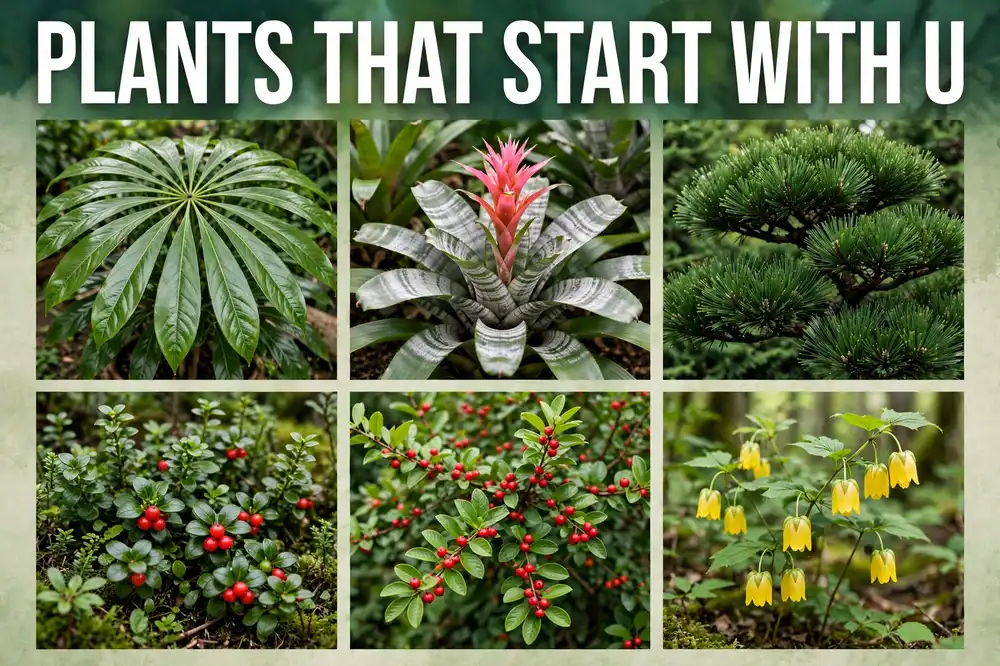
Looking for plants that start with U? Few letters are as scarce in the plant world as U, but the ones it does claim are remarkably varied: the umbrella plant shading living rooms everywhere, the urn plant (silver vase bromeliad) with its pink flower spike, the slow-growing umbrella pine that outlives its gardeners, uva ursi carpeting northern forests with red berries, and the Chilean guava, whose strawberry-scented fruit tastes like nothing else in the garden. This guide covers 23 real plants that start with U — every entry verified against botanical references — with scientific names, native regions, bloom seasons, hardiness zones, and practical growing advice. A few entries carry an honest caveat where the plant is obscure, a cultivar group rather than a species, or grown mainly by collectors, so you always know exactly what you are getting. If blooms are your main interest, see also our companion guide to flowers that start with U.
Every entry below lists light and water needs plus the USDA hardiness zone, so you can tell at a glance which U-plants suit your windowsill or garden. You will also find two comparison tables, hands-on growing tips, and answers to the questions gardeners ask most about plants starting with U.
Quick Answer
Popular plants that start with U include Umbrella Plant, Dwarf Umbrella Tree, Umbrella Palm, Umbrella Pine, Urn Plant, Uva Ursi, Utah Juniper, Utah Agave, Ulex (Gorse), Ugni (Chilean Guava), Udo, Uvularia (Merrybells), Utricularia (Bladderwort), and Elm (Ulmus). They span tropical houseplants, cold-hardy conifers, native groundcovers, woodland perennials, fruiting shrubs, and desert natives — covering USDA zones 2–11, so there is a U-plant for nearly every garden and windowsill.
Table of Contents
U-Plants at a Glance
Use this table to compare all 23 plants that start with U side by side, from botanical names to native regions.
| Plant name | Scientific name | Type | Light | Native region |
|---|---|---|---|---|
| Umbrella Plant | Heptapleurum actinophyllum | Evergreen houseplant / tree | Bright indirect | Australia, New Guinea |
| Dwarf Umbrella Tree | Heptapleurum arboricola | Evergreen houseplant / shrub | Bright indirect | China, Taiwan |
| Umbrella Palm | Cyperus alternifolius | Sedge / pond plant | Full sun to part shade | Madagascar, East Africa |
| Umbrella Pine | Sciadopitys verticillata | Evergreen conifer | Full sun to part shade | Japan |
| Umbrella Magnolia | Magnolia tripetala | Deciduous tree | Part shade | Eastern North America |
| Umbrella Leaf | Diphylleia cymosa | Woodland perennial | Part to full shade | Appalachian Mountains, USA |
| Umbrella Bamboo | Fargesia murielae | Clumping bamboo | Part shade | Central China |
| Urn Plant | Aechmea fasciata | Bromeliad houseplant | Bright indirect | Brazil |
| Uva Ursi | Arctostaphylos uva-ursi | Evergreen groundcover | Full sun to part shade | Northern Hemisphere (circumboreal) |
| Utah Juniper | Juniperus osteosperma | Evergreen tree | Full sun | Western USA |
| Utah Agave | Agave utahensis | Succulent | Full sun | Southwestern USA |
| Utah Serviceberry | Amelanchier utahensis | Deciduous shrub | Full sun to part shade | Western USA |
| Ussurian Pear | Pyrus ussuriensis | Fruit tree | Full sun | Northeast Asia |
| Ulex (Common Gorse) | Ulex europaeus | Evergreen shrub | Full sun | Western Europe |
| Ugni (Chilean Guava) | Ugni molinae | Evergreen shrub | Full sun to part shade | Chile, Argentina |
| Udo | Aralia cordata | Herbaceous perennial | Part shade | Japan, Korea, eastern China |
| Uvularia (Merrybells) | Uvularia grandiflora | Woodland perennial | Part to full shade | Eastern North America |
| Utricularia (Bladderwort) | Utricularia vulgaris | Carnivorous aquatic | Full sun | Europe, Asia, North America |
| Unicorn Plant | Proboscidea parviflora | Summer annual | Full sun | Southwestern USA, Mexico |
| Upas Tree | Antiaris toxicaria | Tropical tree | Full sun | Tropical Asia and Africa |
| Uraria | Uraria picta | Tropical legume | Full sun | Tropical Asia, Africa |
| Usambara Violet | Saintpaulia cultivars | Houseplant (cultivar group) | Bright indirect | Tanzania (species origin) |
| Ulmus (Elm) | Ulmus americana | Deciduous shade tree | Full sun | Eastern North America |
Bloom Season, Water Needs & Hardiness Zones
This second table focuses on practical care: when each U-plant blooms, how much water it wants, and the USDA zones where it survives winter outdoors.
| Plant name | Bloom season | Water needs | USDA hardiness |
|---|---|---|---|
| Umbrella Plant | Rarely indoors | Medium — let top inch dry | 10–11 |
| Dwarf Umbrella Tree | Rarely indoors | Medium — dry then soak | 10–11 |
| Umbrella Palm | Summer (inconspicuous) | High — loves wet soil | 9–11 |
| Umbrella Pine | Non-flowering (conifer) | Medium — evenly moist | 5–8 |
| Umbrella Magnolia | Late spring to early summer | Medium — moisture-loving | 5–8 |
| Umbrella Leaf | Late spring | Medium-high — moist shade | 5–8 |
| Umbrella Bamboo | Rarely (decades apart) | Medium-high — consistent | 5–9 |
| Urn Plant | Once at maturity, long-lasting | Medium — keep central cup filled | 10–11 |
| Uva Ursi | Spring (flowers), fall (berries) | Low once established | 2–6 |
| Utah Juniper | Non-flowering (conifer) | Low — very drought tolerant | 4–8 |
| Utah Agave | Once in a lifetime (monocarpic) | Low — sharp drainage | 5–9 |
| Utah Serviceberry | Spring (flowers), summer (fruit) | Low-medium — drought tolerant | 3–8 |
| Ussurian Pear | Early spring | Medium | 3–7 |
| Ulex (Common Gorse) | Late winter to spring | Low — poor soil fine | 6–9 |
| Ugni (Chilean Guava) | Late spring to summer | Medium — evenly moist | 8–10 |
| Udo | Late summer (inconspicuous) | Medium-high — rich moist soil | 4–8 |
| Uvularia (Merrybells) | Spring | Medium — moist shade | 4–9 |
| Utricularia (Bladderwort) | Summer | Aquatic — grows in water | 5–10 |
| Unicorn Plant | Summer | Low-medium — heat tolerant | Grown as annual |
| Upas Tree | Year-round (tropics) | Medium | 10–12 |
| Uraria | Summer to fall | Medium | 10–11 |
| Usambara Violet | Nearly year-round indoors | Medium — bottom water | Indoor plant |
| Ulmus (Elm) | Early spring (inconspicuous) | Medium — adaptable | 2–9 |
23 Plants That Start With U: The Complete List
Below is the full rundown — houseplants, conifers, woodland perennials, fruiting shrubs, desert natives, and a few honest rarities — with the growing details that matter for each one. If you are working through the whole alphabet, our guide to plants that start with X covers another famously scarce letter.
1. Umbrella Plant (Heptapleurum actinophyllum)
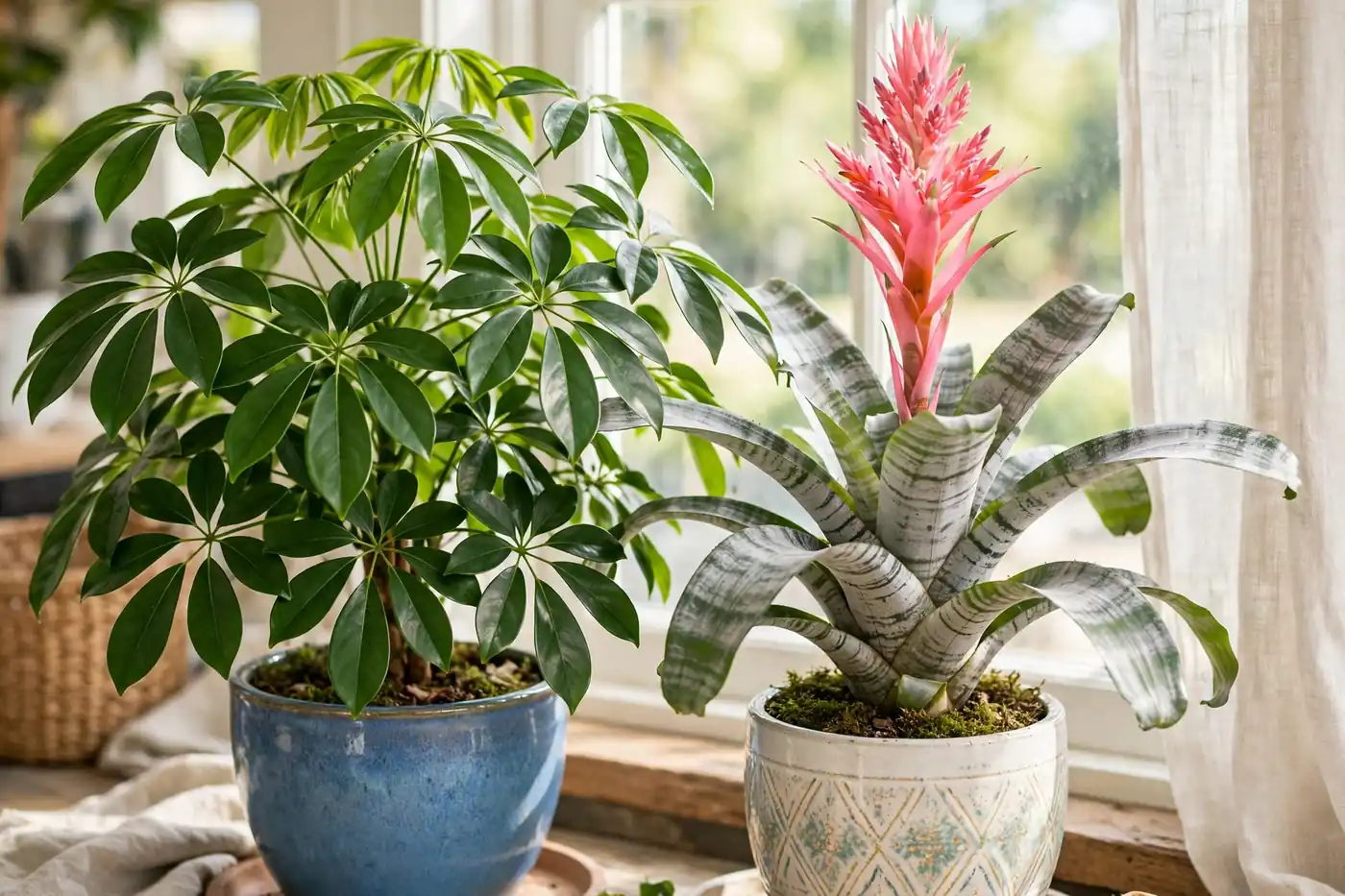
The umbrella plant is the classic big-leafed houseplant of offices and malls: glossy leaflets radiate from each leaf stalk like the ribs of an umbrella, and a mature plant can reach six feet indoors (far taller in the tropics). Botanical note: this plant was long sold as Schefflera actinophylla, but taxonomists moved the genus Schefflera into Heptapleurum — nursery labels are slowly catching up, so you will see both names. It is native to Australia and New Guinea and hardy outdoors only in zones 10–11, where it can become an aggressive seeder in places like Florida and Hawaii.
Indoors, give it bright indirect light (it tolerates some direct morning sun) and water when the top inch of soil dries; overwatering drops leaves fast. It appreciates humidity but adapts to average homes. Prune leggy stems in spring to keep it bushy, and wipe the broad leaves to keep them photosynthesizing. Important: all parts are toxic to dogs and cats if chewed. For detailed care, see the Gardening Know How umbrella plant care guide.
2. Dwarf Umbrella Tree (Heptapleurum arboricola)
The dwarf umbrella tree is the umbrella plant’s smaller, better-behaved cousin — native to China and Taiwan, with 7 to 9 smaller leaflets per leaf and a naturally compact habit that tops out at 3 to 6 feet in a pot. It is the one most people actually mean when they say “schefflera,” and the variegated forms (cream-splashed leaflets) are among the most reliable variegated houseplants you can buy. Like its larger relative, it rarely flowers indoors and is hardy outdoors only in zones 10–11.
Give it bright, filtered light — direct hot sun burns the leaves — and let the soil dry out between thorough waterings. It likes humidity, so a pebble tray helps in dry homes. Pinch growing tips to encourage branching, and watch for spider mites, mealybugs, and scale, which are its main pests. Note that all parts are seriously toxic to dogs and cats, so keep it away from pets. The NC State Extension profile confirms the toxicity warning and full care details.
3. Umbrella Palm (Cyperus alternifolius)
Despite the name, the umbrella palm is not a palm at all — it is a sedge from Madagascar and East Africa, grown for the dramatic starburst of narrow leaf-like bracts that radiate from the top of each tall stem like a paper parasol. It is a natural for water gardens and pond margins, where it happily stands with its roots submerged, and it also makes a striking houseplant in a deep saucer of water. Hardy outdoors in zones 9–11; elsewhere, overwinter it indoors.
This is one plant you cannot overwater: keep the soil constantly wet or the pot standing in an inch or two of water. Give it full sun to part shade and feed lightly through the growing season. It spreads by rhizomes, so contain it in pots near natural waterways — it can naturalize aggressively in warm climates. Propagate by division or by turning a cut stem upside-down in water (the bracts root into new plants, a neat trick). For enclosed water-feature ideas, see our guide to the best terrarium plants for companion planting inspiration.
4. Umbrella Pine (Sciadopitys verticillata)
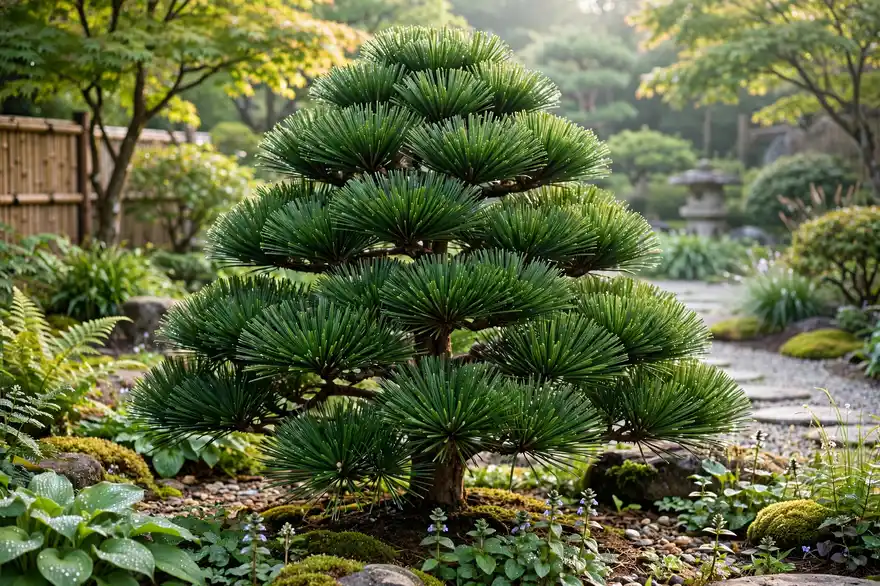
The Japanese umbrella pine is a living fossil — the sole survivor of its genus and family — and one of the most distinctive conifers you can grow. Its thick, glossy, dark-green needles are arranged in perfect whorls around the stems, giving the whole tree a layered, parasol-like silhouette. Growth is famously slow (often just a few inches a year), but a 50-year-old specimen is a garden treasure. Native to Japan, it is hardy in zones 5–8 and eventually reaches 20 to 30 feet.
Plant it in full sun to part shade with rich, acidic, evenly moist but well-drained soil, and shelter it from harsh winter winds, which brown the needles. Mulch generously and never let it sit in waterlogged soil. It needs no pruning — its natural symmetry is the whole point. Because it is so slow, buy the largest specimen you can afford; you are purchasing decades of time. It is one of the finest specimen conifers for a patient gardener.
5. Umbrella Magnolia (Magnolia tripetala)
The umbrella magnolia earns its name from enormous leaves — up to two feet long — clustered in umbrella-like whorls at the branch tips. Native to moist woodlands of the eastern United States, it is a small deciduous tree (15 to 30 feet) with huge, creamy-white, lemon-scented flowers in late spring, followed by showy cone-like red fruit in fall. It is hardy in zones 5–8 and makes a bold statement in a woodland garden where its tropical-looking foliage can shine.
Give it part shade and deep, moist, acidic soil rich in organic matter; it dislikes drought and compacted ground. Plant it where the giant leaves can be admired up close but protected from strong winds, which shred them. It transplants poorly once established, so choose the site carefully. Prune only to remove dead wood — the natural branching pattern is part of its charm.
6. Umbrella Leaf (Diphylleia cymosa)
Umbrella leaf is a choice Appalachian woodland wildflower with a single umbrella-like leaf (sometimes two) sheltering a cluster of small white spring flowers, followed by striking blue berries on red stalks in summer. The flowers and fruit hide beneath the foliage, so it rewards gardeners who get down to look. Native to rich, moist forests of the southern Appalachians, it is hardy in zones 5–8 and spreads slowly by rhizomes into elegant colonies.
Grow it in part to full shade in humus-rich, consistently moist soil — think woodland conditions. It goes dormant in late summer, so mark its spot and pair it with ferns and hostas that fill the gap. Never dig plants from the wild; buy from reputable native-plant nurseries. It is a collector’s plant rather than a beginner’s one, but in the right shady spot it is trouble-free for decades.
7. Umbrella Bamboo (Fargesia murielae)
Umbrella bamboo is a clumping (non-running) bamboo from central China, prized for its graceful arching canes that fountain outward like an umbrella. Unlike running bamboos, it stays in a slowly expanding clump and never needs a root barrier, which makes it the bamboo of choice for smaller gardens and containers. It grows 8 to 12 feet tall, is hardy in zones 5–9, and keeps its foliage through winter in most climates.
Plant it in part shade with rich, moisture-retentive soil — it dislikes hot, dry, windy sites that scorch the leaves. Water consistently the first two years; established clumps are fairly resilient. Mulch to keep roots cool and moist. Thin out the oldest, weakest canes at ground level every few years to keep the clump open and airy. Note: like all bamboos, it flowers gregariously once every many decades and then declines — a rare event, but worth knowing.
8. Urn Plant (Aechmea fasciata)
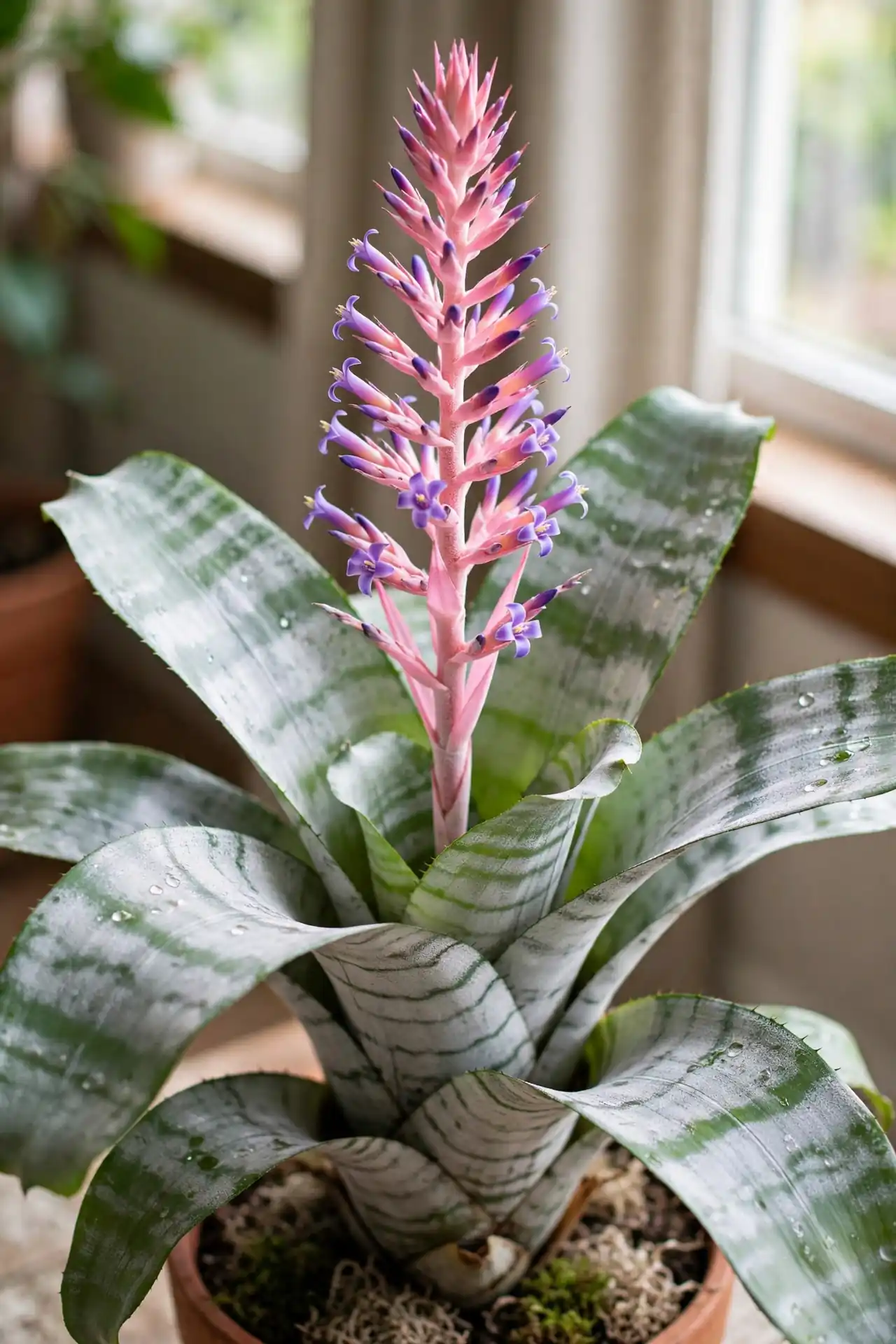
The urn plant — better known as the silver vase bromeliad — is one of the showiest houseplants you can own: a rosette of broad, silvery-banded leaves forms a central “urn” that holds water, and at maturity it sends up a spectacular pink flower spike studded with tiny purple blooms that lasts for months. Native to the rainforests of southeastern Brazil, it is an epiphyte in the wild, growing on trees rather than in soil. Hardy outdoors only in zones 10–11.
Give it bright indirect light and a coarse, fast-draining mix (orchid bark works well). Keep about an inch of water in the central cup, flushing and replacing it monthly to prevent stagnation and mosquitoes. Water the soil lightly; the cup does most of the work. Each rosette blooms once and then slowly dies — but not before producing offsets (“pups”) at the base, which you separate when they reach about six inches tall. The NC State Extension profile confirms the full care routine and pup-propagation method.
9. Uva Ursi (Arctostaphylos uva-ursi)
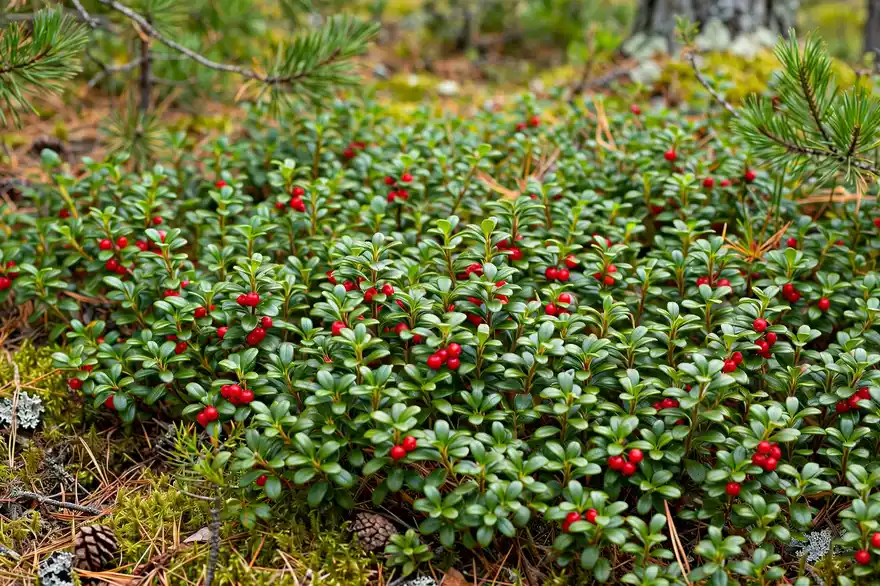
Uva ursi — Latin for “bear’s grape” — is better known as bearberry or kinnikinnick: a tough, evergreen, circumboreal groundcover that carpets northern forests from North America to Eurasia. Its small, leathery leaves turn bronze-red in winter, pinkish urn-shaped flowers appear in spring, and bright red berries follow in fall (edible but mealy — the bears get them first). Hardy in zones 2–6, it thrives where few other evergreens dare.
Plant it in full sun to part shade in poor, sandy, acidic, sharply drained soil — it actually resents rich garden soil and excess fertilizer. Once established it is extremely drought-tolerant and needs almost no care. It is slow to establish, so buy small plants in quantity and be patient. Excellent for slopes, rock gardens, and naturalizing under pines. Historically used in herbal traditions; grow it as an ornamental groundcover and enjoy the four-season interest.
10. Utah Juniper (Juniperus osteosperma)
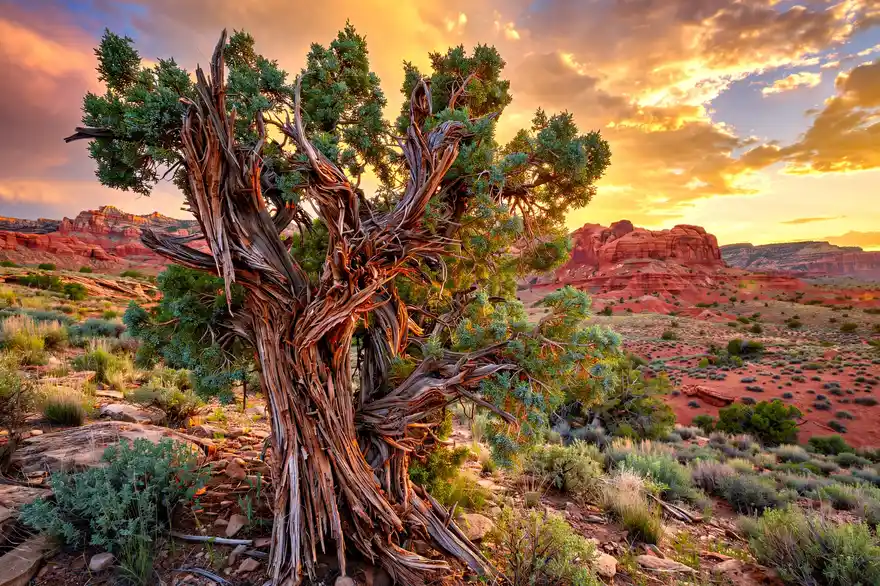
The Utah juniper is the defining tree of the high-desert West — a rugged, slow-growing evergreen with shreddy bark, blue-green scale-like foliage, and dusty-blue berries, sculpted by wind and drought across Utah, Nevada, Arizona, and Colorado. It can live for many centuries; some specimens are over a thousand years old. Hardy in zones 4–8, it is the ultimate xeriscape tree for gardeners who want authentic desert character.
Give it full sun and extremely well-drained, even rocky or alkaline soil — it hates wet feet and rich soil. Once established, it needs no supplemental water in most climates. Do not shear it; prune selectively to enhance its natural windswept form. It is slow, so buy the largest specimen your budget allows. Note: it is a different species from the eastern redcedar and Rocky Mountain juniper, though the care is similar.
11. Utah Agave (Agave utahensis)
One of the most cold-hardy agaves in existence, the Utah agave survives zone 5 winters — a desert succulent you can grow in Denver or Salt Lake City without protection. Its compact rosettes of narrow, gray-green leaves armed with fierce terminal spines form handsome clumps, and after many years it sends up a tall flower spike, sets seed, and dies (monocarpic, but offsets carry on). Native to the deserts and rocky slopes of the Southwest.
Sharp drainage is everything: plant it on a slope, in a raised bed, or in a gritty mix of gravel and sand, in full sun. Winter wet kills it faster than winter cold, so an overhead rain shelter or unheated cold frame helps in soggy climates. Handle with thick gloves — the spines mean business. Water sparingly in summer and almost not at all in winter. A superb choice for rock gardens and xeriscapes in cold climates.
12. Utah Serviceberry (Amelanchier utahensis)
Utah serviceberry is the drought-tough western cousin of the eastern serviceberries: a multi-stemmed deciduous shrub (6 to 12 feet) with white spring flowers, blue-green summer foliage, sweet purplish-black berries in early summer, and good fall color. Native across the interior West, it feeds birds and wildlife and was a traditional food plant of Indigenous peoples. Hardy in zones 3–8, it is one of the most adaptable native fruiting shrubs for dry climates.
Plant in full sun to part shade in well-drained soil — it tolerates poor, rocky, alkaline ground that defeats fussier shrubs. Once established it is genuinely drought-tolerant. The berries are sweet and excellent fresh or in jams; net the bushes if you want to beat the birds to them. Prune lightly after fruiting to shape. A fine native alternative to ornamental shrubs with the bonus of edible fruit.
13. Ussurian Pear (Pyrus ussuriensis)
The Ussurian pear is the hardiest pear species on earth — surviving zone 3 winters that kill European pears — and the backbone of pear breeding for cold climates. Native to northeast Asia (the Ussuri River region of Siberia and Manchuria), it is a vigorous tree with glossy foliage, abundant white spring blossoms, and small, astringent fruits that sweeten after frost. Most gardeners grow it as a pollinator and rootstock for hardier pear varieties rather than for fresh eating.
Plant in full sun with well-drained soil and give it room — it becomes a large tree. It blooms very early, so late frosts can nip the flowers in marginal sites. Pair it with a compatible pollinator variety for fruit set. Prune in late winter to an open center for light and air. If you garden in zone 3 or 4 and thought pears were impossible, the Ussurian pear proves otherwise.
14. Ulex (Common Gorse) (Ulex europaeus)
Ulex — common gorse — is the spiny evergreen shrub that paints European hillsides yellow: masses of coconut-scented, pea-like flowers from late winter into spring, set among fierce green spines (the “leaves” are actually modified spines). It is a nitrogen-fixer that thrives in the poorest soils, hardy in zones 6–9, and historically was cut for fuel and livestock fodder. Honest caveat: it is aggressively invasive in parts of Australia, New Zealand, and the western United States — check local regulations before planting.
Give it full sun and poor, well-drained, even gravelly soil — fertility is wasted on it. It needs no feeding and little water once established. Shear after flowering to keep it compact; never cut into old wood, which rarely resprouts. Wear heavy gloves — the spines are formidable. Where it is not invasive, it makes a superb impenetrable hedging plant and early-season bee forage.
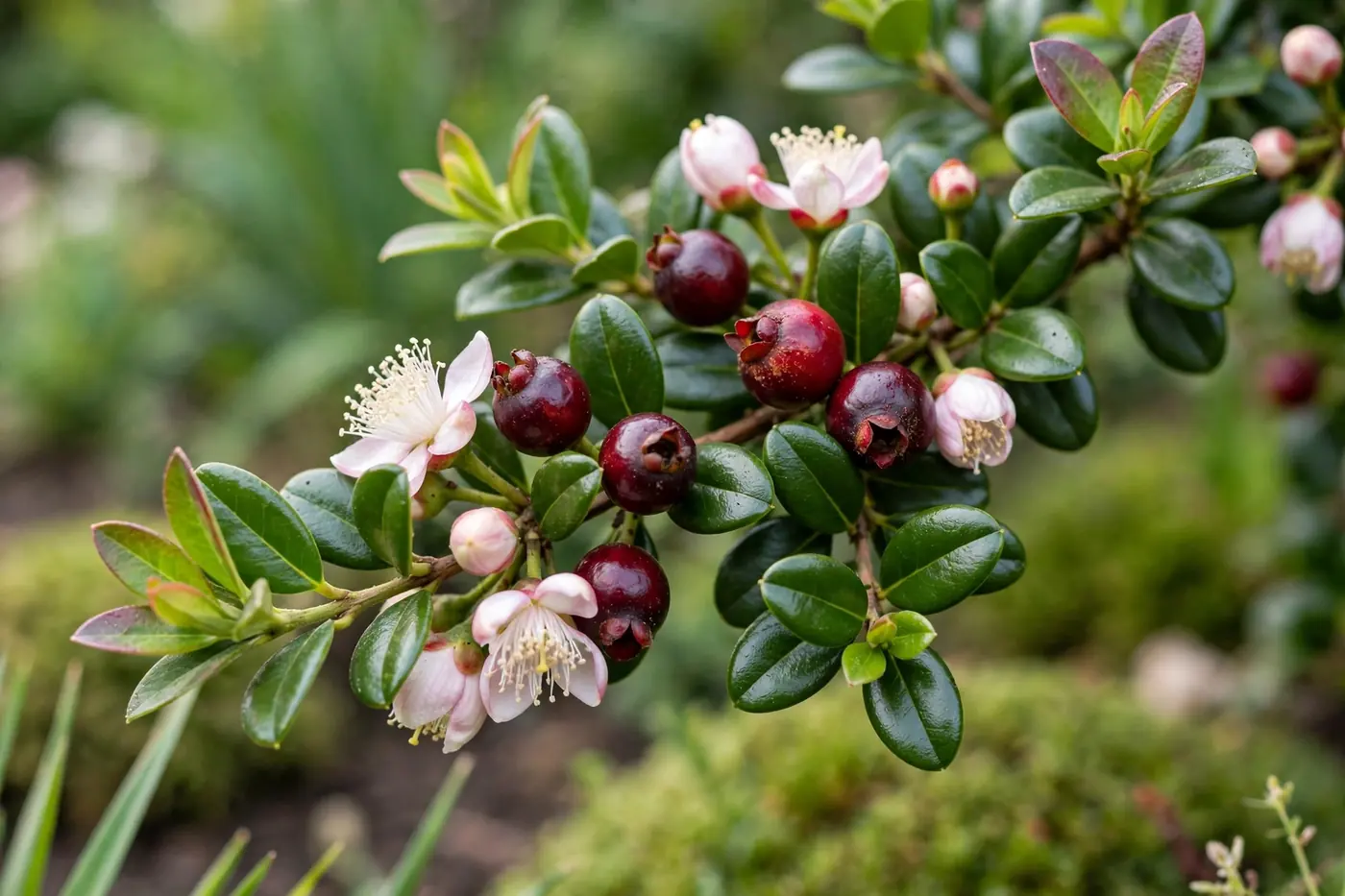
15. Ugni (Chilean Guava) (Ugni molinae)
Ugni — the Chilean guava — is a small evergreen shrub from Chile and Argentina with glossy myrtle-like leaves, delicate pink-white bell flowers in summer, and dark red berries that taste of wild strawberries with a hint of spice. Queen Victoria reportedly loved the fruit, and it is still a niche delicacy. Hardy in zones 8–10 (with shelter), it works as an ornamental fruiting shrub, a low hedge, or a large container plant.
Plant in full sun to part shade with moist, well-drained, slightly acidic soil and shelter from cold winds. Water consistently — it dislikes drying out. In zone 7, grow it in a pot and overwinter frost-free. The berries ripen in fall; pick them fully colored for the best flavor. Prune lightly after fruiting. Few shrubs offer evergreen structure, pretty flowers, and genuinely delicious fruit in one package.
16. Udo (Aralia cordata)
Udo is a Japanese mountain vegetable grown for its crisp, celery-like spring shoots: a large herbaceous perennial (to six feet) in the ginseng family, native to Japan, Korea, and eastern China, with bold compound leaves and frothy white late-summer flowers followed by black berries. The blanched young shoots are a spring delicacy with a distinctive resinous flavor. Hardy in zones 4–8, it doubles as a dramatic shade perennial even if you never eat it.
Grow it in part shade in deep, rich, consistently moist soil — it is a hungry plant. Blanch shoots by mounding soil or covering emerging spears to keep them tender and pale. Harvest shoots when 6 to 8 inches tall; let later growth mature to feed the crown. It dies back completely in winter and returns reliably each spring. Give it space — a mature clump is impressively large.
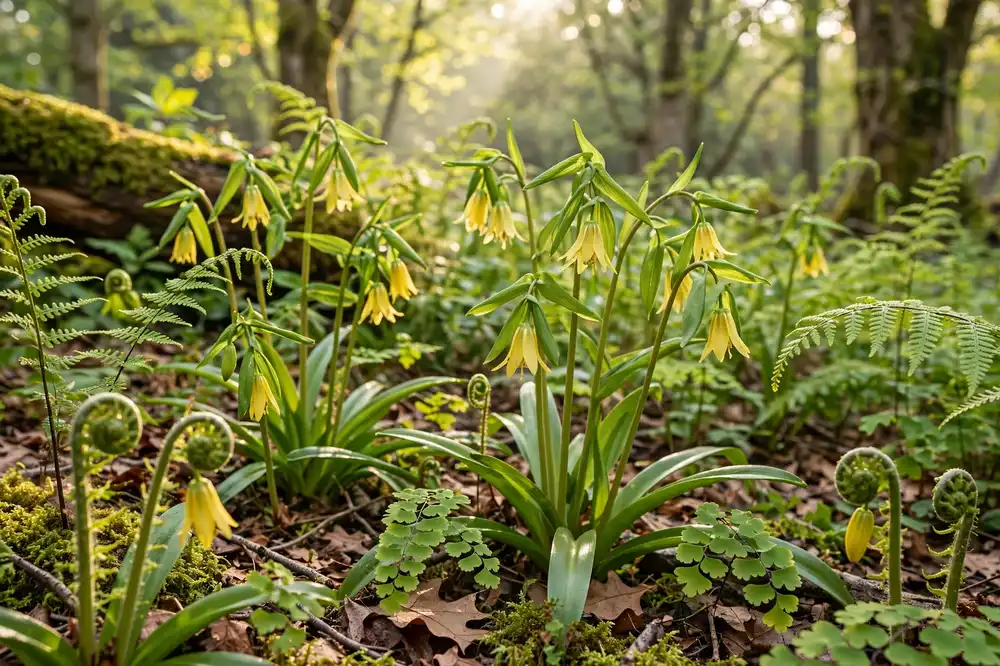
17. Uvularia (Merrybells) (Uvularia grandiflora)
Uvularia — merrybells — is a graceful eastern North American woodland perennial whose nodding, bell-shaped yellow flowers dangle beneath arching stems in mid-spring, like tiny lanterns. The perfoliate leaves (the stem appears to pierce each leaf) add textural interest all season, and the plant spreads slowly into refined colonies. Hardy in zones 4–9, it is a classic companion for ferns, wild ginger, and spring ephemerals.
Plant in part to full shade in humus-rich, moist but well-drained soil. It resents disturbance, so plant it where it can stay. Divide congested clumps in early fall if needed. Deer tend to leave it alone, a real advantage in woodland gardens. For a pink-flowered relative, look for Uvularia perfoliata; the large-flowered merrybells remains the showiest species.
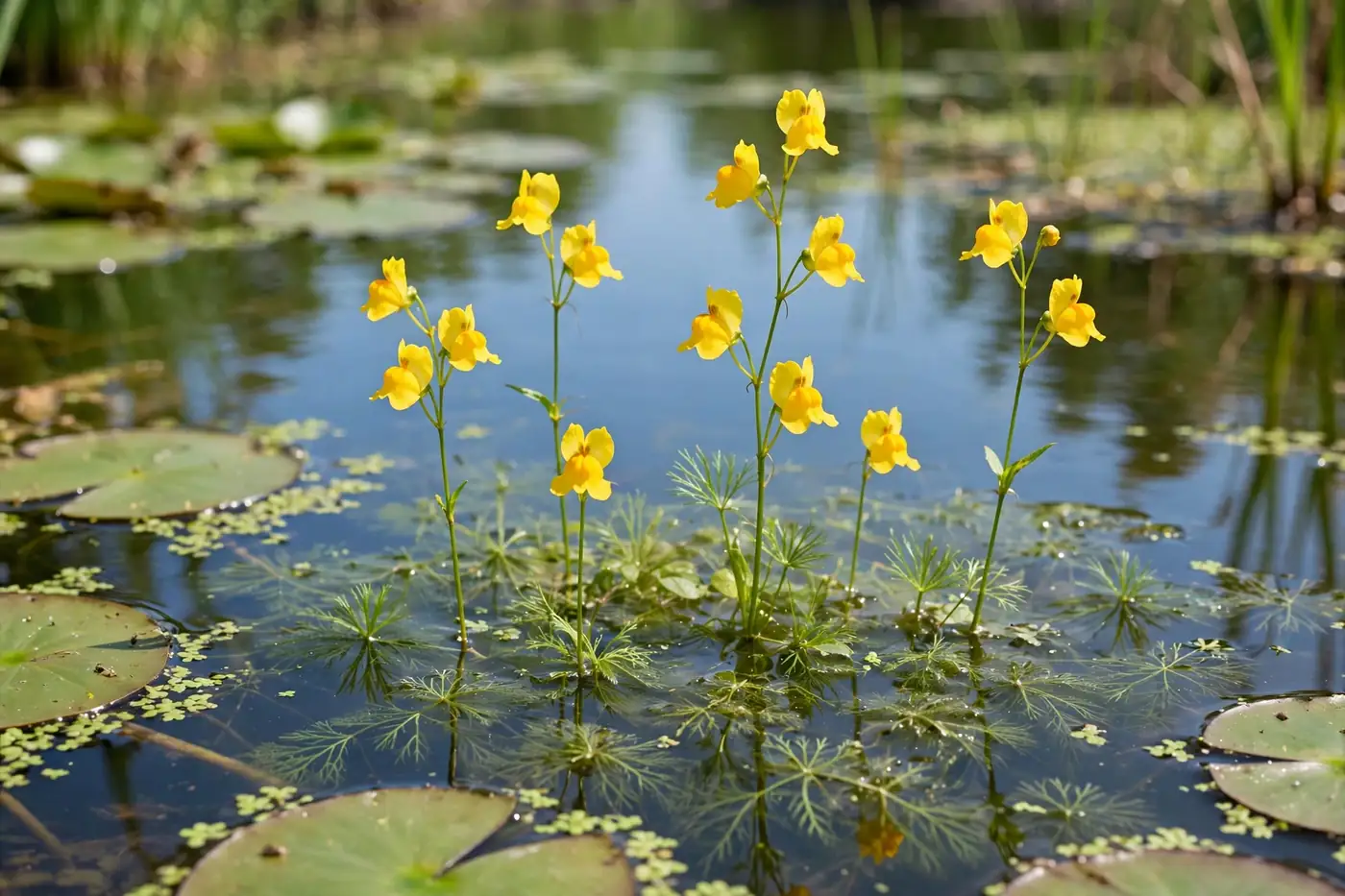
18. Utricularia (Bladderwort) (Utricularia vulgaris)
Utricularia — bladderwort — is a carnivorous plant with one of the fastest traps in nature: tiny underwater bladders snap shut in milliseconds to capture microscopic prey. The greater bladderwort floats freely in ponds and ditches across the Northern Hemisphere, sending up cheerful yellow snapdragon-like flowers on stalks above the water in summer. It has no true roots — the whole plant is a floating trap system. Hardy in zones 5–10.
Grow it in a still, sunny pond or container water garden with no fish large enough to disturb it (small fish are fine — the bladders catch only tiny organisms). It needs no feeding or fertilizing; prey provides its nutrients. It can spread vigorously in ideal conditions, so contain it in small ponds. A fascinating living science exhibit and a conversation piece in any water garden.
19. Unicorn Plant (Proboscidea parviflora)
The unicorn plant — better known as devil’s claw — is a Southwestern annual with an unforgettable seed pod: as the fruit dries, it splits into two long, curved “claws” that catch on passing animals to spread seed. Before that drama, it offers a summer of attractive pinkish-purple, trumpet-shaped flowers and large, velvety leaves. The young green pods are edible when pickled — a traditional food of the Tohono O’odham people. It is grown as a warm-season annual everywhere.
Sow seeds directly in full sun after all frost danger, in average to poor well-drained soil — it loves heat and tolerates drought. Give it room; plants sprawl several feet wide. Harvest young pods for pickling when tender, or leave them to mature into the famous clawed curiosities. It self-sows readily, so one planting often returns. A great novelty plant for children’s gardens and xeriscapes alike.
20. Upas Tree (Antiaris toxicaria)
Honest caveat first: the upas tree is a botanical legend rather than a garden plant. This tall tropical tree of Asia and Africa produces a milky latex so toxic it was famously used for poison arrows — and 19th-century travelers’ tales turned it into the mythical “poison tree of Java” that supposedly killed everything around it. The reality is less dramatic: it is simply a large rainforest tree with toxic sap, grown essentially nowhere as an ornamental and hardy only in zones 10–12. Included here because its U-name is famous, but this one is for reading about, not planting.
In its native range it is a fast-growing canopy tree of lowland rainforests. There is no home-garden culture for it, and none is recommended — the sap is genuinely dangerous. Consider it the U-list’s conversation piece: proof that plant lore can be as interesting as the plants themselves.
21. Uraria (Uraria picta)
Honest caveat: Uraria is a genus of tropical legumes that essentially no home gardener grows — included here for completeness because its U-name is legitimate and botanically verified. Uraria picta, the most referenced species, is a perennial of tropical Asia and Africa with trifoliate leaves marked by pale blotches and spikes of small purple pea-flowers. In its native range it has traditional medicinal uses, but it is a collector’s or botanical-garden plant, hardy only in zones 10–11, with no established ornamental trade.
If you ever encounter it in a tropical botanical garden, expect a scrambling subshrub that wants full sun, warmth, and well-drained soil like its legume relatives. For practical gardening purposes, admire it where botanists keep it — the U-list’s other entries offer far more for your time and money.
22. Usambara Violet (Saintpaulia cultivars)
Honest caveat: “Usambara violet” is not a separate species — it is the show name for prize African violet cultivars, named after the Usambara Mountains of Tanzania where wild Saintpaulia species grow. Included because the name genuinely starts with U and the plants are among the world’s most popular houseplants: rosettes of velvety leaves topped with clusters of purple, pink, white, or blue flowers that can bloom nearly year-round indoors.
Grow them in bright indirect light (an east window is ideal) in a light, airy mix, and water from below or carefully at the soil line — cold water on the leaves causes spots. Let the top of the soil dry slightly between waterings, and feed lightly with African violet fertilizer. They thrive in the humidity of kitchens and bathrooms. If you want the classic “violet” experience, buy any named Saintpaulia cultivar — the Usambara name simply marks the exhibition-grade ones.
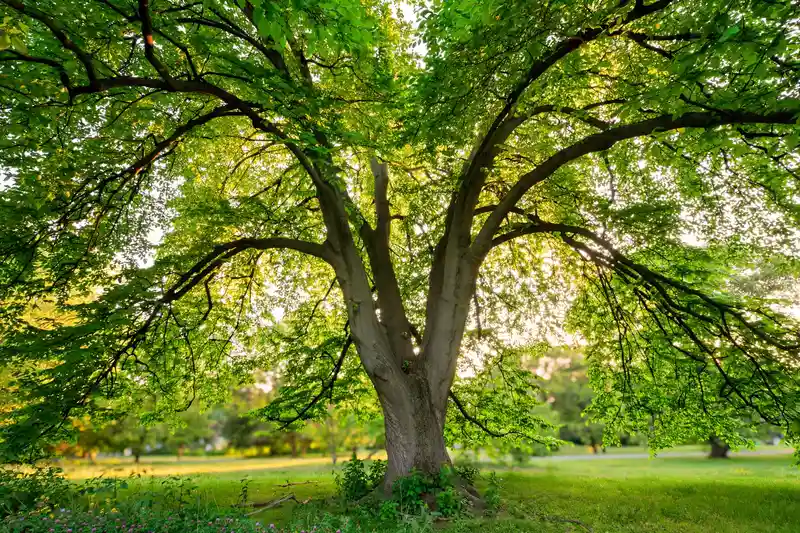
23. Ulmus (Elm) (Ulmus americana)
The U-name here is the genus: Ulmus — the elms. The American elm is one of North America’s noblest shade trees, famous for its soaring vase-shaped canopy that once arched over entire streets. Dutch elm disease devastated populations in the 20th century, but disease-resistant cultivars (the ‘Princeton’ and ‘Valley Forge’ selections, among others) have brought the elm back to landscapes. Hardy in zones 2–9, it is among the most cold-tolerant large shade trees available.
Plant in full sun in any reasonably moist soil — elms are famously adaptable to clay, wet ground, and urban conditions. Water young trees consistently; established elms are tough. Choose a certified disease-resistant cultivar rather than a seedling, and prune in winter to an open structure. For a smaller, tougher alternative, the lacebark elm (Ulmus parviflora, zones 4–9) offers exfoliating bark and strong disease resistance.
Growing Tips for U-Plants
Match the zone before you fall in love. The U-list spans zones 2 to 11, and the tropical stars — umbrella plant, dwarf umbrella tree, urn plant, upas tree, uraria — will not survive a frost. In cold climates, grow them in containers and overwinter indoors, or treat the unicorn plant as the summer annual it is. Conversely, uva ursi, Utah serviceberry, and the elms demand winter chill and sulk in zone 9 heat.
Drainage decides more fates than fertilizer. Utah agave, Utah juniper, uva ursi, and udo’s opposite needs illustrate the point: the desert natives die in winter-wet soil long before cold gets them, while umbrella leaf, uvularia, and udo sulk in dry shade. When in doubt, plant high — mound the soil, use raised beds, or add grit. Urn plants and umbrella palms want the opposite treatment: constant moisture, even standing water.
Know which umbrella you are buying. “Umbrella plant,” “umbrella tree,” and “dwarf umbrella tree” are used interchangeably in stores, but they describe two different species with different mature sizes — and the nursery tag may still say Schefflera while botanists now say Heptapleurum. Check the leaflet count and the label’s fine print: 7–9 small leaflets means the dwarf; large leaflets on a tree-sized plant means the true umbrella plant.
Feed the hungry, starve the desert natives. Udo, umbrella palm, and udo’s vegetable cousins are hungry plants that reward rich soil and regular feeding. Utah juniper, Utah agave, uva ursi, and gorse are the opposite: they evolved in poor soils and resent fertilizer. Read every label through the plant’s eyes, not the garden center’s.
Plan for all four seasons. U-plants make this easy: gorse and ussurian pear open the season, umbrella magnolia and merrybells carry spring, Chilean guava and unicorn plant flower in summer, and uva ursi’s red berries plus the umbrella pine’s evergreen structure hold winter interest. For autumn container color after the summer perennials fade, our mum care guide pairs well with this list.
Which U-Plants Will You Grow?
Twenty-three plants, one scarce letter — and the range is remarkable. Start indoors with a dwarf umbrella tree or an urn plant if you are new to houseplants; plant an umbrella pine or an elm if you want a tree that outlives trends; grow uva ursi or Utah serviceberry if you want tough native groundcovers and fruit. Even the honest caveats have their place: the upas tree’s legend and the bladderwort’s snap-traps make the U-list the most story-rich letter in the garden.
Keep exploring the alphabet with our guides to plants that start with A, plants that start with N, and plants that start with X — or browse flowers that start with U if blooms are your main pursuit. Pick three U-plants that fit your light and zone, get them in the ground this season, and watch the letter U earn its keep. Happy planting!
Frequently Asked Questions
What are the most popular plants that start with U?
The most popular U-plants are the umbrella plant, dwarf umbrella tree, umbrella palm, umbrella pine, urn plant (silver vase bromeliad), uva ursi (bearberry), Utah juniper, Utah agave, gorse (Ulex), Chilean guava (ugni), udo, merrybells (Uvularia), bladderwort (Utricularia), and elm (Ulmus). Together they cover houseplants, conifers, groundcovers, woodland perennials, fruiting shrubs, and desert natives, and most are available at nurseries or native-plant specialists.
Which plants starting with U are good houseplants?
The dwarf umbrella tree and umbrella plant are the classic U houseplants — tolerant, attractive, and widely sold. The urn plant (Aechmea fasciata) is the showiest choice with its pink flower spike, the umbrella palm thrives in a bright bathroom or a pot standing in water, and Usambara (African) violets bloom nearly year-round on a windowsill. All need bright indirect light and none tolerates frost.
Which U-plants are cold hardy?
Uva ursi (zones 2–6) and American elm (zones 2–9) are the toughest, followed by Utah serviceberry and Ussurian pear (zone 3), udo and merrybells (zone 4), and umbrella pine, umbrella magnolia, umbrella leaf, and umbrella bamboo (zone 5). If you garden in zone 5 or colder, start with these — the tropical U-plants must come indoors for winter.
Are umbrella plants toxic to pets?
Yes — both the umbrella plant and the dwarf umbrella tree contain compounds that are toxic to dogs and cats if chewed, causing mouth irritation, drooling, and digestive upset. The NC State Extension profiles for both species carry explicit toxicity warnings. If your pets chew plants, choose the umbrella palm or Usambara violets instead, and keep schefflera-type plants out of reach.
What is the difference between the umbrella plant and the dwarf umbrella tree?
They are two different species. The umbrella plant (Heptapleurum actinophyllum) has large leaflets and becomes a small tree, even outdoors in the tropics. The dwarf umbrella tree (Heptapleurum arboricola) has smaller leaflets (7–9 per leaf), stays compact, and is the better houseplant. Both were formerly classified as Schefflera, so old labels and new botanical references may disagree.
Which plants that start with U have edible parts?
Several: Chilean guava (ugni) has strawberry-flavored berries, Utah serviceberry and Ussurian pear produce edible fruit, udo is grown as a Japanese spring vegetable, uva ursi berries are edible (though mealy), and young unicorn plant pods can be pickled. Always confirm identification before eating any plant, and note that the upas tree’s sap is dangerously toxic — it is strictly ornamental in the wild, not a food plant.
References
- NC State Extension — Aechmea fasciata (Urn Plant)
- NC State Extension — Heptapleurum arboricola (Dwarf Umbrella Tree)
- Missouri Botanical Garden — Plant Finder
- Royal Horticultural Society — Schefflera Plant Search
- Gardening Know How — Umbrella Plant Care
- The Old Farmer’s Almanac — Umbrella Plant Growing Guide