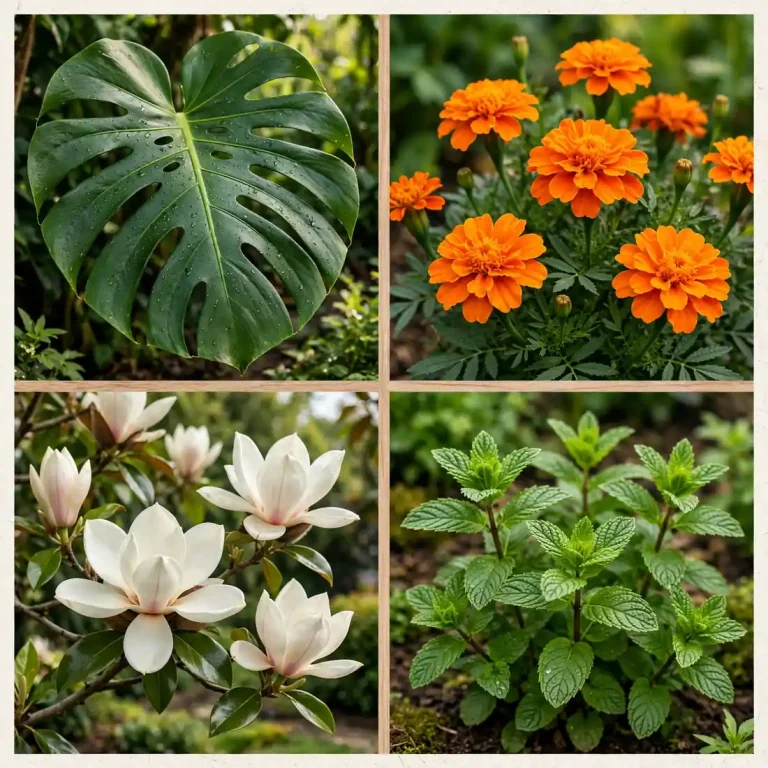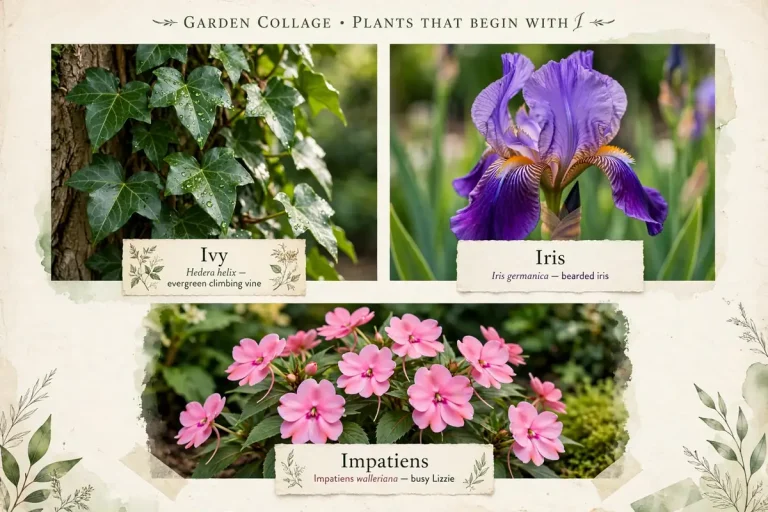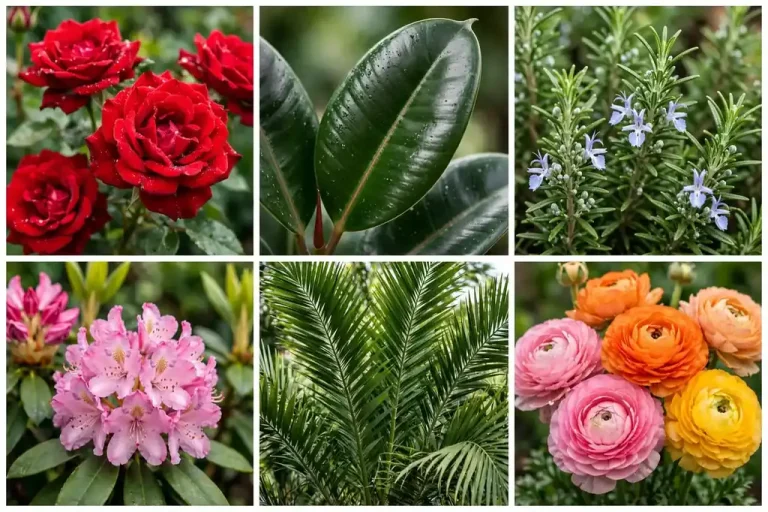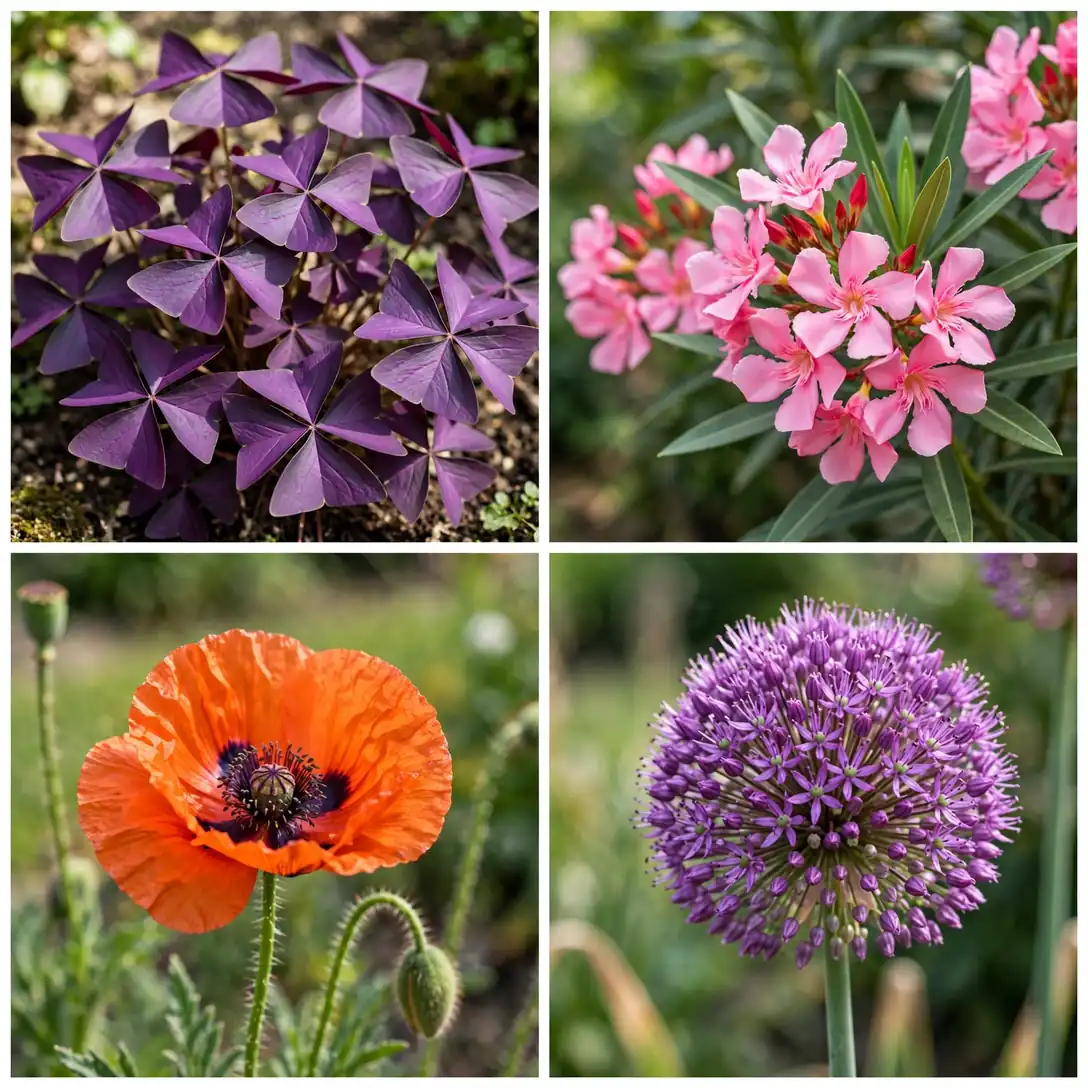
23 Plants That Start with O (Names, Photos & Care Tips)
Looking for plants that start with O? The letter O punches well above its weight in the plant world. It gives us one of the world’s most important kitchen herbs (oregano), one of the most beautiful flowering houseplants (purple shamrock oxalis), desert icons like the ocotillo and old man cactus, and fragrant shrubs like osmanthus and orange jasmine. Whether you garden in a sunny border, a shady corner, a desert yard, or a bright windowsill, there is an O plant that fits.
Below you will find 23 real, botanically verified plants that start with O, each with its scientific name, an honest description, and practical growing tips. We have also flagged the ones that need caution: oleander is highly toxic, while obedient plant, orange trumpet vine, and oxeye daisy can all spread aggressively if you turn your back. Like our plants that start with W guide, every entry here is a genuine species or well-established garden plant — no invented names, no filler.
Quick Answer
23 real plants that start with O include oxalis, orchid cactus, oregano, olive tree, oyster plant, obedient plant, oriental poppy, oxeye daisy, ocotillo, oleander, ostrich fern, ornamental onion, osmanthus, opuntia, old man cactus, orange trumpet vine, orange jasmine, ornamental kale, ox tongue, iron cross oxalis, evening primrose, osteospermum, and Oswego tea. Best beginner picks: oregano, ox tongue, and evening primrose. Best for shade: ostrich fern and ox tongue. Most fragrant: osmanthus and orange jasmine. Warning: oleander is toxic in all its parts, and obedient plant and orange trumpet vine spread aggressively.
Table of Contents
- O Plants at a Glance
- 1. Oxalis (Purple Shamrock)
- 2. Orchid Cactus
- 3. Oregano
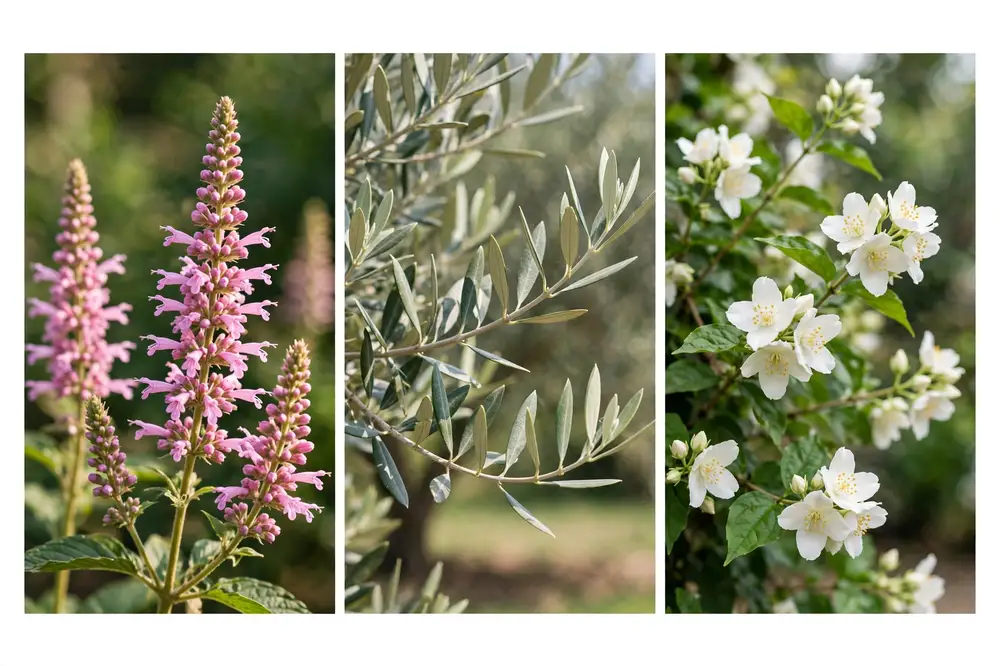
- 4. Olive Tree
- 5. Oyster Plant
- 6. Obedient Plant
- 7. Oriental Poppy
- 8. Oxeye Daisy
- 9. Ocotillo
- 10. Oleander
- 11. Ostrich Fern
- 12. Ornamental Onion
- 13. Osmanthus (Sweet Olive)
- 14. Opuntia (Prickly Pear)
- 15. Old Man Cactus
- 16. Orange Trumpet Vine
- 17. Orange Jasmine
- 18. Ornamental Kale
- 19. Ox Tongue
- 20. Iron Cross Oxalis
- 21. Evening Primrose
- 22. Osteospermum (African Daisy)
- 23. Oswego Tea (Bee Balm)
- Light, Water & Hardiness Comparison
- Frequently Asked Questions
- References
O Plants at a Glance
| # | Common Name | Scientific Name | Type |
|---|---|---|---|
| 1 | Oxalis (Purple Shamrock) | Oxalis triangularis | Houseplant / bulb |
| 2 | Orchid Cactus | Epiphyllum spp. | Epiphytic cactus |
| 3 | Oregano | Origanum vulgare | Perennial herb |
| 4 | Olive Tree | Olea europaea | Evergreen tree |
| 5 | Oyster Plant | Tradescantia spathacea | Tropical perennial |
| 6 | Obedient Plant | Physostegia virginiana | Perennial flower |
| 7 | Oriental Poppy | Papaver orientale | Perennial flower |
| 8 | Oxeye Daisy | Leucanthemum vulgare | Perennial flower |
| 9 | Ocotillo | Fouquieria splendens | Desert shrub |
| 10 | Oleander | Nerium oleander | Evergreen shrub |
| 11 | Ostrich Fern | Matteuccia struthiopteris | Perennial fern |
| 12 | Ornamental Onion | Allium spp. | Bulb |
| 13 | Osmanthus (Sweet Olive) | Osmanthus fragrans | Evergreen shrub |
| 14 | Opuntia (Prickly Pear) | Opuntia spp. | Desert cactus |
| 15 | Old Man Cactus | Cephalocereus senilis | Columnar cactus |
| 16 | Orange Trumpet Vine | Campsis radicans | Climbing vine |
| 17 | Orange Jasmine | Murraya paniculata | Tropical shrub |
| 18 | Ornamental Kale | Brassica oleracea (Acephala Group) | Cool-season annual |
| 19 | Ox Tongue | Gasteria spp. | Succulent |
| 20 | Iron Cross Oxalis | Oxalis deppei | Bulb |
| 21 | Evening Primrose | Oenothera biennis | Biennial wildflower |
| 22 | Osteospermum (African Daisy) | Osteospermum spp. | Tender perennial |
| 23 | Oswego Tea (Bee Balm) | Monarda didyma | Perennial flower |
1. Oxalis (Purple Shamrock) — Oxalis triangularis
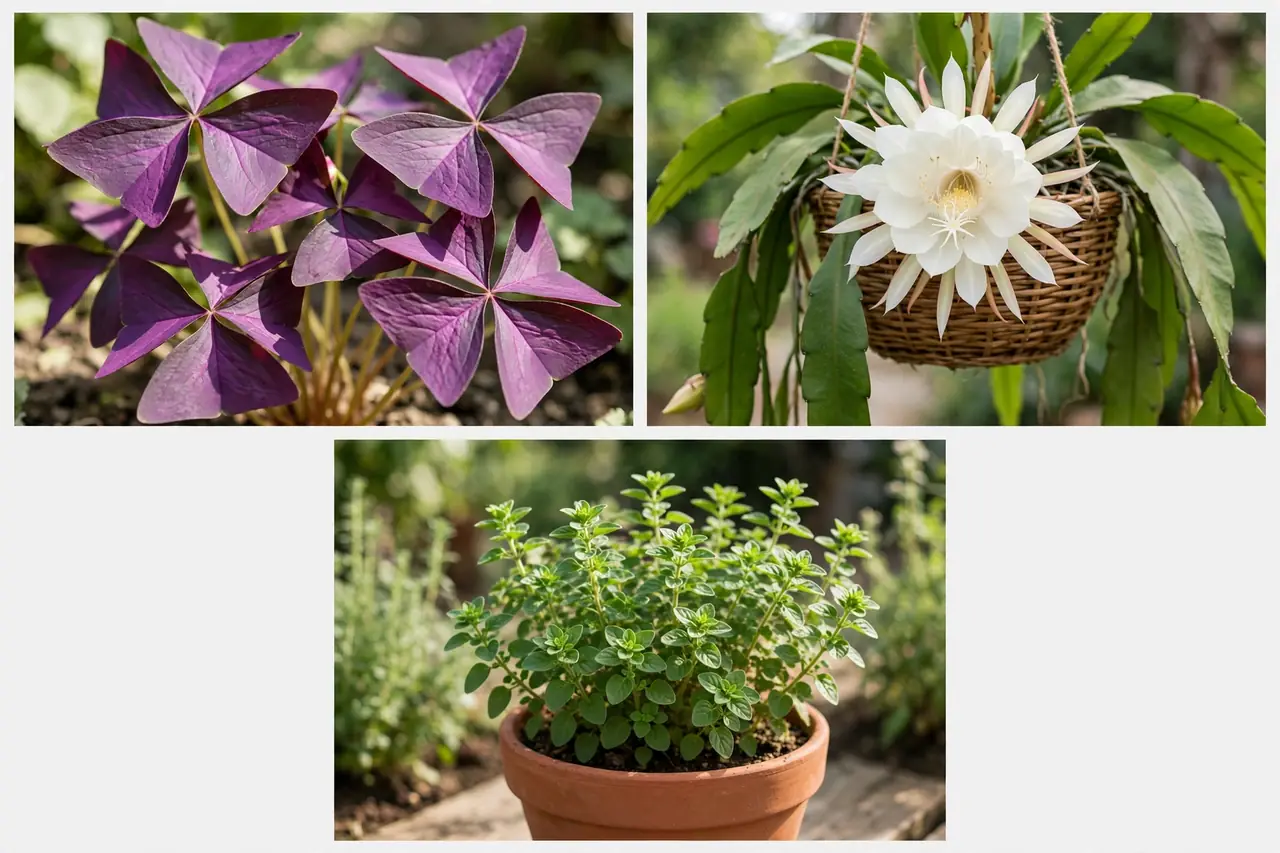
Oxalis triangularis, commonly called purple shamrock or false shamrock, is one of the most striking houseplants you can own. Its deep-purple, triangular leaflets fold up at night and reopen in the morning — a movement called photonasty that never gets old to watch. In spring and summer it produces delicate pinkish-lavender flowers held above the foliage. Native to Brazil, it grows from small bulbs (corms) and naturally goes dormant once or twice a year, dying back to nothing before resprouting. Many beginners panic and throw it away during dormancy, which is a shame, because the plant is simply resting.
Growing tips: Give it bright, indirect light — too little light fades the purple color, too much direct sun scorches the leaves. Use a well-draining potting mix and water when the top inch of soil dries out. When the foliage collapses and dies back, stop watering, move the pot to a cool dark spot for two to three weeks, then bring it back into light and resume watering. It will also work in a large open terrarium; see our best terrarium plants roundup for companions that share its humidity needs. Hardy outdoors only in zones 7–10.
2. Orchid Cactus — Epiphyllum spp.
Despite the name, the orchid cactus is not an orchid — it is a group of epiphytic (tree-dwelling) cacti from the jungles of Central and South America, the best known being Epiphyllum oxypetalum, the night-blooming cereus. Unlike desert cacti, these grow in humid forests with their roots in leaf litter, and they reward patience with enormous, fragrant white flowers that open after dark and fade by morning. Some hybrids bloom in shades of pink, red, and orange. The flattened, leaf-like stems can trail several feet, making orchid cacti superb hanging-basket plants, and their dramatic night blooms earn them a place among truly unusual and beautiful flowers.
Growing tips: Grow in a hanging basket in bright, filtered light — direct midday sun burns the stems. Use a fast-draining epiphytic mix (cactus soil amended with orchid bark and perlite works well). Water thoroughly when the top couple of inches dry out in the growing season, and keep it barely moist in winter. Cool autumn nights (around 50–60°F / 10–15°C) help trigger buds. Do not treat it like a desert cactus: it wants more water and humidity than a prickly pear ever would.
3. Oregano — Origanum vulgare
Oregano is the backbone of Mediterranean cooking and one of the easiest perennial herbs a beginner can grow. This woody-based perennial, hardy in zones 4–9, forms low mounds of small, aromatic oval leaves topped in midsummer by clusters of pinkish-purple flowers that bees absolutely mob. Greek oregano (Origanum vulgare subsp. hirtum) is the most pungent culinary type, but all forms are ornamental enough for a flower border. Once established, it shrugs off drought, poor soil, and neglect — conditions that actually intensify its essential oils and flavor.
Growing tips: Plant in full sun (six or more hours) in average to poor, well-drained soil — rich soil produces lush but bland leaves. Water deeply but infrequently once established. Harvest sprigs just before the flowers open, when flavor peaks, and shear the plant back by a third after its first bloom to force a fresh flush of leaves. In cold climates, mulch the crown in winter. Divide congested clumps every three to four years in spring to keep them vigorous.
4. Olive Tree — Olea europaea
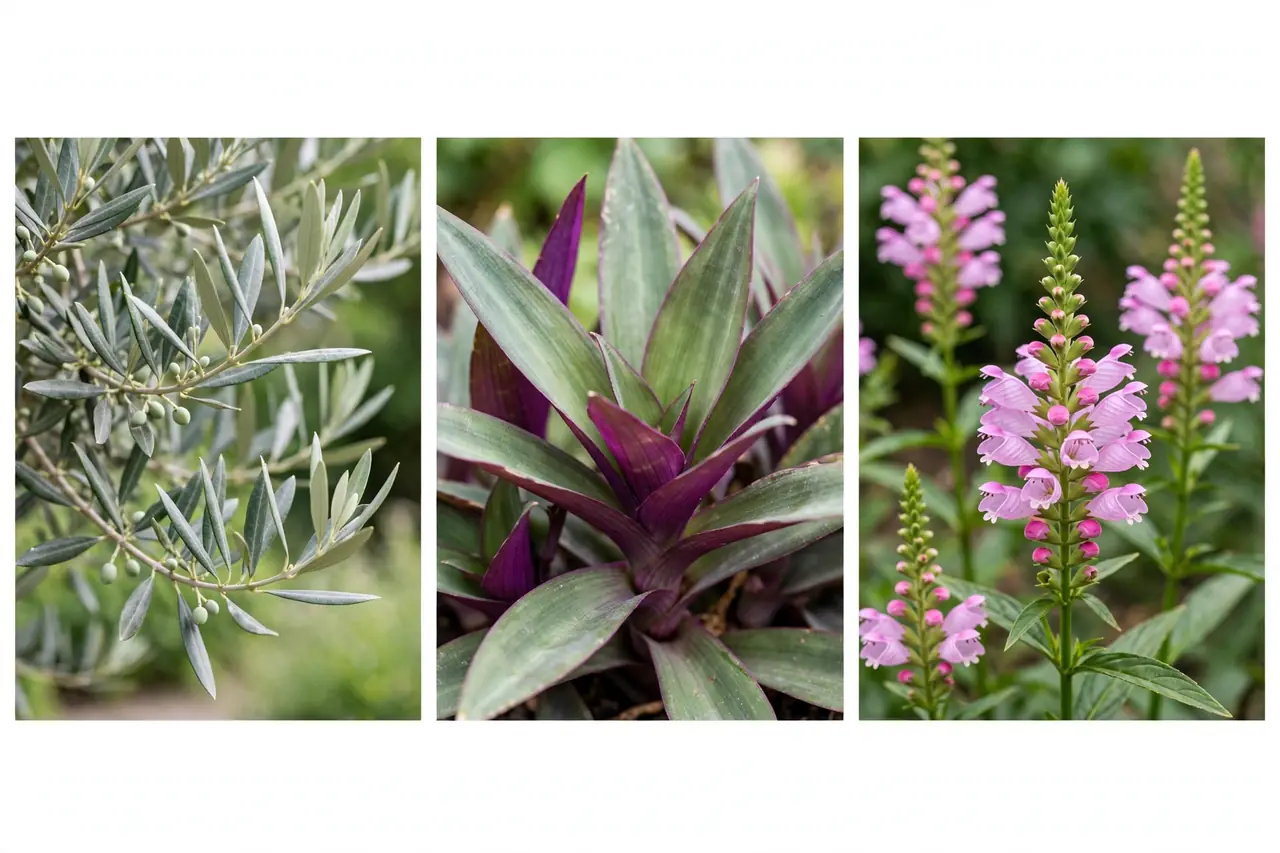
Few plants carry as much history as the olive tree. Olea europaea has been cultivated around the Mediterranean for at least 6,000 years, and its silvery-green evergreen foliage and gnarled trunks give any garden an instant sense of age and calm. Outdoors it is hardy in zones 8–10 (a few cultivars tolerate zone 7 with protection). Fruiting requires hot summers plus a certain number of winter chill hours, and most varieties need a compatible pollinator nearby, so ornamental growers in cooler climates often grow fruitless or container specimens purely for the look.
Growing tips: Full sun is non-negotiable, and drainage matters more than fertility — olives thrive in rocky, alkaline soil and rot in soggy ground. Water deeply but rarely once established; overwatering is the most common killer. Prune in late winter to open the canopy to light and air. For indoor growing, choose a dwarf cultivar, place it in your brightest window or under a grow light, and keep winter temperatures cool (50–60°F / 10–15°C) to mimic its natural rest.
5. Oyster Plant — Tradescantia spathacea
The oyster plant, also sold as Moses-in-the-cradle, is a tropical perennial from Central America grown for its stiff, sword-shaped leaves — glossy green on top, rich purple underneath. Small white flowers nestle inside boat-shaped purple bracts, which is where the common names come from. In zones 9–11 it makes a tough, colorful groundcover; everywhere else it is a nearly indestructible houseplant. One caution: the sap can irritate skin and eyes, so wear gloves when pruning, and note that it has naturalized aggressively in parts of Florida and Hawaii, where it should not be planted outdoors.
Growing tips: Indoors, give it bright indirect light — strong light deepens the purple undersides. Water when the top inch of soil dries; it tolerates missed waterings far better than soggy roots. Outdoors in warm climates, plant it in part shade with well-drained soil and expect it to spread; contain it with edging or grow it in pots. Wipe dusty leaves occasionally so the plant can photosynthesize efficiently, and repot when roots fill the container.
6. Obedient Plant — Physostegia virginiana
Obedient plant earns its name from a charming quirk: its tubular pink, lavender, or white flowers stay put when you bend them sideways on the stem, as if obeying your touch. This North American native (zones 3–9) blooms from late summer into fall, filling the awkward gap between summer perennials and autumn color, and its nectar-rich spikes are magnets for bees, butterflies, and hummingbirds. Now the honest warning: “obedient” describes the flowers, not the plant. It spreads vigorously by underground rhizomes and will happily take over a border if you let it.
Growing tips: Plant in full sun to part shade in average, moist soil — it tolerates clay and even rain-garden conditions. To manage its spread, divide clumps every two to three years, deadhead before seeds set, or sink a root barrier around the planting. Cutting stems back by half in early summer produces bushier plants with more flowers. It pairs beautifully with ornamental grasses and late-season asters in a prairie-style planting.
7. Oriental Poppy — Papaver orientale
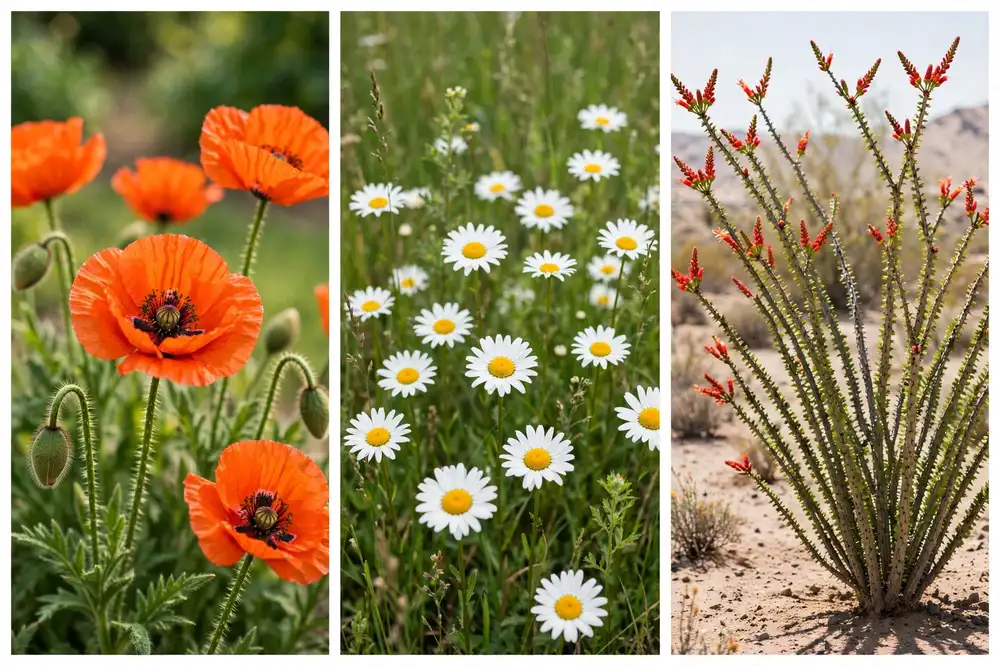
When an oriental poppy blooms in late spring, everything else in the border stops to look. Its enormous crepe-paper flowers — in blazing orange-red, scarlet, pink, salmon, or white, often with a dark basal blotch — can span six inches across on sturdy hairy stems. Hardy in zones 3–8, it is a true perennial that returns for decades from a deep taproot. The one thing that alarms new growers: after blooming, the foliage yellows and dies back completely by midsummer. The plant is not dead; it is dormant, and fresh basal leaves reappear in fall. For more spring drama, browse our flowers that start with O collection.
Growing tips: Plant in fall in full sun and deep, rich, well-drained soil, setting the crown no more than an inch below the surface. Because of the taproot, oriental poppies resent transplanting — choose the spot carefully the first time. Water well during bloom, then back off during summer dormancy. Mulch in fall in cold climates, and stake tall varieties in windy sites. One of the boldest full sun perennials you can grow, it needs almost no care once settled.
8. Oxeye Daisy — Leucanthemum vulgare
The oxeye daisy is the classic wild daisy of European meadows — white ray petals around a golden disk, nodding on wiry stems in early summer. Hardy in zones 3–8 and utterly unfussy, it naturalizes readily in meadows and cottage gardens. A word of honesty, though: it self-seeds enthusiastically and is listed as invasive or a noxious weed in parts of North America and Australia. If you garden near wild areas, the refined Shasta daisy (Leucanthemum × superbum) gives you the same look in a better-behaved package.
Growing tips: Full sun and average, well-drained soil are all it asks. Deadhead promptly after the first flush to encourage a second round of blooms and to prevent thousands of seedlings. Divide clumps every two to three years in early spring to keep them vigorous. It tolerates poor soil and drought once established, making it a good choice for low-maintenance naturalistic plantings where its spreading habit is an asset rather than a problem.
9. Ocotillo — Fouquieria splendens
The ocotillo looks like something from another planet: a fountain of long, thorny gray-green canes erupting from a central base, tipped in spring with blazing clusters of red-orange tubular flowers. Native to the Sonoran and Chihuahuan deserts (zones 8–11), it is not a true cactus but a master of desert survival — it sprouts small leaves within days of rain and drops them just as fast when drought returns, photosynthesizing through its green canes in between. Hummingbirds time their spring migration to its bloom, and desert gardeners prize it as a dramatic living fence.
Growing tips: This plant demands full, blazing sun and exceptionally sharp drainage — a raised mound of sandy or gravelly soil is ideal. Plant container-grown specimens at the same depth they grew in the nursery, and water sparingly until new growth appears. Once established, rainfall alone usually suffices; supplemental water in extended drought will trigger a fresh flush of leaves. Never fertilize heavily, and give it room: mature plants reach 15–20 feet across.
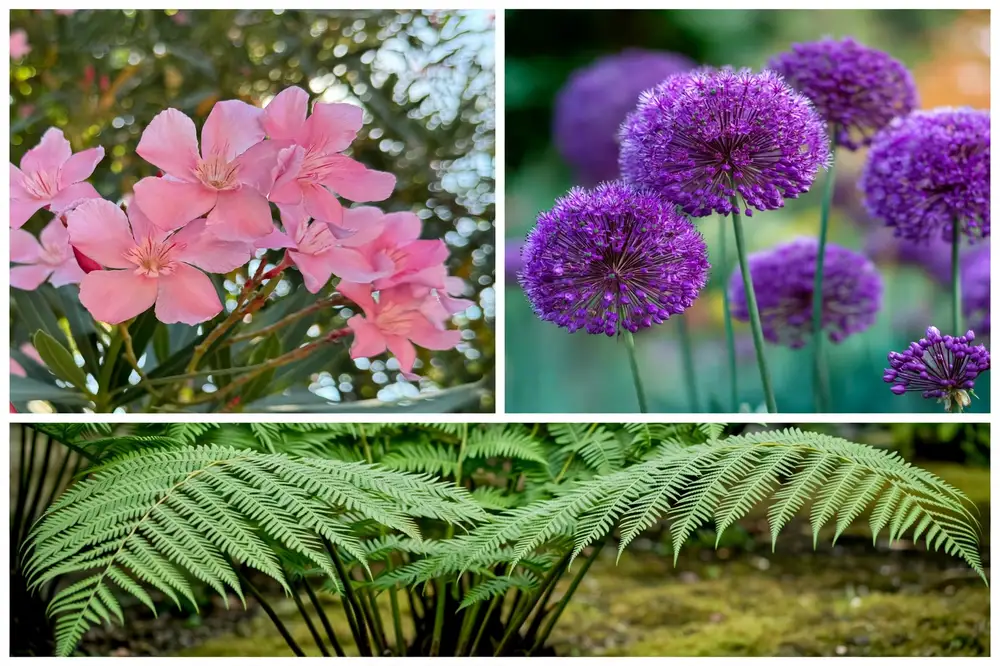
10. Oleander — Nerium oleander
Oleander is one of the most beautiful — and most dangerous — shrubs in warm-climate gardening. This Mediterranean evergreen (zones 8–10) produces masses of fragrant flowers in pink, red, white, or yellow from summer into fall, shrugs off heat, drought, salt spray, and poor soil, and clips neatly into hedges. But every part of the plant — leaves, flowers, stems, sap, even smoke from burning prunings — contains cardiac glycosides that can be fatal if ingested. Do not plant oleander where children or pets play, near vegetable gardens, or anywhere fallen leaves could contaminate a pond or livestock area. If anyone ingests any part, treat it as a medical emergency.
Growing tips: Plant in full sun in well-drained soil and water regularly the first season; established plants are extremely drought tolerant. Prune right after the main bloom to shape the shrub and encourage the next flush, always wearing gloves and long sleeves. In colder zones, grow dwarf cultivars in large containers and overwinter them in a bright, frost-free garage or greenhouse. Never compost oleander prunings or burn them — bag them for disposal instead.
11. Ostrich Fern — Matteuccia struthiopteris
The ostrich fern is the aristocrat of shade gardening. Its tall, arching fronds rise in a perfect shuttlecock-like vase up to six feet in ideal conditions, emerging each spring as the edible fiddleheads prized by foragers (always cook fiddleheads thoroughly before eating). Native to temperate regions of North America, Europe, and Asia, it is hardy in zones 3–7 and spreads steadily by underground runners to form lush colonies — exactly what you want for filling a damp, shady corner, and exactly why you should site it where it has room to roam.
Growing tips: Shade to part shade and consistently moist, humus-rich soil are essential — dry soil turns the fronds brown and crispy by midsummer. Mulch generously with leaf mold each fall. Water deeply during dry spells, and divide congested crowns in early spring if the center thins out. If you harvest fiddleheads, take no more than a third of the fronds from any one crown so the plant can replenish its energy.
12. Ornamental Onion — Allium spp.
Ornamental onions bring architectural drama to the late-spring border: perfect spheres of tiny star-shaped flowers — most famously purple, but also white, pink, blue, and yellow — floating on stiff stems above strappy foliage. Giants like Allium giganteum and ‘Globemaster’ reach four feet, while drumstick allium (A. sphaerocephalon) offers egg-sized maroon heads. Hardy in zones 4–9, they are among the most deer- and rabbit-resistant bulbs you can plant, since browsing animals dislike the oniony foliage, and their dried seed heads look sculptural for months after the color fades.
Growing tips: Plant bulbs in fall, three times as deep as the bulb is tall, in full sun and very well-drained soil — wet winter soil rots them. Let the foliage yellow naturally after blooming so the bulb recharges. They are superb companions for roses, whose bare lower stems the alliums help disguise, and they ask for almost nothing beyond that: no deadheading required unless you want to prevent self-seeding.
13. Osmanthus (Sweet Olive) — Osmanthus fragrans
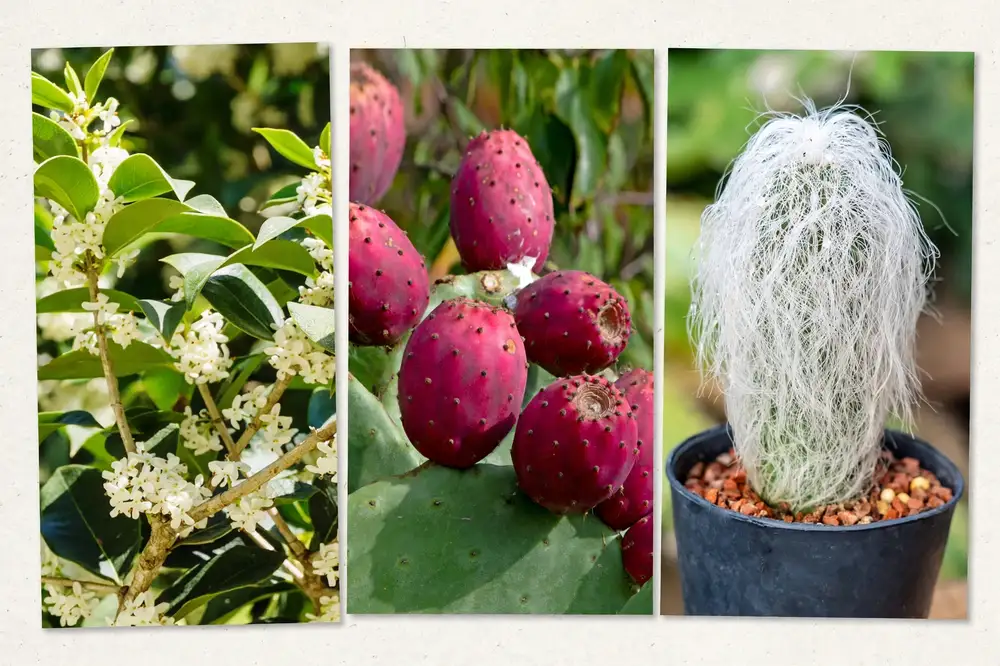
If fragrance is your priority, few shrubs beat osmanthus. Osmanthus fragrans, called sweet olive or tea olive, is an evergreen shrub or small tree (zones 7–10) whose tiny white or orange flowers release an intensely sweet, apricot-like perfume each fall — a scent you will notice from across the garden. In China its flowers are dried for tea and desserts. It grows slowly into a dense, handsome plant up to 15 feet tall, useful as a fragrant hedge or specimen. Fragrance gardeners browsing our plants that start with A guide will find more scented shrubs to pair with it.
Growing tips: Plant in full sun to part shade in moist, well-drained, slightly acidic soil. Water regularly the first two years, then it tolerates moderate drought. Prune lightly right after flowering if shaping is needed — heavy pruning sacrifices the next season’s bloom. Mulch to keep roots cool, and in zone 7, site it in a sheltered spot out of harsh winter wind.
14. Opuntia (Prickly Pear) — Opuntia spp.
Prickly pears are the most recognizable cacti in North America: flat, paddle-shaped pads (botanically, flattened stems) that root wherever they touch soil, crowned in early summer with satiny yellow, orange, or red flowers followed by edible pear-shaped fruits called tunas. Depending on species, they are hardy from zone 4 (the eastern prickly pear, Opuntia humifusa) to zone 11. Handle with respect: beyond the obvious spines, most species carry glochids — tiny barbed bristles that detach at a touch and irritate skin for days. Use tongs and thick gloves, always.
Growing tips: Full sun and gritty, fast-draining soil are mandatory; raised beds or slopes suit them perfectly. Water deeply but infrequently — established plants in the ground often need no supplemental water at all. In cold zones, grow them in terracotta pots and overwinter completely dry in an unheated garage. Harvest fruits with tongs when they turn deep red-purple and give slightly, then singe or scrub off the glochids before eating.
15. Old Man Cactus — Cephalocereus senilis
The old man cactus looks exactly like its name suggests: a tall columnar cactus from Mexico cloaked in long, shaggy white “hair.” That hair is actually a dense mat of fine spines that shades the plant from intense sun and traps a layer of insulating air — a brilliant desert adaptation. It is painfully slow-growing (a foot of growth can take years) and can eventually reach 40 feet in habitat, though container plants stay modest for decades. Hardy only in zones 9–11 outdoors, it spends most of its life elsewhere as a characterful houseplant.
Growing tips: Give it the brightest light you have — a south-facing window or greenhouse. Pot in a very gritty cactus mix in a container with drainage holes, and water thoroughly only when the soil is completely dry; in winter, water barely at all. Never mist the hair — trapped moisture invites rot. Repot rarely, handling with folded newspaper or tongs, and accept that flowering (nocturnal white blooms on mature plants) is a rare bonus indoors, not an expectation.
16. Orange Trumpet Vine — Campsis radicans
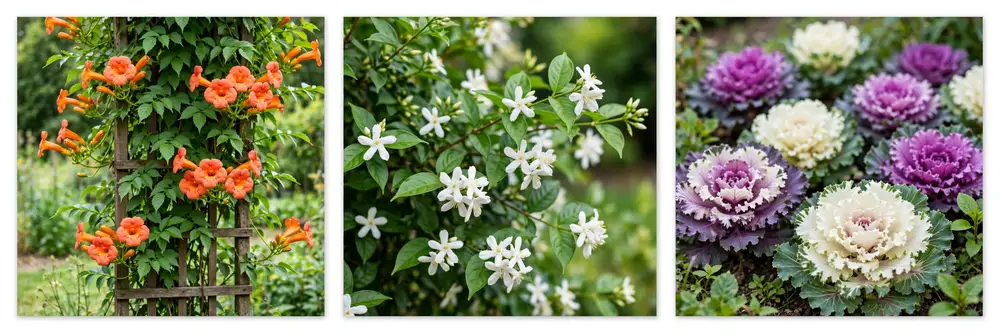
Trumpet vine, also called trumpet creeper, is a powerhouse native vine (zones 4–9) that climbs 30–40 feet by aerial rootlets and covers arbors, fences, and pergolas in clusters of vivid orange-red trumpet flowers all summer. Hummingbirds adore it — few plants attract them more reliably. But go in with eyes open: this is one of the most aggressive ornamental vines sold. It suckers relentlessly from the roots, self-seeds, and can pry apart siding, lift pavement, and swallow small trees. Plant it only where you can mow around it and prune it hard every year. For other climbing options, see the vines in our plants that start with V roundup.
Growing tips: Full sun produces the heaviest bloom; it tolerates almost any soil, and lean soil actually restrains its vigor. Prune hard in late winter, cutting back the previous year’s growth to a framework of older wood, since flowers form on new growth. Deadhead spent clusters to reduce self-seeding, and sever root suckers promptly. Never plant it against your house foundation or near septic systems — give it a freestanding arbor in the middle of the yard instead.
17. Orange Jasmine — Murraya paniculata
Orange jasmine is not a true jasmine, but one whiff of its flowers will make you stop caring about taxonomy. This tropical evergreen shrub (zones 9–11 outdoors; a superb houseplant elsewhere) produces clusters of small white blossoms with an intense orange-blossom perfume, followed by bright red berries that birds love. Its glossy dark-green foliage stays handsome year-round, and it responds well to clipping, so it works as a fragrant hedge in frost-free climates or an elegant container specimen anywhere else. New growth flushes a distinctive bronze-red before hardening off.
Growing tips: Bright light is key — outdoors in full sun to part shade, indoors in your sunniest window. Keep the soil evenly moist but never waterlogged, using a well-drained, slightly acidic mix. It loves warmth and humidity, so mist indoor plants or set pots on pebble trays in winter. Prune after flowering to shape, feed monthly in the growing season, and bring containers indoors well before the first frost.
18. Ornamental Kale — Brassica oleracea (Acephala Group)
When summer flowers fade, ornamental kale takes the stage. These cool-season annuals form tight rosettes of ruffled, fringed, or feathered leaves in shades of purple, rose-pink, and creamy white with green outer leaves — colors that intensify dramatically after the first frosts. Technically edible (it is the same species as edible kale), it is bred for looks rather than flavor and tastes quite bitter. Planted in fall beds and containers, it holds its color through snow in many climates, long after everything else has surrendered. It pairs beautifully with fall mums — see our mum care guide for keeping its companions thriving.
Growing tips: Start plants in late summer so they are well established before cold arrives; full sun gives the tightest rosettes and strongest color. Water regularly — drought stress makes leaves tough and dull. A light feeding at planting is enough; too much nitrogen produces loose, floppy heads. Strip off yellowing lower leaves as they appear to keep rosettes crisp, and replace plants in spring when they bolt.
19. Ox Tongue — Gasteria spp.
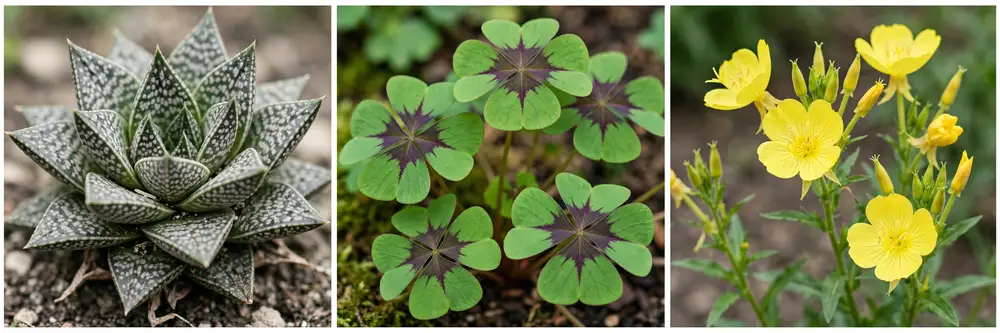
Ox tongue (Gasteria, most commonly G. bicolor and its hybrids) is the succulent for people who do not have a sunny windowsill. Native to the shady rock crevices of South Africa, it forms rosettes of thick, tongue-shaped leaves — often mottled or spotted in greens and grays with subtly rough textures — and sends up wiry stalks of small, curved orange-red flowers that look like tiny stomachs (hence Gasteria, from the Greek for “belly”). It tolerates lower light than almost any other succulent, making it one of the easiest indoor succulents for beginners and a natural fit for terrarium-style plantings.
Growing tips: Bright indirect light is ideal, though it survives in surprisingly dim spots. Plant in a fast-draining cactus or succulent mix and water thoroughly only when the soil is dry — overwatering and rot are the only real threats. In winter, water sparingly. It propagates effortlessly from leaf cuttings or offsets, so one plant becomes many within a couple of years.
20. Iron Cross Oxalis — Oxalis deppei
Iron cross oxalis looks like a four-leaf clover designed by an artist: each leaflet carries a deep reddish-brown blotch at its base, and the four blotches join to form a perfect cross — the “iron cross” of its common name. Native to Mexico, it grows from small bulbs and produces cheerful pink flowers through summer. Like its purple cousin Oxalis triangularis, it goes dormant in winter in cold climates, dying back to its bulbs until spring. It makes a charming edging plant, container filler, or novelty gift plant, and children love hunting for the cross pattern.
Growing tips: Plant bulbs in spring after the last frost, about an inch deep, in bright light with well-drained soil. Water moderately through the growing season and stop as the foliage yellows in fall. In zones 8–10 the bulbs can stay in the ground with mulch; in colder zones, lift and store them dry over winter like gladiola corms. Feed lightly once a month in summer for the densest clover carpet.
21. Evening Primrose — Oenothera biennis
Evening primrose performs a small nightly magic trick: its cupped, lemon-yellow flowers pop open at dusk — sometimes fast enough to watch — releasing a sweet scent that draws night-flying moths. This North American native biennial (zones 4–9) spends its first year as a low rosette, then rockets up a 3–5-foot flower spike in its second summer before setting abundant seed. It self-sows freely, so one planting often becomes a permanent, wandering colony. The seeds are pressed for evening primrose oil, a popular supplement, though the plant’s real garden value is its carefree nature and its role in the night garden.
Growing tips: Full sun and poor to average, well-drained soil suit it best — rich soil makes it tall and floppy. It is extremely drought tolerant once established. Let a few seed heads mature if you want it to naturalize, or deadhead to keep it in bounds. Because it is a biennial, sow or allow seedlings two years running for continuous bloom, and thin self-sown seedlings to about a foot apart.
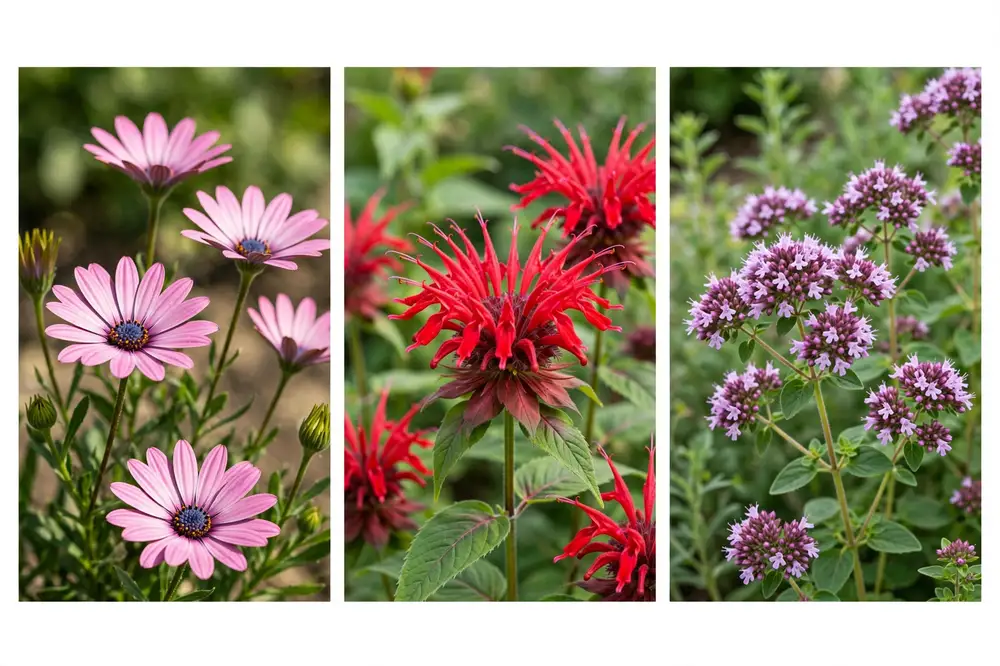
22. Osteospermum (African Daisy) — Osteospermum spp.
Osteospermum, the African daisy, brings jewel-toned color to spring and fall containers: daisy flowers with distinctive spoon-shaped petals in white, pink, purple, orange, and yellow, often with contrasting dark centers. Native to South Africa, most are tender perennials hardy only in zones 10–11, so gardeners in colder climates grow them as annuals. They bloom most heavily in cool weather and often pause during summer heat — a trait to plan around rather than fight. Newer heat-tolerant series have improved summer performance considerably.
Growing tips: Full sun and well-drained soil are essential; soggy roots kill them fast. Deadhead regularly to keep flowers coming, and shear plants back by a third if they stall in midsummer heat — they rebound when nights cool. In warm climates they can perennialize; elsewhere, take cuttings in late summer or simply replant each spring. Pair with cool-season companions like pansies for a long spring display.
23. Oswego Tea (Bee Balm) — Monarda didyma
Oswego tea closes our list with a plant steeped in American history: Monarda didyma, a North American native (zones 4–9) in the mint family, earned its common name when Oswego Native Americans taught early settlers to brew its leaves into a tea — a practice colonists adopted enthusiastically after the Boston Tea Party. Modern gardeners grow it for its shaggy, fireworks-like flower heads in scarlet, pink, lavender, and white, which bloom in midsummer and draw hummingbirds, bees, and butterflies in droves. Its aromatic foliage smells of citrus-mint when crushed.
Growing tips: Plant in full sun in rich, consistently moist soil — unlike many mint relatives, bee balm sulks in drought. Space plants generously and water at the base to discourage powdery mildew, the plant’s notorious weakness; choosing mildew-resistant cultivars like ‘Jacob Cline’ or the Balmy series prevents most problems. Divide clumps every three years in spring to maintain vigor, and deadhead to prolong bloom or leave seed heads for goldfinches.
Light, Water & Hardiness Comparison
Use this quick comparison to match O plants to your conditions. When in doubt, check your USDA zone and give desert plants sharper drainage than you think they need.
| Plant | Light | Water Needs | Hardiness Zones |
|---|---|---|---|
| Oregano | Full sun | Low once established | 4–9 |
| Olive Tree | Full sun | Low once established | 8–10 |
| Oleander | Full sun | Low once established | 8–10 |
| Oriental Poppy | Full sun | Moderate | 3–8 |
| Ostrich Fern | Shade to part shade | High — keep moist | 3–7 |
| Obedient Plant | Full sun to part shade | Moderate to high | 3–9 |
| Ox Tongue | Bright indirect | Low — let dry out | 9–11 (or indoors) |
| Opuntia | Full sun | Very low | 4–11 (by species) |
| Evening Primrose | Full sun | Low | 4–9 |
| Oswego Tea | Full sun | Moderate to high | 4–9 |
Frequently Asked Questions
What are the easiest indoor plants that start with O?
Oxalis triangularis (purple shamrock), oyster plant, and ox tongue are the most forgiving. All three tolerate typical indoor conditions, need only moderate light, and bounce back from the occasional missed watering. Orchid cactus is a step up in care but rewards you with spectacular night blooms.
Is oleander really as poisonous as people say?
Yes. All parts of Nerium oleander — leaves, flowers, stems, sap, and even smoke from burning prunings — contain cardiac glycosides that can cause fatal heart disruption if ingested. It is one of the most toxic commonly planted shrubs. Grow it only where children, pets, and livestock cannot reach it, always wear gloves when pruning, and never burn the trimmings.
Which plant starting with O is best for a complete beginner?
Oregano outdoors or ox tongue indoors. Oregano thrives on neglect in full sun and poor soil, while ox tongue tolerates low light and infrequent watering better than almost any other succulent. Evening primrose is another excellent beginner choice for sunny garden beds since it self-sows and needs almost no care.
Which O plants attract pollinators?
Oregano flowers are bee magnets, obedient plant and Oswego tea draw bees, butterflies, and hummingbirds, and orange trumpet vine is a hummingbird favorite. Oriental poppy, osteospermum, and evening primrose (for night-flying moths) all support pollinators too.
Can I grow an olive tree indoors?
Yes, with the right conditions: your brightest window or a grow light, a dwarf cultivar, well-drained soil, and cool winter temperatures around 50–60°F (10–15°C). It will grow as an attractive foliage plant, but do not expect fruit — indoor trees rarely get the chill hours and pollination they need to set olives.
What O plants grow well in shade?
Ostrich fern is the top pick for deep, moist shade, forming dramatic vase-shaped colonies. Ox tongue handles surprisingly low light for a succulent, and oxalis does well in bright indirect light indoors. Osmanthus also tolerates part shade while still flowering fragrantly.
References
- RHS Plant Finder — the Royal Horticultural Society’s plant advice and growing guides.
- The Old Farmer’s Almanac — planting calendars, frost dates, and vegetable and herb growing guides.
- Gardening Know How — practical how-to articles on growing flowers, herbs, shrubs, and houseplants.
- University of Minnesota Extension — research-based gardening and horticulture information.
- Clemson University Home & Garden Information Center — fact sheets on landscape plants, pests, and plant health.