30 Plants That Start With Q: Names, Pictures & Growing Tips
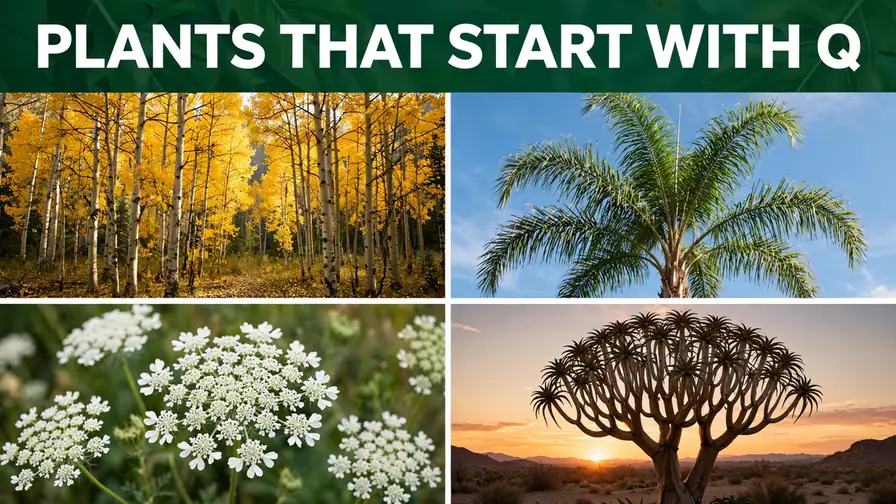
Looking for a plant that starts with Q? You have found the hardest letter in the plant alphabet — and the most rewarding one. Q gives you the shimmering gold of a quaking aspen grove, the feathery elegance of a queen palm, the old-world charm of a quince heavy with fragrant fruit, the lacy white parasols of Queen Anne’s lace, and the surreal forked silhouette of Africa’s quiver tree. Whether you are hunting for a striking tree, a fragrant shrub, a houseplant, or a wildflower for a school alphabet garden, this guide covers 30 real plants that start with Q, each with its scientific name and practical growing advice.
Every entry below lists the plant’s botanical name, light needs, water needs, bloom season, and USDA hardiness zone, so you can tell at a glance which Q-plants suit your garden. You will also find two handy comparison tables, practical growing tips, and answers to the questions gardeners ask most about plants starting with Q. Let’s dig in.
Quick Answer
Popular plants that start with Q include Quaking Aspen, Queen Palm, Common Quince, Flowering Quince, Queen Anne’s Lace, Queen of the Night, Quiver Tree, Queen’s Wreath, Queen of the Prairie, and Queen’s Tears. They span towering trees, tropical vines, fragrant roses, desert succulents, and delicate wildflowers across USDA zones 1–11, so there is a Q-plant for nearly every climate.
Table of Contents

Q-Plants at a Glance
Use this table to compare all 30 plants that start with Q side by side, from botanical names to native regions.
| Plant name | Scientific name | Type | Light | Native region |
|---|---|---|---|---|
| Quaking Aspen | Populus tremuloides | Deciduous tree | Full sun | North America |
| Queen Palm | Syagrus romanzoffiana | Evergreen palm | Full sun | South America (Brazil, Argentina, Uruguay) |
| Common Quince | Cydonia oblonga | Deciduous fruit tree | Full sun | Southwest Asia, Caucasus |
| Flowering Quince | Chaenomeles speciosa | Deciduous shrub | Full sun to part shade | China |
| Queen Anne’s Lace | Daucus carota | Biennial wildflower | Full sun | Europe, Southwest Asia |
| Queen of the Night | Epiphyllum oxypetalum | Epiphytic cactus | Bright indirect light | Central & South America |
| Quiver Tree | Aloidendron dichotomum | Succulent tree | Full sun | Namibia, South Africa |
| Queen’s Wreath | Petrea volubilis | Evergreen vine | Full sun to part shade | Tropical Americas |
| Queen of the Prairie | Filipendula rubra | Herbaceous perennial | Full sun to part shade | Central & eastern North America |
| Queensland Umbrella Tree | Schefflera actinophylla | Evergreen tree | Full sun to part shade | Australia, New Guinea |
| Quandong | Santalum acuminatum | Hemi-parasitic tree | Full sun | Australia |
| Queen Elizabeth Rose | Rosa ‘Queen Elizabeth’ | Grandiflora rose | Full sun | Hybrid (US breeding) |
| Japanese Flowering Quince | Chaenomeles japonica | Deciduous shrub | Full sun to part shade | Japan |
| Queen’s Tears | Billbergia nutans | Evergreen bromeliad | Bright indirect light | South America (Brazil, Argentina, Uruguay) |
| Quaker Ladies | Houstonia caerulea | Herbaceous perennial | Full sun to part shade | Eastern North America |
| Cypress Vine | Ipomoea quamoclit | Tender annual vine | Full sun | Tropical Americas |
| Queen of the Meadow | Filipendula ulmaria | Herbaceous perennial | Full sun to part shade | Europe, West Asia |
| Queensland Bottle Tree | Brachychiton rupestris | Succulent tree | Full sun | Queensland, Australia |
| Queensland Flame Tree | Brachychiton acerifolius | Deciduous tree | Full sun | Eastern Australia |
| Queensland Nut | Macadamia integrifolia | Evergreen tree | Full sun to part shade | Queensland & NSW, Australia |
| Queensland Maple | Flindersia brayleyana | Evergreen rainforest tree | Full sun | Queensland, Australia |
| Queensland Kauri | Agathis robusta | Evergreen conifer | Full sun | Queensland, Australia & New Guinea |
| Queensland Blue Gum | Eucalyptus tereticornis | Evergreen tree | Full sun | Australia, Papua New Guinea |
| Queensland Lacebark | Brachychiton discolor | Deciduous tree | Full sun | Eastern Australia |
| Queensland Silver Wattle | Acacia podalyriifolia | Evergreen tree/shrub | Full sun | SE Queensland & NE NSW, Australia |
| Queensland Fan Palm | Licuala ramsayi | Evergreen palm | Part shade | Queensland, Australia |
| Quassia | Quassia amara | Evergreen shrub/small tree | Part shade | Tropical Americas |
| Quinine Tree | Cinchona officinalis | Evergreen tree | Part shade | Andes, South America |
| Queen of Sheba Orchid | Thelymitra speciosa | Terrestrial orchid | Full sun | Southwest Western Australia |
| Queen’s Delight | Stillingia sylvatica | Herbaceous perennial | Full sun | Southeastern US |
Bloom Season, Water Needs & Hardiness Zones
Planning your garden calendar? This second table shows when each Q-plant blooms, how much water it wants, and the USDA zones where it grows outdoors year-round.
| Plant name | Bloom season | Water | Hardiness zone | Mature size |
|---|---|---|---|---|
| Quaking Aspen | Spring (catkins) | Medium | 1–6 | 20–50 ft tall |
| Queen Palm | Summer | Medium | 9b–11 | 30–50 ft tall |
| Common Quince | Spring | Medium | 5–9 | 10–20 ft tall |
| Flowering Quince | Early spring | Medium | 5–9 | 6–10 ft tall |
| Queen Anne’s Lace | Summer | Low to medium | 3–9 | 2–4 ft tall |
| Queen of the Night | Summer (night blooms) | Medium | 10–11; houseplant elsewhere | 6–10 ft stems |
| Quiver Tree | Winter | Low (drought tolerant) | 9b–11 | 20–30 ft tall |
| Queen’s Wreath | Spring to summer | Medium | 9b–11 | 25–40 ft vine |
| Queen of the Prairie | Summer | High (moist soil) | 3–9 | 4–8 ft tall |
| Queensland Umbrella Tree | Summer | Medium | 9b–12 | 30–50 ft tall |
| Quandong | Spring to summer | Low to medium | 8–11 | 10–20 ft tall |
| Queen Elizabeth Rose | Late spring to fall | Medium | 5–10 | 4–6 ft tall |
| Japanese Flowering Quince | Early spring | Medium | 5–9 | 2–4 ft tall |
| Queen’s Tears | Spring | Medium (cup watering) | 9b–11; houseplant elsewhere | 1–2 ft tall |
| Quaker Ladies | Spring | Medium | 4–9 | 3–6 in tall |
| Cypress Vine | Summer to fall | Medium | Annual (9–11 perennial) | 10–20 ft vine |
| Queen of the Meadow | Summer | High (moist soil) | 3–9 | 3–6 ft tall |
| Queensland Bottle Tree | Spring | Low (drought tolerant) | 9b–11 | 30–60 ft tall |
| Queensland Flame Tree | Spring (leafless bloom) | Medium | 9b–12 | 30–50 ft tall |
| Queensland Nut | Spring | Medium | 9b–11 | 30–40 ft tall |
| Queensland Maple | Spring | Medium | 10–11 | 40–100 ft tall |
| Queensland Kauri | Non-flowering conifer | Medium | 10–11 | 100–150 ft tall |
| Queensland Blue Gum | Fall to winter | Low to medium | 9–11 | 100–150 ft tall |
| Queensland Lacebark | Summer | Medium | 9b–11 | 30–90 ft tall |
| Queensland Silver Wattle | Winter to spring | Low to medium | 8–11 | 10–25 ft tall |
| Queensland Fan Palm | Spring | Medium to high | 10b–11 | 30–50 ft tall |
| Quassia | Year-round (tropics) | Medium | 10–11 | 6–20 ft tall |
| Quinine Tree | Summer | Medium to high | 10–11 | 30–50 ft tall |
| Queen of Sheba Orchid | Winter to spring | Low to medium | 9–10 | 4–8 in tall |
| Queen’s Delight | Spring | Medium | 7–10 | 1–3 ft tall |
30 Plants That Start With Q: The Complete List
Here they are — 30 beautiful, real plants beginning with Q, each with growing notes so you can pick the right ones for your garden.
1. Quaking Aspen (Populus tremuloides)
Quaking aspen is North America’s most widely distributed native tree, famous for leaves that tremble and shimmer in the slightest breeze thanks to their flattened leaf stalks. In fall, whole mountainsides turn gold at once, because most aspens in a grove are actually one giant organism connected by roots — Utah’s “Pando” clone is a single 80,000-year-old male aspen covering 106 acres. Give it full sun and well-drained soil in a cool climate; it struggles in hot, humid regions and spreads aggressively by root suckers, so plant it where you have room.
Best suited to zones 1–6, aspens make stunning specimen trees and windbreaks in northern gardens. Water young trees regularly until established, then leave them mostly alone. Avoid planting near foundations or septic lines, since the wandering roots are famously thirsty and persistent.
Bloom: Spring (catkins) | Light: Full sun | Zone: 1–6 | Best for: Northern landscapes, fall color, naturalized groves
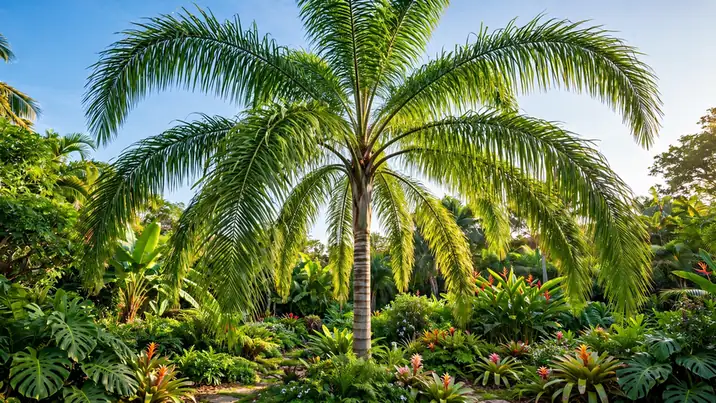
2. Queen Palm (Syagrus romanzoffiana)
Queen palm is the graceful, fast-growing palm that lines streets and resort gardens across the warm South, with smooth grey trunks and feathery arching fronds up to 15 feet long. It shoots up quickly — often several feet a year — and produces dangling clusters of orange date-like fruits that birds and squirrels love. Plant in full sun with well-drained soil, and give young palms regular water; established trees handle brief drought. Watch for frizzle top, a manganese deficiency that crinkles new fronds — a palm-specific fertilizer prevents it.
Hardy to about 15°F (zones 9b–11), queen palm is one of the most cold-tolerant feather palms. Expect some mess: falling fruits and old fronds need regular cleanup, so site it away from pools and walkways. Remove dead fronds with a pole saw, never a climbing spike, which wounds the trunk.
Bloom: Summer | Light: Full sun | Zone: 9b–11 | Best for: Tropical streetscapes, poolside planting, fast shade
3. Common Quince (Cydonia oblonga)
Common quince is the ancient golden fruit tree of the Caucasus and Southwest Asia, grown for over 4,000 years for its intensely aromatic, lemon-yellow fruits. Raw quinces are too astringent to eat, but cooked they transform into ruby-pink jelly, membrillo paste, and fragrant preserves — one simmering pot will perfume your whole kitchen. Trees are small (10–20 feet), self-fertile, and bear pretty pale-pink spring blossoms, so a single tree fruits without a pollination partner.
Plant in full sun with fertile, well-drained soil in zones 5–9, and choose a variety suited to your chill hours — ‘Smyrna’ and ‘Pineapple’ are reliable in warm regions. Quinces are prone to fire blight, so prune for air circulation and avoid overhead watering. Harvest in fall when the fuzz rubs off and the fruit turns deep gold.
Bloom: Spring | Light: Full sun | Zone: 5–9 | Best for: Edible landscaping, jams and jellies, heritage orchards
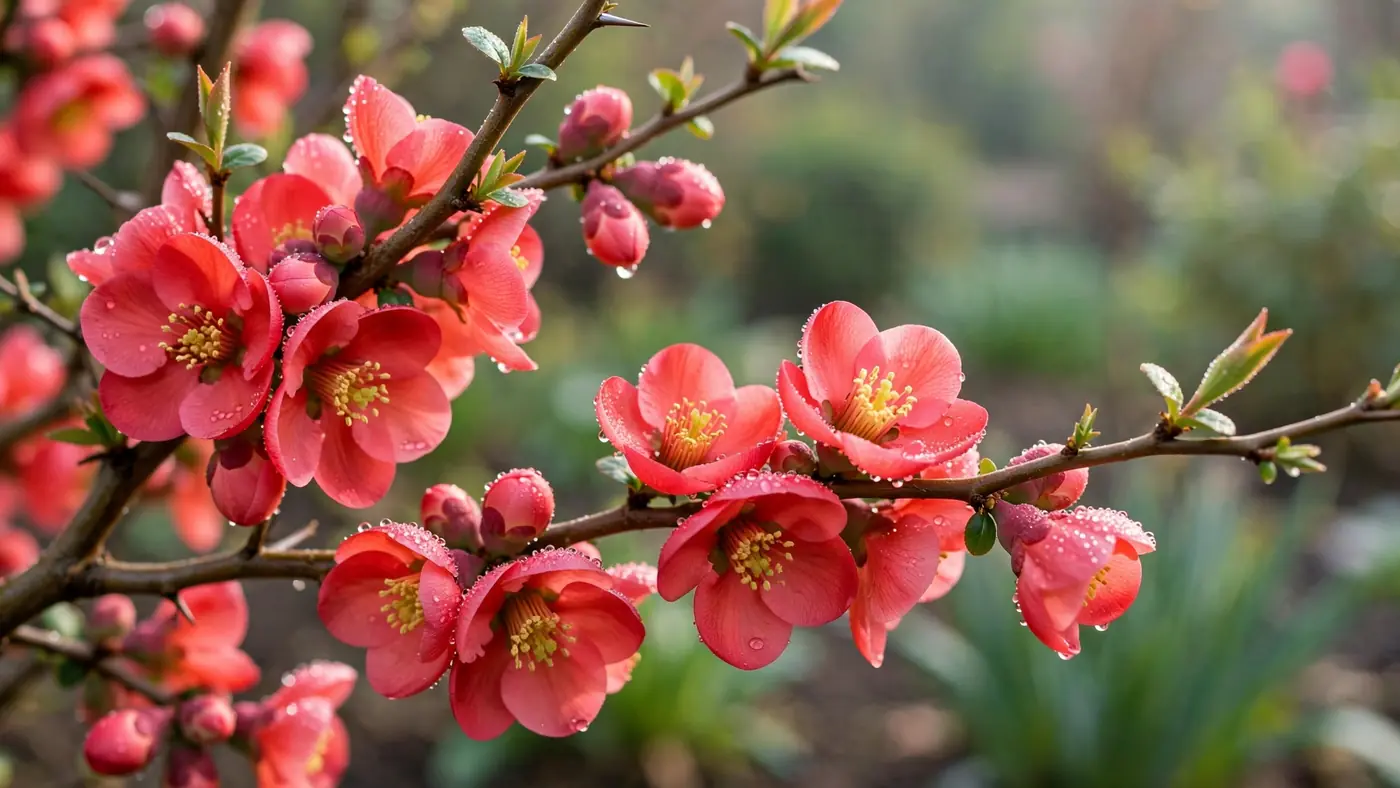
4. Flowering Quince (Chaenomeles speciosa)
Flowering quince is the shrub that saves late winter — its bare thorny branches erupt in clusters of red, pink, or orange blooms weeks before forsythia wakes up. Tough, drought-tolerant, and nearly indestructible once established, it makes an excellent informal hedge or security planting under windows. Small, hard, apple-like fruits follow the flowers and make excellent jelly, though they are far too tart to eat fresh.
Give it full sun to part shade in zones 5–9 and prune right after flowering, since next year’s blooms form on old wood. It tolerates poor soil and city conditions, but leaf spot can mar the foliage in wet summers — space plants for airflow. For smaller gardens, look for compact forms under 4 feet.
Bloom: Early spring | Light: Full sun to part shade | Zone: 5–9 | Best for: Early color, thorny hedges, cut branches for forcing
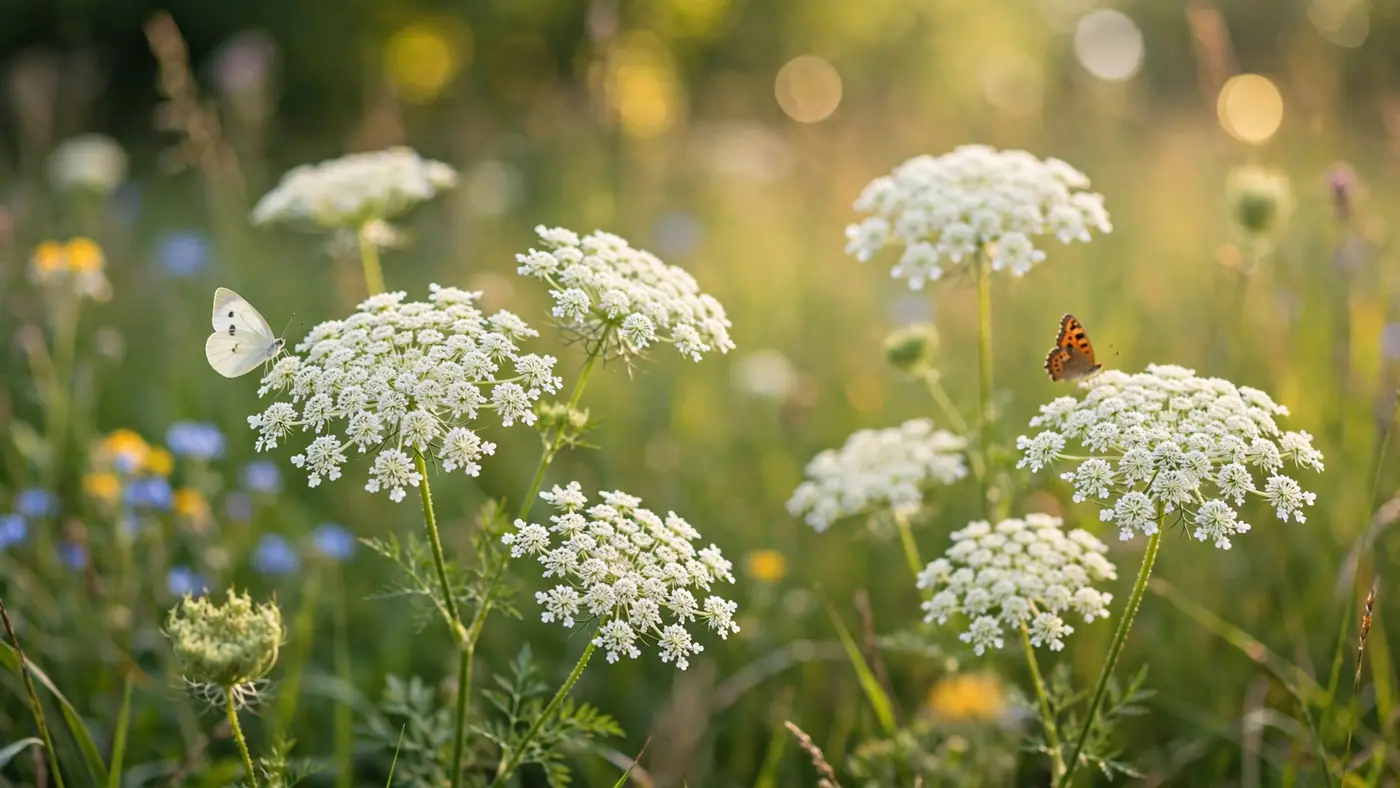
5. Queen Anne’s Lace (Daucus carota)
Queen Anne’s lace is the familiar wild carrot whose flat, lacy white umbels — each with a single dark-red central floret — dot meadows and roadsides all summer. This biennial spends its first year as a low rosette, then sends up 2–4 foot flower stalks the second year and self-seeds freely. Swallowtail butterflies lay eggs on it, and beneficial insects flock to the flowers, making it a quiet workhorse of pollinator gardens and cottage borders.
Grow it in full sun with average soil in zones 3–9; it asks for almost nothing and naturalizes readily. One caution matters more than any growing tip: learn to tell it from poison hemlock before you pick or plant it — Queen Anne’s lace has hairy stems and a carrot-scented root, while hemlock has smooth, purple-spotted stems and no hairs. When in doubt, don’t touch.
Bloom: Summer | Light: Full sun | Zone: 3–9 | Best for: Wildflower meadows, pollinator gardens, naturalized borders
6. Queen of the Night (Epiphyllum oxypetalum)
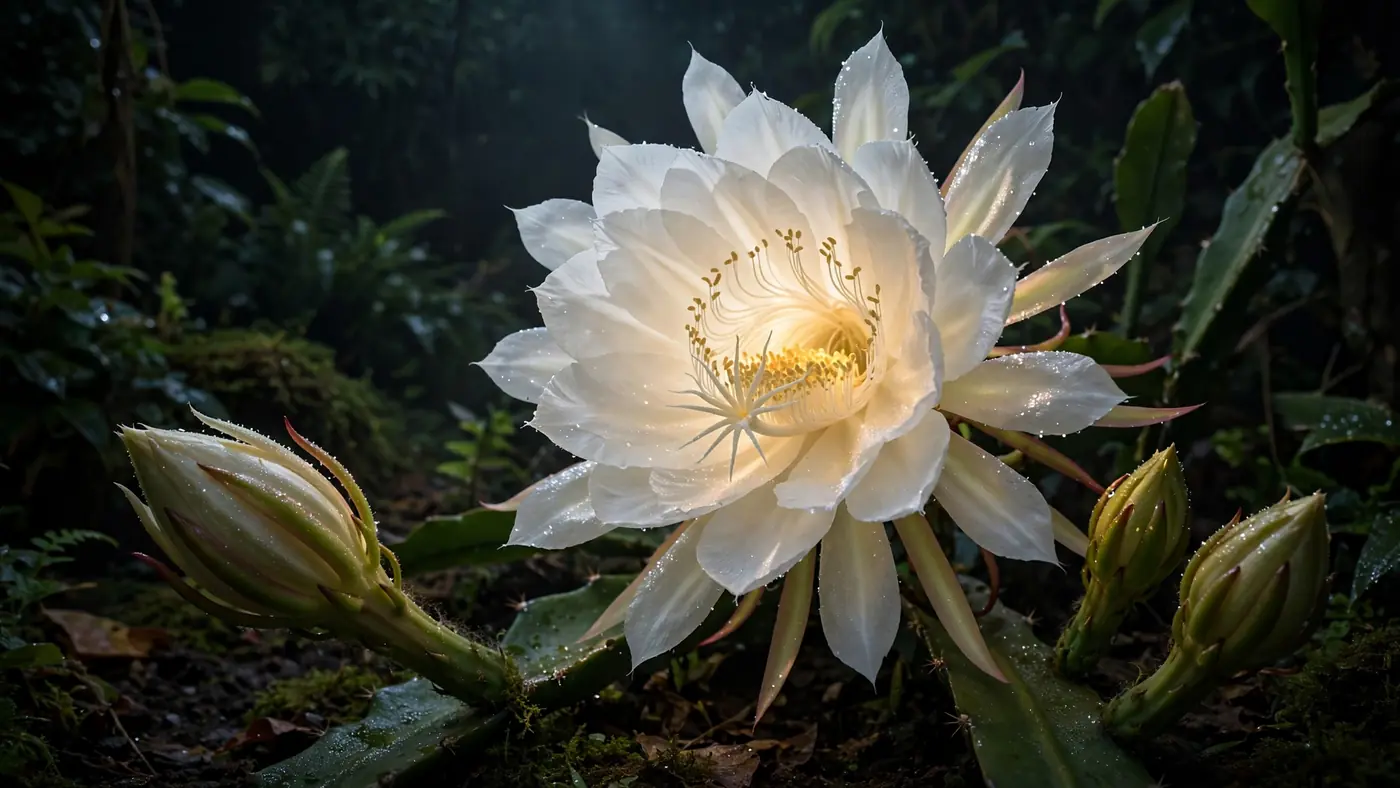
Queen of the night is the legendary night-blooming cereus, an epiphytic cactus that produces dinner-plate-sized, intensely fragrant white flowers that open after dark and wilt by dawn — often just one night a year. Gardeners have hosted “bloom parties” around a single opening flower for generations. In the wild it scrambles through Central and South American rainforest trees; indoors it grows in a hanging basket or pot of coarse orchid mix.
Give it bright indirect light, a chunky fast-draining mix, and water only when the top few inches dry out — it rots faster than it dries. Outdoors only in zones 10–11; everywhere else it is a houseplant that summers outside in shade. A cool, dry winter rest encourages blooming, so ease off water from late fall.
Bloom: Summer (one-night blooms) | Light: Bright indirect | Zone: 10–11; houseplant elsewhere | Best for: Night gardens, collectors, fragrant houseplants
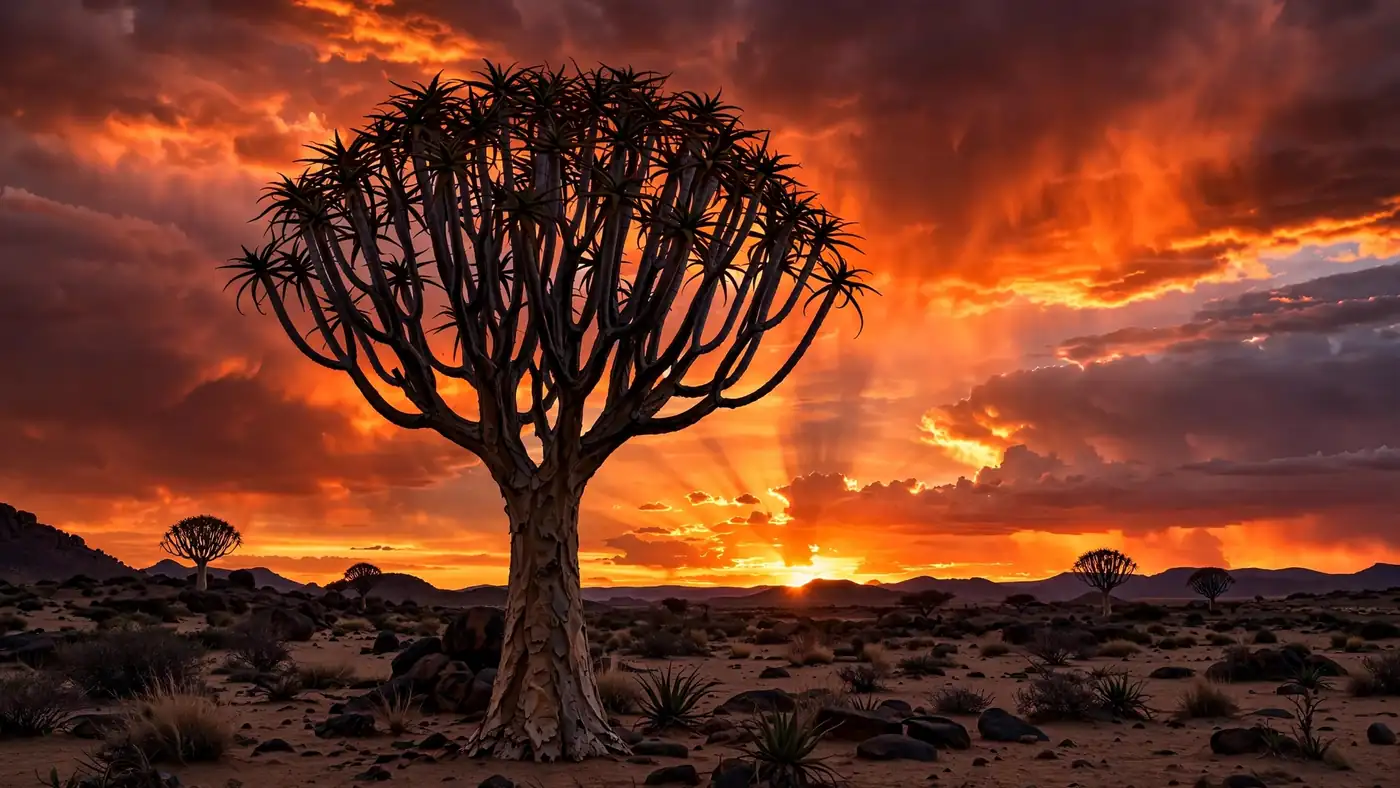
7. Quiver Tree (Aloidendron dichotomum)
Quiver tree is the surreal forked giant of the Namib Desert, a tree-sized aloe that branches again and again into a perfect candelabra silhouette against the sunset. The San people hollowed its soft branches into quivers for their arrows — hence the name. Despite looking like a desert sculpture, it is alive and tough: thick succulent bark stores water, and in winter it crowns itself with spikes of bright yellow flowers that feed sunbirds.
Grow it in full sun with extremely sharp drainage in zones 9b–11; heavy or wet soil kills it faster than any drought. It is slow but long-lived, eventually reaching 20–30 feet, and makes a jaw-dropping xeriscape specimen. Protect young plants from hard frosts, and never water in winter when it is resting.
Bloom: Winter | Light: Full sun | Zone: 9b–11 | Best for: Xeriscapes, succulent collections, dramatic specimens
8. Queen’s Wreath (Petrea volubilis)
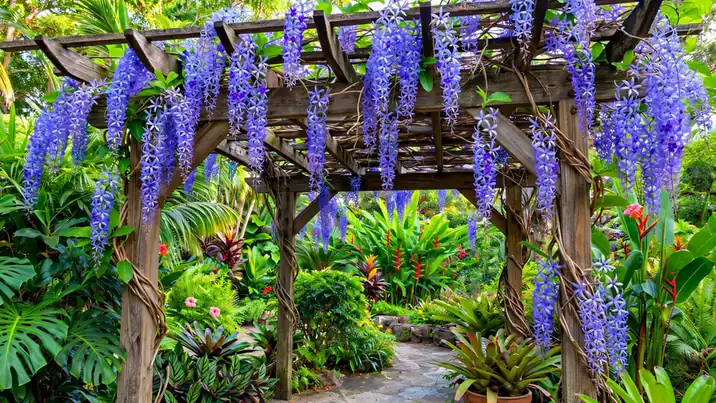
Queen’s wreath is a tropical vine that drapes pergolas and fences in cascading racemes of violet-blue, star-shaped flowers each spring — from a distance the whole vine looks dusted with wisteria. Up close the flowers have a two-tone trick: each blossom sits in a larger star-shaped calyx that lingers after the petals fall, stretching the show for weeks. The rough, sandpapery leaves were once used as natural sandpaper in the Caribbean.
Plant in full sun to part shade in zones 9b–11 with a very sturdy support — mature vines reach 25–40 feet and get heavy. Prune hard right after flowering to control size and encourage the next bloom. It dislikes frost and soggy soil; in marginal zones, grow it in a large pot and overwinter indoors. Note that “queen’s wreath” is also used for coral vine in some regions — this is the true Petrea.
Bloom: Spring to summer | Light: Full sun to part shade | Zone: 9b–11 | Best for: Pergolas, tropical fences, large containers
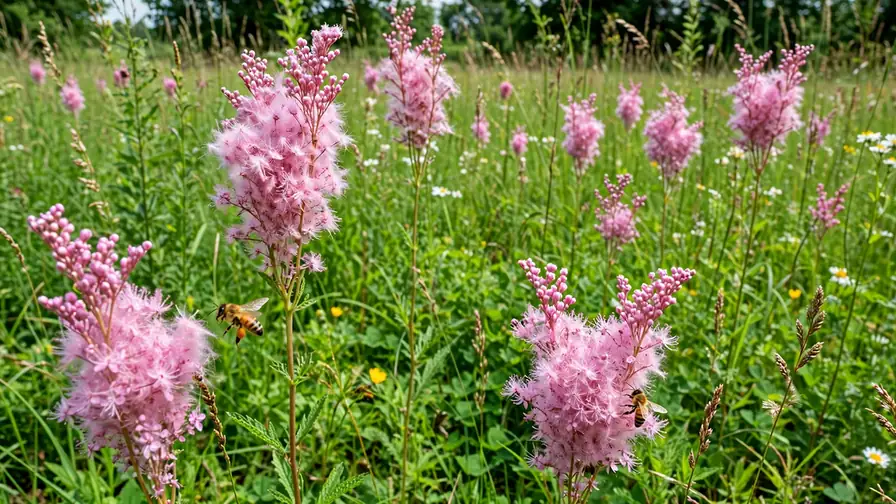
9. Queen of the Prairie (Filipendula rubra)
Queen of the prairie earns its royal title in midsummer, when 4–8 foot stems top out in fluffy plumes of deep pink — like pink cotton candy held above the border. Native to wet meadows of central and eastern North America, it is one of the tallest and showiest native perennials, and a magnet for bees and butterflies. The cultivar ‘Venusta’ is even more vigorous, with richer pink flowers.
This is a plant for damp ground: give it full sun to part shade and consistently moist, even boggy soil in zones 3–9, and it will thrive where most perennials sulk. In dry soil it scorches and sulks, so mulch deeply and water through dry spells. Divide congested clumps every few years in spring to keep the plumes coming.
Bloom: Summer | Light: Full sun to part shade | Zone: 3–9 | Best for: Rain gardens, pond edges, native plantings
10. Queensland Umbrella Tree (Schefflera actinophylla)
Queensland umbrella tree is the bold tropical that stages glossy green leaves in umbrella-like whorls at the ends of its branches, maturing into a 30–50 foot evergreen tree crowned with striking red flower spikes. Young plants are popular houseplants, but outdoors in zones 9b–12 it grows fast and big. Before planting, check local rules: it is invasive in Florida, Hawaii, and other warm regions, where birds spread its seeds into natural areas.
Give it full sun to part shade and average, well-drained soil; it tolerates wind, salt, and neglect once established. As a houseplant, provide bright light and let the top of the soil dry between waterings — it hates wet feet. If you want the look without the size or the invasive risk, grow dwarf schefflera (S. arboricola) instead.
Bloom: Summer | Light: Full sun to part shade | Zone: 9b–12 | Best for: Tropical landscapes (where not invasive), large houseplants
11. Quandong (Santalum acuminatum)
Quandong is Australia’s desert peach — a small tree bearing bright-red, tart fruits with a flavor somewhere between peach and rhubarb, long prized as bush tucker by Aboriginal peoples. The fruit dries beautifully, the kernel tastes like almond, and even the leaves were traditionally used medicinally. What makes quandong fascinating to grow is that it is hemi-parasitic: its roots tap into neighboring plants for water and nutrients, so it needs host plants (grasses, acacias, or other natives) planted alongside it.
Plant in full sun with deep, well-drained soil in zones 8–11, and always install several host plants at the same time. Quandong is extremely drought-tolerant once established but slow to get going — scarify seeds and be patient. It rarely fruits heavily without its hosts, so treat it as a small ecosystem, not a solo tree.
Bloom: Spring to summer | Light: Full sun | Zone: 8–11 | Best for: Bush-tucker gardens, arid landscapes, collectors
12. Queen Elizabeth Rose (Rosa ‘Queen Elizabeth’)
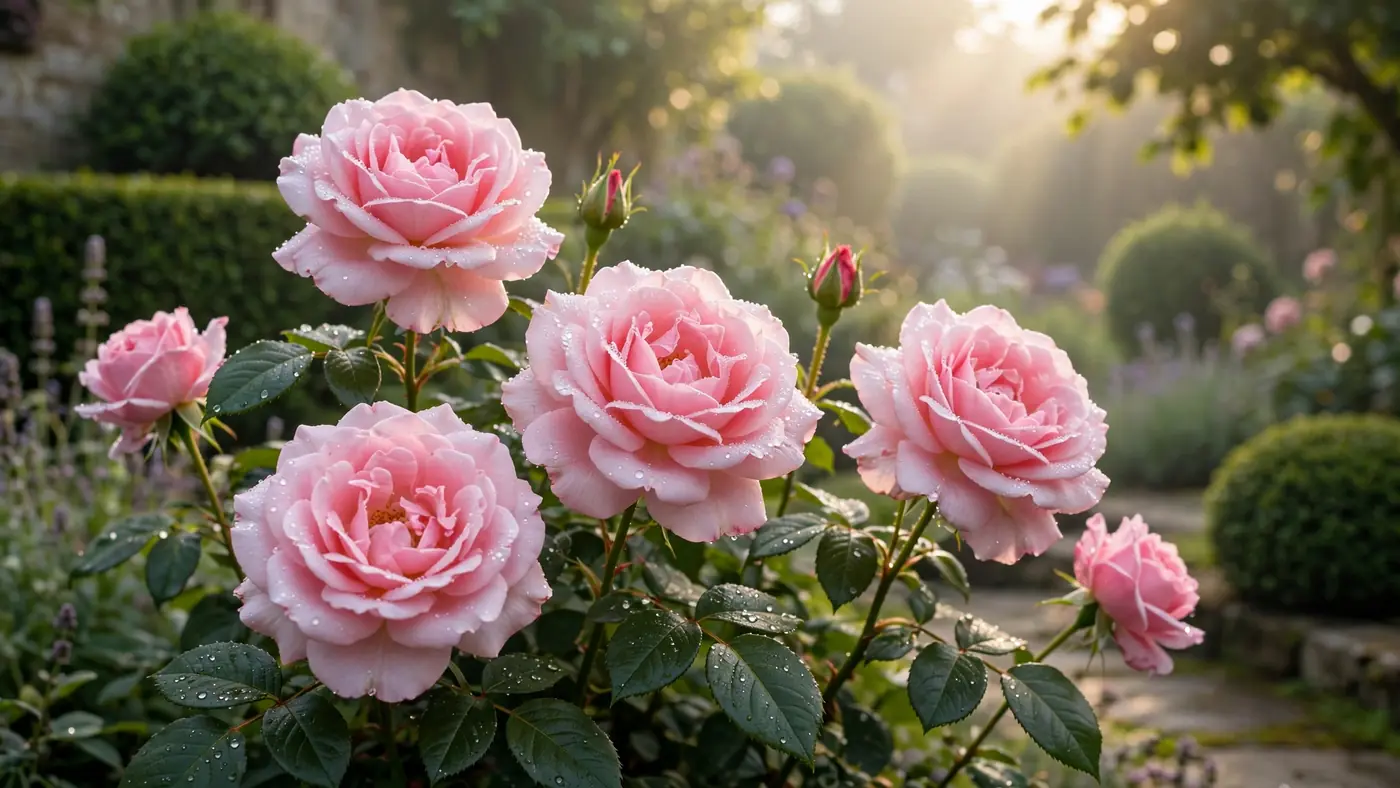
Queen Elizabeth rose is the grandiflora that launched a whole class of roses — introduced in 1954 and named for the British queen, it combined hybrid-tea elegance with floribunda clusters on tall, stately stems. The clear-pink, lightly fragrant blooms keep coming from late spring to fall, and the plant’s vigor and disease resistance made it an All-America Rose Selections winner that is still widely grown today. It works as a specimen, a hedge, or the backbone of a rose border.
Give it full sun, rich well-drained soil, and good air circulation in zones 5–10. Water deeply at the base, mulch to keep roots cool, and deadhead spent clusters to push rebloom. Prune in late winter, removing weak wood and shaping to an open vase form for the strongest flowering stems.
Bloom: Late spring to fall | Light: Full sun | Zone: 5–10 | Best for: Rose borders, cut flowers, hedges
13. Japanese Flowering Quince (Chaenomeles japonica)
Japanese flowering quince is the compact cousin of flowering quince — a dense, twiggy shrub just 2–4 feet tall that covers itself in orange-red (sometimes pink or white) blossoms in very early spring. Its small size makes it perfect for low hedges, foundation plantings, and even bonsai, where the gnarled branches and spring flowers are prized. Like its larger relative, it bears small tart fruits useful for jelly.
Plant in full sun to part shade in zones 5–9 with average, well-drained soil. It tolerates drought and urban conditions once established, and shearing right after bloom keeps a hedge tidy — though a natural, slightly wild shape shows off the flowers better. Few pests bother it, making it one of the lowest-maintenance spring shrubs.
Bloom: Early spring | Light: Full sun to part shade | Zone: 5–9 | Best for: Low hedges, foundations, bonsai
14. Queen’s Tears (Billbergia nutans)
Queen’s tears is the friendliest bromeliad for beginners — a clumping evergreen that sends up arching stems of pink bracts holding blue-edged green petals, each dripping with nectar like glistening tears. It multiplies into generous clumps by offsets (“pups”), shrugs off neglect, and even survives light frosts that kill fussier bromeliads, making it one of the few bromeliads hardy outdoors in zone 9b.
Grow it in bright indirect light with a coarse, fast-draining mix; keep the central leaf cups filled with fresh water and let the soil dry slightly between waterings. Outdoors in zones 9b–11 it naturalizes under trees; everywhere else it is an easy houseplant. Divide pups when they reach a third of the parent’s size to expand your collection.
Bloom: Spring | Light: Bright indirect | Zone: 9b–11; houseplant elsewhere | Best for: Beginners, hanging baskets, shaded patios
15. Quaker Ladies (Houstonia caerulea)
Quaker ladies — also called bluets — are the tiny pale-blue wildflowers that carpet eastern North American lawns and woodland edges each spring, each blossom just half an inch across with four delicate petals and a yellow eye. They bloom so early and so low that they finish before the first mowing, which is why they persist in old lawns that are never sprayed. In drifts they create a blue haze no bedding plant can imitate.
Plant in full sun to part shade with moist, slightly acidic soil in zones 4–9; they resent hot, dry sites. Let them naturalize in lawn areas, rock gardens, or woodland edges, and hold off mowing until seed sets in early summer. They pair beautifully with other spring ephemerals like violets and spring beauties.
Bloom: Spring | Light: Full sun to part shade | Zone: 4–9 | Best for: Naturalized lawns, rock gardens, woodland edges
16. Cypress Vine (Ipomoea quamoclit)
Cypress vine earns its Q through its botanical name — it was once classified in its own genus as Quamoclit pennata — and earns its garden fame with feathery, fern-like foliage and masses of small scarlet trumpet flowers. Hummingbirds find it irresistible, visiting from the first blooms of summer until frost. Give it a trellis, fence, or mailbox post and this fast annual vine will climb 10–20 feet in a single season from seed.
Sow directly after the last frost in full sun (nick seeds or soak overnight for faster germination) and provide average, well-drained soil — rich soil grows leaves at the expense of flowers. It self-seeds freely, so deadhead if you don’t want volunteers next year. In zones 9–11 it may return as a short-lived perennial.
Bloom: Summer to fall | Light: Full sun | Zone: Annual (9–11 perennial) | Best for: Hummingbird gardens, trellises, quick cover
17. Queen of the Meadow (Filipendula ulmaria)
Queen of the meadow, or meadowsweet, perfumes European wetlands each summer with clouds of creamy-white, almond-scented plumes above fern-like foliage. It carries real history: the plant’s salicylic acid compounds were the original source of aspirin — the drug’s name comes from Spiraea, the genus meadowsweet was once placed in. It was also a favorite strewing herb, scattered on floors for its sweet scent.
Like its American cousin, it demands damp ground — plant in full sun to part shade with consistently moist soil in zones 3–9, beside ponds or in boggy borders. The double-flowered form ‘Flore Pleno’ and the variegated ‘Variegata’ are garden-worthy selections. Cut back spent plumes to keep plants tidy, and never let it dry out in summer heat.
Bloom: Summer | Light: Full sun to part shade | Zone: 3–9 | Best for: Bog gardens, pond margins, heritage plantings
18. Queensland Bottle Tree (Brachychiton rupestris)
Queensland bottle tree looks like a botanical cartoon — a massive, swollen, bottle-shaped trunk that stores water for the dry season, topped with a small crown of narrow leaves. Mature trunks can reach 60 feet around, and the tree sheds its leaves in drought to conserve moisture, then covers its bare branches with clusters of creamy-yellow bell flowers. It is one of Australia’s most drought-adapted trees and a living sculpture in any arid garden.
Plant in full sun with excellent drainage in zones 9b–11; wet feet in winter are its main enemy. It grows slowly but lives for centuries, eventually reaching 30–60 feet — give it space and never amend the planting hole with rich soil, which encourages rot. A perfect centerpiece for xeriscapes and succulent gardens.
Bloom: Spring | Light: Full sun | Zone: 9b–11 | Best for: Xeriscapes, specimen planting, arid gardens
19. Queensland Flame Tree (Brachychiton acerifolius)
Queensland flame tree stages one of the great floral spectacles on Earth: in spring it drops its maple-like leaves and covers every bare branch in masses of scarlet, bell-shaped flowers — whole streets in eastern Australia ignite at once. The display lasts for weeks, followed by curious boat-shaped seed pods. Even out of bloom it is handsome, with glossy lobed leaves and a sturdy, spreading canopy.
Grow it in full sun with well-drained soil in zones 9b–12, allowing room for a 30–50 foot tree with a broad crown. It needs regular water while young but tolerates dry spells once established. The seed pods contain irritating hairs, so site it away from play areas and wear gloves when handling fallen pods.
Bloom: Spring (on bare branches) | Light: Full sun | Zone: 9b–12 | Best for: Street trees, parks, spectacular spring display
20. Queensland Nut (Macadamia integrifolia)
Queensland nut is the macadamia — the world’s most luxurious nut, native to the rainforests of Queensland and northern New South Wales. The evergreen tree itself is ornamental, with whorled glossy leaves and drooping racemes of creamy-white, honey-scented flowers in spring, followed by the famous hard-shelled nuts. Aboriginal peoples ate macadamias for thousands of years before commercial orchards spread them worldwide.
Plant in full sun to part shade with deep, well-drained, slightly acidic soil in zones 9b–11. Trees need 5–7 years to bear and protection from frost when young; mature trees handle brief dips below freezing. Water regularly — drought drops the nut crop. Choose smooth-shelled M. integrifolia cultivars for eating; the rough-shelled M. tetraphylla is more cold-hardy but the nuts are less sweet.
Bloom: Spring | Light: Full sun to part shade | Zone: 9b–11 | Best for: Edible landscaping, subtropical orchards, ornamental evergreens
21. Queensland Maple (Flindersia brayleyana)
Queensland maple is a giant of Australia’s tropical rainforests, soaring 100 feet or more with a straight, fluted trunk — and despite the name it is no maple at all, but a member of the citrus family. Its timber is among Australia’s most prized cabinet woods, with a silky, maple-like grain. In the garden it is strictly a tree for large properties and parks, where its dense evergreen canopy and spring clusters of white flowers make a magnificent shade tree.
Plant in full sun with rich, moist, well-drained soil in zones 10–11, sheltered from strong wind when young. It grows steadily and needs room for both height and a wide-spreading root system — never plant near buildings or pipes. Best admired in arboretums and botanical gardens outside its native range.
Bloom: Spring | Light: Full sun | Zone: 10–11 | Best for: Large properties, parks, botanical collections
22. Queensland Kauri (Agathis robusta)
Queensland kauri is a living fossil — a member of the ancient Araucaria family that dominated the forests of the dinosaurs, growing into a colossal evergreen conifer up to 150 feet tall with a trunk like a cathedral column. Its bark peels in coppery flakes, its cones are the size of grapefruits, and a mature tree is one of the most imposing sights in any botanical garden. It produces a valuable resin once used in varnishes.
This is a tree for estates, parks, and arboretums in zones 10–11, planted in full sun with deep, well-drained soil. It is slow-growing but exceptionally long-lived and wind-firm once established. Give it enormous space — a kauri’s grandeur needs room, and its surface roots resent competition.
Bloom: Non-flowering conifer | Light: Full sun | Zone: 10–11 | Best for: Arboretums, estates, ancient-plant collections
23. Queensland Blue Gum (Eucalyptus tereticornis)
Queensland blue gum — also widely called forest red gum — is a towering eucalypt with smooth, mottled bark that sheds in patches of cream, grey, and salmon, revealing fresh bark beneath. Fast-growing to 100–150 feet, it is a classic Australian shade and timber tree, and its nectar-rich winter flowers feed koalas, parrots, and honeybees. Like all eucalypts, its aromatic leaves are unmistakable.
Plant in full sun with well-drained soil in zones 9–11, far from structures — eucalypts drop limbs and have thirsty, far-reaching roots. It tolerates drought, poor soil, and heat once established. Not a tree for small gardens, but superb for acreage, windbreaks, and wildlife plantings where its flowers support native fauna through winter.
Bloom: Fall to winter | Light: Full sun | Zone: 9–11 | Best for: Acreage, windbreaks, wildlife habitat
24. Queensland Lacebark (Brachychiton discolor)
Queensland lacebark is the showiest of the Australian bottle-tree clan: in summer it drops its leaves and covers its bare branches in big, rosy-pink, bell-shaped flowers up to 2 inches across — a floral fireworks display against the sky. The “lacebark” name comes from the fine, net-like pattern of its bark. It is smaller and more garden-friendly than its bottle-tree cousin, typically reaching 30–50 feet in cultivation.
Grow in full sun with well-drained soil in zones 9b–11. It is drought-tolerant once established and handles light frosts better than many tropical trees. Like other brachychitons, the seed pods contain irritating hairs — enjoy the flowers, but leave the pods alone and site the tree away from high-traffic areas.
Bloom: Summer | Light: Full sun | Zone: 9b–11 | Best for: Specimen trees, summer color, warm-climate gardens
25. Queensland Silver Wattle (Acacia podalyriifolia)
Queensland silver wattle — also called Mount Morgan wattle — is grown for one of the prettiest foliage-and-flower combinations in the garden: soft, silvery-grey, rounded phyllodes set against fluffy balls of lemon-yellow flowers in late winter and spring. It grows fast, fixes nitrogen, and feeds bees and seed-eating birds, making it a superb pioneer tree for new gardens and revegetation plantings.
Plant in full sun with well-drained soil in zones 8–11. It tolerates drought, frost, and poor soil, but it is relatively short-lived (10–15 years) — use it as a fast screen or nurse tree while slower specimens establish. Prune lightly after flowering to keep it bushy, and remove spent seed pods to limit self-seeding where it naturalizes readily.
Bloom: Winter to spring | Light: Full sun | Zone: 8–11 | Best for: Fast screens, silver foliage, wildlife gardens
26. Queensland Fan Palm (Licuala ramsayi)
Queensland fan palm grows some of the most perfect leaves in the plant kingdom — nearly circular, pleated fans up to 6 feet across, folded like a paper parasol. Native to the rainforest understory of northern Queensland, it is a slow, stately palm for shaded tropical gardens, eventually forming a slender trunk 30–50 feet tall crowned with that unmistakable ring of fans. Few plants stop visitors in their tracks like a mature specimen backlit by sun.
Plant in part shade with rich, consistently moist, well-drained soil in zones 10b–11, sheltered from wind that tatters the leaves. It needs humidity and dislikes cold, dry air — in marginal climates, grow it in a large pot in a humid greenhouse or bright bathroom. Patience is required: it may take a decade to form a trunk.
Bloom: Spring | Light: Part shade | Zone: 10b–11 | Best for: Tropical shade gardens, collectors, conservatories
27. Quassia (Quassia amara)
Quassia — also called bitterwood — is a small tropical tree famous for wood so intensely bitter that cups carved from it turn water into a traditional tonic. The bitterness comes from quassin, one of the bitterest natural substances known. In the garden it is valued for its handsome pinnate leaves and upright clusters of slender, coral-red tubular flowers that hummingbirds probe year-round in the tropics.
Grow in part shade with rich, moist, well-drained soil in zones 10–11; it is an understory plant that scorches in harsh full sun. Keep it evenly moist and sheltered from wind. Outside the tropics, it can be grown in a large container and overwintered indoors, though flowering will be reduced. A conversation piece for tropical and medicinal-plant collections.
Bloom: Year-round (tropics) | Light: Part shade | Zone: 10–11 | Best for: Tropical gardens, medicinal-plant collections, hummingbirds
28. Quinine Tree (Cinchona officinalis)
Quinine tree changed world history: its bark yielded quinine, the first effective treatment for malaria, and 19th-century “quinine hunters” smuggled its seeds out of the Andes to establish plantations that saved countless lives. The tree itself is attractive — an evergreen of the coffee family with glossy leaves and fragrant clusters of pink-white flowers — and it still grows wild in the misty cloud forests of Ecuador and Peru.
Cultivate in part shade with cool, moist, humus-rich soil in zones 10–11, mimicking its cloud-forest home; it dislikes both frost and baking heat. This is a botanical-garden and collector’s tree rather than a landscape staple, valued as a living piece of medical history. Never harvest bark from wild trees — many wild populations are threatened.
Bloom: Summer | Light: Part shade | Zone: 10–11 | Best for: Botanical collections, medicinal-plant gardens, history lovers
29. Queen of Sheba Orchid (Thelymitra speciosa)
Queen of Sheba orchid — the Eastern Queen of Sheba — is one of Australia’s most flamboyant wildflowers: a tuberous sun orchid whose glossy purple-and-gold blooms open only on hot, sunny days and close again at night. Each plant bears just one or two flowers on a slender stem above a single spiraling leaf, and the whole plant stands barely 8 inches tall. It grows wild in the shrublands of southwest Western Australia and flowers in late winter to spring.
This is a plant to admire, not to grow — terrestrial sun orchids depend on specific soil fungi and are essentially uncultivable outside their habitat, and wild populations must never be dug. If you visit Western Australia in wildflower season, look for them in sandy-clay shrublands on hot afternoons. For the home garden, grow the name’s spirit instead with easy sun-loving orchids suited to your climate.
Bloom: Winter to spring (native season) | Light: Full sun | Zone: 9–10 | Best for: Wildflower watching, native-plant appreciation
30. Queen’s Delight (Stillingia sylvatica)
Queen’s delight is a modest but charming native of the southeastern United States, a 1–3 foot perennial of the spurge family that sends up spikes of tiny yellow-green flowers each spring above handsome, slightly toothed leaves. It thrives in the sandy soils of pine flatwoods and open woodlands, where its drought tolerance and wildlife value — bees work the flowers, birds eat the seeds — make it a solid citizen of native plantings.
Plant in full sun with sandy, well-drained soil in zones 7–10; it tolerates poor soil and dry spells once established. Like many spurges, it produces a milky sap that can irritate skin, so wear gloves when handling. Combine with other southeastern natives like bluestem grasses and black-eyed Susans for an authentic regional meadow.
Bloom: Spring | Light: Full sun | Zone: 7–10 | Best for: Native plantings, sandy soils, wildlife gardens
Growing Tips for Q-Plants
Match the plant to your zone first. Q-plants are a climate split personality: quaking aspen, Queen Anne’s lace, and the two Filipendula queens thrive in cold zones, while most of the Queensland contingent — bottle tree, flame tree, fan palm, kauri — need frost-free zone 9b and warmer. Check your USDA zone against the tables above before falling in love with a plant; a queen palm in zone 7 is a short, sad story.
Respect the water divide. Many Q-plants evolved for extremes. The Queensland bottle tree, quiver tree, and Queensland blue gum want sharp drainage and shrug off drought, while queen of the prairie and queen of the meadow demand consistently moist, even boggy soil and will scorch without it. Group plants with similar water needs together so you are not drowning the desert natives to satisfy the meadow lovers.
Give sun-lovers real sun. Flowering quince, roses, wattles, and most Australian trees bloom poorly in shade — six or more hours of direct sun is the price of admission. The exceptions prove the rule: queen of the night, queen’s tears, quassia, and the quinine tree all prefer the dappled light of their forest origins and burn in harsh afternoon sun.
Check invasiveness before planting exotics. Queensland umbrella tree is a documented invader in Florida and Hawaii, and Queen Anne’s lace self-seeds aggressively enough to be weedy in some states. A quick check with your local extension service takes five minutes and keeps you — and your neighbors — out of trouble.
Start with the easy winners. New to Q-plants? Flowering quince and queen of the prairie are nearly indestructible in their zones, queen’s tears forgives almost any indoor neglect, and cypress vine gives you a 15-foot hummingbird show from a packet of seed. Master those, then graduate to the quandong’s host-plant puzzles and the queen of the night’s one-night bloom parties.
Which Q-Plants Will You Grow?
From the trembling gold of quaking aspen to the one-night magic of queen of the night, the desert sculpture of the quiver tree to the rainforest fans of Queensland palms, plants that start with Q span every continent, every habit, and USDA zones 1 through 11. Start with proven winners matched to your conditions — perhaps flowering quince for early spring color, queen of the prairie for a damp sunny spot, queen’s tears for the windowsill, or a queen palm for instant tropics. Pick three or four favorites from this list, give them the right spot, and the alphabet’s toughest letter will reward you with a garden full of stories.
Frequently Asked Questions
What plants start with Q?
Real plants that start with Q include quaking aspen, queen palm, common quince, flowering quince, Queen Anne’s lace, queen of the night, quiver tree, queen’s wreath, queen of the prairie, queen’s tears, quaker ladies, quandong, queen Elizabeth rose, Queensland bottle tree, Queensland nut (macadamia), and queen’s delight. This guide covers 30 of them with growing details for each.
What is the most common plant that starts with Q?
For most gardeners, the most familiar Q-plants are common quince (the classic fruit tree), flowering quince (the early-spring shrub), queen palm (the ubiquitous warm-climate palm), and quaking aspen (North America’s most widespread native tree). Queen Anne’s lace is probably the Q-plant most people have seen without knowing its name.
Are there any houseplants that start with Q?
Yes — queen’s tears (Billbergia nutans) is one of the easiest bromeliads for indoor growing, and queen of the night (Epiphyllum oxypetalum) is a spectacular night-blooming cactus for a bright windowsill. Young Queensland umbrella trees are also sold as houseplants, though they eventually want to become 40-foot trees.
What fruit trees start with Q?
Quince is the classic Q fruit: common quince (Cydonia oblonga) for cooking and preserves, plus flowering quince and Japanese flowering quince whose tart fruits make excellent jelly. Quandong produces tart red desert fruits, and Queensland nut is the macadamia — one of the world’s finest edible nuts.
What trees that start with Q grow in cold climates?
Quaking aspen is the cold-climate champion, hardy all the way to zone 1 and thriving across Canada and the northern US. Common quince and flowering quince handle zones 5–9, and queen of the prairie is a hardy perennial (not a tree) for zones 3–9. Most other Q-trees are Australian or tropical and need zone 9 or warmer.
Is Queen Anne’s lace safe to plant in the garden?
Yes, Queen Anne’s lace itself is safe and beneficial — swallowtail caterpillars feed on it and pollinators love the flowers. The real caution is identification: it closely resembles poison hemlock, which is deadly. Learn the differences (hairy stems and carrot-scented roots on Queen Anne’s lace; smooth, purple-spotted stems on hemlock) and never pick wild umbels you cannot positively identify. It also self-seeds freely, so deadhead if you want to contain it.