Plants That Start With B: 25 Beautiful Choices for Every Garden
Looking for a plant that starts with B? Whether you’re planning a themed garden, finishing an A-to-Z plant collection, or just curious about what’s out there, the letter B delivers some of the most beloved plants in gardening. From the dramatic orange blooms of Bird of Paradise to the humble but mighty Basil, B-plants cover every corner of the garden: houseplants, shade perennials, sun-loving shrubs, edible herbs, and ornamental grasses.
In this guide, you’ll find 25 real plants that start with B, each with its scientific name, an honest description, and practical growing tips. We also include two warnings you should know before planting: Burning Bush is invasive in many US states, and Boxwood is vulnerable to a serious disease called boxwood blight. Botanical honesty matters to us — every plant here is a genuine, verifiable species or genus.
Quick Answer
The most popular plants that start with B include Bird of Paradise (Strelitzia reginae), Begonia (Begonia spp.), Boston Fern (Nephrolepis exaltata), Bougainvillea, Blueberry (Vaccinium spp.), Boxwood (Buxus sempervirens), Butterfly Bush (Buddleja davidii), Black-eyed Susan (Rudbeckia hirta), Bee Balm (Monarda didyma), Blanket Flower (Gaillardia spp.), and Basil (Ocimum basilicum). Scroll down for 25 entries with scientific names and growing tips.
Table of Contents
- 1. Bird of Paradise
- 2. Boston Fern
- 3. Begonia
- 4. Bamboo Palm
- 5. Bromeliad
- 6. Bougainvillea
- 7. Blueberry
- 8. Boxwood
- 9. Butterfly Bush
- 10. Black-eyed Susan
- 11. Bleeding Heart
- 12. Blue Fescue
- 13. Bird’s Nest Fern
- 14. Burro’s Tail
- 15. Bear’s Breeches
- 16. Balloon Flower
- 17. Bachelor’s Button
- 18. Bee Balm
- 19. Blanket Flower
- 20. Bergenia
- 21. Brunnera
- 22. Bluebell
- 23. Burning Bush
- 24. Bay Laurel
- 25. Basil
- Light, Water & Hardiness Comparison
- FAQ
- References
Plants That Start With B: At a Glance
| # | Plant | Scientific Name | Type |
|---|---|---|---|
| 1 | Bird of Paradise | Strelitzia reginae | Tropical flower |
| 2 | Boston Fern | Nephrolepis exaltata | Fern / houseplant |
| 3 | Begonia | Begonia spp. | Bedding flower / houseplant |
| 4 | Bamboo Palm | Chamaedorea seifrizii | Houseplant palm |
| 5 | Bromeliad | Guzmania lingulata | Tropical houseplant |
| 6 | Bougainvillea | Bougainvillea glabra | Flowering vine / shrub |
| 7 | Blueberry | Vaccinium corymbosum | Fruit shrub |
| 8 | Boxwood | Buxus sempervirens | Evergreen shrub |
| 9 | Butterfly Bush | Buddleja davidii | Flowering shrub |
| 10 | Black-eyed Susan | Rudbeckia hirta | Perennial / biennial |
| 11 | Bleeding Heart | Lamprocapnos spectabilis | Shade perennial |
| 12 | Blue Fescue | Festuca glauca | Ornamental grass |
| 13 | Bird’s Nest Fern | Asplenium nidus | Tropical fern / houseplant |
| 14 | Burro’s Tail | Sedum morganianum | Succulent |
| 15 | Bear’s Breeches | Acanthus mollis | Architectural perennial |
| 16 | Balloon Flower | Platycodon grandiflorus | Perennial |
| 17 | Bachelor’s Button | Centaurea cyanus | Annual wildflower |
| 18 | Bee Balm | Monarda didyma | Perennial / herb |
| 19 | Blanket Flower | Gaillardia spp. | Perennial |
| 20 | Bergenia | Bergenia cordifolia | Shade perennial |
| 21 | Brunnera | Brunnera macrophylla | Shade perennial |
| 22 | Bluebell | Hyacinthoides non-scripta | Spring bulb |
| 23 | Burning Bush | Euonymus alatus | Shrub (invasive warning) |
| 24 | Bay Laurel | Laurus nobilis | Evergreen tree / herb |
| 25 | Basil | Ocimum basilicum | Culinary herb |
1. Bird of Paradise (Strelitzia reginae)
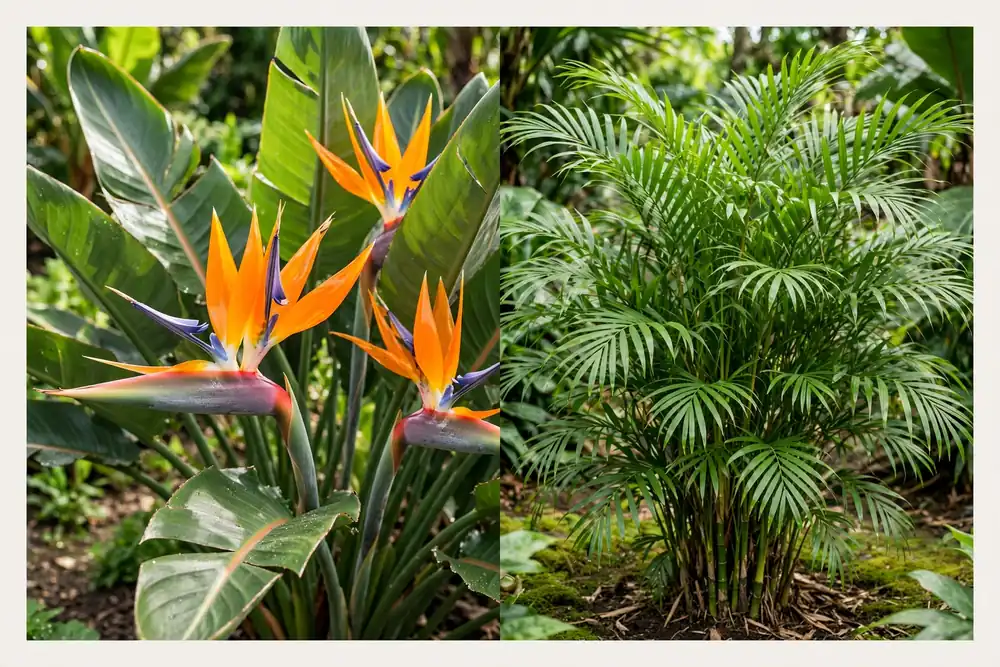
Bird of Paradise is one of the most recognizable tropical flowers in the world, named for its unmistakable blooms that resemble a colorful bird in flight — bright orange sepals and vivid blue petals emerging from a green, boat-shaped bract. Native to South Africa, this clumping perennial grows 3–5 feet tall with broad, banana-like evergreen leaves that give it a lush, architectural presence even when it isn’t flowering. Outdoors it thrives in USDA zones 9–11, where mature clumps bloom from late winter through spring. In colder climates it makes a dramatic indoor statement plant, though flowering indoors requires very bright light and patience.
Growing tips: Give Bird of Paradise full sun to light shade and rich, well-draining soil. Water deeply when the top inch of soil dries, and reduce watering in winter. Feed monthly in the growing season with a balanced fertilizer to encourage blooms, and don’t deadhead too aggressively — spent flowers can be cut back to the base, but the plant blooms on established clumps, so dividing it too often delays flowers. For more tropical showstoppers in the same league, browse our collection of unusual and beautiful flowers for inspiration.
2. Boston Fern (Nephrolepis exaltata)
The Boston Fern is the classic hanging fern — a graceful, arching mass of sword-shaped fronds that can reach 2–3 feet long. Discovered as a natural mutation in a Massachusetts nursery shipment in the 1890s (hence “Boston”), Nephrolepis exaltata ‘Bostoniensis’ became one of the first mass-marketed houseplants and remains a top seller today. It’s a true tropical fern, hardy outdoors only in zones 9–11, but it shines as an indoor plant or summer porch specimen, where its lush foliage softens porches, bathrooms, and shaded patios.
Growing tips: Boston Ferns demand humidity — dry indoor air is their number-one enemy. Mist daily or place the pot on a pebble tray with water, keep the soil consistently moist (never soggy), and give bright indirect light. Brown frond tips usually mean low humidity or underwatering; crispy brown fronds won’t recover, so trim them at the base. In winter, reduce feeding but don’t let the soil dry out. Repot when roots fill the pot, and divide congested clumps in spring for free new plants.
3. Begonia (Begonia spp.)
Begonia is a giant genus of more than 2,000 species, but gardeners mostly know three groups: wax begonias (Begonia × semperflorens) for sunny bedding, tuberous begonias for spectacular summer shade flowers, and rex begonias grown indoors for their painted, metallic foliage. Wax begonias bloom nonstop from spring to frost in red, pink, or white; tuberous types produce rose-like blooms up to 6 inches across; rex begonias offer some of the most colorful leaves of any houseplant. Few genera offer this much variety from a single letter of the alphabet.
Growing tips: Most begonias want bright indirect light or part shade and soil that stays lightly moist — soggy soil rots their fleshy stems fast. For bedding begonias, space 6–8 inches apart and deadhead lightly to keep them tidy (wax types are self-cleaning). Lift tuberous begonia tubers before the first frost in cold climates and store dry over winter. If you love B-initialed bloomers, our guide to flowers that start with B has even more to explore.
4. Bamboo Palm (Chamaedorea seifrizii)
Bamboo Palm is a clustering palm from Central America that grows multiple slender, bamboo-like stems topped with feathery green fronds, reaching 4–8 feet indoors over time. It’s one of the most forgiving indoor palms, tolerating lower light than most of its relatives while still delivering a genuinely tropical look. It also earned fame in the classic NASA Clean Air Study for filtering indoor air pollutants, which cemented its reputation as an ideal office and living-room plant. Give it a few years and it develops into a graceful, multi-stemmed specimen.
Growing tips: Place in bright indirect light (it tolerates medium light but grows slower), water when the top 2 inches of soil are dry, and keep humidity above average — brown leaf tips signal dry air. Use a well-draining potting mix and a pot with drainage holes; palms hate wet feet. Wipe fronds occasionally to remove dust, watch for spider mites in dry winter air, and repot only when root-bound since palms prefer snug pots. Feed lightly in spring and summer.
5. Bromeliad (Guzmania lingulata)
Bromeliads are the flamboyant centerpieces of the houseplant world — stiff, arching rosettes of glossy leaves topped by a star-shaped flower bract in red, orange, yellow, or pink that lasts for months. Guzmania lingulata, the scarlet star, is the most common indoor type. In the wild these are epiphytes that grow on trees in tropical rainforests, collecting water in the “tank” formed by their leaf bases. One honest caveat: each rosette blooms only once, then slowly dies — but it produces offsets (“pups”) that become the next generation.
Growing tips: Keep the central cup filled with fresh water (flush it weekly to prevent stagnation) and keep the potting mix lightly moist. Bright indirect light keeps colors vivid; direct sun scorches the leaves. When the mother plant fades after blooming, wait until pups are one-third her size, then separate and pot them up. No repotting gymnastics needed otherwise — bromeliads have tiny root systems and prefer small pots. They also make excellent candidates for enclosed glass gardens.
6. Bougainvillea (Bougainvillea glabra)
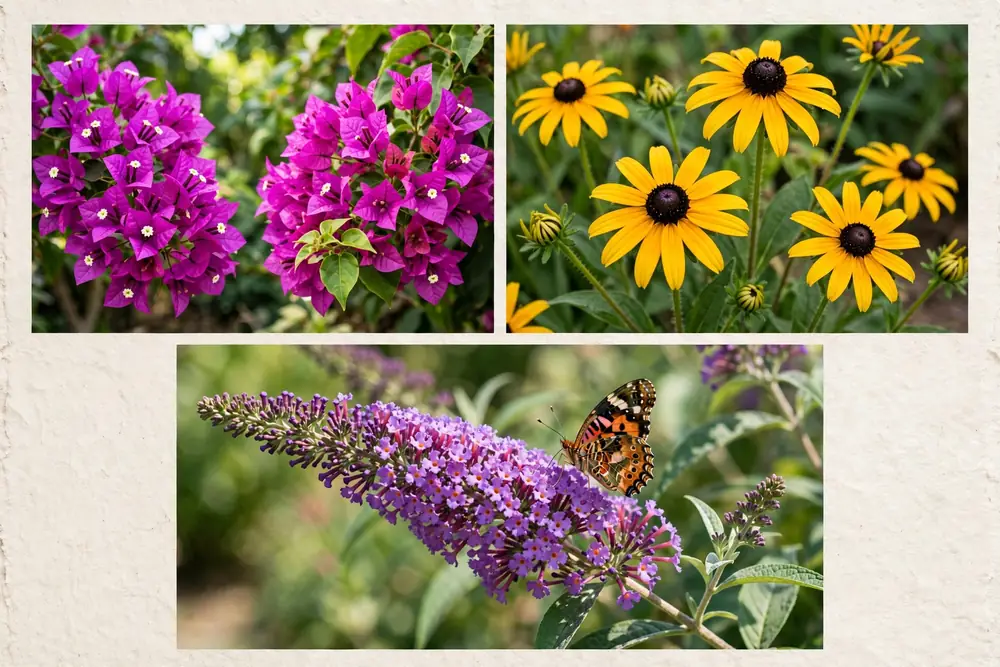
Bougainvillea is pure Mediterranean and tropical drama — a vigorous woody vine whose papery bracts blaze in magenta, purple, red, orange, pink, or white for months on end. The actual flowers are tiny and white; it’s the colorful bracts that do all the showboating. In zones 9–11 it climbs walls, pergolas, and fences up to 20 feet or more, while northern gardeners grow it in large containers and overwinter it indoors. Bougainvillea glabra is the most common garden species, slightly less thorny and more floriferous than its cousin B. spectabilis.
Growing tips: Bougainvillea blooms best when slightly stressed — full sun (at least 6 hours), lean well-draining soil, and deep but infrequent watering. Overwatering and overfeeding produce lush leaves and zero flowers, so hold back. Prune hard after each bloom flush to keep it in bounds, and always wear gloves: the thorns are serious. In cold climates, bring containers inside before frost, cut back by a third, and keep barely moist through winter in a bright cool spot.
7. Blueberry (Vaccinium corymbosum)
Blueberry bushes prove that edible plants can be ornamental: in spring, urn-shaped white flowers attract pollinators; in summer, dusty-blue berries rich in antioxidants; in fall, the foliage turns brilliant scarlet. Highbush blueberry (Vaccinium corymbosum), the main cultivated species, grows 4–6 feet tall in zones 4–7 and yields several pounds of fruit per bush once established. Lowbush types suit colder regions, while rabbiteye blueberries handle southern heat. One plant is technically self-fertile, but cross-pollination between two different varieties dramatically increases yield.
Growing tips: Blueberries are acid-lovers — they need soil pH of 4.5–5.5, which most garden soils don’t have. Test your soil and amend with sulfur and peat moss or pine bark before planting; growing in large containers with ericaceous compost is the easiest workaround. Keep plants consistently watered (berries swell on steady moisture), mulch with pine needles, and net bushes against birds at harvest time. Prune in late winter, removing old wood to encourage vigorous new fruiting canes.
8. Boxwood (Buxus sempervirens)
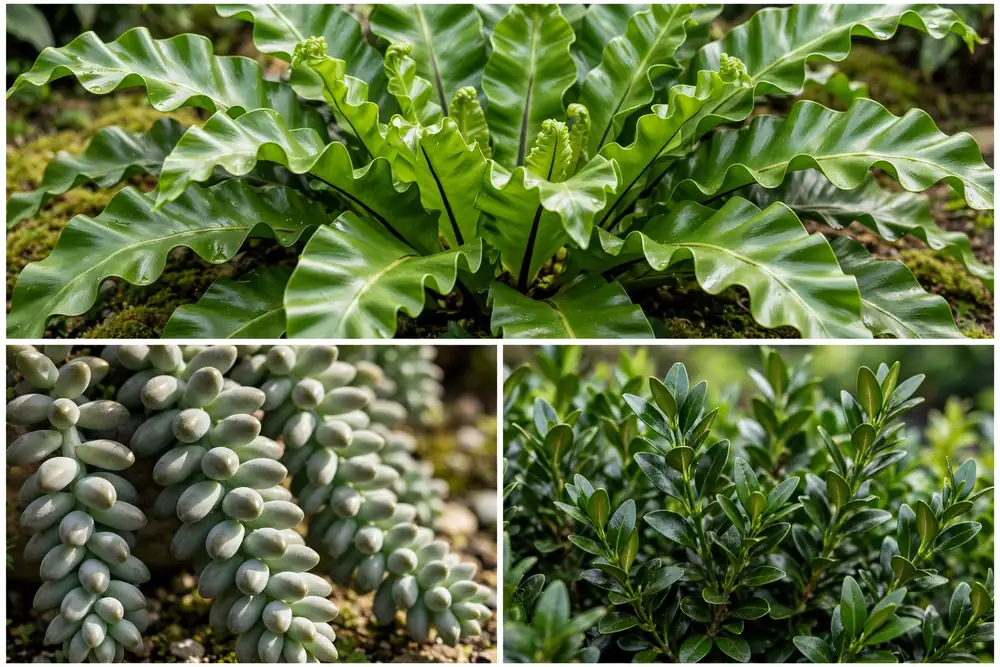
Boxwood is the backbone of formal gardens — a slow-growing evergreen shrub with tiny, dense, glossy leaves that tolerates shearing into hedges, topiary, and parterres like no other plant. Common boxwood (Buxus sempervirens) has anchored European gardens for centuries and works in zones 5–8. It provides rare winter structure, smells faintly of cat urine to some noses after rain (a love-it-or-hate-it trait), and lives for decades with minimal fuss. Japanese boxwood (B. microphylla) is a common alternative with better heat tolerance.
Growing tips: Plant in well-draining soil with part shade in hot climates; winter sun and wind cause bronzing, so site accordingly. Water deeply during establishment, then only in drought. Honest warning — boxwood blight: a fungal disease (Calonectria pseudonaviculata) causes rapid defoliation and black stem lesions, and it has spread widely through the nursery trade. Buy only from reputable sources, disinfect pruning tools between plants, avoid overhead watering, and space plants for airflow. If blight hits, removal is usually the only option — which is why some gardeners now plant blight-resistant alternatives like inkberry holly instead.
9. Butterfly Bush (Buddleja davidii)
Butterfly Bush earns its name honestly — its long, fragrant flower spikes in purple, pink, white, or blue are butterfly magnets from midsummer to fall, drawing in swallowtails, monarchs, and hummingbirds by the dozen. A fast-growing deciduous shrub reaching 6–10 feet, Buddleja davidii blooms on new wood, so it flowers reliably even after brutal winters in zones 5–9. Newer sterile cultivars like the Lo & Behold and Miss series solve the plant’s one real drawback (self-seeding) while keeping the pollinator show going.
Growing tips: Plant in full sun and average, well-draining soil — butterfly bush tolerates poor soil but hates wet feet. Cut the whole shrub back to 12 inches in early spring; it regrows vigorously and blooms better for it. Deadhead spent spikes to extend flowering into fall. One caution: in the Pacific Northwest and some other regions, Buddleja davidii self-seeds aggressively and is considered invasive — check local guidance and choose sterile cultivars where that’s a concern.

10. Black-eyed Susan (Rudbeckia hirta)
Black-eyed Susan is the cheerful workhorse of summer borders — golden-yellow daisy petals around a dark chocolate-brown cone, blooming for weeks from midsummer into fall. Rudbeckia hirta is technically a short-lived perennial or biennial, but it self-sows so freely you’ll never be without it. It mixes beautifully with purple coneflowers and ornamental grasses in naturalistic plantings, and the seed heads feed goldfinches through winter if you leave them standing. Few plants give this much color for this little effort.
Growing tips: Full sun and average soil are all it asks — it even tolerates clay and drought once established. Deadhead for continuous bloom, or leave seed heads for birds and self-sowing. It can flop in rich soil, so skip the fertilizer. Divide or replant every few years to keep displays vigorous.
11. Bleeding Heart (Lamprocapnos spectabilis)
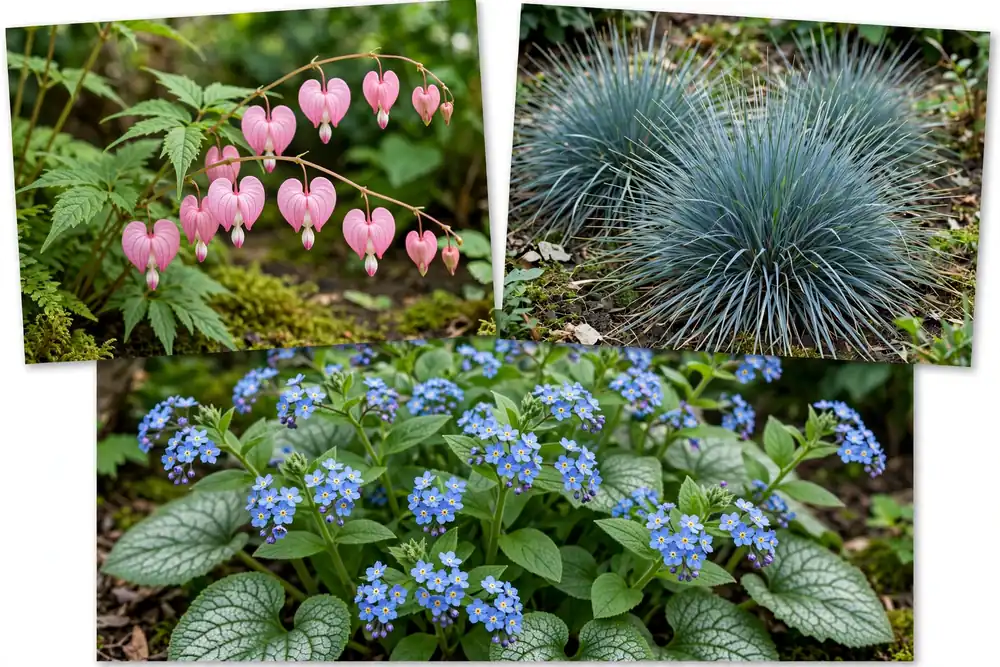
Bleeding Heart is the undisputed romantic of the shade garden — arching stems hung with rows of pink-and-white heart-shaped flowers, each with a little white “tear” drop, blooming in mid to late spring. Formerly classified as Dicentra spectabilis, Lamprocapnos spectabilis grows 2–3 feet tall in zones 3–9 and looks best massed under trees or along shaded paths. The foliage goes dormant and disappears by midsummer (totally normal), so plant it where later-emerging perennials like hostas can fill the gap.
Growing tips: Give it rich, moist, well-draining soil in part to full shade. Water well in spring; once dormant, it needs nothing. Don’t panic when the leaves yellow and vanish in July — mark the spot so you don’t dig it up by accident. Divide congested clumps in fall or early spring every 4–5 years. Note that all parts contain alkaloids and can irritate skin, so wear gloves when handling and keep it away from curious pets that chew plants.
12. Blue Fescue (Festuca glauca)
Blue Fescue is a compact ornamental grass prized for its intense silvery-blue foliage — dense tufts of needle-like blades forming neat mounds about 8–12 inches tall. Festuca glauca ‘Elijah Blue’ is the most popular cultivar, with the steeliest color. It’s evergreen in mild climates, works beautifully edging paths, spilling over rock walls, or contrasting with burgundy and chartreuse companions in containers, and its fine texture softens the edges of any planting. Small tan flower spikes appear in summer but the foliage is the real show.
Growing tips: Full sun brings out the bluest color; shade turns it green and floppy. It needs sharp drainage — wet winter soil kills more blue fescue than cold does. Comb out dead blades with your fingers in early spring and shear the whole tuft back by half to refresh it. Divide every 2–3 years to keep centers from dying out, and replant divisions in lean soil. It dislikes heavy feeding and humid heat, so it’s happiest in zones 4–8 with good air circulation.
13. Bird’s Nest Fern (Asplenium nidus)
Bird’s Nest Fern breaks every fern stereotype — instead of divided fronds, it produces broad, glossy, apple-green leaves in a shuttlecock-like rosette that really does resemble a bird’s nest. Asplenium nidus is a tropical epiphyte from Southeast Asia and the Pacific, hardy outdoors only in zones 10–11, but an exceptionally handsome and undemanding houseplant. Its bold, simple foliage makes it a perfect contrast plant among feathery ferns and fussy tropicals, and it’s far more tolerant of indoor conditions than its delicate looks suggest.
Growing tips: Bright indirect light, warm temperatures, and humidity above 50% keep it happiest — bathrooms with windows are ideal. Water the soil, not the central rosette, letting the top inch dry between waterings; water sitting in the crown invites rot. It’s a slow grower, so feed sparingly and repot rarely. Avoid wiping the fronds with leaf-shine products, which clog its pores. If you like humidity-loving tropicals, our best terrarium plants guide has more ideas for enclosed growing.
14. Burro’s Tail (Sedum morganianum)
Burro’s Tail is a trailing succulent with rope-like stems densely packed with plump, blue-green, teardrop leaves — mature specimens cascade 2–3 feet from hanging baskets in a waterfall of beads. Native to rocky cliffs in southern Mexico, Sedum morganianum is a conversation-piece houseplant that’s surprisingly easy as long as you respect one rule: don’t touch it much. The leaves detach at the slightest bump (hence its other common name, donkey’s tail), though every fallen leaf can be laid on soil to root a new plant.
Growing tips: Give it the brightest light you have — a south or west window — and gritty, fast-draining cactus mix. Water deeply but infrequently, only when the soil is fully dry; in winter, water barely at all. Hang it where it won’t be brushed against, since knocked-off leaves won’t reattach (propagate them instead). Repot rarely and handle by the root ball, never the stems. Outdoors it’s hardy only in zones 10–11.
15. Bear’s Breeches (Acanthus mollis)
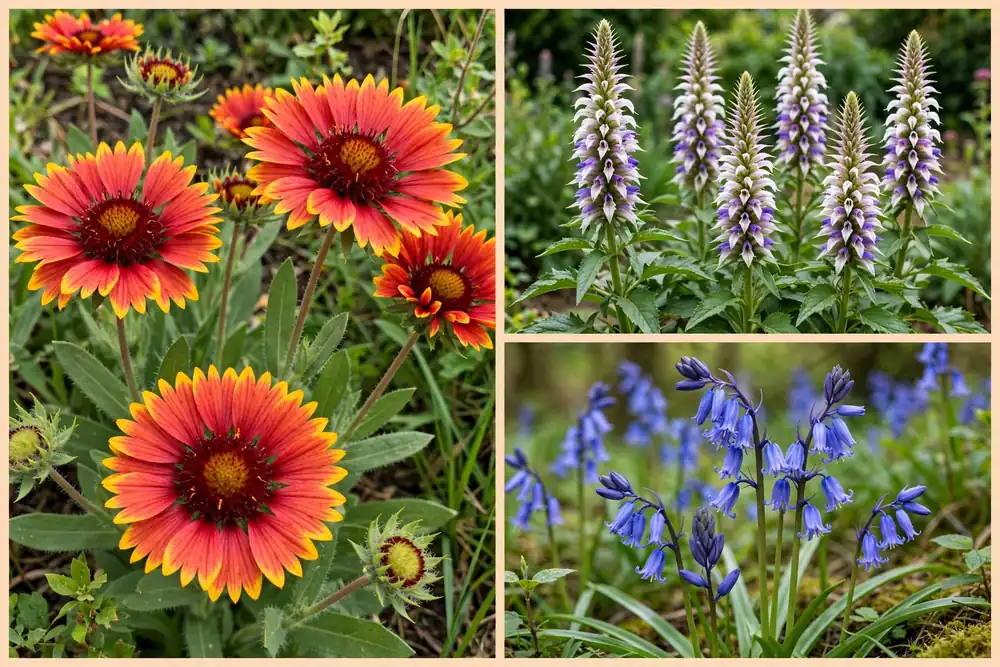
Bear’s Breeches is pure garden architecture — huge, glossy, deeply lobed dark-green leaves up to 2 feet long, topped in summer by towering 3–4 foot spikes of hooded white-and-purple flowers. Acanthus mollis has been an ornamental icon since ancient Greece (its leaves inspired Corinthian column capitals). It thrives in zones 7–10, forming bold clumps that anchor shady borders and look magnificent against walls. It’s dramatic, deer-resistant, and once established, nearly indestructible — which cuts both ways.
Growing tips: Plant in part shade with rich, well-draining soil and give it room — clumps spread 3 feet wide via thick fleshy roots. Water regularly the first year; after that it’s quite drought-tolerant. Honest warning: those fleshy roots make it extremely hard to remove once established, and it can be aggressive in mild climates. Plant it only where you want it forever, ideally contained by paths or walls. Cut flower spikes back after blooming and remove tattered leaves in late winter for a fresh spring flush.
16. Balloon Flower (Platycodon grandiflorus)
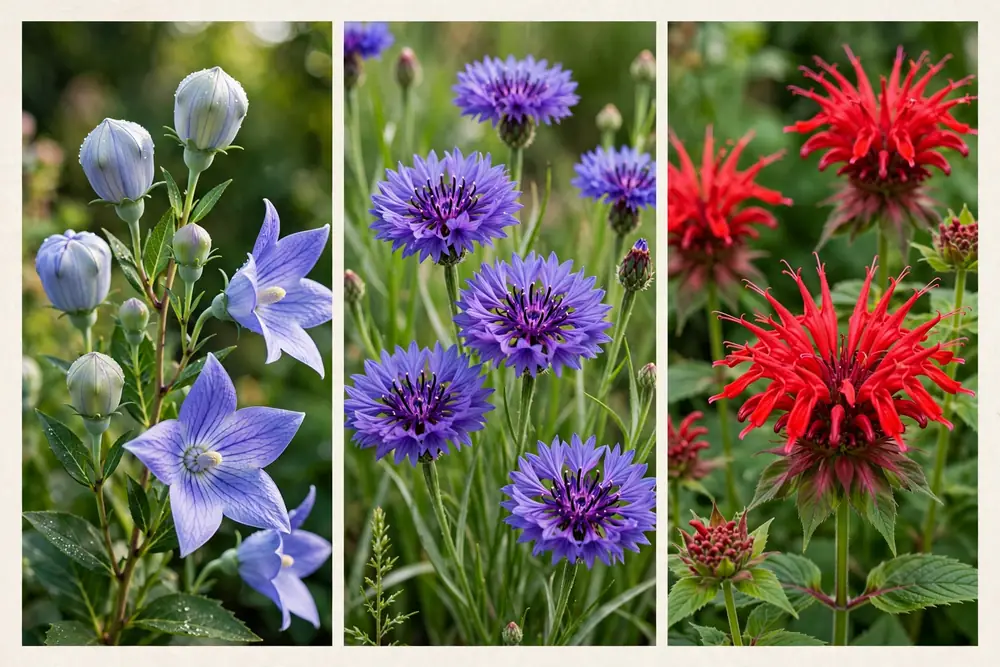
Balloon Flower delights twice: first as puffy, balloon-like buds that pop open into star-shaped blue, violet, pink, or white flowers, and again as one of the longest-lived perennials you can plant. Platycodon grandiflorus forms tidy 1–2 foot mounds in zones 3–8, blooms from midsummer into fall, and individual plants can thrive for decades in the same spot. The buds are the charm — kids love squeezing them to make them “pop.” Double-flowered and dwarf cultivars extend the options for small gardens.
Growing tips: Full sun to part shade and well-draining soil; it resents winter wetness. Here’s the key rule: never move it. Balloon flower develops deep taproots and resents disturbance — plant it once, in its forever spot. Deadhead to extend blooming, cut stems back in fall, and mulch lightly in cold regions. For a blue-and-purple themed border, pair it with companions from our purple perennial flowers collection.
17. Bachelor’s Button (Centaurea cyanus)
Bachelor’s Button, also called cornflower, is the classic cottage-garden annual — fringed, thistle-like blooms in true cornflower blue (plus pink, white, and burgundy varieties) on wiry 1–3 foot stems from early summer on. Centaurea cyanus is ridiculously easy from seed, beloved by bees and butterflies, and excellent as a cut flower. It self-sows freely, so one sowing often becomes a permanent colony. The blue form is one of the few genuinely blue annual flowers you can grow from a packet of seed.
Growing tips: Sow directly outdoors in early spring (it dislikes transplanting) in full sun and average soil — rich soil causes floppy growth. Thin seedlings to 6 inches apart, deadhead for continuous bloom, and let a few flowers go to seed for next year’s volunteers. Succession-sow every two weeks through midsummer for flowers into fall. It tolerates poor soil and drought, making it ideal for wildflower meadows and low-maintenance beds.
18. Bee Balm (Monarda didyma)
Bee Balm is a pollinator powerhouse — shaggy, firework-like flower heads in scarlet, pink, purple, or white that hummingbirds, bees, and butterflies mob from midsummer on. Monarda didyma is a North American native mint-family perennial for zones 4–9, growing 2–4 feet tall with aromatic, oregano-scented foliage you can brew into Oswego tea. Modern mildew-resistant cultivars like ‘Jacob Cline’ solved its historic powdery-mildew problem. It’s both ornamental and genuinely useful in the herb garden.
Growing tips: Full sun to part shade, rich moist soil, and good air circulation are the formula — crowding invites mildew. Space plants 18–24 inches apart, divide every 3 years to keep them vigorous, and shear back by a third after the first flush for rebloom. Fall cutback follows the same routine as many perennials; if you’re unsure of the technique, our mum care guide covers seasonal perennial maintenance in detail.
19. Blanket Flower (Gaillardia spp.)
Blanket Flower looks like a sunset frozen in petals — daisy-like blooms banded in red, orange, and yellow that flower nonstop from early summer until hard frost. Gaillardia × grandiflora (the garden hybrid) and G. pulchella (the annual species) thrive in zones 3–10, shrug off heat, drought, and poor soil, and reseed politely. Few perennials bloom this long with this little care, which is why blanket flower is a staple of hot, dry, low-maintenance borders across the country.
Growing tips: Full sun is non-negotiable — shade makes it leggy and flowerless. Plant in well-draining (even sandy) soil and don’t fertilize; rich soil shortens its life. Deadhead regularly for the longest display, and divide or replace every 2–3 years since plants can be short-lived in heavy soils. For more tough-as-nails heat lovers, see our roundup of full sun perennials.
20. Bergenia (Bergenia cordifolia)
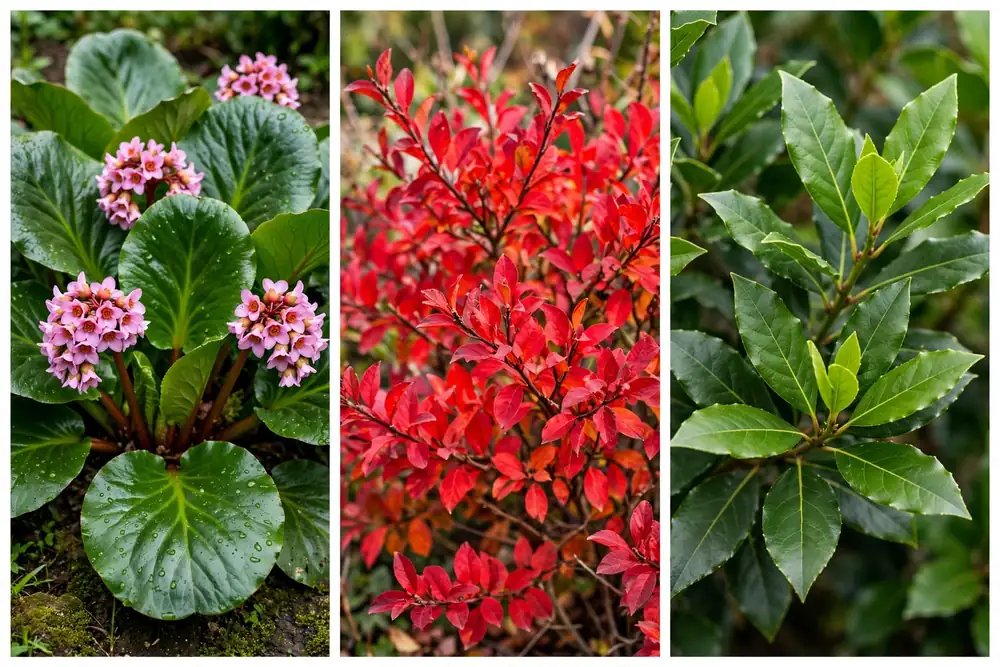
Bergenia, nicknamed “pigsqueak” (rub the leaves and you’ll hear why), is a tough evergreen groundcover with big, glossy, leathery leaves and clusters of pink or magenta flowers on stout stems in early spring. Bergenia cordifolia grows 12–18 inches tall in zones 3–8, and in cold climates the foliage turns rich burgundy-red in winter — rare four-season interest from a shade perennial. It’s one of the few plants that looks good in deep shade, under trees, and along north-facing foundations where little else thrives.
Growing tips: Part to full shade and moist, humus-rich soil suit it best, though established plants tolerate drier shade. Remove tattered winter leaves in early spring before the flower stalks emerge. Divide crowded clumps every 4–5 years in spring. It pairs beautifully with ferns and hostas along shaded paths. If you’re building an alphabetized shade collection, our plants that start with G list has more shade-tolerant companions to browse.
21. Brunnera (Brunnera macrophylla)
Brunnera is often called false forget-me-not, and one look at its clouds of tiny sky-blue flowers in spring tells you why. Brunnera macrophylla forms neat 12–18 inch mounds of heart-shaped leaves in zones 3–8, and the variegated cultivar ‘Jack Frost’ — with silver-frosted leaves veined in green — is one of the most striking shade plants ever bred. After the spring flowers fade, the foliage carries the show all season. It’s a refined, long-lived alternative to hostas for brightening dark corners.
Growing tips: Consistent moisture is the secret — brunnera sulks in dry shade. Give it rich, humus-y soil, part to full shade, and a thick mulch to hold moisture. Cut back the flower stems after blooming and remove any scorched leaves in summer; fresh foliage follows. Divide in fall every 4–5 years if the center thins. Slugs can nibble the leaves, so use iron-phosphate bait early in the season.
22. Bluebell (Hyacinthoides non-scripta)
The common bluebell (Hyacinthoides non-scripta) is the flower of English spring — nodding, sweetly scented violet-blue bells on arching stems, carpeting ancient woodlands in April and May. This is the true native bluebell of the British Isles, protected by law in the wild there. It naturalizes beautifully under deciduous trees in zones 4–8, multiplying over the years into drifts. Note the distinction: Spanish bluebells (H. hispanica) are stouter, unscented, and can hybridize with and outcompete the native — choose the true species for authenticity.
Growing tips: Plant bulbs 3–4 inches deep in fall, in humus-rich soil under deciduous trees where they’ll get spring sun and summer shade. Let the foliage die back naturally after flowering — the leaves feed next year’s bulbs. Once established, leave them undisturbed; they resent moving. If you love spring ephemerals, our plants that start with W collection includes more woodland beauties.
23. Burning Bush (Euonymus alatus)
Burning Bush is famous for one thing: the most intense red fall color of any shrub — entire plants ignite into neon crimson in October, thanks to distinctive corky “wings” on the stems (alatus means “winged”). Euonymus alatus grows 8–12 feet in zones 4–8 and was planted by the millions as a foundation shrub. We’re including it because people ask about it constantly — but we can’t recommend planting it, and here’s why.
Growing tips — and an honest invasive warning: Burning bush is invasive in many US states, including Massachusetts, New Hampshire, and others across the Northeast and Midwest, where birds spread its seeds into forests and it outcompetes native understory plants. Several states have banned its sale. If you already have one, consider replacing it with a native alternative with great fall color, such as Virginia sweetspire (Itea virginica), black chokeberry (Aronia melanocarpa), or highbush blueberry. If you keep an existing plant, at minimum remove all berries before birds eat them. Check your state’s invasive plant list before buying.
24. Bay Laurel (Laurus nobilis)
Bay Laurel is the source of the bay leaves in your spice jar — an aromatic Mediterranean evergreen tree or large shrub with glossy, leathery, lance-shaped leaves. Laurus nobilis grows slowly to 10–20 feet in zones 8–10 (it’s the classic plant for clipped standards and topiary cones flanking doorways), and northern gardeners grow it in containers, bringing it indoors for winter. Fresh leaves are more potent than dried, and the tree itself is handsome enough to earn a spot purely as an ornamental.
Growing tips: Full sun to part shade and well-draining soil; it’s drought-tolerant once established but appreciates regular water in containers. In zones below 8, overwinter indoors in a bright, cool room and water sparingly. Prune or shear in summer to maintain topiary shapes. Harvest leaves as needed — older, lower leaves have the strongest flavor — and dry them for two weeks before storing. Watch for scale insects indoors and treat with horticultural oil.
25. Basil (Ocimum basilicum)
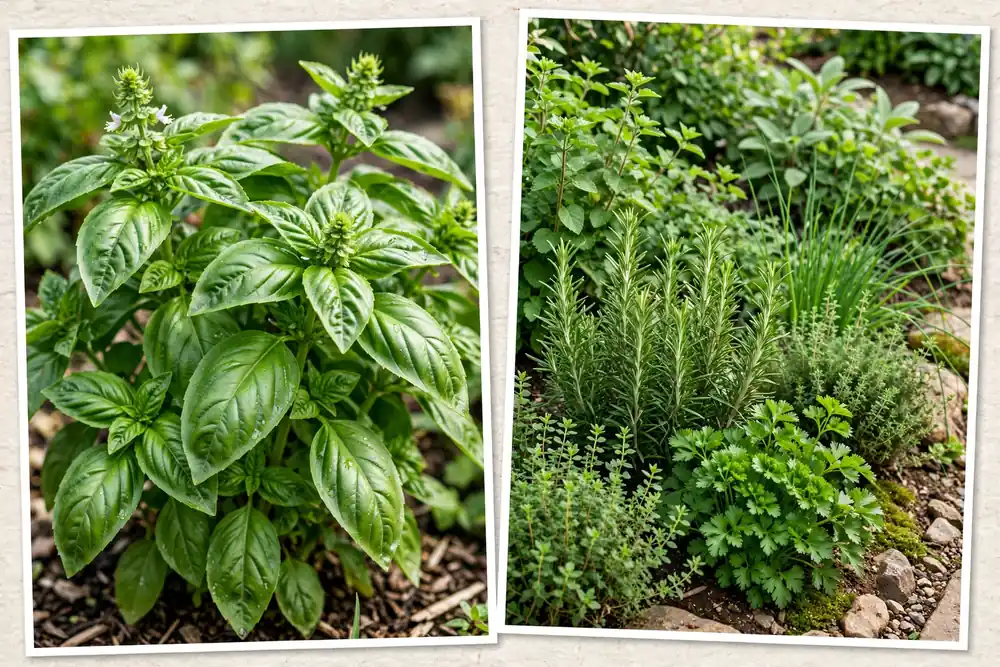
Basil is the world’s most popular culinary herb for a reason — sweet, clove-scented leaves that define pesto, caprese, and Thai curries alike. Ocimum basilicum is a tender annual (though perennial in zones 10–11) growing 1–2 feet tall, with dozens of cultivars from classic Genovese to Thai, lemon, and purple ruffles types. It’s also one of the easiest edibles for beginners: a sunny pot on a patio can supply a household all summer. Few “plants that start with B” pull double duty in the kitchen and the garden this well.
Growing tips: Basil demands warmth — don’t plant out until nights stay above 50°F. Give it full sun, rich moist soil, and pinch the growing tips regularly to keep it bushy; never let it flower if you want leaf production (pinch off any flower buds immediately). Water at the base to avoid fungal leaf diseases. Harvest from the top down, taking no more than a third at once. Start new plants every few weeks for a continuous supply, since individual plants decline by late summer.
Light, Water & Hardiness Comparison
Use this quick comparison to match B-plants to your garden’s conditions:
| Plant | Light | Water Needs | USDA Zones |
|---|---|---|---|
| Bird of Paradise | Full sun to part shade | Medium | 9–11 |
| Boston Fern | Indirect light / shade | High | 9–11 (houseplant elsewhere) |
| Begonia | Part shade | Medium | Annual / 9–11 |
| Blueberry | Full sun | High | 4–7 |
| Boxwood | Part shade to full sun | Medium | 5–8 |
| Black-eyed Susan | Full sun | Low–medium | 3–9 |
| Bleeding Heart | Part to full shade | Medium | 3–9 |
| Bee Balm | Full sun to part shade | Medium–high | 4–9 |
| Blanket Flower | Full sun | Low | 3–10 |
| Bluebell | Part shade | Medium | 4–8 |
| Bay Laurel | Full sun to part shade | Medium | 8–10 |
| Basil | Full sun | Medium | Annual (10–11 perennial) |
Frequently Asked Questions
What is the most popular plant that starts with B?
Bird of Paradise (Strelitzia reginae) is probably the most searched, thanks to its dramatic flowers and popularity as a houseplant. Begonia, Boston Fern, and Bougainvillea are close behind, each dominating their own category — bedding flowers, hanging ferns, and flowering vines respectively.
Which B plants are best for beginners?
Black-eyed Susan, Blanket Flower, Bachelor’s Button, Basil, and Blue Fescue are nearly foolproof — they tolerate imperfect soil, need little feeding, and forgive missed waterings. For indoor beginners, Bamboo Palm and Bird’s Nest Fern are the most forgiving B houseplants.
Are there any B plants I should avoid planting?
Yes — Burning Bush (Euonymus alatus) is invasive in many US states and banned from sale in several; choose native fall-color alternatives instead. Also, Butterfly Bush (Buddleja davidii) self-seeds aggressively in some regions, so plant sterile cultivars there. Boxwood is fine to plant but buy from reputable nurseries to avoid boxwood blight.
What B plants grow well in shade?
Bleeding Heart, Brunnera, Bergenia, Bluebell, and Boston Fern all thrive in shade. Begonia (wax and tuberous types) and Balloon Flower handle part shade too. For deep, dry shade, Bergenia is one of the toughest options on this list.
Which plants that start with B are edible?
Basil and Bay Laurel are kitchen staples, and Blueberry is the standout fruit. Bee Balm leaves make a pleasant herbal tea. Note: Bleeding Heart is toxic if ingested, and only true Bay Laurel (Laurus nobilis) leaves are culinary — never substitute other “laurel” species.
Can I grow Bird of Paradise indoors?
Yes, as a foliage plant — it needs your brightest window (ideally south-facing) and several years to mature. Indoor flowering is rare because most homes don’t provide enough light intensity or the seasonal temperature shifts that trigger blooms. In zones 9–11, plant it outdoors for reliable flowers.
References
- Royal Horticultural Society (RHS) — plant profiles and growing advice
- The Old Farmer’s Almanac — planting guides and growing calendars
- Gardening Know How — plant care guides and problem diagnosis
- University of Minnesota Extension — research-based planting and growing guides
- NC State Extension Plant Toolbox — detailed plant fact sheets with landscape uses