32 Plants That Start With S: Names, Pictures & Growing Tips
Looking for plants that start with S? You have come to the right place. The letter S is one of the richest in the plant world — it gives us the towering sunflower, the nearly indestructible snake plant, the airy spider plant, fragrant sweet peas, the sculptural staghorn fern, and trees as grand as the southern magnolia. Whether you are a houseplant beginner, a pollinator-garden planner, or just helping a young gardener with an alphabet project, this guide covers 32 real plants that start with S, each with a vivid description and practical growing advice.
Every entry below lists the plant’s scientific name, light needs, water habits, and USDA hardiness zone, so you can tell at a glance which S-plants fit your home and garden. You will also find two handy comparison tables, practical growing tips, and answers to the questions gardeners ask most about plants starting with S. Let’s dig in.
Quick Answer
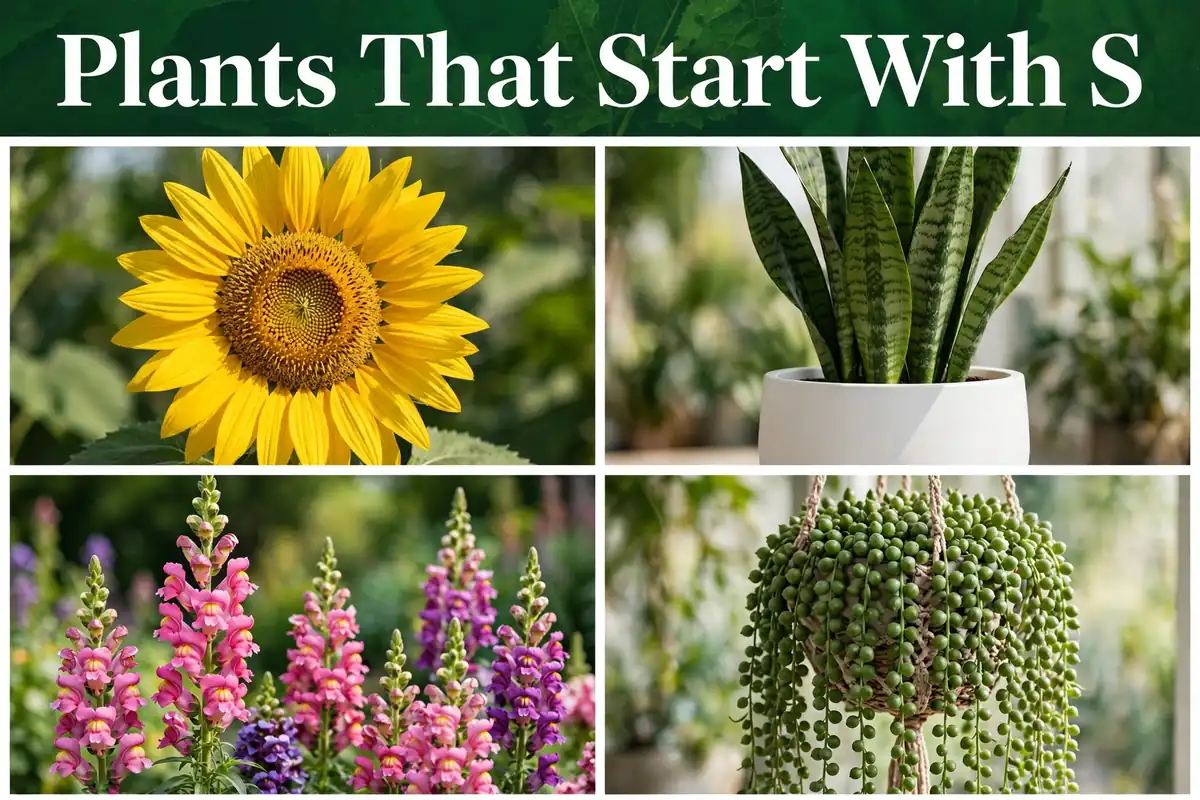
Popular plants that start with S include Sunflower, Snake Plant, Spider Plant, Snapdragon, Sweet Pea, Salvia, String of Pearls, Swiss Cheese Plant, Sago Palm, Schefflera, Shamrock, and Snowdrop. They span towering annuals, forgiving houseplants, fragrant vines, hardy shrubs, and evergreen trees across USDA zones 3–12, so there is an S-plant for nearly every home and garden.
Table of Contents
S-Plants at a Glance
Use this table to compare all 32 plants that start with S side by side, from botanical names to native regions.
| Plant name | Scientific name | Type | Light | Native region |
|---|---|---|---|---|
| Sunflower | Helianthus annuus | Annual flower | Full sun | North America |
| Spider Plant | Chlorophytum comosum | Evergreen perennial houseplant | Bright indirect light | South Africa |
| Snake Plant | Sansevieria trifasciata (syn. Dracaena trifasciata) | Succulent houseplant | Low to bright indirect light | West Africa |
| Snapdragon | Antirrhinum majus | Tender perennial; annual elsewhere | Full sun | Mediterranean (Spain, Italy, Morocco) |
| Sweet Pea | Lathyrus odoratus | Hardy annual vine | Full sun | Sicily, southern Italy |
| Salvia | Salvia nemorosa | Herbaceous perennial | Full sun | Europe, Central Asia |
| Sedum ‘Autumn Joy’ | Hylotelephium ‘Herbstfreude’ (syn. Sedum spectabile) | Succulent perennial | Full sun | Hybrid (East Asian parentage) |
| String of Pearls | Senecio rowleyanus (syn. Curio rowleyanus) | Trailing succulent | Bright indirect light | Southwest Africa (Namibia) |
| Swiss Cheese Plant | Monstera deliciosa | Tropical evergreen climber | Bright indirect light | Central America (Mexico to Panama) |
| Sago Palm | Cycas revoluta | Evergreen cycad | Full sun to part shade | Japan (Ryukyu Islands) |
| Schefflera | Heptapleurum arboricola (syn. Schefflera arboricola) | Evergreen shrub / houseplant | Bright indirect light | Taiwan |
| Shamrock | Oxalis triangularis | Bulbous perennial houseplant | Bright indirect light | Brazil |
| Snowdrop | Galanthus nivalis | Bulbous perennial | Part shade | Europe |
| Statice | Limonium sinuatum | Tender annual | Full sun | Mediterranean |
| Strawflower | Xerochrysum bracteatum (syn. Helichrysum bracteatum) | Tender annual | Full sun | Australia |
| SunPatiens | Impatiens × hybrida ‘SunPatiens’ | Tender annual | Full sun to part shade | Hybrid (New Guinea parentage) |
| Sweet Alyssum | Lobularia maritima | Hardy annual | Full sun to part shade | Mediterranean |
| Spiderwort | Tradescantia virginiana | Herbaceous perennial | Part shade to full sun | Eastern North America |
| Staghorn Fern | Platycerium bifurcatum | Epiphytic fern | Bright indirect light | Australia, New Guinea |
| Sweet Potato Vine | Ipomoea batatas (ornamental types) | Tender annual foliage plant | Full sun | Central and South America |
| Southern Magnolia | Magnolia grandiflora | Evergreen tree | Full sun to part shade | Southeastern US |
| Serviceberry | Amelanchier canadensis | Deciduous shrub / small tree | Full sun to part shade | Eastern North America |
| Japanese Spirea | Spiraea japonica | Deciduous shrub | Full sun | Japan, Korea, China |
| Summersweet | Clethra alnifolia | Deciduous shrub | Part shade to full sun | Eastern US |
| Silver Dollar Eucalyptus | Eucalyptus polyanthemos | Evergreen tree | Full sun | Australia (Victoria, New South Wales) |
| Lamb’s Ear | Stachys byzantina | Evergreen perennial | Full sun to part shade | Turkey, Armenia, Iran |
| Stokes’ Aster | Stokesia laevis | Herbaceous perennial | Full sun to part shade | Southeastern US |
| Siberian Iris | Iris sibirica | Herbaceous perennial | Full sun to part shade | Central Europe to Central Asia |
| Shasta Daisy | Leucanthemum × superbum | Herbaceous perennial | Full sun | Hybrid (European/American parentage) |
| Sea Holly | Eryngium planum | Herbaceous perennial | Full sun | Europe to Central Asia |
| Boston Fern | Nephrolepis exaltata ‘Bostoniensis’ | Evergreen fern houseplant | Bright indirect light | Tropical Americas |
| Star Jasmine | Trachelospermum jasminoides | Evergreen vine | Full sun to part shade | East Asia (Japan, Korea, China) |
Bloom Season, Water Needs & Hardiness Zones
Planning your garden calendar? This second table shows when each S-plant blooms, how much water it wants, the USDA zones where it grows outdoors year-round, and its mature size.
| Plant name | Bloom season | Water needs | Hardiness zone | Mature size |
|---|---|---|---|---|
| Sunflower | Summer to fall | Moderate | Grown as annual | 3–10 ft tall (varies by cultivar) |
| Spider Plant | Spring (small white flowers) | Moderate; let dry between waterings | Houseplant (9–11 outdoors) | 12–24 in. spread |
| Snake Plant | Rarely blooms indoors | Low; drought-tolerant | Houseplant (9–11 outdoors) | 1–4 ft tall |
| Snapdragon | Spring to fall | Moderate | 8–11; annual elsewhere | 6 in.–4 ft tall |
| Sweet Pea | Spring to early summer | Regular; keep soil moist | Hardy annual | 6–9 ft climbing vine |
| Salvia | Late spring to fall | Moderate; drought-tolerant | 4–9 | 18–36 in. tall |
| Sedum ‘Autumn Joy’ | Late summer to fall | Low; drought-tolerant | 3–9 | 18–24 in. tall |
| String of Pearls | Spring–summer (tiny white flowers) | Low; succulent | Houseplant (9–12 outdoors) | Trailing 2–3 ft |
| Swiss Cheese Plant | Rarely blooms indoors | Moderate; moist but well-drained | Houseplant (10–12 outdoors) | 6–10 ft indoors |
| Sago Palm | Spring (cones, not flowers) | Moderate; drought-tolerant once established | 9–10 | 3–10 ft tall, very slow-growing |
| Schefflera | Summer (outdoors in tropics) | Moderate | Houseplant (10–11 outdoors) | 3–6 ft indoors |
| Shamrock | Spring to fall (indoors) | Moderate; rest after dormancy | Houseplant (8–11 outdoors) | 6–12 in. tall |
| Snowdrop | Late winter to early spring | Moderate | 3–7 | 6–10 in. tall |
| Statice | Summer to fall | Moderate; drought-tolerant | Grown as annual | 12–30 in. tall |
| Strawflower | Summer to frost | Moderate; drought-tolerant | Grown as annual | 1–3 ft tall |
| SunPatiens | Spring to frost | Regular; keep soil moist | Grown as annual | 18–36 in. tall |
| Sweet Alyssum | Spring to fall | Moderate | Hardy annual; perennial in 9–11 | 4–8 in. tall, spreading |
| Spiderwort | Late spring to summer | Moderate to moist | 5–9 | 18–24 in. tall |
| Staghorn Fern | Does not flower | Moderate; mist or soak | Houseplant (9–11 outdoors) | 2–3 ft fronds |
| Sweet Potato Vine | Rarely (grown for foliage) | Regular | Grown as annual | Trailing 4–10 ft |
| Southern Magnolia | Late spring to summer | Moderate to moist | 7–9 | 60–80 ft tall |
| Serviceberry | Spring (white flowers); berries in June | Moderate | 4–7 | 15–25 ft tall |
| Japanese Spirea | Summer | Moderate | 4–9 | 2–4 ft tall |
| Summersweet | Mid to late summer | Moist; tolerates wet soil | 3–9 | 4–8 ft tall |
| Silver Dollar Eucalyptus | Spring (inconspicuous) | Low once established | 9–11 | 30–75 ft tall |
| Lamb’s Ear | Summer (pink-purple spikes) | Low; drought-tolerant | 4–8 | 12–18 in. tall, spreading |
| Stokes’ Aster | Summer | Moderate | 5–9 | 12–24 in. tall |
| Siberian Iris | Late spring to early summer | Moist; likes wet soil | 3–9 | 2–4 ft tall |
| Shasta Daisy | Summer to early fall | Moderate | 5–9 | 2–3 ft tall |
| Sea Holly | Summer | Low; drought-tolerant | 4–9 | 2–3 ft tall |
| Boston Fern | Does not flower | Regular; keep soil moist | Houseplant (10–11 outdoors) | 2–3 ft spread |
| Star Jasmine | Late spring to early summer | Moderate | 7–10 | Climbing 15–20 ft |
32 Plants That Start With S: The Complete List
Here they are — 32 beautiful, real plants beginning with S, each with growing notes so you can pick the right ones for your home and garden.
1. Sunflower (Helianthus annuus)
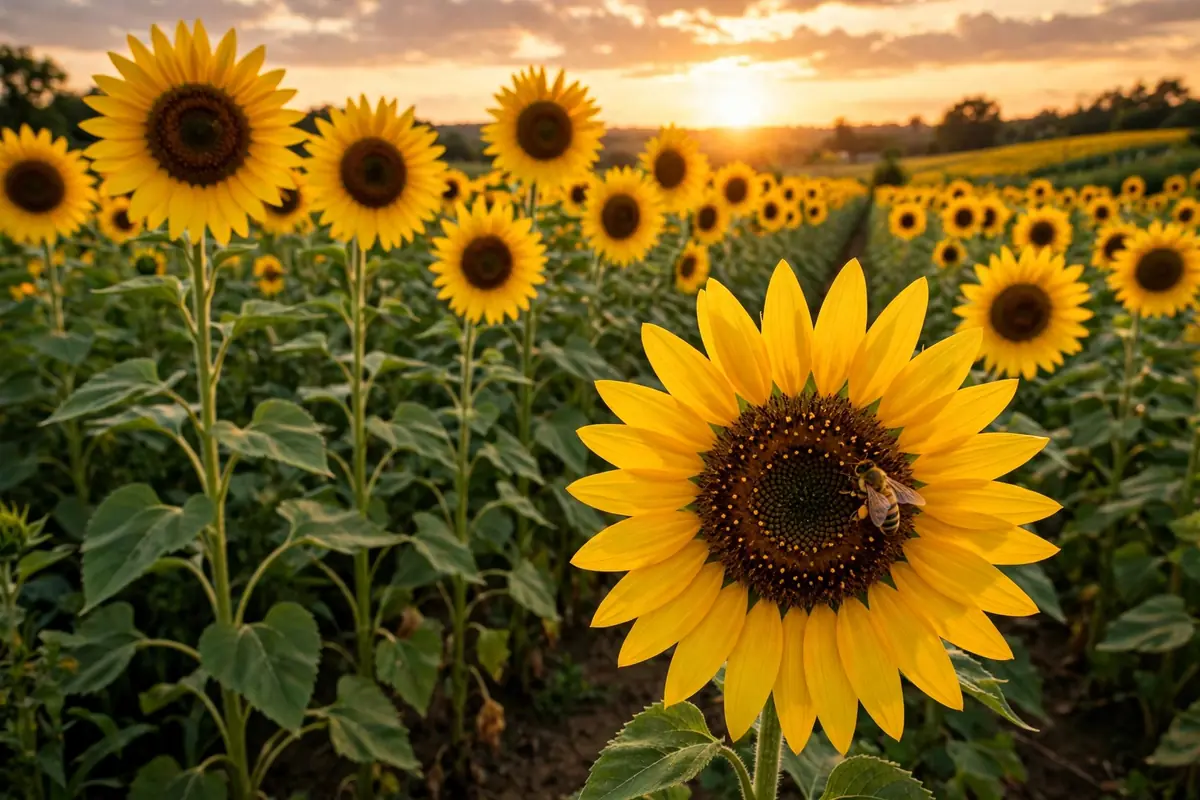
Sunflower is the undisputed icon of the summer garden — a towering annual whose giant golden faces track the sun across the sky. Native to North America, it has been cultivated for thousands of years, and modern breeding has produced everything from 12-foot giants with dinner-plate blooms to foot-tall dwarfs made for containers. The huge flower heads are really hundreds of tiny florets packed together, which is why bees, butterflies, and birds all feast on them. Choose pollenless varieties for cut flowers and seed-producing types if you want to harvest snacks or feed wildlife.
Sow seeds directly in the garden after the last frost, 1 to 1.5 inches deep in full sun with 6 to 8 hours of direct light. Sunflowers dislike root disturbance, so avoid transplanting. They grow fast — most bloom within 70 to 95 days — and need only average soil with good drainage, though they appreciate a rich bed. Stake tall varieties, water deeply but infrequently once established, and stagger plantings every couple of weeks for continuous blooms. At season’s end, leave heads standing for the birds.
Bloom: Summer to fall | Sun: Full sun | Zone: Grown as annual | Best for: Cutting gardens, children’s gardens, pollinators
2. Spider Plant (Chlorophytum comosum)
Spider plant is the classic beginner houseplant — a fountain of arching green-and-white striped leaves that produces dangling baby plantlets (“spiderettes”) on long stems, earning it the nickname “airplane plant.” Native to South Africa, it is one of the most forgiving indoor plants ever sold, tolerating low light, occasional missed waterings, and dry indoor air. The babies root easily, so one plant becomes many gifts within a year. It was even studied by NASA among plants that help clean indoor air.
Give it bright indirect light for the boldest variegation, though it survives in lower light. Water when the top inch of soil dries out; brown leaf tips usually mean fluoride in tap water or underwatering — use rainwater or let tap water sit overnight. It prefers to be slightly pot-bound, which also triggers more plantlets. Feed lightly in spring and summer. Outdoors it is only hardy in zones 9–11, where it works as a groundcover or hanging basket plant.
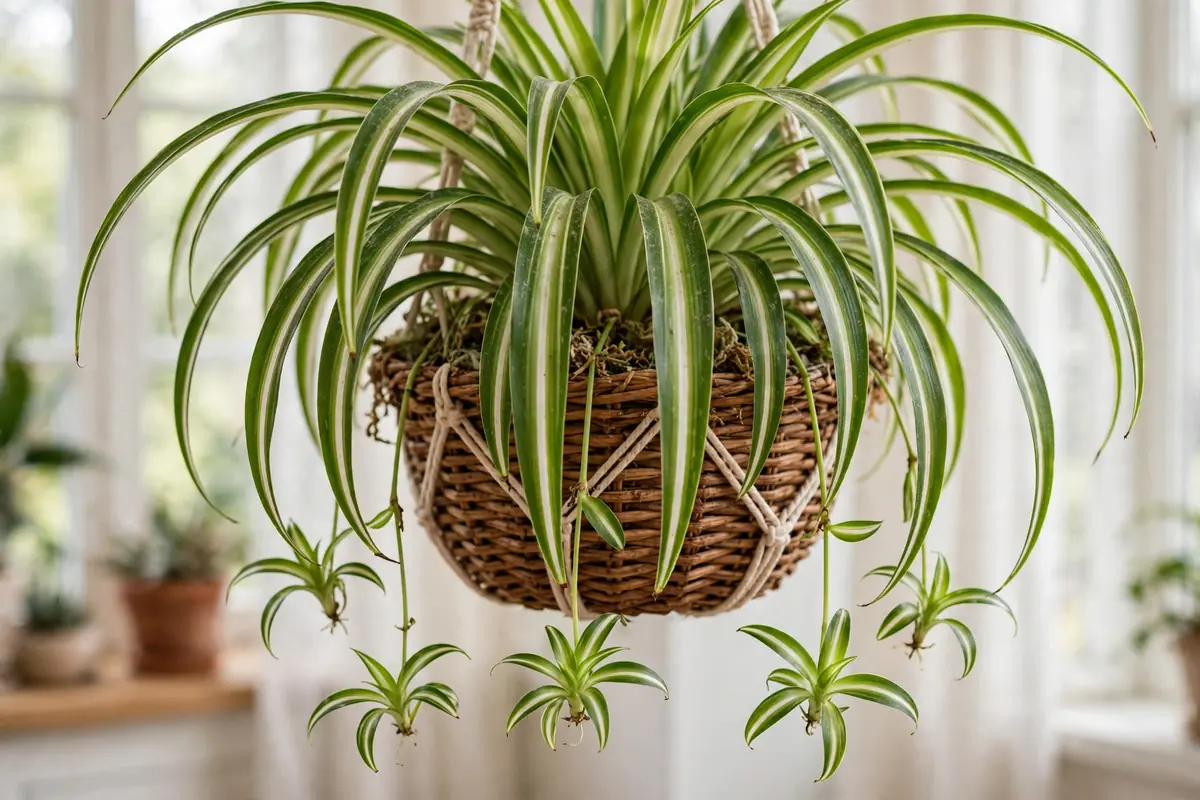
Flowers: Small white blooms in spring | Light: Bright indirect | Zone: Houseplant (9–11 outdoors) | Best for: Beginners, hanging baskets, gifts
3. Snake Plant (Sansevieria trifasciata)
Snake plant — also sold as mother-in-law’s tongue, and now officially reclassified as Dracaena trifasciata — is famous for being nearly impossible to kill. Its stiff, upright sword-like leaves with dark green banding look sculptural in modern interiors, and it is one of the few houseplants that tolerates dark corners, bright windows, and months of neglect equally well. It is also one of the best plants for bedrooms, since it continues releasing oxygen at night.
The golden rule is to underwater rather than overwater: let the soil dry out completely between waterings, and in winter you may water only once a month. It needs a pot with drainage holes and gritty, fast-draining soil; soggy soil rots the rhizomes quickly. Snake plants grow slowly and prefer snug pots. Divide crowded clumps in spring to propagate. Outdoors it is hardy in zones 9–11, where it can become aggressive in frost-free climates — keep it contained.
Flowers: Rarely blooms indoors | Light: Low to bright indirect | Zone: Houseplant (9–11 outdoors) | Best for: Neglect-proof decor, bedrooms, offices
4. Snapdragon (Antirrhinum majus)
Snapdragon is the cottage-garden charmer whose tubular blooms open like little dragon mouths when you squeeze them — a delight for kids and bumblebees alike. Native to the rocky Mediterranean, it produces tall spikes of ruffled flowers in nearly every color, from pastel blush to hot magenta, from spring well into fall. Modern series like ‘Rocket’ and ‘Potomac’ give 3- to 4-foot stems for cutting, while dwarf types edge borders beautifully. Technically a tender perennial hardy in zones 8–11, almost everyone grows it as a cool-season annual.
Snapdragons love cool weather: plant them in early spring in full sun with rich, well-drained soil, and they will bloom before the heat arrives, often reblooming in fall. In hot climates, give afternoon shade. Pinch young plants at 4–6 inches tall to encourage branching, deadhead regularly for continuous bloom, and cut deeply for bouquets — they last a week or more in a vase. Start seeds indoors 8–10 weeks before the last frost; the tiny seeds need light to germinate, so press them onto the soil surface.
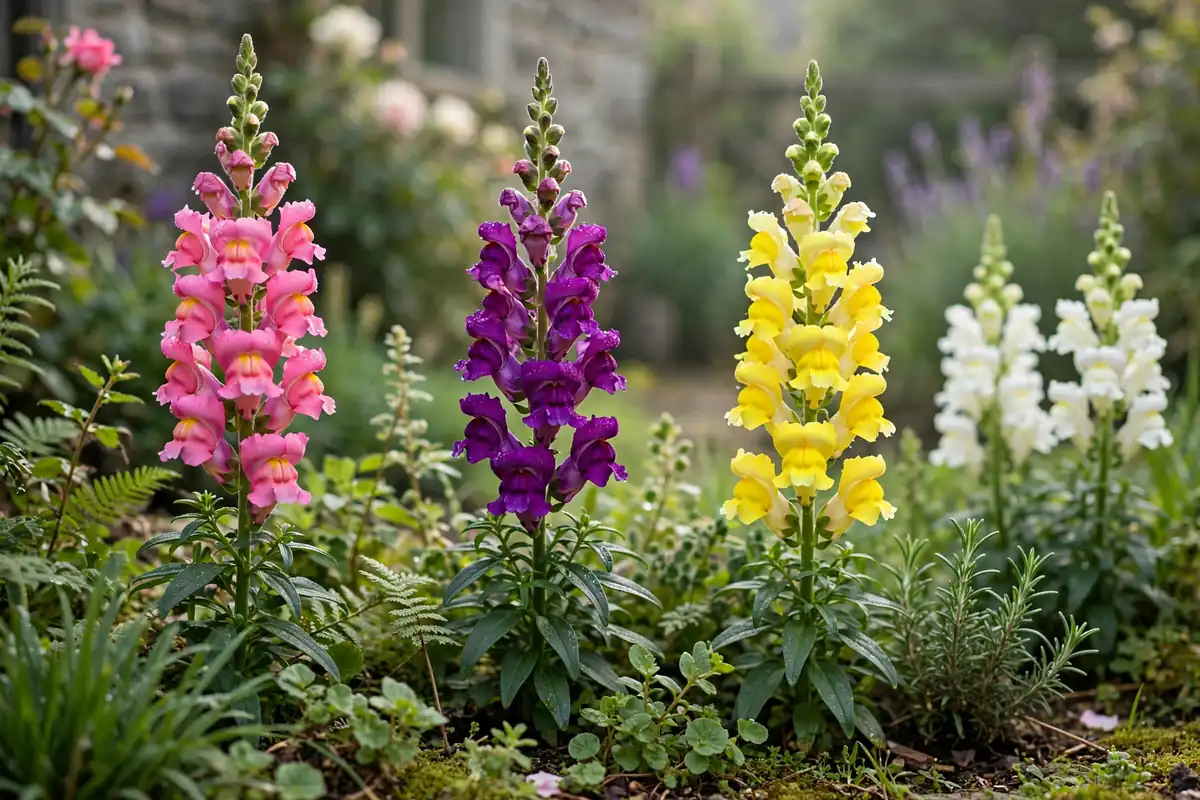
Bloom: Spring to fall | Sun: Full sun | Zone: 8–11; annual elsewhere | Best for: Cut flowers, cottage gardens, kids
5. Sweet Pea (Lathyrus odoratus)
Sweet pea is the most romantic flower in the cool-season garden — climbing vines draped in ruffled, butterfly-like blooms with a honey-and-orange-blossom perfume that no modern rose can match. Native to Sicily, it has been beloved since the Victorian era, and heirloom varieties like ‘Cupani’ and ‘Old Spice’ are still grown for their intense scent. The vines climb 6 to 9 feet up trellises, obelisks, and fences, producing armloads of cut flowers. Note: sweet peas are ornamental only — all parts are poisonous, unlike edible garden peas.
Sweet peas demand cool weather and rich soil: sow in late winter or very early spring as soon as soil can be worked (or in fall in zones 8–10), soaking seeds overnight first. Give them full sun, a deep compost-rich trench, at least 6 feet of sturdy support, and consistent moisture. Keep their heads in the sun and their roots cool with mulch or low annuals in front. Pick flowers relentlessly — the more you cut, the more they bloom — and never let them set seed if you want months of flowers.
Bloom: Spring to early summer | Sun: Full sun | Zone: Hardy annual | Best for: Fragrance, trellises, cut flowers
6. Salvia (Salvia nemorosa)
Salvia — specifically the woodland sage, Salvia nemorosa — is the backbone of the summer perennial border, sending up dense spikes of violet-blue, pink, or white flowers from late spring through fall. Compact cultivars like ‘Caradonna’ (with dark purple stems) and ‘May Night’ bloom for months and are magnets for bees, butterflies, and hummingbirds while deer walk right past them. The foliage is aromatic, and the whole genus Salvia also includes culinary sage and the scarlet bedding salvias, so the name covers a lot of garden ground.
Plant salvia in full sun with average, well-drained soil — it hates wet feet, especially in winter. It is drought-tolerant once established and thrives on lean soil; too much fertilizer makes it floppy. The secret to months of bloom is shearing: cut the whole plant back by half after the first flush fades and it will rebloom strongly. Divide congested clumps every 3–4 years in spring. Hardy in zones 4–9, it is one of the most reliable perennials for hot, sunny borders.
Bloom: Late spring to fall | Sun: Full sun | Zone: 4–9 | Best for: Pollinators, borders, deer-resistant gardens
7. Sedum ‘Autumn Joy’ (Hylotelephium ‘Herbstfreude’)
‘Autumn Joy’ sedum is the plant that carries the garden into fall — a clump-forming succulent perennial whose flat-topped flower heads open pink in late summer, deepen to coppery red, and dry into architectural seed heads that look stunning under frost. Now officially classified as Hylotelephium ‘Herbstfreude’, it is a hybrid with thick, fleshy blue-green leaves and a tidy 18- to 24-inch habit. Butterflies swarm the late-season blooms when little else is flowering, and it is one of the toughest perennials you can plant.
Give it full sun and sharp drainage — this is the one requirement it will not compromise on. Rich or wet soil makes it flop and rot. Once established, it needs almost no water and no fertilizer; it actually prefers poor soil. Cut the dried stems back in early spring rather than fall to enjoy winter structure and give beneficial insects a home. Divide in spring every few years if the center thins. Hardy in zones 3–9, it shrugs off heat, drought, and neglect.
Bloom: Late summer to fall | Sun: Full sun | Zone: 3–9 | Best for: Fall color, butterflies, drought gardens
8. String of Pearls (Senecio rowleyanus)
String of pearls is the succulent that stops people mid-scroll — long trailing strands of perfectly round, bead-like green leaves cascading from a hanging pot. Native to the dry regions of Namibia, each “pearl” is a water-storing leaf with a tiny translucent window that lets light inside. Recently reclassified as Curio rowleyanus, it occasionally produces small white cinnamon-scented flowers. It is a collector’s favorite and one of the most photogenic houseplants in existence — but keep it away from pets and small children, as it is toxic if eaten.
Treat it like the desert plant it is: very bright indirect light (a few hours of gentle morning sun is ideal), gritty cactus soil, and water only when the pearls start to soften slightly — overwatering is the number one killer. A shallow pot with drainage is better than a deep one, since its roots are shallow. In summer it can hang outdoors in dappled shade in zones 9–12. Propagate by laying a strand on moist soil; the pearls root at the nodes within weeks.
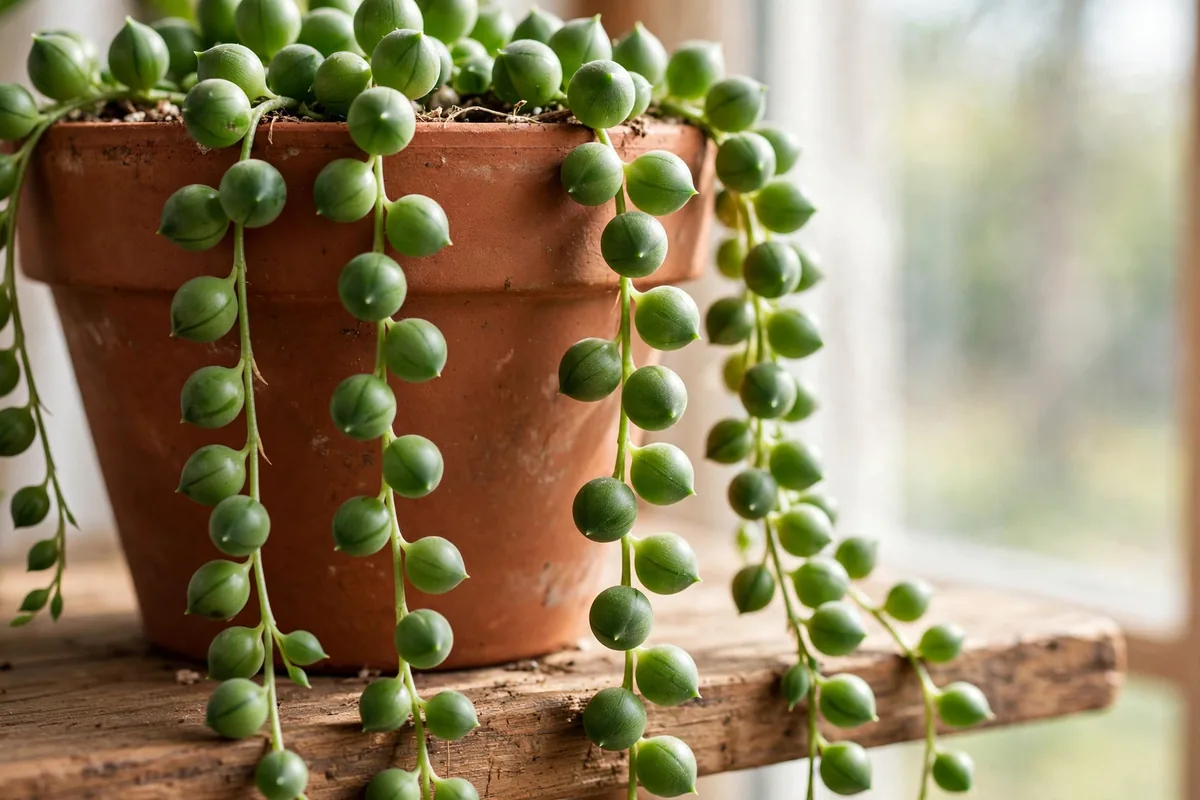
Flowers: Tiny white cinnamon-scented blooms | Light: Bright indirect | Zone: Houseplant (9–12 outdoors) | Best for: Hanging baskets, succulent collectors
9. Swiss Cheese Plant (Monstera deliciosa)
Swiss cheese plant — Monstera deliciosa — is the statement houseplant of the decade, with enormous glossy leaves split into dramatic slots and holes (fenestrations) that develop as the plant matures. Native to the rainforests of Central America, where it climbs trees toward the canopy, it can reach 6 to 10 feet indoors with leaves 2 feet wide. The holes are thought to help the plant survive heavy tropical downpours. Give it a moss pole to climb and it will reward you with ever-larger, ever-more-dramatic foliage.
Provide bright indirect light — direct sun scorches the leaves, while too little light keeps new leaves small and hole-free. Water when the top 2 inches of soil dry out, and use a chunky aroid mix of bark, perlite, and potting soil for the drainage its epiphytic roots crave. It loves humidity, so mist occasionally or group it with other plants. Wipe leaves monthly to keep them glossy. Hardy outdoors only in zones 10–12. Note: all parts are toxic to pets if chewed.
Flowers: Rarely blooms indoors | Light: Bright indirect | Zone: Houseplant (10–12 outdoors) | Best for: Statement plants, tropical interiors
10. Sago Palm (Cycas revoluta)
Sago palm is not a palm at all but an ancient cycad — a living fossil from the age of the dinosaurs, with a crown of stiff, feathery, deep-green fronds unfurling from a squat trunk. Native to Japan’s Ryukyu Islands, it grows with glacial slowness, adding just an inch or two of trunk a year, which makes it perfect for containers and bonsai-style specimens. A mature plant with a flush of new fronds is breathtaking, and it brings instant tropical architecture to patios and entryways. Critical warning: all parts, especially the seeds, are highly toxic to dogs, cats, and humans.
Plant in full sun to part shade with excellent drainage — in zones 9–10 it lives outdoors year-round; elsewhere grow it in a pot and bring it inside before frost. It tolerates drought once established but flushes best with regular water in the growing season. Feed lightly in spring and summer. Protect the crown from hard freezes with frost cloth, and never cut off yellowing lower fronds until they are fully brown. A new flush of fronds appears once a year, usually in spring.
Bloom: Spring cones (not flowers) | Sun: Full sun to part shade | Zone: 9–10 | Best for: Tropical architecture, containers, specimen plants
11. Schefflera (Heptapleurum arboricola)
Schefflera — the dwarf umbrella plant, now botanically Heptapleurum arboricola — is the glossy-leaved workhorse of indoor plant collections, with whorls of oval leaflets radiating like umbrella spokes from each stem. It comes in solid green and gold-variegated forms, grows quickly to 3–6 feet indoors, and tolerates the dry air and uneven care of real homes better than most tropicals. In zones 10–11 it is planted outdoors as a hedge or foundation shrub, though it can be aggressive in frost-free regions like Florida and Hawaii.
Indoors, give it bright indirect light and let the top inch or two of soil dry between waterings; it drops leaves when overwatered or moved suddenly. It responds beautifully to pruning — cut back leggy stems in spring and they branch into bushier growth. Wipe leaves occasionally to keep them shining, and feed monthly in the growing season. Rotate the pot regularly for even growth. Outdoors in warm zones, plant in part shade with room to spread.
Flowers: Summer (outdoors in tropics) | Light: Bright indirect | Zone: Houseplant (10–11 outdoors) | Best for: Easy indoor trees, offices, hedges in warm zones
12. Shamrock (Oxalis triangularis)
Shamrock — the purple kind sold as Oxalis triangularis — is the houseplant with a magic trick: its deep-purple triangular leaflets fold up like butterflies at night and open again each morning. Delicate pale-pink or white flowers hover above the foliage from spring to fall. It grows from small bulbs, goes dormant periodically (the foliage collapses and looks dead), and then resurrects itself weeks later — a cycle that panics beginners but is completely normal. It is the classic St. Patrick’s Day plant and a charming year-round windowsill companion.
Give it bright indirect light for the richest purple color; too little light turns the leaves greenish and leggy. Water when the top inch of soil is dry, and feed lightly during active growth. When it goes dormant, stop watering, let the bulbs rest in the pot for 4–6 weeks, then resume watering to trigger regrowth. Divide the bulbs when repotting to multiply your plants. Outdoors it is hardy in zones 8–11 as a shade groundcover.
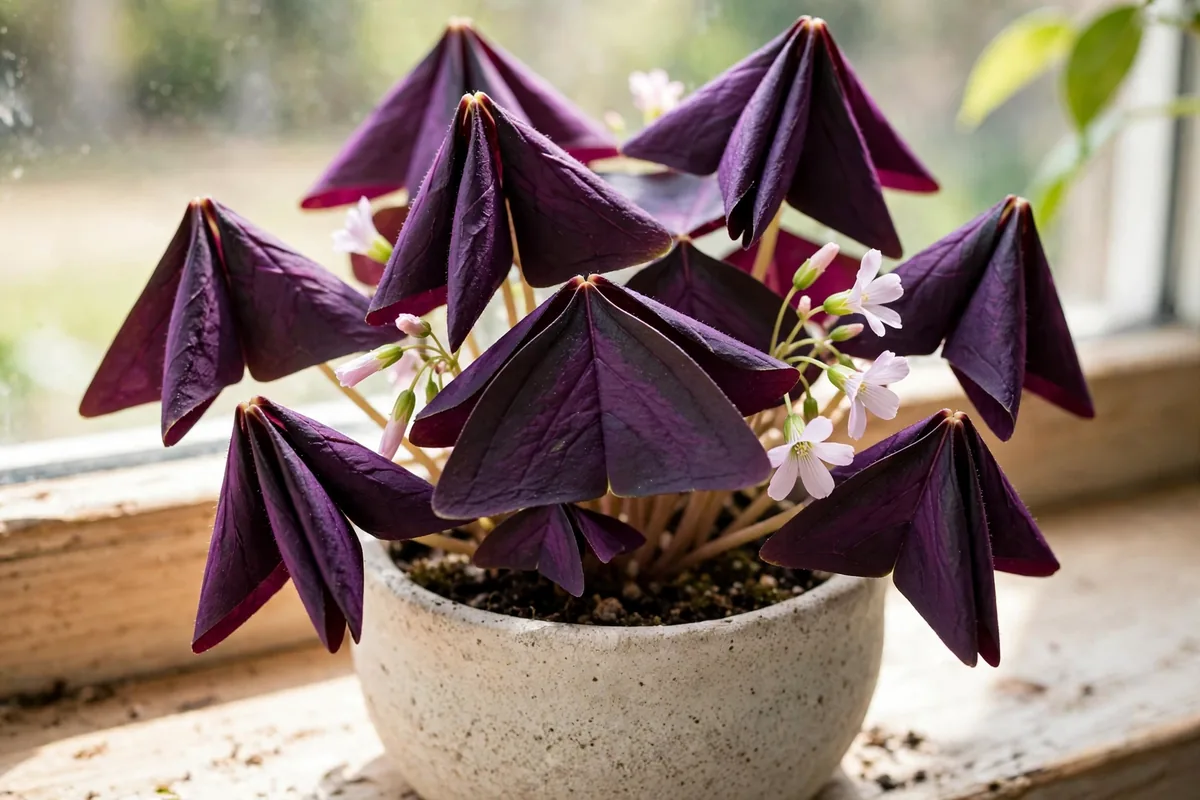
Bloom: Spring to fall (indoors) | Light: Bright indirect | Zone: Houseplant (8–11 outdoors) | Best for: Windowsills, St. Patrick’s Day, unique foliage
13. Snowdrop (Galanthus nivalis)
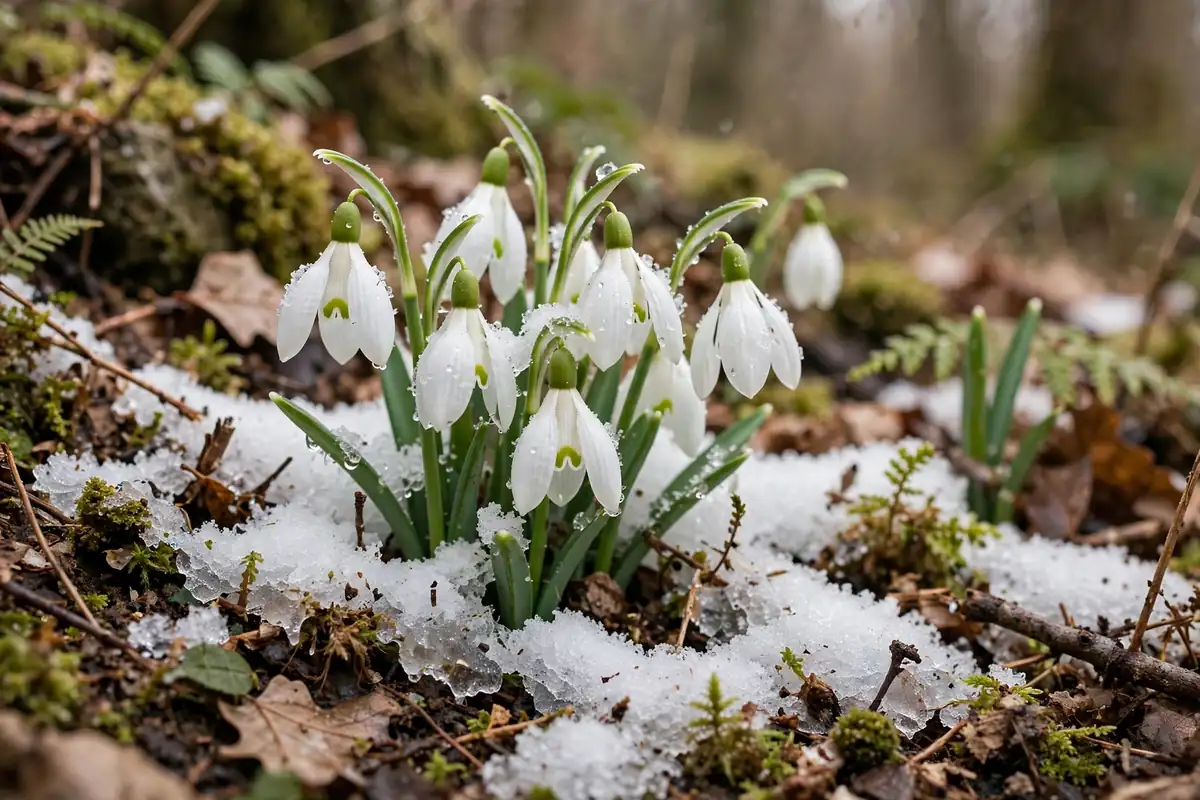
Snowdrop is winter’s bravest flower — nodding white bells with green markings that push through snow and frozen soil in late winter, sometimes blooming while snow is still on the ground. Native to European woodlands, Galanthus nivalis is one of the earliest nectar sources for emerging bees, and a drift of them under bare trees is one of gardening’s great joys. They naturalize into ever-larger colonies and have inspired obsessive collectors (“galanthophiles”) who pay fortunes for rare cultivars. All parts are toxic if eaten, which conveniently makes them deer- and rodent-proof.
Plant bulbs 3–4 inches deep in fall in part shade with humus-rich, well-drained soil — under deciduous trees is ideal, since they get sun before the leaves emerge. The best planting method is actually “in the green”: buy and plant them just after flowering in spring, which establishes far more reliably than dry bulbs. Let the foliage die back naturally to feed next year’s bulbs. Once established, divide congested clumps right after flowering. Hardy in zones 3–7.
Bloom: Late winter to early spring | Light: Part shade | Zone: 3–7 | Best for: Early color, woodland gardens, naturalizing
14. Statice (Limonium sinuatum)
Statice is the everlasting flower — papery, intensely colored blooms in purple, blue, pink, yellow, and white that hold their color for months after drying, making it the backbone of dried arrangements and florist bouquets. The true flowers are tiny and white, nestled inside the colorful papery calyces that do all the showing off. Native to the Mediterranean, it blooms from summer to fall on stiff, winged stems, and butterflies love it fresh in the garden too. A single sowing gives you both garden color and winter crafts.
Sow indoors 6–8 weeks before the last frost or direct-sow after frost in full sun with well-drained, even sandy soil — statice tolerates salt and poor soil. Space plants about a foot apart for good air circulation. It is drought-tolerant once established and needs no deadheading; in fact, the more you cut for drying, the more it blooms. For dried flowers, harvest when the calyces are fully colored but before the tiny white flowers fade, and hang bunches upside down in a dark, airy spot.
Bloom: Summer to fall | Sun: Full sun | Zone: Grown as annual | Best for: Dried flowers, cutting gardens, coastal gardens
15. Strawflower (Xerochrysum bracteatum)
Strawflower is nature’s origami — crisp, papery blooms in blazing orange, red, pink, yellow, and white that feel like straw to the touch and practically never fade, fresh or dried. Native to Australia and formerly known as Helichrysum bracteatum, it blooms from summer to frost on 1- to 3-foot plants, and the buds open like little pinecones before unfurling. It is a top-tier cut flower with a vase life of over a week, and dried strawflowers keep their color for years, making them wreath-makers’ gold.
Start seeds indoors 6–8 weeks before the last frost or direct-sow after frost — the seeds need light to germinate, so barely cover them. Plant in full sun with well-drained soil; strawflower tolerates heat and drought once established. For dried flowers, cut stems when blooms are three-quarters open and hang them upside down immediately — waiting too long lets them open fully and lose form. Deadhead or cut regularly to keep new buds coming until frost.
Bloom: Summer to frost | Sun: Full sun | Zone: Grown as annual | Best for: Dried flowers, cut flowers, hot sunny beds
16. SunPatiens (Impatiens × hybrida ‘SunPatiens’)
SunPatiens solved the biggest problem in shade gardening: they are impatiens that thrive in full sun. Bred in Japan from New Guinea impatiens parentage, these vigorous hybrids grow 18–36 inches tall and wide, smothered in large blooms of red, pink, orange, white, and purple from spring to frost. Unlike old-fashioned impatiens, they are highly resistant to downy mildew, tolerate heat and humidity, and never need deadheading — the flowers are self-cleaning. They are the go-to bedding plant for instant, season-long color.
Plant after all frost danger in full sun to part shade with rich, moisture-retentive soil. SunPatiens are thirsty — especially in sun — so water consistently and mulch well; wilting in afternoon heat is normal and they recover by evening. Space 14–18 inches apart; they fill in fast. Feed every two weeks with balanced fertilizer for maximum bloom. They root easily from cuttings if you want to overwinter favorites indoors, though most gardeners treat them as annuals.
Bloom: Spring to frost | Sun: Full sun to part shade | Zone: Grown as annual | Best for: Bedding, containers, nonstop color
17. Sweet Alyssum (Lobularia maritima)
Sweet alyssum is the honey-scented carpet of the spring garden — low mounds of tiny white, pink, or purple flowers that spill over edging, fill gaps between paving, and perfume the air with a sweet, honeyed fragrance. Native to the Mediterranean coast, it blooms from spring to fall, attracts hoverflies and tiny beneficial wasps that control aphids, and self-sows politely. It is one of the best companion plants in the vegetable garden and a classic for the fronts of borders and window boxes.
Sow directly in early spring or start indoors — the tiny seeds germinate quickly in cool soil. It prefers full sun to part shade and average, well-drained soil, and actually blooms best in cool weather; in hot summers it may pause, then rebound in fall. Shear plants back by half after the first flush to trigger rebloom. In zones 9–11 it can behave as a short-lived perennial. Let a few plants self-sow and you will never buy it again.
Bloom: Spring to fall | Sun: Full sun to part shade | Zone: Hardy annual; perennial in 9–11 | Best for: Edging, fragrance, companion planting
18. Spiderwort (Tradescantia virginiana)
Spiderwort is the tough native perennial with a daily magic show — clusters of three-petaled blue, purple, or white flowers that open each morning and melt away by afternoon, replaced by fresh blooms the next day. Native to eastern North American woodlands and meadows, Tradescantia virginiana grows 18–24 inches tall with grass-like foliage and blooms from late spring into summer. The flowers are also a curiosity: their stamen hairs change color in the presence of radiation, which once made spiderwort a living pollution monitor.
Plant in part shade to full sun with average to moist soil — spiderwort tolerates clay and even wet spots where fussier perennials fail. In full sun it needs consistent moisture or the foliage goes dormant by midsummer; in part shade it stays handsome longer. Cut the whole plant back hard after the first bloom flush for fresh foliage and a possible rebloom. Divide every 3–4 years in spring or fall. Hardy in zones 5–9 and unbothered by deer.
Bloom: Late spring to summer | Light: Part shade to full sun | Zone: 5–9 | Best for: Native gardens, rain gardens, woodland edges
19. Staghorn Fern (Platycerium bifurcatum)
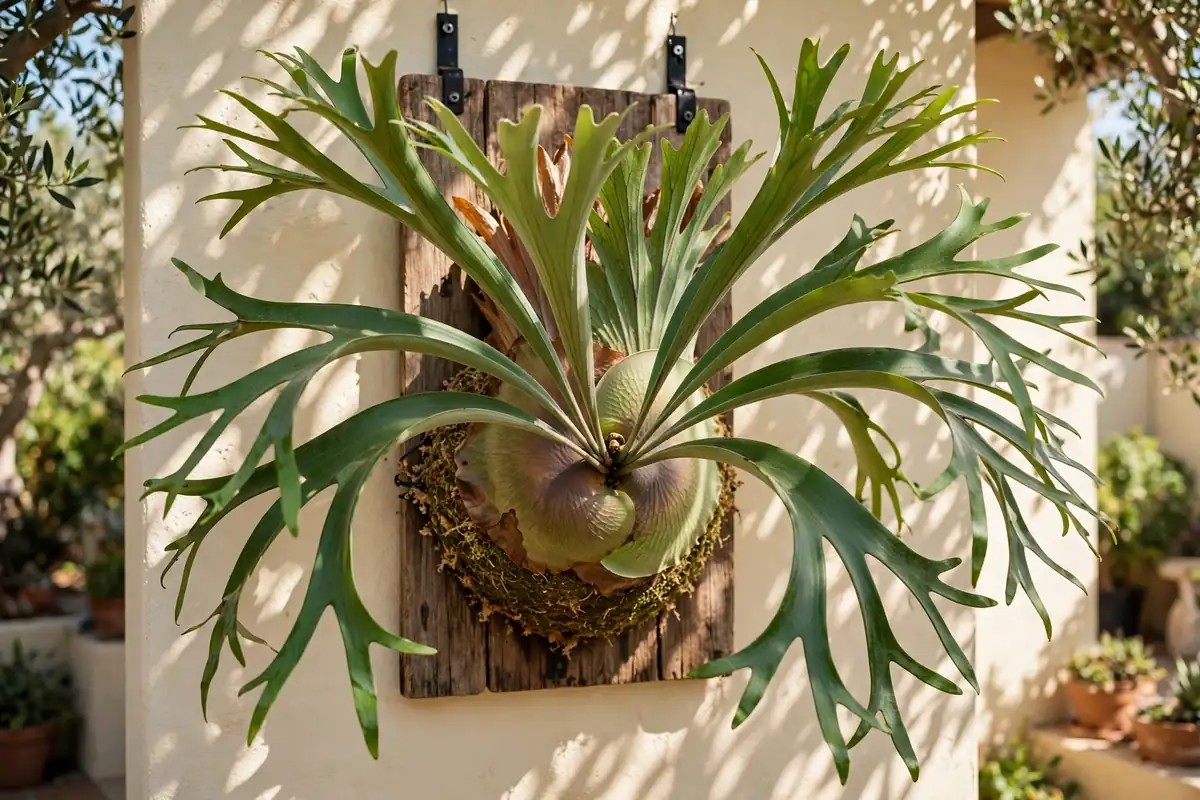
Staghorn fern is living sculpture — an epiphytic fern from Australia that grows on trees, not in soil, with two kinds of fronds: round shield fronds that clasp the mount and dramatic forked “antlers” that cascade outward up to 3 feet. Mounted on a wooden board or hung in a basket, it becomes a piece of botanical art for a bright wall or patio. Platycerium bifurcatum is the most forgiving staghorn species, tolerating the ups and downs of home care far better than its fussier cousins.
Mount it on cedar, cork bark, or a wire basket packed with sphagnum moss — never in potting soil. Give it bright indirect light and water by soaking the mount thoroughly, then letting it dry; misting alone is rarely enough. In summer, a monthly weak liquid feed during watering keeps it vigorous. It can summer outdoors in dappled shade in zones 9–11 but must come inside before frost. Never remove the brown shield fronds — they protect the roots and feed the plant as they decay.
Flowers: Does not flower | Light: Bright indirect | Zone: Houseplant (9–11 outdoors) | Best for: Living wall art, patios, collectors
20. Sweet Potato Vine (Ipomoea batatas)
Sweet potato vine is the foliage spiller that professional container designers reach for first — vigorous trailing vines in chartreuse ‘Marguerite’, near-black ‘Blackie’, or tricolor pink, all grown from the same species that gives us sweet potatoes. The ornamental types are bred for leaf color rather than tubers, and a single plant can trail 4–10 feet in one season, cascading over pots, walls, and window boxes. It is the fastest way to add drama to summer containers, and the heart-shaped leaves look lush from planting day.
Plant after the soil warms in full sun — it needs heat to perform and sulks in cold, wet spring soil. Give it rich, well-drained soil and regular water; it grows so fast it is a heavy feeder, so fertilize monthly. Pinch or trim rampant vines to keep containers balanced (the trimmings root easily in water). It is grown as an annual everywhere except zones 9–11, where the tubers may overwinter. Note: ornamental types produce small, bitter tubers — grow vegetable varieties if you want to eat them.
Flowers: Rarely (grown for foliage) | Sun: Full sun | Zone: Grown as annual | Best for: Containers, spillers, fast summer coverage
21. Southern Magnolia (Magnolia grandiflora)
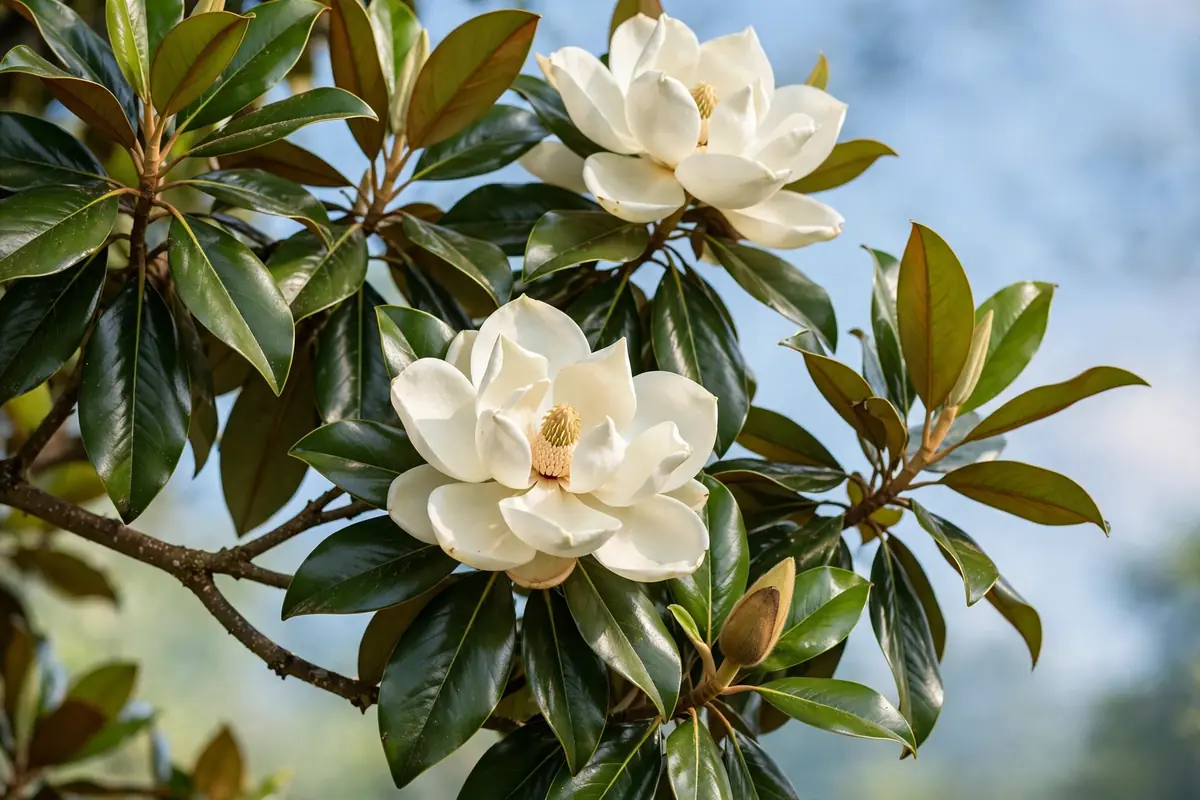
Southern magnolia is the grand dame of Southern landscapes — a massive evergreen tree with glossy, leathery leaves and dinner-plate-sized, lemon-scented white blossoms in late spring and summer. Native to the southeastern US, it grows 60–80 feet tall with a dense, pyramidal form that provides year-round privacy and deep shade. Cultivars like ‘Little Gem’ and ‘Teddy Bear’ bring the same glossy foliage and fragrant flowers to smaller yards at 20–30 feet. The large red seed cones in fall feed wildlife, and the wood is famously hard.
Plant in full sun to part shade with moist, acidic, well-drained soil — it dislikes both drought and waterlogged ground. Give it room: surface roots and heavy leaf drop make it a poor neighbor for lawns and flowerbeds right under the canopy. Mulch widely and let fallen leaves form a natural mulch. Prune only to remove damaged branches, since it heals slowly. Hardy in zones 7–9, it is a legacy tree — plant one for your grandchildren as much as yourself.
Bloom: Late spring to summer | Light: Full sun to part shade | Zone: 7–9 | Best for: Shade trees, privacy, Southern gardens
22. Serviceberry (Amelanchier canadensis)
Serviceberry is the four-season native that does everything — clouds of white star-shaped flowers in early spring, sweet blueberry-like fruits in June, brilliant orange-red fall color, and smooth gray bark for winter interest. Also called juneberry or shadbush, Amelanchier canadensis grows as a multi-stemmed shrub or small tree 15–25 feet tall, fitting neatly into suburban yards. The berries are delicious fresh, in pies, and in jam — if you can beat the birds and cedar waxwings to them.
Plant in full sun to part shade with average, well-drained, slightly acidic soil; it tolerates clay and even wet sites. Full sun gives the heaviest berry crops. Water during establishment, then it needs little care. Prune in late winter to remove suckers and maintain a tree form, or let it grow multi-stemmed for a natural look. Watch for cedar-apple rust in areas with junipers nearby. Hardy in zones 4–7, it is one of the best small native trees for wildlife gardens.
Bloom: Spring; berries in June | Light: Full sun to part shade | Zone: 4–7 | Best for: Native gardens, edible landscaping, four-season interest
23. Japanese Spirea (Spiraea japonica)
Japanese spirea is the fuss-free flowering shrub of foundation plantings everywhere — compact mounds 2–4 feet tall covered in flat clusters of pink, red, or white flowers in summer, with foliage that often emerges colorful in spring and turns fiery in fall. Cultivars like ‘Goldflame’, ‘Little Princess’, and ‘Anthony Waterer’ give you choices in leaf color from gold to blue-green. Butterflies visit the blooms for weeks, and the plant asks for almost nothing in return. It is one of the most widely planted shrubs in America for good reason.
Plant in full sun for the best flowering and foliage color, in average, well-drained soil. It tolerates heat, drought, and clay once established. The key maintenance is a hard spring pruning: cut the whole shrub back to 6–12 inches in late winter and it will flush fresh and bloom beautifully. Deadhead spent clusters for a possible light rebloom. Hardy in zones 4–9. Note: it can self-seed aggressively in some regions, so deadheading also keeps it in bounds.
Bloom: Summer | Sun: Full sun | Zone: 4–9 | Best for: Foundation plantings, low hedges, easy color
24. Summersweet (Clethra alnifolia)
Summersweet is the fragrant shrub that perfumes the July garden when almost nothing else dares to bloom — bottlebrush spikes of intensely sweet white or pink flowers that smell like honey and draw butterflies, bees, and hummingbirds from blocks away. Native to the eastern US, including wet woodlands and swamps, Clethra alnifolia is one of the few flowering shrubs that truly thrives in shade and wet soil. Cultivars like ‘Hummingbird’ stay compact at 3 feet, while ‘Ruby Spice’ offers rose-pink blooms. The glossy leaves turn golden yellow in fall.
Plant in part shade to full sun — it blooms heaviest with at least some sun — in moist, acidic soil; it tolerates standing water and rain-garden conditions that kill other shrubs. Mulch well to keep roots cool and moist. Prune in late winter, since it blooms on new wood, and remove suckers if you want to limit spreading. Hardy in zones 3–9, it is deer-resistant and one of the best native shrubs for fragrance.
Bloom: Mid to late summer | Light: Part shade to full sun | Zone: 3–9 | Best for: Fragrance, shade, wet soils, rain gardens
25. Silver Dollar Eucalyptus (Eucalyptus polyanthemos)
Silver dollar eucalyptus is the florist’s favorite foliage — round, silvery-blue juvenile leaves on graceful stems that are the backbone of bouquets and wreaths. Eucalyptus polyanthemos, the red box eucalyptus from southeastern Australia, grows into a 30- to 75-foot evergreen tree in the ground, but most gardeners coppice it yearly to keep a supply of the coveted round leaves at picking height. The aromatic foliage is also the classic base for dried arrangements and shower bundles.
Plant in full sun with sharp drainage — eucalyptus hates wet feet. It is drought-tolerant once established and grows astonishingly fast, often 6 feet a year. Hardy only in zones 9–11; elsewhere grow it in a large pot and overwinter indoors, or treat it as an annual foliage plant. Coppice (cut to near ground level) in early spring for the best juvenile foliage. Give trees plenty of space: roots are aggressive and leaf litter is heavy. Never plant near structures or septic systems.
Bloom: Spring (inconspicuous) | Sun: Full sun | Zone: 9–11 | Best for: Cut foliage, fast screens, aromatic gardens
26. Lamb’s Ear (Stachys byzantina)
Lamb’s ear is the plant everyone wants to touch — low rosettes of thick, tongue-shaped leaves covered in silvery-white woolly hairs so soft they feel like a lamb’s ear, exactly as the name promises. Native to the dry hillsides of Turkey and Iran, Stachys byzantina spreads into a shimmering silver groundcover 12–18 inches tall, topped in summer by spikes of small pink-purple flowers that bees adore. Children love it, designers love its contrast against dark foliage, and it is one of the best plants for sensory gardens.
Plant in full sun to part shade with very well-drained, even poor soil — the one thing it cannot stand is wet winter soil, which rots the crowns. It is extremely drought-tolerant once established and needs no fertilizer. Remove spent flower stalks if you prefer a pure foliage carpet, or leave them for the bees. Divide congested clumps in spring. In humid climates, give it extra spacing for air circulation. Hardy in zones 4–8 and deer-resistant.
Bloom: Summer (pink-purple spikes) | Light: Full sun to part shade | Zone: 4–8 | Best for: Groundcover, sensory gardens, silver contrast
27. Stokes’ Aster (Stokesia laevis)
Stokes’ aster is the native perennial with the most extravagant flowers — 3- to 4-inch frilly, cornflower-like blooms in lavender-blue, with white, pink, and yellow forms, floating above evergreen rosettes from early to midsummer. Native to the coastal Southeast, Stokesia laevis is the only species in its genus, and it has no serious pests or diseases. Cultivars like ‘Peachie’s Pick’ and ‘Blue Danube’ extend the color range, and the blooms are excellent cut flowers with a long vase life.
Plant in full sun to part shade with average, well-drained soil — it tolerates heat, humidity, and even brief flooding, but not winter wet. Deadhead regularly to stretch the bloom season for weeks. Cut back tattered foliage in late winter to make way for fresh evergreen rosettes. Divide every 3–4 years in spring to keep plants vigorous. Hardy in zones 5–9, it is a standout for Southern perennial borders and native plantings.
Bloom: Summer | Light: Full sun to part shade | Zone: 5–9 | Best for: Native borders, cut flowers, Southern gardens
28. Siberian Iris (Iris sibirica)
Siberian iris is the elegant, no-fuss iris — slender upright foliage like ornamental grass topped in late spring by refined blue, purple, or white flowers with intricate veining. Unlike bearded irises, Iris sibirica never needs dividing to keep blooming, never gets iris borer, and its foliage stays handsome all season, earning it a place in perennial borders long after the flowers fade. It thrives in wet soil where most perennials drown, making it a rain-garden star, yet it also performs in average garden soil.
Plant in full sun to part shade in moist, acidic to neutral soil — the wetter the better, though established clumps tolerate average conditions. Unlike bearded iris, plant the rhizomes 1–2 inches deep and mulch well. Leave the foliage standing through winter for structure and cut it back in early spring. Divide only when the center dies out, which may take a decade. Hardy in zones 3–9, it is one of the longest-lived, lowest-maintenance perennials you can grow.
Bloom: Late spring to early summer | Light: Full sun to part shade | Zone: 3–9 | Best for: Rain gardens, wet soils, low-maintenance borders
29. Shasta Daisy (Leucanthemum × superbum)
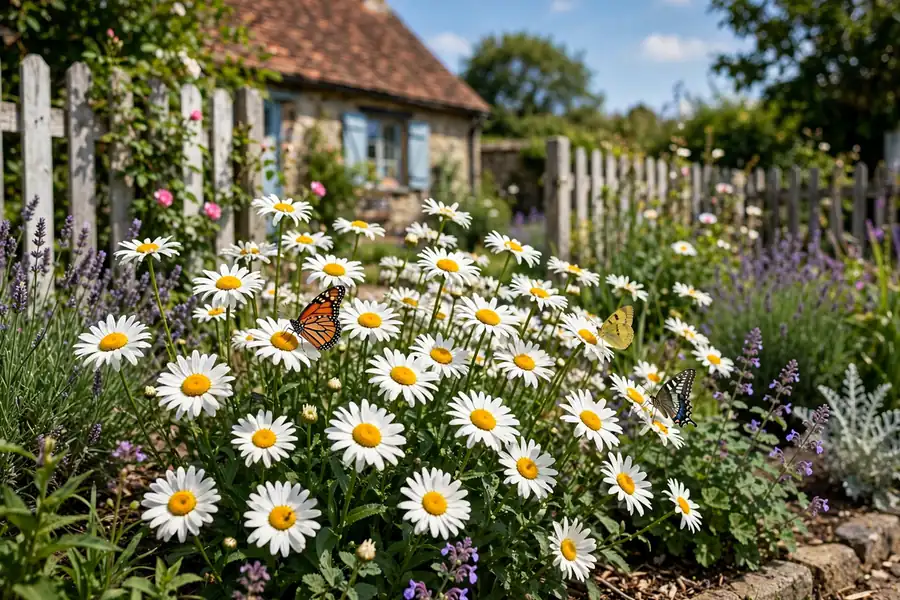
Shasta daisy is the classic white daisy of summer borders — cheerful white petals around golden centers on sturdy 2- to 3-foot stems, blooming for weeks in midsummer. Bred by Luther Burbank from four daisy species and named for snowy Mount Shasta, Leucanthemum × superbum comes in single, double, and frilly forms like ‘Becky’, ‘Alaska’, and ‘Crazy Daisy’. It is the quintessential cottage-garden flower, a superb cut flower, and a butterfly magnet that pairs with everything.
Plant in full sun with average, well-drained soil — Shastas dislike winter wet more than winter cold. Deadhead spent blooms to extend flowering into fall, and cut the whole plant back after the first flush for a strong rebloom. Divide every 2–3 years in spring or fall to keep clumps vigorous; they decline if left crowded. Stake tall varieties in windy sites. Hardy in zones 5–9, it is an easy, long-lived perennial for sunny borders.
Bloom: Summer to early fall | Sun: Full sun | Zone: 5–9 | Best for: Cottage gardens, cut flowers, butterflies
30. Sea Holly (Eryngium planum)
Sea holly is the steely-blue architectural perennial that looks like it was designed, not grown — thistle-like flower heads in metallic blue surrounded by spiny silver-blue bracts on branching 2- to 3-foot stems. Eryngium planum blooms all summer, holds its color and form for months, and dries perfectly for everlasting arrangements. Bees and butterflies mob it, deer will not touch it, and its cool blue tones make hot-colored neighbors like rudbeckia and echinacea look even better. It is drought-proof once established and utterly unbothered by poor soil.
Plant in full sun with very sharp drainage — sandy or gravelly soil is ideal, and winter wet is its only real enemy. It develops a deep taproot, so plant it where it will stay; it resents transplanting. No staking, no deadheading, no dividing needed — just cut back the stems in late winter. Leave some seed heads standing for winter interest and self-sown seedlings. Hardy in zones 4–9, it is a top pick for xeriscapes and coastal gardens.
Bloom: Summer | Sun: Full sun | Zone: 4–9 | Best for: Drought gardens, dried flowers, architectural contrast
31. Boston Fern (Nephrolepis exaltata ‘Bostoniensis’)
Boston fern is the timeless hanging-basket fern — arching, feathery fronds up to 3 feet long cascading from a pot in a fountain of fresh green. Discovered as a natural mutation in a Boston nursery in the 1890s, ‘Bostoniensis’ became the Victorian parlor fern and never left our homes. Unlike many ferns it adapts to indoor life, and its dense fronds are excellent at adding humidity and softness to rooms. Outdoors in zones 10–11 it is a lush shade groundcover or porch plant.
Indoors, give it bright indirect light and consistent moisture — Boston ferns sulk dramatically when they dry out, dropping leaflets everywhere. They love humidity, so mist regularly, use a pebble tray, or run a humidifier nearby. Keep them away from heating vents and cold drafts. Feed lightly monthly in spring and summer. Divide overgrown root balls in spring to make new plants. If fronds brown at the tips, raise the humidity before watering more.
Flowers: Does not flower | Light: Bright indirect | Zone: Houseplant (10–11 outdoors) | Best for: Hanging baskets, humid bathrooms, classic interiors
32. Star Jasmine (Trachelospermum jasminoides)
Star jasmine is the evergreen vine with the most intoxicating spring perfume — masses of starry white flowers in late spring whose sweet, orange-blossom scent carries across the whole yard. Despite the name it is not a true jasmine, but Trachelospermum jasminoides from East Asia outperforms the real thing: glossy evergreen foliage year-round, vigorous twining growth to 15–20 feet, and tolerance of both sun and shade. It covers fences, pergolas, and walls in a fragrant green blanket, and in fall the leaves often blush bronze-red.
Plant in full sun to part shade with average, well-drained soil — it flowers heaviest in sun but stays evergreen and handsome in shade. Provide a sturdy trellis, wires, or fence; the twining stems need support to climb. Water regularly the first year, then it is quite drought-tolerant. Prune after flowering to control size and encourage bushiness. Hardy in zones 7–10; in colder zones grow it in a pot and overwinter indoors. The milky sap can irritate skin, so wear gloves when pruning.
Bloom: Late spring to early summer | Light: Full sun to part shade | Zone: 7–10 | Best for: Fragrant vines, privacy screens, pergolas
Growing Tips for S-Plants
With 32 very different S-plants on this list — from desert succulents to swamp-loving shrubs — a few universal rules will set you up for success no matter which ones you choose.
Match the plant to your light, not the other way around. Sun-lovers like sunflower, salvia, sedum, sea holly, and strawflower need 6+ hours of direct sun and will stretch and flop without it. Shade-tolerant picks like summersweet, spiderwort, hosta-companion Siberian iris, and Boston fern thrive where sun-blazers fail. Houseplants such as snake plant, monstera, and schefflera want bright indirect light — a spot near, not in, a sunny window.
Water deeply, then let dry — for most of them. The number one killer of snake plants, string of pearls, and sedums is kindness: too much water rots them. Let succulents and drought-tolerant perennials dry out between waterings. The exceptions prove the rule — summersweet, Siberian iris, and SunPatiens genuinely like consistently moist soil, so group plants with similar thirst together.
Know your zone before you fall in love. Check the hardiness zones in the tables above before you buy. Tropical S-plants like monstera, staghorn fern, and sago palm cannot survive freezing winters outdoors — grow them as houseplants or in pots you can move inside. Hardy natives like serviceberry, spiderwort, and Stokes’ aster sail through cold winters with no help, while sunflowers, sweet peas, and statice are grown as annuals almost everywhere.
Feed the heavy bloomers, starve the tough ones. Hungry annuals like sunflowers, sweet peas, SunPatiens, and sweet potato vine bloom and grow best with regular feeding. But drought-adapted plants like sedum, sea holly, lamb’s ear, and salvia actually perform worse in rich soil — too much fertilizer makes them floppy and short-lived. When in doubt, lean soil and mulch beat heavy feeding.
Deadhead and cut to keep the show going. Shasta daisies, salvias, snapdragons, and Stokes’ aster all rebloom or bloom longer when spent flowers are removed. Sweet peas and strawflowers produce more the more you cut. Leave the seed heads of sedum ‘Autumn Joy’, sea holly, and coneflower-types standing for winter structure and bird food instead.
Which S-Plants Will You Grow?
From the towering sunflower to the trailing string of pearls, the fragrant sweet pea to the ancient sago palm, plants that start with S span every corner of the garden — sunny borders, shady woodlands, rain gardens, containers, and every windowsill in the house. Start with easy winners matched to your conditions: perhaps a snake plant or spider plant if you are new to houseplants, ‘Autumn Joy’ sedum or salvia for a sunny border, summersweet or serviceberry for native plantings, or star jasmine to perfume a fence. Pick three or four favorites from this list, give them the right spot, and the letter S will fill your garden with life from late-winter snowdrops to fall’s coppery sedums.
Frequently Asked Questions
What plants start with S?
Real plants that start with S include sunflower, snake plant, spider plant, snapdragon, sweet pea, salvia, sedum, string of pearls, Swiss cheese plant (monstera), sago palm, schefflera, shamrock, snowdrop, statice, strawflower, SunPatiens, sweet alyssum, spiderwort, staghorn fern, sweet potato vine, southern magnolia, serviceberry, spirea, summersweet, lamb’s ear, Stokes’ aster, Siberian iris, shasta daisy, sea holly, Boston fern, and star jasmine. This guide covers 32 of them with growing details for each.
What are the easiest houseplants that start with S?
The easiest S-houseplants are snake plant (thrives on neglect, tolerates low light), spider plant (forgiving and produces free baby plants), and schefflera (fast-growing and adaptable). String of pearls and Swiss cheese plant are beautiful but need brighter light and more careful watering, so they suit growers with a little experience.
What plants starting with S are good for beginners outdoors?
Beginner-friendly outdoor S-plants include sunflowers (sow direct, bloom in weeks), sweet alyssum (self-sows and perfumes edging), salvia (blooms for months with one shearing), sedum ‘Autumn Joy’ (nearly indestructible), shasta daisy (classic and long-lived), and Japanese spirea (one spring pruning a year). All tolerate a wide range of soils and shrug off most pests.
Which plants that start with S attract pollinators?
Sunflowers feed bees, butterflies, and seed-eating birds; salvia, Stokes’ aster, and shasta daisy are butterfly magnets; summersweet and sweet alyssum draw bees and beneficial insects; snapdragons are bumblebee favorites; and sea holly is mobbed by pollinators all summer. Planting several of these together creates a season-long pollinator buffet.
What fragrant plants start with S?
The most fragrant S-plants are sweet pea (honey-and-orange-blossom perfume), star jasmine (powerful spring scent), summersweet (honey-sweet July blooms), sweet alyssum (honey fragrance along paths), and southern magnolia (lemon-scented giant blossoms). For indoor fragrance, the tiny blooms of string of pearls smell faintly of cinnamon.
Which S-plants are toxic to pets?
Several popular S-plants are toxic if chewed: sago palm (highly toxic to dogs and cats, especially the seeds), Swiss cheese plant, snake plant, string of pearls, schefflera, and shamrock (oxalic acid). Sweet pea seeds are poisonous too. If you have curious pets, stick with pet-safe choices like spider plants, Boston ferns, and shasta daisies — and keep the toxic ones out of reach or outdoors.