
Fall Flowers: 25 Stunning Blooms for Autumn Gardens
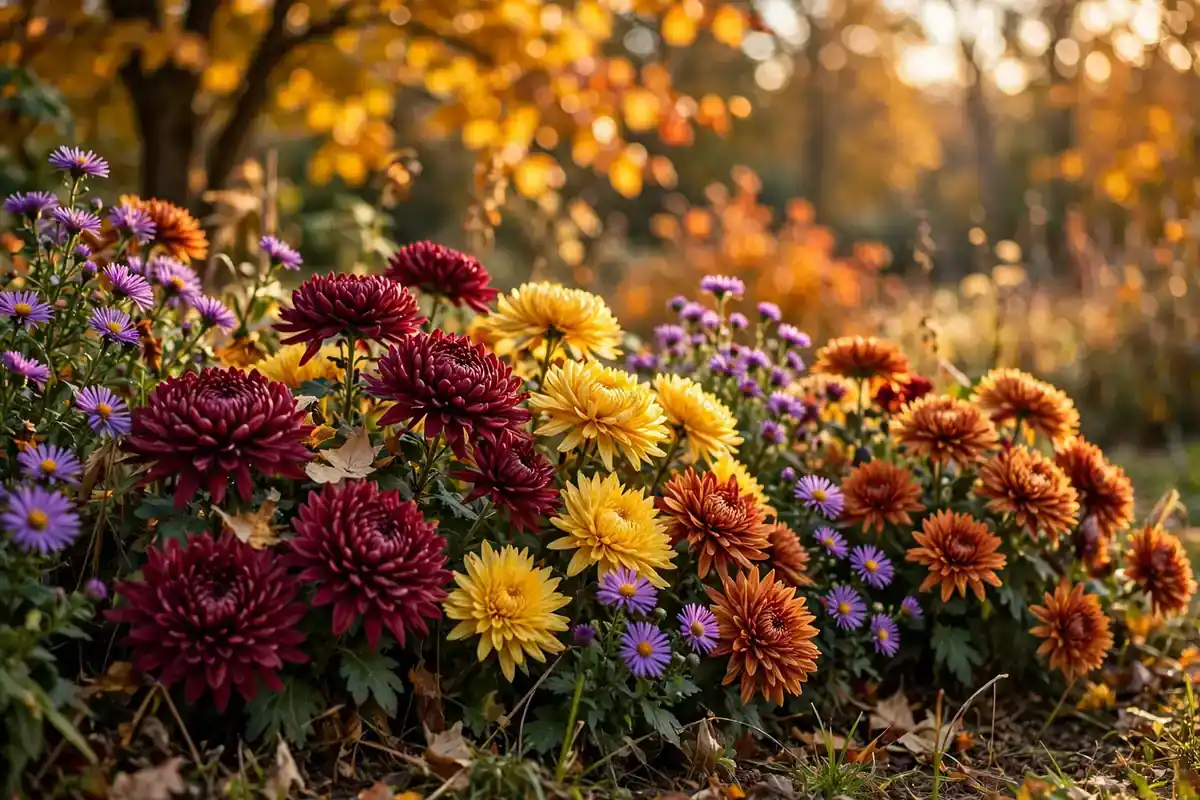
Most gardens peak in June and coast downhill from there. By late August the phlox are mildewed, the daylilies are done, and the border is mostly green. Fall flowers fix that. Planted and timed properly, a garden can be at its best in September and October — asters and mums in full color, dahlias still pumping out blooms, goldenrod feeding the last bees, and seed heads catching low evening light.
This guide lists 25 flowers that genuinely bloom in autumn — not bulbs you plant in fall for spring, but plants that flower in fall itself. Every entry gives you the botanical name, zones, size, bloom season, sun and soil needs, and one honest care note: which mums need pinching by July 4, which anemone will take over a bed, and why goldenrod is not the plant making you sneeze. If you are planning ahead, our guide to winter flowers picks up exactly where this list leaves off.
Quick Answer
The best fall flowers are garden mums, New England asters, sedum ‘Autumn Joy’, goldenrod, Japanese anemone, and dahlias — all bloom from late August through October in most climates. Plant perennials like asters, sedum, and goldenrod in spring so they establish before flowering. Annuals like marigolds, zinnias, and pansies can go in as late as August. The key timing rule: pinch mums and asters by July 4 at the latest, or they flower tall, leggy, and late.
Table of Contents
- Fall Flowers at a Glance
- When to Plant Fall Flowers
- Asters and Mums: The Backbone of Autumn
- Classic Fall Perennials
- Late Bloomers for Shade
- Fall-Blooming Bulbs and Corms
- Late-Season Annuals and Tender Plants
- Ornamental Grasses and Seed Heads
- Plant in Fall vs. Bloom in Fall
- How to Choose Fall Flowers for Your Garden
- Common Mistakes
- Frequently Asked Questions
Fall Flowers at a Glance
Use this table to shortlist plants for your zone, then read the entries below for care details. Bloom times are for a typical zone 6 garden; expect them two weeks earlier in zone 8 and later in zone 4.
| Flower | Botanical Name | USDA Zones | Height | Bloom Time |
|---|---|---|---|---|
| Garden Mum | Chrysanthemum × morifolium | 5–9 | 1–3 ft | Sep–Oct |
| New England Aster | Symphyotrichum novae-angliae | 4–8 | 3–6 ft | Aug–Oct |
| New York Aster | Symphyotrichum novi-belgii | 4–8 | 1–4 ft | Aug–Oct |
| Sedum ‘Autumn Joy’ | Hylotelephium ‘Herbstfreude’ | 3–9 | 1.5–2 ft | Aug–Oct |
| Goldenrod | Solidago rugosa ‘Fireworks’ | 4–9 | 3–3.5 ft | Aug–Sep |
| Helenium (Sneezeweed) | Helenium autumnale | 3–8 | 3–5 ft | Aug–Oct |
| Black-Eyed Susan | Rudbeckia fulgida ‘Goldsturm’ | 3–9 | 2–3 ft | Jul–Oct |
| Purple Coneflower | Echinacea purpurea | 3–8 | 2–4 ft | Jun–Sep, seed heads fall |
| Blanket Flower | Gaillardia × grandiflora | 3–10 | 1–2 ft | Jun–frost |
| Russian Sage | Salvia yangii | 4–9 | 3–4 ft | Jul–Oct |
| Joe-Pye Weed | Eutrochium purpureum | 4–9 | 5–7 ft | Jul–Sep |
| Ironweed | Vernonia noveboracensis | 5–9 | 4–6 ft | Aug–Sep |
| Blue Mistflower | Conoclinium coelestinum | 5–10 | 1.5–3 ft | Aug–Oct |
| Japanese Anemone | Eriocapitella hupehensis | 4–8 | 2–4 ft | Aug–Oct |
| Toad Lily | Tricyrtis formosana | 4–9 | 2–3 ft | Sep–Oct |
| Turtlehead | Chelone lyonii | 3–8 | 2–4 ft | Aug–Sep |
| Autumn Crocus | Colchicum autumnale | 4–8 | 6–9 in | Sep–Oct |
| Fall Crocus | Crocus speciosus, C. sativus | 6–8 | 4–6 in | Oct–Nov |
| Sternbergia | Sternbergia lutea | 6–9 | 6 in | Sep–Oct |
| Dahlia | Dahlia × pinnata | 8–11 (lift below 8) | 1–6 ft | Jul–frost |
| Marigold | Tagetes erecta, T. patula | Annual, all zones | 0.5–3 ft | Jun–frost |
| Zinnia | Zinnia elegans | Annual, all zones | 1–4 ft | Jun–frost |
| Celosia | Celosia argentea | Annual, all zones | 1–3 ft | Jun–frost |
| Ornamental Kale | Brassica oleracea | Annual, all zones | 1–1.5 ft | Foliage Sep–winter |
| Pansy | Viola × wittrockiana | 6–10 (fall annual north) | 6–9 in | Sep–Nov, again spring |
When to Plant Fall Flowers
Fall flowers confuse people because planting date and flowering date are months apart. The working rule: perennials that bloom in fall go in the ground in spring or early summer; annuals for fall color go in from spring through August; fall-blooming bulbs go in during late summer.
Plant asters, mums, sedum, goldenrod, and helenium in spring, like any other perennial. They build roots and foliage all summer, then flower when days shorten. A spring-planted mum pinched through early July will be three times the size of a September pot mum — and far more likely to survive winter, because its roots are established. Pot mums bought in full bloom are usually grown as short-lived annuals: enjoy them, but do not count on them returning.
Annuals work on a different clock. Marigolds, zinnias, and celosia planted in May still flower in October if deadheaded — or sow a second batch in July for fresher fall plants. Pansies and ornamental kale reverse the pattern: plant them in late August or September, because cool nights trigger their best color.
Fall-blooming bulbs — colchicum, fall crocus, and sternbergia — are planted in August, and they are in a hurry: colchicum corms often flower within four to six weeks of planting. Buy them early and plant them the week they arrive.
Asters and Mums: The Backbone of Autumn
If you plant nothing else from this list, plant these two groups. Mums give you the warm colors — gold, rust, burgundy, bronze — and asters give you the cool purple, violet, and pink that makes them look richer. Together they carry a border from late August to hard frost, feeding bees and migrating monarchs when almost nothing else is open. Asters anchor any collection of purple perennial flowers, because few purple plants flower so late.
1. Garden Mum (Chrysanthemum × morifolium)
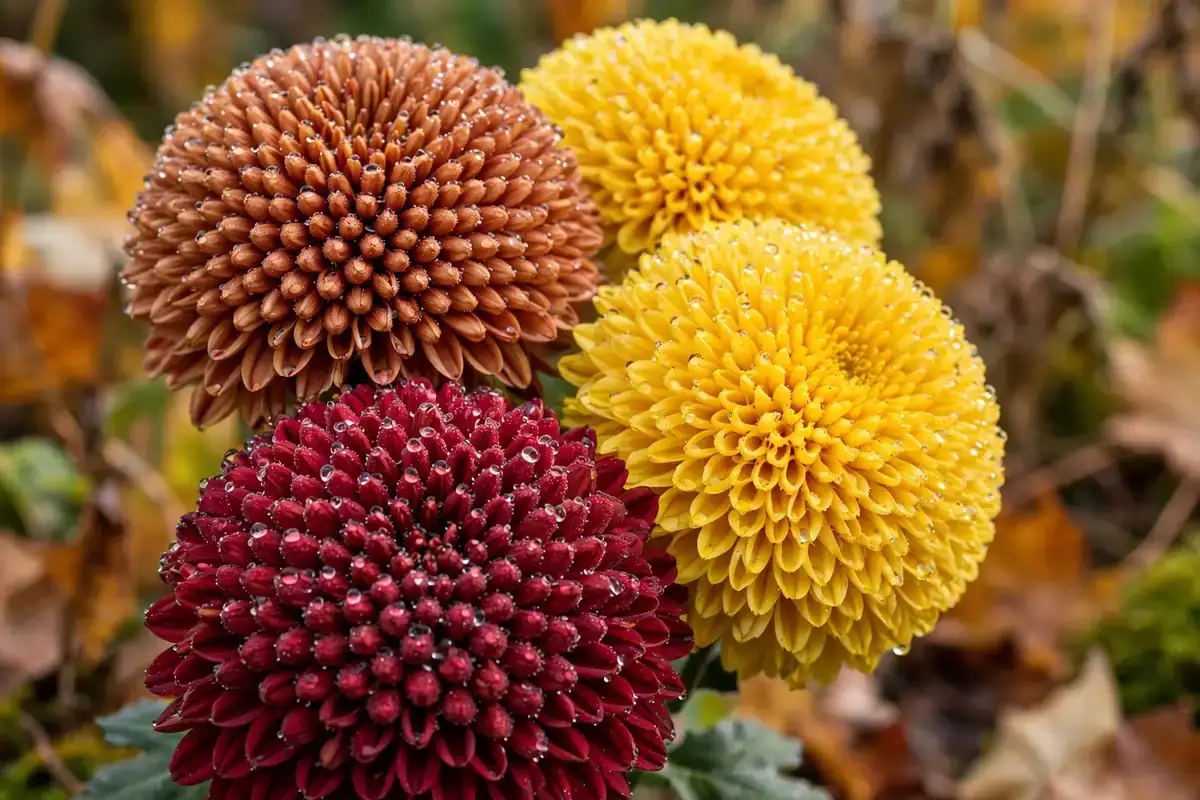
Zones 5–9 | 1–3 ft tall, 1–2 ft spread | Blooms September–October | Full sun, well-drained fertile soil. Hardy garden mums are short-day plants: they set buds as nights lengthen, which is why they flower in fall whenever you plant them. Choose named hardy varieties — Korean and Rubellum types, and modern no-pinch series — over anonymous florist pot mums if you want a perennial.
Honest care note: Pinch shoot tips every two to three weeks from late spring until July 4, then stop — later pinching removes flowering buds and pushes bloom past frost. Porch lights left on all night can also delay flowering, because mums count dark hours, not calendar dates. Our detailed mum care guide covers feeding, dividing, and winter protection step by step. The RHS chrysanthemum growing guide is a solid reference for exhibition types as well.
2. New England Aster (Symphyotrichum novae-angliae)
Zones 4–8 | 3–6 ft tall, 2–3 ft spread | Blooms August–October | Full sun, average to moist soil. This is the big aster of roadside meadows: clouds of violet-purple daisies with orange-yellow centers on tall stems. Named forms like ‘Purple Dome’ (compact, 18–24 inches) and ‘Harrington’s Pink’ keep the flower power tidier. It is one of North America’s most important fall nectar plants — on a warm September afternoon one plant will be working with bees, skippers, and monarchs at once.
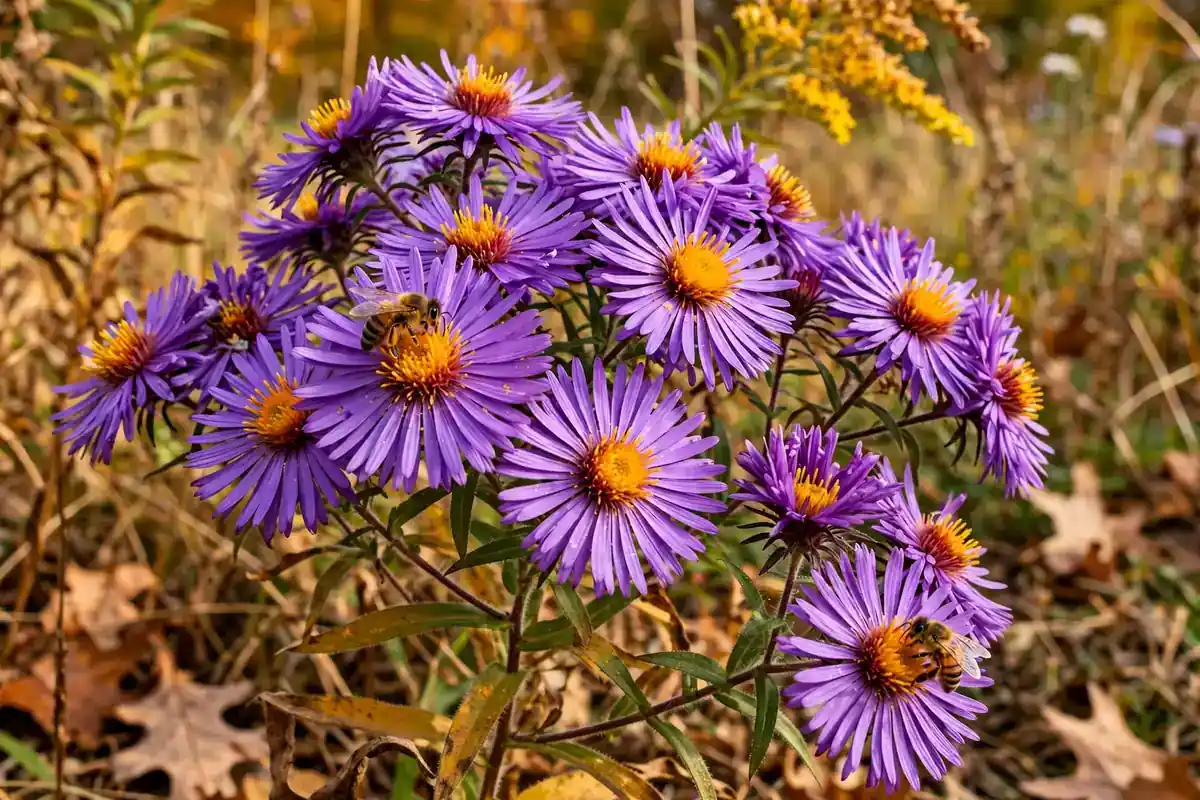
Honest care note: Tall plants get bare, mildewed lower stems by August. Hide the legs behind sedum or grasses, and cut stems back by a third in late May or June — the Chelsea chop — for shorter, sturdier growth. Grow it lean; overfed asters flop.
3. New York Aster (Symphyotrichum novi-belgii)
Zones 4–8 | 1–4 ft tall, 1.5–3 ft spread | Blooms August–October | Full sun, moist, fertile soil. The Michaelmas daisy, named for flowering around Michaelmas (September 29). It forms denser, bushier mounds than its New England cousin, in blue, lavender, pink, and white, and dwarf series stay near 12–18 inches for the front of a border. It wants consistent moisture and sulks in the dry, poor ground its cousin copes with.
Honest care note: This aster is prone to powdery mildew and spreads by rhizomes — sometimes assertively. Divide every two to three years in spring, discard the woody center, and give it air space rather than fungicide. In a small garden, grow it in a large pot sunk into the border.
Classic Fall Perennials
These are the long-season workhorses. Most start in August, several carry on from summer, and a few are grown as much for their seed heads as their flowers. Plant them in spring among your full-sun perennials and the border will not have a gap between the last daylily and the first frost.
4. Sedum ‘Autumn Joy’ (Hylotelephium ‘Herbstfreude’)
Zones 3–9 | 1.5–2 ft tall and wide | Blooms August–October | Full sun, poor to average, sharply drained soil. Flat heads of tiny pink flowers open over blue-green succulent foliage in August, deepen to salmon, then copper-red, then a russet brown that stands through winter snow. Few plants give four months of changing color for zero effort, and bees work the flowers heavily.
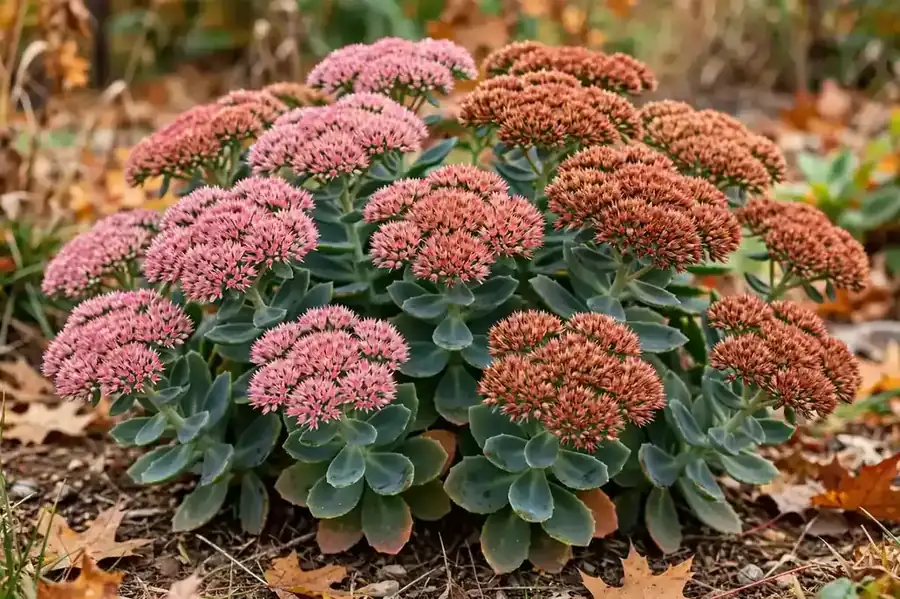
Honest care note: ‘Autumn Joy’ flops open in the middle in rich soil or part shade — the classic donut. Grow it hard: full sun, no fertilizer, lean soil. Newer upright forms like ‘Autumn Fire’ hold their shape better.
5. Goldenrod (Solidago rugosa ‘Fireworks’ and relatives)
Zones 4–9 | 3–3.5 ft tall, 2–3 ft spread | Blooms August–September | Full sun, average to dry soil. Arching sprays of tiny gold flowers that feed more native bees and migrating butterflies than almost any other fall plant. Named selections like ‘Fireworks’ and the compact ‘Little Lemon’ (12–18 inches) are clump-forming and garden-tidy, unlike the aggressive rhizome-spreading species.
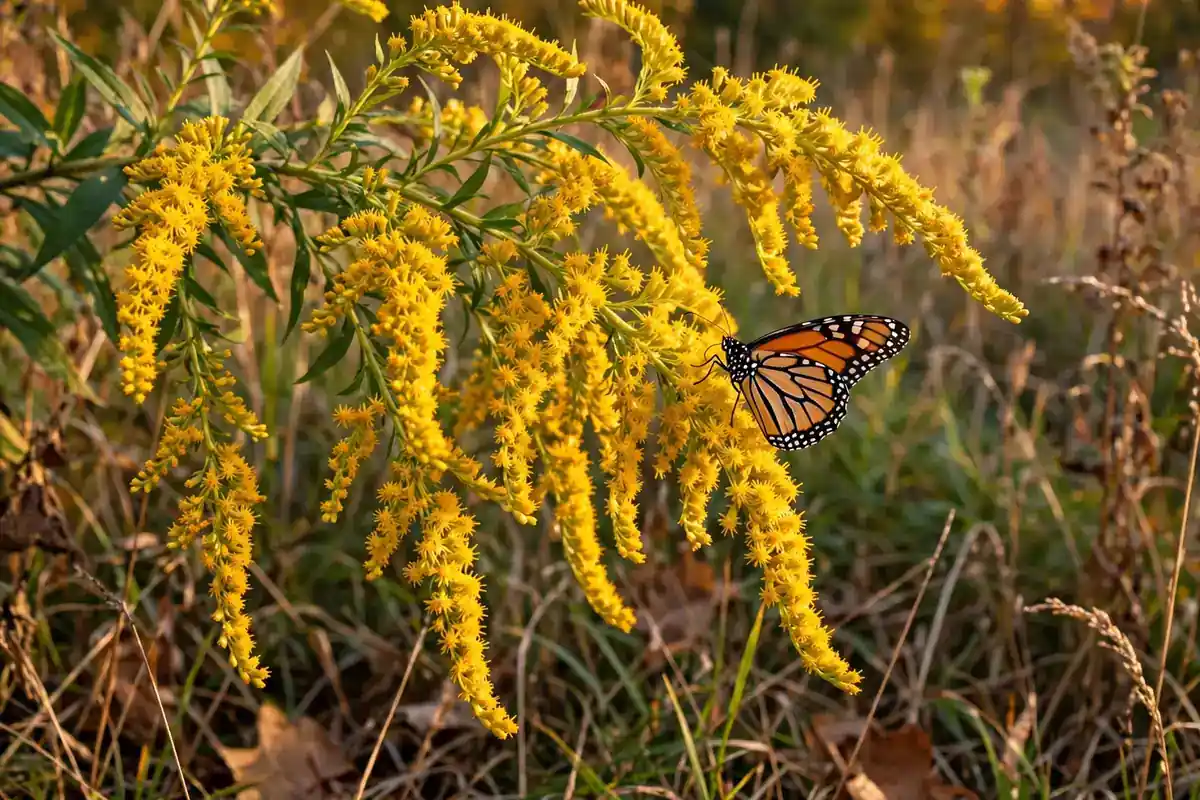
Honest care note — the allergy myth: Goldenrod does not cause hay fever. Its pollen is heavy, sticky, and moved by insects, not wind. The plant making you sneeze in September is ragweed, an inconspicuous green-flowered weed that blooms at the same time and releases clouds of wind-borne pollen. The Missouri Botanical Garden Plant Finder states this plainly in its goldenrod entries: goldenrods have been wrongfully accused of causing hay fever. Plant goldenrod without guilt — but do check the species before you buy, because Canada goldenrod (Solidago canadensis) will colonize a small garden.
6. Helenium, or Sneezeweed (Helenium autumnale)
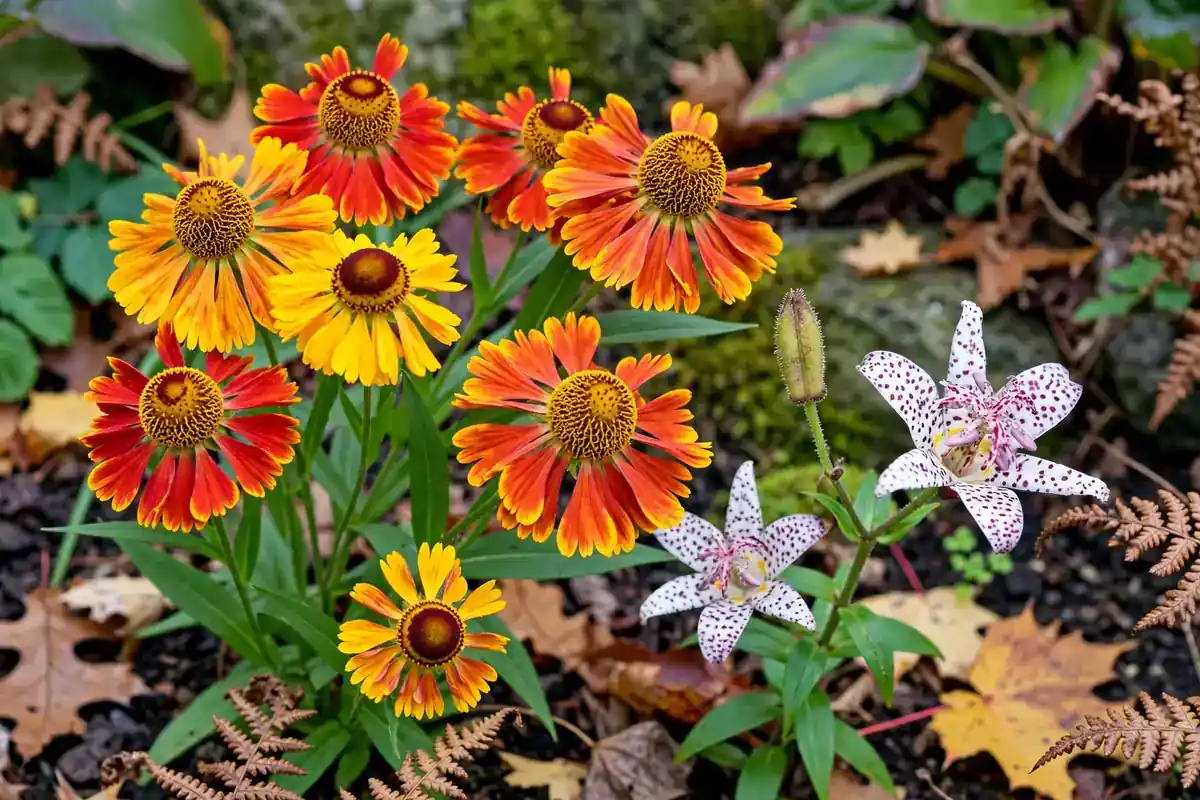
Zones 3–8 | 3–5 ft tall, 2 ft spread | Blooms August–October | Full sun, moist, fertile soil. Despite the common name, this is another unfairly blamed plant — the name comes from dried leaves once used in snuff, not from pollen. The flowers are unmistakable: reflexed petals in hot yellow, orange, and mahogany around a prominent brown cone. Cultivars like ‘Mardi Gras’ and ‘Salsa’ pack a fall bonfire into one plant, and modern short series stay near 2 feet.
Honest care note: Helenium is a moisture lover from wet meadows. In dry soil it wilts, mildews, and gives up by its second year. Water in dry spells, mulch well, divide every two to three years, and deadhead to push the display into October.
7. Black-Eyed Susan (Rudbeckia fulgida ‘Goldsturm’)
Zones 3–9 | 2–3 ft tall, 1.5–2 ft spread | Blooms July–October | Full sun, average soil. ‘Goldsturm’ starts in midsummer and refuses to stop — golden daisies with near-black cones until frost, and the cones stand all winter as bird food. A drift of it next to purple asters is the classic American fall combination.
Honest care note: It self-seeds and spreads into a solid colony — a feature or a takeover, depending on your garden size. It is also prone to leaf spot that blackens lower leaves in wet summers; it looks rough but rarely kills the plant. Cut out spotted stems and improve airflow.
8. Purple Coneflower (Echinacea purpurea)
Zones 3–8 | 2–4 ft tall, 1.5 ft spread | Blooms June–September, seed heads through fall | Full sun, well-drained soil. Coneflower earns its place twice: late flowers often continue into September, and the spiky orange-brown cones peak in autumn, when goldfinches balance on them picking out seeds. Straight species plants are tougher and better for pollinators than fancy double cultivars.
Honest care note: Do not deadhead all of it. Leave seed heads standing until spring for the birds and winter structure. Coneflowers hate wet winter soil — in heavy clay, plant high or add grit, or they rot out over winter.
9. Blanket Flower (Gaillardia × grandiflora)
Zones 3–10 | 1–2 ft tall and wide | Blooms June to frost | Full sun, poor, sharply drained soil. Red-and-yellow pinwheel flowers on a plant that blooms harder the hotter and poorer the site gets. The Arizona series flowers the first year from seed and keeps going until a hard freeze. It pairs naturally with other hot-colored flowers that start with F and fall annuals in a sunset-themed bed.
Honest care note: Blanket flower is short-lived — two to three years is normal — and dies fastest in rich, wet soil. Treat it as a fast, self-seeding perennial, not a permanent plant.
10. Russian Sage (Salvia yangii, formerly Perovskia atriplicifolia)
Zones 4–9 | 3–4 ft tall, 3 ft spread | Blooms July–October | Full sun, dry, well-drained soil. Airy lavender-blue spikes over silvery, aromatic foliage, with white stems that stay attractive into winter. Its cool blue is the best foil on this list for orange marigolds and rust mums. Compact forms like ‘Little Spire’ fit smaller gardens.
Honest care note: Russian sage resents wet winter soil. Cut it back hard in mid-spring, never in fall — hollow stems channel water into the crown. In zone 4, a dry site matters more than mulch.
11. Joe-Pye Weed (Eutrochium purpureum)
Zones 4–9 | 5–7 ft tall, 3–4 ft spread | Blooms July–September | Full sun to part shade, moist soil. A giant of the late-summer border: huge dusty-pink heads on purple-spotted stems, vanilla-scented and magnetic to swallowtails. It bridges August into September. Dwarf selections like ‘Little Joe’ bring it down to 3–4 feet.
Honest care note: On dry soil it wilts daily and mildews. Give it a low spot, pond edge, or rain garden, and room to be big — keeping full-size Joe-Pye small defeats the point of planting it.
12. Ironweed (Vernonia noveboracensis)
Zones 5–9 | 4–6 ft tall, 2–3 ft spread | Blooms August–September | Full sun, moist to average soil. Intense violet-purple clusters on iron-stiff stems that never need staking. Common in eastern meadows but still underused in gardens, it is one of the last strong nectar sources for migrating monarchs.
Honest care note: It emerges late in spring, so mark the spot before planting over it in April. A Chelsea chop in June produces a manageable 3-foot plant that flowers a little later, right into fall.
13. Blue Mistflower (Conoclinium coelestinum)
Zones 5–10 | 1.5–3 ft tall, spreading | Blooms August–October | Full sun to part shade, moist soil. Fluffy powder-blue heads like a hardy bedding ageratum, blooming later than almost anything else here and still fresh when the asters finish. Butterflies use it heavily, and it lights up a moist border in October, when blue flowers are rare.
Honest care note: This plant spreads — rhizomes run and it self-seeds into a colony. Superb for a wild edge or rain garden, a menace in a tidy small border. Plant it where it can roam, or in a buried pot.
Late Bloomers for Shade
Fall color is not only a sunny-border game. Three distinctive autumn flowers prefer shade or woodland edges, blooming when shade gardens are usually finished. If you collect odd, elegant plants — the kind in our list of unusual and beautiful flowers — start here.
14. Japanese Anemone (Eriocapitella hupehensis, formerly Anemone hupehensis)
Zones 4–8 | 2–4 ft tall, spreading | Blooms August–October | Part shade, moist, humus-rich soil. Saucer-shaped pink or white flowers with golden stamens, on wiry stems above mounds of grape-like leaves. They flower for six weeks or more and look best in soft light under high trees. ‘Honorine Jobert’ (white) and ‘September Charm’ (silvery pink) are the two to know.
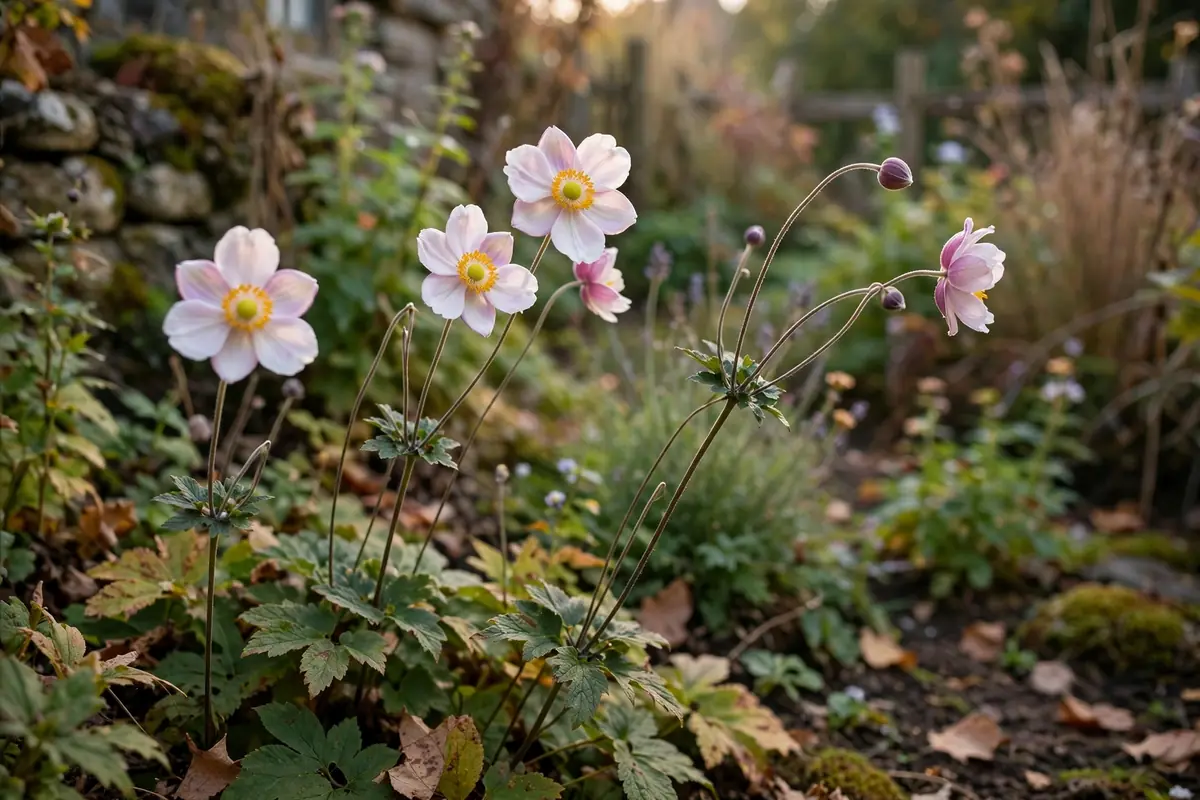
Honest care note — the spread warning: Established plants spread by running roots and can take over a mixed border — every root fragment left behind grows a new plant. Give them their own space, a spot among shrubs, or a large container. They also take a season to settle: a plant that sulks in year one often explodes in year two.
15. Toad Lily (Tricyrtis formosana and T. hirta)
Zones 4–9 | 2–3 ft tall, 1.5–2 ft spread | Blooms September–October | Part to full shade, moist, rich soil. Orchid-like, star-shaped flowers, white to pale lilac and heavily spotted with purple, in early fall when the shade garden has nothing else in flower. The flowers are small — an inch or so — so plant them beside a path or bench where you will actually see them.
Honest care note: Slugs shred the foliage in wet seasons. The bigger killer is dry soil: toad lilies in dry shade under thirsty tree roots simply fail to flower. Mulch deeply and water in dry spells.
16. Turtlehead (Chelone lyonii)
Zones 3–8 | 2–4 ft tall, 1.5–2.5 ft spread | Blooms August–September | Part shade to full sun, moist to wet soil. Hooded pink flowers that resemble a turtle’s head poking out of its shell, on glossy, disease-resistant foliage. It hosts the Baltimore checkerspot butterfly and is one of the best fall flowers for a wet corner where most perennials rot. ‘Hot Lips’ has the deepest pink flowers.
Honest care note: Planted in dry border soil it stays stunted and may not flower at all. Give it a ditch, pond margin, or downspout bed, and it spreads slowly into a solid, weed-proof clump.
Fall-Blooming Bulbs and Corms
A small group breaks the bulb rule: these are planted in late summer and flower that same autumn, weeks later — the fastest gratification in gardening, and the easiest to miss, because garden centers stock them for only a few weeks in August. Note the distinction: these bloom in fall. Tulips and daffodils are planted in fall but bloom in spring (see the section below).
17. Autumn Crocus (Colchicum autumnale)
Zones 4–8 | 6–9 in tall | Blooms September–October | Full sun to part shade, well-drained soil. Big, goblet-shaped lilac-pink flowers that appear directly from bare ground with no leaves at all — hence the name “naked ladies” in some regions. The strap-shaped leaves arrive in spring and die back by midsummer, which is why the fall flowers seem to come from nowhere. ‘Waterlily’ is a popular double form.
Honest care note: All parts are poisonous, including to pets — plant it out of reach of toddlers and grazing animals, and wear gloves handling corms. Plant in August, only 3–4 inches deep; planted too late or too deep, they flower weakly the first year.
18. Fall Crocus (Crocus speciosus and Saffron Crocus, C. sativus)
Zones 6–8 | 4–6 in tall | Blooms October–November | Full sun, gritty, well-drained soil. True crocuses that flower in autumn, not spring. Crocus speciosus gives violet-blue goblets with feathery orange stigmas. Saffron crocus adds a harvest: each bloom produces three red stigmas — the saffron threads — picked on a dry morning and dried indoors. About 50 flowers make one gram, so grow it as a pleasure, not a business plan.
Honest care note: Corms rot in heavy, wet winter soil and get dug up by squirrels and voles. Plant in gritty soil or pots, and cover new plantings with wire mesh until shoots appear.
19. Sternbergia (Sternbergia lutea)
Zones 6–9 | About 6 in tall | Blooms September–October | Full sun, hot, sharply drained soil. Often called the fall daffodil, though the flower looks more like a golden-yellow crocus on a short stem. From dry Mediterranean hillsides, it multiplies steadily in a hot, baked spot — a south wall base, gravel garden, or rockery — and flowers every fall for decades.
Honest care note: Sternbergia fails for one reason only: kindness. Rich, watered border soil rots it. Plant in late summer in your leanest, driest, sunniest ground, leave undisturbed, and do not water in summer dormancy.
Late-Season Annuals and Tender Plants
Perennials build the structure, but annuals give fall its saturated color — and they are the fastest fix for an empty September border. Several summer annuals improve as nights cool, and two plants here are grown specifically for fall. Dahlias and marigolds also double as classic purple annual flowers in their violet and burgundy forms, so one planting can serve two color schemes.
20. Dahlia (Dahlia × pinnata hybrids)
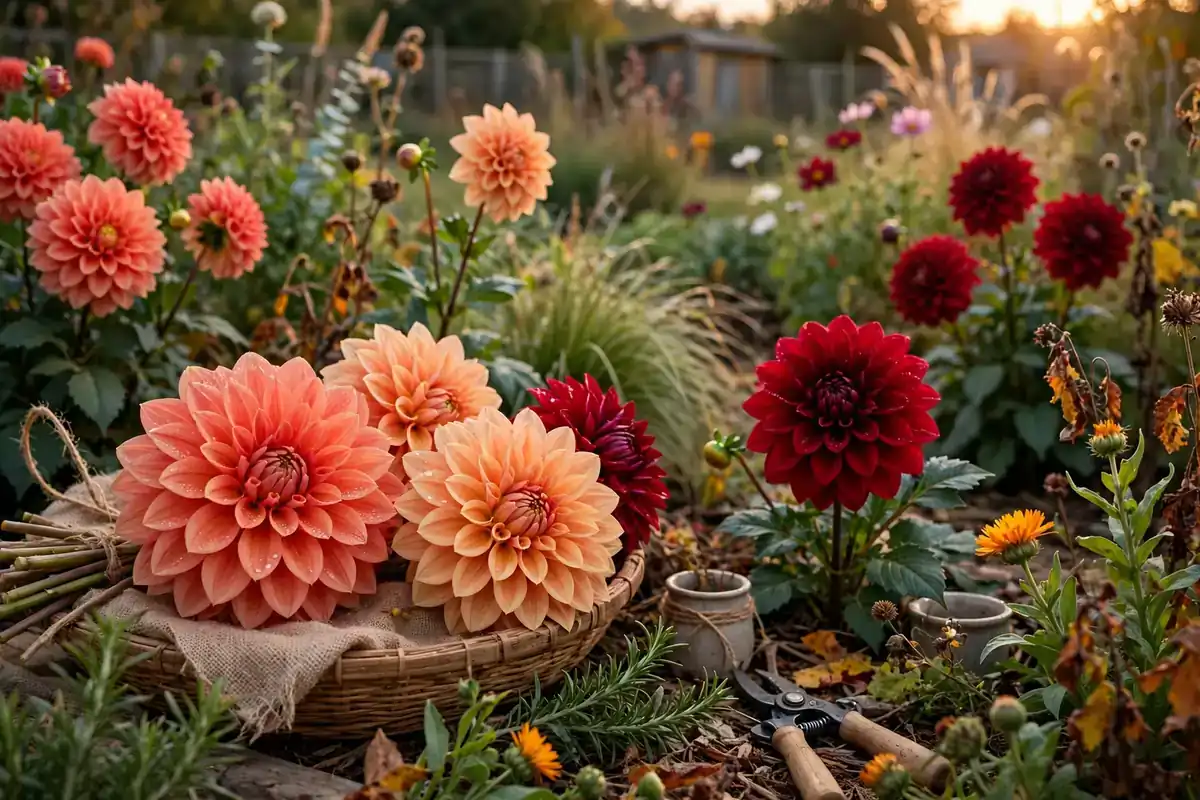
Zones 8–11 as perennials; grown as annuals elsewhere | 1–6 ft tall | Blooms July to first frost | Full sun, rich, well-drained soil. Dahlias hit their stride in fall. Summer heat slows them; cool September and October nights produce their biggest, most intensely colored flowers, until the first frost blackens the foliage overnight. From 2-inch pompons to 10-inch dinner plates, in every color except true blue, nothing matches them for cutting.
Honest care note: In zones 7 and colder, dahlias are a commitment: dig tubers after first frost, dry them a day, and store in barely damp peat in a cool, dark place, checking monthly for rot. Skip the digging and you buy new tubers every spring — which many gardeners happily do.
21. Marigold (Tagetes erecta and T. patula)
Annual in all zones | 6 in–3 ft tall | Blooms June to frost | Full sun, average soil. The workhorse of Day of the Dead altars and fall containers. African marigolds (T. erecta) give big pompon heads in orange and gold on 2–3 ft plants; French marigolds (T. patula) are compact edging plants in mahogany, rust, and bicolors. Cool weather deepens their colors.
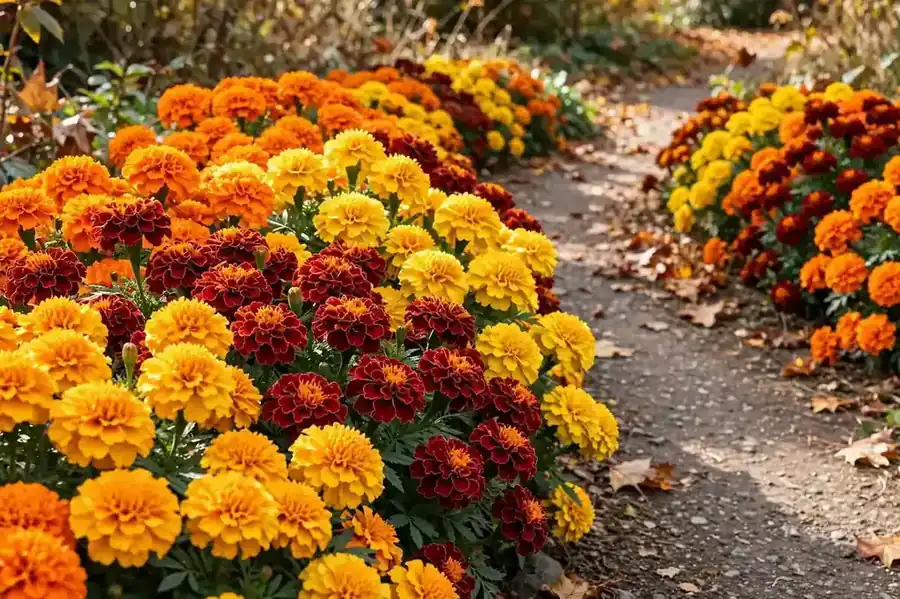
Honest care note: A July sowing or August transplants look far better in October than May-planted marigolds, which by fall are often mite-riddled and woody. Deadhead, and hose mites off leaf undersides hard if you find webbing.
22. Zinnia (Zinnia elegans)
Annual in all zones | 1–4 ft tall | Blooms June to frost | Full sun, fertile, well-drained soil. Zinnias flower until frost stops them, and monarchs know it — a September zinnia patch is a fueling station. Keep cutting and the plant keeps branching; a bed cut hard in late August throws a fresh fall flush. Tall cutting types outperform dwarf bedding types in autumn.
Honest care note: Powdery mildew whites out zinnia foliage by late summer in humid climates. Water at the base, space for airflow, and choose mildew-resistant series (Profusion, Zahara) for bedding. A mildewed plant still flowers — it just looks tired doing it.
23. Celosia (Celosia argentea)
Annual in all zones | 1–3 ft tall | Blooms June to frost | Full sun, warm, well-drained soil. Plumed and crested celosias in scarlet, orange, gold, and magenta, with a texture between a flame and a piece of coral. Celosia loves heat, then holds its color into fall because the heads dry on the plant rather than collapsing. Cut stems also dry beautifully for winter arrangements.
Honest care note: Celosia seedlings stall permanently if roots are cramped or chilled in spring. Buy fresh, uncrowded transplants, plant only after nights are reliably warm, and do not let them dry out in their first two weeks.
24. Ornamental Kale and Cabbage (Brassica oleracea)
Annual in all zones | 1–1.5 ft tall and wide | Color September through winter | Full sun, fertile soil. The one entry grown for foliage, not flowers: tight rosettes whose centers turn pink, purple, red, and cream as nights drop below 50°F (10°C). It looks better after frost than before it, survives light snow, and carries beds from October into December, when even pansies have quit.
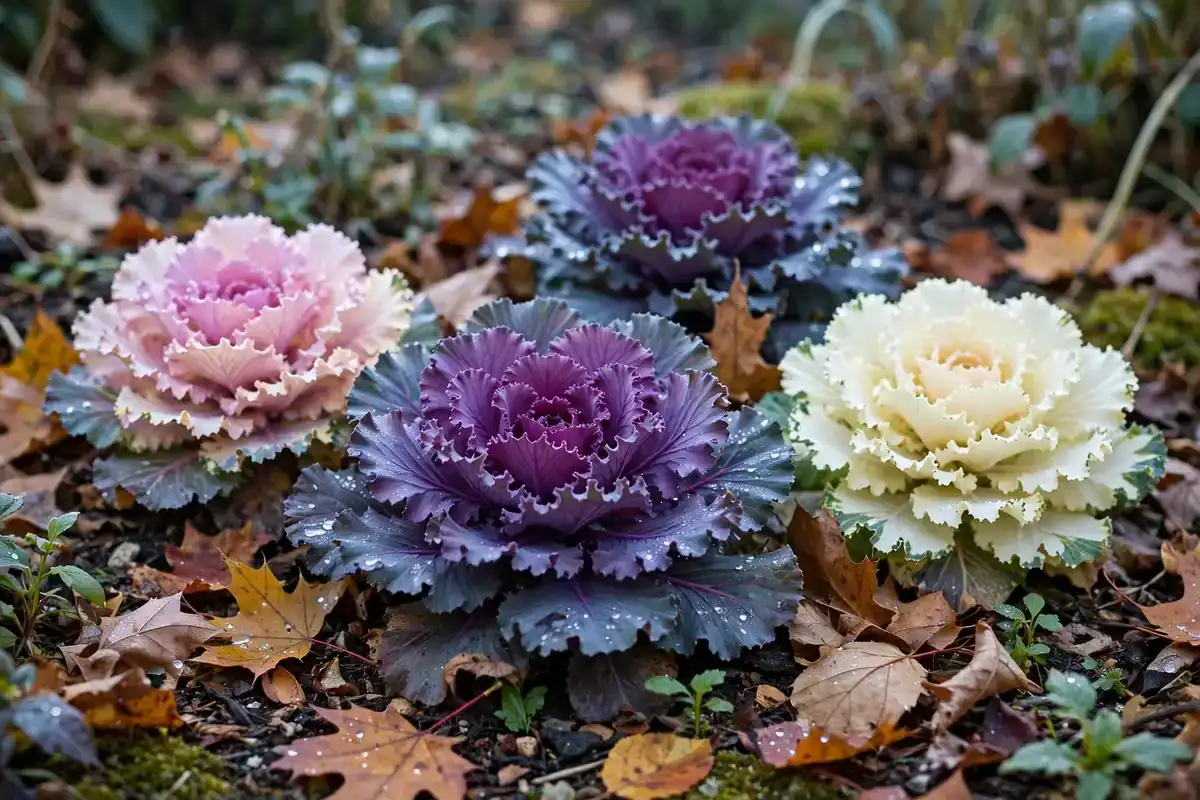
Honest care note: Plant it in late August or September — planted early in summer heat, it bolts and stays green. Cabbage worms treat it as food because it is food (an edible brassica bred for looks), so check leaf undersides and pick worms off by hand.
25. Pansy (Viola × wittrockiana)
Zones 6–10; a fall annual in cold zones | 6–9 in tall | Blooms September–November, often again in spring | Full sun to part shade, moist, fertile soil. Plant pansies in early fall and you get two shows: a fall flush until hard freeze, and — in zones 6 and warmer, with mulch — an early spring encore from the same plants. Cool nights intensify the colors, and modern series shrug off frosts that kill summer bedding.
Honest care note: Fall pansies must go in while soil is still warm — by mid-September in zone 6, earlier further north — so roots establish before winter. Pansies dropped into cold October soil sulk, then heave out over winter. Water new plantings for the first month.
Ornamental Grasses and Seed Heads
Fall flowers look twice as good with ornamental grasses behind them. Grasses are companions, not entries on the list of 25, but no autumn border is complete without their plumes and movement — and they peak at the same moment.
Pink muhly grass (Muhlenbergia capillaris, zones 6–9) produces a floating cloud of pink haze in September and October. Little bluestem (Schizachyrium scoparium, zones 3–9) turns coppery red-purple with fluffy white seed heads. Switchgrass (Panicum virgatum, zones 4–9) gives airy panicles and yellow fall color. Fountain grass (Pennisetum alopecuroides, zones 5–9) arches bottlebrush plumes from August onward. Plant grasses in spring and cut them down in late winter, not fall — the birds and structure are worth more than a tidy November bed.
Seed heads do the same job for free. Resist deadheading everything in September: coneflower cones feed goldfinches, sedum heads stand through snow, and black-eyed Susan cones carry a border into winter. A garden cut to the ground by October has given away half its season.
Plant in Fall vs. Bloom in Fall
These two phrases get mixed up constantly, because fall is peak selling season for both groups. Keep them straight:
- Bloom in fall (this article): mums, asters, goldenrod, anemones, dahlias, colchicum, fall crocus. You buy these for flowers in September and October. Perennials are best planted in spring; fall purchases in bloom are fine for instant color but establish less reliably.
- Plant in fall, bloom in spring: tulips, daffodils, hyacinths, alliums, and spring crocus. Fall planting gives them the winter chill they require. They will show you nothing but soil and mulch until March, and that is correct — do not dig them up in November to check.
- Both: pansies and ornamental kale are planted in fall and display in fall. Perennials can also be planted in early fall, given six weeks of root growth before the ground freezes — but they will not flower that fall.
The takeaway: if a September plant tag promises spring flowers, plant it for next year — but do not expect it to rescue this autumn’s border. For color now, you need the bloom-in-fall group, plus annuals.
How to Choose Fall Flowers for Your Garden
- Short on space or growing in pots? Dwarf New York asters, cushion mums, ‘Little Lemon’ goldenrod, ornamental kale, and pansies. Pots of mums and kale by a front door are the fastest fall display there is.
- Want pollinators and monarchs? New England aster, goldenrod, ironweed, Joe-Pye weed, and blue mistflower. Single flowers beat doubles — bees cannot reach nectar in a tight pompon mum.
- Dry, sunny, poor soil? Sedum, blanket flower, Russian sage, goldenrod, and sternbergia. These five resent rich, wet ground and thrive on neglect.
- Wet soil or a rain garden? Joe-Pye weed, turtlehead, helenium, ironweed, and blue mistflower all want moisture most fall flowers cannot stand.
- Shade under trees? Japanese anemone, toad lily, and turtlehead, with fall crocus and colchicum dotted through groundcover at their feet.
- Cut flowers? Dahlias first, then mums, zinnias, celosia (which also dries), and helenium. Cut in the morning; sear dahlia stem ends in hot water for 30 seconds and they last a week.
- Lowest maintenance? Sedum ‘Autumn Joy’, goldenrod ‘Fireworks’, coneflower, and black-eyed Susan, left standing all winter and cut down once in spring. That is the whole program.
Whatever you choose, buy fall perennials in spring when you can: they cost less, the selection of named varieties is better, and the plant gets a full season of root growth before it has to perform.
Common Mistakes
- Pinching mums and asters too late. Every pinch after July 4 delays flowering. Stop by Independence Day in the US (early July anywhere) and let buds form.
- Expecting pot mums to be perennial. A mum bought in full bloom in October has spent its energy on flowers, not roots. Plant spring mums for permanence; treat fall pot mums as long-lasting annuals.
- Blaming goldenrod for allergies. It is ragweed. Removing goldenrod does nothing for your sneezing and removes one of the best fall pollinator plants from your garden.
- Planting a spreading goldenrod or mistflower without room. Spreading species colonize a small border. Choose clump-forming selections, or give spreaders a wild corner.
- Cutting everything down in October. You remove bird food, winter structure, and crown insulation. Leave perennials standing until spring unless disease forces cleanup.
- Watering overhead in fall. Cool nights plus wet foliage equals mildew on asters and zinnias. Water at the base, in the morning.
- Confusing plant-in-fall bulbs with fall flowers. Tulips planted in October bloom in April. For color this fall, plant colchicum, pansies, and mums — not daffodils.
Frequently Asked Questions
What flowers bloom in the fall?
The main fall-blooming flowers are chrysanthemums, asters, sedum, goldenrod, helenium, Japanese anemone, dahlias, marigolds, zinnias, and pansies, plus specialists like toad lily, colchicum, and fall crocus. Most begin in late August or September and continue until hard frost — in zone 6, six to eight weeks of bloom. See the at-a-glance table above for zones and bloom times for all 25.
When should I plant fall flowers?
Plant fall-blooming perennials (asters, mums, sedum, goldenrod) in spring so they establish before flowering, and pinch until July 4. Plant annuals in May for a long season, or put in fresh marigold, zinnia, pansy, and kale transplants in August. Plant fall-blooming bulbs — colchicum, fall crocus, sternbergia — in August; they flower weeks later.
Do mums come back every year?
Hardy garden mums planted in spring in zones 5–9 come back and get bigger each year. Mums bought in full bloom in fall often do not survive winter, even if the tag says hardy, because they had no time to root before freezing. To give one its best chance, plant immediately, water deeply, and mulch after the ground freezes.
Is goldenrod bad for allergies?
No. Goldenrod pollen is heavy and insect-carried; it barely becomes airborne. Fall hay fever is caused mainly by ragweed, which blooms at the same time, has dull green flowers most people never notice, and releases huge amounts of wind-borne pollen. Allergy sufferers can plant goldenrod safely.
What fall flowers are best for bees and butterflies?
New England aster, goldenrod, ironweed, Joe-Pye weed, blue mistflower, and sedum, roughly in that order. Choose single-flowered varieties — tightly doubled mums and dahlias offer little accessible nectar. Keep a mix flowering from August through October, because migrating monarchs and late bumblebee queens need fuel all season.
One Comment