Edelweiss Flower: Meaning, Types and How to Grow the Alpine Star
A white woolly star that grows where almost nothing else dares — on limestone cliffs two miles above the sea, in blizzards of ultraviolet light. Edelweiss is the Alps made into a flower: the badge of mountain troops, the coin in Austrian pockets, the love-token young men once risked cliffs to fetch, and the song that closes The Sound of Music.
It is also, in the wild, a protected plant — picking it is illegal across its native range. The good news: modern garden forms let you grow the legend legally in a rock garden at sea level. This guide covers what edelweiss is, the six kinds worth knowing, what it means (courage and devotion), and the one trick to growing it — drainage sharp enough to mimic a cliff.
Quick Answer
An edelweiss flower is the white star-shaped bloom of Leontopodium alpinum, a high-mountain plant of the Alps and other Eurasian ranges, in the daisy family. The white “petals” are actually woolly bracts (modified leaves) surrounding clusters of tiny yellow florets — the felt protects the plant from intense alpine UV, cold and drying wind. Edelweiss grows 6 to 12 inches tall in USDA zones 4 to 7, flowering in summer, and demands sharply drained, gritty, preferably alkaline soil: winter wet kills more edelweiss than winter cold ever will. Wild plants are legally protected — never pick them; grow cultivated forms instead.
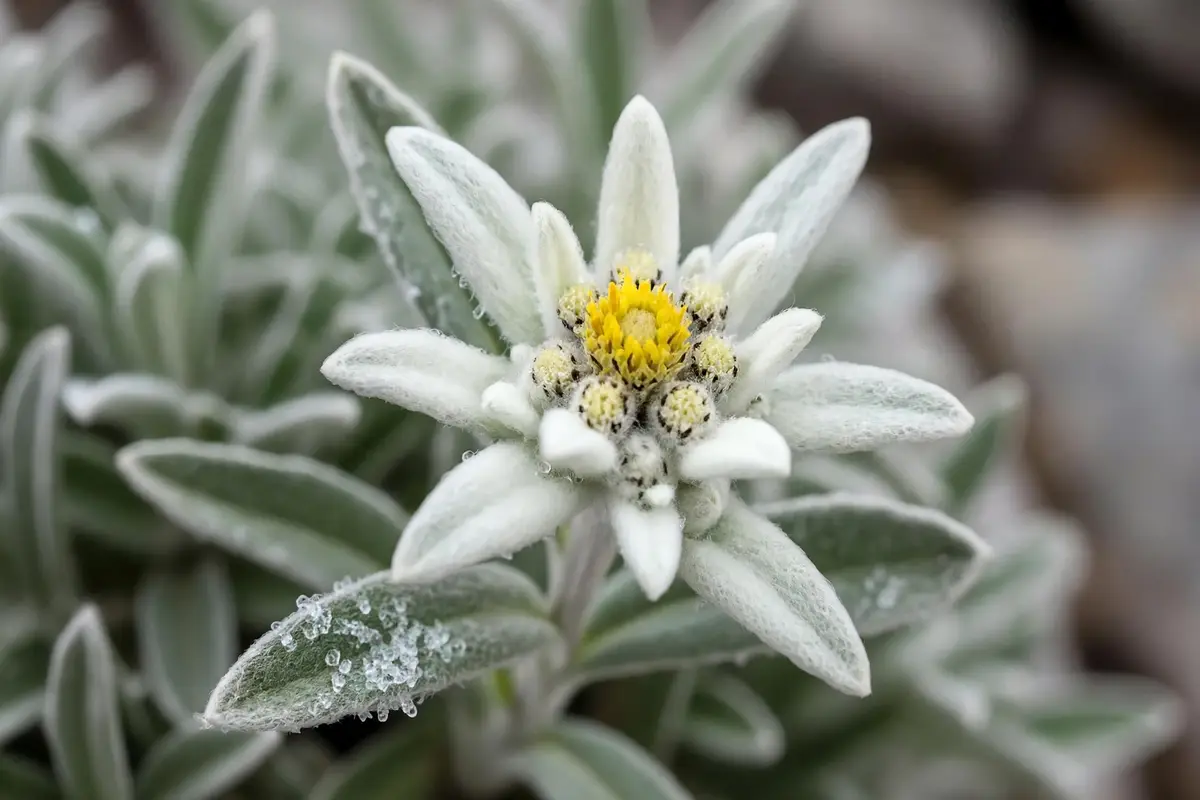
Table of Contents
- What Is an Edelweiss Flower?
- Types of Edelweiss and 6 Kinds Worth Knowing
- Edelweiss Flower Meaning and Symbolism
- Edelweiss Flower Colours and Their Meanings
- How to Grow Edelweiss
- Common Mistakes When Growing Edelweiss
- Where to See Edelweiss — the Protected Flower
- Frequently Asked Questions
What Is an Edelweiss Flower?
Edelweiss is Leontopodium alpinum (often classed as L. nivale subsp. alpinum), a member of the daisy family, Asteraceae, native to the high Alps, Pyrenees, Carpathians and Balkan ranges, with some forty relative species scattered across the mountains of Europe and Asia as far as the Himalayas and Siberia. The name is German: edel, “noble”, + weiß, “white”. The scientific name tells the other half of the story: Leontopodium is Greek for “lion’s paw” — the felted flower head squeezed in a hiker’s fingers really does feel like a tiny paw. You can read more on the Edelweiss page on Wikipedia.
Everything about the plant is alpine engineering. The dense white wool that makes the star is a blanket against the three killers of altitude: fierce ultraviolet (the felt contains compounds that absorb UV, including leontopodic acid — the same antioxidant now prized in skincare), freezing nights, and desiccating wind. The true flowers are the modest yellow clusters at the star’s centre; the white bracts are the billboard, visible to pollinating flies across a grey scree. At home altitudes of 6,500 to 10,000 feet, it blooms June to September amid limestone rocks — and it became so emblematic that Austria puts it on the 2-cent euro coin, mountain soldiers wear it as their badge, and Switzerland and Austria both claim it as a national symbol.
Edelweiss Flower Quick Facts
- Botanical name: Leontopodium alpinum (syn. L. nivale subsp. alpinum).
- Family: Asteraceae, the daisy family.
- Hardiness: USDA zones 4 to 7.
- Height: 6 to 12 inches, in neat felty rosettes.
- Bloom time: summer (June to September in the wild).
- Sun and soil: full sun; gritty, alkaline, sharply drained — cliff conditions.
- Good to know: legally protected in the wild — picking is prohibited; cultivate, never collect.
Types of Edelweiss and 6 Kinds Worth Knowing
The wild species, its two great garden forms, its Asian cousins, and the flower’s second career. The table separates them; the profiles follow. For the full list of flower names, see our flower names A to Z guide.
| Type | What it is | Flowers | Height | Best use |
|---|---|---|---|---|
| L. alpinum (species) | The wild Alpine edelweiss | White woolly stars, yellow centre | 6–12 in | Rock gardens (nursery seed only) |
| ‘Blossom of Snow’ | Modern garden selection | Large stars, repeat bloom | 10–16 in | Borders, cutting, pots |
| ‘Matterhorn’ | Compact selection | Early, tight white stars | 6–8 in | Troughs, edging |
| L. himalayanum | Himalayan edelweiss | White stars, felted rosettes | 8–12 in | Alpine houses, specialists |
| L. japonicum | Japanese edelweiss | White stars on leafy stems | 12–18 in | Woodland-edge rockeries |
| Skincare edelweiss | L. alpinum extract | Cultivated in Alpine farms | — | Anti-ageing cosmetics |
1. The Species — the Wild Alpine Star
The original, exactly as it grows between the limestone boulders: small, dense, intensely white stars on short stems, felted all over. Nursery plants raised from seed of cultivated stock bring the wild flower legally to the rock garden. The species is the most demanding of the set in one way — it insists on its poverty: rich soil and winter rain make it lush, leggy and short-lived, where cliff treatment keeps it tight and perennial.
2. ‘Blossom of Snow’ — the Garden-Ready Edelweiss
The selection that changed edelweiss from a specialist’s trophy to a garden plant: bred in Germany, it produces notably larger white stars (up to 3 inches across) over a long season, with repeat flowering and a vigour that tolerates ordinary border soil as long as drainage is right. It is the form grown for cutting and for the cosmetics trade — and the one to buy if you want the Sound-of-Music flower without the alpine-house fuss.
3. ‘Matterhorn’ — the Compact Form
A neat, early-flowering selection forming tight rosettes with flowers held close — built for troughs, alpine sinks and the front of scree beds where its bigger cousins would sprawl. Everything the species teaches (starvation soil, sharp drainage, winter dryness) applies double at this scale: a waterlogged trough in January is the end of the story.
4. Himalayan Edelweiss — Leontopodium himalayanum
From the highest flora on earth: the edelweiss clan continues across the Himalayas, where L. himalayanum felts itself against even fiercer UV at up to 16,000 feet. Rarely grown outside alpine houses and botanic collections, but proof the genus is a mountain strategy, not a single flower — woolly white stars evolved wherever the air got thin.
5. Japanese Edelweiss — Leontopodium japonicum
The eastern cousin grows taller and leafier, in mountain meadows rather than bare cliffs, carrying its white stars on stems up to 18 inches. It tolerates a touch more moisture and shade than the Alpine species — the bridge between the edelweiss legend and ordinary garden conditions, and a favourite of Japanese alpine gardeners.
6. Skincare Edelweiss — the Extract Story
The wool’s UV shield turned out to be chemistry humans want: leontopodic acid and related antioxidants survive in the bracts, and edelweiss extract now fronts premium anti-ageing creams. Because wild collection is banned, the cosmetics industry farms edelweiss in high Swiss and Austrian fields — the protected flower became a mountain crop, one of the happier endings in plant conservation, and the reason the legend now sits on our white flowers list with a farm-to-face story nobody predicted.
Edelweiss Flower Meaning and Symbolism
Edelweiss means courage, devotion and purity — and it may be the only flower whose meaning was earned in person. In the folklore of the Alps, the stars grew on cliffs no sane person would climb; a young man who brought one down for his beloved had literally proved his love and his nerve, and more than a few never came back. The flower pinned to a hat or pressed in a letter said what words could not: I dared, for you. The name itself (noble-white) carries the purity half of the message, and the armies of the mountains adopted the rest — Austrian and German mountain troops have worn the edelweiss badge since the First World War as the sign of soldiers who belong to the high places.
Rodgers and Hammerstein gave the flower its global second life in 1959: the “Edelweiss” song in The Sound of Music — Captain von Trapp’s love-letter to Austria itself — fixed the little white star in the world’s mind as home, blessing and quiet defiance (“bless my homeland forever”). Send or plant edelweiss for devotion with backbone: congratulations to the brave, loyalty to the steadfast, and remembrance of everyone whose love was proved rather than promised.
Edelweiss Flower Colours and Their Meanings
Edelweiss is a one-colour flower — the discipline is part of its charm:
- White — purity, courage and devotion: the only true edelweiss colour, the “noble white” of its name.
- Silver-grey foliage — endurance and remembrance: the felted leaves are the mountain winter carried through summer.
- The yellow centre — the heart of the Alps: the tiny true flowers at the star’s core, gold like the larch light of autumn.
Anyone selling pink or blue “edelweiss” is selling something else — among the surest field marks of the genuine plant is that it never colours.
How to Grow Edelweiss
Grow it like a cliff, and the legend becomes a straightforward rock-garden plant. Gardeners on r/gardening on Reddit sum the species up as “the flower that dies of kindness” — every failure is luxury: rich soil, generous water, a cosy winter mulch.
Site and Soil — Build the Cliff
Full sun, and the sharpest drainage you can build: a rock garden, raised bed, trough or scree slope of gritty soil — half grit or coarse sand by volume is not too much — ideally alkaline (add limestone chippings if your soil is acid). Plant in spring, setting the rosette exactly at soil level (buried crowns rot), and top-dress with a gravel collar that keeps the wool dry at the neck. In the ground or a pot, the rule is the same one that governs our fall flowers bulb plantings: water must pass through, never sit.
Care Through the Year
Water in dry spells during the first season only; afterwards the rosettes are drought-proof by design. Never feed — a starved edelweiss is a tight, white, long-lived edelweiss, and a fed one is a brief green disappointment. The real killer is winter wet: in rainy winter climates, grow it in a pot under an eave, or cover the crowns with a pane of glass or an open cloche from November to March (snow itself is fine — snow is dry; it is the cold rain that rots the felt). Plants are short-lived perennials (two to four years is honest), so let a flower or two set seed each year and scatter it on the gravel — edelweiss self-renews beautifully when the surface stays gritty, and fresh seedlings keep the colony young.
Growing from Seed
Sow fresh seed on the surface of gritty compost in late winter — the seed needs light and a spell of cold to germinate (a few weeks in a cold frame or fridge does it). Prick out into gritty pots and grow on a full season before planting out; first flowers usually come in the second summer. Choose garden selections (‘Blossom of Snow’ seed strains, ‘Matterhorn’) for reliability, and never buy any plant or seed offered as wild-collected — the protected status is real, and cultivated stock is better garden material anyway.
Common Mistakes When Growing Edelweiss
The classic mistake is planting edelweiss in a normal border: average soil, average moisture, company of thirsty perennials — it lingers a season and rots in the first wet winter. The second is mulching with compost or bark against the crown, a warm wet blanket on a plant built for cold dry stone; gravel is the only mulch it wants. The third is overwatering in summer “because everything else is thirsty” — the felt rosettes sulk and melt in humid heat; water the neighbours, skip the star.
And the fourth mistake is not about gardens at all: picking it on a hike. However abundant a slope looks, wild edelweiss is protected by law across the Alps and Carpathians, collection can draw real fines, and the colonies recover slowly at altitude. Photograph it, by all means — against the limestone, it photographs like a flag.
Where to See Edelweiss — the Protected Flower
In flower from June to September, between roughly 6,500 and 10,000 feet: limestone ridges and rocky meadows in the Austrian, Swiss, French and Italian Alps, the Pyrenees, the Carpathians (where Romania protects it as a national treasure) and the Balkan ranges. Alpine botanic gardens — Schynige Platte above Interlaken, the Lautaret garden in the French Alps — grow it at stroller height, and high Alpine trails pass wild colonies that you may admire in place. It appears on Austria’s 2-cent coin, on mountain-troop caps, and at the throats of half the huts in the Alps as the house emblem. See it, leave it: the protection is precisely what keeps the stars on the mountainsides.
Frequently Asked Questions
Is edelweiss illegal to pick?
Yes, in the wild across its native range — Austria, Switzerland, Germany, Italy, Slovenia, Romania and others protect it by law, and picking (or digging) wild plants can be fined. The ban is why garden-bred forms exist: buy nursery plants and seed from cultivated stock, and the law is never an issue. If your question is not answered here, the questions about edelweiss on Quora cover most of the rest.
What does edelweiss symbolise?
Courage, devotion and purity — the love-token fetched from dangerous cliffs, the badge of mountain soldiers, and Austria’s musical farewell in The Sound of Music. It is the flower of love proved by daring, and of homes remembered from far away.
Can edelweiss grow at sea level?
Yes — altitude itself is not the requirement; its conditions are: sharp drainage, lean gritty soil, full sun, and dry winter crowns. Gardeners at sea level in zones 4 to 7 grow it well in rock gardens, troughs and pots; humid heat (hot sticky summers) is harder on it than low altitude.
Is edelweiss a perennial?
A short-lived one — typically two to four years per rosette — but a generous self-seeder on gritty ground, so a planting renews itself if seed is allowed to fall on gravel. Treat each plant as temporary and the colony as permanent.
Why did my edelweiss die over winter?
Almost certainly winter wet, not cold: edelweiss survives deep alpine frost under dry snow, but cold rain soaking the felted crown in heavy soil rots it. Replant in spring into a grittier mix, set the crown high with a gravel collar, and (in wet-winter regions) shelter pots under an eave or cover crowns with glass.
Is edelweiss really used in skincare?
Yes — its UV-protective compounds (notably leontopodic acid) are cultivated in high Alpine farms and extracted for premium anti-ageing products. The industry exists because wild picking is banned: farming the protected flower funds both the creams and the conservation. For more flowers under the same letter, see our guide to flowers that start with E.