Nigella Flower: Types, Meaning and How to Grow It
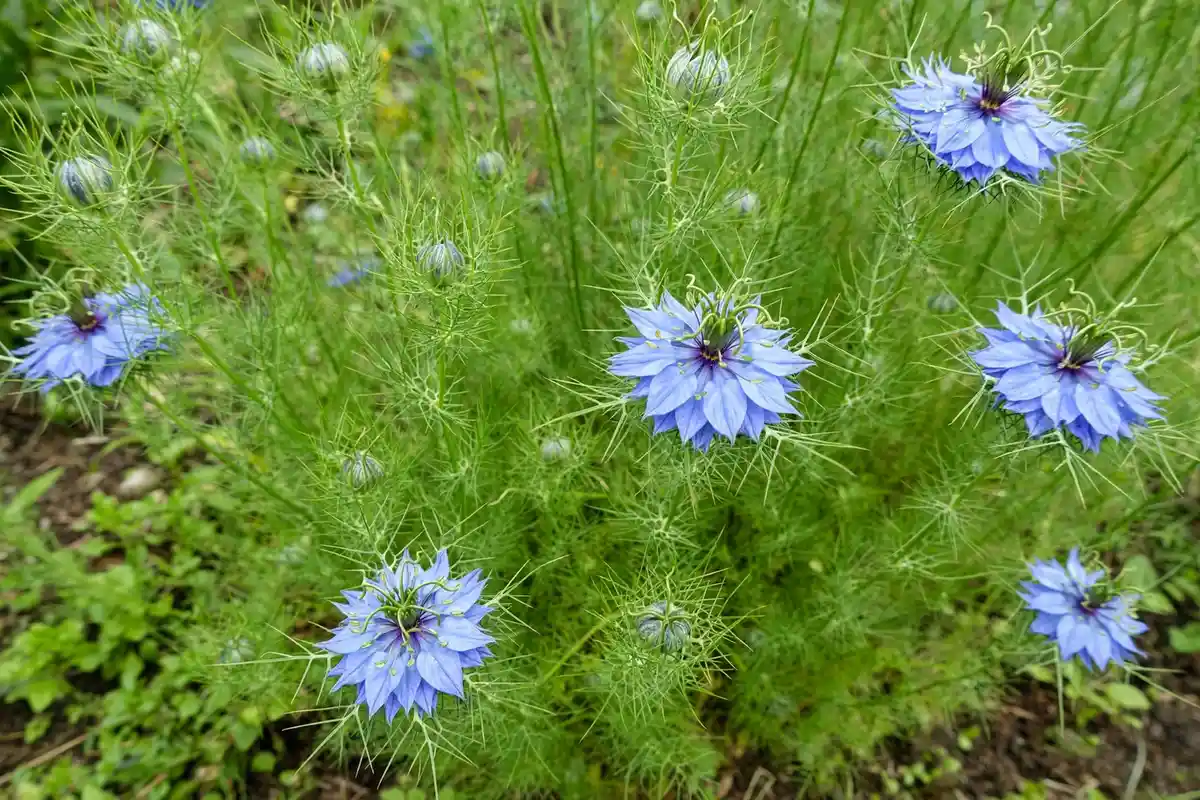
Love-in-a-mist might be the most romantic common name in the seed catalogue — and the plant earns it. A flower of cornflower blue floats in a haze of thread-fine, fennel-like foliage, as if it were rising out of green mist; then, as if one good trick were not enough, it retires into a striped, balloon-like seed pod that lasts into autumn and through the dried-flower season. One sowing buys three acts: mist, flower, and architecture.
This guide covers the six nigellas worth knowing (the heirloom blues, the white and rose forms, and the architectural pod kinds), what it means — openness, perplexity, and a kiss in the mist — and the two rules of its easy craft: sow it where it will flower, because it sulks at being moved, and sow it twice, because succession is the whole secret.
Quick Answer
The nigella flower is Nigella damascena, a hardy annual in the buttercup family Ranunculaceae from the Mediterranean and North Africa, bearing blue, white or pink star-shaped flowers inside a ruff of finely cut foliage, followed by ornamental striped seed pods. It grows in any temperate climate as a spring-sown annual (zones 2 to 11 as an annual), self-sows freely, flowers about ten weeks from sowing, and wants full sun and ordinary, drained soil. The nigella flower means openness and curiosity — its name, from Latin niger, refers to its black seeds.
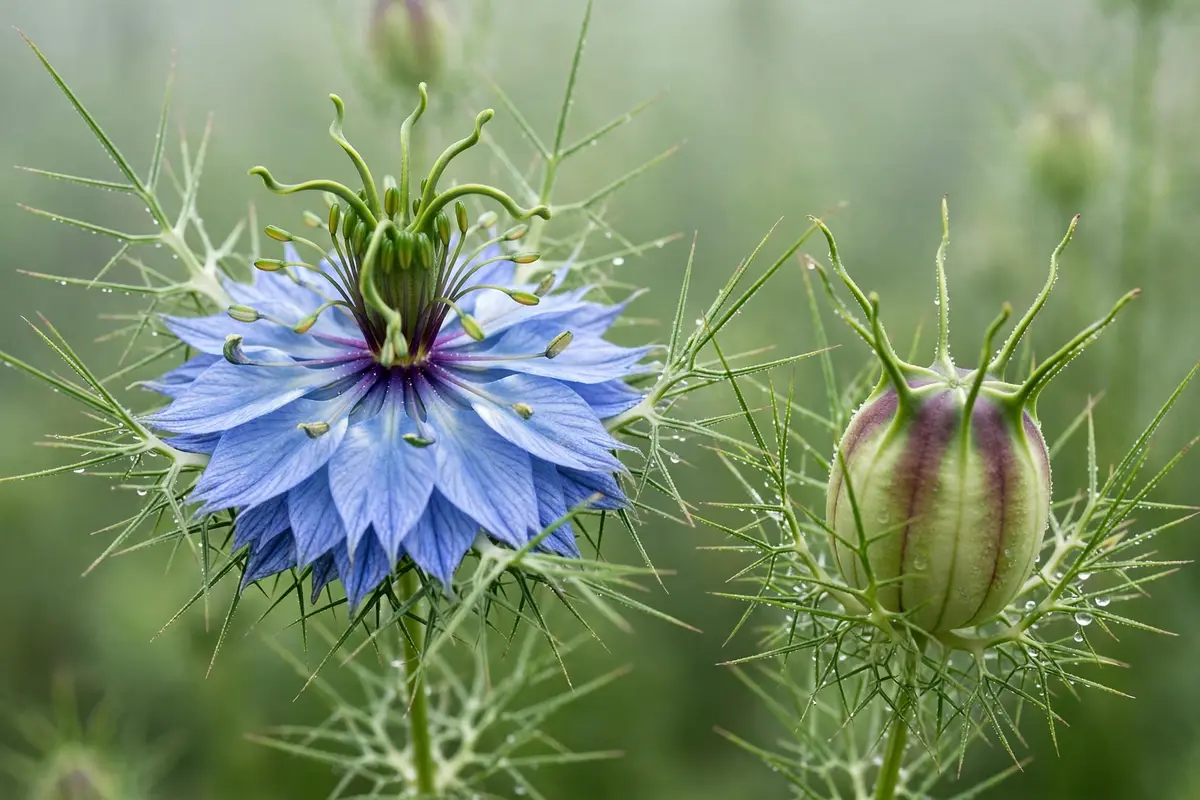
Table of Contents
- What Is a Nigella Flower?
- Types of Nigella and 6 Kinds Worth Knowing
- Nigella Flower Meaning and Symbolism
- Nigella Flower Colours and Their Meanings
- How to Grow Nigella
- Common Mistakes When Growing Nigella
- The Second Act: Why the Pods Matter as Much as the Flowers
- Frequently Asked Questions
What Is a Nigella Flower?
A nigella flower is a small star with stage lighting: five true sepals spread like petals in blue, white or rose, the real petals shrunk to nectar scales at the centre, and the whole bloom ringed by that famous mist — a ruff of finely dissected bracts and feathered foliage that frames every flower in green haze. Behind the flower stands the family signature: kinship with the wolfsbane flower and the hellebore (all Ranunculaceae), though nigella is the gentle, annual cousin. When the petals fall, the ovary inflates into a striped, spiky balloon — a seed capsule like a little hot-air ship — holding the jet-black seeds that gave the genus its name (nigella = little black one) and cooks their spice: the seeds of its cousin N. sativa are the “black cumin” or kalonji of Middle Eastern and South Asian kitchens. You can read more on the Nigella damascena page on Wikipedia.
The garden species travelled from Mediterranean cornfields, where it was a weed of grain — the “fitches” of biblical translations may well be it — into cottage gardens, where its habit of sowing itself into gravel, cracks and rose beds made it a signature of the informal style. It asks for nothing but a spring scattering and repays it from early summer to the frost: flowers for the vase, pods for the dried arrangement, and seed left waiting in the soil for next year.
Nigella Quick Facts
- Botanical name: Nigella damascena (ornamental); N. sativa is the spice species.
- Family: Ranunculaceae, the buttercup family.
- Hardiness: hardy annual — grown spring to autumn anywhere; seed survives winter in the soil.
- Height: 12 to 24 inches by variety.
- Bloom time: early to late summer, about ten weeks after sowing; pods follow into autumn.
- Sun and soil: full sun; ordinary, well-drained soil — poor soil is fine.
- Good to know: hates transplanting (taproot) — sow in place; self-sows reliably; pods are premier dried-flower material.
Types of Nigella and 6 Kinds Worth Knowing
The classic blue, the white wedding form, and the pod specialists. The table separates them; the profiles follow. For the full list of flower names, see our flower names A to Z guide.
| Type | Flowers | Height | Season | Best use |
|---|---|---|---|---|
| ‘Miss Jekyll’ (blue) | Sky/cornflower blue, semi-double | 18 in | Early–mid summer | The cottage standard |
| ‘Miss Jekyll Alba’ | Pure white | 18 in | Early–mid summer | White gardens, weddings |
| ‘Persian Jewels’ | Mixed blue, rose, white | 16 in | Early–mid summer | Seed-mix colour drifts |
| ‘Mulberry Rose’ | Deep rose-pink | 18 in | Early–mid summer | Colour-planned beds |
| ‘African Bride’ | White petals, dark centre | 24 in | Mid summer | Contrast, cutting |
| ‘Delft Blue’ / pod kinds | Blue-white marbled; huge pods | 18–24 in | Summer + autumn pods | Dried arrangements |
1. ‘Miss Jekyll’ — the Heirloom Blue
The love-in-a-mist of memory: semi-double flowers in true cornflower blue over the finest mist, named for Gertrude Jekyll, who grew drifts of it in her Munstead borders. Miss Jekyll is the default seed-packet choice and the colour against which the others are judged — sow it once and it returns, self-sown, in slightly wandering shades of the same blue for years.
2. ‘Miss Jekyll Alba’ — the White Form
The same plant bleached to bridal white: flowers of porcelain against the green mist, glowing at dusk and moonlight. Alba is the wedding nigella — fresh in bouquets, and the pods dry to parchment for winter work. In white gardens it is the softener that lets stronger whites hold their line.
3. ‘Persian Jewels’ — the Mix
A strain rather than a single colour: blues, rose, mauve and white from one packet, bred for the jewel-box drift effect in cottage borders and cutting rows. Persian Jewels is the lazy artist’s choice — sow thickly, let the mix resolve itself, and cut whatever is open. Self-sown returns shuffle the colours again each year.
4. ‘Mulberry Rose’ — the Deep Pink
The richest of the named colours: saturated rose-pink flowers that read mulberry in shade, warming the palette where the blues go cool. Mulberry Rose pairs with silver foliage and apricot roses in the modern cottage style — and its pods stripe the same deep tones as they dry.
5. ‘African Bride’ — the Dramatic Contrast
White petals around an almost black centre of stamens, on the tallest plants in this list: a graphic, modern-looking nigella that florists fight over. African Bride cuts superbly and its pods are correspondingly grand. Give it the back of the nigella patch and let the contrast do the work.
6. ‘Delft Blue’ and the Pod Kinds — Grown for Act Three
‘Delft Blue’ marbles its petals in blue and white like the pottery, but the connoisseurs’ kinds are chosen as much behind the flower as in it: selections bred for oversized, strongly striped pods (‘Delft Blue’ among them) that dry to green-and-maroon striped balloons holding their shape for a year. Sow these where the autumn garden needs architecture — the pods are the point.
Nigella Flower Meaning and Symbolism
Nigella’s language is misty by design: in the Victorian flower language, love-in-a-mist means perplexity, openness to love, and “you puzzle me” — the flower visible but veiled, the message clear but not quite touchable. Its gentler modern readings keep the mist and drop the tease: openness, curiosity, tenderness, and a kiss in passing. The black seeds add the older layer — nigella was a plant of kitchens and remedies across the Mediterranean and Asia for millennia (the sativa seeds carry proverbs about healing in several traditions), making the garden flower a small emblem of the useful hidden inside the beautiful.
Send love-in-a-mist for beginnings that are not yet certainties: new love, new friendship, any message best delivered through a little beautiful fog. It naturalises in this garden the way it does in borders — happily alongside the forget-me-not flower, its partner in blue cottage drifts.
Nigella Flower Colours and Their Meanings
- Cornflower blue — openness and a kiss in the mist: ‘Miss Jekyll’, the classic.
- White — tenderness veiled: Alba and African Bride’s bridal register.
- Rose and mulberry — perplexity warming to love: the pink strains.
- Marbled blue-white — curiosity: ‘Delft Blue’, the collector’s pattern.
How to Grow Nigella
The whole craft fits in one sentence: scatter seed where the plants will flower, in spring, and then scatter more a month later. Gardeners on r/gardening on Reddit call it the throw-and-forget flower: “the only annual I never start in pots — it punishes moving and rewards neglect.”
Sowing in Place
Nigella grows a taproot and sulks — sometimes fatally — when transplanted, so sow directly outdoors from early spring (and again in late spring for succession; an autumn sowing works in mild climates for the earliest flowers). Scatter on raked, ordinary soil in full sun, cover lightly (the seed needs a little darkness), thin to 9–12 inches, and water only to germinate. Poor, gravelly ground suits it fine — the cornfield weed in its ancestry remembers lean living. That is the entire establishment phase.
Succession, Support and Self-Sowing
Each plant flowers for roughly six to eight weeks, so the season is built by sowing twice: April and May sowings carry the patch from June to September between them. The mist of foliage mostly self-supports, but a thicket of twiggy sticks pushed in early stops a lush patch flopping in storms. Then decide the autumn policy: deadhead for tidiness, or — better — leave the pods to ripen, dry and drop their seed, and the patch renews itself forever, wandering a little further into the gravel each year like a friendly rumour.
Common Mistakes When Growing Nigella
Mistake one is starting it in pots and transplanting: the taproot objects, growth checks for weeks, and the direct-sown patch overtakes the cosseted one by June. Mistake two is a single sowing and a six-week season, followed by the verdict that nigella is “short-flowering” — the flower is fine; the sowing plan was the short part.
Mistake three is rich, wet soil, which grows mist at the expense of flowers and flops the whole enterprise. Mistake four is deadheading every pod in August: you have just deleted the dried-flower crop, the autumn architecture, and next year’s free plants in one tidy pass. And mistake five is tidying the self-sown seedlings away as weeds in spring — learn their ferny, carrot-top look, because they are next summer’s patch arriving by itself.
The Second Act: Why the Pods Matter as Much as the Flowers
Most annuals are done when the petals drop. Nigella trades its flowers for something rarer — a striped, inflated capsule with a crown of spikes, part lantern, part balloon — that holds the border’s architecture from midsummer to winter and the dried-flower vase’s for a year beyond that. Florists buy the pods by the bunch; gardeners who know leave whole plants standing into autumn, when frost outlines the capsules like paper ornaments. Judge a nigella variety by its pods as well as its petals (the reason the pod-bred kinds exist), and the plant stops being a six-week annual and becomes a three-season one.
Frequently Asked Questions
Is nigella the same as black cumin or kalonji?
Close cousins, not the same plant. The garden flower is Nigella damascena; the spice comes from Nigella sativa, grown for its black seeds (kalonji, “black cumin,” black seed) since antiquity. The garden species’ seeds are not the culinary article — plant damascena for flowers and pods, sativa for the kitchen. If your question is not answered here, the questions about the nigella flower on Quora cover most of the rest.
Does nigella come back every year?
The plant is an annual, but the patch is effectively perennial: ripe pods scatter hundreds of seeds that overwinter in the soil and germinate in spring, exactly where (and a little beyond where) their parents grew. Leave pods standing if you want the colony to renew itself.
When does nigella flower?
About ten weeks from sowing: a spring sowing flowers from early summer for six to eight weeks, and a second sowing a month later extends the display into September. Mild-climate autumn sowings flower earliest of all, in late spring.
Can nigella grow in pots?
Yes, if sown directly into the pot (never transplanted into it): use a deep container of ordinary, free-draining compost, sow thickly, and enjoy flowers then pods at chair height. Dwarf forms stay neatest; all forms appreciate the same lean regime as in the ground.
Are nigella pods good for dried flowers?
Among the best: cut stems when the pods are fully formed and striped, hang them upside down in a dry, airy place, and they keep their shape and striping for a year or more. They are a staple of winter arrangements and wreaths.
Is nigella safe around pets?
The ornamental species is not a food plant and its seeds contain bitter compounds in quantity; casual garden contact is not a concern, but do not feed the seed to pets or treat it as the culinary species. Keep the two nigellas’ jobs separate — beauty in the border, spice (sativa only) in the kitchen. For more flowers under the same letter, see our guide to flowers that start with N.