Vinca Flower: Meaning, Types and How to Grow Periwinkle
Order “vinca” at a garden centre and you may be handed two completely different plants: a tough evergreen groundcover with blue spring stars, or a heat-loving summer bedding plant from Madagascar that gave modern medicine two of its great cancer drugs. Same name, same family, opposite jobs — and both earn their place.
This guide untangles the two vincas: the periwinkles (Vinca minor and Vinca major) that carpet shady banks, and the annual vinca (Catharanthus roseus) that flowers through the hottest summers on earth. You will find the six kinds worth growing, what vinca means, how to grow each type, and the one warning each plant carries — the groundcover spreads, and the pretty bedding plant is poisonous.
Quick Answer
A vinca flower is the five-petalled bloom of plants in the dogbane family: the evergreen periwinkles Vinca minor and Vinca major, and the Madagascar periwinkle Catharanthus roseus sold as “annual vinca”. Periwinkles are hardy groundcovers (USDA zones 4 to 8) flowering in spring in sun or shade; annual vinca is a tender summer bedding plant (perennial only in zones 10 to 11) flowering from summer to frost in full sun and heat. Both are easy, both are toxic if eaten, and both dislike wet feet.
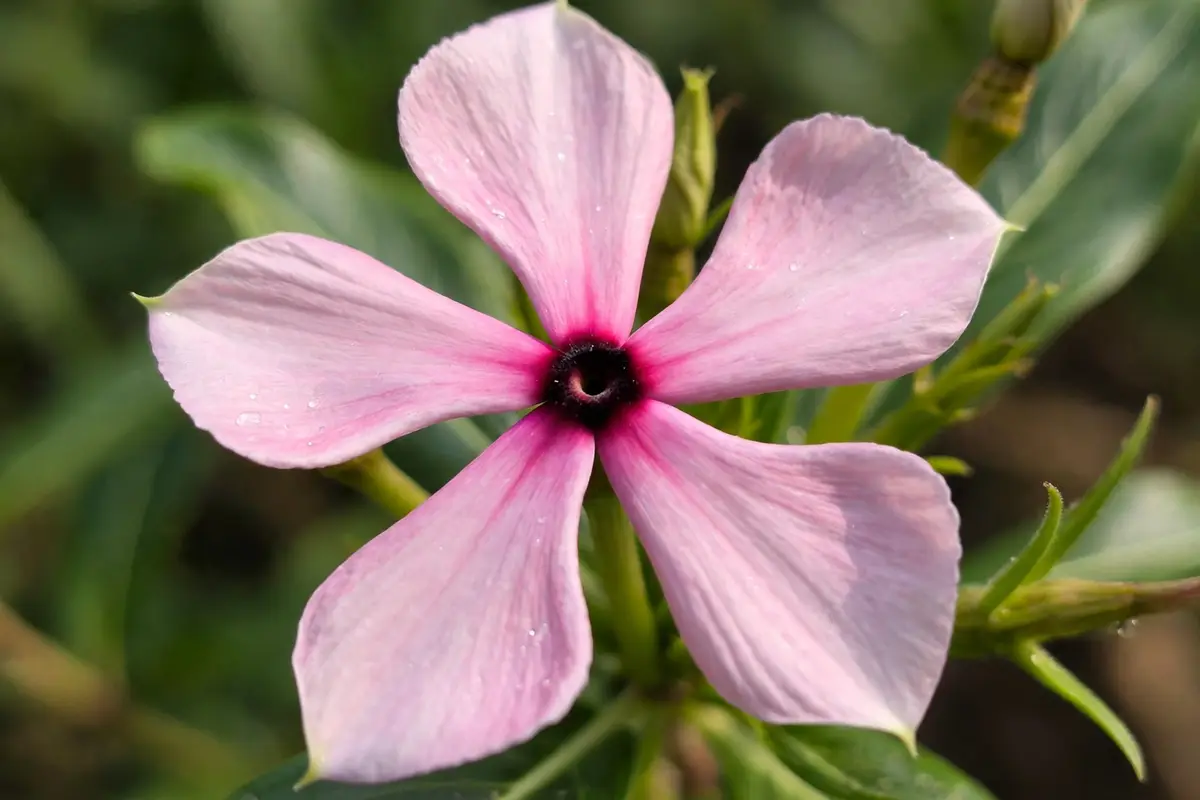
Table of Contents
- What Is a Vinca Flower?
- Types of Vinca and 6 Kinds Worth Growing
- Vinca Flower Meaning and Symbolism
- Vinca Flower Colours and Their Meanings
- How to Grow Vinca
- Common Mistakes When Growing Vinca
- Vinca vs Catharanthus: Which “Vinca” Do You Have?
- Frequently Asked Questions
What Is a Vinca Flower?
Vinca is a small genus of trailing plants in the dogbane family, Apocynaceae — kin to oleander and plumeria, which explains the family traits: glossy leaves, milky sap, pinwheel five-petalled flowers, and alkaloid chemistry. The two periwinkles are European natives long planted as evergreen groundcover: lesser periwinkle, Vinca minor, fine-textured and restrained; greater periwinkle, Vinca major, bolder in every part. The name Vinca is usually traced to Latin vincire, “to bind” — the long trailing stems were wound into garlands and wreaths. You can read more on the Vinca page on Wikipedia.
The third “vinca” is an impostor by name only: Catharanthus roseus, the Madagascar periwinkle, was once classified as Vinca rosea, and the trade never gave the name back. It is a tropical subshrub grown worldwide as summer bedding — and one of the most consequential medicinal plants ever found: in the 1950s, researchers investigating its folk use for diabetes isolated the alkaloids vincristine and vinblastine, which became cornerstone chemotherapy drugs (famously transforming childhood leukaemia outcomes). A bedding plant that changed oncology carries its “flower” fame quietly. All three plants are poisonous if eaten — admire, plant, don’t nibble.
Vinca Flower Quick Facts
- Botanical names: Vinca minor, Vinca major, Catharanthus roseus.
- Family: Apocynaceae, the dogbane family.
- Hardiness: periwinkles zones 4 to 8 (evergreen); Catharanthus zones 10 to 11, else annual.
- Height: periwinkles 4–8 in (trailing mats); Catharanthus 6–18 in mounds.
- Bloom time: periwinkles spring (lighter repeats); Catharanthus summer to frost.
- Sun and soil: periwinkles shade to sun, any drained soil; Catharanthus full sun, heat, sharp drainage.
- Good to know: both poisonous if eaten; periwinkles can spread aggressively — site with intent.
Types of Vinca and 6 Kinds Worth Growing
Three groundcovers and three forms of the summer star. The table separates them; the profiles follow. For the full list of flower names, see our flower names A to Z guide.
| Type | Plant | Flowers | Habit | Best use |
|---|---|---|---|---|
| Vinca minor (species) | Lesser periwinkle | Lilac-blue stars, spring | Fine mat, 4–6 in | Shade groundcover |
| ‘Bowles’s Variety’ | V. minor cultivar | Larger, rich blue | Neater mat | Best blue flowers |
| Variegated periwinkles | ‘Illumination’, ‘Argenteovariegata’ | Blue / lilac | Gold- or cream-edged leaves | Dark corners, baskets |
| Vinca major | Greater periwinkle | Big violet-blue | Bold, arching, 12–18 in | Banks, rough ground |
| Catharanthus Cora® series | Annual vinca, disease-resistant | Full colour range | Mounds 10–16 in | Humid-climate bedding |
| Catharanthus species colours | Madagascar periwinkle | Pink, white, red, apricot | Bushy 12–18 in | Hot borders, pots |
1. Vinca minor — the Shade Carpet
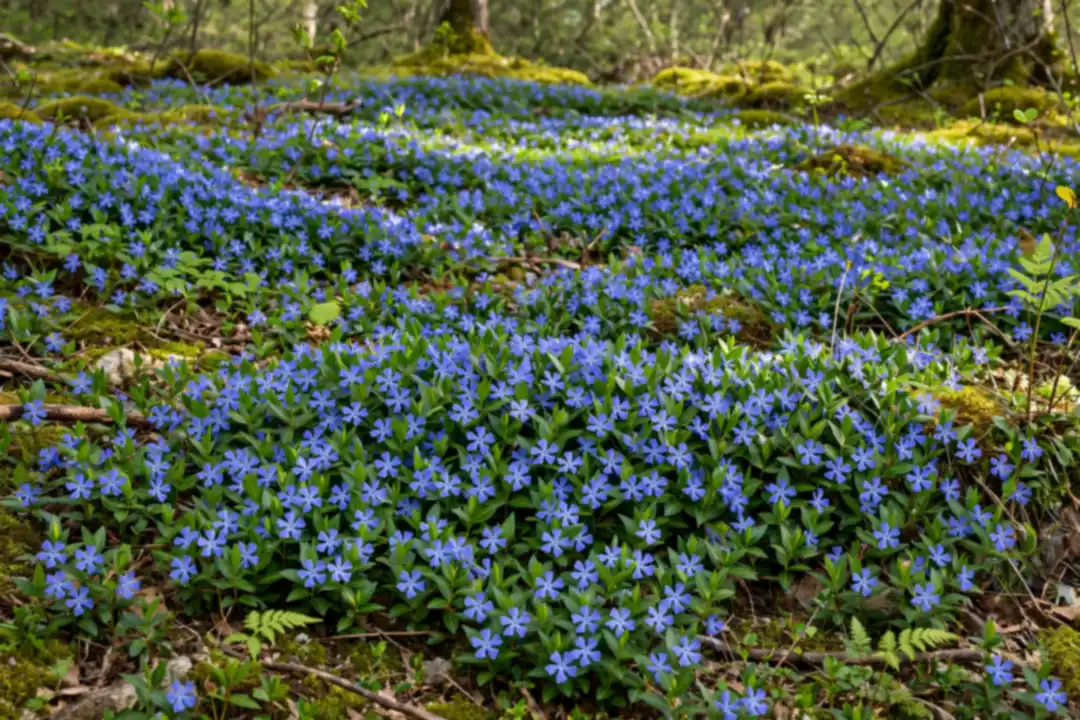
The classic periwinkle: wiry trailing stems set with small, glossy, evergreen leaves and lilac-blue pinwheels in spring, rooting as they run. It carpets the ground under trees where grass gives up, holds banks against erosion, and asks for nothing — no mowing, no feeding, barely any water once settled. This is the plant of churchyards and old gardens across two continents, still flowering where the gardeners are a century gone.
2. ‘Bowles’s Variety’ — the Best Blue
The cultivar connoisseurs plant instead of the species: flowers notably larger and a richer, deeper blue, on a slightly neater, less rampant plant (also sold as ‘La Grave’). If the periwinkle’s job includes actually being looked at — edging a path, clothing a small bank — ‘Bowles’s’ earns the upgrade. It is the flower behind most of the genus’s fame among our blue flowers.
3. Variegated Periwinkles — Light for Dark Corners
Periwinkle foliage, illuminated: ‘Illumination’ runs gold-centred leaves, ‘Argenteovariegata’ cream edges, and V. major ‘Variegata’ does the same trick boldly. Variegated forms grow a touch slower (a virtue in this genus) and light up shade like ground-level lanterns. In hanging baskets and wall tops the trailing variegated stems are worth the whole plant; the spring flowers are a bonus.
4. Vinca major — the Bold Banker
Everything about the greater periwinkle is scaled up: bigger heart-shaped leaves (often with a pale, hairy edge), bigger violet-blue flowers, and arching stems that layer a bank fast. It is the right tool for rough slopes, underplanting big shrubs, and anywhere its enthusiasm can be given room — and the wrong tool for a small, precious border: major means it. In mild climates it is a near-evergreen juggernaut; in cold ones it retreats politely to its crown.
5. Catharanthus Cora® Series — the Problem-Solver
Annual vinca’s historic weakness is aerial Phytophthora — “vinca decline” — which melts plantings in hot, humid, rainy summers. The Cora series was bred with strong resistance to that disease, in the full colour range (whites, pinks, reds, apricots) on uniform mounds. In the humid south and anywhere summer bedding failed before, Cora is the professional’s default — the drug-plant’s grandchildren, engineered for the thunderstorm season.
6. Catharanthus Species Colours — the Heat Champion
Beyond the series, the species colours and novelty lines (tattooed dark-eyed forms, trailing Cascade types for baskets) share one superpower: nothing in the bedding world flowers harder through heat, humidity and drought once established. Glossy leaves, pinwheel blooms from planting-out to frost, zero deadheading (the plant self-cleans). White forms in particular light up our white flowers list in the months when most white bedding has fainted from the heat.
Vinca Flower Meaning and Symbolism
Periwinkle means tender recollection, fond memories and early friendship — in the language of flowers it is the bloom of sweet remembrance, planted for centuries in churchyards and on graves (in Italy it was called fior di morte, the flower of death, for its cemetery carpeting — remembrance in its literal form). Its blue also tied it to the Virgin Mary in medieval devotion, and blue periwinkle garlands signified faithfulness and everlasting love: the binding stems (vincire) made it a marriage symbol too, woven into bridal wreaths to bind the couple.
The floriographers add pleasant memories and “joy of my early friendships” — periwinkle is the flower you plant where someone loved is remembered, or send an old friend to say the early days still matter. Its modern twin carries a second, unofficial meaning: hope in the face of cancer, earned outright by vincristine’s story.
Vinca Flower Colours and Their Meanings
Across both plants, the palette and its messages:
- Blue and lilac periwinkle — fond recollection and faithfulness: the classic colour, spring’s carpet stars.
- White vinca — purity and remembrance: white periwinkle for memorial planting; white Catharanthus for clean summer brightness.
- Pink vinca — friendship and sweet memories: Catharanthus pinks carry the summer message.
- Red and dark-eyed vinca — strength and hope: the modern bedding colours, boldness in the heat.
How to Grow Vinca
Two plants, two recipes — keep them separate and both are nearly unkillable. Gardeners on r/gardening on Reddit say “vinca problems are always water problems — too much, or in the wrong season”.
Growing Periwinkle (Vinca minor & major)
Plant in spring or autumn, in sun or shade (flowering is heaviest with some sun; the carpet forms anywhere), spacing rooted pieces or small pots 12 inches apart for minor, 18 for major; stems root at the nodes and knit the mat within a season or two. Water to establish, then leave alone. Shear or mow (on a high setting) after spring flowering to keep the mat dense and low. The one management duty is the border of the patch: periwinkle crosses into lawns and neighbouring beds cheerfully, so give it a hard edge — path, wall, mown strip — and plant it only where a permanent carpet is truly wanted. Near wild ground, prefer contained sites: in parts of North America periwinkle has escaped into woodlands, and the honest gardener plants it as a kept plant, not a released one. It carpets happily beneath spring bulbs and its fellow binding trailers near our violet flower patches.
Growing Annual Vinca (Catharanthus)
Heat is the ignition key: do not plant out until nights are reliably warm (above 15°C / 60°F) — cold soil at planting is the number-one killer of spring-bought vinca, stunting it for weeks. Set in the sunniest, hottest spot you own, in soil with genuinely sharp drainage (raised beds and pots shine), spacing 10–12 inches. Water to establish, then sparingly: established plants are drought-tough, and overwatering in heat invites the stem diseases the Cora series resists. No deadheading, no staking, no fuss — just wait for warm nights and stand back.
Propagation
Periwinkles propagate themselves: peg down a trailing stem and it roots (or simply dig rooted sections and move them). Catharanthus grows from seed started indoors 10–12 weeks before last frost (seed needs warmth to germinate) — or buy plants; in frost-free zones it self-seeds and persists as a short-lived perennial.
Common Mistakes When Growing Vinca
For the groundcovers, the classic mistake is planting periwinkle where you wanted a guest and got a tenant for life — it is functionally permanent and spreads into woods and lawns if unedged. The second is shearing never: old mats grow woody and bare in patches; the post-flowering trim keeps them young. For Catharanthus, the mistakes are the cold start (planting into cool April soil) and the kind watering can — nightly overhead watering in a humid summer is the disease’s invitation.
And for both: planting in boggy ground. Every vinca wants drainage more than it wants anything else you can give it.
Vinca vs Catharanthus: Which “Vinca” Do You Have?
The two-minute ID. Periwinkle (Vinca): trailing, ground-hugging stems rooting as they run; evergreen leaves in cold winters; flowers in spring (with light repeats), lilac-blue (rarely white or plum); bought as groundcover in flats of small rooted plants; perennial in zones 4–8. Annual vinca (Catharanthus): upright mounded bushlets, not trailers; glossy leaves with a pale midrib stripe; flowers nonstop summer-to-frost in pink, white, red and eye-patterned forms; sold in bedding six-packs in late spring; dies at first frost outside zones 10–11. If it flowers hardest in August heat, it is Catharanthus; if it carpeted your shade all winter, it is Vinca. Same family, same pinwheel blueprint, opposite seasons of glory.
Frequently Asked Questions
Is vinca a perennial or an annual?
Both, by plant: the periwinkles (Vinca minor, V. major) are hardy evergreen perennials; the bedding “annual vinca” (Catharanthus roseus) is a tropical perennial grown as an annual wherever frost occurs. Check which one the label means before planning its winter. If your question is not answered here, the questions about the vinca flower on Quora cover most of the rest.
Is vinca poisonous?
Yes — all three plants contain alkaloids and are toxic if eaten (the Catharanthus alkaloids are literally chemotherapy agents in purified, dosed form). Keep them as ornamentals, and site them away from grazing animals and nibbling pets; normal garden handling is fine.
Does vinca come back every year?
Periwinkle, yes — permanently, evergreen, expanding. Annual vinca returns only where winters are frost-free (zones 10–11), though it may self-seed in warm gardens elsewhere. Elsewhere, plant it fresh each late spring.
When does vinca bloom?
Periwinkles peak in spring (March to May) with scattered repeat flowers into summer on the mat. Annual vinca starts once nights warm up — late spring onward — and flowers without pause until the first frost.
Is vinca invasive?
Periwinkle is listed as invasive in parts of North America and Australia where it escapes into woodland; it is manageable in gardens with hard edging and responsible siting (not beside wild areas). Catharanthus is not a garden-escape problem in temperate zones — frost handles it.
Can vinca grow in pots?
Beautifully, both: variegated periwinkles trail from baskets and tall pots for years, and Catharanthus is a premier pot plant for hot terraces (where its perfect drainage needs are easiest to meet). For more flowers under the same letter, see our guide to flowers that start with V.