Celosia Flower: Meaning, Types and How to Grow It
Some flowers look like flames, some look like feathers, and one — the crested celosia — looks like a velvet brain crossed with a rooster’s comb, in scarlet, gold or magenta. Celosia is summer’s most theatrical annual: heat-proof, drought-proof, unfading in the vase and immortal dried, grown from a plant whose leaves, in West Africa, are dinner. If a flower can be both a joke and a jewel, this is the one.
This guide covers the three celosia tribes — crested cockscombs, feathery plumes and wheat-like spikes — plus the famous modern cultivars, explains the name puzzle (celosia IS cockscomb), gives its meanings (boldness, warmth and a little affectionate silliness), and keeps the growing advice as simple as the plant deserves.
Quick Answer
The celosia flower is the flame-like or comb-like flowerhead of Celosia argentea and its forms, an annual in the amaranth family Amaranthaceae from tropical Africa and Asia, named from the Greek kelos, “burned”, for its fiery look. Garden celosias grow 6 inches to 3 feet in USDA zones 2 to 11 as annuals (perennial only in frost-free zones 10–11), flower from midsummer until frost in full sun and heat, and come in three shapes: crested (Cristata, the cockscomb), plumed (Plumosa) and spiked (Spicata). Celosia means boldness, courage and warm affection, its dried heads are near-immortal, and its young leaves are eaten as “Lagos spinach” in West Africa.
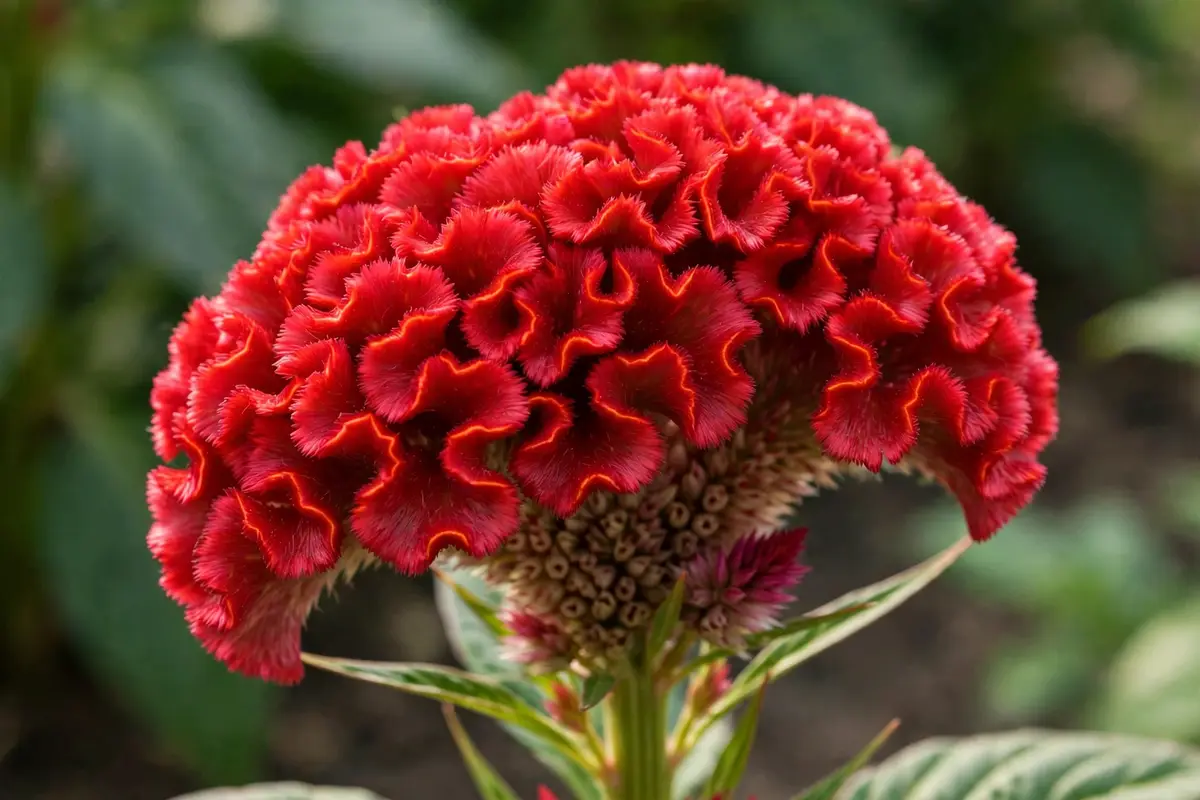
Table of Contents
- What Is a Celosia Flower?
- Types of Celosia and 6 Kinds Worth Knowing
- Celosia Flower Meaning and Symbolism
- Celosia Flower Colours and Their Meanings
- How to Grow Celosia
- Common Mistakes When Growing Celosia
- Celosia vs Cockscomb: Same Plant, Two Names
- Frequently Asked Questions
What Is a Celosia Flower?
What looks like one flamboyant flower is actually a dense head of hundreds of tiny florets, and its shapes come from a quirk: in the Cristata group the flower stem flattens and fuses (a mutation called fasciation), producing the famous crested “comb” that can reach the size of a dinner plate in exhibition strains. Plumosa kinds keep the normal branching stem and open soft, feathery plumes; Spicata narrows the plume into a candle-like wheat spike. All are forms of Celosia argentea, a tropical plant domesticated twice over — in Africa as a leafy vegetable (celosia leaves are “Lagos spinach”, a market green across West Africa) and in Asia as an ornamental, where crested forms were temple and festival flowers in China and India for centuries. You can read more on the Celosia page on Wikipedia.
Celosia’s great virtues are stamina and colour-fastness. The pigments (betacyanins, the same family that colours beetroot) hold fast: a fresh celosia lasts one to two weeks in the vase, and dried it keeps its colour for a year and more, which made it a classic “everlasting” for winter bouquets long before dried flowers were fashionable again. In the garden it is one of the very last annuals standing — flowering harder, if anything, as the heat peaks, and feeding bees on its tiny florets while self-seeding politely for next year. The Victorians, unsure whether to admire or laugh, gave the cockscomb the floriographic meanings of singularity and humour; modern senders have decided for admiration, and send it for boldness.
Celosia Flower Quick Facts
- Botanical name: Celosia argentea (Cristata, Plumosa and Spicata groups).
- Family: Amaranthaceae, the amaranth family.
- Hardiness: annual everywhere except zones 10–11 (short-lived perennial there); grown as a summer annual in zones 2–11.
- Height: 6 inches (dwarf plumes) to 3 feet (cutting crested kinds).
- Bloom time: midsummer to first frost.
- Sun and soil: full sun, heat; well-drained soil, tolerates poor and dry.
- Good to know: superb fresh (1–2 weeks) and dried (a year+); leaves eaten as Lagos spinach; pinching young plants makes them branch and multiply the heads.
Types of Celosia and 6 Kinds Worth Knowing
Three shapes, six ambassadors. The table separates them; the profiles follow. For the full list of flower names, see our flower names A to Z guide.
| Type | Shape | Height | Character | Best use |
|---|---|---|---|---|
| Cristata group (cockscomb) | Crests, fans, “brains” | 1–3 ft | Sculptural, velvet | Show beds, cutting, conversation |
| Plumosa group (plume) | Feathery plumes | 6 in–2 ft | Soft, colourful | Bedding, pots, mass colour |
| Spicata group (wheat) | Slim spikes | 2–3 ft | Airy, wheat-like | Naturalistic beds, bouquets |
| ‘Dragon’s Breath’ | Red plumes, red foliage | 2 ft | All-red drama | Containers, autumn displays |
| ‘Intenz’ | Magenta spikes | 1½ ft | Compact, neon | Patio pots, edging |
| ‘Kurume’ series | Giant crests | 2–3 ft | Florist-grade | Cut flowers, exhibition |
1. Cristata Group — the Cockscomb Itself
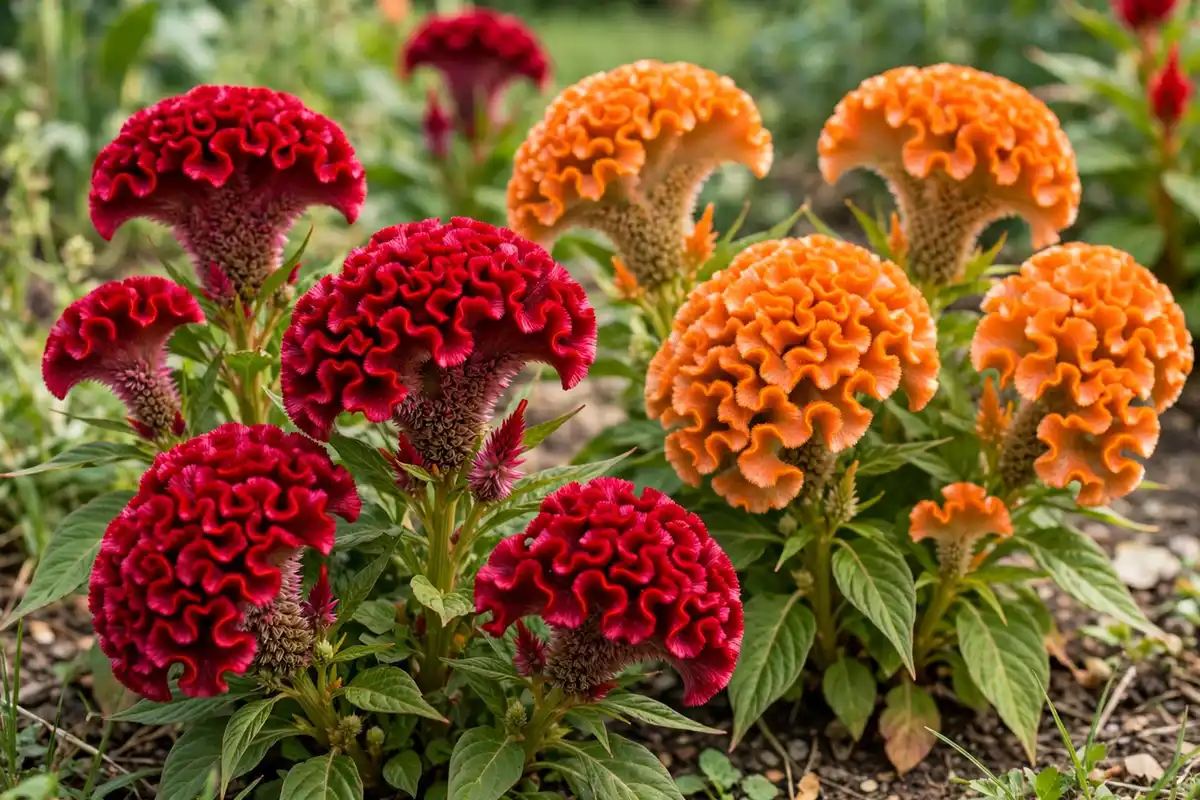
The fasciated originals: flattened, folded crests in scarlet, orange, gold, rose and wine, with a texture like crushed velvet. Dwarf strains (the ‘Jewel Box’ type) edge beds at a foot tall; the tall cutting kinds carry heads 6 inches and more across. This is the celosia of temple offerings and county-show benches — the one that stops visitors mid-sentence. Deadhead side shoots if you want one giant crest per stem; let it branch if you want a bouquet plant instead.
2. Plumosa Group — the Feather Plumes
The bedding workhorse: soft pyramidal plumes in the full flame palette, on plants from the 6-inch ‘Kimono’ dwarfs to 2-foot cutting types like the ‘Century’ series. Massed, a plume bed looks like coloured smoke, and it is the friendliest celosia for beginners — no fasciation freakery, just weeks of colour that laughs at heatwaves which flatten petunias.
3. Spicata Group — the Wheat Celosia
The spicata kinds (‘Flamingo Feather’ in pink-and-cream is the famous one) narrow the plume into tapering spikes that read as ornamental wheat dyed in sunset colours. They move in wind where crests sit still, mix beautifully with grasses and cosmos, and dry to the most natural-looking of all the celosias. The florist’s quiet favourite.
4. ‘Dragon’s Breath’ — the All-Red Statement
A modern plumosa bred for drama: burgundy-red foliage from the day it sprouts, topped from late summer by glowing red plumes — the plant is the colour of embers at every stage. It asks for the largest pot and the sunniest step you own, sulks in cool wet summers (it is the most tropical-feeling of the set), and rewards a hot season like nothing else in a container.
5. ‘Intenz’ — the Patio Performer
A compact spicata-plume hybrid in saturated magenta-purple, bred for pots: tidy at 18 inches, flowering from the first warm weeks to frost, and sterile, so it never pauses to set seed. The celosia for balconies and doorsteps, and proof the family has fully entered the designer-perennial era — except it is an annual, replaced fresh each spring.
6. ‘Kurume’ Series — the Florist’s Crests
Japanese-bred crested kinds with the largest, cleanest combs in the trade, on tall straight stems bred for the cutting bench — ‘Kurume Corona’ in bi-coloured gold and red is the showpiece. Grow them in a cutting row, pinch once for branching or not at all for giants, and harvest as the crest firms: the vase life is measured in weeks, the dried life in seasons.
Celosia Flower Meaning and Symbolism
Celosia’s modern meaning is boldness — courage, warmth and the confidence to be seen — which follows its look exactly: no shy flower wears scarlet velvet shaped like a flame. The older floriography was more ambivalent: the cockscomb stood for singularity, humour and even “foppery”, an affectionate tease for a flower that could not help showing off. Both readings survive: celosia is the bouquet for the friend who is gloriously too much, sent with love and a wink. Its dried permanence adds a third meaning, immortality and unfading affection — the flower that keeps its colour keeps its message.
In China the cockscomb’s shape earned it a place among auspicious flowers (the comb suggests the official’s hat, and with it wishes for success and promotion), and in India crested celosias garland festivals in marigold season. Send celosia for congratulations, for bold new ventures, and for anyone whose motto is “why not” — in the language of our red flowers, it is passion with its sense of humour intact.
Celosia Flower Colours and Their Meanings
- Scarlet red — boldness and courage: the classic cockscomb, all heart.
- Orange — warmth and enthusiasm: flame plumes at full summer.
- Yellow and gold — cheer and success: the auspicious comb of Chinese tradition.
- Pink — affection with a wink: ‘Flamingo Feather’ softening the joke.
- Magenta and wine — drama and singularity: ‘Intenz’ and ‘Dragon’s Breath’ after dark.
How to Grow Celosia
The secret of celosia is one word: warmth. It is a tropical annual that checks the temperature before it grows, and most failures are just cold feet. Gardeners on r/gardening on Reddit put it bluntly: “celosia planted out before the nights are warm just sits there glaring at you — wait for real summer, then it grows like it’s making up for lost time.”
Sowing and Planting
Sow indoors 6–8 weeks before the last frost, barely covering the seed (it needs light), and handle seedlings by the leaf, never the stem — the root disturbance sulk is real, so biodegradable pots are celosia’s friend. Plant out only when nights stay above 50°F (10°C), into full sun and drained soil; space dwarfs 8 inches, tall kinds a foot. Direct-sown plants in warm climates catch up fast and often outgrow transplants. Pinch the growing tip of young plants once, and each will branch into several flower stems.
Care Through Summer
Water at the base in dry spells (wet foliage invites the few leaf spots celosia gets) and feed sparingly — rich feeding makes leaves at the expense of crests. The plants ask almost nothing else: no deadheading needed (the heads ARE the show until frost), aphids occasionally, and a carpet of self-sown seedlings to edit next spring. For cut flowers, harvest when the crest or plume is fully coloured and firm; for drying, hang single stems upside down somewhere dark and airy for two weeks.
Common Mistakes When Growing Celosia
Mistake one is planting out too early: cold soil and chilly nights stunt celosia permanently — the checked plant rarely recovers its momentum even when summer arrives. Wait for warmth; this single patience wins most of the crop. Mistake two is root disturbance at transplant: torn roots and pinched stems cause the famous celosia sulk (and, in crested kinds, can trigger premature tiny combs). Sow in cells or peat pots and plant the whole thing.
Mistake three is crowding tall crested kinds in rich, wet soil, where stems rot at the base just as the show peaks — drainage and spacing are the insurance. Mistake four is overfeeding: heavy nitrogen gives you a handsome spinach plant (which, in fairness, is what it is in Lagos) and small flowers. And mistake five is discarding the bed at first frost’s rumour — celosia flowers until a real frost actually lands, often outlasting everything else in the summer display.
Celosia vs Cockscomb: Same Plant, Two Names
One plant wearing a Latin name and a nickname. Celosia is the genus name (from kelos, burned) and covers every form — crested, plumed and spiked alike. Cockscomb is the folk name for just one of those forms: the Cristata group, whose fasciated crest reminded somebody of a rooster’s comb, permanently. So every cockscomb is a celosia, but a plumed or wheat celosia is nobody’s cockscomb. Seed catalogues use both words loosely (“celosia (cockscomb)” on packets of pure plume seed is common and confusing); buy by the group name — Cristata, Plumosa, Spicata — and you will always get the shape you meant.
Frequently Asked Questions
Is celosia a perennial or an annual?
An annual in almost every garden: it grows, flowers until frost, sets clouds of tiny black seed and dies. Only in frost-free zones 10–11 does it live on as a short-lived perennial. The consolation is the self-seeding — leave a few heads standing and next summer’s plants arrive free. If your question is not answered here, the questions about the celosia flower on Quora cover most of the rest.
Is celosia edible?
The leaves of Celosia argentea are a genuine vegetable — “Lagos spinach”, eaten across West Africa and in parts of Asia, cooked like spinach. The flowers are used as a garnish and natural colouring in some cuisines. (As with any ornamental plant, eat only plants grown without sprays and identified with certainty — the garden centre bedding plant is for looking at.)
How do you dry celosia?
Cut stems when the heads are fully coloured and firm, strip the leaves, and hang them upside down in small bunches in a dark, dry, airy place for about two weeks. Celosia is one of the best drying flowers in existence: the colour holds for a year and more, crests keeping their shape like velvet sculptures.
Why is my celosia not growing?
Almost always cold: nights below 50°F (10°C), cold wet soil, or a checked transplant. Celosia sits still in cool weather by tropical design. Give it warmth, sun and time — once nights warm up, growth is startlingly fast. A pinched, stunted comb on a tiny plant is the classic sign it was planted out too early.
Does celosia come back every year?
The plant itself does not (outside frost-free zones), but its seedlings do: celosia self-seeds generously, and volunteers appear in late spring exactly where last year’s bed stood. Gardeners who like tidy control collect the seed heads into an envelope instead — the seed stays viable for years.
Is celosia good for bees?
Yes — the tiny florets in every plume and crest offer nectar and pollen through summer, and the open kinds (especially spicata and plumosa) hum with bees on hot afternoons. For more flowers under the same letter, see our guide to flowers that start with C.