Hawaiian Flower: The Real Hawaii State Flower, Island Flowers and Meaning
Ask ten people to name the Hawaiian flower and nine of them will picture the same thing: a big red hibiscus behind someone’s ear, or a white plumeria in a lei at the airport. Both pictures are true to the Hawaii visitors actually see, and both are wrong about the flower Hawaii itself chose. The real Hawaiian flower is yellow, rare, and most tourists never see it growing wild at all. It lives on dry, sunny slopes, it is protected by law, and it has a name most people outside the islands have never heard: ma’o hau hele.
This guide untangles the three phrases people search for — Hawaiian flower, Hawaii flower, and Hawaii state flower — because they sound like one question and are actually three. It covers the official state flower and the long, slightly messy story of how it was chosen, the famous flowers everyone associates with the islands, the separate official flower of each of the eight main islands, what these flowers mean, and how to grow the Hawaiian flower at home, in Hawaii or far from it.
Quick Answer
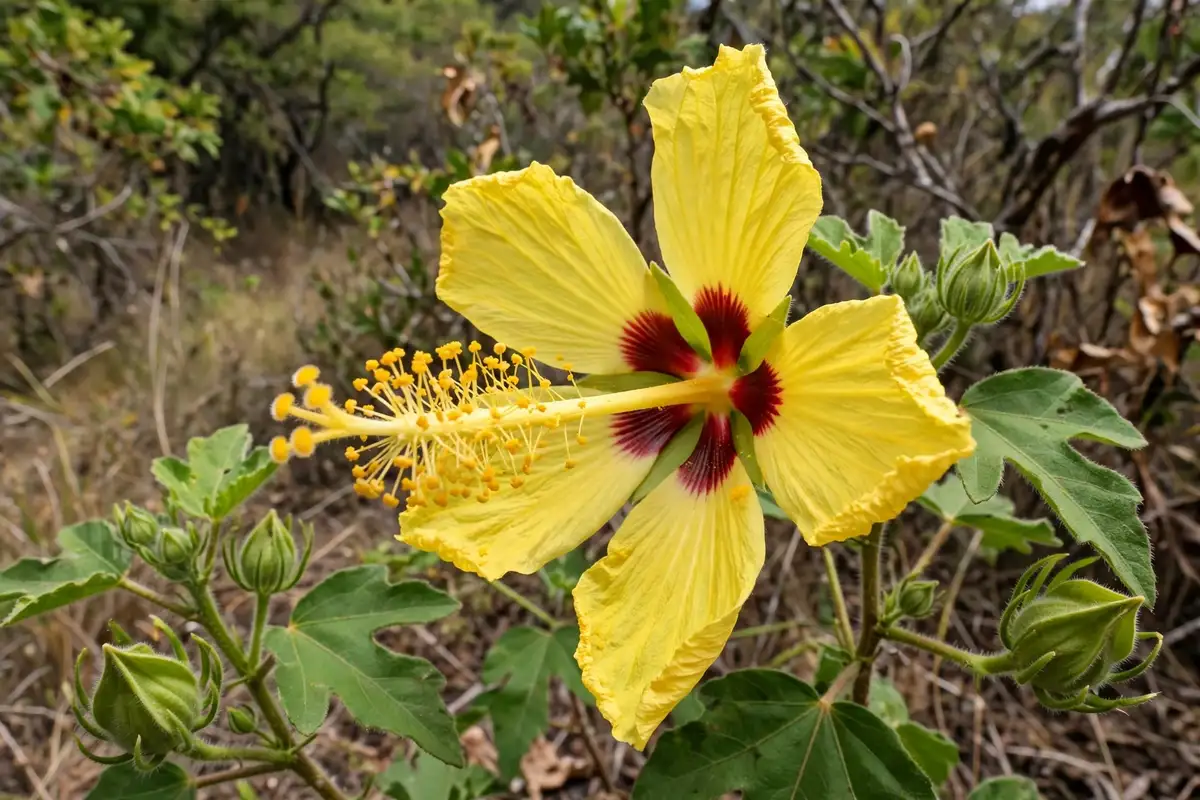
If you searched for a Hawaii flower, the answer is the yellow hibiscus, Hibiscus brackenridgei, the Hawaiian flower most people mean. It is known in Hawaiian as ma’o hau hele or pua aloalo. It was designated the official Hawaii state flower on 6 June 1988. It is a native yellow hibiscus found only in Hawaii, it is federally listed as endangered, and it is not the red tropical hibiscus or the plumeria most visitors picture — those are beautiful, famous, and introduced from elsewhere. Each of the eight main Hawaiian islands also has its own official flower or lei material, from the red ‘ohi’a lehua of Hawai’i Island to the pink lokelani rose of Maui.
Table of Contents
- What Is the Hawaiian Flower?
- The State Flower Story: 1923 to 1988
- The Flowers Everyone Pictures in Hawaii
- Each Island Has Its Own Flower
- Meaning and Symbolism
- How to Grow Hawaiian Flowers
- Lei Culture and Lei Day
- Frequently Asked Questions
What Is the Hawaiian Flower?
There is no single flower called “the Hawaiian flower” in the way there is a single rose or a single sunflower. The phrase is a catch-all, and what it points to depends on who is asking. A gardener usually means the yellow hibiscus. A traveller usually means whatever was in their welcome lei. A schoolchild doing a state-symbols project means the official Hawaii state flower. All three answers overlap, and the overlap is where the confusion starts.
The official answer is the clearest place to begin. The Hawaii state flower is the native yellow hibiscus, Hibiscus brackenridgei, called ma’o hau hele in Hawaiian and pua aloalo as a general name for hibiscus. The name ma’o hau hele translates roughly as “green travelling hibiscus”, a nod to the way the plant sprawls and wanders across dry ground. It is endemic to Hawaii, which means it grows naturally nowhere else on Earth, and it is one of only seven hibiscus species native to the islands. The flower itself is a clear, sunny yellow, usually with a deep red centre, carried on a sprawling shrub that can grow into a small tree in the right spot.
What makes the choice interesting is what it is not. It is not the red hibiscus. The big red tropical hibiscus, Hibiscus rosa-sinensis, is the one on the postcards, the hotel logos and the printed shirts, and it is not native to Hawaii at all. It is a garden plant from Asia, bred into hundreds of hybrids, and it arrived with people rather than evolving on the islands. For decades, nobody in charge had specified which hibiscus the state meant, so the red one did the job in the public imagination by default. The 1988 law exists precisely because that default was wrong.
The yellow hibiscus is also genuinely hard to find in the wild. It grows on the dry, leeward sides of the islands, in dry forest and low shrubland, on all the main islands except Kaho’olawe and Ni’ihau, and it is federally listed as endangered, with only a small number of mature wild plants remaining. Most yellow hibiscus people see in Hawaii are nursery-grown garden plants, which is exactly how the state would like it to stay.
The State Flower Story: 1923 to 1988
The story of the Hawaii state flower is really two laws, sixty-five years apart, and a long stretch of polite vagueness in between. In 1923, when Hawaii was still a territory, the legislature named the hibiscus as the official territorial flower. It did not say which hibiscus. It did not name a colour or a species. At the time that hardly seemed to matter: hibiscus of every colour was already everywhere, and the flower’s job was to stand for the islands in general, not to pass a botany exam.
That vagueness lasted for decades. Hawaii became a state in 1959, and the hibiscus came along as the state flower, still unspecified. In practice, the red tropical hibiscus became the visual shorthand for Hawaii, because it was the showiest and the most planted. Meanwhile the native yellow hibiscus, the plant that actually belonged to the islands, quietly declined in the wild as dry forests were grazed, built on and crowded out by introduced plants.
The correction came in 1988. The Hawaii State Legislature passed a law designating the native yellow hibiscus, Hibiscus brackenridgei, as the official state flower, and Governor John Waihee signed it on 6 June 1988. The law settled the matter in plain terms: the state flower is the yellow one, the native one, the ma’o hau hele. It was a deliberate choice to honour the islands’ own flora rather than a handsome import, and it also gave the endangered plant a small measure of official protection in the public mind. Hawaii’s own botanical garden, the National Tropical Botanical Garden, still works to clear up the confusion today, because the red hibiscus has not given up its postcard job.
In 2000, a further law, Act 165, formally recognised the official flower or lei material of each individual island as well. So Hawaii now has one state flower and eight island flowers, different on purpose: one plant stands for the whole state, and eight more stand for the places inside it.
The Flowers Everyone Pictures in Hawaii
If the official Hawaiian flower is a rare yellow hibiscus, why does everyone picture plumeria? Because the flowers of a holiday are not the same as the flowers of a place, and Hawaii’s holiday flowers are spectacular. The three that dominate the image of Hawaii are the plumeria, the orchid and the bird of paradise, and none of the three is native to the islands. That does not make them fake or unimportant; it makes them a second story, about what people brought to Hawaii and what Hawaii made its own.
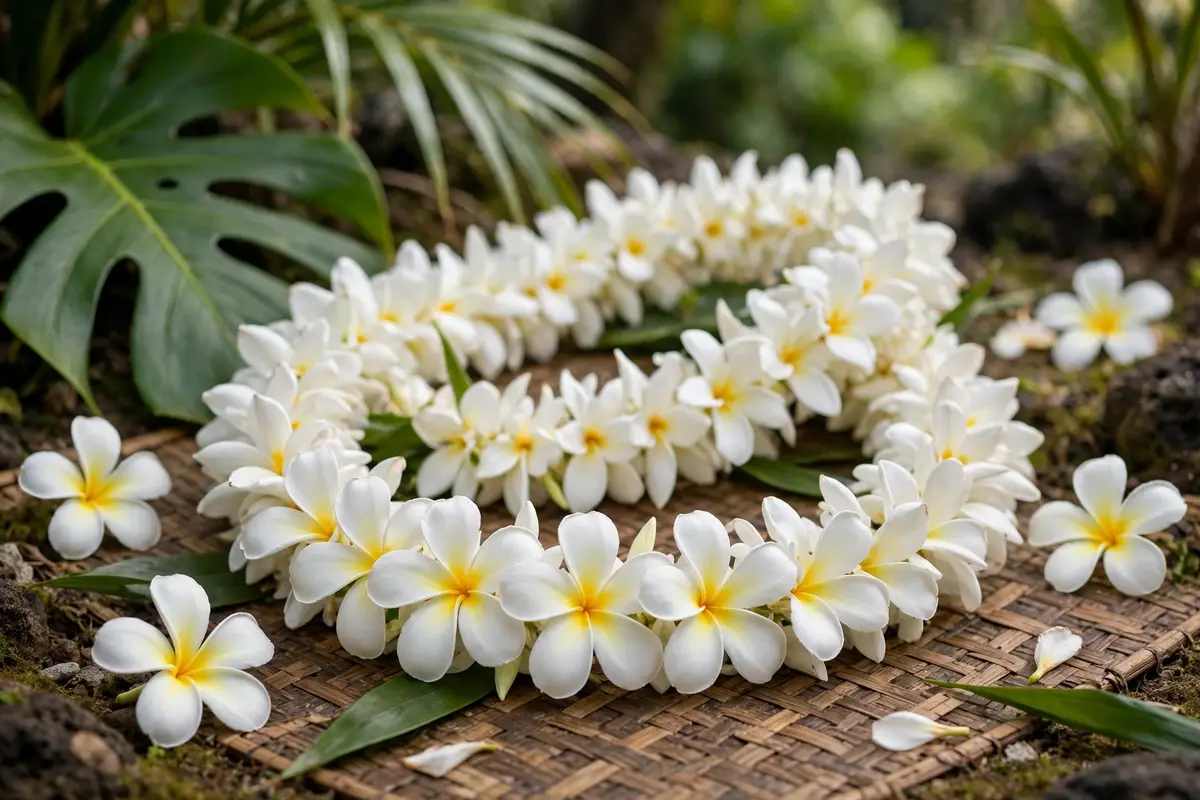
The plumeria is the white or pink five-petalled flower of the classic lei, and the one most visitors remember by smell. It came from the Americas and arrived in Hawaii in the 1860s, and it spread because it is almost absurdly well suited to the islands: it loves heat, tolerates drought, drops its leaves in the dry season and flowers extravagantly on bare branches. Its Hawaiian name, melia, is used more often than plumeria in everyday speech, and a single tree can scent a whole garden in the evening. It is not the state flower, it is not native, and it is still, for most people, the smell of Hawaii.
Orchids are the second flower of the Hawaii imagination, arriving in leis, corsages and hotel arrangements. Most are hybrids bred for the flower trade and grown commercially on the islands, especially the Big Island, rather than gathered from the wild. The bird of paradise, with its orange and blue crest like a bird in flight, is the third: a South African plant that grows so happily in Hawaii that visitors assume it must be native. Together, the three make the point that Hawaii’s flower culture is a blend — a few rare natives at the centre of the law, and beloved imports doing the everyday work of beauty, scent and welcome.
Each Island Has Its Own Flower
The state flower is not the whole story. Each of the eight main Hawaiian islands has its own official flower or lei material, and its own official colour to match. The pairings were traditional for generations and were formally written into law in 2000. If you want a Hawaii flower that is truly local, this is the list to learn. Our flower names A to Z guide is a good place to keep exploring once you know the names here.
- Hawai’i (the Big Island) — red, ‘ohi’a lehua. The blossom of the native ‘ohi’a tree, a burst of red stamens that looks like a bottle brush. It is sacred to Pele, the volcano goddess, and tradition says picking one can bring rain. The tree is under threat from a fungal disease called Rapid ‘Ohi’a Death.
- Maui — pink, lokelani. The pink Damask rose, Rosa damascena, known as the lokelani or “heavenly rose”. It is the only island emblem that is not native: it was brought to the islands in the 1800s and became so beloved that Maui adopted it anyway.
- O’ahu — yellow, pua ‘ilima. The tiny yellow flower of the native ‘ilima shrub, Sida fallax. In old Hawaii the ‘ilima lei was the lei of high chiefs, and it takes hundreds of the small blossoms to string a single lei.
- Kaua’i — purple, mokihana. Not a flower at all, strictly speaking, but the fragrant green berry of the native mokihana tree, Pelea anisata, which grows only on Kaua’i. The berries smell of anise and have been strung into leis for centuries.
- Moloka’i — green, pua kukui. The small white blossom of the kukui, or candlenut tree, Aleurites moluccana. The kukui is also the state tree of Hawaii, and its oily nuts were once burned for light.
- Lana’i — orange, kaunaoa. A native dodder vine with fine orange strands that grows along the coast, winding around host plants.
- Ni’ihau — white, pupu. The tiny seashells of Ni’ihau, strung into the famous Ni’ihau shell leis. The “Forbidden Isle” is privately owned and largely closed to visitors, which is why a Ni’ihau shell lei is the most valuable lei in Hawaii.
- Kaho’olawe — grey, hinahina. The native beach heliotrope, a silvery-grey plant of the dry coast. Kaho’olawe is uninhabited and was long used as a bombing range; its emblem is a quiet, tough survivor.
Notice what the list rewards: not showiness, but belonging. Seven of the eight emblems are native or endemic plants, and the one exception, Maui’s rose, earned its place over two centuries of being loved. The yellow hibiscus sits above the list as the state flower, and the island flowers sit below it as the local truth.
Meaning and Symbolism
In Hawaii, flowers are not decoration first and meaning second; the two arrive together. A hibiscus behind the right ear traditionally signals that the wearer is single, behind the left that they are taken. A lei is not a souvenir but a greeting, a farewell, a thank-you and a blessing. The flower is the vehicle; the meaning is the gift.
The yellow hibiscus carries the heaviest symbolism of all, because it is both the state flower and an endangered native. It stands for the natural beauty of Hawaii and for the islands’ unique living heritage — the plants and animals that exist nowhere else. Its rarity has become part of its meaning: to see a ma’o hau hele in flower is to see something that Hawaii could lose, and that Hawaii has chosen, by law, to keep. That is a different kind of symbolism from the red hibiscus on a shirt. One says “Hawaii is beautiful”. The other says “Hawaii is irreplaceable”.
The island flowers carry their own meanings. The ‘ohi’a lehua belongs to Pele, and its red is the red of the volcano and of the island it names. The ‘ilima, once the flower of chiefs, still carries a sense of rank and honour, which is why an ‘ilima lei is a serious gift rather than a casual one. The mokihana’s scent is the scent of Kaua’i itself to people who grew up there. And the lokelani, the rose that is not native and was chosen anyway, is a reminder that Hawaiian culture has always absorbed what arrived by sea and made it Hawaiian.
How to Grow Hawaiian Flowers
Growing the Hawaiian flower depends on which flower you mean, because the native yellow hibiscus and the tropical hibiscus want different things, and confusing them is the most common mistake. The ma’o hau hele is a plant of dry places. In the wild it grows on the leeward, drier sides of the islands, in dry forest and scrub, in full sun and poor, sharp-draining soil. It is drought-tolerant once established, it dislikes wet feet, and it is hardy only where winters stay warm and frost-free, roughly USDA zones 10 to 12. In Hawaii it is grown as a garden shrub; outside Hawaii it is a conservatory or warm-climate plant, and it must come from a nursery, never from the wild, where it is protected and far too scarce to collect.
The tropical hibiscus most people actually grow, Hibiscus rosa-sinensis and its hundreds of hybrids, is a much easier customer. It wants full sun, rich and moist but well-drained soil, regular water and feeding, and it is hardy in zones 9 to 11, grown in pots and brought inside wherever winters turn cold. It is the plant to choose if you want the big, bright Hawaiian look without the conservation worry; leave the ma’o hau hele to the specialists.
Plumeria is the easiest of the famous three to grow well. It wants heat, full sun and very little fuss: free-draining, almost sandy soil, water through the growing season, and a dry rest in winter when it drops its leaves. It is hardy only in zones 10 to 12, so in cooler climates it is a pot plant that summers outdoors and winters in a bright, frost-free room.
One warning belongs in every guide to growing Hawaiian flowers. The ma’o hau hele is endangered, the ‘ohi’a is threatened by a spreading fungal disease, and several island emblems grow only in one place. Buy nursery-grown plants, keep garden plants away from wild populations, and clean tools and shoes after walking in native forest. Grow the garden kinds at home and admire the wild kinds where they live.
For gardeners who love island flowers in general, the same warm-climate, free-draining approach works far beyond Hawaii. Our guide to Australian native flowers covers another set of sun-loving, drought-tough flowers that thrive on the same kind of care, and the overlap between the two lists is a useful reminder that the world’s dry places grow some of its best flowers. The r/gardening community on Reddit is a good place to compare notes with other warm-climate growers.
Lei Culture and Lei Day
No guide to the Hawaiian flower is complete without the lei, because the lei is where the flower stops being a plant and becomes a custom. In ancient Hawaii, leis were made from what the islands provided: ‘ohi’a lehua, yellow ‘ilima and naupaka flowers, the fruits of the hala tree, maile vines and ti leaves. The flowers that arrived later — plumeria, orchid, tuberose, carnation — joined the tradition rather than replacing it, and a modern lei can mix native and introduced flowers without anyone thinking twice about it.
Lei Day, on 1 May, is the custom’s public holiday. It honours not only the lei but the colours and flowers of each island, and it is celebrated with lei-making contests, hula, music and the giving of leis to anyone and everyone. The day is a reminder that in Hawaii a flower is something you give away, not something you keep. A lei is worn, admired, and then returned to the earth or the sea when it fades, which is a gentler ending than most flowers get.
If you are ever given a lei, the etiquette is simple: accept it with a bow of the head, wear it over the shoulders, and do not remove it in front of the person who gave it to you. The rules are small, but they carry the same message as the flowers themselves: respect, welcome, and aloha.
Frequently Asked Questions
What is the official flower of Hawaii?
The official Hawaii state flower — the flower people mean when they search for a Hawaii flower — is the native yellow hibiscus, Hibiscus brackenridgei, known in Hawaiian as ma’o hau hele or pua aloalo. It was designated by law on 6 June 1988; the broader hibiscus had been the territorial flower since 1923, but the 1988 law specified the native yellow species. More questions about the Hawaiian flower on Quora cover the same confusion between the red and yellow hibiscus.
Is the Hawaiian flower the plumeria?
No. Plumeria is the flower most visitors associate with Hawaii, and it is the classic lei flower, but it is not native to the islands and it is not the state flower. It arrived from the Americas in the 1860s and became beloved because it suits Hawaii’s climate so well. The state flower is the yellow hibiscus.
What is the Hawaiian flower called in Hawaiian?
The state flower is called ma’o hau hele, and hibiscus in general is called pua aloalo. The island flowers have their own names: ‘ohi’a lehua for Hawai’i Island, lokelani for Maui, pua ‘ilima for O’ahu, and mokihana for Kaua’i. If you are looking for flowers by their first letter, our flowers that start with H guide includes hibiscus among the H flowers.
Can I grow the Hawaii state flower at home?
You can grow nursery-raised ma’o hau hele only somewhere warm and frost-free, roughly USDA zones 10 to 12, with full sun and very well-drained soil. Never take plants from the wild: the species is federally endangered. Most gardeners outside Hawaii grow tropical hibiscus hybrids instead.
Why is the Hawaii state flower yellow and not red?
Because the law chose the flower that is actually native to Hawaii. The familiar red hibiscus, Hibiscus rosa-sinensis, is an introduced garden plant from Asia. The 1988 law specified the native yellow Hibiscus brackenridgei precisely to correct the long-standing confusion and to honour the islands’ own flora.
What flower represents each Hawaiian island?
Hawai’i Island is the red ‘ohi’a lehua, Maui is the pink lokelani rose, O’ahu is the yellow pua ‘ilima, Kaua’i is the purple mokihana berry, Moloka’i is the white pua kukui blossom, Lana’i is the orange kaunaoa vine, Ni’ihau is the white pupu shell, and Kaho’olawe is the grey hinahina. Each island also has a matching official colour.
So a Hawaii flower is not one flower but a small family of answers, and the best of them is the one Hawaii chose for itself. The yellow hibiscus is native, it is rare, and it is protected, and it asks a little more of the people who love it than the red hibiscus on a postcard does. Grow the bright garden kinds, wear the plumeria leis, learn the eight island flowers, and leave the wild ma’o hau hele to the dry slopes where it belongs. Next in this series, the State Flowers cluster continues with California, Texas and Florida, one state flower at a time.