
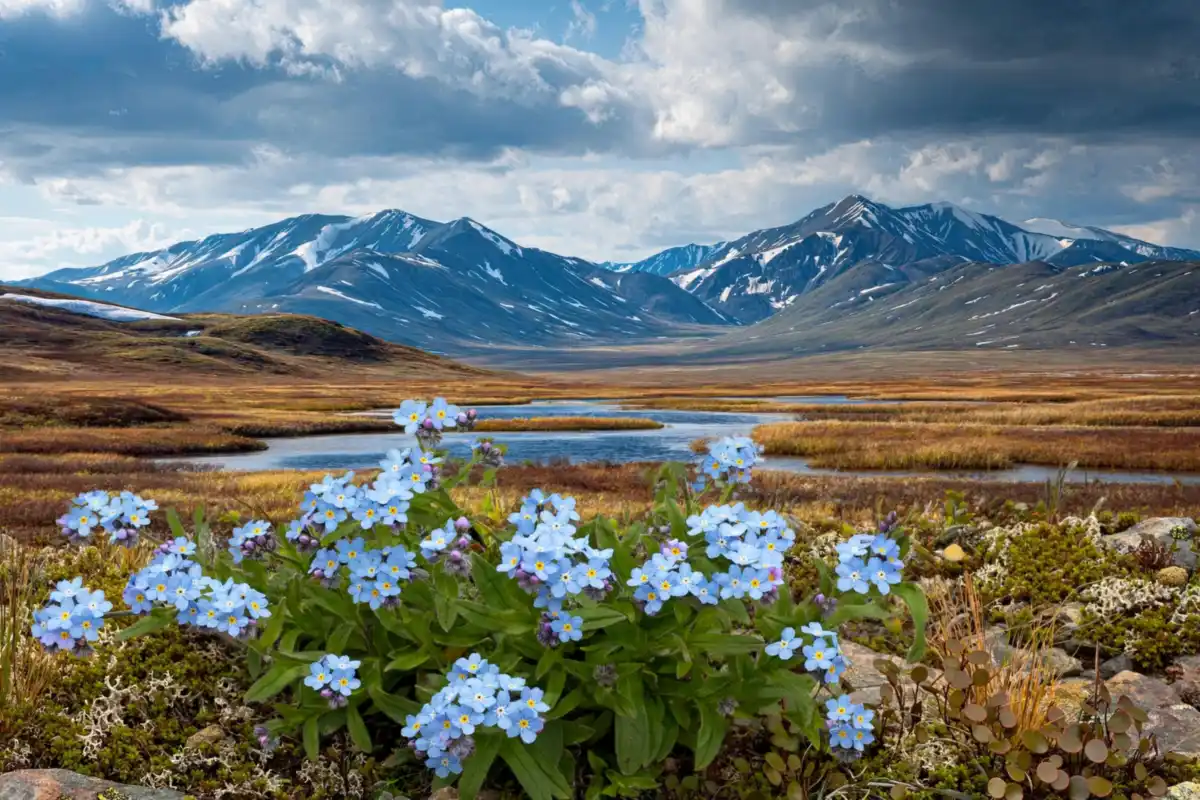
Alaska State Flower: The Forget-Me-Not in the Flag
Alaska chose its flower before it was even a state — and then, a decade later, wove the flower into its flag. The Alaska state flower is the alpine forget-me-not, adopted by the territorial legislature in 1917, a tiny sky-blue wildflower with a golden eye that blooms through the short Arctic summer on tundra and mountain slope. When a 13-year-old boy named Benny Benson designed Alaska’s flag in 1927, he made the field blue “for the sky and the forget-me-not” — which makes this the only state flower that flies over the state on its own colours, every day.
This guide covers the Alaska state flower and its story, the flag written in its colours, what the forget-me-not means (its name is the meaning), six more Alaska flowers worth knowing — including fireweed, the state’s summer clock — and how to grow forget-me-nots: where the Alaska kind fits the cold garden, and where its garden cousins should do the work instead.
Quick Answer
The Alaska state flower is the alpine forget-me-not, Myosotis alpestris, adopted in 1917 by Alaska’s territorial legislature. It is a low, tufted perennial wildflower of tundra, meadows and rocky slopes across Alaska: clusters of small sky-blue, five-petalled flowers with yellow-to-white eyes, blooming through the brief northern summer. Alaska has no separate state wildflower — the forget-me-not covers both honours. Forget-me-nots mean true love, remembrance and fidelity — the flower’s name is quite literally a request not to be forgotten.
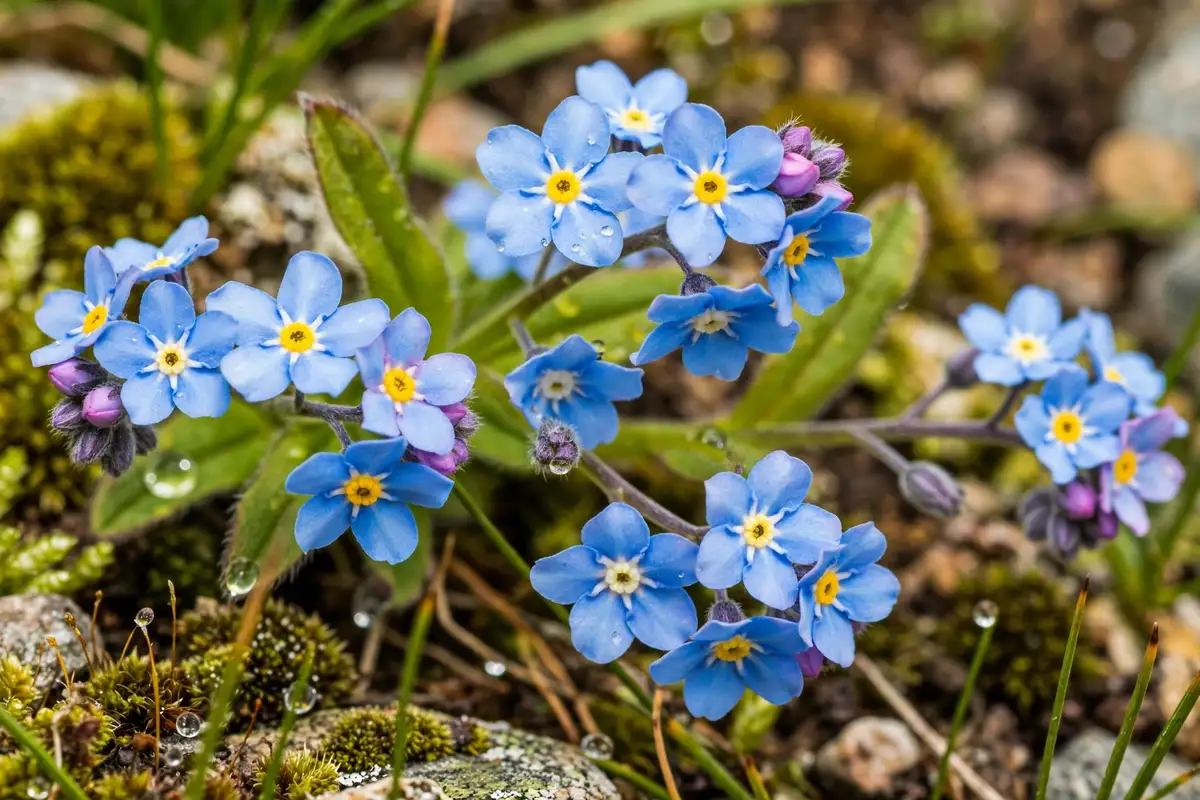
Table of Contents
- What Is the Alaska State Flower?
- The Story: 1917, the Pioneers and the Pre-State Flower
- A State Flag Written in Forget-Me-Nots
- Forget-Me-Not Meaning and Symbolism
- 6 More Alaska Flowers Worth Knowing
- How to Grow Forget-Me-Nots
- Common Mistakes When Growing Forget-Me-Nots
- Frequently Asked Questions
What Is the Alaska State Flower?
The alpine forget-me-not is a mountain professional: a compact perennial, just 2 to 8 inches tall, that makes its entire living in a few weeks of tundra summer between snowmelt and frost. Its flowers are the family’s classic design — five sky-blue petals around a ring of white scales and a golden eye — held in tight clusters above hairy, spoon-shaped leaves. It grows wild across Alaska, from the Brooks Range to the Aleutian meadows, and across the mountain north of the whole world besides; sourdoughs adopted it as the pioneer’s badge, and early Alaskans mailed its pressed flowers south as proof that the far north flowered. Our forget-me-not guide covers the genus’s kinds, colours and care in full. You can read more on the forget-me-not page on Wikipedia.
Alaska State Flower Quick Facts
- State flower: alpine forget-me-not, Myosotis alpestris — family Boraginaceae.
- Adopted: 1917, by the territorial legislature — 42 years before statehood (1959); there is no separate state wildflower.
- Championed by: the Pioneers of Alaska, the gold-rush generation’s fraternal order, who wore it as their emblem.
- The flower: sky blue with a yellow-white eye; small (about 1/3 inch), in clustered heads; one summer bloom.
- The plant: low tufted perennial, 2 to 8 inches; wild across Alaska’s tundra, meadows and slopes.
- In the garden: the alpine species is a rock-garden specialist (zones 3 to 7, sharp drainage); the cottage forget-me-not M. sylvatica is the easy bedding cousin.
- Good to know: Alaska’s flag (1927) is blue, its designer’s own words, partly “for the forget-me-not, an Alaskan flower” (see story below).
The Story: 1917, the Pioneers and the Pre-State Flower
In 1917 Alaska was a territory with gold-rush memories still fresh, and the men who had lived them — organized as the Pioneers of Alaska — had already chosen the forget-me-not as their emblem: the little blue flower that grew on every claim and hillside, standing for the vow the pioneers made each other, not to forget. The territorial legislature made it official that year, and the flower served Alaska through the long territorial decades. It had company in the honour roll from the start: it is one of the earliest state flowers in the Union (Maine’s pine cone, 1895, and a handful of others predate it), chosen not from a catalogue but from the ground the choosers actually walked — a working flower for a working territory, small as the summer and stubborn as the people.
A State Flag Written in Forget-Me-Nots
Ten years after the flower, Alaska got its flag by competition — and the winner was Benny Benson, a 13-year-old Aleut boy living at the Jesse Lee Home orphanage in Seward. His design, chosen in 1927 from hundreds of entries, sets eight gold stars on deep blue: the Big Dipper for strength (the bear it pictures) and the North Star for Alaska’s place at the top of the map. Benson’s own explanation survives, and it names the flower: the blue field, he wrote, stands for the sky — and for the forget-me-not, an Alaskan flower. No other state flies its flower in its flag’s field colour; Alaskans have flown theirs since 1927, 32 years before the flag itself became a state flag at statehood in 1959. Where the Georgia state flower carries its meaning in a legend, Alaska’s carries it in cloth — remembrance, stitched into the banner.
Forget-Me-Not Meaning and Symbolism
No flower states its meaning more plainly: forget-me-not means remembrance, true love and fidelity — in the old German tale, a knight drowning in the Danube threw the flowers to his lady with the cry that named them. Alaska’s use of it is the meaning at full strength: a territory of scattered camps and long winters adopted the flower as a bond — remember the ones the north took, remember the ones who stayed, remember each other. Worn by the Pioneers, woven into the flag, blooming unasked on tundra a thousand miles from the nearest garden, it remains the most literal emblem in the state flower list: not a symbol of remembrance. The thing itself.
6 More Alaska Flowers Worth Knowing
The northern summer is short and spends everything at once. The table separates the cast; the profiles follow. For thousands more flower names, see our flower names A to Z guide.
| Flower | Colour | Season | Character | Best use |
|---|---|---|---|---|
| Fireweed | Magenta-pink | Summer | The summer clock | Wild meadows, burns |
| Arctic lupine | Blue-purple spikes | Early summer | The soil-builder | Roadsides, gardens |
| Wild geranium | Lavender-pink | Summer | The trail-side friend | Meadow gardens |
| Arctic poppy | Yellow | Summer | The sun-tracker | Rock gardens |
| Salmonberry | Magenta | Spring | The berry herald | Coastal thickets |
| Monkshood | Deep blue-violet | Late summer | Beautiful and deadly | Admire only |
1. Fireweed — the Summer Clock
Chamerion angustifolium is Alaska’s unofficial second flower and its calendar: the tall magenta spikes open from the bottom up all summer, and the saying runs that when the bloom reaches the top and turns to cotton, summer is done and winter is loading. Fireweed rushes into burned or cleared ground first — the land’s own first responder, and a honey and jelly plant besides.
2. Arctic Lupine — the Soil-Builder
Lupinus arcticus paints roadsides and gravel bars blue-purple each June — and works while it blooms, fixing nitrogen into Alaska’s thin young soils so other plants can follow. Its seeds are famously patient: lupine seeds germinated from lemming-burrow caches were once claimed to be thousands of years old (the famous figure was later doubted — but decades-old viable seed is proven). Our lupine guide covers the family’s kinds and care.
3. Wild Geranium — the Trail-Side Friend
Geranium erianthum, the woolly geranium, opens lavender-pink cups along Alaska’s trails and meadow edges all summer — a hardy true geranium (no relation to the bedding “geraniums,” which are pelargoniums) that asks nothing and shows up everywhere from Juneau to Nome.
4. Arctic Poppy — the Sun-Tracker
Papaver radicatum and kin perform the tundra’s neatest trick: the yellow cup rotates through the day to face the sun, a little solar dish that focuses warmth on the flower’s centre — heating the insects that visit and ripening seed faster in a summer with no time to waste.
5. Salmonberry — the Berry Herald
On the wet coast, Rubus spectabilis opens deep magenta flowers weeks before the leaves finish — the First Foods signal along the shore, promising the salmonberries (orange to red, raspberry-shaped) that feed bears, birds and people by midsummer.
6. Monkshood — Beautiful and Deadly
Aconitum delphinifolium lifts hooded, deep blue-violet spires in late-summer meadows — and every part of it is seriously poisonous, as its old career in arrow poisons attests. Alaska’s wild garden, like the state itself, keeps some beauty strictly for looking at.
How to Grow Forget-Me-Nots
Two plants share the name, and choosing the right one is the whole game: the alpine species is a rock-garden jewel for cold climates, while its woodland cousin is the easy spring bedding plant. Gardeners on r/gardening on Reddit pass on the rule as the family’s first law: “sow the cottage kind like you mean forever — because once it flowers, it will do the sowing itself.”
The Alpine Species — for Specialists
Myosotis alpestris wants what Alaska gives it: full sun, gritty, sharply drained soil, cool summers and cold winters (zones 3 to 7). In a rock garden or trough, watered in drought and never coddled with rich soil, it forms the tight blue cushions of the tundra in miniature. Where summers run hot and humid it fades — which is not failure but geography, and the cue to grow the cousin below.
The Cottage Cousin — for Everyone Else
Myosotis sylvatica is the forget-me-not of spring bedding: sow in summer for flowers the following April–May under tulips and wallflowers, in sun or part shade and ordinary soil kept moist. Treat it as a self-renewing biennial — let one patch go to seed each year and shake the stems where you want next spring’s drift. The blue (with pink and white forms) is fleeting at about six weeks — plan succession as Alaska does: let the summer flowers take over on schedule.
Common Mistakes When Growing Forget-Me-Nots
Mistake one is buying the alpine species for a hot, humid garden: it is a tundra plant and will leave by August; match the species to the climate before blaming the plant. Mistake two is rich, wet soil for the alpine kind — root rot takes what the cold never could; drainage is its non-negotiable. Mistake three is deadheading the cottage kind completely: no seed, no next spring — leave the seedheads on at least part of the patch.
Mistake four is sowing the cottage species in spring expecting spring flowers: it is a biennial that blooms in its second year, so sow by midsummer for the April show. Mistake five is dry shade under thirsty trees, where even the tolerant cousin thins out — water the drift in its first autumn. And mistake six is tidying the faded plants too fast in early summer: their seed is next year’s blanket, and the goldfinches work the seedheads before you should.
Frequently Asked Questions
What is the Alaska state flower?
The alpine forget-me-not, Myosotis alpestris, adopted in 1917 by Alaska’s territorial legislature — one of the earliest state flower adoptions in America, and 42 years before Alaska became a state. There is no separate Alaska state wildflower. If your question is not answered here, the questions about the Alaska state flower on Quora cover most of the rest.
What does the Alaska flag have to do with the flower?
Everything about its colour: Benny Benson, the 13-year-old who designed the flag in 1927, explained that the blue field stands for the Alaska sky and for the forget-me-not, “an Alaskan flower”. The gold stars form the Big Dipper and the North Star. Alaska’s is the only state flag whose field colour officially honours its state flower.
When does the forget-me-not bloom in Alaska?
Through the northern summer — roughly June into August depending on latitude and snowmelt — in tundra, meadows, roadsides and rocky slopes statewide. The bloom follows the retreating snow, sometimes within days of melt.
Can I grow the Alaska forget-me-not in my garden?
In cold climates, yes: zones 3 to 7 with sharp drainage and cool summers suit Myosotis alpestris in rock gardens and troughs. In warmer or humid regions, grow the woodland species M. sylvatica as spring bedding instead — same blue, far easier company.
Are forget-me-nots perennial?
The alpine species is a true (if sometimes short-lived) perennial. The cottage species is a biennial that perpetuates itself by self-seeding so reliably that a planted patch behaves like a perennial — new plants each year from last year’s seed.
Why is it called forget-me-not?
The name rides a German legend: a knight, swept away by the Danube while picking the blue flowers for his lady, threw them to her with a last cry of “Vergissmeinnicht!” — forget me not. The name stuck in a dozen languages, and Alaska’s pioneers adopted the flower for exactly the sentiment it carries.
One Comment