
Utah State Flower: The Sego Lily, the Pioneer Story and Growing Guide
Most state flowers are monuments to beauty. Utah’s is a monument to survival. In the brutal first years of settlement in the Salt Lake Valley — when swarms of crickets stripped the wheat in 1848 and hunger stalked the cabins — the pioneers lived, in part, on a wildflower: the sego lily, whose starchy bulbs they dug and ate the way the Native peoples of the Great Basin had for centuries. Sixty years later, Utah made the flower official — not because it was the showiest bloom in the state, but because it had fed the state. It remains the only state flower chosen as a memorial to being kept alive.
This guide covers the Utah state flower and its story, what the sego lily means, where to see it (Cedar Breaks’ alpine meadows are its cathedral), six more Utah flowers worth knowing, and how to grow mariposa lilies — a connoisseur’s bulb with exacting, entirely learnable rules.
Quick Answer
The Utah state flower is the sego lily, Calochortus nuttallii, adopted on 18 March 1911. It is a cup-shaped mariposa lily — white to lilac petals, each with a maroon blotch and a yellow, hair-fringed base — flowering late spring to early summer across the dry West in zones 4 to 8 conditions of perfect drainage and a dry summer rest. Its bulbs were a traditional food of Great Basin peoples and a survival food of Utah’s pioneers in 1848–49, and the flower stands for survival, gratitude and resilience. The word “sego” comes from the Shoshone language.
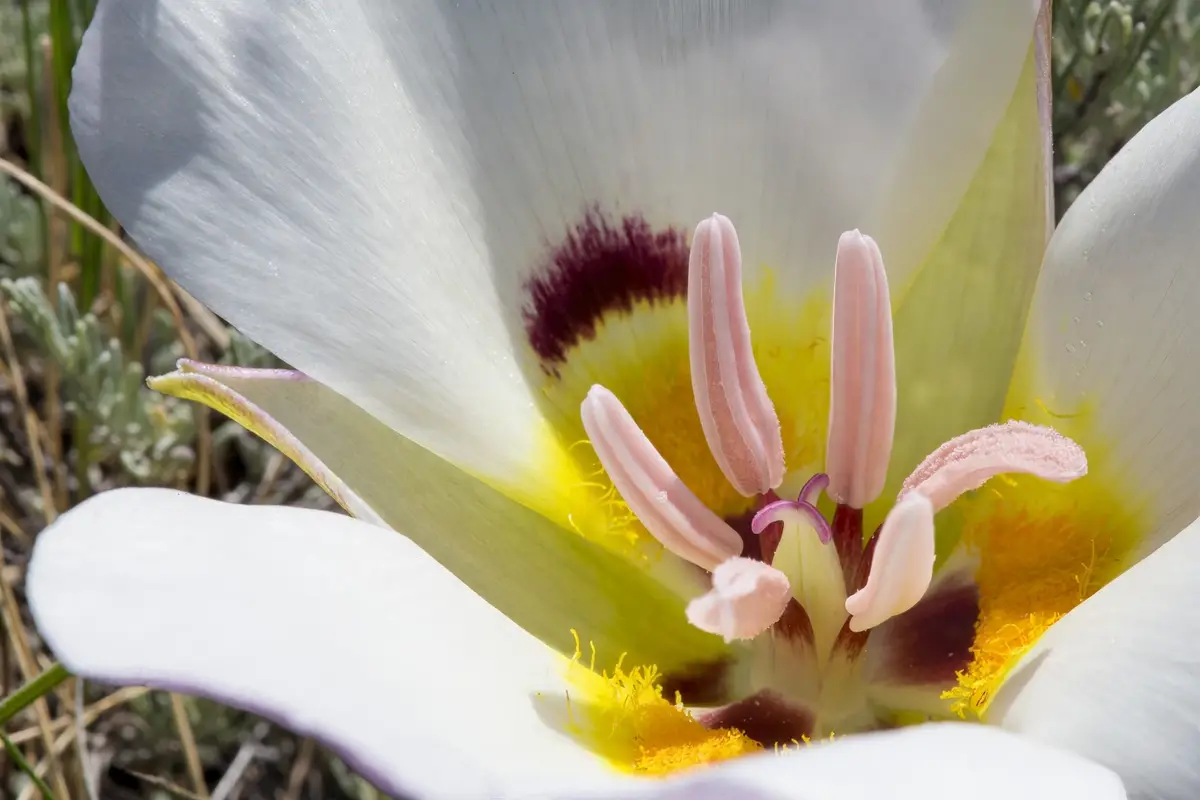
Table of Contents
- What Is the Utah State Flower?
- The Story: Crickets, Hunger and the Flower That Fed Utah
- Sego Lily Meaning and Symbolism
- Where to See Sego Lilies in Utah
- 6 More Utah Flowers Worth Knowing
- How to Grow Sego Lilies and Mariposa Lilies
- Common Mistakes When Growing Mariposa Lilies
- Frequently Asked Questions
What Is the Utah State Flower?
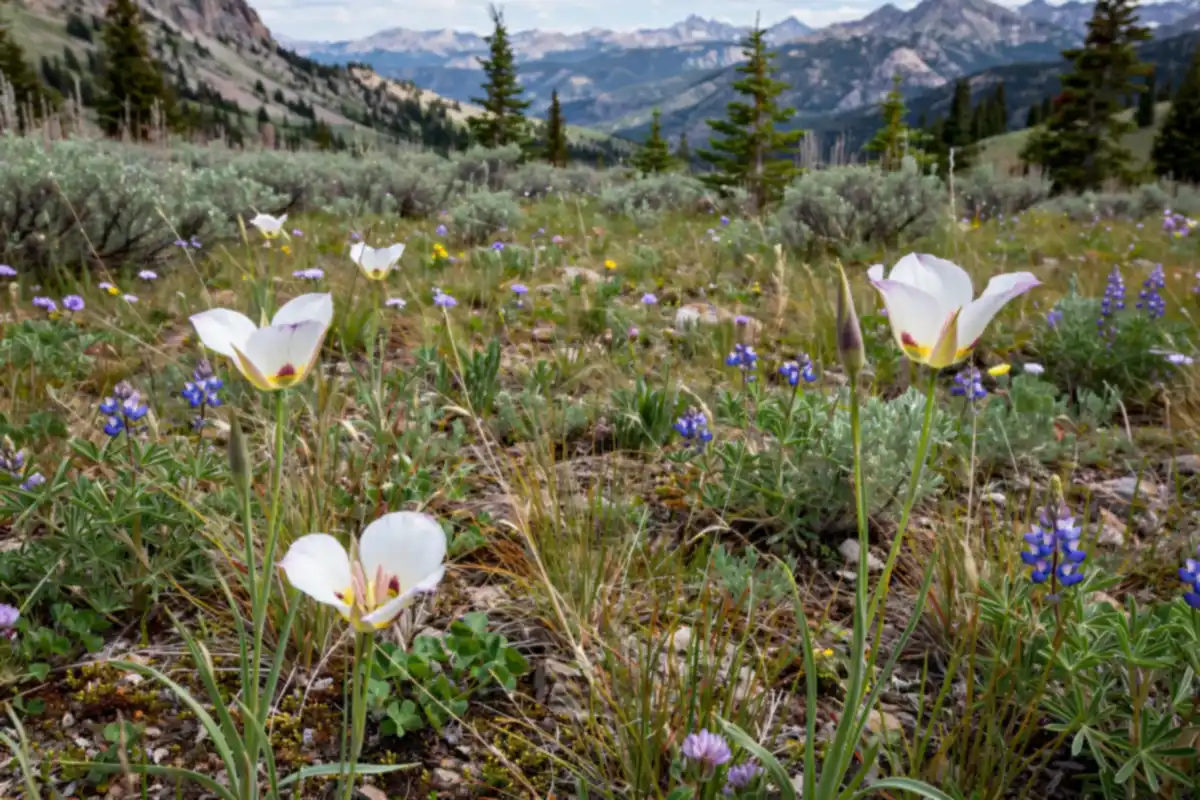
The sego lily belongs to Calochortus, the mariposa lilies — a western North American genus famous among bulb lovers for cups of almost painted intricacy. Calochortus nuttallii stands 8 to 18 inches tall on a wiry stem over grass-like leaves, carrying one to several blooms like small tulips: three broad petals in white, cream or pale lilac, each painted at the base with a crescent of maroon-purple around a yellow gland fringed with hairs. It grows across the Great Basin and Colorado Plateau — dry slopes, sagebrush flats and open pine woods, from valley floor to mountain meadow — and it is tuned to that climate in its bones: sprout with the spring moisture, flower fast, set seed, and sleep underground through the baking summer and the frozen winter. You can read more on the Calochortus nuttallii page on Wikipedia.
Utah State Flower Quick Facts
- State flower: sego lily, Calochortus nuttallii — family Liliaceae, one of the mariposa lilies.
- Adopted: 18 March 1911, as Utah’s official state flower and floral emblem.
- The name: “sego” from Shoshone seego; the bulb was a Native food long before statehood.
- Native range: the interior West — Great Basin and Colorado Plateau, Utah to Montana and Arizona.
- Bloom season: May to July depending on elevation; a spring bulb that rests dry in summer.
- Height and habit: 8 to 18 inches; wiry stem, grass-like leaves, a deep-set bulb.
- Conditions: zones 4 to 8 in effect — full sun, gritty perfectly-drained soil, dry summer rest is non-negotiable.
- Good to know: the bulbs are edible and were a staple food (roasted, boiled or dried for winter); wild plants should be left standing — grow from nursery seed or bulbs, never dig wild ones.
The Story: Crickets, Hunger and the Flower That Fed Utah
The pioneers reached the Salt Lake Valley in 1847, and 1848 nearly ended the experiment: swarms of flightless crickets — the “Mormon crickets” of Utah legend, answered famously by flocks of gulls — destroyed much of the first full crop, and the winter that followed was a famine winter. Families rationed, foraged, and dug. What they dug, following the knowledge of the Shoshone, Ute and Paiute peoples who had harvested them for generations, were sego bulbs: walnut-sized, starchy, and stored in the dry ground like a pantry. Through 1848 and 1849 the bulbs — baked, boiled, and traded — helped carry the settlements to their next harvest. When Utah chose a state flower in 1911, schoolchildren and pioneers’ societies campaigned for the sego lily on exactly those grounds: it was not a decoration, it was a debt remembered. The legislature agreed, and the sego lily became the rare state emblem whose citation would read like a thank-you note.
Sego Lily Meaning and Symbolism
The sego lily means survival, gratitude and resilience — the flower of making do and living through. Where the Florida state flower smells of abundance, the sego lily stands for the opposite virtue: endurance in scarcity, beauty in a hard land, help found close to the ground. It is also Utah’s reminder of debts owed across cultures — the pioneers survived partly on Indigenous knowledge, and the flower’s own name keeps the receipt, in Shoshone. In the language of flowers its cup of white and maroon reads as purity tested and kept: a small, bright thing that outlasts crickets, drought and winter, and is still standing in May.
Where to See Sego Lilies in Utah
Timing runs uphill: valley populations flower in May, mountain ones into July, and elevation is your calendar. The cathedral is Cedar Breaks National Monument, whose rim-top meadows at 10,000 feet hold mariposa lilies among paintbrush and lupine in July (its wildflower festival lands mid-July); Antelope Island’s dry slopes bloom earlier and close to Salt Lake City; the foothill benches and sagebrush flats of the whole Wasatch Front carry scattered plants wherever building has not reached. Seek them on foot, on open dry ground, in the morning when the cups are fresh — and leave every plant exactly as found: wild sego lilies belong to the slopes, the seed bank and the story.
6 More Utah Flowers Worth Knowing
The desert state flowers harder than its reputation. The table separates them; the profiles follow. For thousands more flower names, see our flower names A to Z guide.
| Flower | Colour | Season | Character | Best use |
|---|---|---|---|---|
| Firecracker penstemon | Scarlet tubes | Spring–summer | Hummingbird fireworks | Dry banks, rock gardens |
| Scarlet gilia | Red trumpets | Summer | The skyrocket flower | Mountain meadows |
| Apache plume | White, then pink plumes | Spring–autumn | Two shows in one shrub | Desert landscaping |
| Desert evening primrose | White, huge | Spring | The dune opener | Sandy wild gardens |
| Prince’s plume | Yellow spires | Spring–summer | The selenium flag | Wild dry slopes |
| Utah serviceberry | White clouds | Spring | The canyon orchard | Native hedges, wildlife |
1. Firecracker Penstemon — Hummingbird Fireworks
Penstemon eatonii throws scarlet tubes on tall wands over evergreen rosettes, timed for hummingbirds and impossible to miss against sagebrush grey. Utah is penstemon country — hundreds of western species, many born here — and this is the flagship: drought-proof, gravel-happy, and redder than the rocks.
2. Scarlet Gilia — the Skyrocket
Ipomopsis aggregata waits a year (or two) as a rosette, then fires a rocket: a tall spike of scarlet trumpets in summer meadows, hummingbird-pollinated, seeding itself for the next show. It is the red exclamation point of Utah’s mountain July.
3. Apache Plume — Two Shows, One Shrub
Fallugia paradoxa flowers white like a wild rose in spring, then dresses each seed in a feathery pink plume that glows backlit for months — a desert shrub with a second act longer than its first. Canyon-country gardens lean on it heavily.
4. Desert Evening Primrose — the Dune Opener
Oenothera deltoides opens huge white cups at ground level on sandy flats, fragrant at dusk, fading pink by noon. In a wet spring whole dune fields west of the Wasatch turn white at breakfast time.
5. Prince’s Plume — the Selenium Flag
Stanleya pinnata raises yellow spires 4 feet tall from desert pavement — and tells geologists something: it thrives on selenium-rich soils other plants refuse, which makes it both a wildflower and a prospecting instrument. Leave it wild; it does not transplant its opinions.
6. Utah Serviceberry — the Canyon Orchard
Amelanchier utahensis clouds canyon slopes with white blossom in spring, then offers blue-black berries that fed Native families and still feed birds (and jam-makers who beat the birds to them). A tough, pretty, useful shrub for native plantings statewide.
How to Grow Sego Lilies and Mariposa Lilies
Think like a desert bulb: water in spring, drought in summer, drainage always. Gardeners on r/gardening on Reddit pass on the mariposa rule as the genus’s first law: “kill them with kindness in August, and they’ll never forgive you.”
Planting and Position
Buy nursery-grown bulbs or seed (never wild-collected — the wild stands are the seed bank and the heritage). Plant bulbs in autumn, 3 to 4 inches deep, in the grittiest, sharpest-draining soil you can offer — a raised bed or rock garden of sandy loam and gravel in full sun — or grow in deep clay pots of gritty mix where winters are wet. In climates with summer rain, pots under an eave for the dry rest are the reliable route: water through spring growth and flowering, then stop as the leaves yellow and keep the bulbs dry and warm until autumn.
Care and Patience
Mariposas reward patience: seed takes years to reach flowering size (a bulb’s childhood is spent mostly underground), offsets build slowly, and a happy clump resents disturbance — mark the spot and leave it alone. Protect bulbs from rodents (wire mesh under the bed is the desert gardener’s answer), and never feed richly: lean soil, spring moisture, summer drought, winter cold. Get those four right and the painted cups come back each year like a kept promise.
Common Mistakes When Growing Mariposa Lilies
Mistake one is summer water: the bulbs evolved for a bone-dry rest, and irrigated beds rot them in a season — this is the genus’s killer, and it wears the mask of good care. Mistake two is rich, heavy soil: clay and compost hold the wet that ends them; think gravel with a little soil in it, not the reverse. Mistake three is planting too shallow or in a spot that gets dug annually — the bulbs sit deep and the clumps hate moving.
Mistake four is expecting tulip manners: sego lilies are slender, brief and wild-looking, a connoisseur’s flower rather than a bedding display. Mistake five is impatience with seed — three to five years to flower is normal, and the wait is the hobby. And mistake six is the unforgivable one: digging wild bulbs. Apart from the ethics (and local protections), wild-dug mariposas usually die of the move. Nurseries propagate them properly; buy there.
Frequently Asked Questions
What is the Utah state flower?
The sego lily, Calochortus nuttallii — adopted 18 March 1911 in memory of the pioneer years, when its edible bulbs helped feed the settlements through the cricket-plague famine of 1848–49, a use learned from the Native peoples of the Great Basin. If your question is not answered here, the questions about the Utah state flower on Quora cover most of the rest.
Why did Utah choose the sego lily?
Because it had saved lives. During the hunger years of 1848–49, pioneers dug and ate sego bulbs as the region’s Native peoples had long done. When the state flower was chosen in 1911, pioneers’ societies and schoolchildren backed the sego lily as a memorial of survival — and the legislature agreed.
Are sego lily bulbs really edible?
They were a genuine staple: starchy bulbs eaten roasted, boiled, steamed in pits, or dried and ground, by Great Basin peoples for centuries and by pioneers in the famine years. Today the right relationship is respect, not dinner — wild plants are the seed bank and the living memorial, and garden-grown mariposas are for looking at.
When do sego lilies bloom?
May in the valleys, into July in the high country — the season climbs with the snowmelt. Cedar Breaks’ meadows peak around July; foothill and desert populations can be finished by June. Each plant flowers briefly, so a slope in bloom is a matter of days, not months.
Can I grow sego lilies in my garden?
Yes, if you can give a desert bulb its four terms: full sun, gritty free-draining soil, spring moisture, and a completely dry summer rest — in the ground in dry-summer climates (zones 4 to 8), or in deep gritty pots anywhere. Buy nursery-propagated bulbs or seed; never dig wild plants.
What does “sego” mean?
It comes from the Shoshone word seego for the plant and its edible bulb — a reminder written into the state flower’s very name that the knowledge which fed the pioneers was Native knowledge first.
One Comment