Holly Flower: Types, Meaning and How to Grow It
Every December the same green-and-red silhouette appears on a million cards, wreaths and mantels — and most people could not tell you a single thing about the living plant behind it. Holly is not just Christmas décor that happens to grow: it is one of the world’s great garden genera, more than 400 species strong, with a rule unlike almost any other shrub — the plants are male or female, and only the females carry the famous red berries, and only if a male grows near enough to be useful. That one rule, learned or missed, decides whether your holly is a legend or a disappointment.
This guide covers the six hollies worth knowing (English, American, winterberry, Japanese, yaupon and the variegated beauties), what it means — protection, good luck and eternal life — and how to grow berry-laden branches of your own, with the male-and-female rule explained plainly up front.
Quick Answer
Holly is the genus Ilex in the family Aquifoliaceae — more than 400 species of evergreen and deciduous shrubs and trees grown for glossy leaves (often spiny) and bright berries in red, orange, yellow or black. The small white holly flowers open in spring; the berries ripen for winter. Hollies are dioecious: male and female flowers grow on separate plants, so berrying females need a male of the same species nearby. Most garden hollies are hardy in zones 5 to 9 for acidic, well-drained soil in sun or part shade. The holly plant means protection, good luck and eternal life, and it is December’s most famous symbol.
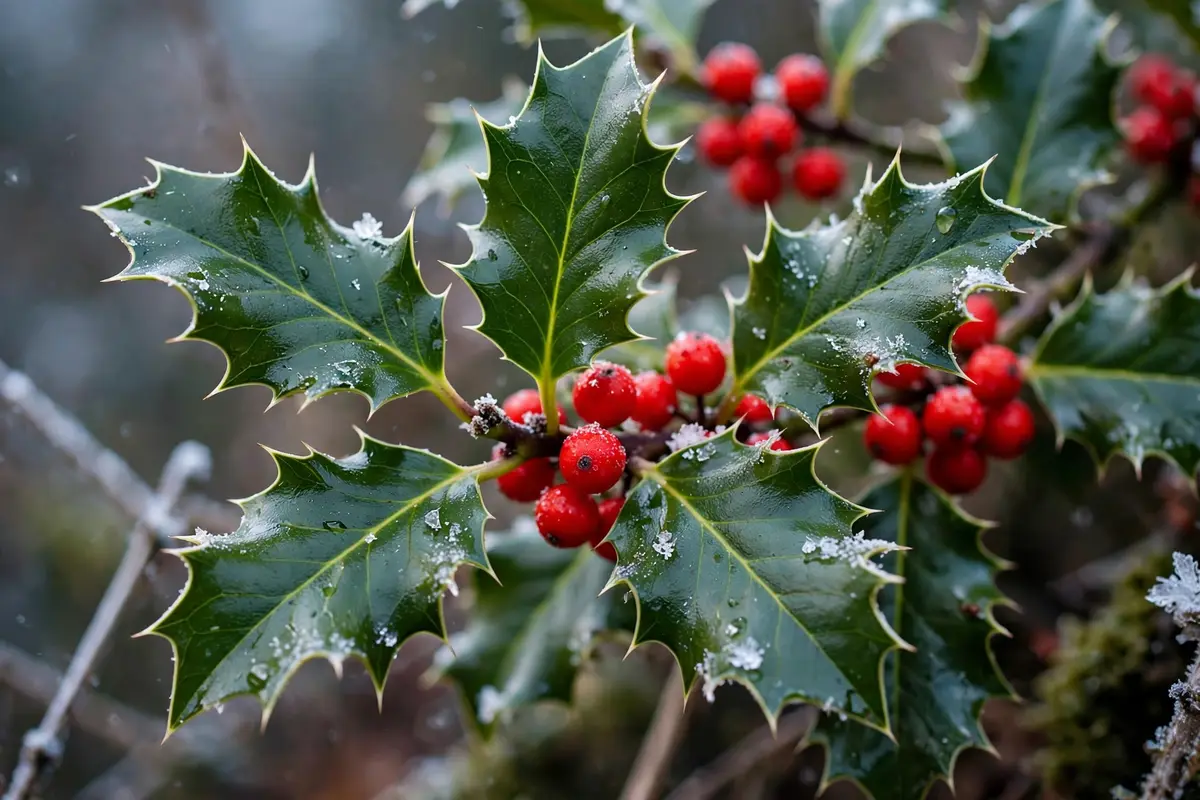
Table of Contents
- What Is a Holly?
- Types of Holly and 6 Kinds Worth Knowing
- Holly Meaning and Symbolism
- Holly Berry Colours and Their Meanings
- How to Grow Holly (and Get Berries)
- Common Mistakes When Growing Holly
- The Male-and-Female Rule: Why Your Holly Has No Berries
- Frequently Asked Questions
What Is a Holly?
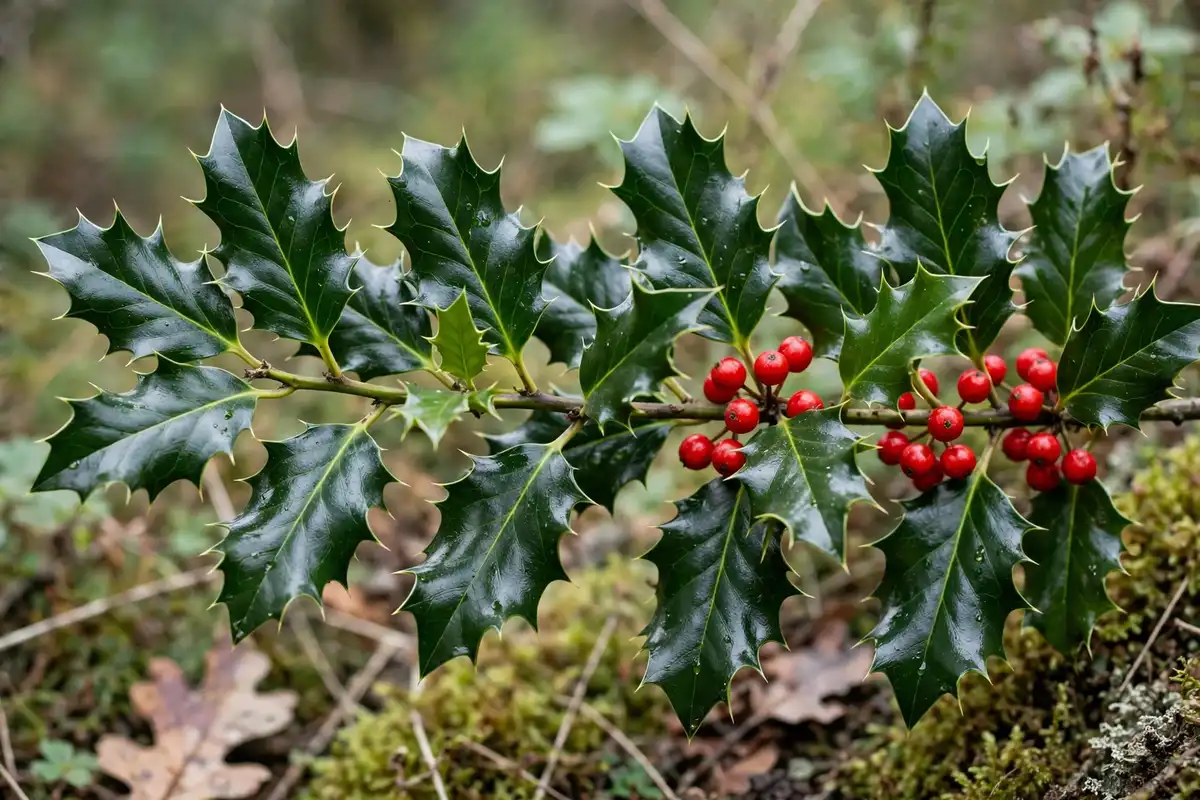
Say holly and everyone sees the leaf: dark, glossy, armed with spines like a green shield — and the berries, red as sealing wax, holding their colour deep into winter. The plant behind the picture is Ilex, a giant genus spread across the world’s temperate and tropical zones, from 60-foot trees to rock-garden miniatures. Its flowers are the quiet part of the story — tiny, white, four-petalled, opening in spring and beloved by bees — because holly’s strategy is to flower modestly in April and spend the whole year turning that modesty into December glory. You can read more on the Holly page on Wikipedia.
The single fact that governs the genus is its private life: hollies are dioecious, meaning each plant is either male or female. Females flower, and — if a male of the same species flowered within bee-range at the same time — berry. Males flower and never berry. Almost every holly heartbreak in gardening history traces back to that sentence, which is why it gets its own section below. Everything else about holly is easy: it is tough, long-lived, largely deer-proof, and generous to winter birds once the frosts soften the harvest.
Holly Quick Facts
- Botanical name: Ilex (more than 400 species); family Aquifoliaceae — the holly family, of which it is the star.
- Native range: worldwide in temperate and tropical regions; the famous kinds from Europe, North America, China and Japan.
- Hardiness: zones 5 to 9 for most garden kinds (winterberry to zone 3).
- Height: 1 to 60 feet depending on species — dwarf shrubs to full trees.
- Flowers and berries: small white flowers in spring; berries ripen autumn, hold through winter.
- Sun and soil: full sun to part shade (best berries in sun); acidic, moist, well-drained soil.
- Good to know: plants are male OR female — females need a male pollinizer for berries. Berries are mildly toxic to people and pets (upset stomachs; keep them decorative, not edible). December’s birth “flower” in the broad seasonal sense, and the classic Christmas plant.
Types of Holly and 6 Kinds Worth Knowing
The classics, the natives, and the specialists. The table separates them; the profiles follow. For the full list of flower names, see our flower names A to Z guide.
| Type | Leaves | Berries | Height | Best use |
|---|---|---|---|---|
| English (I. aquifolium) | Spiny, glossy, evergreen | Red | 15–50 ft | The classic Christmas holly |
| American (I. opaca) | Spiny, dull green, evergreen | Red | 15–50 ft | US native specimen tree |
| Winterberry (I. verticillata) | Plain, deciduous | Red, on bare stems | 6–10 ft | Winter display, wet soil |
| Japanese (I. crenata) | Tiny, spineless, evergreen | Black | 2–8 ft | Hedges, boxwood substitute |
| Yaupon (I. vomitoria) | Small, evergreen | Red, translucent | 8–20 ft | Screens; caffeinated tea leaves |
| Variegated (‘Golden King’) | Gold-edged, evergreen | Red | 10–20 ft | Bright winter focal point |
1. English Holly — the Christmas Original
Ilex aquifolium, the holly of carols and cards: deeply glossy, fiercely spiny leaves and sealing-wax red berries on a slow, dense tree. Its spines have a trick worth knowing — leaves high in the tree, beyond browsing reach, grow smooth and spineless, so one tree wears armour below and velvet above. Hundreds of cultivars descend from it, silver-edged, gold-edged and golden-berried. The benchmark by which all hollies are judged.
2. American Holly — the Native Classic
Ilex opaca, the eastern American answer: spiny leaves in a duller, matte green, red berries, and a tidy pyramidal habit that makes it the finest native specimen tree for zones 5 to 9. It dresses the woods of the US southeast every winter, feeds birds through the cold months, and asks for acid soil and patience — it grows slowly into a tree your grandchildren will prune. Delaware’s state tree, no less.
3. Winterberry — the Bare-Stem Show
Ilex verticillata drops its plain leaves in autumn — and that is the show: thousands of scarlet berries studding bare grey stems, the most electric winter display any shrub offers, and the florist’s favourite cut stem. It is a swamp native (zones 3 to 9), so it takes wet soil that kills other hollies, and it needs its own male (‘Southern Gentleman’ is the classic pollinizer). Plant females in threes beside water and wait for November.
4. Japanese Holly — the Boxwood Impersonator
Ilex crenata has tiny, spineless, oval leaves and a dense habit so like boxwood that it is planted wherever boxwood blight has struck — hedges, balls, topiary — in zones 5 to 8. Its berries are black and discreet; the plant is grown for the green architecture, and in Japan it is a sacred plant of Shinto shrines (the related I. integra hosts spirits in folklore). The holly for gardeners who “don’t like holly” — no spines, all structure.
5. Yaupon — the Tea Holly
Ilex vomitoria (ignore the alarming name — a misunderstanding of its ceremonial use) is a small-leaved southeastern US native with beautiful translucent red berries — and a unique claim: its leaves are the only native North American source of caffeine, brewed as yaupon tea by Indigenous peoples for centuries and now back in fashion. Dwarf forms make superb hedges in zones 7 to 10; the species is drought-, heat- and salt-tough once settled.
6. Variegated Hollies — ‘Golden King’ and Kin
English holly in festival dress: leaves edged in gold (‘Golden King’, a female despite the name — it berries red) or silver (‘Argentea Marginata’), glowing in winter light when the garden needs colour most. Slower and smaller than the green kinds, they are planted singly, as the bright exclamation point of a winter border — and their clippings are the wreath-maker’s first choice.
Holly Meaning and Symbolism
Holly’s meanings were old before Christmas adopted them: to the Romans it was a plant of Saturnalia, sent as a good-luck token in midwinter; the Druids are said to have brought it indoors so woodland spirits had shelter through the cold; and its evergreen defiance of winter made it the natural emblem of eternal life and protection — planted by doors, it was believed to guard the house against lightning and ill luck. Christianity took the symbol and deepened it: the spines as the crown of thorns, the red berries as drops of blood, the evergreen leaf as life unending — which is why “The Holly and the Ivy” still sings. In the language of flowers, holly means defence and domestic happiness: armour outside, warmth within. It defends the gate among the H entries in our flowers that start with H guide.
Holly Berry Colours and Their Meanings
- Red — protection and sacrifice: the Christmas colour, berries like drops of courage in the snow.
- Orange and gold — stored sunlight: ‘Amber’ and the yellow-berried forms, winter cheer without the cliché.
- Black — quiet structure: the Japanese holly’s berries, grown for the leaf instead.
How to Grow Holly (and Get Berries)
Acid soil, winter patience, and one male in the neighbourhood: that is the whole syllabus. Gardeners on r/gardening on Reddit pass on the rule as the genus’s first commandment: “no berries? Check for a boyfriend first.”
Planting and Position
Plant in spring or autumn in acidic, moist but well-drained soil — holly sulks in lime and in drought when young. Full sun gives the densest growth and heaviest berries; part shade is tolerated, deep shade is not. Water through the first two summers, mulch with leaf mould or bark, and site with the mature size in mind: a “shrub” of I. aquifolium is a 30-foot tree in waiting. Winterberry alone prefers its feet wet; Japanese holly wants shelter from cold winter wind in borderline zones.
Care and Pruning
Established hollies ask for almost nothing: an acid-friendly feed in spring if growth is pale, and pruning in mid-winter — timed, conveniently, so the clippings become the Christmas greenery. Shape hedges in late spring instead. The berries form on the previous year’s wood in most kinds, so winter pruning means choosing: a hard trim costs next year’s berries on the cut branches, which is why the wise prune a third of the plant at a time.
Common Mistakes When Growing Holly
Mistake one is the classic: one female, no male, no berries — the fix is in the section below. Mistake two is alkaline soil: yellowing leaves with green veins (chlorosis) almost always mean the pH is too high; sulphur and acidic mulch answer it. Mistake three is planting a future tree in a shrub’s space and spending twenty years fighting it with shears — read the label’s mature size and believe it.
Mistake four is pruning at the wrong moment — a spring shear removes the flowering wood and with it the berries; winter or late spring (for hedges) is the window. Mistake five is drought in the first years: young hollies dropped into dry summer soil fail quietly, so water like you mean it until established. And mistake six is assuming the berries are for you: holly berries are mildly toxic to people and pets — beautiful on the branch and in a vase, off the menu entirely.
The Male-and-Female Rule: Why Your Holly Has No Berries
Here is the whole mystery, solved. Hollies are dioecious — separate sexes, separate plants. A female holly’s flowers must receive pollen from a male holly of the same species flowering at the same time within bee range — roughly 30 to 50 feet. No male, no pollination, no berries: the flowers simply fall. Garden centres sell berrying females with the pollinizer listed on the label (winterberry ‘Red Sprite’ pairs with ‘Jim Dandy’ or ‘Southern Gentleman’; American and English hollies pair within their own species, and one male serves five to eight females). If your holly has never berried, do not feed it, move it or curse it — check the neighbourhood for a male, and if there is none, plant one. It is the single most successful “treatment” in the genus.
Frequently Asked Questions
Why does my holly have no berries?
Almost always the male-and-female rule: your plant is female and there is no male of the same species within about 50 feet, or your plant is itself male (males never berry). Other causes: pruning off the flowering wood in spring, a very hard late frost on the spring flowers, or a plant too young. The section above explains the fix. If your question is not answered here, the questions about the holly plant on Quora cover most of the rest.
Are holly berries poisonous?
Mildly, yes — for people and pets. The berries contain ilicin and related compounds and cause nausea and stomach upset if eaten in quantity; they are not usually dangerous in small accidental amounts, but treat them as strictly decorative. Birds eat them safely, especially after frosts soften them.
Is holly a flower?
Holly does flower — small, white, four-petalled blooms in spring that bees love — but it is grown for its evergreen leaves and winter berries, not its blossom. It is December’s birth plant in the seasonal sense: the “flower” of the darkest month is a berry on a glossy leaf.
How fast does holly grow?
Slowly to moderately: English and American hollies add roughly 6–12 inches a year into large shrubs or trees; Japanese holly is slower still and ideal for tight hedges; winterberry grows faster (to 6–10 feet) in moist soil. Holly is a plant-for-decades choice, not a quick screen.
When should I prune holly?
Mid-winter for specimen shrubs — the clippings double as Christmas greenery — and late spring for hedges. Remember that berries form on the previous year’s growth: prune a third at a time if you want berries and shape in the same year.
Can holly grow in pots?
Yes — Japanese holly and the smaller English cultivars do well in large pots of ericaceous (acid) compost, and a berried female beside a front door is a Christmas classic. Keep the compost moist, feed in spring, and remember the male rule still applies if you want the berries.