Arizona State Flower: The Saguaro Blossom, Night Blooms and Cactus Flowers
Every state flower asks to be seen in daylight — except one. Arizona’s blooms in the dark. On warm nights in May, the tops of giant saguaros open white, waxy flowers like lanterns lit one by one across the desert, courting bats through the night before closing by midday. The saguaro blossom has been the Arizona state flower since 1931 — carried on a plant that may wait sixty years to produce its first flower, and that state law, like Colorado’s columbine, guards with actual penalties.
This guide covers the Arizona state flower and its story, what the saguaro blossom means (and the harvest festival that follows it), where to witness a bloom night, six more Arizona flowers worth knowing, and the honest guide to cactus flowers for gardeners — saguaro terms, and the generous relatives that bloom in a pot within a year.
Quick Answer
The Arizona state flower is the saguaro blossom — the flower of the giant saguaro cactus, Carnegiea gigantea — designated in March 1931. The flowers are white and waxy, about 3 inches across, opening at night in May and June at the tips of the trunk and arms, pollinated by bats and doves, and followed by ruby-red fruit. The saguaro grows only in the Sonoran Desert, may live 150 to 200 years, and is strictly protected: wild plants cannot be moved or harmed without permits. The flower means endurance, patience and desert resilience.
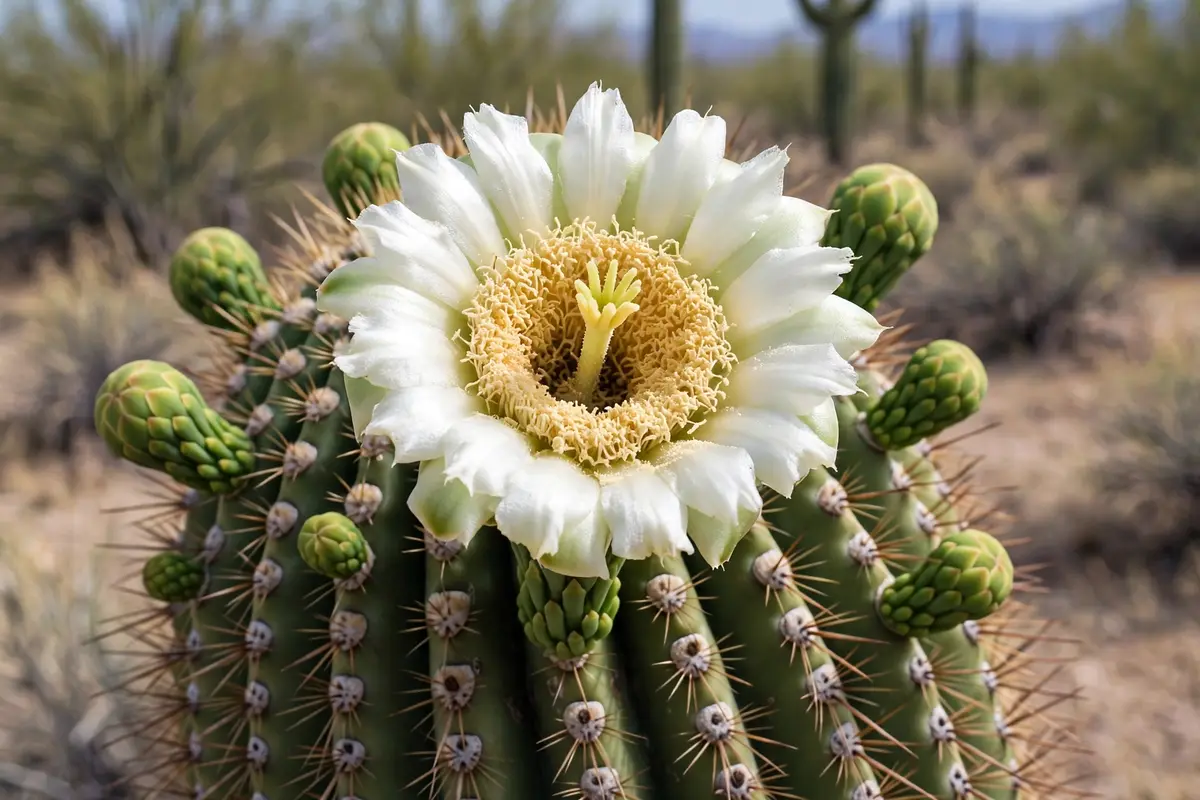
Table of Contents
- What Is the Arizona State Flower?
- The Story: 1931, and the Most Protected Plant in America
- Saguaro Blossom Meaning and the Harvest That Follows
- Where and When to See Saguaro Blossom
- 6 More Arizona Flowers Worth Knowing
- How to Grow Saguaros — and Cactus Flowers You Can Grow
- Common Mistakes With Cactus Flowers
- Frequently Asked Questions
What Is the Arizona State Flower?
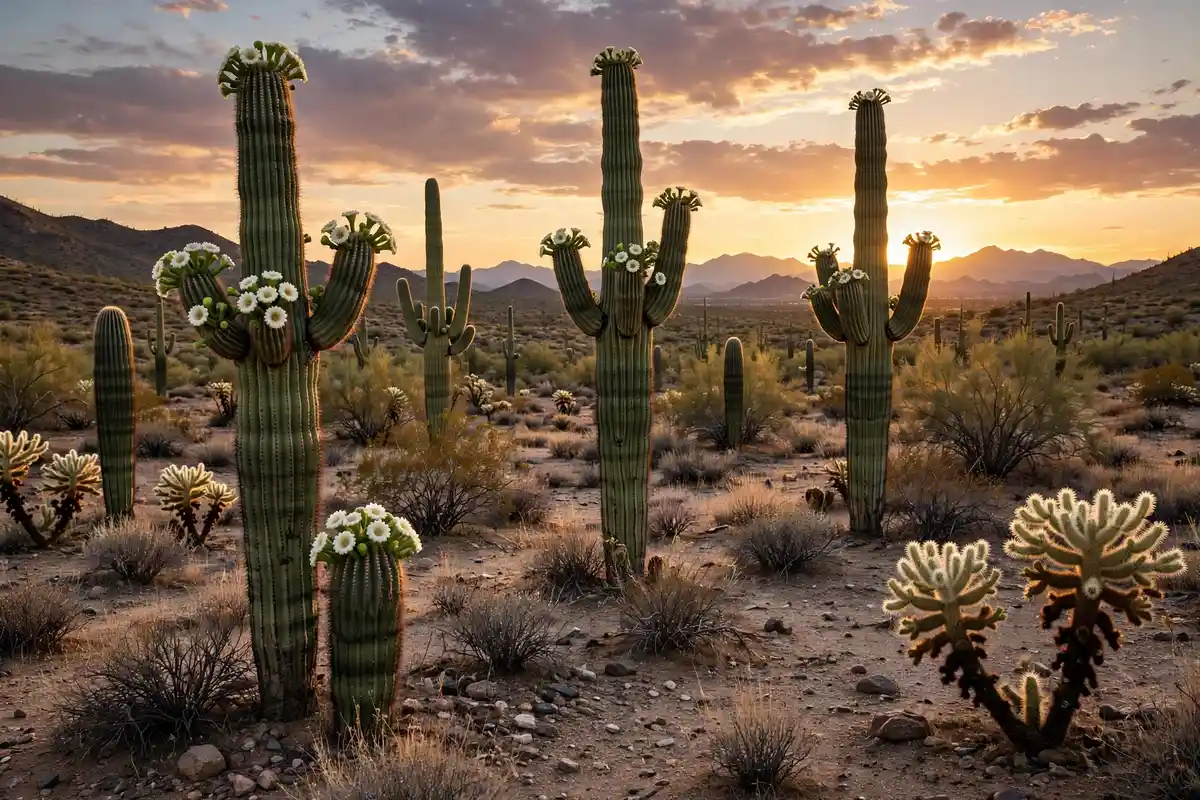
The saguaro is the largest cactus in the United States — a ribbed green column that can reach 40 to 60 feet, weigh several tons (most of it stored water), and live two centuries — and it grows wild only in the Sonoran Desert of Arizona, a sliver of California, and northern Mexico. Its blossom crowns the plant: buds clustered at the stem tips open after sunset into funnels of white petals around golden centres, fragrant and full of nectar, calling in lesser long-nosed bats on their migration and white-winged doves by morning. Each flower lasts barely a day, but a mature saguaro opens them in sequence for weeks — a chandelier relit nightly. Pollinated flowers ripen into red fruit that splits open like a flower itself. You can read more on the Saguaro page on Wikipedia.
Arizona State Flower Quick Facts
- State flower: saguaro cactus blossom, flower of Carnegiea gigantea — family Cactaceae.
- Designated: March 1931 as Arizona’s state flower (the blossom, not the whole plant — the law names the flower).
- The flower: white, waxy, ~3 inches; opens at night, closes by the next midday; May–June.
- Pollinators: lesser long-nosed bats by night; white-winged doves and bees by day.
- The plant: 40 to 60 feet, up to 200 years; first flowers at roughly 40 to 70 years old; arms come later still.
- Range: Sonoran Desert only — Arizona, a corner of California, northern Mexico.
- Protection: among America’s strictest native-plant laws — moving or harming a wild saguaro without permits is a criminal offence.
- Good to know: the red fruit (ha:ṣañ) is the traditional harvest of the Tohono O’odham, whose new year begins with picking it.
The Story: 1931, and the Most Protected Plant in America
Arizona became a state in 1912 with a flower-shaped hole in its symbols, and in March 1931 the legislature filled it with the blossom of the plant that already stood — literally, arms raised — as the state’s silhouette on every postcard and licence-plate horizon. The choice was identity by acclamation: nothing else on Earth is so purely Arizonan. But admiration had a shadow: as desert land was cleared and cacti became fashionable cargo, saguaros were dug, rustled, and shot at. Arizona answered with some of the toughest native-plant protection in the country — the saguaro became a “highly safeguarded” native plant, landowners need permits and tags to move even their own, and cactus rustling is prosecuted as a felony. The state flower thus carries a bodyguard as heavy as the Colorado state flower‘s — and rather heavier teeth.
Saguaro Blossom Meaning and the Harvest That Follows
The saguaro blossom means endurance, patience and provision — the desert virtues. In the language of flowers a bloom earned after sixty years of waiting reads as faithfulness to place: this plant cannot be hurried, transplanted casually, or grown anywhere else, and its flower is the reward of a lifetime spent standing still in difficult country. For the Tohono O’odham, on whose land the saguaro’s heartland lies, the blossom opens the year’s great cycle: flower in May, fruit in late June and July, and the ha:ṣañ harvest — families picking the red fruit with long poles, making syrup, jam and ceremonial wine — traditionally begins the new year and calls the monsoon rains. The state flower, in other words, is also a calendar, a pantry and a prayer.
Where and When to See Saguaro Blossom
Timing is half the craft: individual flowers open after dark and fade by the following afternoon, and the colony season runs May into June, peaking around late May. Saguaro National Park, in its two districts flanking Tucson, is the guaranteed theatre — go at dawn, when last night’s flowers still stand open and the doves are working them, and again at dusk to watch new buds unfurl. The Desert Botanical Garden in Phoenix runs night events in season, when the garden’s giants flower under floodlights and the bats, with luck, attend. Remember the etiquette: admire from the path, never climb for a closer look, and leave every petal and fruit — the law, the bats and the O’odham calendar all say the same thing.
6 More Arizona Flowers Worth Knowing
The desert’s spring cast, when the rains have been kind. The table separates them; the profiles follow. For thousands more flower names, see our flower names A to Z guide.
| Flower | Colour | Season | Character | Best use |
|---|---|---|---|---|
| Mexican gold poppy | Orange-gold cups | Spring | The desert carpet | Wildflower drifts |
| Brittlebush | Yellow daisies | Spring | Silver and gold | Rocky slopes, xeriscape |
| Desert marigold | Yellow | Spring–autumn | The long-season daisy | Roadsides, dry beds |
| Ocotillo | Flame red | Spring | Fire on whips | Specimen, living fence |
| Parry’s penstemon | Hot pink spikes | Spring | The hummingbird spire | Desert gardens |
| Sacred datura | White trumpets | Summer nights | The moonflower of the desert | Wild corners (with respect) |
1. Mexican Gold Poppy — the Desert Carpet
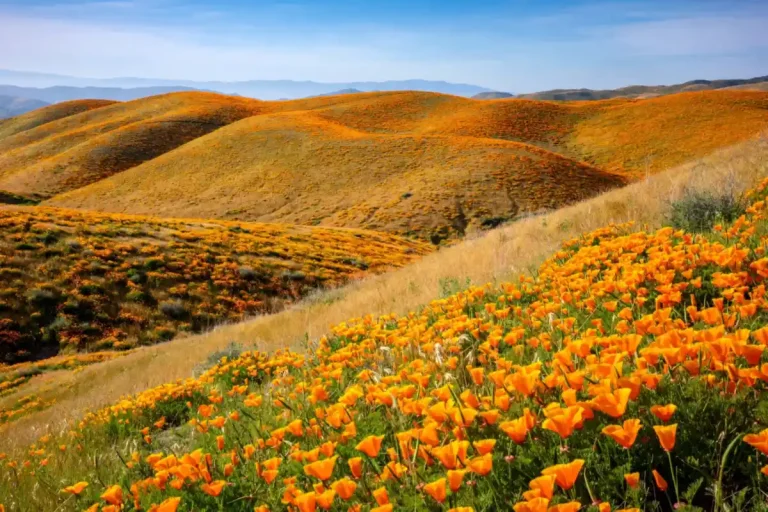
Eschscholzia californica subsp. mexicana — the California poppy’s desert sister — paints whole bajadas orange-gold in a wet spring, opening with the sun and folding by afternoon. Peralta and Picacho Peak in a good year are bucket-list Arizona: hillsides you can see glowing from the highway.
2. Brittlebush — Silver and Gold
Encelia farinosa pairs silver-white leaves with clouds of yellow daisies on rocky slopes statewide — the desert’s most reliable spring shrub, and a lesson in design: pale foliage is sunscreen, and the whole plant is engineered for glare.
3. Desert Marigold — the Long-Season Daisy
Baileya multiradiata flowers when almost nothing else will: yellow pompons on grey felted mounds from spring all the way to frost along roadsides and in the poorest soil, asking for nothing but sun and neglect. The xeriscaper’s annuity.
4. Ocotillo — Fire on Whips
Fouquieria splendens is not a cactus but out-cactuses them all for drama: long thorny wands, leafless most of the year, tipped after spring rains with clusters of flame-red tubes that hummingbirds patrol. It leafs out and drops leaves with each rain — five wardrobes a year.
5. Parry’s Penstemon — the Hummingbird Spire
Penstemon parryi is the Sonoran’s own penstemon: blue-green rosettes sending up wands of hot-pink trumpets each spring, the definitive flower of Tucson and Phoenix desert gardens, happy in gravel and reflected heat that would finish lesser perennials.
6. Sacred Datura — the Moonflower of the Desert
The desert’s night trumpet, Datura wrightii, opens huge white trumpets at dusk along washes and roadsides — gorgeous, and, as our full datura guide sets out, seriously poisonous in all parts. Admire it where it grows, gloves on if you must handle it, and never bring it to a salad or a ceremony.
How to Grow Saguaros — and Cactus Flowers You Can Grow
Honesty first: a saguaro is a relationship measured in generations. Gardeners on r/gardening on Reddit pass on the desert rule as the family law: “you don’t plant a saguaro for yourself — you plant it for your grandchildren’s shade.”
Saguaro Terms
Legally and practically, saguaros belong to the Sonoran Desert: nursery-grown seedlings (never wild-dug — permits protect every wild plant) grow an inch or two a year in youth, need gritty mineral soil, full desert sun, and protection below about 25°F, which ends them in most of America. In Tucson and Phoenix landscapes, permitted, tagged nursery plants are the only route, and even there, your seedlings will flower for your heirs. Grow one as an heirloom if you live in its homeland; elsewhere, grow its spirit in relatives that keep a human schedule.
The Generous Relatives
For the white-night-flower experience on a windowsill timescale, plant the Easter lily cactus (Echinopsis hybrids): fat little globes that, after a cool dry winter rest, open enormous white-to-pink trumpets overnight — often within their first year or two, and repeatedly each summer. The night-blooming cereus clan (Peniocereus, Selenicereus) gives the true midnight opening on climbing stems. Hedgehog cacti (Echinocereus) are the desert garden’s spring fireworks in magenta and scarlet, hardy well beyond the Sonoran. All share the saguaro’s terms, scaled down: gritty soil, hard sun, and a winter kept cool and nearly dry — that rest is the trigger the flowers are waiting for.
Common Mistakes With Cactus Flowers
Mistake one is water love: cacti in rich soil on a weekly watering rota rot from the base, flowers or no flowers — lean mineral soil and deep, rare drinks are the regime. Mistake two is skipping the winter rest: a cactus kept warm and watered all winter grows soft and skips flowering; the cool, dry rest is the bloom switch. Mistake three is a light-starved windowsill — etiolated, stretched plants cannot flower; cacti need the strongest light you can offer.
Mistake four is impatience with slow species (see the saguaro’s sixty-year courtship) — match species to your horizon, or mix fast echinopsis with slow heirlooms. Mistake five is moving a wild or unpermitted saguaro, ever: it is a crime, and the plant usually dies of it besides. And mistake six is fertilizing like a rose: desert plants want dilute, occasional feeding in growth — richness buys rot, not blossom.
Frequently Asked Questions
What is the Arizona state flower?
The saguaro blossom — the white, night-opening flower of the giant saguaro cactus — designated the Arizona state flower in March 1931. The law names the blossom of Carnegiea gigantea, the Sonoran Desert giant found wild almost entirely within Arizona and northern Mexico. If your question is not answered here, the questions about the Arizona state flower on Quora cover most of the rest.
When do saguaros bloom?
May into June, peaking around late May. Each flower opens after sunset and closes by the next midday, but a mature plant opens its buds in sequence over several weeks. Go at dawn or dusk in Saguaro National Park or Phoenix’s Desert Botanical Garden for the full performance.
How old is a saguaro when it first flowers?
Roughly 40 to 70 years — a saguaro at 10 years old may stand only an inch and a half tall. Arms begin appearing at around 50 to 100 years. The state flower is a senior citizen’s blossom, which is rather the point of it.
Is it illegal to take a saguaro from the desert?
Yes — emphatically. Saguaros are highly safeguarded native plants under Arizona law: moving, harming or possessing one without the proper permits and tags is a criminal offence, prosecuted including as felony cactus rustling. Legal plants come only from licensed nurseries.
Can I grow a saguaro outside Arizona?
Nursery seedlings survive in frost-free, dry climates (parts of southern California and similar) and as long-term pot plants anywhere bright — but they are lifelong, slow commitments that will never see desert conditions indoors, and they cannot tolerate hard frost. Most gardeners outside the Sonoran Desert do better with echinopsis and hedgehog cacti, which flower young and generously.
What pollinates the saguaro blossom?
At night, the lesser long-nosed bat — the flower’s shape, scent and timing are built for it, and the bat’s migration follows the bloom north. By morning, white-winged doves and bees work the still-open flowers. The arrangement is so central that saguaros and their bats are a textbook partnership on two wings.