Datura Flower: Types, Meaning and How to Grow It
Every garden has one plant with a reputation, and datura’s is earned twice over: at dusk it opens huge white trumpets that pour scent into the night air, and in the same leaves and seeds it carries some of the most potent poisons in the plant kingdom. Temples in India offer it to Shiva; soldiers at Jamestown in 1676 ate it and went mad for days (which is where “jimsonweed” comes from); Georgia O’Keeffe painted its white trumpets in the desert light. This is a guide written with respect — for the flower’s beauty, its history, and its danger, in that order and without blinking at the third.
This guide covers the six daturas worth knowing (ornamental ‘metel’ doubles, downy moonflower, sacred datura, jimsonweed and kin), what it means — mystery, deception and power — and how to grow it safely, with the safety rules stated as plainly as the care rules, plus the one identification test that separates it from its cousin brugmansia.
Quick Answer
Datura is a genus of about nine species in the nightshade family Solanaceae, grown for huge upward-facing trumpet flowers in white, purple or yellow that open at dusk and scent the night, followed by spiky thorn-apple seed pods. It is a fast annual (a short-lived perennial in zones 9 to 11) for full sun and rich, well-drained soil, 3 to 5 feet tall, flowering from summer to frost — and every part of it is highly poisonous, containing tropane alkaloids (scopolamine, atropine, hyoscyamine). Grow it only where children, pets and livestock cannot reach it, and handle it with gloves. The datura flower means mystery, deception and hidden power.
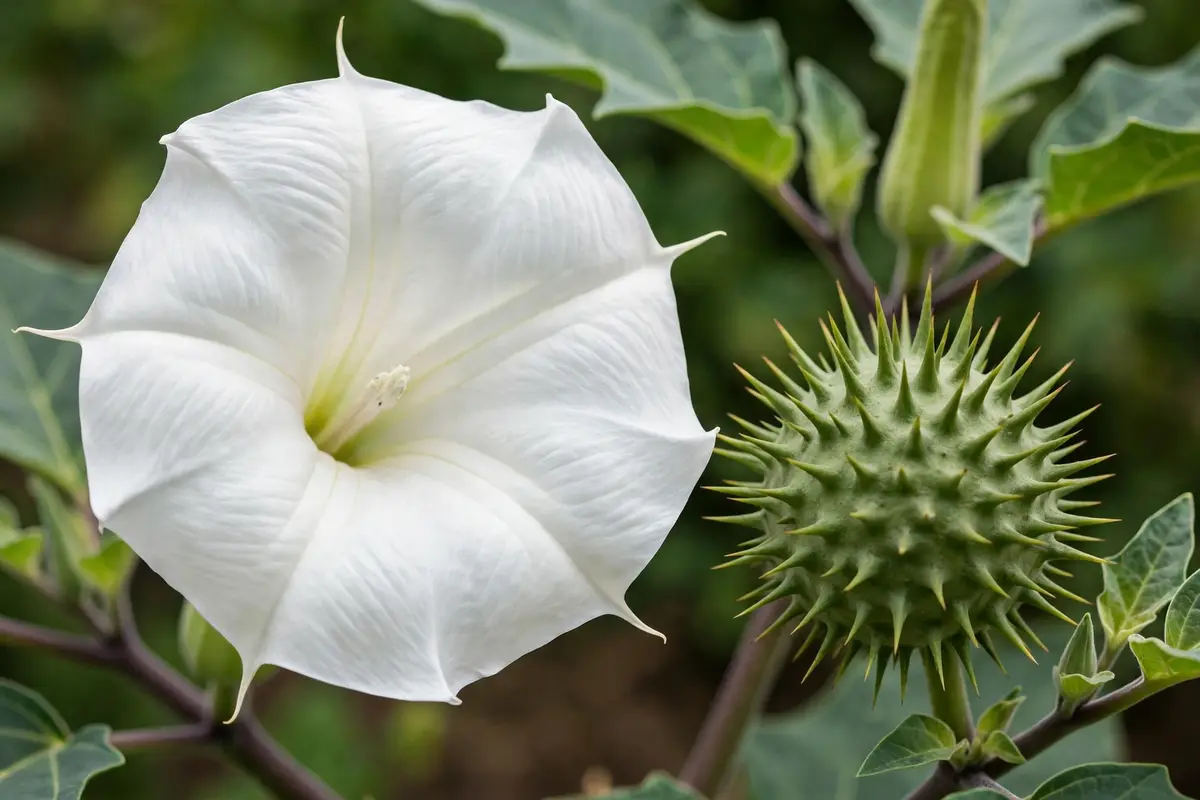
Table of Contents
- What Is a Datura?
- Types of Datura and 6 Kinds Worth Knowing
- Datura Flower Meaning and Symbolism
- Datura Flower Colours and Their Meanings
- How to Grow Datura — Safely
- Common Mistakes When Growing Datura
- Datura vs Brugmansia: The Up-and-Down Test
- Frequently Asked Questions
What Is a Datura?
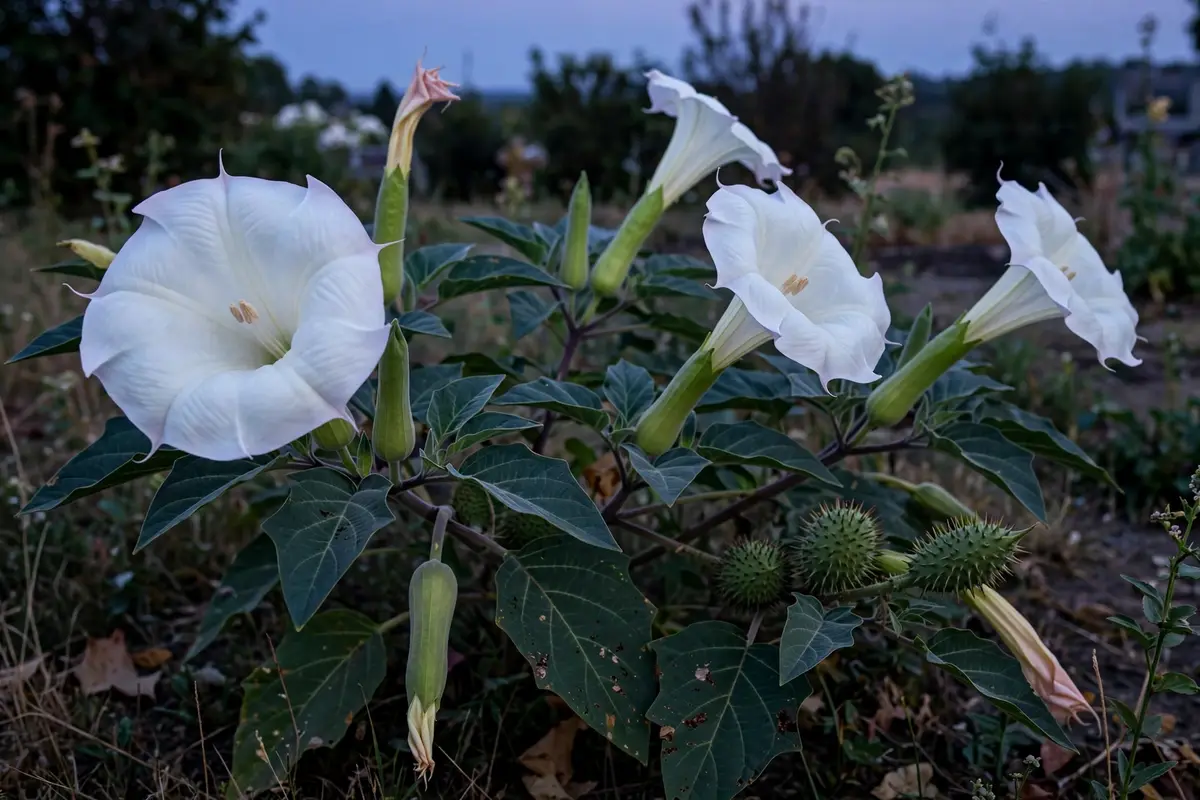
The flower tells the story first: a trumpet 6 to 8 inches long, flaring at the mouth, held facing upward to the sky — that upward face is datura’s signature, the quickest way to separate it from its hanging-flowered cousin brugmansia. The trumpets open at dusk, white kinds glowing in moonlight and releasing a heavy, sweet scent for the hawk-moths that pollinate them, and each flower is done by the next afternoon. Behind them come the pods that give the plant its other name — thorn apples — round, spiky capsules packed with seeds. You can read more on the Datura page on Wikipedia.
The genus sits in the nightshade family with tomatoes and deadly nightshade, and like its darkest relatives it is loaded: every part — leaf, flower, seed, root — carries tropane alkaloids that act powerfully on the nervous system. That chemistry made datura sacred (an offering to Shiva in Hindu temples, a ritual plant in ancient Mexico, where the Aztecs called it toloache) and infamous (the Jamestown soldiers of 1676, poisoned by leaves in a salad, gave Datura stramonium its name “jimsonweed” — Jamestown weed — after days of delirium). A plant with this much power is not a toy; grown knowingly, at the back of a border, away from small hands, it is also one of the great night flowers.
Datura Quick Facts
- Botanical name: Datura (about 9 species); common names include devil’s trumpet, thorn apple, moonflower (shared with others), jimsonweed.
- Family: Solanaceae, the nightshade family.
- Native range: the Americas (most species), with D. metel long naturalized across Asia; now worldwide in warm climates.
- Hardiness: grown as a fast annual almost everywhere; short-lived perennial in zones 9 to 11.
- Height: 3 to 5 feet in a season, bushy and fast.
- Bloom time: summer to frost; flowers open at dusk, night-scented, each lasting a day.
- Sun and soil: full sun; rich, well-drained soil; generous water and feed in the growing season.
- Good to know — safety: ALL parts are highly poisonous (tropane alkaloids). Never ingest any part; wear gloves; keep away from children, pets and livestock; wash hands after handling. Sacred to Shiva in Hindu tradition.
Types of Datura and 6 Kinds Worth Knowing
The ornamentals, the night-flowers, and the famous wild kinds. The table separates them; the profiles follow. For the full list of flower names, see our flower names A to Z guide.
| Type | Flowers | Character | Season | Best use |
|---|---|---|---|---|
| D. metel (ornamental) | White, purple, yellow; doubles | The garden kind | Summer–frost | Borders, large pots |
| D. innoxia (downy) | White, downy leaves | Soft, moonlit | Summer–frost | Night gardens |
| D. wrightii (sacred) | Huge white trumpets | Desert native | Summer–autumn | Dry gardens, Southwest |
| D. stramonium (jimsonweed) | White-violet, spiky pods | The infamous weed | Summer | Wild corners only |
| D. ferox | White, fiercest spines | The most spiked pods | Summer | Collectors |
| D. ceratocaula | White, marsh-loving | The swamp kind | Summer | Pond edges |
1. Datura metel — the Ornamental
The datura of the seed catalogues: single, double and even triple trumpets in white, cream, yellow and deep purple (‘Blackcurrant Swirl’ is the famous double purple), on bushy 3–4 foot plants bred for the border. D. metel has been grown in Asia for centuries — it is the datura of Hindu ritual, offered to Shiva — and its garden forms are the safest place to start: showy, long-flowering, and easy from seed. All the genus’s toxicity rules apply in full.
2. Datura innoxia — the Downy Moonflower
Velvet-grey, downy leaves and pure white trumpets that open as the light fails: D. innoxia is the datura most often sold as a “moonflower” plant for night gardens, and on a warm evening a mature bush in full flower is genuinely spectacular — dozens of white trumpets glowing at dusk, scent everywhere. It self-seeds freely where it is happy, which is both its charm and a warning: one plant is a colony in waiting.
3. Datura wrightii — the Sacred Datura
The desert kind, native to the American Southwest and Mexico: the largest, cleanest white trumpets of the genus on blue-grey foliage, opening at dusk over hot gravel and closing by mid-morning. It is sacred in the traditions of the region’s peoples, and it is the datura Georgia O’Keeffe painted — her white trumpet studies are this flower. Perennial from a tuberous root in its homeland; grown as an annual elsewhere.
4. Datura stramonium — Jimsonweed
The infamous one: a coarse weed of waste ground worldwide, white-to-violet trumpets and the spikiest, most upright thorn-apple pods. Its place in history is the Jamestown story and a long career in old medicine (its alkaloids are real drugs at controlled doses — and a menace at uncontrolled ones). Grow it only as a curiosity in a controlled corner, if at all; in many places it arrives uninvited anyway. Know it mainly to recognize it.
5. Datura ferox — the Fierce One
“Ferox” means fierce, and the pods earn it: the longest, stoutest spines in the genus on a compact plant with white flowers. A collector’s kind from South America, grown where its armour can be admired at arm’s length. Everything said about the genus’s chemistry applies with emphasis — this is a look-at-it plant par excellence.
6. Datura ceratocaula — the Swamp Datura
The exception that tests the rule: a datura that likes wet feet, native to Mexican marshes and lake edges, with white trumpets on a sprawling plant — the only kind for a pond edge or a boggy corner, where its thirsty cousins would sulk. Rare in gardens, but proof the genus holds more variety than its desert reputation suggests.
Datura Flower Meaning and Symbolism
Datura’s meanings are as double as the plant: in the Victorian language it stands for deceitful charms and deception — beauty with a hidden catch — and for mystery and power. In Hindu tradition the same chemistry reads the opposite way: datura is sacred to Shiva, offered at his temples and associated with the god’s power over poison itself (Shiva, who drank the world’s poison and held it in his throat), so the flower means the divine mastery of dangerous forces. Both readings agree on the core: this is the flower of power that must be respected. Among night-openers it stands with the dramatic crew in our flowers that start with D guide — the letter where the garden’s most dangerous beauty lives.
Datura Flower Colours and Their Meanings
- White — mystery and moonlight: the night trumpet in its sacred form.
- Purple — power and hidden depths: ‘Blackcurrant Swirl’ and the dark doubles.
- Yellow — guarded warmth: the rarer colour, beauty with a warning label.
How to Grow Datura — Safely
Sun, feed, and a fence of common sense: that is the whole contract. Gardeners on r/gardening on Reddit pass on the placement rule as the genus’s first law: “back of the border, gloves on, kids briefed — then enjoy the show.”
Planting and Position
Sow seed indoors in spring (it germinates in warmth, sometimes slowly) or buy young plants, and set them out after the last frost in full sun and rich, well-drained soil, 2–3 feet apart — a datura in a good summer grows like it means it. Feed and water generously through the season; pot-grown plants (a good option where control matters) need a large container and the same generous hand. Place the plant deliberately: the back of a border, a corner by a fence, anywhere its beauty is public and its reach is private — never beside a vegetable bed, a play area, or a path where pods can drop within a toddler’s reach.
The Safety Rules (Read These First)
One: never eat any part of the plant, and never let curiosity talk you into it — datura poisoning is a medical emergency, not an adventure. Two: wear gloves when pruning, deadheading or handling seed pods, and wash hands and tools afterwards. Three: deadhead or collect the spiky pods before they split if children, pets or livestock share the space — the seeds are the most concentrated part. Four: never burn prunings where the smoke can be breathed, and compost with care. Five: label the plant, and brief anyone who gardens with you. Followed calmly, these rules make datura what generations of temple and desert gardeners have kept it as: a plant of awe, kept at the proper distance.
Common Mistakes When Growing Datura
Mistake one is planting it within reach — by the kitchen door, in the herb bed (a genuinely dangerous confusion with its nightshade cousins), anywhere small hands or grazing mouths go. Mistake two is underestimating the self-seeding: a plant left to pod freely can seed a colony, so deadhead where spread is not wanted. Mistake three is a starved, dry plant — datura is a hungry, thirsty grower in season, and the spindly result disappoints everyone.
Mistake four is confusing it with brugmansia when buying or advising (see the test below) — the care differs, the size differs enormously, and the pot that suits one buries the other. Mistake five is casual handling: pruning bare-handed and rubbing an eye is the genus’s most common home accident, and gloves prevent all of it. And mistake six is keeping it where local rules say not to — some regions restrict or discourage datura as an invasive or hazardous weed, so check before you plant.
Datura vs Brugmansia: The Up-and-Down Test
The two trumpet genera are confused constantly, and one glance settles it. Datura: the flowers face UP, opening to the sky on a bushy herbaceous plant (soft stems, dies back or grown as an annual), followed by spiky, upright thorn-apple pods. Brugmansia: the flowers hang DOWN like bells from a woody shrub or small tree, followed by smooth, hanging pods. Up and spiky — datura. Down and smooth — brugmansia. Both are nightshade-family beauties with real toxicity (brugmansia carries the same alkaloid family), so the safety rules travel with either name; but the plant in your pot is told apart by which way its trumpets point.
Frequently Asked Questions
Is datura poisonous?
Yes — seriously. All parts contain tropane alkaloids (scopolamine, atropine, hyoscyamine) and are highly poisonous to people, pets and livestock; ingestion is a medical emergency. This is not a mild-irritant plant like poinsettia: grow it out of reach, handle it with gloves, and never eat any part of it. If your question is not answered here, the questions about the datura flower on Quora cover most of the rest — but for any exposure, call poison control or a vet first, not the internet.
Is datura the same as moonflower?
Partly — “moonflower” is a shared nickname. White daturas (especially D. innoxia) are sold as moonflower for their dusk-opening white trumpets, but the name also belongs to a morning-glory vine (Ipomoea alba) that is a completely different, far safer plant. Check the Latin name before you buy or plant.
Does datura come back every year?
In zones 9 to 11, several kinds are short-lived perennials (sacred datura returns from its root). Everywhere else it is grown as an annual — but it self-seeds so freely that a planting can appear “perennial” by its own sowing. Deadhead the pods if you want it gone next year.
Why is datura called devil’s trumpet?
For its upward-facing trumpets and its dark reputation — the mirror of brugmansia, the angel’s trumpet, whose flowers hang down. The devil/angel pairing is garden folklore, not botany, but the up-versus-down distinction underneath it is real and useful.
Can I grow datura in a pot?
Yes — a large pot is often the most controlled way to grow it: full sun, rich compost, generous water and feed, and the pot placed where children and pets cannot reach it. Pot plants stay smaller (2–3 feet) and their pods are easy to deadhead before they split.
What is datura used for?
Ornamentally, as this guide covers; ritually, as an offering to Shiva in Hindu temples; and historically in traditional medicines — its alkaloids (atropine, scopolamine) are genuine pharmaceuticals at controlled doses. None of that makes home use safe: the gap between a dose and a poisoning in the raw plant is unmeasurable at home, which is why the plant’s modern home is the back of the border, admired in the evening.