
Michigan State Flower: The Apple Blossom and the Tiny Iris
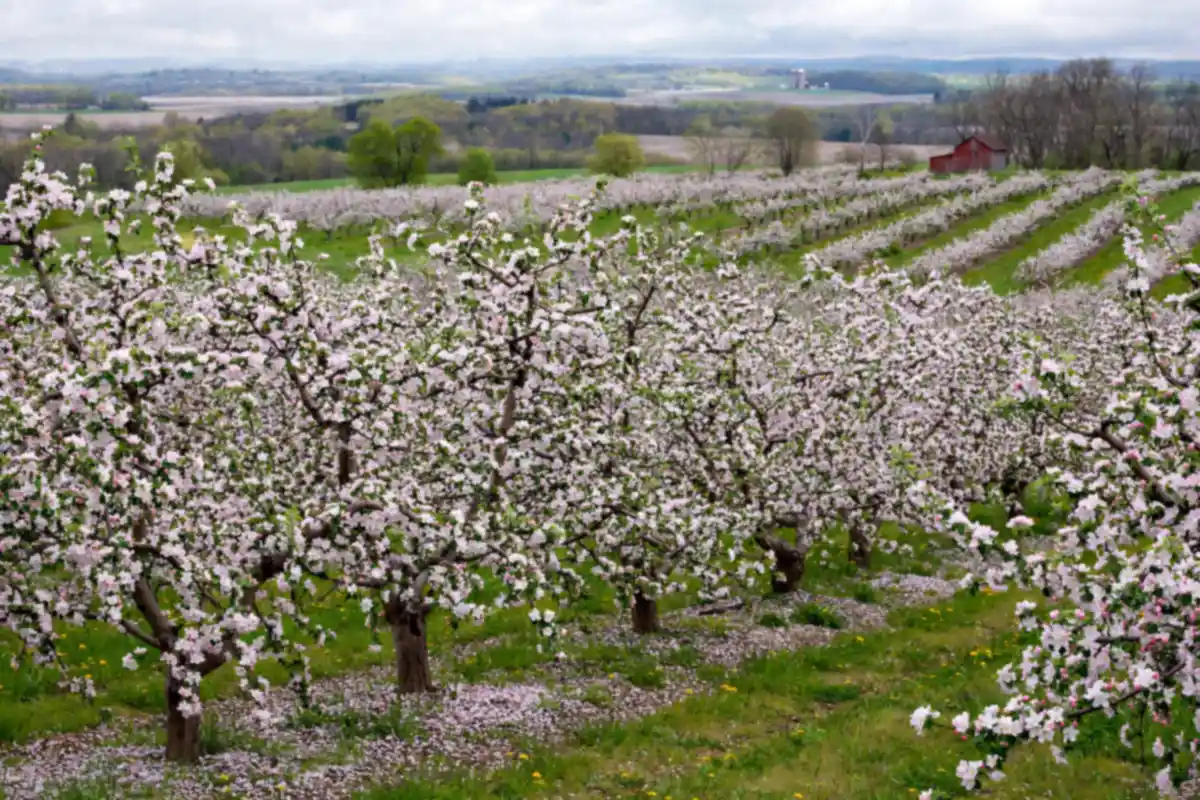
For about ten days each May, Michigan’s Lake-shore orchards do something no photograph quite believes: whole hillsides turn white-pink at once, row upon row of apple trees in bloom, with the big lake shining beyond. The apple blossom has been the Michigan state flower since 1897 — one of America’s earliest choices — and it was picked with charming practicality: a flower whose beauty comes with a harvest attached. Michigan, meanwhile, keeps a second, secret official bloom — a thumbnail iris found almost nowhere else on Earth.
This guide covers the Michigan state flower and its 1897 story, what apple blossom means, the dwarf lake iris (the state wildflower), six more Michigan flowers worth knowing, and how to grow apple trees that flower like an orchard — chill hours, pollination partners and all.
Quick Answer
The Michigan state flower is the apple blossom — the flower of the apple tree, Malus domestica — adopted in 1897. It is a cluster of soft pink buds opening to white, five-petalled, honey-scented flowers in mid-spring, on trees hardy across zones 4 to 8. Michigan ranks among America’s top apple states, and its orchard country lines the Lake Michigan shore. Michigan also has a state wildflower: the dwarf lake iris (Iris lacustris), adopted in 1998, a rare miniature found mainly on northern Great Lakes shores. Apple blossom means promise, hope and good fortune.
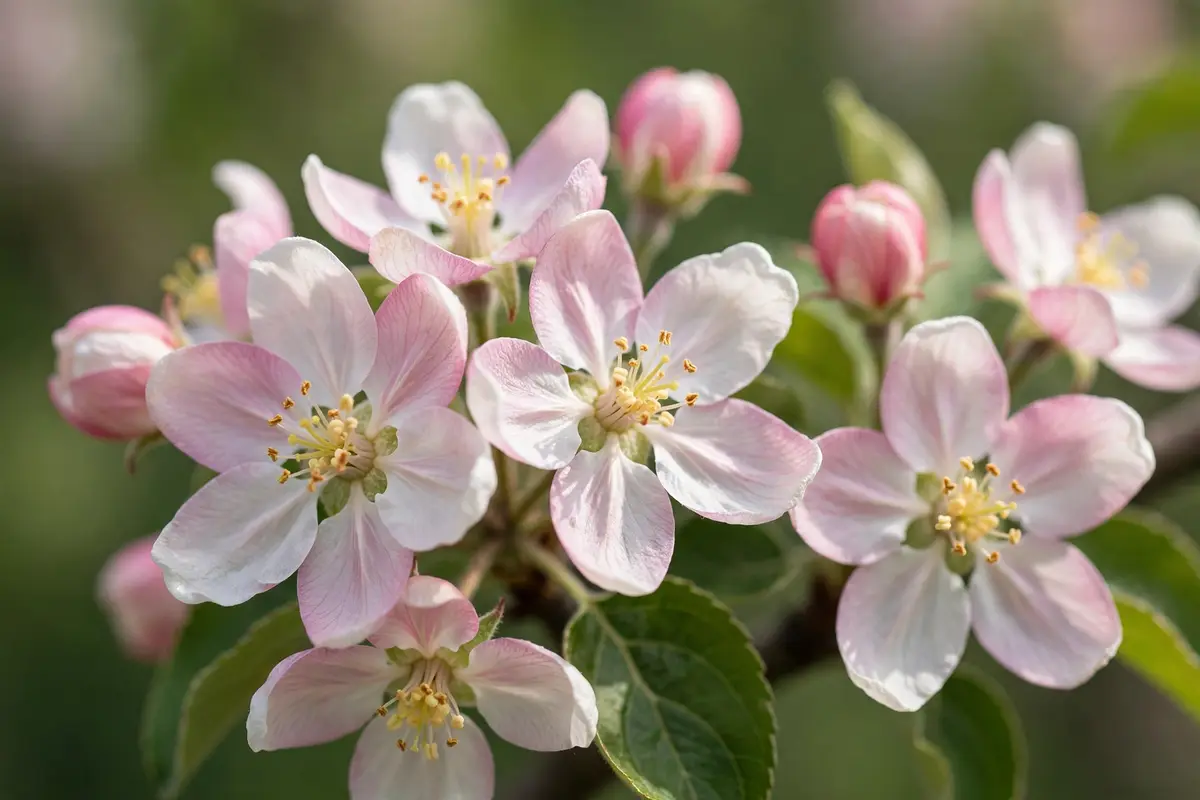
Table of Contents
- What Is the Michigan State Flower?
- The Story: 1897, an Early Choice With a Harvest Attached
- Apple Blossom Meaning and Symbolism
- Michigan’s Second Official Flower: The Dwarf Lake Iris
- 6 More Michigan Flowers Worth Knowing
- How to Grow Apple Trees for Blossom
- Common Mistakes When Growing Apple Trees
- Frequently Asked Questions
What Is the Michigan State Flower?
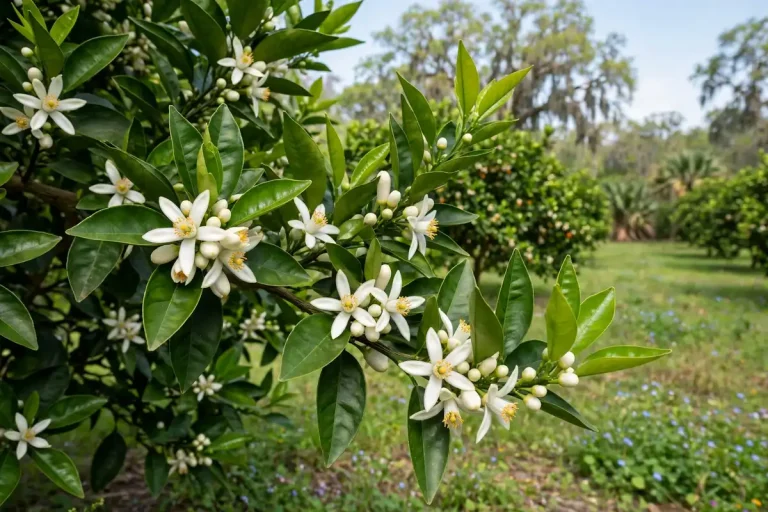
Apple blossom is spring’s most businesslike beauty: buds that blush deep pink, opening into loose clusters of white petals washed pink, with a boss of golden stamens and a scent of honey and almonds that bees cross counties for. Each cluster carries a king bloom at its centre — the first to open, and usually the finest fruit if it sets. The tree behind the flower is the domestic apple, descended from the wild forests of Kazakhstan and carried to Michigan by pioneers and by the era’s most famous nurseryman-ghost, Johnny Appleseed, whose real orchards dotted the Old Northwest. The state’s genius was geography: Lake Michigan tempers the shore climate, holding back spring frosts and sheltering what became the Fruit Ridge and the peninsula orchard country. You can read more on the Apple page on Wikipedia.
Michigan State Flower Quick Facts
- State flower: apple blossom, flower of Malus domestica — family Rosaceae.
- Adopted: 1897, one of the earliest state-flower designations in the United States.
- The flower: pink buds opening white-pink, five petals, honeyed scent; mid-spring, about 7 to 10 days per orchard.
- The crop: Michigan is a top-three US apple state; orchards centre on the Lake Michigan shore (the Fruit Ridge, Old Mission and Leelanau peninsulas).
- Tree life: zones 4 to 8; needs winter chill hours to bloom well; most varieties need a different variety nearby for pollination.
- State wildflower (separate title): dwarf lake iris, Iris lacustris (1998) — found almost only on Great Lakes shores.
- Good to know: the Blossom Tour country north of Traverse City times festivals to the bloom — a Michigan May institution.
The Story: 1897, an Early Choice With a Harvest Attached
Michigan chose early and chose fruitfully. In 1897 — when few states had floral emblems at all — the legislature adopted the apple blossom, praising a flower native to the cultivated landscape the young state was busy planting. The reasoning shows in the era’s words: beauty, fragrance, and the promise of the crop in a single cluster; an emblem that worked for a living. It was also a bet on geography that paid off spectacularly: the lake-moderated shore became one of the continent’s great fruit belts, and the state that picked a blossom in 1897 now measures its harvest in a billion pounds of apples in a good year. Compare the Florida state flower, another orchard blossom chosen a dozen years later — two states, two fruits, the same honest idea: let the emblem be the livelihood.
Apple Blossom Meaning and Symbolism
Apple blossom means promise, hope and good fortune — the flower of good things visibly on their way. Where a rose declares love achieved, the blossom declares it scheduled: spring’s signature on autumn’s contract. In older flower language it carried “I prefer you before all” — a compliment hidden in an orchard — and across northern Europe blossom-time marked the hinge of the year, when winter’s account closed and the farm’s hopes walked out in white. Michigan’s reading adds its own flavour: promise, yes, but promise with calluses — the prettiest flower in the state is also a shift worker, and its beauty lasts ten days precisely because it has somewhere to be.
Michigan’s Second Official Flower: The Dwarf Lake Iris
Below the orchard headline runs a footnote of a flower. In 1998 Michigan adopted the dwarf lake iris as state wildflower — a violet-blue iris three to six inches tall, blooming in May on gravelly northern shores where almost nobody walks. Iris lacustris is a Great Lakes endemic, federally listed as threatened, found mainly around the northern lakes; whole colonies fit in a dinner plate. It is the anti-apple-blossom: no crop, no orchard, no spectacle — just rarity itself, honoured. Michigan’s two official flowers divide the state’s character exactly: the blossom for what Michigan grows, the iris for what Michigan alone keeps.
6 More Michigan Flowers Worth Knowing
Lakes moderate everything, including the wildflower calendar. The table separates them; the profiles follow. For thousands more flower names, see our flower names A to Z guide.
| Flower | Colour | Season | Character | Best use |
|---|---|---|---|---|
| Dwarf lake iris | Violet-blue | May | The thumbnail rarity | Protected shores (admire only) |
| Michigan lily | Orange, spotted | Early summer | The namesake turkscap | Moist meadows, pond edges |
| Large-flowered trillium | White, aging pink | Spring | The woods in white | Shade gardens |
| Wild lupine | Blue spikes | Late spring | The butterfly’s cradle | Sandy prairies |
| Fringed gentian | Sky blue | Autumn | The last blue | Wet meadows |
| Jack-in-the-pulpit | Green and maroon | Spring | The woodland preacher | Shade gardens |
1. Dwarf Lake Iris — the Thumbnail Rarity
The state wildflower (see above): a complete iris — falls, standards, crest — shrunk to thimble scale on the limestone shores of the northern lakes. Federally threatened and almost entirely Michigan’s responsibility: the smallest official flower in this series, and among the rarest.
2. Michigan Lily — the Namesake Turkscap
Lilium michiganense carries Michigan in its Latin name and its carriage: whorled stems to 6 feet, nodding orange turkscaps freckled maroon over moist meadows and stream banks in early summer. The wild lily the state’s botanists claimed for their own.
3. Large-Flowered Trillium — the Woods in White
Trillium grandiflorum turns April and May woodlands white by the acre — three great petals aging blush-pink over three broad leaves — the signature of Michigan’s beech-maple forests. Slow from seed (ants plant it), protected by custom and in spirit by law: look, photograph, leave.
4. Wild Lupine — the Butterfly’s Cradle
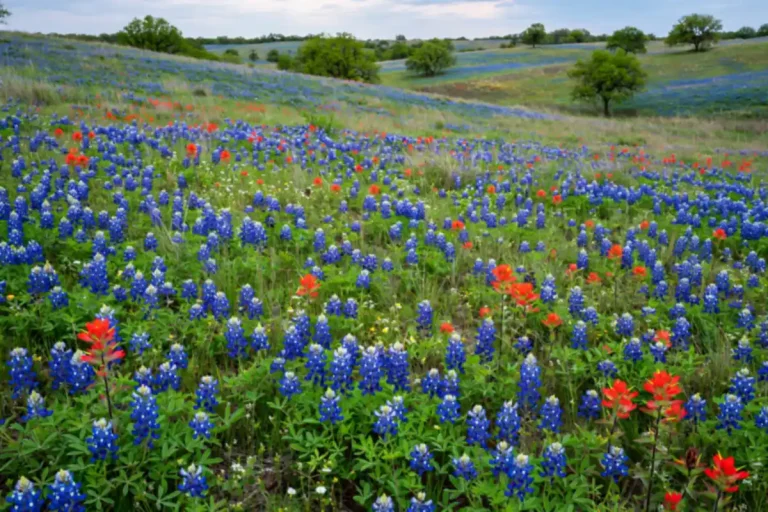
Blue spikes over sandy oak savannas in late spring — and the sole cradle of the Karner blue butterfly, whose caterpillars eat nothing else. Our lupine guide covers the genus: grow the garden kinds at home, and leave Michigan’s wild stands to the smallest blue butterfly in the north.
5. Fringed Gentian — the Last Blue
Gentianopsis crinita saves its sky-blue, fringed goblets for autumn, opening only in sunshine in wet meadows when the year’s other flowers have filed away — the traditional “flower of the fall” that poets used to close the season with.
6. Jack-in-the-Pulpit — the Woodland Preacher
Arisaema triphyllum preaches each spring from a striped green-and-maroon pulpit in every damp Michigan wood, then trades sermon for spectacle: a spike of scarlet berries in autumn. A shade-garden character with two costumes a year.
How to Grow Apple Trees for Blossom
Blossom is a budget the tree keeps all year: winter chill deposits it, spring spends it. Gardeners on r/gardening on Reddit pass on the orchard rule as the family’s first law: “no chill, no flowers — the tree counts the cold so you don’t have to.”
Choosing and Planting
Match the variety to your chill hours and zone: Michigan’s lakeside climate gives most varieties their 800 to 1,200 chill hours easily, while low-chill types exist for mild coasts. Plant in full sun, in well-drained soil, with room to grow — dwarf rootstocks give an 8 to 10 foot tree for small gardens and flower youngest. Crucially, apples are mostly self-sterile: plant a second, different variety that blooms at the same time within bee range (or graft a pollinator branch, the old orchard trick), or the blossom will be a show without a sequel.
Pruning and the Blossom Budget
Prune in late winter, lightly, to an open vase or central leader: fruiting wood is two-to-four-year growth, so butchery removes exactly the branches that flower. Feed modestly in spring, water in drought while fruit swells, and thin a heavy set ruthlessly — a tree allowed to overbear this year will hand you a blossom-less, rest year next (biennial bearing is the apple’s revenge for greed). Blossom first, crop second, patience always.
Common Mistakes When Growing Apple Trees
Mistake one is planting a single tree and blaming the bees: most apples need a different variety’s pollen — no partner, no fruit, though the blossom show alone fools many into thinking all is well. Mistake two is ignoring chill hours, especially in mild climates: a high-chill variety in a warm winter makes leaves and almost no flower. Mistake three is pruning like a hedge in summer or hacking in autumn — you are cutting off next May.
Mistake four is overfeeding nitrogen, which buys leafy whips at blossom’s expense. Mistake five is letting a young tree crop heavily in year two: pretty, and the start of a biennial sulk — thin early crops hard. And mistake six is wet feet: apples rot at the crown in soggy clay; drainage and a graft-union kept above soil are the difference between an orchard tree and a memorial.
Frequently Asked Questions
What is the Michigan state flower?
The apple blossom — the flower of the apple tree — adopted as the Michigan state flower in 1897, one of the earliest such choices in the country. Michigan also has a state wildflower, the dwarf lake iris (1998). If your question is not answered here, the questions about the Michigan state flower on Quora cover most of the rest.
Why did Michigan choose the apple blossom?
For beauty with a harvest attached: in 1897 the young fruit state picked the flower that represented its orchards — fragrant, lovely, and the visible promise of the crop — over purely ornamental rivals. The lake-shore fruit belt that followed made it one of the most literal state emblems in America.
When do apple trees bloom in Michigan?
Mid-spring — typically May along the Lake Michigan shore, earlier inland in the south of the state. An orchard’s full show lasts about a week to ten days, and the Traverse City country times its blossom festivals to the peak.
Do I need two apple trees to get fruit?
Usually, yes: most varieties are self-sterile and need pollen from a different variety flowering at the same time (a neighbour’s tree or a crabapple within bee range counts). A few varieties are partly self-fertile, but even they crop better with company.
What is the dwarf lake iris?
Michigan’s state wildflower (adopted 1998): Iris lacustris, a violet-blue iris only a few inches tall, growing almost exclusively on the gravelly shores of the northern Great Lakes. It is federally listed as threatened — a flower to seek out gently and leave exactly as found.
Why did my apple tree flower but not fruit?
The friendly causes: no pollination partner blooming alongside, a frost during bloom (the lakeside orchards exist precisely to dodge this), bee-less cold wet weather at flowering, or a tree still too young. Also check the calendar — a tree that cropped enormously last year may be taking its biennial rest.
One Comment