
Washington State Flower: The Coast Rhododendron and Its Unusual Story
In 1892, Washington prepared to send a floral emblem to the great Chicago World’s Fair — and the state did something quietly remarkable: it put the choice to a vote of its women, most of whom could not yet vote for anything. They chose the coast rhododendron, the great evergreen shrub whose pink trusses light up the Northwest’s dark forests each spring. The Washington state flower was official in hearts for nearly seventy years before the legislature caught up in 1959 — a flower that arrived by bouquet first and by statute second.
This guide covers the Washington state flower and its story, what the coast rhododendron means, where to see it wild (and tame — Washington grows rhododendrons like nowhere else in America), six more Washington flowers worth knowing, and how to grow rhododendrons: acid soil, cool roots, and patience measured in decades.
Quick Answer
The Washington state flower is the coast rhododendron, Rhododendron macrophyllum, chosen by Washington’s women in 1892 and officially designated in 1959. It is a large evergreen shrub, 6 to 12 feet and more, bearing dome-shaped trusses of pink, bell-shaped flowers in late spring over leathery leaves, native to coastal forests from British Columbia to California. In gardens it wants what its forest gives: acidic soil, steady moisture, shade at the roots, and zones 7 to 9. All rhododendrons are poisonous if eaten — beauty at a respectful distance.
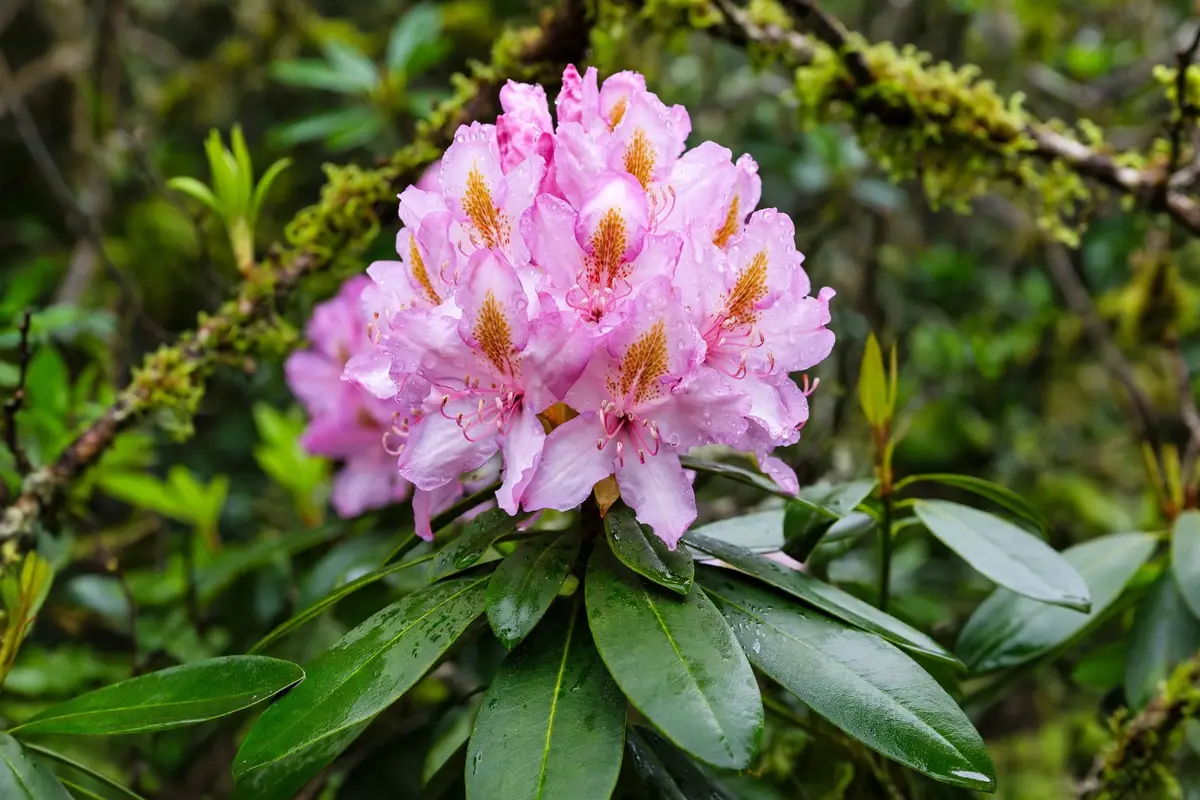
Table of Contents
- What Is the Washington State Flower?
- The Story: 1892, the Women’s Vote and the Long Road to 1959
- Coast Rhododendron Meaning and Symbolism
- Where to See Coast Rhododendrons
- 6 More Washington Flowers Worth Knowing
- How to Grow Rhododendrons
- Common Mistakes When Growing Rhododendrons
- Frequently Asked Questions
What Is the Washington State Flower?
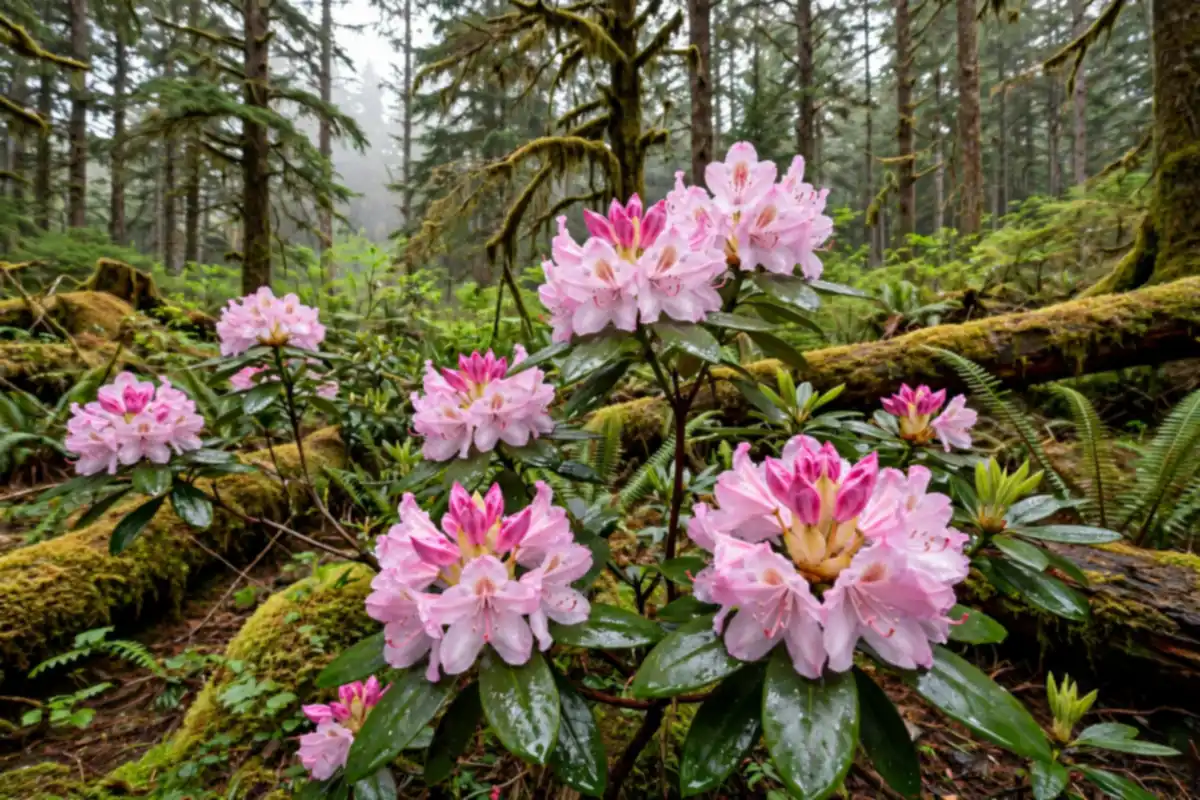
The coast rhododendron is the wild parent looming behind the whole garden family: an evergreen shrub to small tree of the coastal understory, with long, leathery, deep-green leaves clustered at the branch tips like umbrella spokes. In late spring each bud opens into a truss — ten to twenty bells of rose-pink (white and deeper pink forms occur), freckled gold-green in the throat — until a wild thicket in bloom looks lit from inside. Note the family connection: every azalea is also a rhododendron — our azalea guide covers those smaller cousins — and the state flower is the family’s Pacific giant. It grows where the fog belt touches forest, from British Columbia down the Cascades’ wet western slope to northern California, thriving on acid forest soils under tall conifers. You can read more on the Rhododendron macrophyllum page on Wikipedia.
Washington State Flower Quick Facts
- State flower: coast rhododendron, Rhododendron macrophyllum — family Ericaceae.
- Chosen: 1892, by the votes of Washington women for the 1893 Chicago World’s Fair; officially adopted 1959.
- The plant: evergreen shrub 6 to 12+ feet; large leathery leaves; trusses of pink bells in late spring.
- Greek roots: rhododendron = “rose tree”; macrophyllum = “large-leaved”.
- Native range: coastal forests, British Columbia to California, on the wet west slope of the Cascades.
- Conditions: zones 7 to 9; acidic soil (pH 4.5 to 6), steady moisture, shade or morning sun.
- Handle with care: all parts contain grayanotoxins and are poisonous to people and livestock — admire, don’t nibble.
- Good to know: Washington’s climate suits rhododendrons so well the state hosts world-class collections — and the genus runs to over a thousand species, most from Asia.
The Story: 1892, the Women’s Vote and the Long Road to 1959
The story starts with an exhibition: for the 1893 World’s Columbian Exposition in Chicago, Washington wanted a floral emblem, and in 1892 the choice was put to the state’s women — in an era when women’s ballots counted for almost nothing else, a detail Washington still tells with pride. The rhododendron carried the vote against its rivals (clover had its backers) and duly represented the young state at the fair. Then — nothing, officially, for sixty-seven years. The flower was the emblem by universal consent and by custom, printed and planted everywhere, while the statute books stayed silent. Only in 1959 did the legislature finally write down what everyone already knew, designating the coast rhododendron the official state flower. It may be the longest engagement in state-flower history: chosen in 1892, wed in 1959, devoted throughout.
Coast Rhododendron Meaning and Symbolism
The rhododendron in the language of flowers carries a double message — elegance and abundance on one side, and an old warning on the other (“beware”, say the oldest floriographies, mindful of its poison). Washington’s reading has always chosen the generous side: the coast rhododendron means steadfast beauty — an evergreen that keeps its leaves through the darkest, wettest winter and then spends its spring in pink. There is a democratic poetry in its story too: the flower chosen not by a committee of legislators but by the votes of women who were themselves waiting to be officially counted — rather like the flower, emblematic long before the paperwork. Where the Colorado state flower needed a law for protection, Washington’s needed one only for recognition.
Where to See Coast Rhododendrons
Wild, the classic drive is the Olympic Peninsula in May and June, where Rhododendron is so much a local fixture that a town — Port Townsend, home of a rhododendron festival each May — celebrates it; the Dosewallips and the old-growth trails of Olympic National Forest carry thickets under cathedral conifers. Tame, Washington outdoes itself: the Rhododendron Species Botanical Garden in Federal Way holds one of the world’s great species collections, Seattle’s Washington Park Arboretum blazes in May, and Tacoma’s Point Defiance keeps a famous rhododendron garden. Between the wild thickets and these collections, May in western Washington is a rhododendron pilgrimage with many shrines.
6 More Washington Flowers Worth Knowing
Rain makes riches: Washington’s cast runs from prairie to rainforest. The table separates them; the profiles follow. For thousands more flower names, see our flower names A to Z guide.
| Flower | Colour | Season | Character | Best use |
|---|---|---|---|---|
| Great camas | Blue-violet spikes | Spring | The prairie sea | Native meadows |
| Western trillium | White, aging pink | Early spring | The forest jewel | Shade gardens |
| Red flowering currant | Rosy red clusters | Early spring | The hummingbird’s return | Native hedges |
| Columbia lily | Orange turkscaps | Early summer | The wild tiger lily | Woodland edges |
| Balsamroot | Golden sunflowers | Spring | The eastern sun | Dry slopes, east side |
| Nootka rose | Pink, wild-simple | Late spring | The hedgerow rose | Wildlife thickets |
1. Great Camas — the Prairie Sea
Camassia leichtlinii once turned whole South Sound prairies blue each spring — “the water is flowers”, travellers wrote — and its bulbs were a premier Native food, tended and harvested for millennia. Prairies like Glacial Heritage preserve the spectacle: a blue season you stand inside.
2. Western Trillium — the Forest Jewel
Trillium ovatum opens pure white in the early-spring woods, three petals over three leaves, aging blush-pink — a wildflower so bound to its forest that picking the flower can starve the plant for years. Buy nursery-propagated plants, and let the wild ones light the trail.
3. Red Flowering Currant — the Hummingbird’s Return
Ribes sanguineum hangs rosy-red clusters just as the rufous hummingbirds arrive from Mexico — a reunion timed to the week, both parties having travelled to keep it. For early spring colour in native plantings it has no Washington rival.
4. Columbia Lily — the Wild Tiger Lily
Lilium columbianum raises whorls of leaves up a 4-foot stem and nods orange turkscap bells freckled maroon along woodland edges and mountain roadsides — the Northwest’s own true lily, a tiger lily born here rather than imported.
5. Balsamroot — the Eastern Sun
Cross the Cascades and the state changes its palette: Balsamorhiza sagittata gilds the dry Columbia hills with sunflowers over silver-sage leaves each spring, a drought masterpiece whose deep taproot laughs at the rain shadow.
6. Nootka Rose — the Hedgerow Rose
Rosa nutkana, the wild rose of the coast, opens big single pink blooms on bristly canes and follows with plump hips that feed winter birds. In thickets and wet edges it knits wildlife habitat; in gardens it asks only to be left a corner and a little wildness.
How to Grow Rhododendrons
Forest terms: acid, moist, shady at the roots, never wet. Gardeners on r/gardening on Reddit pass on the rhodie rule as the family’s first law: “plant it high, keep it cool, and water it like it still rains in April.”
Planting and Position
Site in dappled shade or morning sun (in the cloudy Northwest, nearly full sun thrives; in hotter climates, afternoon shade is survival). The soil must be acidic — pH 4.5 to 6 — and humus-rich but free-draining: rhododendron roots are fine, fibrous and shallow, and they suffocate in clay. Plant high, with the top of the root ball at or slightly above soil level, and mulch deeply with pine bark or needles. If your soil is alkaline or heavy, raised beds of ericaceous compost are the honest answer — a rhododendron in the wrong soil declines in slow motion and no feeding rescues it.
Care Through the Years
Water deeply in dry spells, especially while establishing and in late summer when next year’s buds form — drought then means a flowerless spring. Feed lightly with an ericaceous fertilizer in spring if growth is pale. Prune only for shape, immediately after flowering (buds for next year set by midsummer), and deadhead spent trusses on garden hybrids where practical. Given its terms, a rhododendron is a decades-long citizen: old Washington gardens hold plants older than the houses they shade.
Common Mistakes When Growing Rhododendrons
Mistake one is planting too deep: the single most common killer. Rhododendrons planted low suffocate slowly — always high, always proud of the soil. Mistake two is alkaline or limey soil and hard tap water, which locks away iron and paints the leaves yellow between green veins; test the soil before blaming the plant. Mistake three is wet clay: drainage is not optional for a root system built for forest duff.
Mistake four is pruning in autumn or winter, which removes the trusses forming for spring — prune straight after bloom or not at all. Mistake five is letting a young plant dry out in August and then wondering at a budless April; late-summer water is next spring’s flowers. And mistake six is nibbling curiosity: every part of the plant is poisonous, and honey from rhododendron nectar is the famous “mad honey” — plant it where children and livestock won’t browse it.
Frequently Asked Questions
What is the Washington state flower?
The coast rhododendron, Rhododendron macrophyllum — chosen by a vote of Washington’s women in 1892 to represent the state at the Chicago World’s Fair, and made the official state flower in 1959. It is the pink-trussed evergreen shrub of the coastal forests. If your question is not answered here, the questions about the Washington state flower on Quora cover most of the rest.
Why did Washington choose the rhododendron?
Because the voters of 1892 — the state’s women, entrusted with choosing the fair’s floral emblem — picked the flower that already defined the Northwest’s spring woods. The legislature merely ratified their choice, sixty-seven years later, in 1959.
When do rhododendrons bloom in Washington?
The wild coast rhododendron blooms mainly in May and June, later at elevation; garden hybrids spread the season from March (the earliest) through June. Peak at the big collections — Federal Way, the Arboretum, Point Defiance — is usually May.
Can I grow the coast rhododendron in my garden?
Yes, where summers stay moderate (zones 7 to 9) and you can give it acidic, free-draining soil, steady moisture, and at least light shade. It is slower and choosier than the garden hybrids bred from Asian species — allow it years, and buy from Northwest nurseries for plants raised in your climate.
Are rhododendrons poisonous?
Yes — leaves, flowers and nectar contain grayanotoxins, dangerous to people, pets and livestock if eaten, and historically infamous via “mad honey” made from rhododendron nectar. Grow them as ornamentals, site them away from browsing animals, and teach children that these flowers are for eyes only.
Are azaleas the same as rhododendrons?
Botanically, yes: azaleas are rhododendrons — a gardener’s group within the genus, usually smaller and often deciduous. The state flower is the opposite end of the family: the largest, evergreen, wild coast species. Hybrids between the groups fill most garden centres.
One Comment