
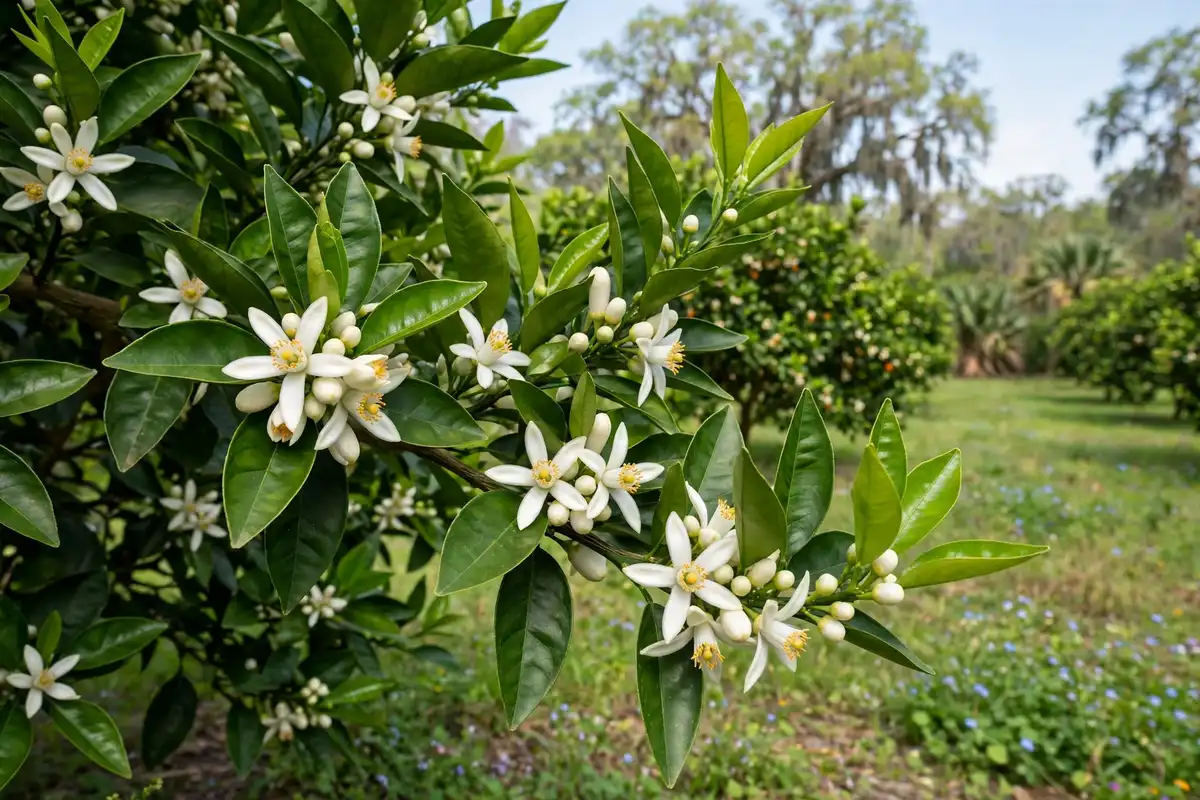
Florida State Flower: The Orange Blossom, Its Meaning and Growing Guide
Some state flowers you have to go looking for. Florida’s announces itself: in spring, whole citrus groves turn white at once and the warm air for miles carries a perfume so rich it has been bottled for centuries. The orange blossom is the Florida state flower — a small, waxy, five-petalled star on the same tree that gives the state its oranges — and it was chosen, unusually, for its scent as much as its beauty. It also carries one of the oldest wedding traditions in the flower world: brides have worn orange blossom for two hundred years to promise purity and fruitfulness in a single flower.
This guide covers the Florida state flower and its 1909 adoption, what orange blossom means and why brides wear it, Florida’s second official bloom (the state wildflower), six more Florida flowers worth knowing, and how to grow an orange tree and get blossom of your own — plus an honest word about the disease reshaping Florida citrus.
Quick Answer
The Florida state flower is the orange blossom — the flower of the orange tree, Citrus × sinensis — designated on 15 November 1909. It is a fragrant white star of five waxy petals, flowering mainly in spring (with smaller flushes through the year in warm districts), on evergreen citrus trees hardy outdoors in zones 9 to 11. Florida also has a state wildflower — coreopsis, adopted in 1991. Orange blossom means purity, innocence and eternal love, and its scent is the basis of classic perfumes, orange-blossom water and Florida’s prized orange-blossom honey.
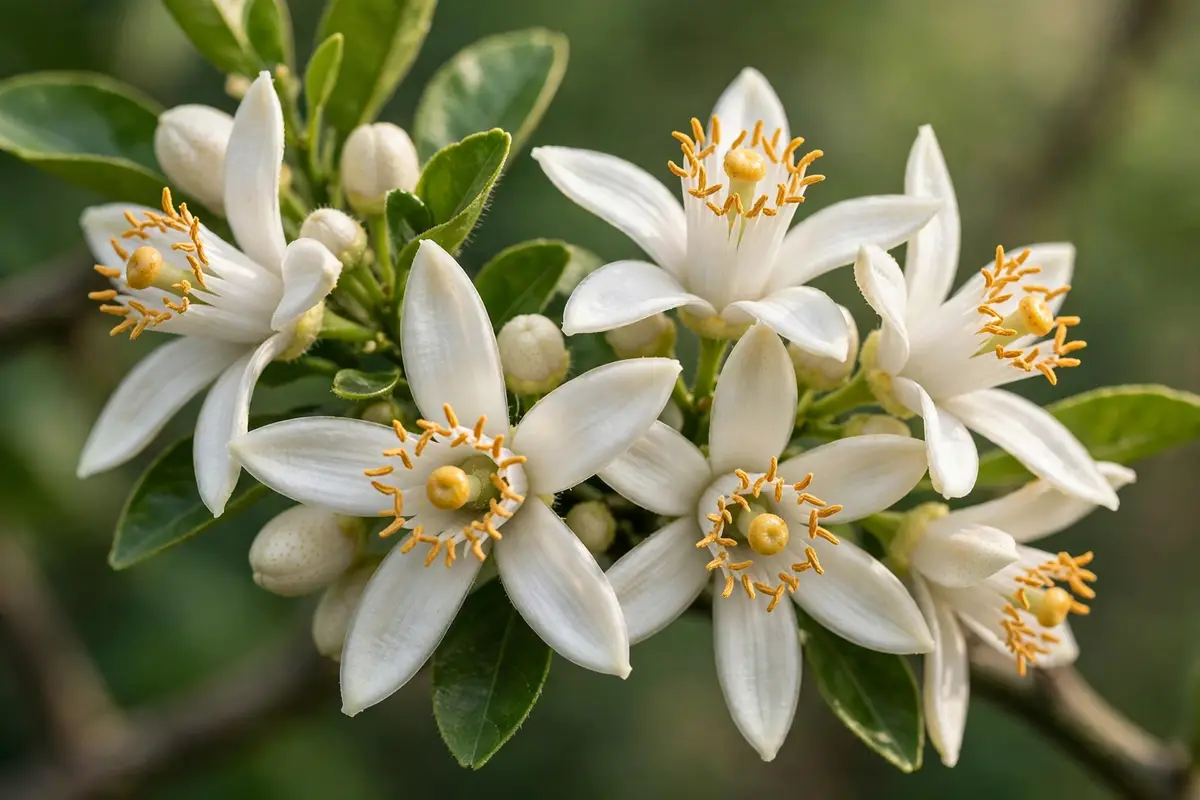
Table of Contents
- What Is the Florida State Flower?
- The Story: 1909 and the Grove State’s Choice
- Orange Blossom Meaning: Brides, Perfume and Honey
- Florida’s Other Official Flower: The State Wildflower
- 6 More Florida Flowers Worth Knowing
- How to Grow an Orange Tree for Blossom
- Common Mistakes When Growing Citrus for Blossom
- Frequently Asked Questions
What Is the Florida State Flower?
The orange blossom is the flower of the sweet orange tree — the same species whose fruit fills Florida’s groves. It opens as a cluster of round white buds (old texts call them pearls), then stars of five thick, waxy petals around a boss of golden stamens, heavy with one of the most loved scents in nature: sweet, heady, faintly green. A tree in full bloom carries blossom and ripening fruit at the same time, flower and harvest on one branch — part of why the flower has always stood for abundance. Oranges themselves are not native: Spanish settlers brought citrus to Florida in the 1500s (the first plantings are tied to St. Augustine’s founding era), wild groves spread from discarded seeds, and the introduced tree became the state’s defining plant. You can read more on the Orange blossom page on Wikipedia.
Florida State Flower Quick Facts
- State flower: orange blossom, flower of Citrus × sinensis (sweet orange) — family Rutaceae.
- Designated: 15 November 1909, by the Florida Legislature.
- The flower: white, five waxy petals, intensely fragrant; main flush in spring.
- The tree: evergreen, 20 to 30 feet in groves; dwarf forms for gardens and pots.
- Hardiness: zones 9 to 11 outdoors; container citrus elsewhere, wintered indoors.
- State wildflower (separate title): coreopsis, adopted 1991 — Florida has two official flowers.
- Good to know: blossom and fruit appear on the tree together; not every blossom sets fruit (a fraction is normal — the rest is the tree’s arithmetic, not failure).
The Story: 1909 and the Grove State’s Choice
By 1909, citrus was becoming Florida’s identity — groves marching down the peninsula, fruit shipped north by rail, the state’s name turning golden in northern winters. When the legislature chose a state flower that November, it chose the industry and the landscape in one gesture: the orange blossom, praised in the resolution’s spirit for a fragrance and beauty no rival could match. It was also a sensory choice in a way state flowers rarely are — many are picked from a photograph; the orange blossom is picked from the air. A century on, the choice has a bittersweet edge: citrus greening disease (huanglongbing), spread by a tiny psyllid and confirmed in Florida in 2005, has since cut the state’s orange production to a fraction of its peak and emptied famous groves. The state flower today is also a reminder — of what the groves were, and of why Florida fights to keep them.
Orange Blossom Meaning: Brides, Perfume and Honey
Orange blossom means purity, innocence and eternal love — and fruitfulness beside them, which made it the bridal flower of the nineteenth century. The fashion peaked when Queen Victoria wore a wreath of real orange blossom at her wedding in 1840; for decades afterwards, brides across Europe and America wore it fresh, waxed or embroidered, a flower that promised a pure heart and a fruitful marriage at once. The scent built its own industries: orange-blossom water flavours Mediterranean and Middle Eastern cooking, neroli oil from the petals anchors classic perfumery, and in Florida the spring bloom yields orange-blossom honey — pale, citrus-kissed, and made by bees worked through the groves at blossom time. Few state flowers can be worn, tasted and breathed; compare the Texas state flower, which is looked at and legislated about, but never eaten.
Florida’s Other Official Flower: The State Wildflower
Florida hedged its bets: alongside the grove flower, it keeps a roadside one. In 1991 the state adopted coreopsis — the golden tickseed daisies that sheet Florida’s roadsides and meadows in spring and summer — as the official state wildflower. The two titles divide the state’s character neatly: orange blossom for the cultivated Florida of groves and gardens, coreopsis for the wild Florida that flowers on its own. Our full coreopsis guide covers the genus, its kinds and its easy care.
6 More Florida Flowers Worth Knowing
Beyond the two officials, Florida’s year-round garden cast. The table separates them; the profiles follow. For thousands more flower names, see our flower names A to Z guide.
| Flower | Colour | Season | Character | Best use |
|---|---|---|---|---|
| Coreopsis (state wildflower) | Golden yellow | Spring–summer | The roadside daisy | Meadows, wild edges |
| Firebush | Scarlet-orange tubes | Spring–frost | Hummingbird magnet | Hedges, wildlife gardens |
| Passionflower (maypop) | Purple and white | Spring–autumn | The alien masterpiece | Fences, butterfly gardens |
| Bougainvillea | Magenta, coral, gold | Almost all year | The colour waterfall | Walls, arches, pots |
| Blanket flower | Red and gold | Spring–frost | The beach daisy | Coastal and dry beds |
| Confederate jasmine | White, perfumed | Spring | The scented curtain | Fences, groundcover |
1. Coreopsis — the State Wildflower
Florida’s second official flower (see above): golden daisies by the acre on roadsides and in meadows, the easiest native colour in the state, and a first-rate pollinator plant. Sow it once and it manages itself.
2. Firebush — the Hummingbird Station
Hamelia patens, a Florida native shrub, pours out slim scarlet-orange tubes from spring to frost and draws hummingbirds and butterflies in shifts; the berries that follow feed birds. It freezes back in the north of the state and returns from the roots — toughness with a work ethic.
3. Passionflower — the Alien Masterpiece
The native maypop, Passiflora incarnata, opens one of the most elaborate flowers on the continent — a purple-and-white corona like a tiny festival — and hosts the Gulf fritillary butterfly, whose caterpillars need its leaves. Edible fruit (the maypop) follows for the gardener the butterflies leave some for.
4. Bougainvillea — the Colour Waterfall
South Florida’s signature spill: papery bracts in magenta, coral, scarlet and gold cascading over walls and arches almost all year. It is a vine with thorns and opinions — full sun, sharp drainage, and neglect as a feeding plan — and frost turns it to sticks north of zone 9.
5. Blanket Flower — the Beach Daisy
Gaillardia pulchella laughs at salt, sand and drought: red-and-gold daisies on the dunes and in dry beds from spring to frost, self-sowing through the poorest soil in the state. If a flower can thrive where the mower gives up, it is this one.
6. Confederate Jasmine — the Scented Curtain
Not a true jasmine but better behaved: Trachelospermum jasminoides covers Florida fences and banks with glossy evergreen leaves and, in spring, clouds of white pinwheels with a perfume in the orange-blossom league. One planting scents a whole street corner in April.
How to Grow an Orange Tree for Blossom
Sun, drainage, and a winter plan: that is the whole syllabus. Gardeners on r/gardening on Reddit pass on the citrus rule as the family’s first law: “they would rather be thirsty in the sun than fed in the shade.”
Planting and Position
Outdoors in zones 9 to 11, plant in the sunniest spot you have, in sandy, free-draining soil, away from frost pockets — citrus flower buds are set in winter, and a hard freeze takes the spring show with it. Everywhere else, grow a dwarf citrus (a sweet orange, or the smaller calamondin and Meyer lemon for reliability) in a large pot of gritty, free-draining compost: summer it outdoors in full sun, winter it in the brightest, coolest room you have. Feed with a citrus fertilizer through the growing season; keep winter watering lean.
Bloom, Fruit and the Honest Word on Disease
A healthy young tree flowers within a few years of planting (grafted trees sooner). Expect most blossoms to fall — a citrus tree sets only a small percentage of its flowers as fruit, and that is arithmetic, not failure. The honest word: in Florida, citrus greening is now the background fact of citrus life. Backyard trees still bloom and fruit across the state, but plant with eyes open — buy certified disease-free stock from a reputable nursery, never move citrus plants or fruit across state lines casually (it is regulated for good reason), and take local extension advice on care. The flower is worth the vigilance.
Common Mistakes When Growing Citrus for Blossom
Mistake one is shade: a citrus in half-sun makes leaves and almost no flower — it is a full-sun tree or nothing. Mistake two is wet feet: heavy, soggy soil rots roots and drops buds; citrus wants drainage more than richness. Mistake three is frost surprise — one hard freeze on an unprotected young tree can end both blossom and tree; know your zone and have a fleece-and-lights plan.
Mistake four is pruning at the wrong time: a winter haircut removes the wood that carries spring blossom; prune after flowering, lightly. Mistake five is panic at blossom drop, followed by over-watering and over-feeding — the tree sheds surplus flowers by design, and kindness drowns the arithmetic. And mistake six is buying an unlabelled bargain citrus of unknown health: with greening in the picture, certified clean stock is the whole game.
Frequently Asked Questions
What is the Florida state flower?
The orange blossom — the flower of the orange tree — designated the Florida state flower on 15 November 1909. Florida also has a state wildflower, coreopsis (1991), so the state keeps two official flowers: one from the grove, one from the roadside. If your question is not answered here, the questions about the Florida state flower on Quora cover most of the rest.
What does orange blossom mean?
Purity, innocence and eternal love — with fruitfulness alongside, which is why it became the classic bridal flower. Queen Victoria’s orange-blossom wreath at her 1840 wedding set a fashion that lasted generations.
When do orange trees bloom in Florida?
The main bloom comes in spring — roughly February to April depending on district and weather — when groves flower almost at once and the scent carries for miles. Smaller flushes can appear at other times in the warmest areas, and bloom and ripening fruit often share the tree.
Can I grow an orange tree outside Florida?
Yes — in the ground in zones 9 to 11 (the Gulf Coast, southern Texas, Arizona’s low desert with water, coastal California), and in pots anywhere, wintered in bright, cool indoor light. Dwarf grafted trees fruit and flower at windowsill-manageable sizes.
Why does my orange tree flower but not fruit?
Usually one of the friendly causes: the tree is young, it is setting only its designed small percentage, pollinators were scarce in a cold or wet bloom week, or water stress hit at fruit-set. In Florida, persistent decline alongside poor fruit points to the sadder cause — ask your county extension office about citrus greening testing.
Is orange blossom edible?
The blossom’s products are: orange-blossom water flavours sweets and drinks across the Mediterranean and Middle East, and the petals yield neroli oil for perfumery. The fresh flowers themselves are a garnish in small amounts in some cuisines — but the famous eating is the fruit, and the famous wearing is the wreath.
One Comment