Georgia State Flower: The Cherokee Rose, Its Legend and Growing Guide
Every Georgia spring, a tough, thorny climber opens snow-white roses along the state’s fences and creek banks — and behind the flower stands the state’s saddest and most beautiful legend. The Cherokee rose has been the Georgia state flower since 1916, named for the Cherokee people, and retold ever since in the story of the Trail of Tears: that the white petals are the tears of Cherokee mothers, the gold heart the gold taken from their land, and the seven leaflets the seven clans. It is a legend, told as one — and it makes this the state flower with the heaviest heart in America.
This guide covers the Georgia state flower and its story (legend labelled as legend), what the Cherokee rose means, Georgia’s state wildflower, six more Georgia flowers worth knowing, and how to grow Cherokee rose — a magnificent, vigorously thorny rose that asks only for sun, room, and a fence worthy of it.
Quick Answer
The Georgia state flower is the Cherokee rose, Rosa laevigata, adopted in 1916. It is a vigorous evergreen-to-semi-evergreen climbing rose — single white flowers with a crown of golden stamens in spring, glossy foliage usually of three leaflets, and formidable thorns — hardy in zones 7 to 10 and naturalized across the Southeast. Despite its name and legend, it is not an American native: it arrived from China in the 1700s and took to the South so completely that Georgia made it the emblem. The state wildflower (1979) is the azalea. The Cherokee rose means remembrance, endurance and love that survives sorrow.
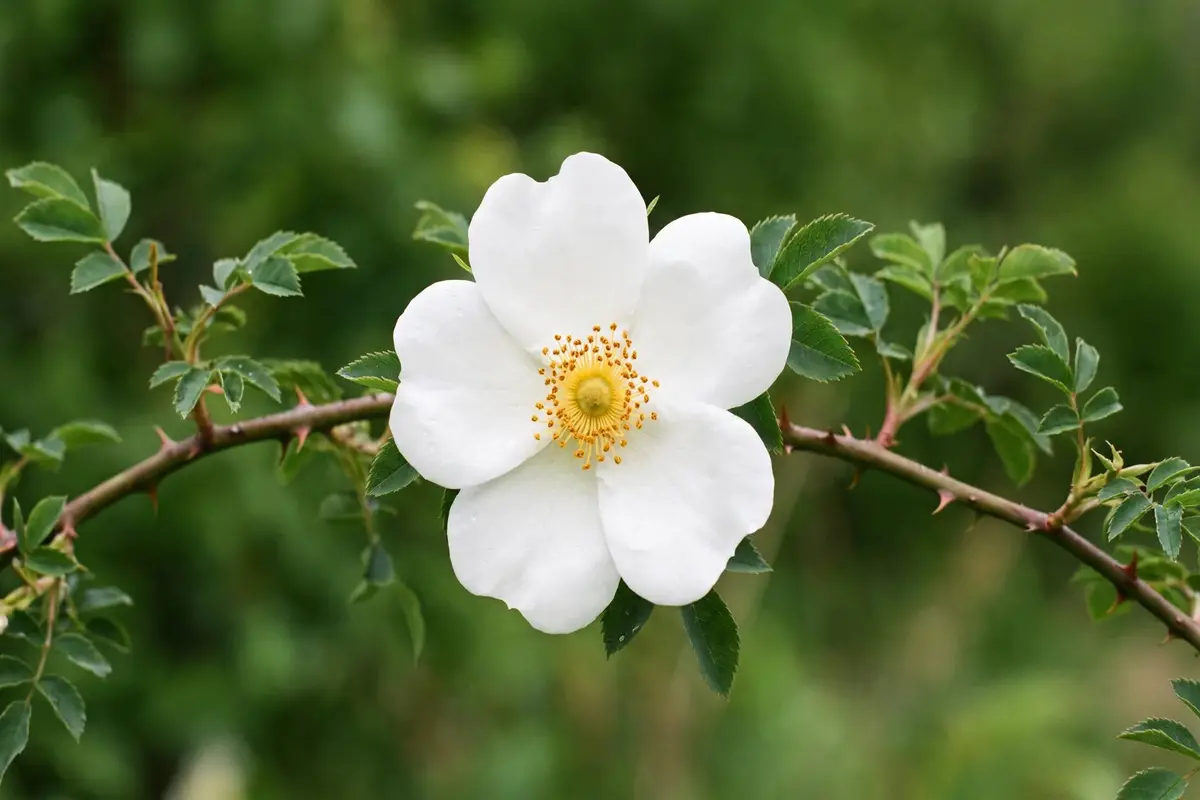
Table of Contents
- What Is the Georgia State Flower?
- The Story and the Legend: 1916 and the Trail of Tears
- Cherokee Rose Meaning and Symbolism
- Georgia’s State Wildflower: The Azalea
- 6 More Georgia Flowers Worth Knowing
- How to Grow Cherokee Rose
- Common Mistakes When Growing Cherokee Rose
- Frequently Asked Questions
What Is the Georgia State Flower?
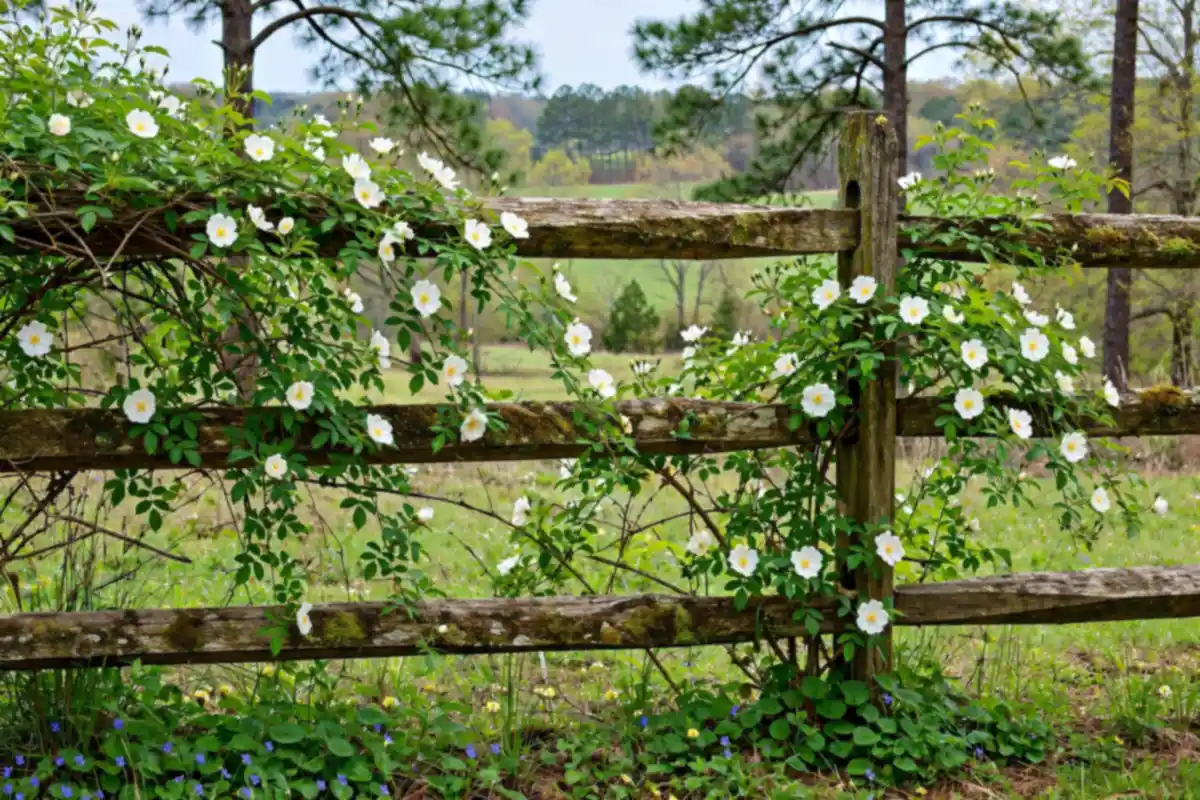
The Cherokee rose is a climbing rose built for the wild margins: long, arching, thorn-armoured canes that scramble over fences, banks and trees to 15 feet and more, dressed in unusually glossy leaves — typically three big leaflets where most roses carry five or seven. In spring it opens single, 3-inch flowers of pure white around a boss of golden stamens, lightly fragrant, followed by bristly orange-red hips. It runs wild through Georgia’s roadsides and old home sites, an escapee long since naturalized as a citizen — which is the honest botanical oddity at the emblem’s heart: Rosa laevigata is native to China, reached the Americas in the colonial era, and loved the Southeast’s climate so well that within a century it was part of the wild landscape the 1916 legislature thought it was honouring. You can read more on the Rosa laevigata page on Wikipedia.
Georgia State Flower Quick Facts
- State flower: Cherokee rose, Rosa laevigata — family Rosaceae.
- Adopted: 1916 as the Georgia state flower; the azalea became state wildflower in 1979.
- The flower: single, white, five petals, golden stamen crown; one generous spring flush, with hips after.
- The plant: vigorous climber/scrambler to 15+ feet; glossy leaves, heavy thorns; evergreen in mild winters.
- Conditions: zones 7 to 10; full sun, almost any drained soil; drought-tough once established.
- Origin: native to China, introduced in the 1700s, naturalized across the Southeast — a beloved immigrant.
- Handle with respect: the thorns are serious equipment; site it where its defence won’t ambush paths.
- Good to know: its hips are used in traditional Chinese medicine (jin ying zi) — the flower’s homeland kept a use the legend’s homeland never claimed.
The Story and the Legend: 1916 and the Trail of Tears
The documented story is short: in the early 1900s Georgia sought a floral emblem, the Cherokee rose — by then woven into the state’s fences, cemeteries and grandmother-lore — was the overwhelming sentimental favourite, and in 1916 the legislature adopted it, naming the Cherokee connection in the flower’s honour. The legendary story is the one Georgia tells about why the name fits. On the Trail of Tears in 1838–39, when the Cherokee were forced from their Georgia homeland westward, the mothers wept for the children who would not survive the march; where their tears fell, the story says, white roses sprang up — white for the tears, gold hearts for the gold stripped from Cherokee land, seven leaflets for the seven clans. Botanists note, kindly, that the plant usually carries three leaflets and came from China besides; the legend is not a botany text, and it does not need to be. It is a memorial a state chose to plant in its emblem — grief and endurance, carried in a flower’s name for more than a century.
Cherokee Rose Meaning and Symbolism
The Cherokee rose means remembrance, endurance and love that outlasts sorrow — the weightiest meaning of any flower in this series. In the ordinary language of roses, a single white rose speaks of purity and worthiness; Georgia’s adds history’s layer: beauty that persists on the very ground of loss, blooming each spring whether or not anyone is left to plant it — the flower naturalized, like memory itself, beyond anyone’s permission. Where the Alabama state flower stands for steadfast devotion in winter, the Cherokee rose stands for devotion tested by the worst a century could do — and still flowering.
Georgia’s State Wildflower: The Azalea
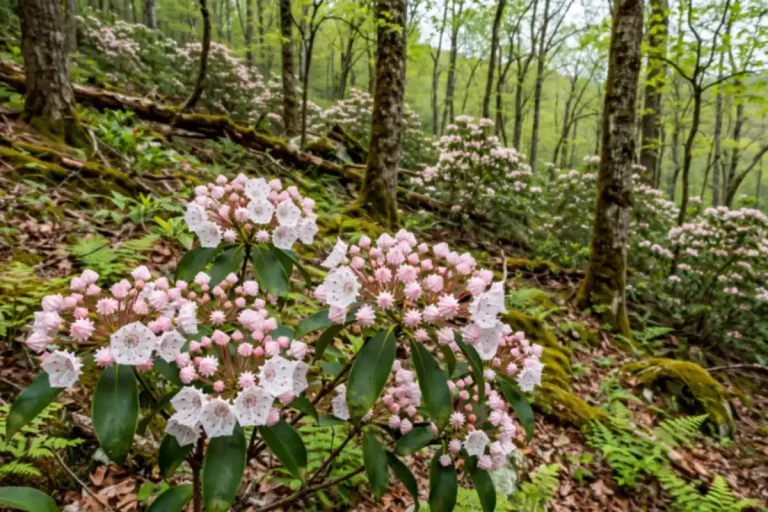
In 1979 Georgia gave its second floral title to the azalea — and pointedly, the native kind: the flame, Piedmont and swamp azaleas that light Georgia’s woods in spring, rather than the evergreen garden imports. Native azaleas are the understory’s fireworks, honeysuckle-scented, in flames of orange, gold, pink and white along streams and slopes — our azalea guide covers the family, wild and tame alike. The pairing is Georgia in two plants: the Cherokee rose for the hedgerow and the legend, the azalea for the wild woods themselves.
6 More Georgia Flowers Worth Knowing
From mountain cove to coastal plain, the cast is long. The table separates them; the profiles follow. For thousands more flower names, see our flower names A to Z guide.
| Flower | Colour | Season | Character | Best use |
|---|---|---|---|---|
| Native flame azalea | Orange and gold | Spring | The wildfire flower | Woodland gardens |
| Flowering dogwood | White and pink | Spring | Atlanta’s icon | Understory tree |
| Southern magnolia | White, lemon-scented | Late spring–summer | The grand dame | Specimen tree |
| Gardenia | White, perfumed | Early summer | The doorway perfume | Foundations, pots |
| Crape myrtle | Every pink and red | Summer | The hundred-day bloom | Streets, small gardens |
| Georgia aster | Violet | Autumn | The namesake rarity | Native plantings |
1. Native Flame Azalea — the Wildfire Flower
The state wildflower’s showpiece: Rhododendron calendulaceum sets Georgia’s mountain woods alight in orange, gold and scarlet each spring before the canopy closes — a deciduous azalea that looks, from a distance, like the hillside caught fire in flowers.
2. Flowering Dogwood — Atlanta’s Icon
Cornus florida is not Georgia’s official anything, and it owns the capital’s spring anyway: the Atlanta Dogwood Festival has celebrated it since 1936, and its white bracts float through every understory and front yard in the state each April. Some flowers need no statute.
3. Southern Magnolia — the Grand Dame
It is Mississippi’s state flower by law, but the great evergreen Magnolia grandiflora, with lemon-scented white saucers the size of dinner plates, is Georgia’s front-yard royalty from Savannah to the mountains’ edge — the tree every Southern garden measures its shade by.
4. Gardenia — the Doorway Perfume
Georgia summers start at the gardenia bush by the door: glossy leaves, white rosettes, and a perfume that announces a house before the doorbell can. It sulks north of zone 8 and in alkaline ground; in Georgia clay amended with pine bark, it holds court for decades.
5. Crape Myrtle — the Hundred-Day Bloom
The South’s summer statue: Lagerstroemia lines Georgia’s streets and small gardens with crinkled crepe blooms from June to September, then pays a second dividend in peeling cinnamon bark and autumn colour. Choose the size class honestly — a full-size crape myrtle is a tree, whatever the tag promised.
6. Georgia Aster — the Namesake Rarity
Symphyotrichum georgianum carries the state in its name and its rarity: violet autumn daisies with dark centres, on a plant now scarce in its own homeland of dry Piedmont woods — a flower conservation groups are working to bring back from the edge, one garden at a time.
How to Grow Cherokee Rose
Sun, room, and a structure with no feelings: that is the whole recipe. Gardeners on r/gardening on Reddit pass on the rule as the family’s first law: “give it the ugly fence and the bad corner — it will make them the best thing in the garden, from a safe distance.”
Planting and Position
Plant in full sun in any well-drained soil — sand, clay and roadside grit all serve — against a strong fence, wall, dead tree or bank it can conquer. Space is the real requirement: a happy Cherokee rose covers 15 feet of fence and reaches into whatever stands nearby, thorns first. Water through the first season, then leave it alone; established plants are famously drought-proof. In zone 7 winters it may die back partway and shrug it off from the base.
Pruning and Manners
It flowers on last year’s wood, in one spring flush: prune immediately after flowering, removing dead wood and shortening the wildest canes, with gauntlets on. Never shear it like a hedge mid-season — you would remove next spring’s show and earn the thorns’ opinion besides. Trained loosely along wires or left to mantle a bank, it asks one afternoon a year and pays a month of white roses each spring, plus autumn hips for the birds.
Common Mistakes When Growing Cherokee Rose
Mistake one is underestimating the vigour: planted in a small border it will annex the border, the path, and the neighbour’s intentions within three seasons — site it like the climber it is. Mistake two is pruning at the wrong time (late winter or summer pruning deletes the spring flush, which forms on old wood). Mistake three is shade: in part shade it grows leaves and thorns and very few roses — this is a full-sun flower.
Mistake four is fussing: rich feeding and constant water buy rank, sappy growth; the Cherokee rose performs best on Southern neglect. Mistake five is planting it beside a path, gate or play area — the thorns are recurved grapples, and children and sleeves learn once. And mistake six is expecting repeat bloom: one glorious spring flush is the plant’s contract (a stray autumn flower or two in mild years is a tip, not a promise) — plant a modern repeat rose elsewhere if you need summer colour too.
Frequently Asked Questions
What is the Georgia state flower?
The Cherokee rose, Rosa laevigata, adopted as the Georgia state flower in 1916. Georgia’s state wildflower, named in 1979, is the azalea — the native azaleas of the state’s woods. If your question is not answered here, the questions about the Georgia state flower on Quora cover most of the rest.
What is the Cherokee rose legend?
Georgia’s beloved retelling of the Trail of Tears holds that white roses sprang where Cherokee mothers’ tears fell on the forced march west in 1838–39 — white petals for their tears, golden hearts for the gold taken from Cherokee land, seven leaflets for the seven clans. It is a legend — the plant usually bears three leaflets and originated in China — preserved because it carries the memory the name was chosen to honour.
Is the Cherokee rose really from Georgia?
No — honestly, it is an immigrant: native to China, introduced to America in the 1700s, and naturalized across the Southeast so thoroughly that by 1916 it read as a wild Georgia flower. The state adopted the plant its landscape had already adopted.
When does the Cherokee rose bloom?
Once, gloriously, in spring — typically April in Georgia — with the single white flowers opening over several weeks along the arching canes. Bristly red-orange hips follow for autumn and winter interest.
Is the Cherokee rose invasive?
It is vigorous and naturalized across the Southeast, spreading along roadsides and old sites, and it can overwhelm small gardens and wild edges where it escapes. In its home range it is a beloved fixture; plant it where its energy serves you, keep it off paths, and think twice before introducing it where it is not already established.
How big does a Cherokee rose get?
Big: canes of 15 feet are ordinary, and an old plant mantling a tree or bank can spread wider still. Give it a fence line, a dead tree, or a slope of its own, and it will be magnificent for decades on nearly no care.