Anemone Flower: Meaning, Types and How to Grow Windflowers
The anemone is the flower that cannot make up its mind about the season, and gardeners love it for exactly that. One branch of the family opens with the first spring bulbs, another carries the border through September and October when everything else is tired, and the most flamboyant of all — the poppy anemone — is the florist’s winter jewel, all velvet petals and soot-black centres. Between them, an anemone is in flower somewhere in the garden for most of the year.
It is also a flower wrapped in story: sprung, the Greeks said, from the blood of Adonis and the tears of Aphrodite, and named for the wind itself. This guide covers what an anemone flower is, the six types that matter, what the anemone means, and how to grow each kind — because the spring and autumn branches of this family ask for opposite treatment, and that is where most plantings go wrong.
Quick Answer
An anemone flower is any plant in the genus Anemone — herbaceous perennials in the buttercup family with poppy-like, petal-ringed flowers around a dark or golden centre. The name comes from the Greek anemos, wind, hence “windflower”. The family splits into spring bloomers grown from small corms or rhizomes (poppy anemone, Grecian windflower, wood anemone) and autumn bloomers grown as border perennials (Japanese anemone). Most are hardy in USDA zones 5 to 9 depending on type, want sun or light shade and well-drained soil, and are mildly toxic — the fresh foliage irritates skin and stomachs, so handle corms and cut stems with gloves.

Table of Contents
- What Is an Anemone Flower?
- Types of Anemone and 6 Windflowers Worth Growing
- Anemone Flower Meaning and Symbolism
- Anemone Flower Colours and Their Meanings
- How to Grow Anemones
- Common Mistakes When Growing Anemones
- Anemones as Cut Flowers
- Frequently Asked Questions
What Is an Anemone Flower?
Anemone is a genus of roughly 60 to 120 species (botanists are still arranging the furniture) in the buttercup family, Ranunculaceae — which makes anemones cousins of the ranunculus, the clematis and the larkspur. They are spread across the temperate world, from Mediterranean hillsides to Japanese woodland edges to North American prairies. The flowers look simple and are built unusually: what appear to be petals are actually sepals, five to many of them arranged around a dense central boss of stamens — sooty black in the poppy anemones, gold in the woodland kinds. You can read more on the Anemone page on Wikipedia.
The “windflower” name is ancient and apt. The spring species open in the season of shifting winds, their slender stems trembling at every gust, and folklore added that the flowers open only when the wind blows — a fancy Pliny repeated. What the wind really does for anemones is carry their fluffy seeds, which drift from the autumn types like thistledown. Gardeners divide the genus by season and root: spring anemones grow from knobbly corms or creeping rhizomes and sleep through summer; autumn anemones are fibrous-rooted border perennials that build through summer and flower as it ends. Knowing which half of the family you hold is the whole secret of growing them, and the types section below is organised by exactly that split.
Anemone Flower Quick Facts
- Botanical name: Anemone (60–120 species).
- Family: Ranunculaceae, the buttercup family.
- Hardiness: USDA zones 5 to 9 for most types; Japanese anemone zones 4 to 8.
- Height: 4 inches (Grecian windflower) to 4 feet (Japanese anemone).
- Bloom time: spring (March–May) for corm and woodland types; late summer to autumn (August–October) for Japanese types.
- Sun and soil: full sun to light shade; moist but well-drained, humus-rich soil.
- Good to know: fresh plants contain an irritant (protoanemonin) — wear gloves and keep away from pets and livestock.
Types of Anemone and 6 Windflowers Worth Growing
Six types cover nearly everything sold as an anemone. The table separates the spring corm-growers from the autumn perennials; the profiles follow. For the full list of flower names, see our flower names A to Z guide.
| Type | Botanical name | Season | Height | Best use |
|---|---|---|---|---|
| Poppy anemone | A. coronaria | Spring | 8–18 in | Cutting, pots, florist flowers |
| Grecian windflower | A. blanda | Spring | 4–6 in | Carpets under trees and shrubs |
| Wood anemone | A. nemorosa | Spring | 6–8 in | Woodland shade, naturalising |
| Snowdrop anemone | A. sylvestris | Spring–early summer | 12–18 in | Fragrant white drifts, wild gardens |
| Japanese anemone | A. × hybrida | Late summer–autumn | 2–4 ft | Autumn borders, shade |
| Pasque flower | Pulsatilla vulgaris | Spring (Easter) | 8–12 in | Rock gardens, silky seed heads |
1. Poppy Anemone (Anemone coronaria)
The showgirl of the family and the one florists mean by “anemone”: velvet-petalled flowers in scarlet, violet, blue, pink and white, each with a dome of near-black stamens, on stems up to 18 inches. The two great strains are De Caen (single flowers) and Saint Brigid (doubles). It grows from a small, hard, claw-like corm, flowers in spring (or winter under glass), and in the Levant it is a wildflower of the hillsides — the scarlet anemones of Galilee are among the candidates for the “lilies of the field”. Treat it as the family’s annual-style performer: plant soaked corms in autumn in mild climates or early spring elsewhere, and expect a blaze rather than a dynasty.
2. Grecian Windflower (Anemone blanda)
The daintiest spring carpet: daisy-like flowers in blue, violet, pink and white, only 4 to 6 inches tall, opening with the early bulbs in March and April. Blanda means charming, and a drift of ‘Blue Shades’ under a shrub or through a lawn edge justifies the name entirely. The small corms are cheap in bulk, which is how they should be bought — by the hundred, scattered and planted where they fall, for a spring haze of colour that returns and gently spreads.
3. Wood Anemone (Anemone nemorosa)
The wildflower of European woods in spring: single white stars, often flushed pink on the back, floating over a carpet of finely cut leaves. Wood anemones spread by thin rhizomes into colonies that can be centuries old — their presence is used by ecologists as an indicator of ancient woodland. In the garden they want shade, leaf mould and patience; they are slow to establish, then permanent. Named forms in soft blue (‘Robinsoniana’) and double white (‘Vestal’) are collector’s plants.
4. Snowdrop Anemone (Anemone sylvestris)
The fragrant one: cupped white flowers with a golden heart, nodding on 12-to-18-inch stems in late spring, sweetly scented — a rarity in this genus — and followed by fluffy, cotton-wool seed heads. It spreads by rhizomes with real enthusiasm, which makes it perfect for a wild corner or a big drift and a poor choice for a small, tidy bed. Give it room and it will fill the room beautifully, in sun or light shade.
5. Japanese Anemone (Anemone × hybrida)
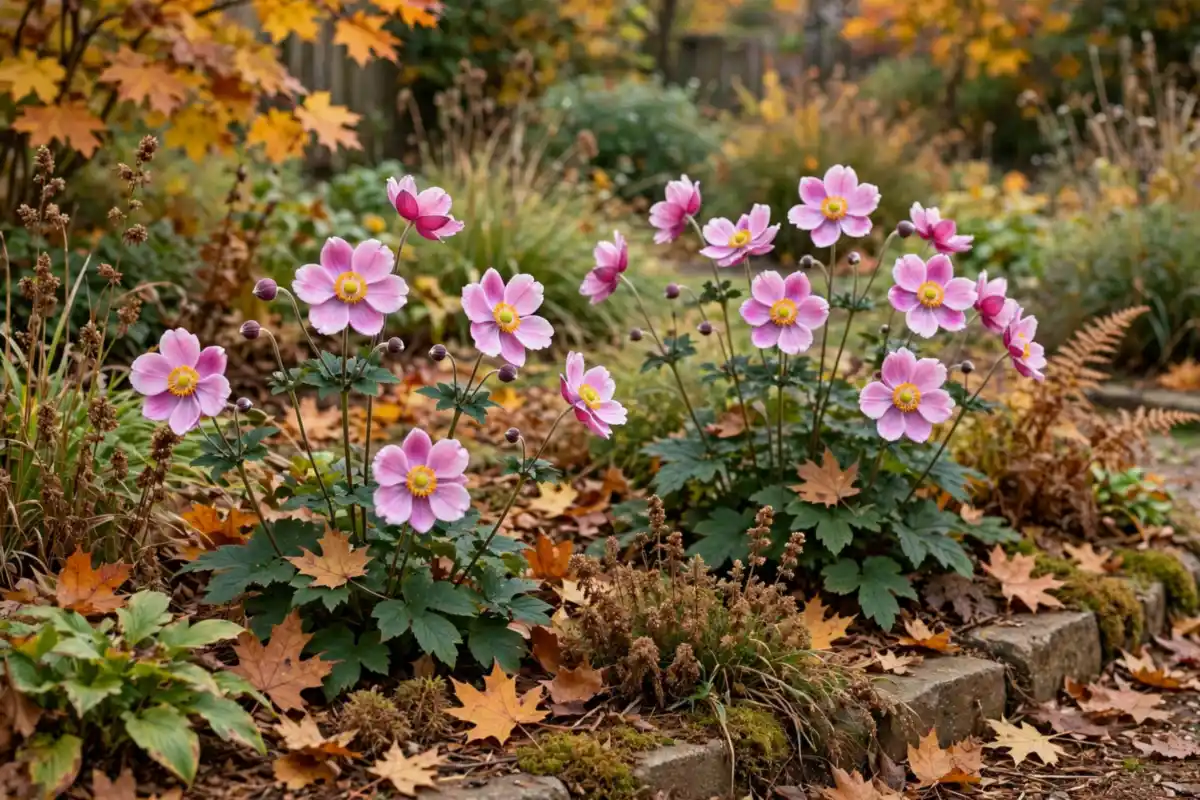
The autumn aristocrat. Despite the name it descends from Chinese species, reached Europe via Japan, and now holds late borders together from August to October: tall, wiry stems carrying pink or white saucers with golden centres, dancing above handsome grape-like leaves. ‘Honorine Jobert’, pure white, is arguably the finest autumn perennial in existence; ‘September Charm’ and the ‘Pamina’ doubles cover the pinks. It is the anemone of the September birth flower season in the garden, hardy to zone 4, slow to settle — give it two years — and then generous for decades, in sun or the part shade few autumn flowers tolerate.
6. Pasque Flower (Pulsatilla vulgaris)
Once filed as Anemone pulsatilla and still sold beside its old family: the Easter flower of chalk grasslands, opening silky purple bells at Easter, every part furred in silver hairs, then retiring into feathery seed heads as good as the flowers. It wants sharp drainage and sun, hates disturbance, and belongs in rock gardens and gravel. Botanists moved it to Pulsatilla, but gardeners — and this guide — keep it at the family table.
Anemone Flower Meaning and Symbolism
The anemone’s meaning is written in its myth. Adonis, beloved of Aphrodite, was killed by a boar on the hunt; where his blood fell and the goddess’s tears mixed with it, the first anemones sprang up — beautiful, and doomed to be brief, since the wind that names them soon strips their petals. From that story the anemone keeps its oldest meanings: forsaken love, loss, and the fragility of beauty. In Victorian flower language an anemone on the doorstep could even carry a darker message — a fading hope, or a warning of sickness.
But the flower refused to stay sad. Because the spring kinds close at night and open with the sun — and because they are among the first flowers of the year — the anemone also came to mean anticipation and expectation: something longed for, arriving at last. In Eastern tradition it is read as protection against evil and ill luck, and in modern bouquets the florist’s anemone means anticipation and excitement far more often than sorrow. The same double life as the narcissus, then: a flower whose dark story and bright season balance each other, which is perhaps why people keep planting it.
Anemone Flower Colours and Their Meanings
Anemones cover an unusually wide palette for one genus, and each colour shifts the message:
- Red anemone — love and sacrifice: the colour of Adonis’s blood in the myth, and the scarlet wild anemone of Mediterranean hillsides. Passionate, and a little solemn.
- White anemone — sincerity, purity and remembrance: the wood anemone and ‘Honorine Jobert’. White anemones are chosen for sympathy flowers precisely because the flower’s story is about love and loss.
- Purple and blue anemone — anticipation and protection: the De Caen violets and the blue blanda carpets carry the Eastern meaning of a shield against ill luck.
- Pink anemone — gentle affection and hope: the Japanese anemones of autumn, whose late flowering makes them a symbol of good things arriving in their own time. For more pink company, see our guide to the poppy flower, the anemone’s close Mediterranean cousin in spirit.
How to Grow Anemones
Grow the two halves of the family differently and both are easy. Gardeners on r/gardening on Reddit repeat the spring rule as a mantra — “soak the corms” — and the autumn rule as a warning: “give it two years before you judge it.”
Spring Anemones: Soak, Then Plant the Corms
Poppy anemone and blanda corms arrive dry, hard and prune-like, and they wake up far better for a soak: four to twelve hours in cool water (some growers add the corms to damp compost overnight instead) until they plump. Plant 2 inches deep and 3 to 4 inches apart, in sun and soil that drains freely — on heavy ground, set them on a layer of grit. In mild climates (zones 8 and up) autumn planting gives the longest spring show; in cold climates, plant coronaria in early spring as the soil warms, and treat it as a spring annual. A succession planting every two weeks stretches the florist-anemone season deliciously.
Woodland Anemones: Rhizomes in Leaf Mould
Wood and snowdrop anemones are planted as rhizomes or pot-grown pieces in autumn or early spring, shallowly, in humus-rich soil under deciduous trees or on the shady side of shrubs. Keep them watered through their first spring, mulch with leaf mould, and then leave them entirely alone — these are plants that reward neglect with permanence. The snowdrop anemone will also take sun if the soil stays moist, and will spread; plant it where spreading is a pleasure.
Japanese Anemones: Patience, Then Decades
Buy Japanese anemones as pot-grown plants and set them out in spring (or early autumn in mild areas), in sun or part shade, in soil enriched with compost. Water through the first season while the roots run; expect modest top growth in year one, flowering stems in year two, and a full colony from year three — the classic perennial sleep-creep-leap. Once established they need nothing but a spring tidy, though very old clumps in rich soil can run; dig out the wanderers and give them away. Avoid planting them in autumn in cold climates: winter wet on unsettled roots is their one real enemy.
Feeding and General Care
Anemones are light feeders. A mulch of compost in spring suits every type; a liquid feed for coronaria in active growth improves the cutting stems. Deadhead the spring types if you want to prevent seeding (or don’t — blanda seedlings are welcome in most gardens), and cut Japanese anemones to the ground in late winter before the new leaves unroll. Slugs love the spring shoots; a night patrol during the first warm weeks saves more plants than any pellet.
Common Mistakes When Growing Anemones
The classic error is planting dry coronaria corms unsoaked in cold, wet soil, where they rot before they wake — soak first, and wait for the soil to be workable. The second is confusing the family’s halves: gardeners dig up “dead” spring anemones in summer (they are dormant, not dead) or expect Japanese anemones to flower the first autumn and dig them out in disappointment just before their leap year.
The third mistake is siting: poppy anemones in shade flower weakly and late, and wood anemones in hot sun simply vanish. Match the type to the light. The fourth is planting Japanese anemone in a small bed beside delicate neighbours — a mature colony is a metre-wide presence, not a tuft. And the fifth is handling fresh-cut or freshly dug plants bare-handed and then rubbing an eye: the sap irritates. Gloves on, always, with this beautiful but faintly unfriendly family.
Anemones as Cut Flowers
The poppy anemone is a professional: cut when the buds show colour and are just beginning to open — they continue to unfurl in the vase — and expect seven to ten days of life, with the flowers closing each night and reopening each morning like a slow tide. Condition stems in cool water straight after cutting, and keep the vase away from ripening fruit, whose ethylene gas ages them. Japanese anemones cut less famously but last well too, and their wiry stems give autumn arrangements an airiness nothing else matches. One caution for mixed vases: anemones are sensitive souls and wilt early in warm rooms — a cool hallway shows them at their best and doubles their applause.
Frequently Asked Questions
Is an anemone a perennial or an annual?
A perennial genus, with an asterisk: Japanese, wood and snowdrop anemones are long-lived perennials that return for years, while the poppy anemone is a tender perennial grown from corms and often replanted each year in cold climates, where winter wet kills the corms. In mild climates even coronaria can persist. If your question is not covered here, the questions about the anemone flower on Quora answer most of the rest.
When do anemones bloom?
It depends which half of the family you plant. Spring anemones — coronaria, blanda, wood and pasque — bloom from March to May. Japanese anemones bloom from August to October, sometimes into November in mild autumns. Plant both halves and anemones bookend your gardening year.
Are anemones poisonous?
Mildly, yes: fresh anemone plants contain protoanemonin, an irritant that blisters skin and upsets stomachs. It breaks down as the plant dries, so dried material is far less active, but the living plant should not be eaten by people or pets, and gloves are wise when dividing rhizomes or handling corms and cut stems.
Do anemones come back every year?
The border and woodland types reliably do, spreading slowly into permanent colonies. Poppy anemone corms return in mild, well-drained gardens but are often treated as replaceable in cold or wet ones — lift and store them dry over winter if you want to keep a favourite strain. Blanda corms naturalise well and usually multiply.
Why did my anemone corms never grow?
Almost always one of three things: they were planted dry and unsoaked in cold soil and rotted; they were planted upside down (the coronaria corm’s point goes down, though they often right themselves); or they were eaten or rotted in waterlogged ground. Soak for a few hours, plant shallow in free-draining soil once it warms, and the failure rate collapses.
Are anemones and poppies the same flower?
No, though the resemblance is real: the poppy anemone is named for looking like a poppy, and both grow wild on the same Mediterranean hillsides. True poppies are genus Papaver; anemones are Anemone, in the buttercup family. For more flowers under the same letter, see our guide to flowers that start with A.