Queen of the Night Flower: Meaning, Types and How to Grow It
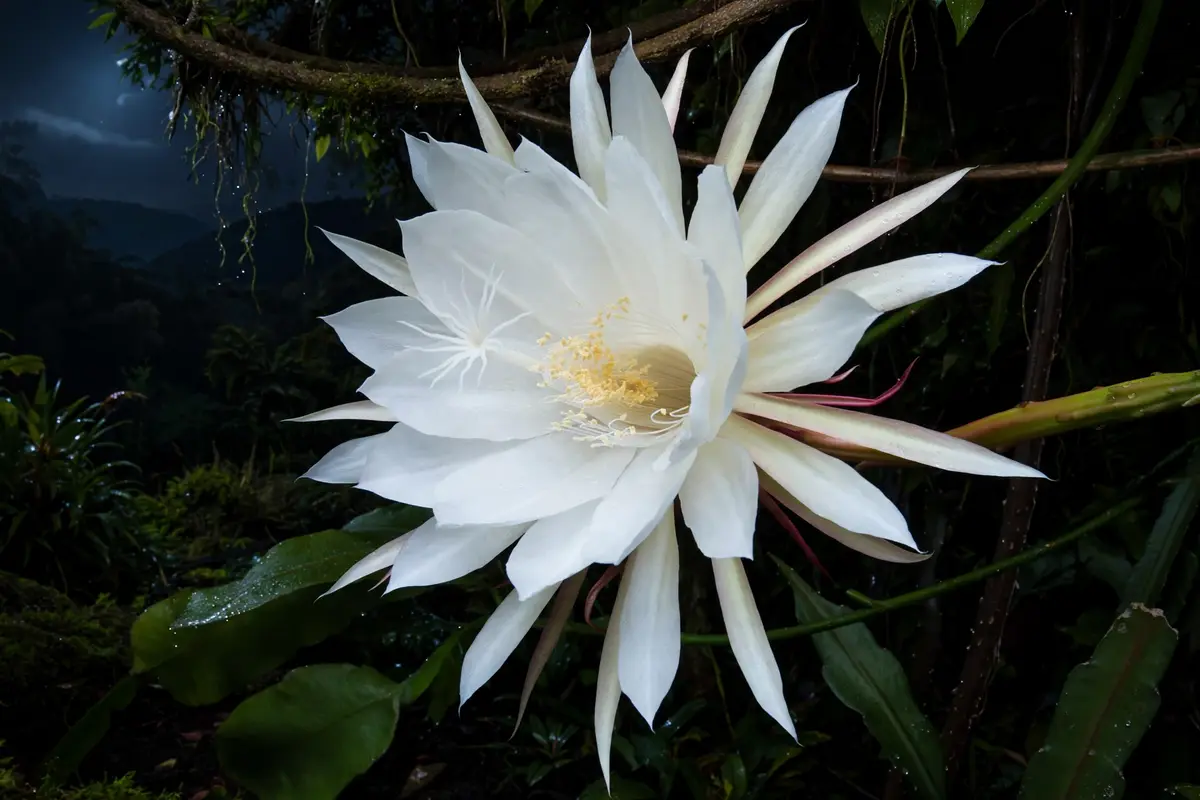
Some gardeners wait all year for one night. The queen of the night flower — a jungle cactus with unremarkable flat green stems — keeps its treasure sealed in a long, plain bud for weeks, then chooses a single warm evening to open it: a white flower up to a foot across, layer upon layer of petals, pouring out one of the richest perfumes in the plant kingdom. By sunrise it has collapsed, finished, gone. Miss the night and you wait for the next bud, which may come in a month, or next year.
That drama is why this plant has viewing parties held in its honour, from Japan to India to Indonesia. This guide covers what the queen of the night flower is, the other cacti that share its title, what it means in the cultures that treasure it, and how to grow it and — the real skill — persuade it to bloom.
Quick Answer
The queen of the night flower is Epiphyllum oxypetalum, a tropical epiphytic cactus (the night-blooming cereus) whose huge, fragrant white flowers open after dusk and last a single night. It grows from flat, leaf-like stems, is frost-tender (a houseplant in cold climates), and needs bright indirect light, a free-draining orchid-like mix, and a cool, drier winter rest to set buds. A mature plant blooms a few times between late spring and autumn, opening each flower around 9–10 pm. The name is also used for several other night-blooming cacti, and in India the plant is widely — if botanically loosely — called Brahma Kamal.
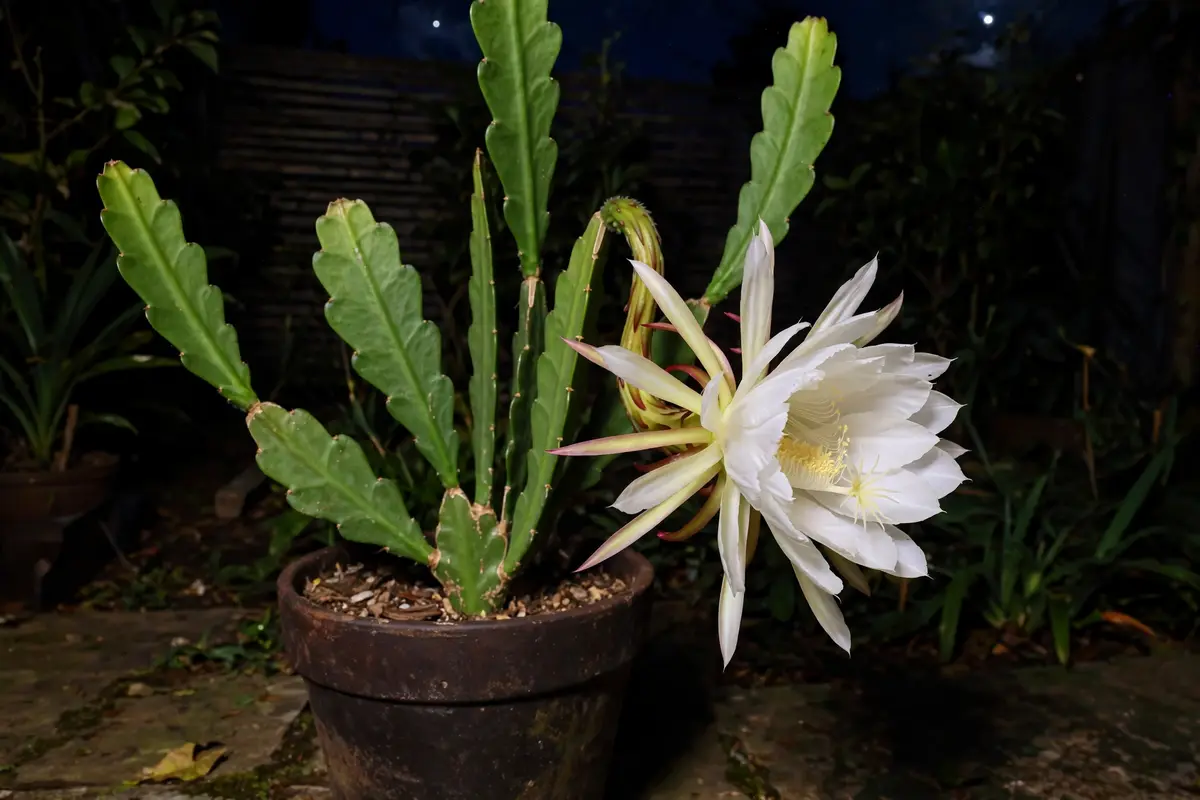
Table of Contents
- What Is the Queen of the Night Flower?
- Types of Queen of the Night and 6 Plants That Share the Crown
- Queen of the Night Flower Meaning and Symbolism
- What a Queen of the Night Flower Symbolises at Night
- How to Grow Queen of the Night
- Common Mistakes When Growing Queen of the Night
- The Blooming Night: What to Expect
- Frequently Asked Questions
What Is the Queen of the Night Flower?
Epiphyllum oxypetalum is a cactus — though you would not guess it from the flat, leaf-like, spineless stems — native to the forests of southern Mexico to Venezuela, where it grows as an epiphyte, perched on tree branches and rocks, rooting in leaf litter rather than desert sand. In the cactus family, Cactaceae, it is famous under a crowd of names: night-blooming cereus, orchid cactus, Dutchman’s pipe cactus, tan hua in Chinese, gekka bijin (“beauty under the moon”) in Japanese, wijaya kusuma in Indonesia, and kadupul in Sri Lanka. You can read more on the Epiphyllum oxypetalum page on Wikipedia.
The flower is an exercise in extravagant timing. The bud develops slowly on the scalloped edge of a stem, pointing upward like a swan’s neck, and on the chosen evening it begins to stir after sunset: the outer petals loosen, the flower opens over two to three hours to a white chalice 8 to 12 inches across, and the scent — sweet, heavy, gardenia-like — carries across a whole garden or house. The audience it evolved for is the night shift: sphinx moths and even bats in its native forests. Then, before dawn, the whole performance folds. Growers who have watched a time-lapse will tell you the real thing, watched live with friends and drinks, is better — which is why the blooming of this flower became a social event in half the countries it reached. It is the crown jewel of the night-blooming flowers we covered in our moon flower guide.
Queen of the Night Flower Quick Facts
- Botanical name: Epiphyllum oxypetalum.
- Family: Cactaceae — a forest cactus and epiphyte, not a desert cactus.
- Hardiness: frost-tender; outdoors only in USDA zones 10 to 11, a houseplant elsewhere.
- Size: stems 3 to 10 feet long in time, arching; flowers 8 to 12 inches across.
- Bloom time: late spring to autumn, a few nights a year; each flower opens at dusk, dead by dawn.
- Light: bright, indirect; morning sun only. Roots want an airy, orchid-style mix.
- Good to know: generally considered non-toxic to people and pets, and in parts of Asia the flowers are eaten in soups after their night.
Types of Queen of the Night and 6 Plants That Share the Crown
“Queen of the night” is a title, not a species, and several cacti wear it. The table separates the claimants; the profiles follow. For the full list of flower names, see our flower names A to Z guide.
| Plant | Botanical name | Type | Flower | Claim to the crown |
|---|---|---|---|---|
| Queen of the night | Epiphyllum oxypetalum | Jungle cactus, houseplant | White, 8–12 in, one night | The usual bearer of the name |
| Night-blooming cereus | Selenicereus grandiflorus | Climbing desert cactus | White and gold, to 12 in | The original “cereus” of old books |
| Arizona queen of the night | Peniocereus greggii | Desert cactus, tuberous root | White, intensely fragrant | Whole valleys bloom one night a year |
| Dragon fruit cactus | Selenicereus undatus | Climbing cactus | Huge white night flowers | Called queen of the night in Hawaii |
| Dutchman’s pipe cactus | Epiphyllum oxypetalum (syn.) | Jungle cactus | Same flower, curved bud | An older name for the same plant |
| “Brahma Kamal” of gardens | Saussurea obvallata (true) | Himalayan alpine | Cream bracts, high mountains | The true Brahma Kamal — a different plant |
1. Queen of the Night (Epiphyllum oxypetalum)
This is the queen of this guide and of most of the world’s windowsills: the flat-stemmed jungle cactus whose flowers are an event. In Japan it is gekka bijin, “beauty under the moon”; in China, tan hua, a byword for something glorious and fleeting; in Indonesia, wijaya kusuma, “flower of victory”, once tied to royal blessing; in Sri Lanka the kadupul flower is considered so precious it is offered, never sold, and legend says the gods descend when it blooms. One plant, four cultures, the same verdict: the single finest night in the flower calendar.
2. Night-Blooming Cereus (Selenicereus grandiflorus)
The name night-blooming cereus originally belonged to this Caribbean climbing cactus, whose vanilla-scented flowers — white petals around a golden heart — were the wonder of Victorian glasshouses, and whose fame is why “cereus” now sticks loosely to the whole group, including our queen. It needs a warm greenhouse or frost-free wall in most climates and repays it with flowers as large as the queen’s own.
3. Arizona Queen of the Night (Peniocereus greggii)
The desert’s answer to the title. Most of the year this Sonoran cactus is a few grey, stick-like stems hiding a huge tuberous root, easy to walk past. Then, on one synchronised night in early summer, every plant in a valley opens its white, perfumed flowers together — Tohono Chul park in Tucson famously holds a public “Bloom Night” for it. If the epiphyllum is a soloist, the peniocereus is a choir.
4. Dragon Fruit Cactus (Selenicereus undatus)
Before it is a fruit, the dragon fruit is a queen: its enormous white night flowers — up to 14 inches long — open after dark for moths and bats, and in Hawaii, where the plant covers old stone walls (the famous panini o kapunahou hedge in Honolulu), it is called queen of the night. Grow it where winters are kind, give it a wall or post to climb, and you get the flowers first and the fruit as a bonus.
5. Dutchman’s Pipe Cactus (Epiphyllum oxypetalum, older name)
Not a different plant at all, but a name worth decoding: Victorian growers called the queen “Dutchman’s pipe” for the long bud’s elegant curve, like the stem of a clay pipe, as it arcs upward in the days before opening. If an old book or a grandparent’s plant label uses this name, you are looking at Epiphyllum oxypetalum itself.
6. The True Brahma Kamal (Saussurea obvallata)
In India, the queen of the night on the windowsill is almost universally called Brahma Kamal, the sacred lotus of Brahma — but the true Brahma Kamal is a completely different plant: a rare Himalayan alpine whose cream, papery bracts open at 10,000 feet and above, and which is the state flower of Uttarakhand. The epiphyllum borrowed the name because it blooms at night like the legendary flower was said to. Both plants deserve respect; they simply are not the same, and the epiphyllum is immeasurably easier to grow at home.
Queen of the Night Flower Meaning and Symbolism
No flower means fleeting beauty as completely as this one. In China, the phrase “tan hua yi xian” — the epiphyllum’s brief appearance — is the standard metaphor for a glorious moment that cannot last, used for everything from a comet to a short-lived celebrity. That is the queen of the night’s central meaning across cultures: precious moments, beauty that must be witnessed now or missed, and the wisdom of paying attention while something wonderful is briefly here.
The flower’s other meanings follow from the performance itself. Purity, from the spotless white petals that open unstained in the dark. Good luck and blessing: in Indonesia the wijaya kusuma was linked to royal fortune, and anyone present at a blooming was considered blessed; in Sri Lankan legend the kadupul’s flowering draws the Nagas and the gods themselves. And rarity as value: a kadupul flower cannot be bought because it dies before it can be sold, which is why it is sometimes called the most precious flower in the world — its price is your evening. To give or share a queen of the night blooming is to say: this moment mattered enough to stop for.
What a Queen of the Night Flower Symbolises at Night
Like the moon flower, the queen is always dressed in white, and white worn for one night only means purity, reverence and the sacredness of the brief — the floral opposite of the everlasting bouquet. Growers pair it with other white flowers in moon gardens, but the queen out-dramatises them all: they merely stay visible after dark, while she performs. Among the world’s fragrant flowers she is also the undisputed night champion — a scent so generous that one open flower perfumes a house, released for an audience of moths and whoever was wise enough to stay up.
How to Grow Queen of the Night
Everything about this plant’s care follows from one fact: in the wild it lives in trees, not in sand. Grow it like an orchid, not like a desert cactus. Gardeners on r/gardening on Reddit trade blooming photos every summer, and the successful growers all describe the same regime: bright shade, airy soil, winter rest.
Light and Position
Give the queen bright, indirect light — an east-facing window, a shaded porch, or under a tree outdoors in summer. A few hours of gentle morning sun are welcome; hard midday sun scorches the flat stems yellow-white. Indoors, the brightest spot out of direct afternoon sun is right. Stems that stretch long, thin and pale are asking for more light; stems that blush purple are coping with slightly too much.
Soil, Pots and Watering
Use a free-draining, airy mix — orchid bark, perlite and a little compost or cactus soil in roughly equal parts — in a pot with generous drainage holes. Water thoroughly when the top inch or two has dried in the growing season; in the wild the roots are rained on and then dry in the breeze, and they rot in permanently soggy soil. The plant is forgiving of missed waterings — the flat stems store water — and unforgiving of wet feet.
The Winter Rest That Makes the Flowers
Buds are earned in winter. From late autumn, keep the plant cooler (ideally 10–15°C / 50–59°F), brighter, and much drier — water only enough to stop the stems shrivelling. This cool, dry rest is the signal that triggers flower buds on the stem edges when growth resumes in spring. A queen kept warm, wet and fed all winter grows plenty of handsome stems and no flowers at all: the single most common story in the mistakes section below.
Feeding, Staking and Propagation
Feed monthly in spring and summer with a balanced liquid fertiliser at half strength, switching to a high-potash feed when buds appear. The long stems need support — a small trellis, a moss pole, or a hanging basket they can cascade from. Propagation could not be easier: cut a stem section, let the cut dry for a few days, and lay it on the mix; it roots in weeks. A cutting takes two to three years to reach flowering size, which is why mature plants are passed between friends like heirlooms.
Common Mistakes When Growing Queen of the Night
The headline mistake is skipping the winter rest: no cool, dry season, no buds. The second is desert-cactus treatment — gritty starvation soil and a blazing windowsill — for a plant that evolved in the rainforest canopy; it wants orchid care, not Sahara care. The third is repotting too eagerly or into too large a pot: queens flower best when snug, and a plant put into a cavernous pot puts its energy into roots, not buds.
The fourth mistake happens on the big night itself: moving the plant, or even turning the pot, once a bud has oriented itself — buds often drop when their light direction changes in the final days. Settle the plant where it will bloom before the buds swell. And the fifth mistake is simply not checking: buds develop quietly for weeks, then ripen over a few days. Learn the signs in the next section and the queen will never perform to an empty room again.
The Blooming Night: What to Expect
A ripening bud announces itself: it swells, the tip lifts and curves upward, and the outer scales loosen — from that point, opening is usually one to three evenings away, and experienced owners start inviting people. On the night itself, movement begins around sunset: the bud trembles, the petals ease apart, and by 9 or 10 pm the flower stands fully open, a foot wide, white as paper and pouring scent. Peak glory is around midnight. By 3 or 4 am the petals soften, and by breakfast the flower hangs limp, its one night spent.
Two practical joys follow. First, the spent flower is not waste everywhere: in Chinese and Southeast Asian kitchens, the wilted blooms are gathered in the morning and simmered into soups, a traditional use with a long history — the flower’s second, quieter gift. Second, a big plant rarely opens just one flower a year: buds come in flushes from late spring to autumn, so a missed night is a postponement, not a tragedy. Keep the plant where the household passes in the evening — near the door, the terrace, the sitting room window — because the queen performs for whoever is home to see her.
Frequently Asked Questions
How often does the queen of the night flower bloom?
A mature, well-rested plant typically blooms two to five times between late spring and autumn, in flushes of one to several flowers, each lasting a single night. Young plants and cuttings need two to three years to reach flowering size, and a plant denied its cool, dry winter rest may not bloom at all — the rest is the trigger. If your question is not answered here, the questions about the queen of the night flower on Quora cover most of the rest.
Why is it called the queen of the night?
Because it rules the night garden: the largest, most fragrant and most dramatic of the night-blooming flowers, opening after dark like royalty arriving at a ball, and gone by morning. Several night-blooming cacti share the title in different regions — the Arizona desert has its own queen — but Epiphyllum oxypetalum is the one the houseplant world means.
Is the queen of the night the same as Brahma Kamal?
In Indian homes, yes by name — the epiphyllum is universally called Brahma Kamal there, for its night blooming and sacred associations. Botanically, no: the true Brahma Kamal is Saussurea obvallata, a rare Himalayan alpine flower and the state flower of Uttarakhand. Your windowsill plant is the cactus; the name is an honour it borrowed.
Is the queen of the night flower poisonous?
It is generally considered non-toxic to people, cats and dogs, and the spent flowers are traditionally eaten in parts of Asia. As with any houseplant, eating large amounts of stem is unwise, and individual sensitivities vary — but of the famous night bloomers, this is one of the safer ones to keep around pets. (Its lookalike-by-name datura, covered in our moon flower guide, is the dangerous one.)
How do I know when my queen of the night will bloom tonight?
Watch the bud: when it has swelled, lifted its tip upward and begun to loosen at the seams, opening is one to three evenings away. On the day itself the bud looks plump and pale by afternoon and starts to stir at dusk. Set the plant in its viewing spot, do not move it, and check in after sunset — the show runs from about 9 pm to the small hours.
Can the queen of the night grow outdoors?
Only where winters stay frost-free (USDA zones 10 to 11) — a tree branch, pergola or shaded wall suits it perfectly there. Everywhere else it lives in a pot: outdoors in bright shade all summer, which it loves, and indoors before the first frost. For more flowers under the same letter, see our guide to flowers that start with Q.