Poinsettia Flower: Types, Meaning and How to Grow It
Here is the world’s most successful seasonal disguise: a Mexican shrub wearing its leaves painted red, sold by the tens of millions every December, and thrown away by January by people who never learn it is a perennial. The poinsettia is not really a flower at all — the scarlet stars are coloured leaves called bracts, and the actual flowers are the tiny yellow beads hiding in the middle. It is also not really poisonous, despite a century of warnings. Almost everything “everyone knows” about this plant is wrong, which is what makes it worth a guide.
This guide covers the six poinsettias worth knowing (classic red, white, pink Princettia, speckled Jingle Bells, curled Winter Rose, and the wild Mexican shrub itself), what it means — good cheer and success — and how to keep it alive past Christmas and bring it back into colour next year, with the famous darkness rule explained honestly.
Quick Answer
The poinsettia is Euphorbia pulcherrima, a shrub in the spurge family Euphorbiaceae from Mexico, grown worldwide as the Christmas plant for its coloured leaf bracts — red, white, pink or speckled — around tiny yellow true flowers. Indoors it wants bright indirect light, warmth away from drafts (65–70°F), and evenly moist soil; it is a tender perennial (zones 9 to 11 outdoors) that can be kept after Christmas, pruned in spring, and re-coloured in autumn with long, uninterrupted nights. The poinsettia means good cheer, success and celebration.
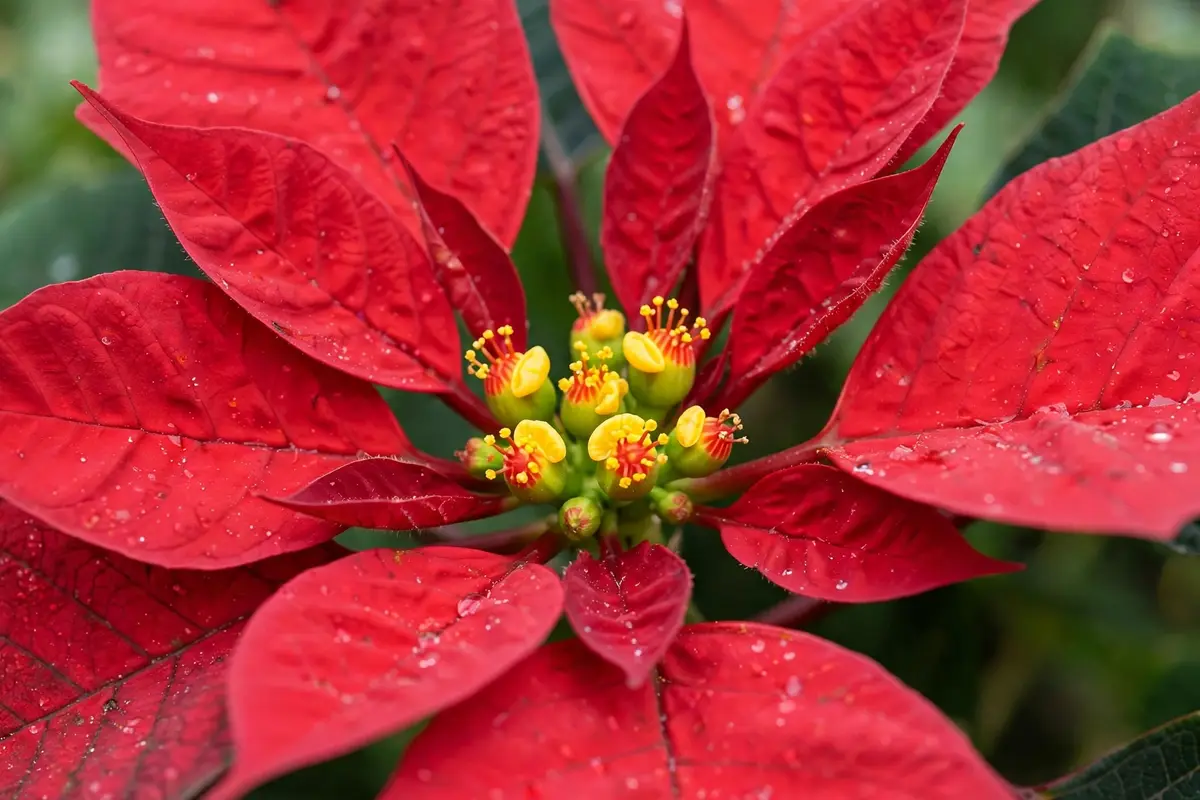
Table of Contents
- What Is a Poinsettia?
- Types of Poinsettia and 6 Kinds Worth Knowing
- Poinsettia Flower Meaning and Symbolism
- Poinsettia Colours and Their Meanings
- How to Grow and Keep Poinsettias
- Common Mistakes When Keeping Poinsettias
- Is the Poinsettia Poisonous? The Myth, Tested
- Frequently Asked Questions
What Is a Poinsettia?
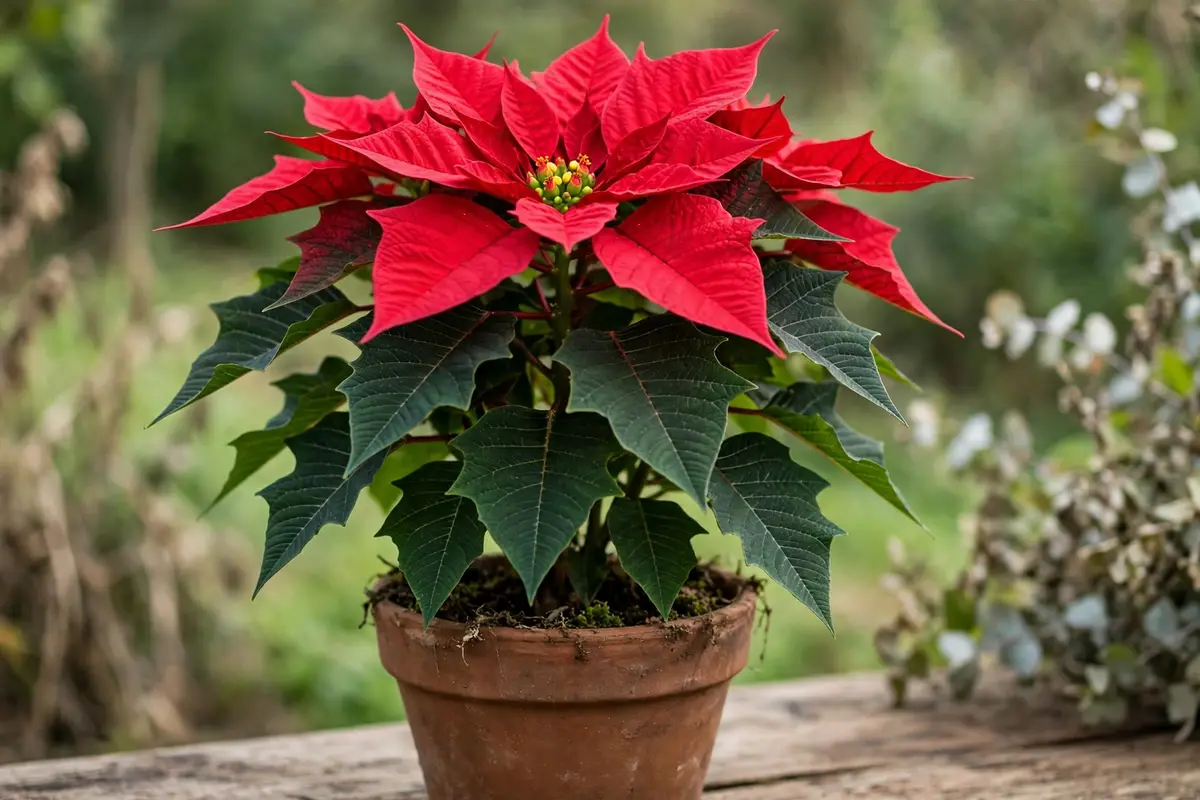
Start with the correction, because everything follows from it: the red stars are not petals. They are bracts — modified leaves that change colour as the days shorten — and the plant’s real flowers are the small yellow-green cups (cyathia) clustered in the bracts’ centre. When you buy a poinsettia, you are buying foliage in costume, which is why it lasts for months instead of the week a true flower would give you. You can read more on the Euphorbia pulcherrima page on Wikipedia.
The plant is Euphorbia pulcherrima — “the most beautiful euphorbia” — a loose shrub from the Pacific coast of Mexico and Guatemala, where it grows 10 feet tall in dry tropical forest and colours up in winter. The Aztecs knew it as cuetlaxochitl, growing it for red dye and for remedies. Its English name honours Joel Roberts Poinsett, the first US minister to Mexico, who sent cuttings home to South Carolina in 1828; in Mexico it is still the flor de Nochebuena, the Christmas Eve flower, and legend ties it to a poor girl named Pepita, whose gift of weeds at a church altar burst into scarlet stars — the Mexican Christmas story in one image.
Poinsettia Quick Facts
- Botanical name: Euphorbia pulcherrima; Mexican name flor de Nochebuena; Aztec name cuetlaxochitl.
- Family: Euphorbiaceae, the spurge family (milky sap in all its stems).
- The “flowers”: coloured bracts (leaves); the true flowers are the tiny yellow cyathia in the centre.
- Native range: Mexico and Guatemala — a winter-flowering shrub of dry tropical forest.
- Hardiness: tender; a houseplant almost everywhere, a perennial shrub in zones 9 to 11.
- Height: 1–2 feet in a Christmas pot; up to 10–13 feet as a wild shrub.
- Colour trigger: short days — it needs long, uninterrupted nights (about 14 hours of darkness) for 8–10 weeks to colour its bracts.
- Good to know: not the poison of legend (see the myth section); the milky sap can irritate skin, and latex-sensitive people should handle with care.
Types of Poinsettia and 6 Kinds Worth Knowing
The classic red, the modern colours, and the wild shrub behind them. The table separates them; the profiles follow. For the full list of flower names, see our flower names A to Z guide.
| Type | Bracts | Character | Season | Best use |
|---|---|---|---|---|
| Classic red (‘Prestige Red’) | Scarlet, classic star | The traditional plant | Nov–Jan | Christmas table, gifts |
| White kinds | Creamy white | Elegant, modern | Nov–Jan | Minimal decor, weddings |
| Pink / Princettia | Soft to hot pink | Compact, long-lasting | Nov–Feb | Pots, bright rooms |
| Speckled (‘Jingle Bells’) | Red splashed cream | Festive, playful | Nov–Jan | Statement plants |
| ‘Winter Rose’ | Curled, rose-like | Unusual texture | Nov–Jan | Collectors, gifts |
| Wild shrub (the species) | Loose red bracts | 10 ft Mexican shrub | Winter | Zones 9–11 gardens |
1. Classic Red — ‘Prestige’ and the Traditional Kinds
The poinsettia of memory: broad scarlet bracts in a perfect star, dark green leaves, and a plant bred to be at its peak exactly in the Christmas window. ‘Prestige Red’ is the industry’s benchmark — compact, long-holding, and the red against which all others are judged. The classic kinds descend from a California breakthrough: the Ecke family of ranchers discovered (and long kept secret) a grafting technique that made poinsettias branch compactly instead of growing leggy, which turned a lanky shrub into the world’s best-selling pot plant.
2. White Poinsettias — the Quiet Ones
Creamy-white bracts on the same classic plant: the white kinds (‘White Star’ and its kin) trade the shout for elegance, and they have quietly become the decorator’s choice — winter weddings, Scandinavian-style rooms, and anywhere red would argue with the furniture. Care is identical to the red kinds; only the costume differs. A white poinsettia in a simple pot is the plant at its most modern.
3. Pink and Princettia — the Long-Season Kinds
Pink poinsettias range from blush to hot pink, and the Princettia line — bred from a related Japanese euphorbia cross — pushes the colour to a clean, bright pink on unusually compact plants that hold their bracts longer than the classics, often well into February. Princettia is the poinsettia for people who found the red ones too Christmas-only: it reads as a flowering houseplant first and a holiday plant second.
4. Speckled and Marbled — ‘Jingle Bells’ and ‘Ice Punch’
The party kinds: ‘Jingle Bells’ splashes cream freckles over red bracts, ‘Ice Punch’ runs a cream blaze down the centre of each bract, and marbled kinds blend pink and cream like watercolour. No two plants are quite alike, which is the charm — and the genetics are unstable enough that growers propagate them carefully to hold the pattern. If a classic red is a uniform, these are fancy dress.
5. ‘Winter Rose’ — the Curled One
A poinsettia that folds its bracts inward and curls them, so the whole head reads like a double rose or a camellia instead of a star. ‘Winter Rose’ (red, and later white and pink forms) is the collector’s kind — the one guests pick up and turn over, trying to work out what it is. It proves how completely the “flower” is a leaf trick: change the leaf’s posture and the whole plant changes species in the eye.
6. The Wild Shrub — the Species Itself
Under all the breeding stands Euphorbia pulcherrima the wild plant: a loose, open shrub to 10 feet or more in Mexican dry forest, with narrower red bracts than any pot kind and none of their discipline. In zones 9–11 it makes a winter-flowering garden shrub of real drama, colouring as the nights lengthen exactly as its Aztec gardeners knew it. Every Christmas pot is this wild thing, tailored.
Poinsettia Flower Meaning and Symbolism
In the language of flowers the poinsettia means good cheer and success — the plant of celebration, congratulations and holiday warmth. But its deeper symbolism is Mexican: there it is the flor de Nochebuena, tied to the legend of Pepita, the poor girl whose humble gift of roadside weeds, laid at a church altar on Christmas Eve, bloomed scarlet before the congregation — the flower of the humble gift transformed, and of purity rewarded. December 12, the Feast of Our Lady of Guadalupe, is its day in Mexico; in the United States, December 12 is kept as National Poinsettia Day, marking the death of Joel Poinsett. Among winter plants it stands with the festive crew in our flowers that start with P guide — the letter of the season’s biggest celebration.
Poinsettia Colours and Their Meanings
- Red — good cheer and celebration: the classic Christmas star.
- White — purity and peace: the Nochebuena legend’s other colour.
- Pink — gentleness and affection: Princettia’s softer season.
- Speckled and marbled — joy and playfulness: the party kinds.
- Burgundy — richness and success: the deep-toned modern kinds.
How to Grow and Keep Poinsettias
Warmth without drafts, light without scorching, and water without drowning: that is the Christmas contract. Gardeners on r/gardening on Reddit pass on the January rule as the plant’s rescue: “don’t throw it out with the tree — it’s a shrub, not a decoration.”
Through Christmas
Give the plant bright, indirect light (a few hours of gentle sun is fine), a steady 65–70°F, and distance from both radiators and chilly windows — drafts and heat blasts are what drop its leaves. Water when the surface dries, thoroughly, and empty the decorative foil or saucer after: a poinsettia standing in water rots its roots while looking, for a week, perfectly fine. Bought plants travel badly in cold air, so sleeve them for the trip home and never leave one in a freezing car.
Keeping It and Re-Colouring It
After the holidays, keep the plant in light and water it sparingly as the bracts fade. In spring, cut the stems back to about 4–6 inches, repot into fresh compost, and grow it on as a green houseplant — outside in summer shade if you like. New growth comes freely. Then the famous part: from late September, the plant needs long nights to colour again — roughly 14 hours of complete, uninterrupted darkness every night for 8–10 weeks (a cupboard or a box from early evening to morning), with bright days between. Even a streetlight or a hallway lamp through the night can reset the clock. Do it properly and your Christmas plant colours itself again for the next one.
Common Mistakes When Keeping Poinsettias
Mistake one is the foil pot standing in water — the classic slow kill; always drain it. Mistake two is a drafty or overheated spot: leaf drop in December is almost always air, not water — a plant by a door or radiator sheds to save itself. Mistake three is the cold trip home: ten minutes in a freezing car can chill a tropical shrub past recovery, and the leaves drop days later, in your warm house, for no visible reason.
Mistake four is throwing it away in January — a healthy perennial composted out of habit; the plant would happily live for years. Mistake five, for re-colouring, is casual darkness: a plant left in a lit room all autumn stays green, because the night-length rule is strict and streetlights count. And mistake six is over-pruning in autumn — cutting back after September removes the very growth that would carry the bracts.
Is the Poinsettia Poisonous? The Myth, Tested
The legend traces to a 1919 story of a child in Hawaii said to have died after eating a poinsettia leaf — a death never medically confirmed, but repeated for a century. The tests say otherwise: Ohio State University research feeding poinsettia to rats found no toxicity even at very high doses, and poison-control data estimate a 50-pound child would need to eat more than 500 leaves to reach even a dose worth noticing — long after the bitter, milky sap made them stop. The honest verdict: poinsettia is not a deadly plant; its sap can irritate skin and mouth, eating leaves may cause nausea, and people with latex allergy should be careful (the sap is a latex relative). Keep it out of a toddler’s reach as you would any houseplant — but the Christmas killer of legend does not exist.
Frequently Asked Questions
How long does a poinsettia last?
In colour, with decent care, from November into February or March — the bracts are leaves, so they fade slowly rather than dropping like petals. As a plant, it is a perennial shrub that can live for years indoors, and be re-coloured each autumn with the darkness treatment. If your question is not answered here, the questions about the poinsettia on Quora cover most of the rest.
Is the poinsettia poisonous to cats and dogs?
Not seriously. The milky sap is mildly irritating — a pet that chews leaves may drool or vomit, and vets classify poinsettia as mildly toxic rather than dangerous. It is nowhere near true lilies (genuinely dangerous to cats) in risk. Keep it out of enthusiastic reach, but there is no need to ban it from a pet’s house.
Why is my poinsettia dropping leaves?
Almost always air or water: a draft, a heat blast, a cold trip home, or roots standing in water in the foil wrapper. Check where the plant sits and whether the pot drains — fix those two and leaf drop usually stops within days.
Can a poinsettia survive outside?
Only in frost-free climates — zones 9 to 11, where it becomes the winter-flowering shrub it is in Mexico, up to 10 feet tall. Everywhere else it is a houseplant that enjoys a summer holiday in shade but must come in well before the first frost.
How do I make my poinsettia turn red again?
Long nights, strictly kept: from late September, give it about 14 hours of complete darkness every night for 8–10 weeks (cupboard or covered box, early evening to morning) and bright light by day. Any light leak at night — even a lamp across the room — can delay or prevent colouring.
What is the red part of a poinsettia called?
A bract — a modified leaf that colours up as the nights lengthen. The true flowers are the tiny yellow-green cups (cyathia) in the bracts’ centre. That is why the display lasts for months: leaves outlast flowers.