Hyacinth Flower: Meaning, Types and How to Grow and Force Bulbs
You smell a hyacinth before you see it — a single pot can perfume a whole room, a drift of them a whole spring garden. Few flowers are as beautiful and as burdened with story: this is the bloom that sprang, in Greek myth, from the blood of Apollo’s beloved, its petals marked with a cry of grief.
The hyacinth went on to fuel an eighteenth-century bulb craze in Holland that rivalled the tulip’s, and it remains the most fragrant bulb you can grow indoors or out. This guide covers what a hyacinth flower is, the types and colours worth knowing, what it means (play, sorrow and constancy, by colour), and how to grow it — including forcing bulbs for winter flowers indoors.
Quick Answer
A hyacinth flower is the densely packed, intensely fragrant spike of Hyacinthus orientalis, a spring bulb from the eastern Mediterranean in the asparagus family. Bulbs are planted in autumn (zones 3 to 8), flower in mid-spring, and need a cold winter chill to bloom well. Colours centre on blue and purple, with pink, white, yellow and red. Hyacinths can also be forced indoors: pre-chilled (“prepared”) bulbs flower in pots or water glasses in winter. Handle bulbs with gloves — they can irritate skin — and keep them from pets.
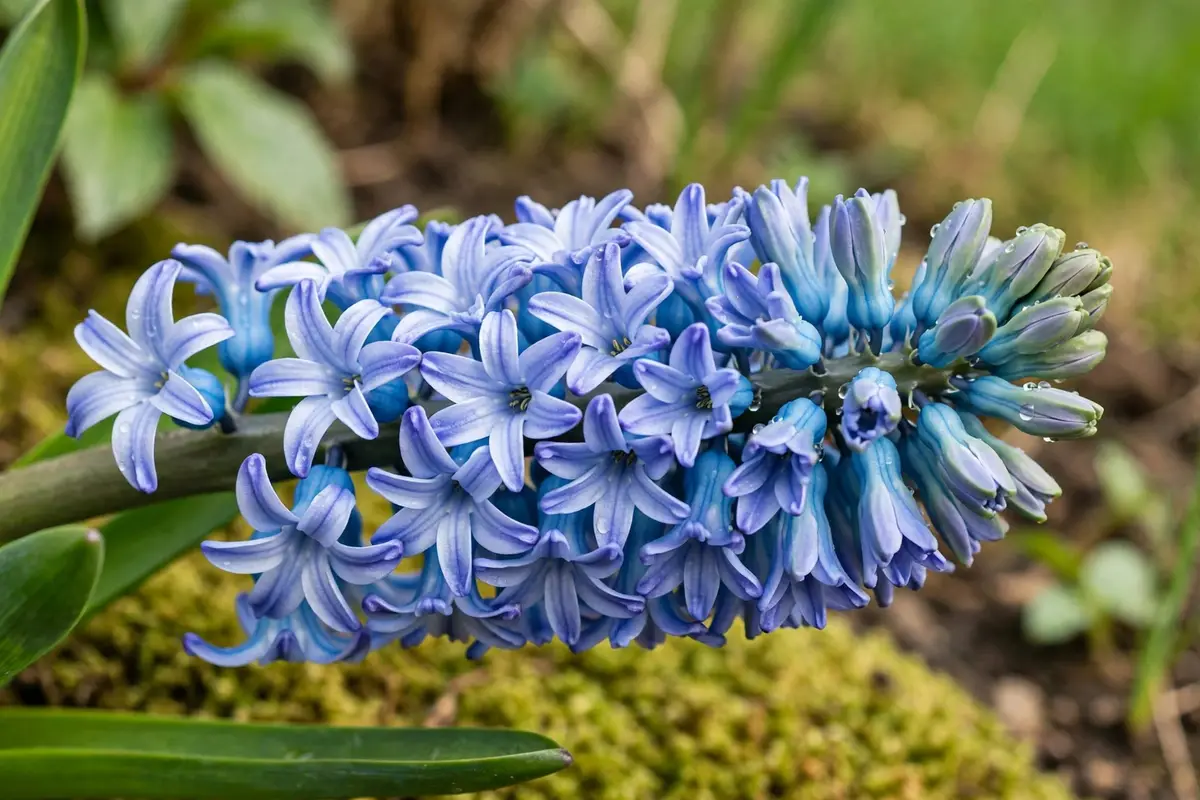
Table of Contents
- What Is a Hyacinth Flower?
- Types of Hyacinth and 6 Kinds Worth Knowing
- Hyacinth Flower Meaning and Symbolism
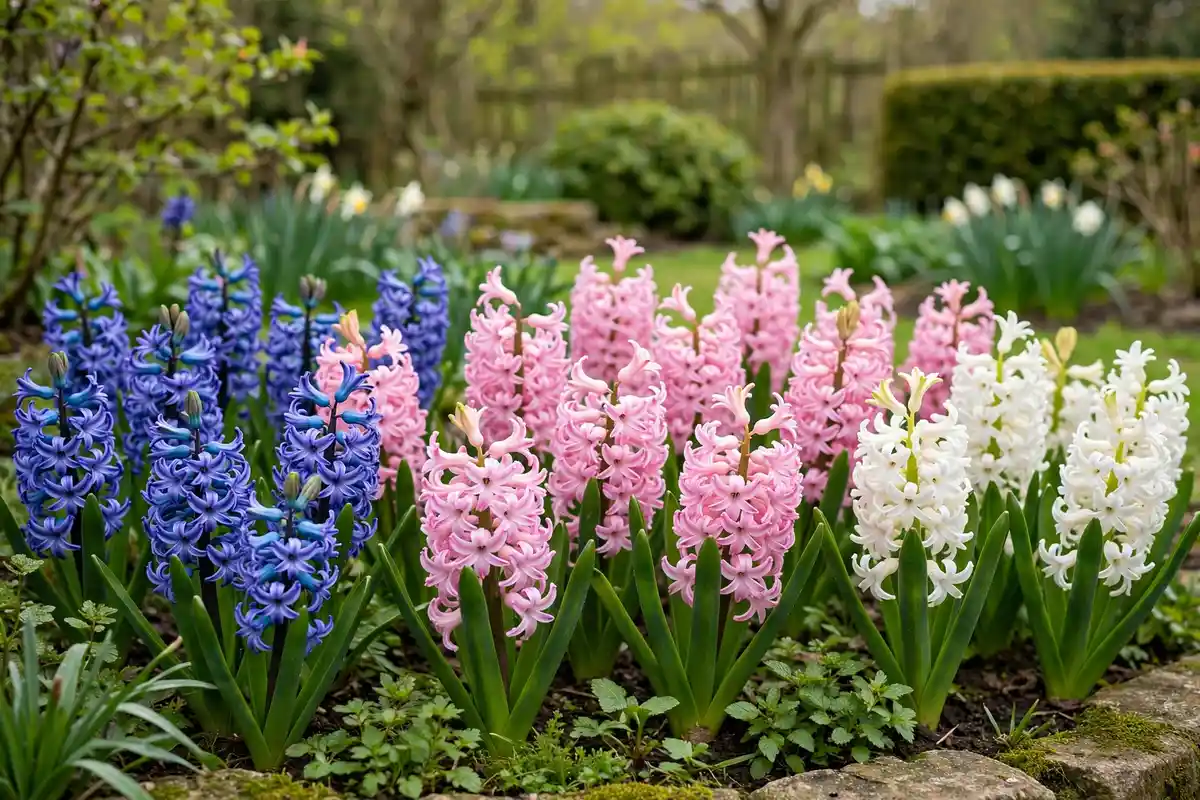
- Hyacinth Flower Colours and Their Meanings
- How to Grow Hyacinths
- Common Mistakes When Growing Hyacinths
- Forcing Hyacinths Indoors
- Frequently Asked Questions
What Is a Hyacinth Flower?
The common hyacinth, Hyacinthus orientalis, is a bulbous perennial in the asparagus family, Asparagaceae, native to the eastern Mediterranean — Turkey, Syria, Lebanon and Israel — where the wild species carries loose spikes of slender blue bells. Every garden hyacinth descends from it. The flower spike is a raceme of 30 to 40 (in big Dutch hybrids, more) waxy, tubular florets, each curled back at the tip, packed so tightly on good bulbs that the spike is a solid column of colour and scent. You can read more on the Hyacinth page on Wikipedia.
The myth came first. Hyacinthus was a Spartan prince loved by Apollo; struck by the god’s discus — blown off course, in later tellings, by the jealous west wind Zephyrus — he died in Apollo’s arms, and from his blood sprang a flower inscribed “AI, AI” (alas). The plant the Greeks meant was probably an iris or larkspur, not today’s hyacinth, but the name and the grief stuck. The bulb’s second fame was commercial: in the 1700s, Dutch growers bred the hyacinth into thousands of named varieties — the era’s “hyacinthomania” saw single bulbs of fashionable doubles change hands for fortunes, and Madame de Pompadour filled Versailles with forced hyacinths. Today’s bedding and forcing hybrids are their descendants.
Hyacinth Flower Quick Facts
- Botanical name: Hyacinthus orientalis.
- Family: Asparagaceae, the asparagus family.
- Hardiness: USDA zones 3 to 8 (needs a winter chill of 12–14 weeks below ~9°C / 48°F).
- Height: 6 to 12 inches in flower.
- Bloom time: mid-spring outdoors (March to April); winter when forced indoors.
- Sun and soil: full sun to light shade; very well-drained soil — bulbs rot in wet ground.
- Good to know: bulbs contain oxalic acid; handle with gloves (hyacinth itch is a real thing).
Types of Hyacinth and 6 Kinds Worth Knowing
Garden hyacinths sort by form and use rather than by species. The table covers the six kinds gardeners meet; the profiles follow. For the full list of flower names, see our flower names A to Z guide.
| Type | Form | Bloom time | Fragrance | Best use |
|---|---|---|---|---|
| Dutch hybrids | Single dense spike | Mid-spring | Very strong | Bedding, pots, forcing |
| Double hyacinths | Double florets, packed | Mid-spring | Strong | Show pots, close display |
| Roman hyacinths | Loose spikes, several per bulb | Early spring | Sweet, lighter | Naturalising, mild areas |
| Multiflora hyacinths | Multiple looser spikes | Mid-spring | Strong | Informal beds, cutting |
| Festival / pastel mixes | Mixed-colour selections | Mid-spring | Strong | Instant colour schemes |
| Wild hyacinth (species) | Loose blue bells | Spring | Sweet | Collectors, species gardens |
1. Dutch Hyacinth Hybrids — the Classic Spike
The hyacinth of bedding displays and winter pots: one massive, fragrant column per bulb, bred in Holland over 300 years into every colour from ‘Delft Blue’ (the classic porcelain blue) through ‘Pink Pearl’ to ‘City of Haarlem’ yellow. Dutch hybrids are the forcing standard — the bulbs you buy “prepared” for Christmas flowering are these. For the biggest spikes, buy the largest bulb grade you can find; with hyacinths, bulb size is spike size.
2. Double Hyacinths
The eighteenth century’s darlings: florets doubled into rosettes, the spikes dense and plush, the prices once absurd. Modern doubles are fewer but choice — ‘Madame Sophie’ white, ‘Chestnut Flower’ in an antique chestnut-pink. Doubles are top-heavy and benefit from a cane or a pot displayed close, and their perfume is as strong as the singles’. They are the hyacinth at its most luxurious — and most fragile in rain.
3. Roman Hyacinths
A different temperament: Hyacinthus orientalis var. albulus, from the French and Italian Riviera, throws several slender, loose spikes per bulb in white, pink or palest blue, weeks earlier than the Dutch types and with a sweeter, lighter perfume. Less formal, more graceful; historically the florist’s forcing hyacinth, and in mild gardens (zones 7 to 10, where Dutch types sulk for lack of chill) the reliable one. They naturalise better than Dutch hybrids too.
4. Multiflora Hyacinths
Bred for informality: instead of one column, each bulb produces a bouquet of several looser spikes, the whole plant reading like a small flowering shrub. Multiflora types flower a little longer, take rain better than the dense Dutch spikes, and mix into spring borders among companions like the narcissus far more naturally. If the classic hyacinth looks too stiff for your garden, this is your form.
5. Festival and Pastel Hyacinth Mixes
Not a botanical kind but the way most gardeners now buy them: colour-graded selections — all-pastel drifts, blue-and-white schemes, sunset mixes — of Dutch hybrids sold to be planted together. The mixes solve the hyacinth’s one design problem, its short, formal stature, by letting you lay colour in ribbons. Plant in groups of nine or more of a kind; single bulbs scattered look lost.
6. The Wild Species (Hyacinthus orientalis)
The ancestor itself: loose, slender spikes of violet-blue bells over narrow leaves, far closer to the flower of the Greek hillsides than to the Dutch cannonballs. Species hyacinths are collectors’ plants — subtle, sweet-scented, and perennial in a way the big hybrids often are not. Grow them in a rock garden or species bed where their restraint is the point. Note two impostors with the name: grape hyacinth is Muscari, a different genus entirely, and water hyacinth is Pontederia crassipes, an unrelated (and in warm climates, highly invasive) aquatic plant.
Hyacinth Flower Meaning and Symbolism
The hyacinth carries the myth in its meanings: playfulness and sport — for the game that killed Hyacinthus — and, beneath that, sorrow and regret. Victorian floriography listed the hyacinth generally for games and play, and then divided it by colour: purple for sorrow and “please forgive me”, blue for constancy, white for loveliness. It is one of the few flowers whose formal message can be an apology.
In Persia, the hyacinth (sonbol) is a symbol of spring and rebirth, set on the Haft-Sin table at Nowruz, the New Year — the flower as the promise that winter ends. Modern gifting keeps the colour meanings: blue hyacinths for steadfastness, purple for a heartfelt sorry, white and pink for celebration and gentle affection. However you send them, the perfume delivers the message before the card is read.
Hyacinth Flower Colours and Their Meanings
Hyacinths cover most of the palette except true red and green — and the blues are the famous ones:
- Blue hyacinth — constancy and steadfast love: ‘Delft Blue’ is the colour the word hyacinth first brings to mind, and the emblem of the genus.
- Purple hyacinth — sorrow, regret and apology: “please forgive me”, straight from the myth. The flower to send when sorry needs flowers.
- Pink hyacinth — playfulness and joy: the Victorian “sport and play” meaning at its happiest, and the classic spring gift.
- White hyacinth — loveliness and purity: the forcing favourite, perfuming winter rooms, and a Haft-Sin table symbol of purity.
- Yellow and apricot hyacinth — friendship and cheerfulness (and, in old lists, jealousy — choose the recipient accordingly): the rarest colours, bred latest, and the warmest in a spring bed.
How to Grow Hyacinths
Outdoors, hyacinths ask for three things: autumn planting, winter cold, and dry feet. Gardeners on r/gardening on Reddit add the fourth: lower your expectations for year two, because the great Dutch spike is partly a hothouse achievement (see the FAQ).
Planting Bulbs in Autumn
Plant in autumn, six to eight weeks before the ground freezes, setting bulbs 4 to 6 inches deep and 4 to 5 inches apart, pointed end up. Larger bulbs (17/18 cm and up) give the grandest spikes. In warm climates (zones 8 and up) pre-chill bulbs in the refrigerator for 12 to 14 weeks away from ripening fruit, whose ethylene gas damages the flower bud — or grow the Roman types that need less chill. Handle all bulbs with gloves: the oxalic acid crystals in the skins cause the notorious “hyacinth itch”.
Soil and Position
Drainage is the whole ballgame: hyacinth bulbs sitting in wet winter soil rot, full stop. Sandy or gritty soil, a slope, or a raised bed suits them; heavy clay needs grit dug beneath each bulb or a move to pots. Full sun gives the straightest, stiffest spikes; light shade lengthens the flowering by a few days. Plant them where the spring show belongs — path edges, doorways, under windows — anywhere the scent can be collected as you pass. They share the early-spring stage with the season of the April birth flower, and a bed timed with daffodils is the classic spring picture.
After Flowering
Deadhead the spike as it fades (seed-making steals the bulb’s strength), but let the leaves die back naturally over six weeks — they are next year’s flower being paid for. Feed once with a bulb fertiliser at leaf emergence. In borders, many gardeners lift, dry and store the bulbs after leaf dieback and replant in autumn; in pots and formal beds, treat them as fresh each year for the biggest spikes, and let the spent garden bulbs naturalise for looser second-year flowers.
Pests, Diseases and Safety
The bulbs’ toxicity is their armour: squirrels, mice and deer mostly leave hyacinths alone, a real virtue among spring bulbs. The diseases that matter are rots in wet soil (see drainage) and, rarely, virus in old stocks — buy clean, firm bulbs. Keep bulbs and forced plants away from pets and children: the bulb is the toxic part (oxalic acid), and the sap can irritate skin.
Common Mistakes When Growing Hyacinths
The most common mistake is planting in wet, heavy ground and finding mush in spring — drainage, drainage. The second is warm-climate disappointment: without 12-plus cold weeks, spikes emerge stunted on short stems (“in the neck”). Chill the bulbs, or choose Roman hyacinths. The third is handling bulbs bare-handed and learning about hyacinth itch the itchy way.
The fourth mistake is cutting the leaves down with the spent flower — the bulb starves and next spring is a leaf-only apology. And the fifth is expecting forced indoor bulbs to repeat the show: a Christmas-forced bulb has spent itself; plant it in the garden for later, smaller springs, and buy fresh for forcing. Forcing itself is covered next.
Forcing Hyacinths Indoors
Forcing — tricking bulbs into winter flower — is the hyacinth’s parlour trick since Versailles. Buy “prepared” bulbs, which the grower has already cold-treated; unprepared bulbs need 12 to 14 weeks in a cold dark place (a refrigerator crisper, an unheated garage, a cold frame) first. Pot prepared bulbs in autumn with the tips just showing, water once, and keep them cool and dark (around 9°C / 48°F) for about ten weeks while roots fill the pot; then move them to a bright, cool room — an unheated windowsill is perfect — and flower follows in three to four weeks. Heat rushes and flops them; cool rooms keep spikes upright and scented for longest.
The prettiest forcing needs no soil at all: a hyacinth glass, the hourglass vase that holds the bulb above water, with the roots trailing down like white lace. Fill to just below the bulb’s base (the bulb itself must not sit in water or it rots), keep cool and dark until the shoot is two inches tall, then bring to light. A single forced hyacinth in a winter window — the heart of the January birth flower season — is worth a greenhouse of apologies.
Frequently Asked Questions
Are hyacinths perennials — do they come back every year?
Yes, the bulbs are perennial, but the show changes: the giant first-year spike is grown from a bulb fattened in Dutch fields, and garden returns are progressively looser and smaller, though often still charming, for several years in good drainage. Roman and species types persist more faithfully. For bedding-grade spikes every year, most gardeners plant fresh bulbs each autumn. If your question is not answered here, the questions about the hyacinth flower on Quora cover most of the rest.
When do hyacinths bloom?
Mid-spring outdoors — March to April in most temperate gardens, between the daffodils and the tulips. Forced indoors, prepared bulbs flower in midwinter, around Christmas to February, after their cold treatment and three to four weeks in the light.
Are hyacinths poisonous?
The bulbs are the toxic part, containing oxalic acid and calcium oxalate crystals: they irritate skin on handling (gloves!) and would upset stomachs — human or pet — if eaten. The flowers and leaves are far less problematic, but treat the whole plant as ornamental and keep bulbs stored away from children and animals.
Why is my hyacinth spike short and stuck at the base?
Insufficient chilling is the usual cause: the flower emerged before the stem could elongate because the bulb did not get its full cold period (common in mild winters or with bulbs stored warm). Water well, and the spike often rises as it develops; next year, chill bulbs longer or plant earlier and deeper where winters are warm.
Can I grow hyacinths in water?
Yes — in a hyacinth glass, with the bulb resting above the water line and roots growing down into it. Use prepared bulbs, keep the vase cool and dark until the shoot is a couple of inches tall, then give light. After flowering, that bulb is spent for forcing; plant it out in the garden.
What is the difference between a hyacinth and a grape hyacinth?
Grape hyacinth is Muscari, a smaller relative in the same family: tight clusters of tiny urn-shaped blue flowers that look like miniature bunches of grapes, flowering a little earlier, with a light musky scent. It naturalises freely and is charming — but it is not a true Hyacinthus. For more flowers under the same letter, see our guide to flowers that start with H.