Stock Flower: Meaning, Types and How to Grow the Doubles
The florist’s secret weapon smells like cloves and candlelight. Stock — tall spikes of ruffled double flowers in white, lilac, rose and wine — is the wedding bouquet’s backbone and the evening garden’s perfume, a cabbage-family wallflower from the Mediterranean cliffs that breeders have spent four centuries turning into the perfect cut flower.
This guide covers the plant and its six best modern series, what stock means (bonds of affection and a happy life), the famous trick for growing the doubles everyone wants, and its plainer sister whose evening scent out-perfumes everything in the garden.
Quick Answer
A stock flower is Matthiola incana, a Mediterranean member of the cabbage family (Brassicaceae) grown for dense spikes of highly fragrant, mostly double flowers in spring and early summer. It grows 12 to 36 inches tall, blooms in USDA zones 7 to 10 as a short-lived perennial but is usually grown as a cool-season annual, and means bonds of affection, lasting beauty and a happy life. The prized double flowers are sterile — they are raised from single-flowered seed parents by a seedling-selection trick explained below — and the clove-rich scent is strongest in the evening.
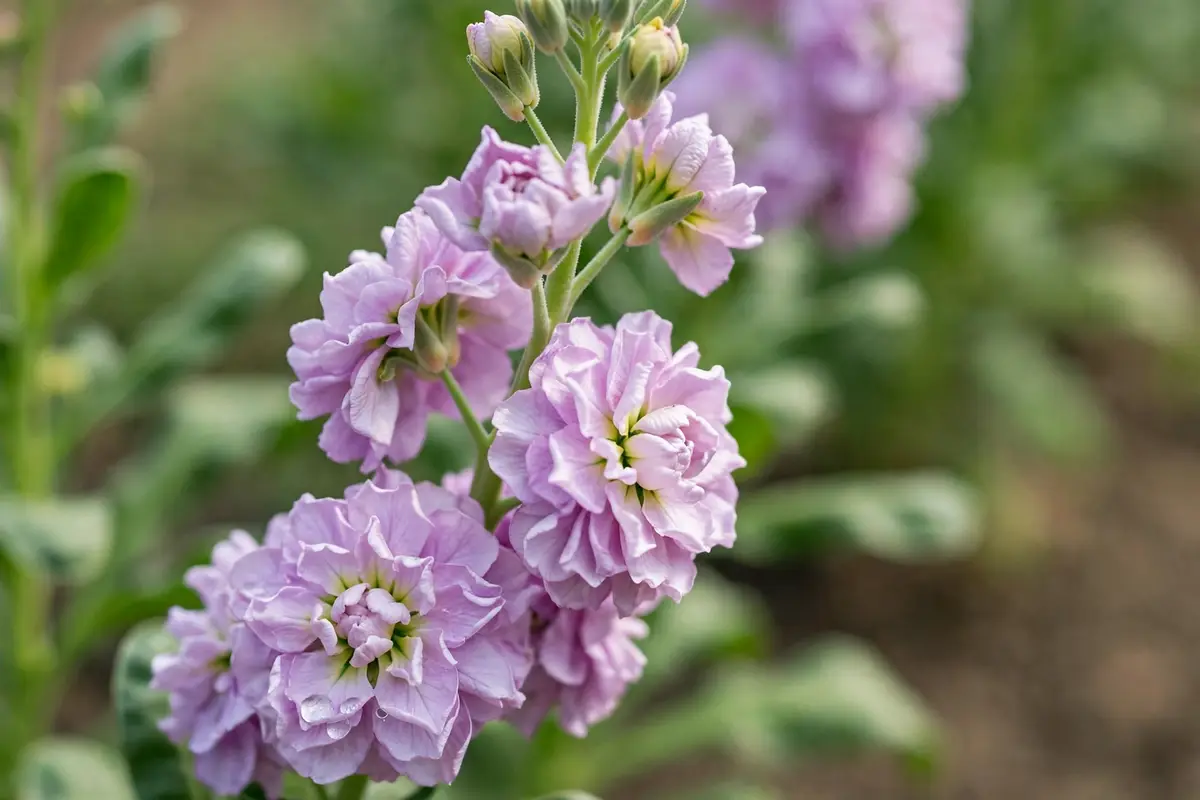
Table of Contents
- What Is a Stock Flower?
- Types of Stock and 6 Kinds Worth Knowing
- Stock Flower Meaning and Symbolism
- Stock Flower Colours and Their Meanings
- How to Grow Stock Flowers
- Common Mistakes When Growing Stock Flowers
- Stock vs Night-Scented Stock
- Frequently Asked Questions
What Is a Stock Flower?
Matthiola incana is a cliff and wall plant of the Mediterranean coasts — the species name incana means hoary, for the soft grey down on its leaves, armour against sea wind and sun. It belongs, improbably, to Brassicaceae, the cabbage and mustard family, alongside wallflowers, which its cross-shaped four-petalled single flowers quietly confess. The genus honours Pietro Andrea Mattioli, the 16th-century Italian botanist-physician whose herbal described it. By the Victorian era stock was a cottage-garden institution: “ten-week stocks” for summer bedding, “Brompton stocks” raised as biennials for spring, and gillyflowers — the old name, from the French girofle, clove — prized because a spike scents a room like mulled wine. You can read more on the Matthiola incana page on Wikipedia.
The double-flower story is the plant’s great peculiarity, and worth telling properly: double stock flowers — the lush rosettes florists use — are sterile and set no seed. For centuries, seed was saved from single-flowered plants and produced a frustrating mix. Then growers discovered the doubles announce themselves in the seed tray: double-flowered seedlings run paler, yellow-green and slightly notched compared with their single siblings, especially after a chill. Commercial seed is still sorted this way, and home growers use the same tell (below). Modern Japanese and Dutch series have pushed the double percentage toward 100% in the best florist strains — a quiet triumph of patient selection over a flower that cannot reproduce itself.
Stock Flower Quick Facts
- Botanical name: Matthiola incana.
- Family: Brassicaceae, the cabbage family.
- Hardiness: USDA zones 7 to 10 (short-lived perennial); elsewhere a cool-season annual.
- Height: 12 to 36 inches by series.
- Bloom time: spring to early summer (cool weather is essential).
- Sun and soil: full sun; rich, alkaline-leaning, well-drained soil.
- Good to know: flowers are edible with a peppery-clove bite (true of the family); scent peaks at dusk.
Types of Stock and 6 Kinds Worth Knowing
The florist’s column series, the garden doubles, the dwarfs, and the scent sister. The table separates them; the profiles follow. For the full list of flower names, see our flower names A to Z guide.
| Type | Flowers | Height | Scent | Best use |
|---|---|---|---|---|
| Column stock (florist type) | Single tall spike, mostly double | 24–36 in | Strong | Cutting, wedding work |
| ‘Iron’ series | Very double, tight spikes | 24–30 in | Strong | Professional cutting |
| ‘Katz’ series | Early, bright colours incl. blue tones | 24–32 in | Strong | Early crops, warm areas |
| ‘Vintage’ series | Branching, double, antique shades | 15–20 in | Strong | Garden beds, bouquets |
| Dwarf series (‘Harmony’, ‘Cinderella’) | Compact double spikes | 8–12 in | Strong | Pots, edging, windowsills |
| Night-scented stock (M. longipetala) | Small single lilac-white | 12–18 in | Extraordinary at night | Evening scent by doors/seats |
1. Column Stock — the Florist’s Spike
The classic cut flower: one unbranched stem carrying a dense column of double rosettes, bred so a whole crop blooms in a tight window for wedding season. Whites, creams and pastels from the column series fill more bridal bouquets than almost any flower we grow — the florist’s alternative when our lilac flower spikes are out of season, with the same perfume-first logic in a longer vase life. Grow it in a cutting row, spaced tight (6 inches) to keep stems single and straight.
2. ‘Iron’ Series — the Professional’s Double
A modern Japanese-bred series famous for an exceptionally high percentage of doubles and iron-straight, uniform spikes. Colours run the full stock palette including a clean white and deep wine. If you grow one series for cutting, growers reach for Iron first — the seedling-selection trick below barely needs applying, so reliable is the breeding.
3. ‘Katz’ Series — the Early, Bright One
Bred for early flowering and heat tolerance at the season’s edges, Katz brings unusual colours to the genus — brighter pinks and lavender-blues — and suits warmer districts where classic stocks sulk. In cool climates it is simply the earliest spike in the row, buying two extra weeks of scented spring.
4. ‘Vintage’ Series — the Garden Branch
Where column types give one spike, Vintage branches: shorter, bushier plants with multiple stems of doubles in dusty antique shades — peach, copper-rose, lavender-grey. This is the cottage gardener’s stock: plant it in beds and mixed borders, cut it loosely, and let it behave like the Victorian bedding plant it descends from.
5. The Dwarfs — ‘Harmony’ and ‘Cinderella’
Eight-to-twelve-inch series bred for pots and edging, with the full clove perfume at knee height. On a windowsill or a doorstep pot they are the cheapest evening scent in gardening. Cinderella runs a touch more compact and double; Harmony offers the widest colour mix. Both forgive the small-container life better than their tall sisters.
6. Night-Scented Stock — the Scent Sister
Matthiola longipetala (sold as M. bicornis) is the family’s plain Jane: wiry stems, small lilac-white single flowers that look half-closed all day — and at dusk, an exhalation of perfume so powerful it carries across a garden, richer than the doubles that outshine it at noon. Sow it by doors, seats and bedroom windows in successive pinches all spring. It is the profile the comparison section below is built around: looks versus scent, the family’s eternal trade.
Stock Flower Meaning and Symbolism
Stock means bonds of affection, lasting beauty and a happy life — the floriography of a flower that lasts in the vase, holds its perfume, and has scented weddings for centuries. Victorians gave it for affection that would outlast the season (“you will always be beautiful to me” is its classic gloss), and the meaning has kept its shape: stock is the bouquet flower of commitment rather than first passion — engagements, anniversaries, weddings, the love that plans to stay.
Its grey-green foliage and evening perfume give it a second, quieter register: contentment in ordinary days. Give white stock for purity and lasting bonds in wedding work, colours for affectionate friendship and congratulations; plant the night-scented kind for nobody but yourself, by the chair where you sit at dusk — some meanings are private.
Stock Flower Colours and Their Meanings
The widest palette of any flower in this series so far, all of it perfumed:
- White — purity and bonds of affection: the wedding standard, a pillar of our white flowers.
- Lilac and lavender — enchantment and first love, sweetened by the clove scent.
- Pink and rose — affection and gratitude: the friendship colours.
- Deep wine and purple — lasting beauty and devotion.
- Peach and cream — sincerity and a contented, happy life.
How to Grow Stock Flowers
Cool weather, rich soil, and the seedling trick for doubles. Gardeners on r/gardening on Reddit repeat the genus rule in every thread: “stock is a spring flower that tolerates cold and quits in heat — sow it earlier than feels sensible.”
Sowing and the Doubles Trick
Sow under cover in late winter (or in autumn in mild climates, overwintering as Brompton types do for spring bloom), barely covering the seed — it wants light — at cool temperatures. Then the famous selection: once seedlings have true leaves, give the tray a few chilly nights (around 40–45°F / 5–7°C). The future doubles turn paler yellow-green with slightly notched leaf edges; the singles stay deeper green. Pot on the pale ones and compost the rest, and your row will bloom double at rates no packet promises. Grow on cool and bright — warm, dark seedlings stretch and blind.
Planting Out and Care
Plant out after the worst frosts into full sun and rich, well-drained soil, slightly alkaline if you can manage it (a little garden lime in acid ground works wonders for this whole family), spacing 6 inches for cutting columns, 10–12 for branching types. Feed lightly, water at the roots, and stake tall column rows in windy gardens. The season ends when summer heat arrives — stock quits above the mid-80s°F — so treat spring as the whole show and follow it with summer annuals like its fellow spike, the snapdragon flower, which takes over the same beds as the weather warms.
Common Mistakes When Growing Stock Flowers
The first mistake is sowing too late or growing seedlings warm: heat at any young stage ruins the crop — stretched plants, button flowers, or spikes that never come. The second is planting every seedling when you wanted doubles: learn the pale-seedling tell, or buy a high-double series like ‘Iron’. The third is rich wet soil and shade: stocks rot and mildew where their cabbage cousins would merely sulk; sun and drainage are non-negotiable.
The fourth mistake is expecting a summer season. Stock is a creature of the cool months; in hot districts it is an autumn-to-spring flower only, and fighting that calendar disappoints everyone. Succession-sow the night-scented species instead — its perfume, at least, loves the warm nights.
Stock vs Night-Scented Stock
Same genus, opposite priorities. Stock proper (Matthiola incana): big double rosettes on formal spikes, the full colour palette, handsome grey foliage, scent strong and clove-sweet by day and stronger at dusk — bred for eyes first, nose a close second; a florist’s crop needing cool weather, selection and care. Night-scented stock (M. longipetala): small single lilac-white flowers that look half-shut by day, insignificant foliage, zero cutting value — and at nightfall the single most powerful perfume of any annual flower, released to summon night-flying moths. Gardeners who “succeed” with stock grow the first for spring glory and scatter the second by every seat and doorway for summer evenings. They are not rivals; they are the day shift and the night shift of the same perfume house.
Frequently Asked Questions
Is the stock flower edible?
Yes — the flowers (like most of the cabbage family’s blooms) are edible, with a peppery, clove-like flavour used to garnish salads and desserts. Grow your own without sprays if you plan to eat them, and eat flowers, never the seed pods, in moderation. If your question is not answered here, the questions about the stock flower on Quora cover most of the rest.
Why are my stock flowers single when the packet showed doubles?
Because doubles are sterile and every seed comes from single parents: an unselected row gives roughly half singles. Apply the cold-and-pale seedling selection (above), or sow a modern high-double series. The singles are still fragrant and pretty — they are simply not the florist’s rosette.
Is stock a perennial?
In mild climates (zones 7–10) it is a short-lived perennial or biennial — the old Brompton stocks were raised exactly that way — but most gardeners treat it as a cool-season annual and sow fresh each year for reliability. It rarely survives real summer heat or hard wet winters.
When should I sow stock?
Late winter under cover for spring planting (the ten-week rule: about ten weeks from sowing to flower in cool conditions), or late summer/autumn in frost-light climates for overwintered spring bloom. The constant is coolness — never sow into heat.
How long does stock last in a vase?
Five to seven days with care: cut when a third to a half of the spike is open, strip lower leaves, and use deep, frequently changed water. A little flower food keeps the perfume coming; the top buds keep opening up the stem.
Why does stock smell stronger at night?
Like its night-scented sister, the species evolved to summon moths after dark, and the scent glands oblige on schedule — dusk is peak perfume. It is why stocks were planted by cottage doors: the evening garden was the sitting room. For more flowers under the same letter, see our guide to flowers that start with S.