Crocus Flower: Meaning, Types and How to Grow Spring’s First Bloom
One week the lawn is winter-brown, the next it is spangled with purple, gold and white goblets pushing straight through the frost — the crocus does not wait for spring, it announces it. And its autumn cousin carries the most expensive spice on earth in three red threads per flower. The smallest bulb in the catalogue may be the best story in the garden.
This guide covers the spring stars, the snow crocuses that flower even earlier, the saffron crocus of October, what the crocus means (cheerfulness and gladness — what else could spring’s herald mean?), and the one lookalike you must never confuse it with.
Quick Answer
A crocus flower is the cup-shaped bloom of the genus Crocus (some 90 species, in the iris family), grown from small corms and flowering in late winter to spring — with a second group, including saffron crocus, flowering in autumn. Spring crocuses grow 3 to 6 inches tall in USDA zones 3 to 8, opening in sun and closing at night and in dull weather. Plant the corms in autumn, 3 to 4 inches deep in well-drained soil, in drifts. Saffron (Crocus sativus) is planted in late summer. Warning: the plant sold as “autumn crocus” (Colchicum) is NOT a crocus at all and is dangerously poisonous — know the difference.
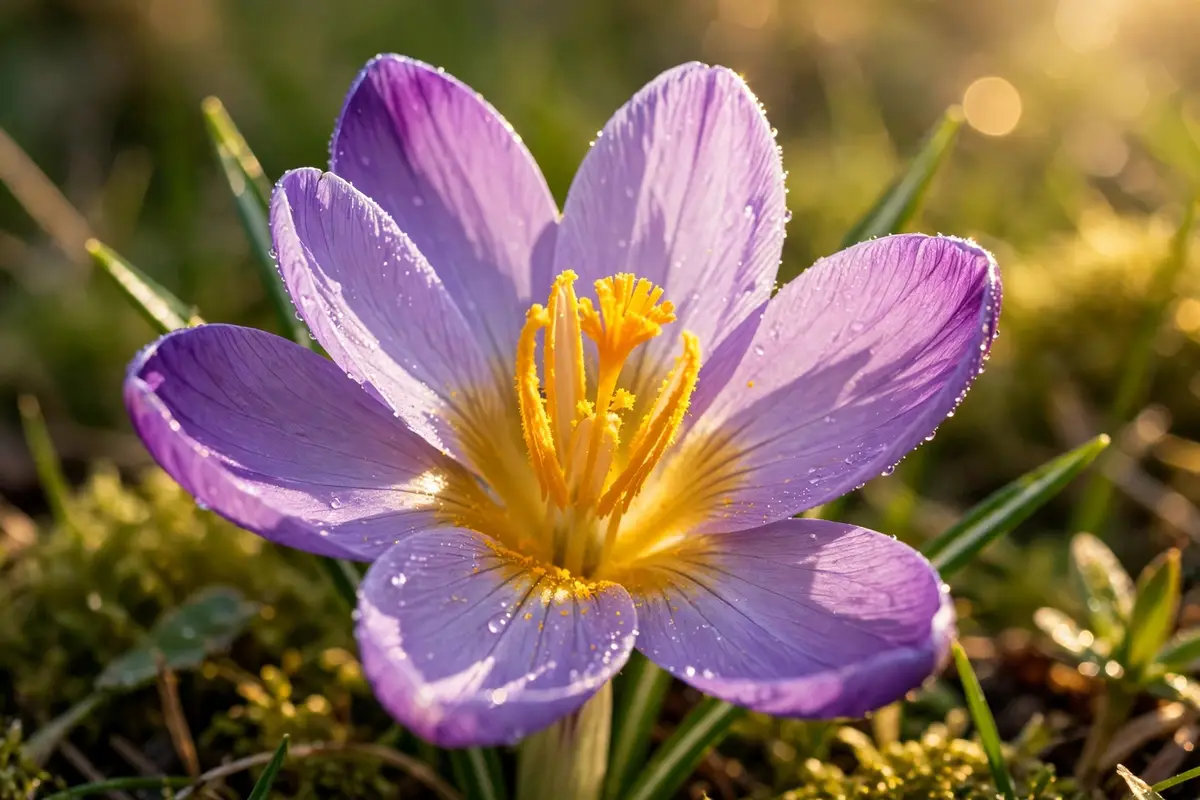
Table of Contents
- What Is a Crocus Flower?
- Types of Crocus and 6 Kinds Worth Growing
- Crocus Flower Meaning and Symbolism
- Crocus Flower Colours and Their Meanings
- How to Grow Crocuses
- Common Mistakes When Growing Crocuses
- Crocus vs Colchicum: the Autumn Crocus Warning
- Frequently Asked Questions
What Is a Crocus Flower?
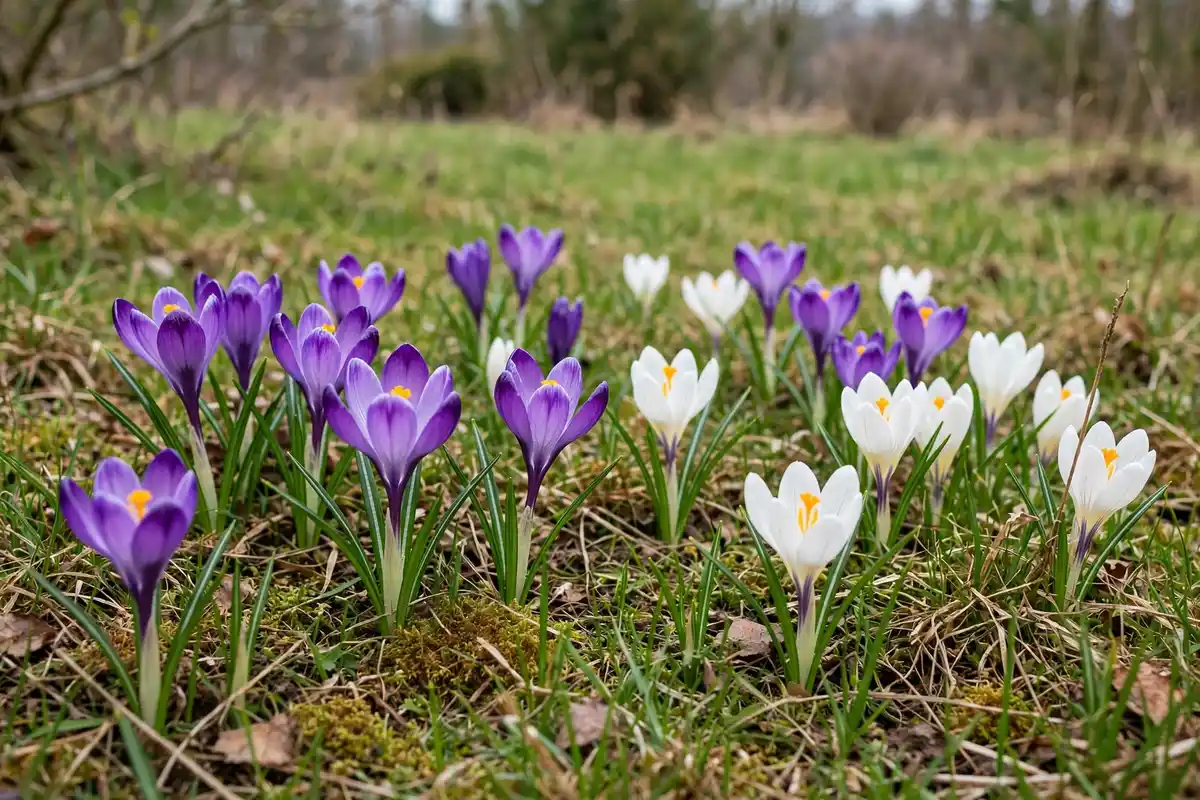
Crocus is a genus of cormous perennials in the iris family, Iridaceae, native from Central and Southern Europe and North Africa across to Central Asia and western China — mountain meadows, woodlands and rocky slopes where winters are cold and summers dry. The flower is a slim chalice of six tepals on a pale underground tube (the true stem stays below soil, lifting the bloom just clear of the frost), with a throat of gold and three stamens. The leaves, grassy with a silvery central stripe, appear with or after the flowers. Greek myth gave the flower its name: Crocus was a mortal youth in love with the nymph Smilax, transformed (in Ovid’s telling) into the flower that bears his name — a love story fossilised into botany. You can read more on the Crocus page on Wikipedia.
The genus divides by season. Spring crocuses — the Dutch crocus, snow crocus and the early species — are winter’s end made visible, flowering from February to April. Autumn crocuses flower leafless in September and October, leaves following in spring. One of the autumn species out-earns all the rest combined: Crocus sativus, the saffron crocus, a sterile plant grown only from divided corms, whose three crimson stigmas per flower are hand-picked and dried into the world’s most valuable spice by weight — roughly 150,000 flowers for a single kilogram. Iran grows around nine-tenths of the world’s saffron; a spring herald in one hemisphere, a harvest worth guarding in the other.
Crocus Flower Quick Facts
- Botanical name: Crocus species (genus of ~90 species).
- Family: Iridaceae, the iris family.
- Hardiness: USDA zones 3 to 8 (spring types).
- Height: 3 to 6 inches.
- Bloom time: late winter to spring (autumn group: September–October).
- Sun and soil: full sun; well-drained soil; corms planted in autumn.
- Good to know: saffron comes from C. sativus; “autumn crocus” Colchicum is a poisonous non-crocus.
Types of Crocus and 6 Kinds Worth Growing
From the first snow crocus to the October spice harvest. The table separates them; the profiles follow. For the full list of flower names, see our flower names A to Z guide.
| Type | Season | Flowers | Height | Best use |
|---|---|---|---|---|
| Dutch crocus (C. vernus hybrids) | Early spring | Big goblets, purple/white/striped | 4–6 in | Drifts, lawns, pots |
| Snow crocus (C. chrysanthus) | Late winter | Small, gold-centred, many cultivars | 3–4 in | Earliest colour |
| C. tommasinianus | Late winter | Lavender, slim, self-seeding | 3–4 in | Naturalising, squirrel-prone gardens |
| Saffron crocus (C. sativus) | Autumn | Lilac with crimson stigmas | 3–4 in | The spice harvest |
| C. sieberi ‘Tricolor’ | Late winter | Lilac, white band, gold throat | 3 in | Rock gardens, troughs |
| Showy autumn crocus (C. speciosus) | Autumn | Large violet-blue, veined | 4–6 in | Autumn drifts |
1. Dutch Crocus — the Big Spring Goblets
The crocus of parks and photographs: large chalice flowers in purple, violet, white and the pinstriped ‘Pickwick’, bred from C. vernus and kin. These are the best lawn crocuses and the showiest in pots — plant at least fifty, because five look like a mistake and five hundred look like spring itself. ‘Flower Record’ (violet) and ‘Jeanne d’Arc’ (white) are the backbone cultivars of every public planting.
2. Snow Crocus — Two Weeks Earlier
C. chrysanthus and its cultivars (‘Blue Pearl’, ‘Cream Beauty’, ‘Goldilocks’, ‘Snowbunting’) flower up to a fortnight before the Dutch giants, smaller but in greater numbers per corm — and frequently through actual snow, which melts around them as their dark buds absorb the sun. For impatient gardeners in cold zones, the snow crocuses are the real first flower of the year, arriving in the same late-winter weeks as the February birth flower violet and primrose.
3. C. tommasinianus — the Self-Sower
The naturaliser: slim lavender goblets that seed themselves into lawns, under shrubs and through gravel, building the wild drifts that plantings aspire to. Gardeners swear squirrels largely leave the “tommies” alone (their corms sit deeper and are said to taste worse) — in squirrel country they are the pragmatic first choice, and the white ‘Albus’ and ruby ‘Ruby Giant’ extend the palette.
4. Saffron Crocus — the October Fortune
C. sativus reverses the calendar: plant the corms in late summer, and in October the lilac flowers open, each carrying three long crimson stigmas — saffron. Pick the threads on a dry morning, dry them, and a bed of fifty corms seasons a winter of paellas. The plant is a sterile triploid, propagated only by corm division for some three thousand years — every saffron crocus on earth is effectively one ancient clone, still in production.
5. C. sieberi ‘Tricolor’ — the Jewel
A Greek mountain miniature with a three-banded flower: deep lilac petals, a white zone, and a golden throat — the whole spring sky in three inches. ‘Tricolor’ is the rock-garden and trough crocus, the one visitors crouch for. Its cousin ‘Firefly’ (lilac with a yellow throat) doubles the charm cheaply.
6. Showy Autumn Crocus — C. speciosus
The true autumn crocus (a genuine Crocus): big violet-blue goblets with dark veining and a blaze of orange anthers, opening leafless from bare September soil. Plant in drifts under deciduous shrubs, where the flowers glow in autumn light and the spring leaves hide beneath the shrub’s own growth. Cultivar ‘Conqueror’ is the deepest blue of the group.
Crocus Flower Meaning and Symbolism
The crocus means cheerfulness, gladness and youthful joy — in the language of flowers it is spring’s own telegram: the dark is over, colour is back. Victorian floriographers fixed the meaning as cheerfulness, and the flower earned it honestly, blooming at temperatures that keep every other bulb underground and opening only when the sun shines (crocus flowers literally close at night and in dull weather — a built-in weather glass).
Its spice carries the second meaning: saffron has meant luxury, rarity and preciousness since antiquity — the dye of royal robes, the colour of sacred garments, a gift literally worth more than gold by weight. And in the Greek myth the flower is love transformed: Crocus, the youth who loved Smilax, changed into the flower — longing turned into the first bright thing of the year. Give crocuses to lift a mood, start a season, or tell someone the cheerful news in flowers.
Crocus Flower Colours and Their Meanings
Small flowers, complete rainbow:
- Purple crocus — dignity and spring royalty: the classic colour, first under the hedges.
- Yellow crocus — cheerfulness doubled: the earliest gold of the year, snow crocus season.
- White crocus — purity and new beginnings: ‘Jeanne d’Arc’ and ‘Snowbunting’ for the year’s clean page, together on our white flowers list.
- Lilac and striped crocus — youthful joy and charm: ‘Pickwick’ stripes for playfulness, saffron-crocus lilac for precious things.
How to Grow Crocuses
The easiest bulbs you will ever plant — generous only about numbers. Gardeners on r/gardening on Reddit give the whole method in one line: “buy hundreds, plant them like you mean it, and the squirrels still leave you a show.”
Planting Corms
Plant spring crocus corms in autumn — September to November, any time before the ground freezes — 3 to 4 inches deep and 2 to 3 inches apart, pointy end up, in clusters and drifts rather than rows (formal lines look wrong on crocuses; nature plants them in spilled handfuls). Saffron crocus goes in in late summer (August–September) for October flowers; autumn species in mid-summer. Our fall flowers planting guides keep the same autumn date for all of them. In lawns, lift a flap of turf, plant beneath, and tread it back — the celebrated crocus lawn — then delay the first mow until the leaves have yellowed (about six weeks after flowering), because those leaves are next year’s flower being paid for.
Site, Soil and Care
Full sun at flowering time is the only real demand (under deciduous trees counts — the crocuses finish before the canopy closes). Soil must drain: corms rot in winter wet, so on clay, plant in raised drifts or add grit to the planting holes. Care afterwards is almost nothing: no feeding needed on decent soil, no deadheading (the early species set seed gladly), and in dry autumns a single watering after planting settles them in. Crocuses are hardy to zone 3 and need a cold winter — mild-climate gardeners in zones 9–10 should pre-chill corms in the fridge for 8–10 weeks before planting, or grow the warm-tolerant autumn species instead.
The Squirrel Problem
Fresh-planted corms are squirrel candy (the animals seem to smell the disturbed soil). Defences that work: plant deeper (4 inches), cover new plantings with chicken wire or hardware cloth until roots anchor, choose C. tommasinianus (least favoured), and interplant with daffodils, whose bulbs nothing eats. By the second year, established colonies are left alone.
Common Mistakes When Growing Crocuses
The first mistake is planting too few — crocuses are a crowd flower, and six in a row reads as an accident. The second is mowing the lawn too early: scalping the leaves before they yellow starves the corms, and the drift thins out within two years. The third is planting in a summer-watered border: crocuses want a dry summer rest, and irrigation aimed at bedding plants rots them where they sleep.
The fourth is planting spring corms in spring (they are autumn stock — spring-planted corms are usually exhausted). And the fifth, gravest mistake is botanical: confusing the real autumn crocus with Colchicum — which gets its own section next, because it is a safety matter, not a style one.
Crocus vs Colchicum: the Autumn Crocus Warning
The plant sold everywhere as “autumn crocus” is usually Colchicum autumnale — which is not a crocus, belongs to a different family, and contains colchicine, a serious poison. The confusion is easy: both send up leafless pink-lilac goblets from autumn soil. Tell them apart by the flower’s anatomy: a true crocus has 3 stamens (and, in saffron crocus, 3 long red stigmas); a Colchicum has 6 stamens. Colchicum’s leaves, when they come in spring, are broad and lily-like — and have been fatally mistaken for wild garlic by foragers, which is why this distinction is stated plainly here, not buried. Rule for the garden: buy autumn-flowering bulbs by Latin name (Crocus speciosus, C. sativus for the true ones), and never eat any part of any “crocus” that you have not verified as Crocus sativus stigma — saffron is the spice; the rest of the genus is not food either. Plant Colchicum only knowingly, labelled, and away from herb beds.
Frequently Asked Questions
When do crocuses bloom?
Spring crocuses flower from late winter into early spring (February to April by zone) — snow crocuses first, Dutch crocuses a fortnight later. Autumn species flower in September and October. The display lasts two to three weeks per type, so plant early, mid and late kinds for a longer show. If your question is not answered here, the questions about the crocus flower on Quora cover most of the rest.
Are crocuses perennials?
Yes — the corms perennialise and multiply, and the early species self-seed into permanent colonies on lawns and banks. The exception is tired soil or hungry rodents: replant fresh corms every few years to keep drifts dense.
How deep do you plant crocus corms?
Three to four inches deep (roughly three times the corm’s own height), point up, in groups. Deeper planting (4 inches) discourages squirrels and delays splitting; saffron corms go slightly deeper, 4 to 6 inches.
Can crocuses grow in pots?
Beautifully — they are small enough for any container. Use gritty compost, plant densely (a finger’s width apart), keep the pot cold and just moist through winter, and set it where you pass daily: half the pleasure of crocus season is watching the buds open and close with the sun.
Is saffron really from a crocus?
Yes: saffron is the dried red stigmas of Crocus sativus, an autumn-flowering crocus. Each flower yields three threads; around 150,000 flowers make a kilogram — hence the price, and hence why home beds grow a seasoning, not a fortune.
Do crocuses need full sun?
At flowering time, yes — buds open properly only in sun (they close in shade and dull weather, which is normal behaviour, not a problem). Summer shade from deciduous trees is fine and even welcome during the corms’ dry rest. For more flowers under the same letter, see our guide to flowers that start with C.