Honeysuckle Flower: Meaning, Types and How to Grow It
Pull one honeysuckle flower apart gently, draw the thread of the style out through the base, and a single bead of nectar follows it — the sweet drop that gave the plant its name and a generation of children their summer ritual. Honeysuckle is the scent of warm evenings on a fence line: tubular flowers opening at dusk for the moths, hummingbirds working the American coral trumpets by day, and a perfume so much itself that “honeysuckle” became the shorthand for summer nostalgia.
This guide covers the six honeysuckles worth knowing — the scented woodbine, the hummingbird’s coral trumpet, the winter-flowering shrub and the beautiful invader you should plant with open eyes — plus honeysuckle’s meanings (devoted love and the bonds of affection), and the honest cautions: sweet nectar, yes; berries, no.
Quick Answer
The honeysuckle flower is the fragrant, tubular bloom of Lonicera, a genus of about 180 arching shrubs and twining climbers in the honeysuckle family Caprifoliaceae — above all the European woodbine Lonicera periclymenum and the American coral honeysuckle L. sempervirens. Climbers grow 10 to 25 feet in USDA zones 4 to 9, flower mainly in summer with scent strongest at dusk, and thrive in sun with their roots in shade. Honeysuckle means devoted affection, lasting bonds and sweetness, and it shares the June birth-flower title with the rose. One caution: Japanese honeysuckle (L. japonica) is invasive across much of North America, and honeysuckle berries should not be eaten.
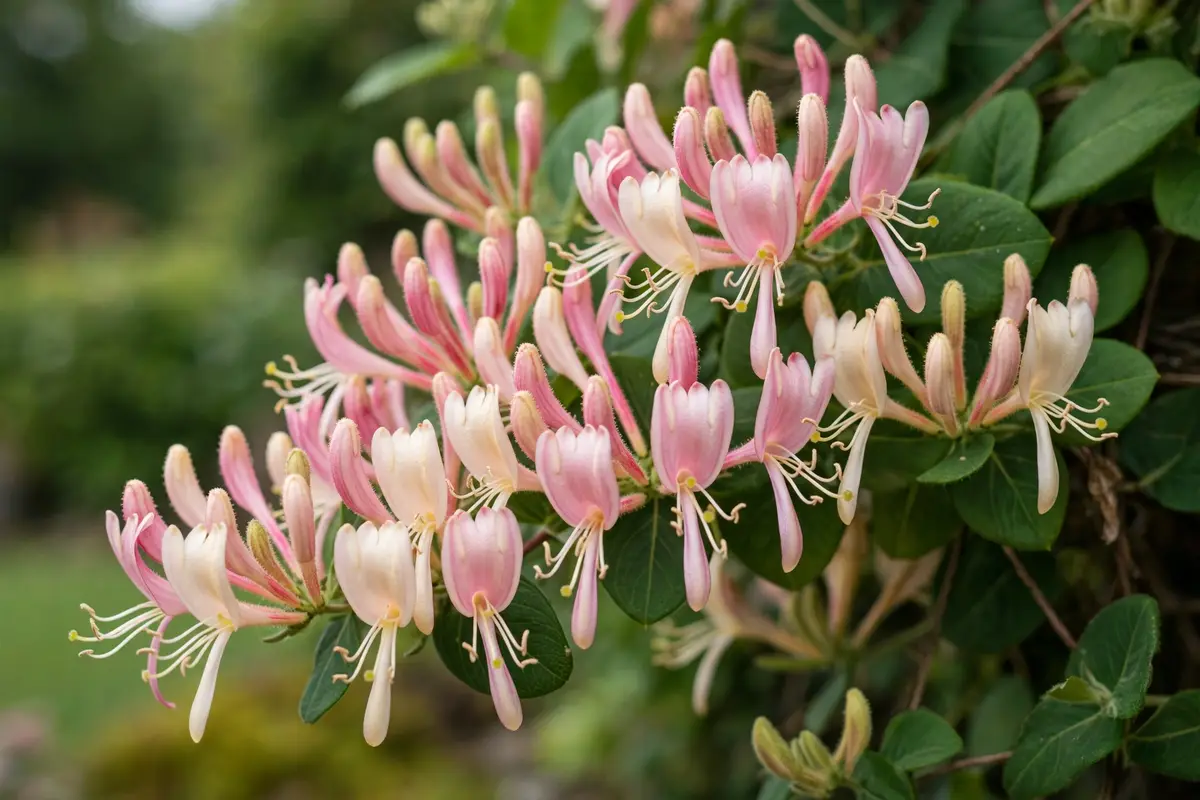
Table of Contents
- What Is a Honeysuckle Flower?
- Types of Honeysuckle and 6 Kinds Worth Knowing
- Honeysuckle Flower Meaning and Symbolism
- Honeysuckle Flower Colours and Their Meanings
- How to Grow Honeysuckle
- Common Mistakes When Growing Honeysuckle
- Honeysuckle vs Jasmine: The Two Scented Climbers
- Frequently Asked Questions
What Is a Honeysuckle Flower?
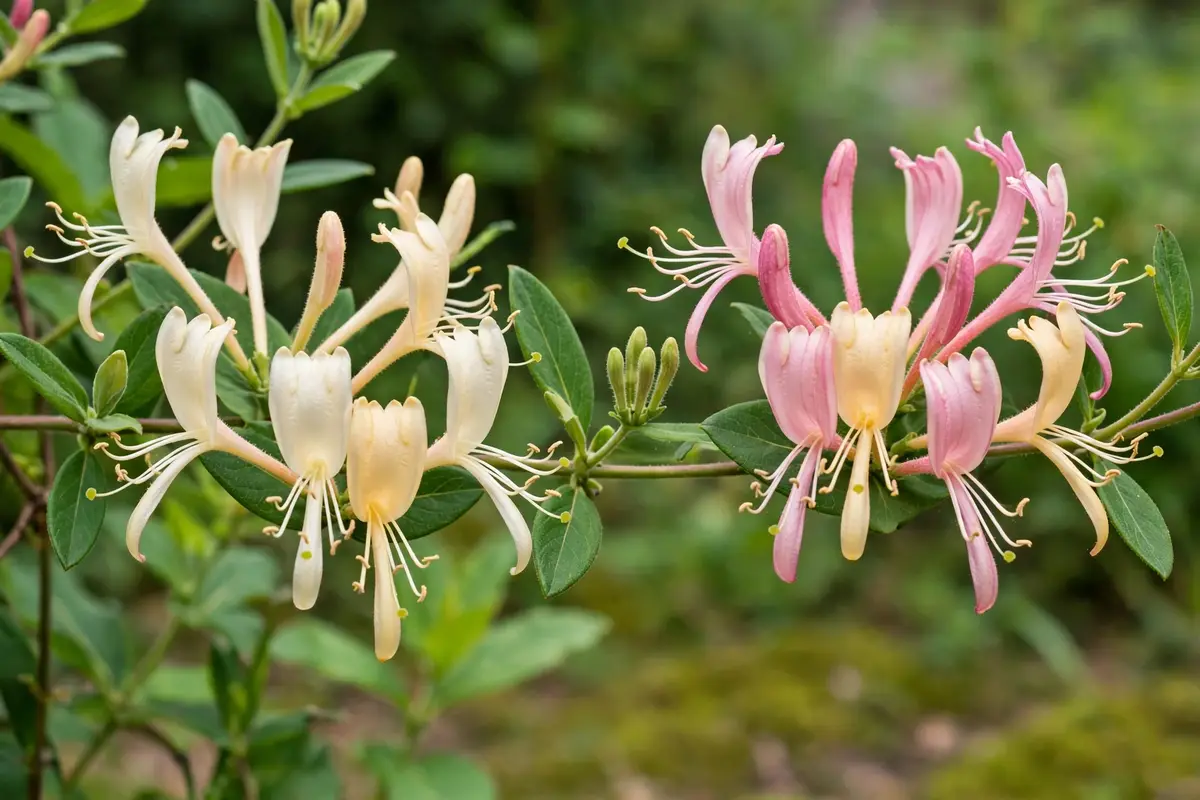
Lonicera — named for the German botanist Adam Lonicer — holds roughly 180 species of deciduous and evergreen shrubs and twiners. The flower is built as a nectar tube: two-lipped, five-lobed, with the reproductive parts thrust out beyond the mouth, and a reservoir of nectar at the tube’s base that only long tongues can reach — hawkmoths by night, hummingbirds (for the American species, whose tubes turned red and scentless for bird eyes) by day. European kinds kept the moth contract: cream and pink flowers that pour out perfume as the light fades. The nectar-drop trick is real botany, not folklore — pull the style through the flower’s base and the drop wells out. You can read more on the honeysuckle page on Wikipedia.
Few flowers carry more childhood. The honeysuckle draped over the porch or the school fence was summer’s free sweetshop, and the plant has threaded through literature as the emblem of clinging affection — Shakespeare’s Titania sleeps in a bank where “the honeysuckle gently entwines”, and woodbine became a folk-name for the binding of lovers. In Britain the woodbine is a protected-feeling wildflower of hedgerows; in America the story splits — the native coral honeysuckle is a conservation darling, while the imported Japanese honeysuckle, planted for a century for banks and scent, escaped so completely that it is now one of the continent’s major invasive vines. And the berries, red or black and bird-loved, are mildly toxic to people: the nectar is the treat, the berries are for the birds, and a guide that does not say so plainly has failed you.
Honeysuckle Flower Quick Facts
- Botanical names: Lonicera periclymenum (woodbine); L. japonica; L. sempervirens (coral).
- Family: Caprifoliaceae, the honeysuckle family.
- Hardiness: zones 4 to 9 (species-dependent).
- Height: climbers 10 to 25 feet; shrubs 6 to 10 feet.
- Bloom time: main flush early–late summer; winter shrub flowers December–March.
- Sun and soil: flowers in sun, roots in shade; most soils, moist but drained.
- Good to know: June birth flower (with the rose); nectar edible, berries NOT; L. japonica invasive in North America — plant the native coral instead.
Types of Honeysuckle and 6 Kinds Worth Knowing
The moth-scented woodbine, the hummingbird trumpet, the gold-and-silver invader, and the shrub that flowers in January. The table separates them; the profiles follow. For the full list of flower names, see our flower names A to Z guide.
| Type | Flowers | Habit | Scent | Best use |
|---|---|---|---|---|
| Woodbine (L. periclymenum) | Cream flushed pink | Twining climber | ★★★ evening | Fences, arches, wild gardens |
| Coral honeysuckle (L. sempervirens) | Coral-red trumpets | Twining climber | None — for birds | Hummingbird gardens (US native) |
| Japanese honeysuckle (L. japonica) | White ageing gold | Rampant climber | ★★★ sweet | INVASIVE in N. America — avoid there |
| Italian woodbine (L. caprifolium) | Cream and rose | Twining climber | ★★★ | Early summer arches |
| Tatarian honeysuckle (L. tatarica) | Pink or white | Upright shrub | Light | Screens, shrub borders |
| Winter honeysuckle (L. fragrantissima) | Creamy-white, tiny | Upright shrub | ★★★ lemon | Winter scent by a path |
1. Woodbine — Lonicera periclymenum, the Scented Original
Europe’s hedgerow honeysuckle and the plant of the poems: whorls of cream flowers flushed crimson-pink, opening through summer, with the perfume engineered for dusk and hawkmoths. Cultivars like ‘Serotina’ (the late Dutch honeysuckle) extend the season to autumn. It is one of the parents of honeysuckle’s June honours — sharing our June birth flower guide with the rose — and the climber to plant where people sit out on summer evenings.
2. Coral Honeysuckle — Lonicera sempervirens, the Hummingbird’s
The American answer: clusters of coral-red trumpets from spring to frost, all but scentless because its pollinator works by sight — the ruby-throated hummingbird, for whom this plant seems personally designed. Semi-evergreen in mild winters, well-behaved where japonica rampages, and the honeysuckle North American gardeners should plant first, last, and instead. ‘Major Wheeler’ is the mildew-resistant, free-flowering pick of the cultivars.
3. Japanese Honeysuckle — Lonicera japonica, the Beautiful Problem
The sweetest scent of all, white flowers ageing to gold on the same stem (“gold and silver flower” in Chinese medicine, where it is a valued herb), evergreen in mild climates, unstoppable everywhere. In North America it has swallowed woodland edges and smothered acres of understory, and many states list it as invasive: outside its home range, admire it, do not plant it, and pull its seedlings without sentiment. The same plant is a treasured medicinal and garden flower in East Asia — context is everything, and in the wrong continent it is a weed with a perfume.
4. Italian Woodbine — Lonicera caprifolium, the Early One
The goat-leaf honeysuckle (its upper leaves fuse around the stem, like a cup) flowers earliest of the climbers, cream and rose in late spring, with orange berries after. A slightly tidier, less rampant woodbine for arches and pergolas in European-style gardens, and one of the oldest cultivated honeysuckles of all — grown since Roman gardens, which knew a good evening scent when they smelled one.
5. Tatarian Honeysuckle — Lonicera tatarica, the Shrub
Not all honeysuckles climb: tatarica is an upright bush (8–10 feet) smothered in pink or white flowers in late spring, followed by red berries the birds strip by midsummer. Useful, hardy, fast screening — with a caveat in North America, where escaped bush honeysuckles (this and its Amur cousin) are invasive in woodlands. In Eurasian gardens it behaves; elsewhere, check your state’s list before planting any bush honeysuckle.
6. Winter Honeysuckle — Lonicera fragrantissima, January Perfume
The shrub that perfumes the bleakest month: tiny creamy flowers on bare branches from December to March, each insignificant to look at, together producing a lemon-sherbet scent that carries twenty feet on cold air. Plant one where the winter path passes, cut sprigs for the house, and forgive its plain green anonymity the rest of the year — for six winter weeks it is the most valuable shrub in the garden.
Honeysuckle Flower Meaning and Symbolism
Honeysuckle means devoted affection and the bonds of love — the vine that twines and holds became the natural emblem of lovers who cling, and the Victorian language gave it the messages “bonds of love”, “devoted affection” and “generous love”. Its sweetness adds happiness and the promise of sweetness in life; its June birth-flower role ties it to early-summer weddings and anniversaries. In folk tradition a honeysuckle by the door kept fevers and ill luck from the house, and bringing the flowers indoors was said (inconveniently for florists) to invite headaches and, in some counties, a wedding within the year.
Give honeysuckle for devoted love without drama — engagements, anniversaries, the friend who has held on through everything — and plant the winter shrub for someone who needs scent in the dark months. Its meaning is attachment, honestly worn: the flower that holds on.
Honeysuckle Flower Colours and Their Meanings
- Cream and pink — devoted affection: woodbine’s two-tone evening whorls.
- Coral red — generous, outward love: the hummingbird trumpets, made to be seen.
- White to gold — sweetness ripening: japonica’s ageing flowers, youth into richness.
- Soft pink — tender attachment: the tatarian shrub’s spring cloud.
- Winter cream — hope in the dark: fragrantissima’s plain flowers, richest scent — a cousin in spirit to our white flowers.
How to Grow Honeysuckle
The old rule is “head in the sun, feet in the shade” — the plant evolved scrambling out of woodland shadow into the light, and it still wants that arrangement. Gardeners on r/gardening on Reddit reduce honeysuckle care to two sentences: “give it something to climb and mulch its roots like a woodland floor, then prune right after flowering or you’ll cut off next year’s show.”
Planting Climbers and Shrubs
Plant climbers against a fence, arch or tree with wires or trellis to start them — honeysuckle twines, it does not self-cling like ivy, so the first turns around the support are yours to make. Set the root ball a couple of inches deeper than it grew in the pot, in any reasonable soil improved with compost, and mulch thickly to keep roots cool. Shrubs need only space and sun. Water the first season; after that, established plants shrug off ordinary drought, though flowering is better with moisture.
Pruning — Timing Is the Whole Game
Most summer honeysuckles flower on the current season’s growth tips — but the safe universal rule is to prune immediately after flowering, which never sacrifices a show. Renovate a tangled climber in late winter, cutting a third of the oldest stems to the base (the winter-flowering shrub is the exception: prune it right after its winter bloom, in early spring). Aphids are the plant’s one reliable pest — they cluster on the soft tips in May; a jet of water or simply the arriving ladybirds handles most years. Powdery mildew finds plants in dry, airless shade: the cure is the siting rule again, sun above and air around.
Common Mistakes When Growing Honeysuckle
Mistake one is planting Japanese honeysuckle in North America — or letting a bird-sown seedling of any bush honeysuckle establish in a US woodland garden. The ecological damage is documented and severe; the natives and the coral species give the same garden effect without it. Mistake two is pruning in spring: the flower buds you remove were this summer’s perfume. Prune after flowering.
Mistake three is expecting a climber to stick like ivy, then blaming the plant when it flops off a smooth wall — it twines, and needs wires, trellis or a host shrub. Mistake four is a hot, dry root run: unmulched roots against a south wall produce mildew and misery; give it the woodland floor it remembers. And mistake five is eating the berries — children especially should learn the line early: nectar drop yes, berries no, they are for the birds.
Honeysuckle vs Jasmine: The Two Scented Climbers
The garden’s two perfume twiners are confused constantly. Honeysuckle (Lonicera, honeysuckle family): two-lipped TUBULAR flowers in whorls at the stem tips, leaves in opposite pairs (sometimes fused around the stem), hardy to zone 4, berries red or black, scent sweet and honeyed, strongest in the true woodbines. Jasmine (Jasminum, olive family): flat STAR-shaped flowers with five spreading petals, often pinnate leaves, many species tender (common jasmine is zone 7 at best), scent richer and more indolic — the perfumer’s flower. Quick checks: tube = honeysuckle, star = jasmine; fused leaf-pairs = honeysuckle; a frost that kills it to the ground in zone 5 = jasmine. Both deserve a seat by the evening bench; only honeysuckle will survive a northern winter to scent it.
Frequently Asked Questions
Is honeysuckle edible?
The nectar is — that single sweet drop pulled from the flower’s base is the traditional taste, and it is the only part to sample. The berries of most honeysuckles are mildly toxic (stomach-upset territory and worse for children), and leaves and stems are not food. Teach the distinction with the flower in hand: nectar yes, berries never. If your question is not answered here, the questions about the honeysuckle flower on Quora cover most of the rest.
Is honeysuckle invasive?
Some species, in some places, severely: Japanese honeysuckle and the bush honeysuckles (Amur, Tatarian) are listed invasive across much of North America. The European woodbines in Europe and the American coral honeysuckle in America are native and welcome. Rule of thumb: plant the honeysuckle from your own continent.
When does honeysuckle flower?
The climbers flower through summer — Italian woodbine earliest (late spring), woodbine and japonica June to September, coral honeysuckle spring to frost in flushes. The winter shrub inverts the calendar entirely, flowering December to March on bare wood.
Why is my honeysuckle not flowering?
Usually one of three causes: spring pruning removed the season’s flower wood (prune after flowering instead); the top of the plant is in too much shade (it climbs to find sun — give it a taller, brighter support); or a young plant is still building roots — honeysuckles often take two seasons to settle before flowering freely.
Does honeysuckle attract hummingbirds?
The coral honeysuckle is one of the finest hummingbird plants in North America — its red tubes are shaped and coloured for them, and it flowers for months. The scented Old World kinds serve hawkmoths at dusk instead. A garden can run both shifts: coral trumpets by day, woodbine perfume by night.
Is honeysuckle a perennial?
Yes — a woody perennial vine or shrub, long-lived once established, with the top growth of climbers sometimes dying back in very cold winters and resprouting from the base. For more flowers under the same letter, see our guide to flowers that start with H.