Pennsylvania State Flower: Mountain Laurel, the Catapult Flower
Pennsylvania’s state flower is a piece of living machinery. The mountain laurel has been the state flower since 1933, and its blossom hides a trick no other shrub in the woods performs: each flower holds its ten stamens cocked like tiny catapults, their tips tucked into pockets in the petals — and when a bee lands, the springs fire, dusting the visitor’s back with pollen. An evergreen that blooms like porcelain and weaponizes its welcome: this is the Pennsylvania state flower, guardian of the Laurel Highlands, and the choice of the most famous conservationist ever to govern the state.
This guide covers the Pennsylvania state flower and its 1933 adoption, how its catapult flower works, what mountain laurel means, six more Pennsylvania flowers worth knowing, and how to grow it: acid soil, cool roots, and patience with the slowest aristocrat in the shrub border.
Quick Answer
The Pennsylvania state flower is the mountain laurel, Kalmia latifolia, adopted in 1933. It is a glossy evergreen shrub, 4 to 10 feet in gardens, flowering in May and June with clusters of pink-to-white cup-shaped blooms over leathery foliage, in zones 4 to 9. It wants acidic soil and light shade and rewards patience — it is slow. Pennsylvania has no separate state wildflower. Mountain laurel means perseverance, ambition and protection — and like its rhododendron cousins it is poisonous, a beauty to admire rather than graze.
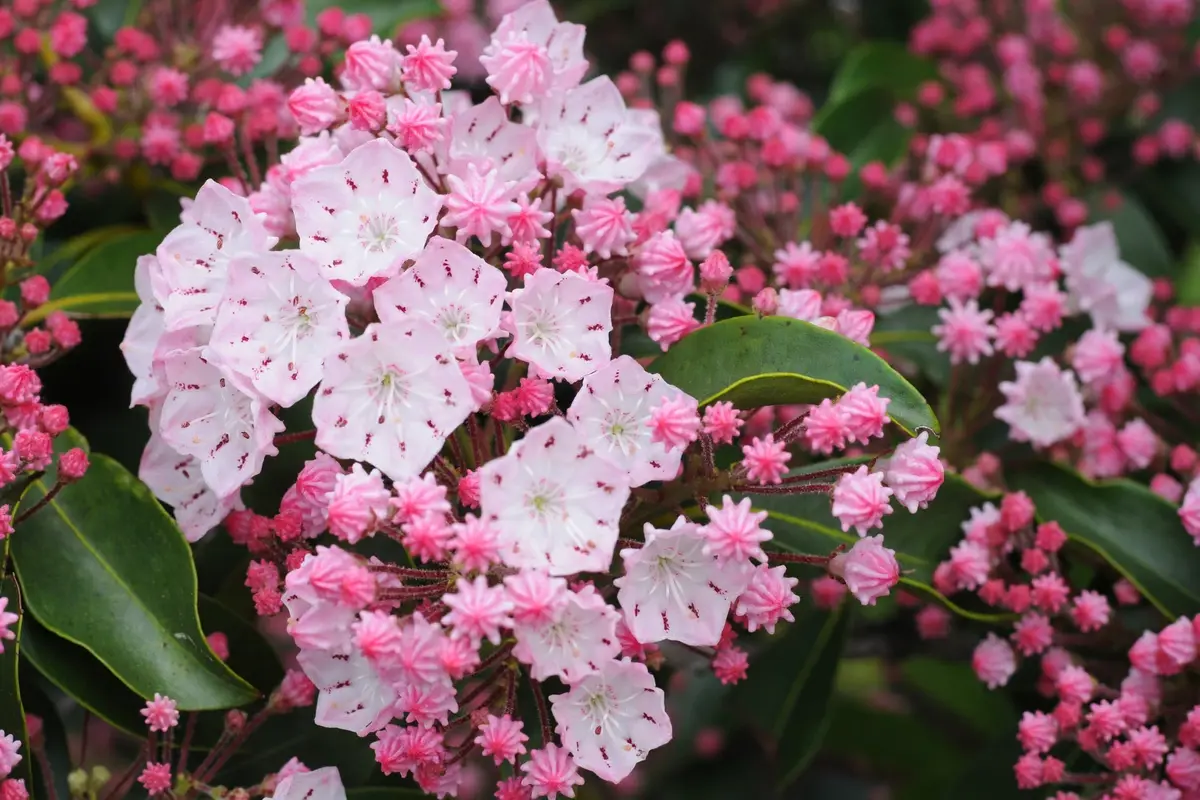
Table of Contents
- What Is the Pennsylvania State Flower?
- The Story: 1933 and the Forester-Governor
- The Catapult Flower: How Mountain Laurel Fires Its Pollen
- Mountain Laurel Meaning and Symbolism
- 6 More Pennsylvania Flowers Worth Knowing
- How to Grow Mountain Laurel
- Common Mistakes When Growing Mountain Laurel
- Frequently Asked Questions
What Is the Pennsylvania State Flower?
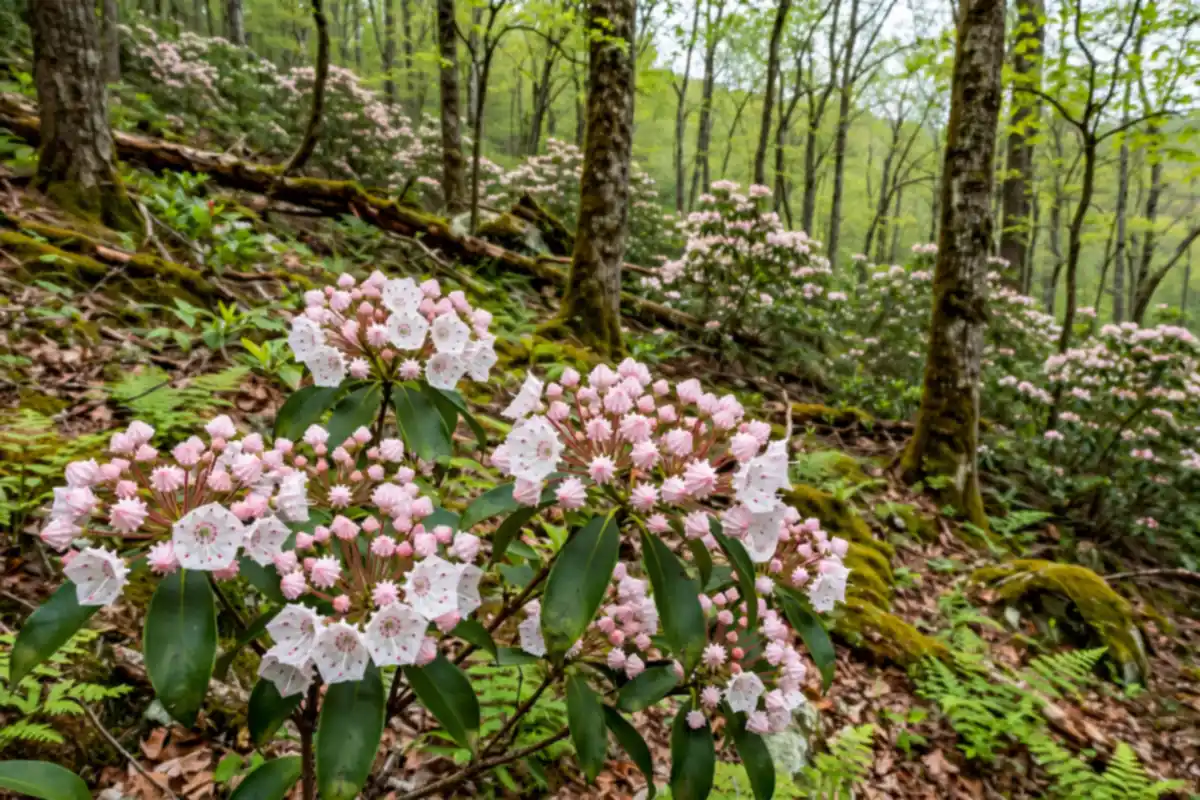
Mountain laurel is an evergreen shrub of the heath family — kin to rhododendrons, azaleas and heathers — with polished, leathery leaves and flower stems that rise like candelabra, each cluster opening in sequence from a ring of sculpted, peppermint-striped buds (the unopened buds are so geometrically neat they look carved from coral). The open flowers are shallow cups, shell pink darkening to white, each painted with a band of burgundy dots that serve as runway lights for bees. In the wild it armours Pennsylvania’s rocky slopes and stream banks from the Poconos to the Laurel Highlands — a region that carries the flower in its name — forming thickets so dense that pioneers called them laurel hells, half in complaint and half in awe. You can read more on the Kalmia latifolia page on Wikipedia.
Pennsylvania State Flower Quick Facts
- State flower: mountain laurel, Kalmia latifolia — family Ericaceae (the heath family).
- Adopted: 1933, signed by Governor Gifford Pinchot, America’s pioneering chief forester.
- The flower: pink-to-white cups, 3/4 to 1 inch, in big clusters; blooms May to June (earlier south, later in the mountains).
- The plant: evergreen shrub 4 to 10 feet in gardens; wild thickets taller; slow-growing and long-lived.
- Conditions: zones 4 to 9; strongly acidic soil (pH 4.5 to 5.5), light shade, cool mulched roots, never wet feet in clay.
- The trick: stamens held cocked in petal pockets; a landing bee triggers them and gets dusted with pollen (see the catapult section).
- Handle with knowledge: all parts are poisonous (grayanotoxins, the “mad honey” family of toxins); deer usually leave it alone for the same reason.
- Good to know: it is named for Pehr Kalm, Linnaeus’s student, who collected it in Pennsylvania in the 1740s and sent it to science.
The Story: 1933 and the Forester-Governor
The man who signed the mountain laurel into law knew more about American forests than any governor before or since: Gifford Pinchot, founder of the U.S. Forest Service, twice governor of Pennsylvania, and the father of the very word “conservation” in its modern sense. In the early 1930s the state was choosing its flower, and more than one candidate had champions in the legislature — the mountain laurel and other woodland favourites each had their bills and backers. When the question settled, it settled on the laurel, and Pinchot’s signature in 1933 made it official: a forester’s flower for the Penn’s Woods state, evergreen in the January forest and blazing along every June stream bank. The laurel has since become the state’s whole floral identity — in the Laurel Highlands’ name, in June laurel festivals, and in thickets that still stop traffic along Pennsylvania’s mountain roads when the bloom peaks.
The Catapult Flower: How Mountain Laurel Fires Its Pollen
Look closely at an unopened mountain laurel flower and you will see the engineering: the ten stamens are bent outward under tension, their pollen tips socketed into ten little pockets around the inside of the cup like arrows nocked in a ring. The arrangement holds while the flower is young. Then a bee — heavy enough, in the right place — lands in the cup and jostles a filament free. The stamen snaps upright in a fraction of a second and flings its pollen onto the bee’s back, precisely where the next flower’s stigma will brush it. Studies have measured the launch at genuine catapult speeds, and the mechanism does two jobs at once: it places pollen on the bee’s body (not its mouth, where it would be eaten) and it rations the dose across many visitors. It is the most mechanically sophisticated flower in this whole series — a mousetrap built of petals, evolved in Pennsylvania’s woods long before anyone thought to make it a state emblem.
Mountain Laurel Meaning and Symbolism
Mountain laurel means perseverance, ambition and protection — the classic laurel of victory, translated to an American evergreen. Its symbolism in Pennsylvania runs practical as well as poetic: a shrub that holds its leaves through mountain winters, thrives on rock where bedding flowers surrender, and then fires its pollen with mechanical genius is a fair portrait of the state that adopted it. It also keeps the family’s warning label: like the Washington state flower — the coast rhododendron, its close cousin — the mountain laurel guards its beauty with grayanotoxin poison, respected by every deer in the commonwealth. Perseverance, in this flower, defends itself.
6 More Pennsylvania Flowers Worth Knowing
Penn’s Woods is a flower garden at state scale. The table separates them; the profiles follow. For thousands more flower names, see our flower names A to Z guide.
| Flower | Colour | Season | Character | Best use |
|---|---|---|---|---|
| Great rhododendron | White-pink | Early summer | The bigger cousin | Woodland plantings |
| Eastern redbud | Magenta-pink | Spring | The April opener | Small trees |
| Flowering dogwood | White and pink | Spring | The understory classic | Woodland edges |
| Dutchman’s breeches | White | Early spring | The tiny laundry line | Spring woodland gardens |
| Turk’s-cap lily | Orange-red | Summer | The towering native | Meadow edges |
| Mountain mint | White, silver-frosted | Summer | The pollinator magnet | Sunny native beds |
1. Great Rhododendron — the Bigger Cousin
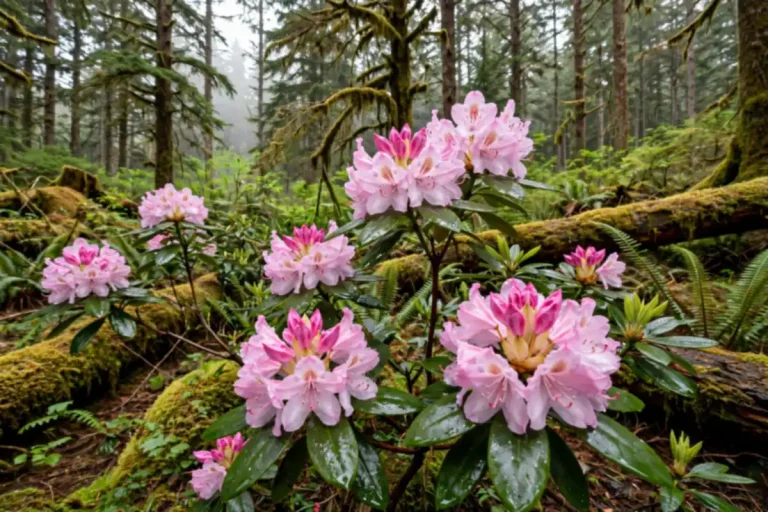
Rhododendron maximum shares the laurel’s thickets and family — great evergreen leaves and white-pink trusses in early summer, on shrubs that swallow whole stream banks. Our azalea guide covers this whole remarkable family, rhododendrons and azaleas together.
2. Eastern Redbud — the April Opener
Cercis canadensis fires the starting gun of the Pennsylvania spring: magenta buds studding bare black branches weeks before the leaves, from Pittsburgh’s hillsides to Philadelphia’s streets — a small native tree that performs in the year’s hardest month to fill.
3. Flowering Dogwood — the Understory Classic
White bracts floating in the April woods: Cornus florida is the classic tree of the Pennsylvania understory, and the white of its spring matches the laurel’s pink of June in a two-act state pageant that runs in every county.
4. Dutchman’s Breeches — the Tiny Laundry Line
Dicentra cucullaria hangs rows of miniature white pantaloons over ferny foliage for a few April weeks in rich woods — an ephemeral so perfectly named and so fleeting that finding a colony in flower feels like catching the woods mid-joke.
5. Turk’s-Cap Lily — the Towering Native
Lilium superbum is the skyscraper of the eastern meadow: stems to 8 feet carrying whorls of recurved orange-red lilies in July, nodding over Pennsylvania’s wet meadows like lanterns — the grandest wild lily in the state.
6. Mountain Mint — the Pollinator Magnet
Pycnanthemum species frost their bracts silver-white in summer and run the state’s busiest insect café: on a July afternoon a patch of mountain mint hosts more kinds of bees and wasps than any flower in this list — plant it and the garden’s whole ecology moves in.
How to Grow Mountain Laurel
Acid soil, light shade, cool roots, patience: mountain laurel is the rhododendron contract with slower payment terms. Gardeners on r/gardening on Reddit pass on the rule as the family’s first law: “plant it like a rhododendron, then wait like it’s an oak — the laurel pays in decades, not seasons.”
Planting and Position
Choose light or dappled shade (it flowers well even in fairly deep woodland shade, and tolerates more sun in the North with water), and soil that is moist but drained, rich in leaf mould, and genuinely acidic — pH 4.5 to 5.5, the ericaceous end of the scale. Plant high like its cousins, keep the root ball at or just above grade, mulch 3 inches with pine bark or leaf mould, and water deeply through the first two summers and in droughts after. On Pennsylvania clay, amend a wide, shallow planting area rather than a deep hole, and never let it sit in a winter puddle.
Cultivars and Care
Modern cultivars shrink the wait and shrink the shrub: ‘Olympic Fire’ (rich pink-red buds), ‘Sarah’ (deep red-pink), ‘Carousel’ (banded pattern flowers), and the Elf and Minuet dwarfs for smaller gardens. Feed once in spring with an acid-lovers’ fertilizer at half strength, prune only to remove dead wood or the odd wayward stem (flower buds for next year form by late summer — August pruning is next June’s loss), and expect a slow, sculptural plant that at fifty years old looks like it was placed by a Japanese master. Disease watch: leaf spot in wet years — improve air flow and avoid overhead watering.
Common Mistakes When Growing Mountain Laurel
Mistake one is neutral or limy soil: like all its family, the laurel starves of iron and yellows in high pH — test first, acidify, or grow it in a raised ericaceous bed. Mistake two is planting deep or in a clay sump; crown rot in wet soil is the quiet killer of more laurels than cold ever was. Mistake three is full blazing sun with dry roots in hot-summer districts: the leaves scorch and the plant sulks — give it the woodland edge it evolved for.
Mistake four is impatience with its pace and “helping” with heavy fertilizer, which buys soft, spot-prone leaves instead of bloom; the laurel’s schedule is its own. Mistake five is pruning in autumn or spring, removing the buds set the previous summer — prune rarely, and only right after flowering if you must. And mistake six is forgetting the poison when siting it: keep laurel clippings out of livestock reach and teach children that this particular evergreen is for looking at — the deer already know.
Frequently Asked Questions
What is the Pennsylvania state flower?
The mountain laurel, Kalmia latifolia, adopted in 1933 and signed into law by Governor Gifford Pinchot, the famous conservationist and founder of the U.S. Forest Service. Pennsylvania has no separate state wildflower. If your question is not answered here, the questions about the Pennsylvania state flower on Quora cover most of the rest.
When does mountain laurel bloom in Pennsylvania?
Late May into June across most of the state — earlier in the southeast, latest in the high Laurel Highlands — with each shrub’s show lasting about two to three weeks. June laurel blooms along mountain roads are a standing Pennsylvania spectacle.
How does the mountain laurel flower shoot pollen?
Its ten stamens are held bent under tension, their tips tucked into pockets in the petals. When a visiting bee jostles one free, the stamen snaps upright like a catapult and dusts pollen onto the bee’s back — a placement that keeps the pollen out of the bee’s mouth and rations it across many flowers.
Is mountain laurel poisonous?
Yes — all parts contain grayanotoxins, the same poisons found in its rhododendron cousins (and in “mad honey”). It is a plant to admire, site away from livestock, and keep children from nibbling; deer, taught by evolution, mostly leave it alone.
Can I grow mountain laurel in my garden?
Yes, wherever you can give it the ericaceous contract: acidic soil (pH 4.5 to 5.5), light shade, cool mulched roots and steady moisture without waterlogging, zones 4 to 9. Compact modern cultivars suit ordinary gardens; the species wants room and decades.
Why is it called mountain laurel?
For its mountain habitat and its resemblance — glossy evergreen leaves — to the true laurel of the Mediterranean, whose family it does not belong to. The genus name Kalmia honours Pehr Kalm, the Finnish-Swedish botanist who botanized Pennsylvania in the 1740s and sent the plant back to Linnaeus.