Clover: Types, Meaning and How to Grow It
One plant in this whole series is famous for two completely different reasons, in two different costumes. In a cottage border it is the shamrock of Ireland and the four-leaf charm of every childhood meadow; in a modern suburb it is the rebel lawn — the ground cover people sow on purpose where their grandparents waged chemical war to remove it. Clover spent a century as the farmer’s best friend (it feeds cattle, bees and the soil itself), a few decades as the lawn’s worst weed, and has now been rehired, at a premium, to do the job grass does badly.
This guide covers the six clovers worth knowing (white, red and crimson, the lawn-bred microclover, and the lucky four-leaf form), what it means — luck, faith, hope and love, one leaf at a time — and how to grow it, whether you want a meadow, a cover crop, or the softest barefoot lawn on the street.
Quick Answer
The clover flower is Trifolium, a genus of about 300 species in the pea family Fabaceae from Europe, Asia and North Africa, with three-parted leaves and rounded heads of small pea-flowers in white, pink, red or crimson. Garden and lawn clovers are hardy perennials or self-sowing annuals (zones 3 to 10 depending on species) that fix nitrogen from the air, feed bees, and thrive in full sun to light shade in ordinary soil. The clover flower means luck — above all the four-leaf form, whose leaves stand for faith, hope, love and luck.
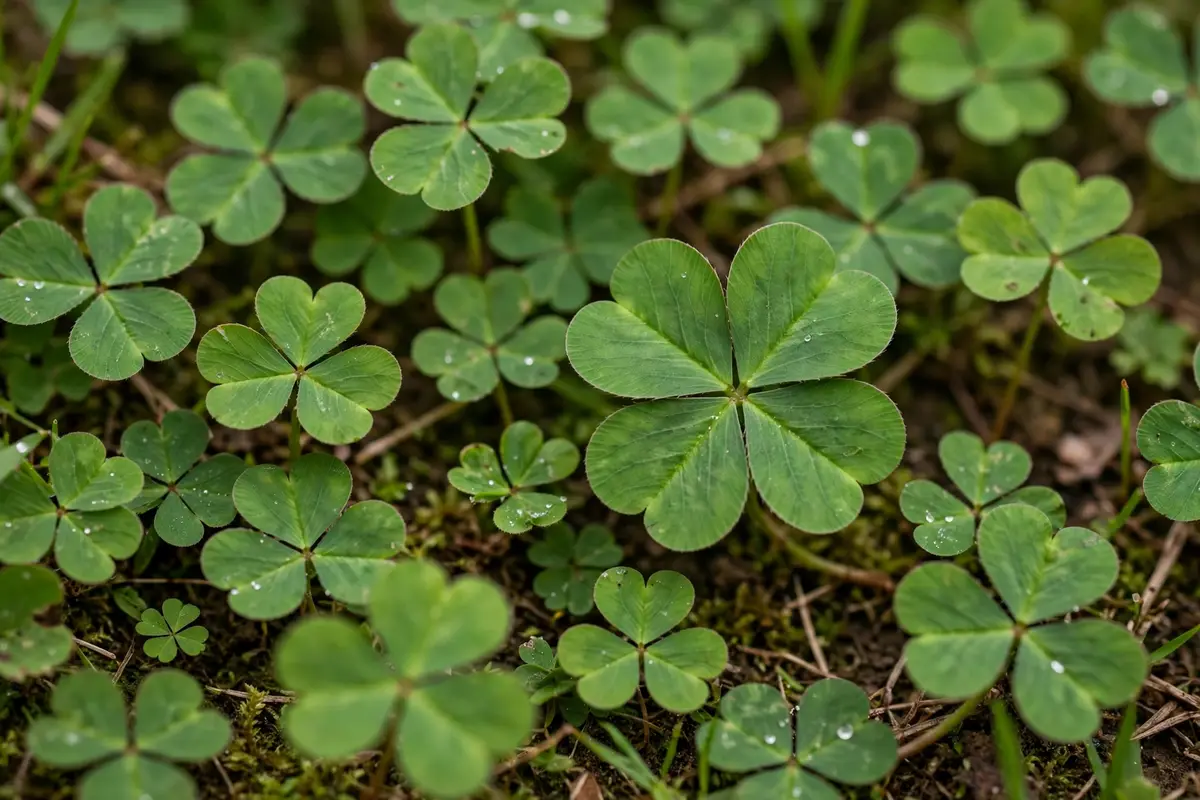
Table of Contents
- What Is a Clover Flower?
- Types of Clover and 6 Kinds Worth Knowing
- Clover Flower Meaning and Symbolism
- Clover Flower Colours and Their Meanings
- How to Grow Clover
- Common Mistakes When Growing Clover
- The Clover Lawn: Grass’s Old Enemy, Rehired
- Frequently Asked Questions
What Is a Clover Flower?
The name is the leaf: Trifolium, “three leaves,” and each rounded flower head is a bouquet of dozens of tiny pea-flowers packed into a pompon — clover is a legume, kin to peas, beans and the garden’s other great soil-improver, the lupine flower. Underground runs the family business: clover roots host bacteria in nodules that pull nitrogen from the air and bank it in the soil, which is why clover meadows stay green in droughts that yellow the grass around them, and why farmers have rotated clover through fields for two thousand years. Bees work the flowers so faithfully that clover honey — mild, pale, classic — is a crop in its own right. You can read more on the Clover page on Wikipedia.
The cultural layer runs as deep as the roots. The three-leaf shamrock is Ireland’s emblem (tradition says St Patrick used its three leaflets to explain the Trinity); the rare four-leaf variant — roughly one in several thousand leaves — became the universal luck charm, its four leaflets read as faith, hope, love and luck. No other lawn plant carries a theology and a superstition in the same handful of leaves.
Clover Quick Facts
- Botanical name: Trifolium spp. (about 300 species; garden kinds below).
- Family: Fabaceae, the pea and bean family.
- Hardiness: white/red clover are hardy perennials (zones 3 to 10); crimson is a self-sowing annual.
- Height: 4 to 8 inches (white, lawns) to 2 feet (red, meadows).
- Bloom time: late spring to autumn by kind; white clover flowers most of the summer.
- Sun and soil: full sun to light shade; ordinary soil, even poor — it makes its own nitrogen.
- Good to know: fixes nitrogen, feeds bees, stays green in drought; four-leaf form about 1 in 5,000 leaves.
Types of Clover and 6 Kinds Worth Knowing
The lawn kinds, the meadow kinds, and the charm. The table separates them; the profiles follow. For the full list of flower names, see our flower names A to Z guide.
| Type | Flowers | Height | Life | Best use |
|---|---|---|---|---|
| White clover (T. repens) | White pompons | 4–8 in | Perennial | Lawns, living mulch |
| Red clover (T. pratense) | Rosy-pink heads | 12–24 in | Short perennial | Meadows, cover crops |
| Crimson clover (T. incarnatum) | Crimson spikes | 12–18 in | Annual | Cover crop, spring show |
| Microclover | Small white, sparse | 3–6 in | Perennial | Mixed modern lawns |
| Strawberry clover (T. fragiferum) | Pink, strawberry-like fruit | 6–12 in | Perennial | Salty/wet ground |
| Four-leaf clover | White (a leaf form) | 4–8 in | Perennial | Luck, the hunt |
1. White Clover — the Lawn Original
Trifolium repens, the creeping white clover of lawns, paths and orchards: stolons root at every node, knitting a mat that shrugs off mowing, foot traffic and drought, and throws white pompons from late spring onwards. Until the 1950s, white clover seed was a standard ingredient of lawn mixes — its fall from grace came with weedkillers that killed it alongside the dandelions. Its return is the modern lawn story below.
2. Red Clover — the Meadow Maker
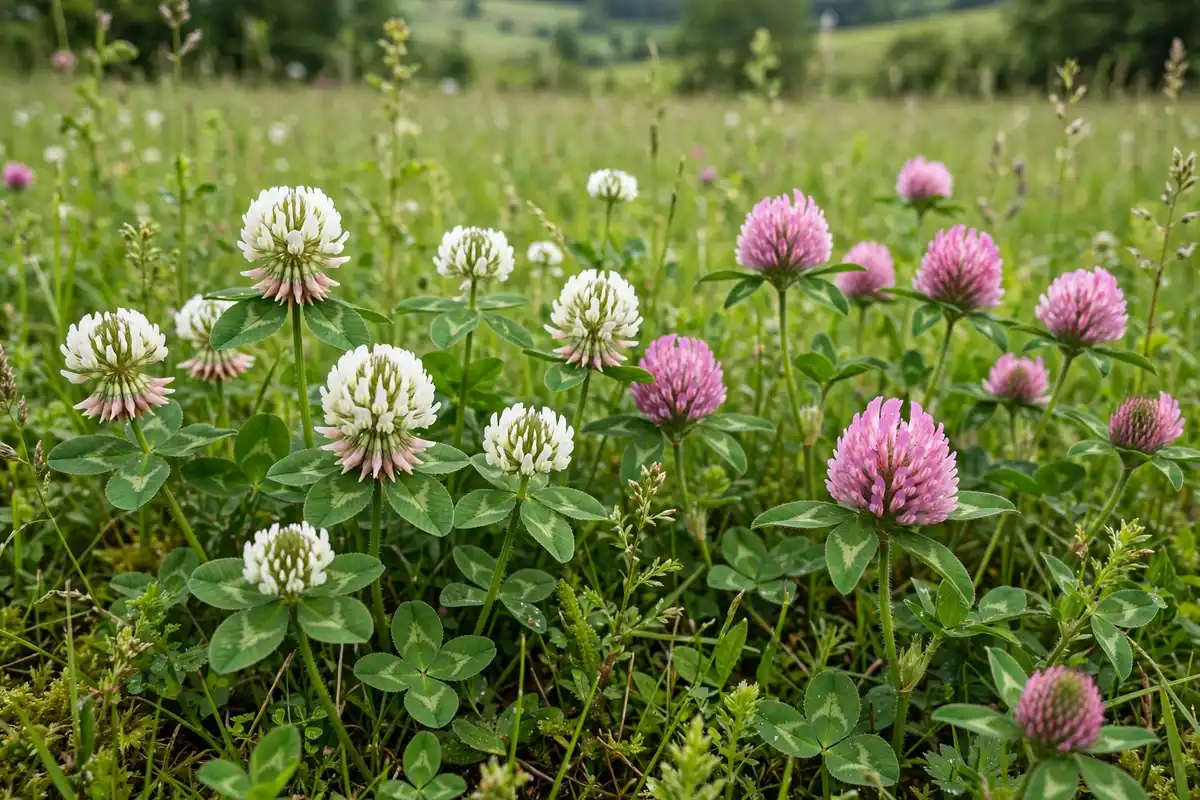
Trifolium pratense, the upright, rosy-headed clover of hay meadows and cottage borders: bigger, bolder and bee-magnetic, with flower heads an inch across over marked trifoliate leaves. Red clover is a short-lived perennial (two to three good years) and the herbalist’s clover — its flowers fill traditional teas and tinctures. In borders it wants the meadow treatment: poor soil, no fuss, and room to billow.
3. Crimson Clover — the Spring Spectacle
Trifolium incarnatum, the cover crop that upstages the flowers it serves: sown in autumn or early spring, it stands up in late spring wearing elongated cones of saturated crimson that stop traffic on farm edges across whole counties. Crimson clover is grown to be ploughed in — a green manure that fixes nitrogen for the crop that follows — but gardeners sow it purely for the six weeks of red, and the bees forgive them.
4. Microclover — the Designer Lawn Leaf
White clover bred small: tiny leaves, low growth, fewer flowers, and a texture that blends into grass instead of patching against it. Microclover is the compromise candidate of the lawn wars — overseeded into an existing lawn it greens the whole sward (its nitrogen feeds the neighbouring grass), tolerates close mowing, and keeps the barefoot softness of clover without the cottage-meadow look. It costs more per pound and earns it.
5. Strawberry Clover — the Problem-Soil Specialist
Trifolium fragiferum, named for its fruiting heads, which swell into pink, strawberry-like bladders: a creeping perennial for the ground the others refuse — salty soil, winter-wet soil, coastal and estuary edges where it pastures livestock on land grass cannot use. In gardens it is the answer for damp, difficult corners that still deserve flowers.
6. Four-Leaf Clover — the Charm
Not a species but a leaf mutation of white clover (some strains breed truer than others): four leaflets where three belong, at odds of roughly one in several thousand. The hunt is the pleasure — a productive patch rewards a slow, practised eye, and found leaves press between book pages into lifelong charms. Faith, hope, love and luck, in that order, says the rhyme; garden centres sell high-percentage strains for pots of guaranteed luck.
Clover Flower Meaning and Symbolism
Clover owns the luck corner of the flower language outright. The ordinary three-leaf plant — the shamrock — means Ireland, faith (three leaflets, one stem: the Trinity in St Patrick’s teaching) and honest good fortune; the four-leaf rarity concentrates it into the famous quartet: faith, hope, love and luck, one virtue per leaflet. In the Victorian language the messages split by colour, white clover saying “think of me” and red clover “industry” — the farmer’s virtue — but luck swallowed them all: no bouquet language survives against a charm every child already knows.
Send clover (or better, grow it) for luck that is meant practically: new homes, new ventures, exam weeks and weddings with outdoor receptions on the lawn itself. Among C-flowers it keeps company in our flowers that start with C guide — the letter where the soil-improvers gather.
Clover Flower Colours and Their Meanings
- White — “think of me”: white clover, the shamrock’s own colour family.
- Red and rosy pink — industry and vitality: red clover, the meadow worker.
- Crimson — bold good fortune: crimson clover’s spring flare.
- Green (four-leaf) — luck itself: faith, hope, love and the fourth leaf.
How to Grow Clover
Scatter, rake, water once, and let the bacteria do the chemistry. Gardeners on r/lawncare on Reddit trade the founding proverb of the clover-lawn movement: “my grandfather paid to put clover in his lawn, my father paid to kill it, and I am paying to put it back.”
Sowing and Establishing
Sow in spring or early autumn onto raked soil or into a scarified lawn, barely covering the small seed (light, not depth, is what it needs), and keep moist until germination in one to two weeks. For a mixed lawn, overseed at a light rate and let clover colonise the thin patches first — it will, eagerly. Inoculated seed establishes fastest on ground that has never grown clover; elsewhere the soil usually holds the bacteria already. Pure clover lawns want a full sowing and a few weeks’ patience while the mat knits.
Care: Mowing, Water and Feeding
Care is mostly abstinence: no nitrogen fertiliser (the plant manufactures it, and feeding only encourages competing grass), modest water (established clover outlasts grass in drought and greens first after rain), and mowing at lawn height if you want it tidy — or left long if you want flowers and bees. The one honest negotiation is the bee question: a flowering clover lawn is a bee pasture, so families with barefoot toddlers often mow during peak bloom to drop the flowers, letting them return between cuts.
Common Mistakes When Growing Clover
Mistake one is using weed-and-feed or broadleaf weedkiller anywhere near it — the herbicides that define a “perfect” lawn kill clover first, which was its whole twentieth-century downfall. A clover lawn is a commitment to a different chemistry: hand-weed or accept the mix. Mistake two is expecting grass-style wear: clover mats handle ordinary traffic but thin on the football patch and the dog run; grass (or a clover-grass mix) still wins the heavy-wear argument.
Mistake three is shade too deep: clover tolerates light shade but sulks under dense tree canopy where even it cannot gather enough light to fix nitrogen profitably. Mistake four is sowing red clover as a lawn — it is an upright, short-lived meadow plant that reads weedy in a sward; lawns are white clover and microclover territory. And mistake five is planting crimson clover expecting permanence: it is a glorious annual — sow it yearly, or let it self-sow, and enjoy the flare on schedule.
The Clover Lawn: Grass’s Old Enemy, Rehired
The shortest history of the lawn fits in clover’s biography: an ingredient in every seed mix until the 1950s, a weed for the herbicide decades, and now — as water bills, fertiliser bans and bee declines bite — the premium choice again, sold as microclover at many times the price of the seed once swept out of barns. The honest ledger: clover lawns need less water, no nitrogen feed, and fewer mowings (it grows lower and slower than grass), stay green through drought, and feed pollinators on an industrial scale. Against it: softer wear tolerance, a less uniform texture than showpiece turf, winter browning in hard climates, and the bee-versus-barefoot negotiation above. Most converts land on the mix — grass for structure, clover for chemistry — which is, not coincidentally, exactly the lawn their great-grandparents had.
Frequently Asked Questions
What is the difference between a shamrock and a clover?
“Shamrock” is the Irish name for a young clover (or clover-like) plant with three leaflets — most often lesser trefoil or white clover — worn on St Patrick’s Day; it is a cultural term, not a separate species. All shamrocks are clover-kind; a four-leaf clover is simply the lucky mutant of the same plants. If your question is not answered here, the questions about the clover flower on Quora cover most of the rest.
How rare is a four-leaf clover?
Roughly one leaf in several thousand carries the extra leaflet — estimates run from 1 in 2,500 to 1 in 10,000 depending on the patch and the strain. They cluster: the trait runs in plant families, so one find justifies searching the same square foot thoroughly. Bred strains sold for pots raise the odds dramatically.
Does clover really improve the soil?
Yes — measurably. Root-nodule bacteria convert air nitrogen into plant-usable form; a clover stand can fix on the order of 100 pounds of nitrogen per acre per year, feeding itself, companion grass, and whatever is planted after it. It is the oldest green manure in agriculture, and the reason clover sits in crop rotations worldwide.
Is clover safe for dogs and livestock?
Grazing clover is a traditional, nutritious forage and ordinary lawn contact is no concern for dogs. Two honest cautions: mouldy clover hay can produce toxins for livestock (a storage problem, not a lawn one), and very rich clover pasture can bloat cattle if introduced abruptly. Garden clover, walked on and admired, is safe ground.
Will clover take over my whole garden?
It spreads by creeping stems and seed and will colonise bare soil enthusiastically — which is the point in a lawn. In borders it behaves like any vigorous ground cover: welcome under shrubs, a weeding task in the rose bed. White clover pulls up easily where it is not wanted; the takeover fear belongs to genuinely thuggish plants, not this one.
When does clover flower?
White clover flowers from late spring through autumn in flushes (heaviest early summer); red clover blooms late spring to midsummer; crimson clover is a spring event, flowering about two months after a spring sowing or in late spring from autumn sowing. Mowing pauses flowering briefly — the plants simply re-bloom lower.