
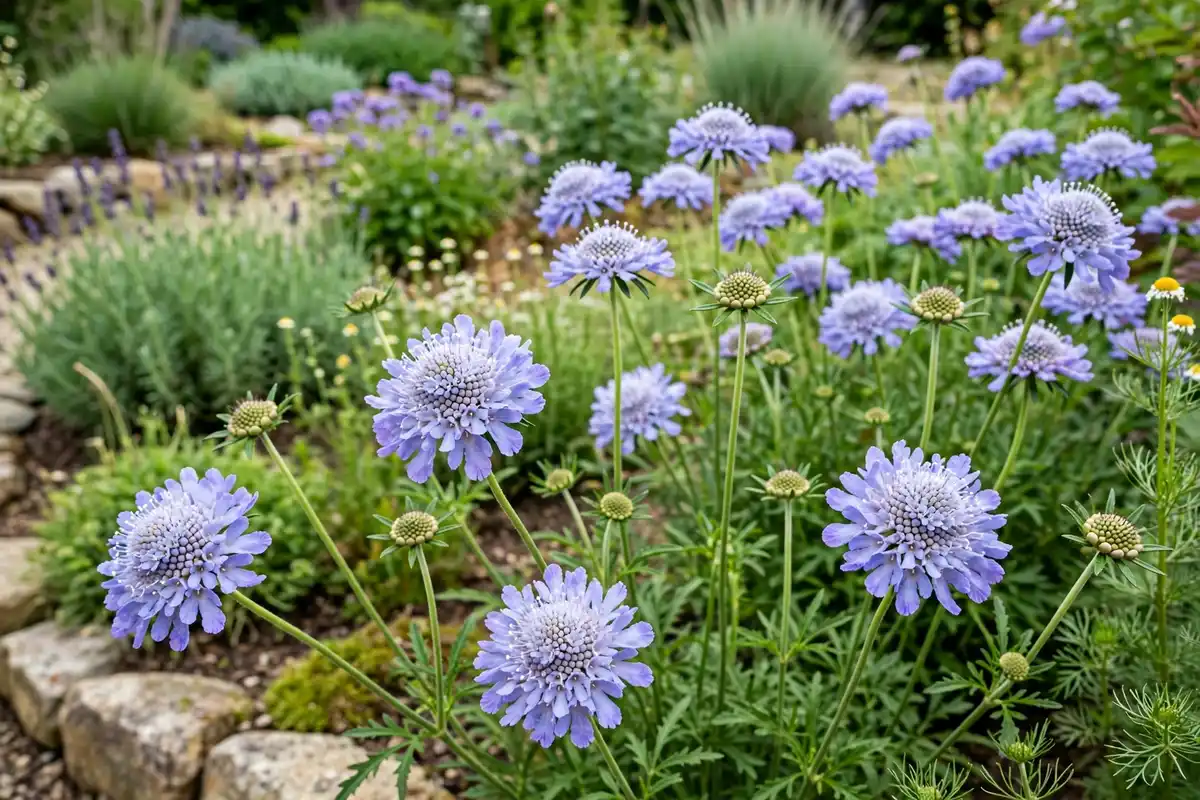
Pincushion Flower: Meaning, Types and How to Grow It
Look at a pincushion flower head closely and the name explains itself: a domed cushion of tiny florets, stuck all over with pins — the long stamens that give every butterfly a landing pad and every bee a week of dinners. Scabiosa is the cottage garden’s marathon runner, flowering from late spring to the first frosts on wiry stems made for cutting, and it wears two folk histories at once: the mourning bride in near-black, and the butterfly banquet in lavender-blue.
This guide covers the six pincushions worth knowing (the tall annuals, the velvet ‘Black Knight’, the perennial ‘Butterfly Blue’ and friends), its meanings — pure love and peace, with the mourning-bride shadow — and untangles the OTHER pincushion, the South African protea that shares the name.
Quick Answer
The pincushion flower is the domed, pin-studded flowerhead of Scabiosa, a genus in the honeysuckle family Caprifoliaceae — above all the annual Scabiosa atropurpurea and the perennials S. columbaria and S. caucasica. Garden pincushions grow 1 to 3 feet in USDA zones 3 to 9 (perennial species) or as hardy annuals anywhere, flower from late spring until frost in full sun with deadheading, and are among the finest butterfly plants in the border. Pincushion means pure love, peace and admiration. Not to be confused with the pincushion protea (Leucospermum), a South African shrub sharing only the name.
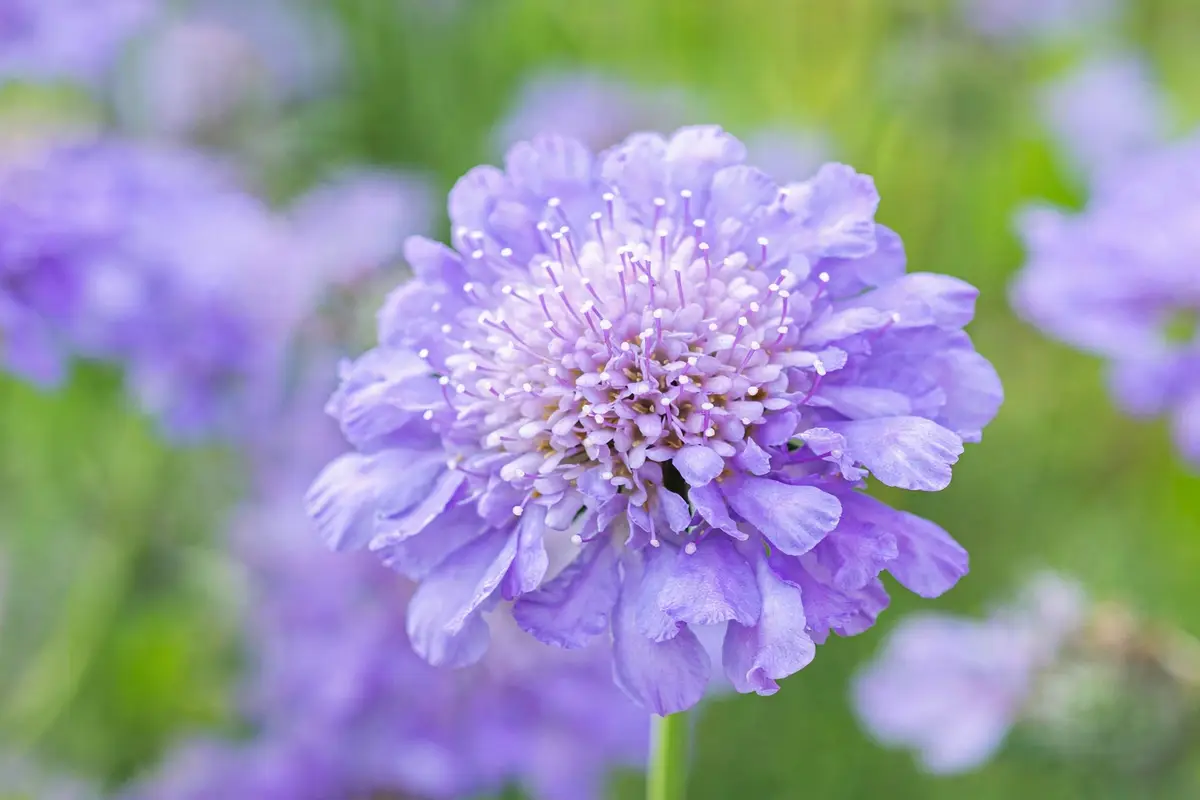
Table of Contents
- What Is a Pincushion Flower?
- Types of Pincushion and 6 Kinds Worth Knowing
- Pincushion Flower Meaning and Symbolism
- Pincushion Flower Colours and Their Meanings
- How to Grow Pincushion Flowers
- Common Mistakes When Growing Pincushion Flowers
- Pincushion vs Pincushion Protea: Two Plants, One Nickname
- Frequently Asked Questions
What Is a Pincushion Flower?
A scabiosa flowerhead is a composite: dozens of small florets packed into a dome, the outer ones lengthening into a frill, the stamens standing proud like pins. The plant was once filed in its own teasel family and is now placed with the honeysuckles — and it shares their generosity, flowering for an astonishing span. The genus name comes from scabies, the itch: medieval herbalists used scabious for skin complaints, an origin the flower has long outgrown. Scabiosa atropurpurea, the tall annual, was the Victorians’ “mourning bride” or “mournful widow” in its darkest forms — the near-black crimson heads read as a widow’s weeds in flower form. You can read more on the Scabiosa page on Wikipedia.
Ecologically, pincushion is a banquet: the flat-topped heads let butterflies, bees, hoverflies and moths feed side by side, and few border plants serve so many pollinators for so many months. Leave the last heads standing and you get the second show — architectural seed heads, little shuttlecocks that hold through autumn and feed small birds. The cutting value matches the wildlife value: the wiry 2-foot stems need no support, the flowers last a week in water, and the more you cut, the more the plant makes. It is, quietly, one of the hardest-working flowers in this whole series.
Pincushion Flower Quick Facts
- Botanical names: Scabiosa atropurpurea (annual); S. columbaria, S. caucasica (perennials, often listed as Lomelosia/Sixalix in new taxonomy).
- Family: Caprifoliaceae, the honeysuckle family.
- Hardiness: perennials zones 3 to 9; atropurpurea is a hardy annual, self-seeding.
- Height: 1 to 3 feet.
- Bloom time: late spring to first frost, with deadheading.
- Sun and soil: full sun; well-drained, neutral to alkaline soil; dislikes wet winter crowns.
- Good to know: elite butterfly plant; cut-and-come-again; seed heads feed birds; the dark forms are the old “mourning bride”.
Types of Pincushion and 6 Kinds Worth Knowing
The tall cutting annuals, the widow in black, and the perennial blues. The table separates them; the profiles follow. For the full list of flower names, see our flower names A to Z guide.
| Type | Flowers | Life | Height | Best use |
|---|---|---|---|---|
| S. atropurpurea (tall mix) | Plum, pink, white, scarlet | Annual | 2–3 ft | Cutting gardens, cottage borders |
| ‘Black Knight’ | Near-black crimson | Annual | 2–3 ft | The mourning bride |
| ‘Butterfly Blue’ (S. columbaria) | Lavender-blue | Perennial | 1–1½ ft | Front borders, butterflies |
| ‘Pink Mist’ (S. columbaria) | Soft pink | Perennial | 1–1½ ft | Butterfly Blue’s partner |
| ‘Fama’ series (S. caucasica) | Large blue or white | Perennial | 2 ft | Cutting, show borders |
| S. ochroleuca ‘Moon Dance’ | Creamy yellow | Perennial | 2 ft | Naturalistic planting |
1. Scabiosa atropurpurea — the Tall Cottage Annual
The pincushion of the cutting patch: tall, branching plants throwing dozens of plum, claret, pink, white and scarlet heads from June until frost, each on a wire of a stem. Sow it once and it self-seeds forever after with a cottage gardener’s manners — appearing where it pleases, never where it harms. The seed mixes (‘Tall Double Mix’ and kin) are the cheapest long-season colour in the catalogue.
2. ‘Black Knight’ — the Mourning Bride
Atropurpurea at its darkest: heads of near-black crimson with white pins, the flower the Victorians called the mournful widow. Black Knight is the goth of the cutting garden and looks expensive beyond its seed-packet price — in arrangements it does what black dahlias do, deepening every colour beside it. Grow it where the story gets told; visitors always ask.
3. ‘Butterfly Blue’ — the Perennial Workhorse
Scabiosa columbaria‘s famous child: a compact perennial mound that covers itself in lavender-blue pincushions from late spring to autumn if deadheaded — a genuinely six-month flower. It earned its name honestly; on warm afternoons the heads carry butterflies like a small airport. Front-of-border, gravel garden, container edge: there is no sunny spot it does not improve.
4. ‘Pink Mist’ — the Soft Partner
The same columbaria constitution in soft pink, bred to plant with Butterfly Blue (the pair together is a border cliché because it works). Pink Mist runs a touch looser and paler, mixing with grasses and pale roses where the blue would shout. Deadhead both together and the two will carry a border’s middle season almost alone.
5. ‘Fama’ Series — the Caucasian Giants
Scabiosa caucasica brings the size: flowers 3 inches and more across in clear blue (‘Fama Blue’) and pure white (‘Fama White’), on 2-foot perennial plants with handsome grey-green basal leaves. These are the show-bench and florist scabiosa, the ones that read as individual flowers rather than texture — and perennials in the bargain, returning for years with winter drainage.
6. ‘Moon Dance’ — the Cream Perennial
Scabiosa ochroleuca softens the palette entirely: creamy-yellow pincushions on airy 2-foot stems, made for naturalistic and prairie-style planting where the blues would be too cool. It is the latest of the set to settle and the most graceful in motion — a moonlit version of the family, and a fine partner for ornamental grasses.
Pincushion Flower Meaning and Symbolism
Pincushion’s bright meanings are pure love, peace and admiration — a devoted, unshowy affection, which fits a flower that gives nectar to all comers for half the year. But scabiosa carries a second, older register: in its dark atropurpurea forms it was the mourning bride, the mournful widow, a flower of loss and of love remembered. The two readings are not contradictions — they are the same sentiment at different seasons of life: love given, and love missed. Modern senders use the bright one; the dark flowers are chosen deliberately, for sympathy and remembrance arrangements with real gravity.
Send the blues and pinks for steadfast affection, get-well wishes and peace-making; send ‘Black Knight’ and the deep plums when the message is grief honoured rather than cheered. Among our blue flowers, ‘Butterfly Blue’ is the one that feeds the butterflies while it speaks.
Pincushion Flower Colours and Their Meanings
- Lavender-blue — peace and pure love: ‘Butterfly Blue’, the pollinator favourite.
- Soft pink — gentle admiration: ‘Pink Mist’ and the pastel annuals.
- Near-black crimson — remembrance: ‘Black Knight’, the mourning bride.
- White — purity and sympathy: ‘Fama White’ for condolence and weddings alike.
- Creamy yellow — quiet joy: ‘Moon Dance’ in the evening border.
How to Grow Pincushion Flowers
Few good plants ask less: sun, drainage, and a pair of snips. Gardeners on r/gardening on Reddit trade one pincushion rule above all: “deadhead like you mean it — five minutes a week is the difference between a June flower and a June-to-October flower.”
Sowing and Planting
Sow the annual atropurpurea indoors in early spring or direct after frost; it germinates readily and flowers the same summer, then seeds itself. Buy the perennials as plants (columbaria and caucasica seed is slower) and set them in full sun into well-drained soil — a handful of grit in the planting hole on heavy ground is the whole secret of their winter survival. Space a foot apart for the compact kinds, 18 inches for the tall annuals, and stake nothing: the wiry stems are self-supporting by design.
Deadheading, Cutting and Winter
Snip each spent head back to the next bud or leaf joint — the plant answers within days with new stems, and a picked bunch for the house does this job for you. Stop deadheading in early autumn and leave the last seed heads standing for the birds and the winter silhouette. Perennial crowns hate winter wet more than cold: a gravel mulch around (not over) the crown keeps them alive where blankets of wet leaves would rot them. Divide columbaria clumps every few springs to keep them vigorous.
Common Mistakes When Growing Pincushion Flowers
Mistake one is forgetting to deadhead, then declaring the plant a short flowerer: an unpicked scabiosa sets seed by July and retires, its work — genetically — done. Mistake two is winter wet on the perennial kinds: crowns planted in soggy hollows rot silently and the spring gap gets blamed on frost. Drainage first, always.
Mistake three is shade: in even half-shade the stems stretch, flop and flower at half strength — pincushion is a full-sun plant without negotiation. Mistake four is rich soil and heavy feeding, which produce leaves and weak stems where lean ground gives wire and flowers. And mistake five is tidiness in autumn: cutting the seed heads away in September removes the birds’ share and the plant’s self-sown future in one tidy gesture.
Pincushion vs Pincushion Protea: Two Plants, One Nickname
The shared nickname crosses families and continents. Pincushion flower (this guide): Scabiosa — small herbaceous plants of Europe and Asia, domed heads an inch or two across with delicate pin stamens, cottage borders, butterflies. Pincushion protea: Leucospermum — a woody South African SHRUB whose large heads carry dozens of stiff, protruding styles like pins in an orange cushion, a florist’s statement flower from the protea family. The tests are scale and stem: scabiosa heads are small on wiry herbaceous stems you can pick by the handful; leucospermum heads are fist-sized on woody stems you buy one at a time. (Both appear in our pages — the protea among the Australian native flowers and South African kin — but they grow, flower and mean entirely different things.)
Frequently Asked Questions
Is pincushion flower a perennial?
Both kinds exist: Scabiosa columbaria (‘Butterfly Blue’, ‘Pink Mist’), S. caucasica (‘Fama’) and S. ochroleuca are true perennials for zones 3–9 with winter drainage; S. atropurpurea (including ‘Black Knight’) is an annual that behaves like a perennial by self-seeding. Check which you are buying — the habit differs, the flower does not. If your question is not answered here, the questions about the pincushion flower on Quora cover most of the rest.
Why is it called a pincushion flower?
For the domed centre and the pins: the stamens stand out of the packed florets exactly like pins stuck in a sewing cushion. The seed heads keep the silhouette — a little architectural dome that lasts into autumn.
Does pincushion flower attract butterflies?
It is one of the best butterfly plants in the temperate border — the flat, nectar-rich heads are built for butterfly tongues, and a ‘Butterfly Blue’ in full flower on a warm day is rarely without visitors. Bees, hoverflies and hawkmoths use it too, and the season runs, with deadheading, from late spring to frost.
How long does pincushion flower bloom?
With regular deadheading, from late spring until the first hard frost — five months is normal for ‘Butterfly Blue’, and the annual atropurpurea runs June to October. Without deadheading the same plants finish in about six weeks; the difference is entirely the snips.
Is pincushion flower good for cutting?
Excellent — the long wiry stems need no support, vase life runs about a week, and cutting IS deadheading, so the vase and the border improve together. Pick when the outer florets open and the dome is fully formed; the near-black and blue forms are florist favourites for contrast.
Is scabiosa the same as pincushion flower?
Yes — scabiosa is the botanical name, pincushion the descriptive nickname, both for the same Scabiosa species above (not for the protea, which is leucospermum). For more flowers under the same letter, see our guide to flowers that start with P.

One Comment