35 Plants That Start With I: Names, Pictures & Growing Tips
Looking for plant names that start with I? You are in the right place. Plants beginning with I range from the climbing English ivy that dresses garden walls and the regal bearded iris of late spring to shade-loving impatiens, sun-hungry ice plants, and stately Italian cypress trees. This guide rounds up 35 real plants that start with I — flowers, houseplants, herbs, shrubs, ornamental grasses, and trees — each with a vivid description, practical growing tips, light needs, and USDA hardiness zones.
Whether you are planning a new border, hunting for a houseplant, or working through an A-to-Z gardening project, every entry below gives you the plant’s scientific name, type, standout features, and the conditions it needs to thrive. You will also find two comparison tables, practical growing advice, and answers to the questions gardeners ask most about I-plants. Let’s dig in.
Quick Answer
Popular plants that start with I include English Ivy, Bearded Iris, Impatiens, Indian Hawthorn, Italian Cypress, Ixora, Ice Plant, Indian Blanket, Inkberry, and Ironweed. They cover vines, bulbs, perennials, shrubs, grasses, and trees across USDA zones 3–12, so there is an I-plant for nearly every US garden and indoor space.
Table of Contents
I-Plants at a Glance
Use this table to compare all 35 plants that start with I side by side, from botanical names to native regions.
| Plant name | Scientific name | Type | Color/Feature | Native region |
|---|---|---|---|---|
| English Ivy | Hedera helix | Evergreen climbing vine | Glossy green lobed leaves | Europe, Western Asia |
| Bearded Iris | Iris germanica | Rhizomatous perennial | Purple, blue, white, yellow blooms | Southern Europe, Mediterranean |
| Impatiens | Impatiens walleriana | Tender annual | Pink, red, orange, white flowers | East Africa |
| Indian Hawthorn | Rhaphiolepis indica | Evergreen shrub | Pink or white spring flowers | Southern China, Southeast Asia |
| Italian Cypress | Cupressus sempervirens | Evergreen conifer tree | Dark green columnar foliage | Mediterranean |
| Ixora | Ixora coccinea | Tropical evergreen shrub | Red, orange, pink flower clusters | South Asia |
| Ice Plant | Delosperma cooperi | Succulent groundcover | Magenta daisy flowers | South Africa |
| Indian Blanket | Gaillardia pulchella | Annual wildflower | Red-and-yellow bicolor blooms | Central North America |
| Inkberry | Ilex glabra | Evergreen shrub | Glossy leaves, black berries | Eastern North America |
| Ironweed | Vernonia noveboracensis | Herbaceous perennial | Intense purple flower clusters | Eastern North America |
| Italian Arum | Arum italicum | Shade perennial | Marbled leaves, orange-red berries | Southern Europe, North Africa |
| Ivy Geranium | Pelargonium peltatum | Trailing tender perennial | Pink, red, white cascading blooms | South Africa |
| New Guinea Impatiens | Impatiens hawkeri | Tender annual | Large vivid blooms, bronze foliage | New Guinea |
| Reticulated Iris | Iris reticulata | Bulb | Deep blue-purple early spring flowers | Turkey, Caucasus, Iran |
| Japanese Iris | Iris ensata | Rhizomatous perennial | Large flat blue, purple, white blooms | Japan, East Asia |
| Siberian Iris | Iris sibirica | Rhizomatous perennial | Blue, purple, white slender blooms | Europe, Central Asia |
| Indigo | Indigofera tinctoria | Tender shrub | Pink pea-like flowers, blue dye | South Asia |
| Indian Shot | Canna indica | Tender rhizomatous perennial | Red-orange tropical blooms, bold leaves | Tropical Americas |
| Iceberg Rose | Rosa ‘Iceberg’ | Floribunda shrub rose | Pure white double blooms | Cultivar (Germany, 1958) |
| Florida Anise (Illicium) | Illicium floridanum | Evergreen shrub | Maroon star flowers, aromatic leaves | Southeastern US |
| Inland Sea Oats | Chasmanthium latifolium | Ornamental grass | Dangling oat-like seed heads | Eastern and central North America |
| Italian Stone Pine | Pinus pinea | Evergreen conifer tree | Umbrella canopy, edible pine nuts | Mediterranean |
| Ixia | Ixia spp. | Cormous perennial | Starry blooms in bright colors | South Africa |
| Indian Mallow | Abutilon spp. | Tender shrub | Lantern-like blooms, maple-like leaves | Tropical and subtropical regions |
| Ironwood | Carpinus caroliniana | Deciduous tree | Fluted gray bark, orange fall color | Eastern North America |
| Virginia Sweetspire (Itea) | Itea virginica | Deciduous shrub | White bottlebrush blooms, red fall foliage | Eastern North America |
| Italian Jasmine | Jasminum humile | Evergreen shrub | Fragrant yellow flowers | Himalayas, Southwest China |
| Ice Plant ‘Jewel of Desert’ | Delosperma ‘Jewel of Desert’ | Succulent groundcover | Multicolor bicolor daisy blooms | Cultivar series |
| SunPatiens Impatiens | Impatiens × hybrida ‘SunPatiens’ | Tender annual | Large blooms in sun or shade | Hybrid series |
| Iris ‘Immortality’ | Iris germanica ‘Immortality’ | Reblooming perennial | Fragrant white blooms, spring and fall | Cultivar |
| Indian Paintbrush | Castilleja coccinea | Hemiparasitic wildflower | Scarlet-red bracts | Eastern and central North America |
| Inkberry ‘Shamrock’ | Ilex glabra ‘Shamrock’ | Compact evergreen shrub | Dense glossy foliage, black berries | Cultivar |
| Ivy ‘Goldchild’ | Hedera helix ‘Goldchild’ | Variegated evergreen vine | Green leaves edged in gold | Cultivar |
| Italian Bellflower | Campanula isophylla | Trailing perennial | Blue or white starry bells | Northern Italy |
| Indian Bean Tree | Catalpa bignonioides | Deciduous tree | White orchid-like blooms, long pods | Southeastern US |
Light, Water & Hardiness Zones
Planning your garden? This second table shows how much sun and water each I-plant wants, and the USDA zones where it grows outdoors year-round.
| Plant name | Light needs | Water needs | Hardiness zone |
|---|---|---|---|
| English Ivy | Part to full shade | Medium; drought tolerant once established | 4–9 |
| Bearded Iris | Full sun | Low to medium; dislikes soggy soil | 3–9 |
| Impatiens | Part to full shade | Medium; keep evenly moist | Grown as annual; 10–11 perennial |
| Indian Hawthorn | Full sun to part shade | Medium | 7–10 |
| Italian Cypress | Full sun | Low once established | 7–10 |
| Ixora | Full sun to part shade | Medium; enjoys humidity | 9–11 |
| Ice Plant | Full sun | Low; needs sharp drainage | 5–9 |
| Indian Blanket | Full sun | Low; very drought tolerant | Grown as annual; reseeds freely |
| Inkberry | Full sun to part shade | Medium to wet; tolerates soggy soil | 4–9 |
| Ironweed | Full sun | Medium to wet | 4–9 |
| Italian Arum | Part to full shade | Medium; goes dormant in summer | 5–9 |
| Ivy Geranium | Full sun | Medium; let soil dry between waterings | 9–11; annual elsewhere |
| New Guinea Impatiens | Part shade to full sun | Medium; consistent moisture | Grown as annual; 10–11 perennial |
| Reticulated Iris | Full sun | Low; needs a dry summer rest | 5–9 |
| Japanese Iris | Full sun to part shade | High; loves moist soil | 4–9 |
| Siberian Iris | Full sun to part shade | Medium to high | 3–9 |
| Indigo | Full sun | Low to medium | 9–11; annual elsewhere |
| Indian Shot | Full sun | Medium to high | 7–11; lift rhizomes elsewhere |
| Iceberg Rose | Full sun | Medium | 5–10 |
| Florida Anise (Illicium) | Part to full shade | Medium to wet | 7–10 |
| Inland Sea Oats | Part shade | Medium | 5–9 |
| Italian Stone Pine | Full sun | Low once established | 8–11 |
| Ixia | Full sun | Low to medium; dry summer rest | 8–10 |
| Indian Mallow | Full sun to part shade | Medium | 8–11; annual elsewhere |
| Ironwood | Part to full shade | Medium | 3–9 |
| Virginia Sweetspire (Itea) | Full sun to part shade | Medium to wet | 5–9 |
| Italian Jasmine | Full sun to part shade | Medium | 7–11 |
| Ice Plant ‘Jewel of Desert’ | Full sun | Low; sharp drainage essential | 5–9 |
| SunPatiens Impatiens | Full sun to part shade | Medium; consistent moisture | Grown as annual; 10–11 perennial |
| Iris ‘Immortality’ | Full sun | Low to medium | 3–9 |
| Indian Paintbrush | Full sun | Low; never fertilize | 4–8 |
| Inkberry ‘Shamrock’ | Full sun to part shade | Medium to wet | 4–9 |
| Ivy ‘Goldchild’ | Part to full shade | Medium | 4–9 |
| Italian Bellflower | Part shade | Medium; keep evenly moist | 7–10 |
| Indian Bean Tree | Full sun | Medium | 5–9 |
35 Plants That Start With I: The Complete List
Here they are — 35 beautiful, real plants beginning with I, each with growing notes so you can pick the right ones for your garden.
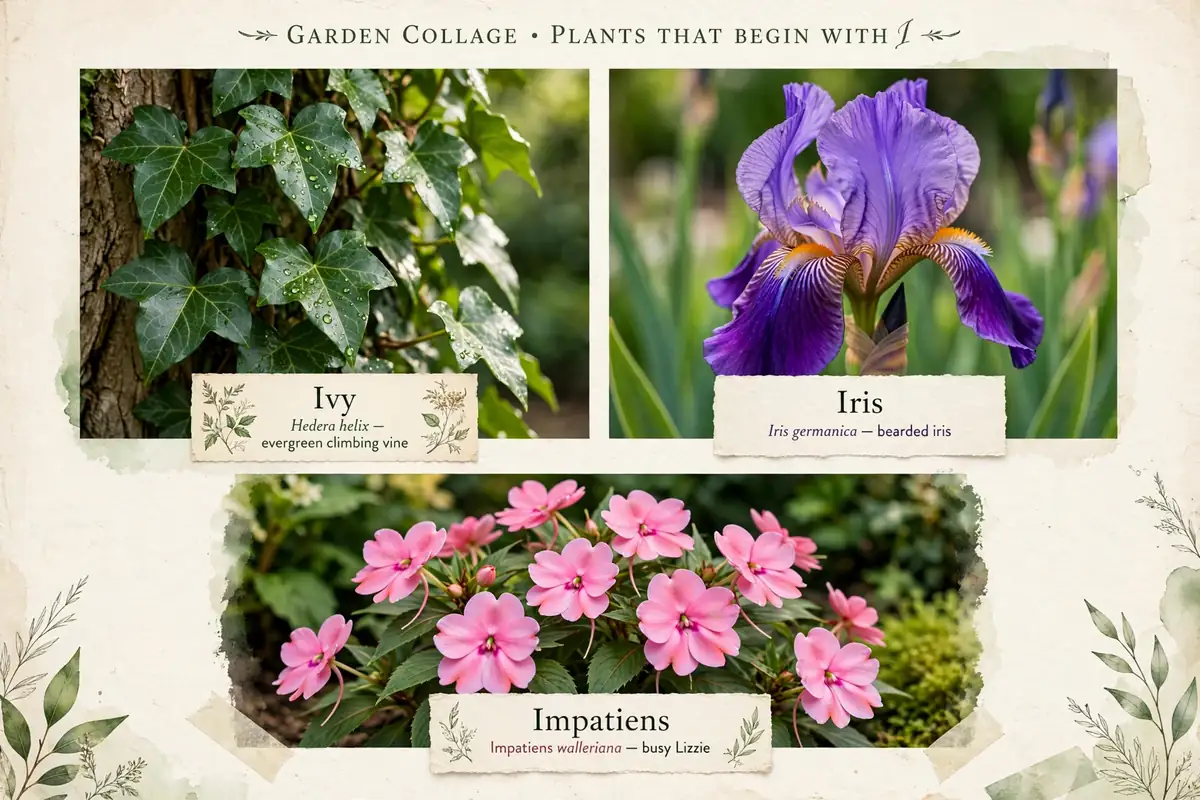
1. English Ivy (Hedera helix)
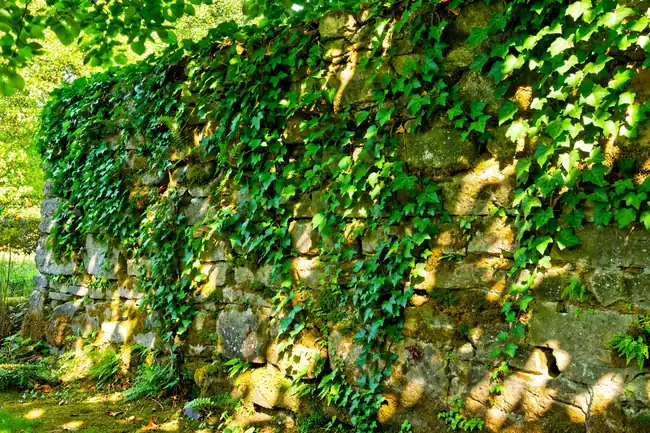
English ivy is the classic shade problem-solver — an evergreen vine whose glossy, lobed leaves climb walls, fences, and trellises on tiny aerial rootlets, or spread into a dense groundcover where grass refuses to grow. It stays green through winter in zones 4–9 and also makes an easy houseplant. One caution: it is aggressive and listed as invasive in parts of the Pacific Northwest and eastern US, so check local guidance and keep it pruned away from trees and gutters.
Light: Part to full shade | Water: Medium; drought tolerant once established | Zone: 4–9 | Best for: Shade groundcover, walls, indoor pots
2. Bearded Iris (Iris germanica)
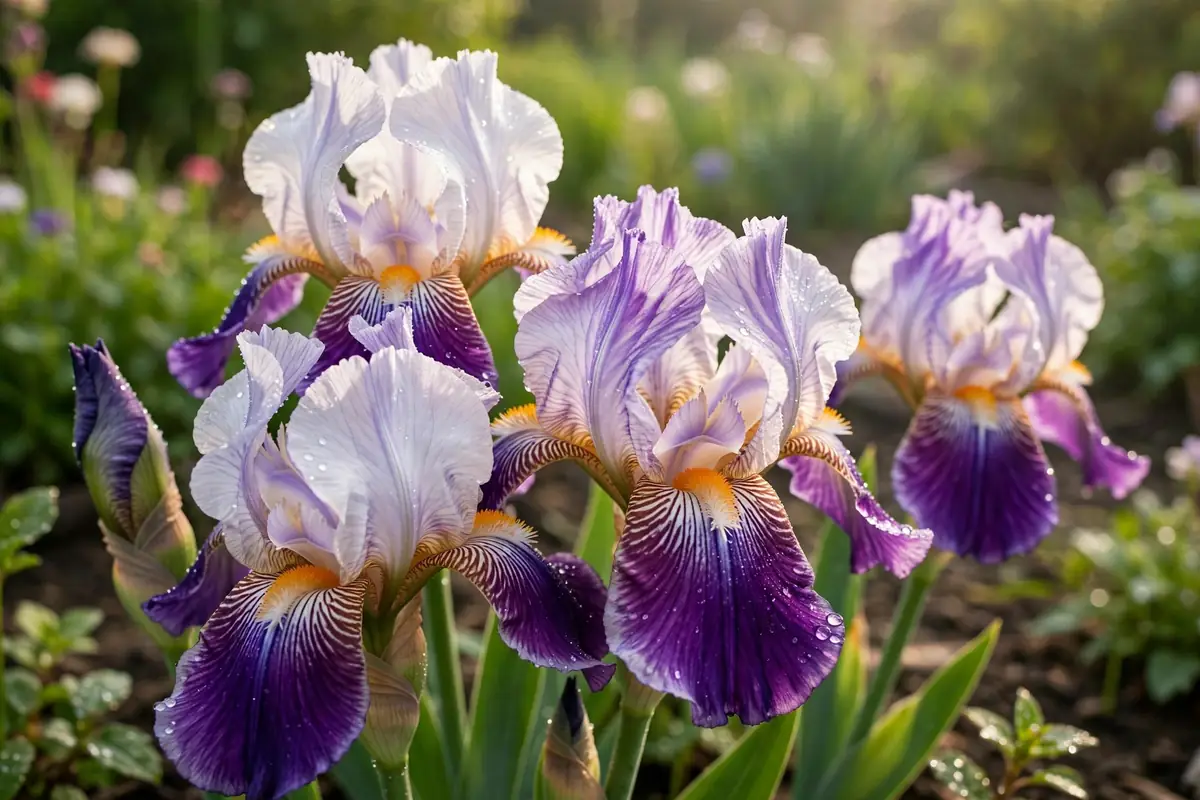
Bearded iris is the showpiece of the late-spring garden, with ruffled blooms in nearly every color — purple, blue, yellow, white, pink, and dramatic bicolors — rising above sword-like fans of foliage. The fuzzy “beard” on each lower petal gives it the name. Plant rhizomes shallowly in late summer with their tops exposed to the sun; burying them is the number-one cause of rot and bloom failure. Divide crowded clumps every 3–4 years after flowering to keep the show strong.
Light: Full sun | Water: Low to medium; dislikes soggy soil | Zone: 3–9 | Best for: Spring borders, cut flowers
3. Impatiens (Impatiens walleriana)
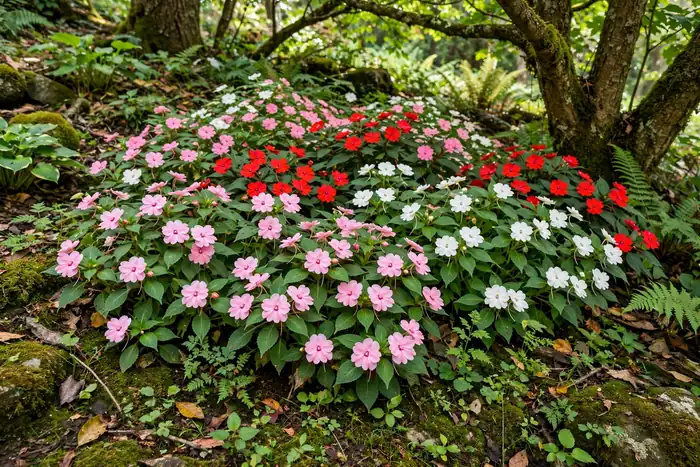
Impatiens are the undisputed champions of shade color, smothering themselves in pink, red, orange, purple, or white blooms from planting until frost. Native to East Africa, these tender annuals thrive where petunias and marigolds fade — under trees, on north-facing porches, and in hanging baskets. Note: impatiens downy mildew has wiped out plantings in some regions since 2011, so choose resistant varieties (like the Beacon series) in areas with a history of the disease, and keep foliage dry.
Light: Part to full shade | Water: Medium; keep evenly moist | Zone: Annual; 10–11 perennial | Best for: Shade beds, containers, hanging baskets
4. Indian Hawthorn (Rhaphiolepis indica)
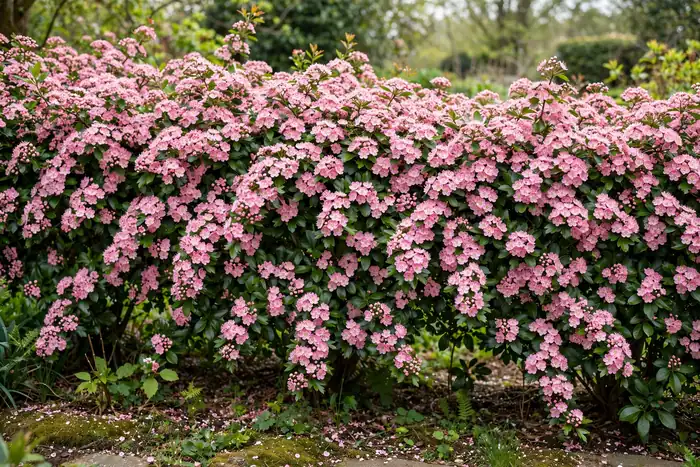
Indian hawthorn is a handsome evergreen shrub that earns its place in Southern gardens with clusters of pink or white starry flowers each spring, followed by blue-black berries birds love. Its leathery, dark-green leaves look tidy year-round with almost no pruning. It makes a reliable low hedge or foundation planting in zones 7–10, tolerating sun or part shade. Choose disease-resistant cultivars, since older varieties can suffer from Entomosporium leaf spot in humid climates.
Light: Full sun to part shade | Water: Medium | Zone: 7–10 | Best for: Evergreen hedges, foundation plantings
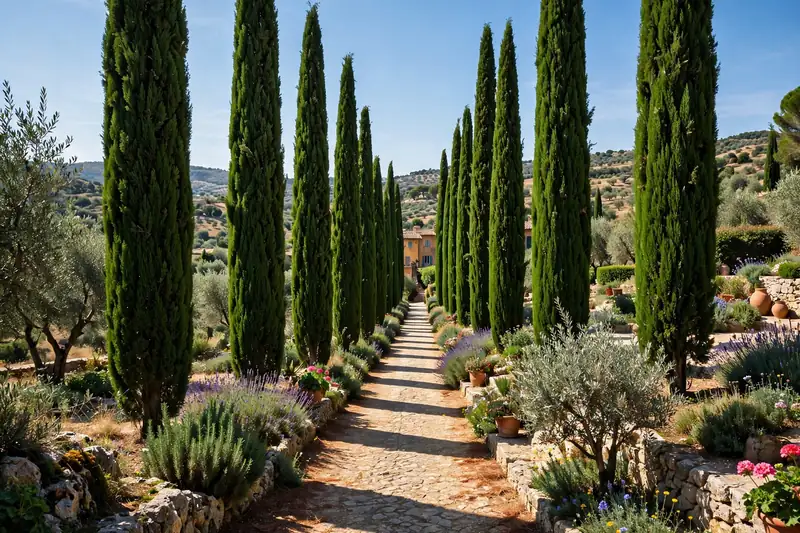
5. Italian Cypress (Cupressus sempervirens)
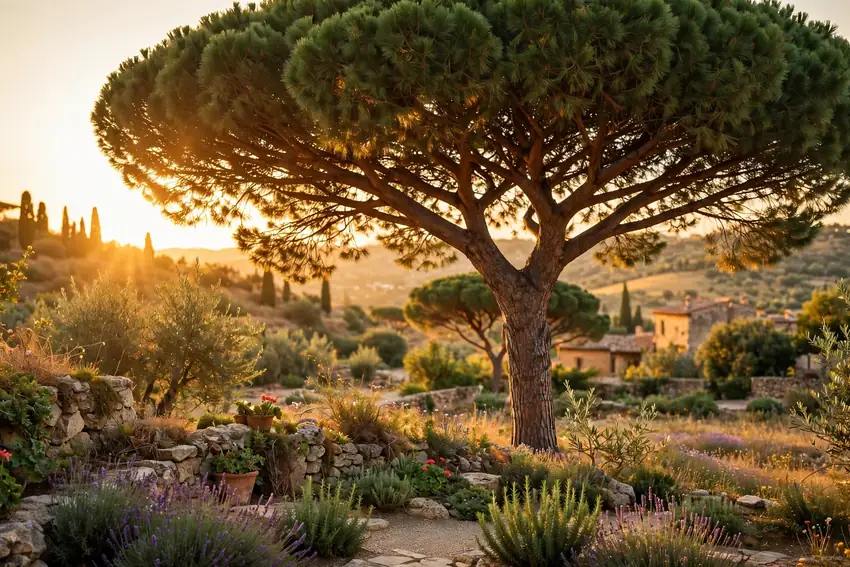
Italian cypress brings instant Mediterranean drama to the landscape — a pencil-thin column of dark-green foliage that can soar 40–60 feet while staying just 3–5 feet wide. Use it to frame entries, mark property lines, or punctuate formal gardens. It demands full sun and well-drained soil, and once established it shrugs off heat and drought. Give it room to grow tall, and avoid planting in heavy wet clay, which invites root problems.
Light: Full sun | Water: Low once established | Zone: 7–10 | Best for: Formal accents, privacy screens
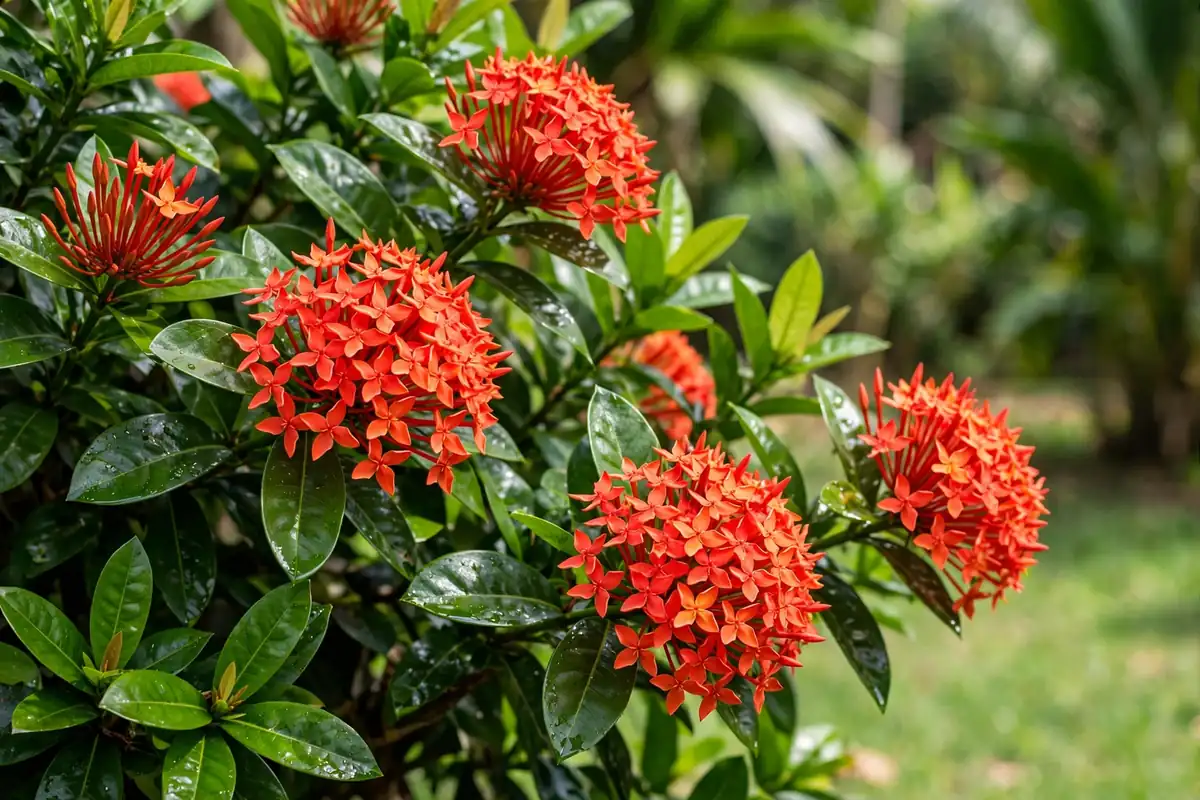
6. Ixora (Ixora coccinea)
Ixora is a tropical shrub that flowers almost nonstop in warm climates, producing dense, round clusters of red, orange, pink, or yellow tubular blooms against glossy evergreen leaves. A staple of Florida and Hawaiian landscaping, it makes a spectacular flowering hedge in zones 9–11. It wants acidic soil, regular moisture, and full sun to part shade. In colder regions, grow dwarf cultivars in pots and bring them indoors before frost.
Light: Full sun to part shade | Water: Medium; enjoys humidity | Zone: 9–11 | Best for: Tropical hedges, patio containers
7. Ice Plant (Delosperma cooperi)
Hardy ice plant is a succulent groundcover that erupts in neon magenta-pink daisy flowers all summer long. Its fleshy evergreen leaves glitter with tiny translucent dots — the “ice” that gives it its name. Native to South Africa, it demands full sun and extremely sharp drainage; wet winter soil kills it faster than cold. Let it spill over rock walls, slopes, and the edges of hot, dry beds in zones 5–9.
Light: Full sun | Water: Low; needs sharp drainage | Zone: 5–9 | Best for: Rock gardens, hot dry slopes
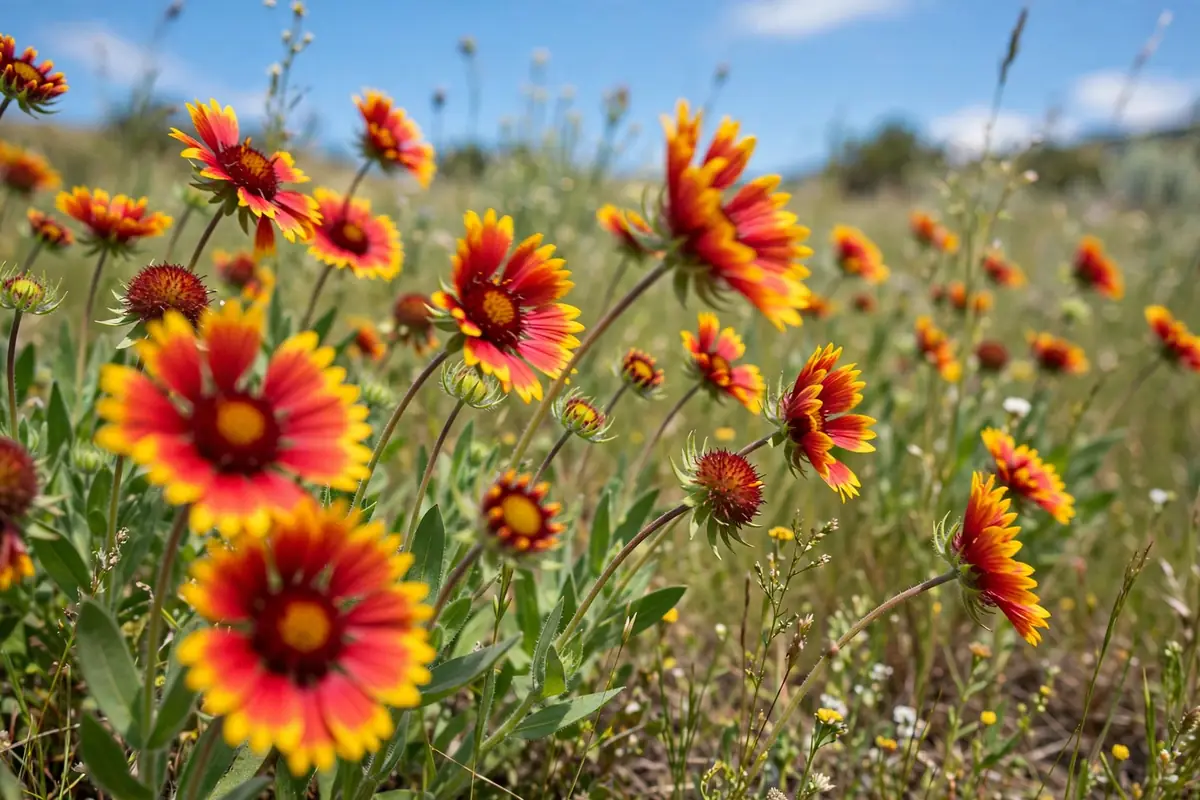
8. Indian Blanket (Gaillardia pulchella)
Indian blanket — the state wildflower of Oklahoma — paints prairies and roadsides in red-and-yellow bicolor daisies from early summer to frost. This cheerful native annual thrives on neglect: full sun, poor soil, and little water are all it asks. Sow seeds directly in spring where you want them, and deadhead or leave the seed heads for goldfinches. It reseeds freely, so plant once and enjoy colonies for years.
Light: Full sun | Water: Low; very drought tolerant | Zone: Annual; reseeds freely | Best for: Wildflower meadows, pollinator gardens
9. Inkberry (Ilex glabra)
Inkberry is the native evergreen shrub that gives boxwood a run for its money — dense, glossy, spineless leaves, a naturally rounded habit, and jet-black berries on female plants in fall. Unlike boxwood, it tolerates wet, even soggy soil, making it perfect for rain gardens and low spots. Plant a male pollinator nearby for the best berry display. It needs no shearing to look tidy in zones 4–9.
Light: Full sun to part shade | Water: Medium to wet | Zone: 4–9 | Best for: Native hedges, wet sites, boxwood alternative
10. Ironweed (Vernonia noveboracensis)
Ironweed is a towering native perennial that commands the late-summer garden with flat-topped clusters of intense, saturated purple flowers on stems 5–7 feet tall. Butterflies mob it, and its seeds feed goldfinches into fall. It loves moist soil and full sun in zones 4–9, naturalizing along pond edges and in rain gardens. Cut stems back by a third in early summer for shorter, bushier plants.
Light: Full sun | Water: Medium to wet | Zone: 4–9 | Best for: Native borders, butterfly gardens, rain gardens
11. Italian Arum (Arum italicum)
Italian arum is a shade garden treasure with an unusual rhythm: its arrow-shaped, cream-marbled leaves emerge in fall, stay handsome all winter, then die back as a pale spring flower gives way to a spike of glowing orange-red berries in summer. It thrives in dry shade where little else grows. Caution: all parts — especially the berries — are toxic if eaten, so site it away from play areas, and note it can self-sow enthusiastically.
Light: Part to full shade | Water: Medium; summer dormant | Zone: 5–9 | Best for: Winter-interest shade beds, dry shade
12. Ivy Geranium (Pelargonium peltatum)
Ivy geranium pairs ivy-shaped, slightly succulent leaves with cascading clusters of pink, red, lavender, or white blooms — the classic plant for window boxes, hanging baskets, and balcony railings. Native to South Africa, it blooms heaviest in full sun with soil that dries slightly between waterings. Grow as an annual in most of the US, or overwinter pots indoors in a bright, cool spot.
Light: Full sun | Water: Medium; let soil dry between waterings | Zone: 9–11; annual elsewhere | Best for: Hanging baskets, window boxes
13. New Guinea Impatiens (Impatiens hawkeri)
New Guinea impatiens upgrades the classic bedding impatiens with bigger, bolder blooms and handsome bronze-tinged foliage. Unlike its shade-only cousin, it tolerates — even enjoys — morning sun, flowering tirelessly until frost. It is also resistant to the downy mildew that troubles common impatiens. Grow as an annual in most regions, giving it consistent moisture and rich soil for the lushest display.
Light: Part shade to full sun | Water: Medium; consistent moisture | Zone: Annual; 10–11 perennial | Best for: Bold bedding color, large containers
14. Reticulated Iris (Iris reticulata)
Reticulated iris is one of the first flowers of spring — vivid violet-blue blooms with golden markings, just 4–6 inches tall, often opening through late snow. Plant the small bulbs in fall in sunny, sharply drained spots: rock gardens, pathway edges, and the fronts of borders. They need a dry summer rest to bloom reliably, so tuck them where summer irrigation won’t reach them.
Light: Full sun | Water: Low; dry summer rest | Zone: 5–9 | Best for: Rock gardens, earliest spring color
15. Japanese Iris (Iris ensata)
Japanese iris produces some of the most spectacular flowers in the garden — huge, flat blooms up to 8 inches wide in blue, purple, pink, and white, often intricately veined, in early summer. Unlike bearded iris, it craves moisture and acidic soil, thriving at pond edges and in boggy spots. Give it full sun to part shade in zones 4–9, and never let it dry out during bloom season.
Light: Full sun to part shade | Water: High; loves moist soil | Zone: 4–9 | Best for: Pond edges, rain gardens, cutting
16. Siberian Iris (Iris sibirica)
Siberian iris is the tough, no-fuss member of the iris family — graceful clumps of narrow foliage topped with slender blue, purple, or white blooms in late spring. It needs no staking, no dividing for years, and no coddling, thriving in zones 3–9 in sun or part shade. Deer leave it alone, and the upright seed heads add winter structure. A perfect perennial for low-maintenance borders.
Light: Full sun to part shade | Water: Medium to high | Zone: 3–9 | Best for: Easy perennials, deer-resistant borders
17. Indigo (Indigofera tinctoria)
True indigo is the plant behind history’s most famous blue dye — its leaves yield the deep blue pigment that colored denim and textiles for centuries. In the garden it is an attractive tender shrub with airy spikes of small pink pea-like flowers in summer. Grow it as an annual in most of the US (perennial in zones 9–11) in full sun and lean soil, and try your hand at a natural dye project with the foliage.
Light: Full sun | Water: Low to medium | Zone: 9–11; annual elsewhere | Best for: Dye gardens, historical plantings
18. Indian Shot (Canna indica)
Indian shot brings unapologetic tropical drama — bold, paddle-shaped green or bronze leaves and spikes of red-orange blooms on plants 3–6 feet tall. A single clump can anchor a summer border or fill a large container. It loves heat, full sun, and moist soil in zones 7–11; in colder regions, lift the rhizomes after frost and store them dry indoors for winter.
Light: Full sun | Water: Medium to high | Zone: 7–11; lift rhizomes elsewhere | Best for: Tropical focal points, large containers
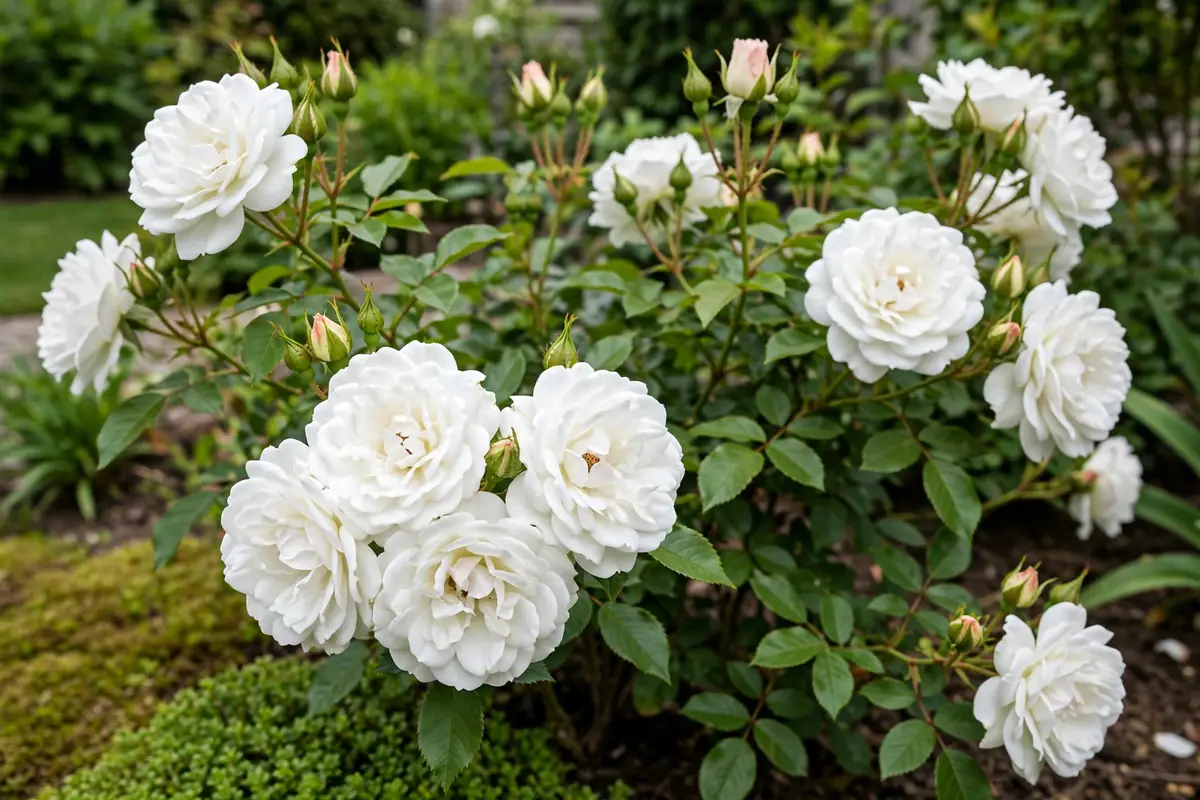
19. Iceberg Rose (Rosa ‘Iceberg’)
Iceberg is one of the world’s most beloved roses — and for good reason. This floribunda, introduced in 1958, covers itself in clusters of pure white, lightly fragrant double blooms from late spring until frost, on a vigorous, disease-resistant bush. It thrives in full sun in zones 5–10 and is far more forgiving than most roses. Deadhead spent clusters to keep the waves of bloom coming.
Light: Full sun | Water: Medium | Zone: 5–10 | Best for: White gardens, continuous rose color
20. Florida Anise (Illicium floridanum)
Florida anise is an underused native evergreen shrub with glossy, aromatic olive-green leaves and unusual maroon, star-shaped flowers in spring. It thrives in the deep shade and moist, acidic soil where many shrubs struggle, making it ideal for woodland gardens in zones 7–10. Deer won’t touch it. Note: despite the name, it is not the culinary star anise (Illicium verum) — its seeds are toxic.
Light: Part to full shade | Water: Medium to wet | Zone: 7–10 | Best for: Woodland gardens, deer-proof evergreens
21. Inland Sea Oats (Chasmanthium latifolium)
Inland sea oats is the rare ornamental grass that loves shade. Its broad leaves form graceful 2- to 4-foot mounds, and in late summer, dangling oat-like seed heads emerge — green, then copper, then tan — rattling softly in the breeze and lasting into winter. Native to eastern North America, it thrives in part shade in zones 5–9. It self-seeds readily, so deadhead if you want to contain it.
Light: Part shade | Water: Medium | Zone: 5–9 | Best for: Shade grasses, winter interest, dried arrangements
22. Italian Stone Pine (Pinus pinea)
Italian stone pine is the iconic umbrella-shaped tree of the Mediterranean, maturing into a broad, flat-topped canopy on a stout trunk. It produces the edible pine nuts used in pesto, though trees take many years to bear. Slow-growing but extremely long-lived, it needs full sun, sharp drainage, and plenty of room in zones 8–11 — a legacy tree for large, warm-climate landscapes.
Light: Full sun | Water: Low once established | Zone: 8–11 | Best for: Mediterranean landscapes, specimen trees
23. Ixia (Ixia spp.)
Ixia, or corn lily, is a South African bulb that produces wiry stems topped with starry, six-petaled blooms in some of the brightest colors in the garden — magenta, scarlet, orange, yellow, and white, often with contrasting dark centers. Blooming in late spring, it loves full sun and a dry summer rest in zones 8–10. Plant corms in fall in drifts for a jewel-box effect, or grow in pots.
Light: Full sun | Water: Low to medium; dry summer rest | Zone: 8–10 | Best for: Bright spring bulbs, containers
24. Indian Mallow (Abutilon spp.)
Indian mallow, also called flowering maple for its maple-like leaves, dangles lantern- or bell-shaped blooms in red, orange, yellow, pink, or white nearly year-round in warm climates. Hummingbirds adore it. In zones 8–11 it grows as a loose, airy shrub; elsewhere, grow it in pots and overwinter indoors in bright light. Give it sun to part shade and pinch tips to keep it bushy.
Light: Full sun to part shade | Water: Medium | Zone: 8–11; annual elsewhere | Best for: Hummingbird gardens, patio pots
25. Ironwood (Carpinus caroliniana)
Ironwood — better known as American hornbeam — is a small native understory tree prized for its smooth, fluted gray bark that looks like flexed muscles. Growing slowly to 20–30 feet, it tolerates deep shade and wet soil where few trees thrive, and its foliage turns glowing orange-red in fall. Extremely hard wood once made it a favorite for tool handles. Plant it as a woodland specimen in zones 3–9.
Light: Part to full shade | Water: Medium | Zone: 3–9 | Best for: Woodland gardens, native shade trees
26. Virginia Sweetspire (Itea virginica)
Virginia sweetspire is a native deciduous shrub that delivers two seasons of glory: fragrant white bottlebrush flower spikes in early summer, then some of the best red fall foliage of any shrub. It suckers gently into handsome colonies and tolerates wet soil, making it perfect for rain gardens and stream banks in zones 5–9. Give it sun for the heaviest bloom, or part shade for woodland edges.
Light: Full sun to part shade | Water: Medium to wet | Zone: 5–9 | Best for: Rain gardens, fall color, native shrubs
27. Italian Jasmine (Jasminum humile)
Italian jasmine — also called yellow jasmine — covers itself in clusters of fragrant, sunny-yellow blooms in late winter and spring, right when the garden needs cheer most. This scrambling evergreen shrub from the Himalayas can be kept as a 6- to 8-foot bush or trained up a trellis in zones 7–11. Give it sun to part shade and prune after flowering to keep it shapely.
Light: Full sun to part shade | Water: Medium | Zone: 7–11 | Best for: Fragrant winter-spring color, trellises
28. Ice Plant ‘Jewel of Desert’ (Delosperma ‘Jewel of Desert’)
The Jewel of Desert series takes hardy ice plant to the next level, with compact mounds smothered in bicolor daisy blooms — ruby, garnet, topaz, moonstone, and more — from late spring through fall. Like the species, it demands full sun and razor-sharp drainage in zones 5–9, and rewards neglect with months of neon color. Superb for rock gardens, green roofs, and the hottest, driest spots in the yard.
Light: Full sun | Water: Low; sharp drainage essential | Zone: 5–9 | Best for: Extended succulent color, green roofs
29. SunPatiens Impatiens (Impatiens × hybrida ‘SunPatiens’)
SunPatiens rewrote the rules for impatiens: these vigorous hybrids thrive in full sun as well as shade, shrug off heat that melts ordinary impatiens, and resist downy mildew. Mounding plants bloom nonstop in vivid pinks, reds, oranges, and whites until frost. They are thirstier than advertised, so give them consistent moisture and rich soil, and they will reward you with the longest color season of any bedding plant.
Light: Full sun to part shade | Water: Medium; consistent moisture | Zone: Annual; 10–11 perennial | Best for: Sun-or-shade bedding, nonstop color
30. Iris ‘Immortality’ (Iris germanica ‘Immortality’)
Iris ‘Immortality’ earns its name by blooming twice — fragrant, ruffled white flowers in late spring, then an encore in late summer and fall. This reblooming bearded iris grows like the classic type: shallow-planted rhizomes, full sun, and well-drained soil in zones 3–9. For the best rebloom, water during summer dry spells and snip spent stalks promptly after the spring show.
Light: Full sun | Water: Low to medium | Zone: 3–9 | Best for: Two seasons of iris blooms, white gardens
31. Indian Paintbrush (Castilleja coccinea)
Indian paintbrush lights up spring meadows with scarlet-red bracts that look like dipped paintbrushes tipping each stem. This eastern native wildflower is hemiparasitic — its roots tap neighboring grasses for nutrients — so it establishes best sown among native grasses in lean, unfertilized soil. Give it full sun in zones 4–8, never transplant established plants, and let it self-sow for returning colonies.
Light: Full sun | Water: Low; never fertilize | Zone: 4–8 | Best for: Native meadows, wildflower gardens
32. Inkberry ‘Shamrock’ (Ilex glabra ‘Shamrock’)
Inkberry ‘Shamrock’ is the compact, well-behaved form of the native inkberry — a dense, naturally rounded evergreen mound just 3–4 feet tall, with small glossy leaves that need no shearing. It keeps the species’ tolerance for wet soil and shade, making it one of the best low native hedges for zones 4–9. Plant several for a tidy evergreen border, with a male pollinator nearby for berries.
Light: Full sun to part shade | Water: Medium to wet | Zone: 4–9 | Best for: Low evergreen hedges, foundation plantings
33. Ivy ‘Goldchild’ (Hedera helix ‘Goldchild’)
Ivy ‘Goldchild’ brightens the shadiest corners with small, lobed leaves edged in glowing gold — a variegated English ivy that practically glows against dark mulch or stone. It climbs or trails like the species but a bit more slowly, and the gold edges hold best with a touch of morning sun. Use it in containers, as a groundcover, or trained up a small trellis in zones 4–9.
Light: Part to full shade | Water: Medium | Zone: 4–9 | Best for: Brightening shade, containers, small trellises
34. Italian Bellflower (Campanula isophylla)
Italian bellflower is a trailing charmer from the cliffs of northern Italy, spilling over pot edges in cascades of starry blue or white bell blooms from summer into fall. It loves part shade, consistent moisture, and cool roots — perfect for hanging baskets and shaded window boxes in zones 7–10. In colder regions, grow it as a houseplant in a bright window, where it blooms for months.
Light: Part shade | Water: Medium; keep evenly moist | Zone: 7–10 | Best for: Hanging baskets, houseplants
35. Indian Bean Tree (Catalpa bignonioides)
Indian bean tree — the southern catalpa — is a fast-growing native shade tree with huge heart-shaped leaves, showy upright clusters of white orchid-like flowers in early summer, and foot-long slender pods that dangle through winter. It reaches 30–50 feet in zones 5–9 with almost no care, tolerating heat, drought, and poor soil. Give it room: the pods and large leaves make it a bit messy for small patios.
Light: Full sun | Water: Medium | Zone: 5–9 | Best for: Fast shade, native trees, wildlife gardens
Growing Tips for I-Plants
With 35 very different I-plants on this list — from tropical shrubs to hardy native trees — a few guiding principles will help you succeed with whichever ones you choose.
Match the plant to your zone first. Hardy workhorses like bearded iris, Siberian iris, inkberry, ironweed, ironwood, and English ivy sail through freezing winters in zones 3–5. Tropical I-plants — ixora, indigo, Indian mallow, and Indian shot — are strictly warm-climate plants (zones 8–11); everywhere else, grow them in pots you can move indoors or treat them as summer annuals. Impatiens and SunPatiens are annuals almost everywhere.
Sort by sun before you plant. The I-list splits neatly: shade lovers (English ivy, impatiens, Italian arum, inland sea oats, ironwood, Florida anise, Italian bellflower) belong under trees and on north sides, while sun worshippers (ice plant, Indian blanket, ironweed, Italian cypress, ixia, bearded iris, Indian paintbrush) need at least six hours of direct light. Planting a shade plant in blazing sun — or vice versa — is the most common reason new plantings fail.
Drainage decides life or death for the succulents and bulbs. Ice plant, Jewel of Desert, reticulated iris, and ixia all demand sharp drainage and will rot in heavy, wet soil — plant them in raised beds, rock gardens, or sandy amended soil, and ease off summer water for the bulbs. At the other extreme, Japanese iris, inkberry, and Virginia sweetspire genuinely enjoy wet feet, so don’t be shy about siting them in low, moist spots.
Respect the enthusiastic spreaders. English ivy and Italian arum can both outgrow their welcome — ivy climbs and smothers, while arum self-sows. Check whether ivy is listed as invasive in your state before planting it outdoors, and deadhead arum’s berry spikes if you don’t want seedlings. Inland sea oats and Indian blanket also self-sow freely; deadhead if you want tidy borders, or let them roam in naturalized areas.
Feed lightly and deadhead the bloomers. Most I-plants — especially natives like ironweed, Indian blanket, and Indian paintbrush — prefer lean soil and need no fertilizer at all; rich feeding produces floppy growth. Save your efforts for deadheading: snipping spent blooms on Iceberg rose, iris ‘Immortality’, ixora, and impatiens keeps new flowers coming for months.
Which I-Plants Will You Grow?
From the shade-draping English ivy to the sun-blazing Indian blanket, plants that start with I cover every corner of the garden — vines, bulbs, perennials, shrubs, grasses, and trees across USDA zones 3 through 11. Start with easy winners matched to your conditions: impatiens or ivy for shade, Siberian iris or inkberry for low-maintenance borders, ice plant for hot dry spots, or an Iceberg rose for months of white blooms. Pick three or four favorites from this list, give each the right spot, and the letter I will fill your garden with color from snowmelt to frost.
Frequently Asked Questions
What plants start with I?
Thirty-five great plants start with I, including English ivy, bearded iris, impatiens, Indian hawthorn, Italian cypress, ixora, ice plant, Indian blanket, inkberry, ironweed, Italian arum, ivy geranium, New Guinea impatiens, Japanese and Siberian iris, indigo, canna (Indian shot), Iceberg rose, inland sea oats, Italian stone pine, ixia, ironwood, itea, Italian jasmine, Indian paintbrush, Italian bellflower, and Indian bean tree. This guide covers all 35 with growing details.
What indoor plants start with I?
Good indoor I-plants include English ivy and ivy ‘Goldchild’ (easy trailing houseplants for bright indirect light), Italian bellflower (blooms for months in a bright window), and Indian mallow (overwinter pots indoors). In warm climates, ixora and ivy geranium also thrive as patio plants brought inside for winter.
What trees start with the letter I?
Trees that start with I include Italian cypress (narrow evergreen column, zones 7–10), Italian stone pine (umbrella canopy, zones 8–11), Indian bean tree (fast-growing native shade tree, zones 5–9), and ironwood (small native understory tree, zones 3–9). Italian cypress suits formal designs, while Indian bean tree and ironwood are excellent native choices.
What shrubs start with I?
Shrubs beginning with I include Indian hawthorn, inkberry (and compact ‘Shamrock’), Florida anise (Illicium), Virginia sweetspire (Itea), Italian jasmine, and ixora. Inkberry and Virginia sweetspire are top native picks for eastern US gardens, Indian hawthorn is a Southern evergreen staple, and ixora shines in frost-free climates.
Which plants that start with I grow in shade?
Shade-tolerant I-plants include English ivy, impatiens, New Guinea impatiens, Italian arum, inland sea oats (one of few shade grasses), ironwood, Florida anise, Italian bellflower, and ivy ‘Goldchild’. For deep shade, lean on ivy, arum, and Florida anise; for part shade with flowers, try impatiens and Italian bellflower.
Which I-plants are best for beginners?
Beginner-friendly I-plants include English ivy (nearly indestructible in shade), impatiens and SunPatiens (instant shade color), Siberian iris (tough perennial needing no staking or dividing), inkberry (easy native evergreen), ice plant (thrives on neglect in sun), and Indian blanket (sow and enjoy). All forgive missed waterings and beginner mistakes.