Black Bat Flower: Types, Meaning and How to Grow It
Most flowers compete to be the brightest thing in the garden. The black bat flower does the opposite — it is the one bloom guests cross the room to stare at, a near-black flower shaped like a bat in flight, with whiskers trailing beneath it like something out of a gothic fairy tale. It does not shout for attention. It does not need to. In a genus full of loud colour, Tacca chantrieri wins by being the darkest, strangest thing on the bench.
This guide covers the black bat flower itself, its white cousin and the rest of the small Tacca genus, what the flower means in a modern garden, and the honest care it demands — because this is a plant that rewards patience and punishes guesswork, and knowing which is which before you buy one saves two years of waiting.
Quick Answer
The black bat flower is Tacca chantrieri, a tropical perennial in the yam family Dioscoreaceae from the rainforest understory of Southeast Asia, famous for near-black, bat-shaped blooms up to 12 inches across with long whisker-like bracts hanging beneath them. It needs bright indirect light, 60–80% humidity, warm temperatures above 55°F (zones 9–11 outdoors, a houseplant everywhere else), and rich, moist, well-drained soil — and it usually takes 18–24 months and at least two mature leaves before it flowers at all. All parts contain calcium oxalate crystals, so keep it away from pets and children.
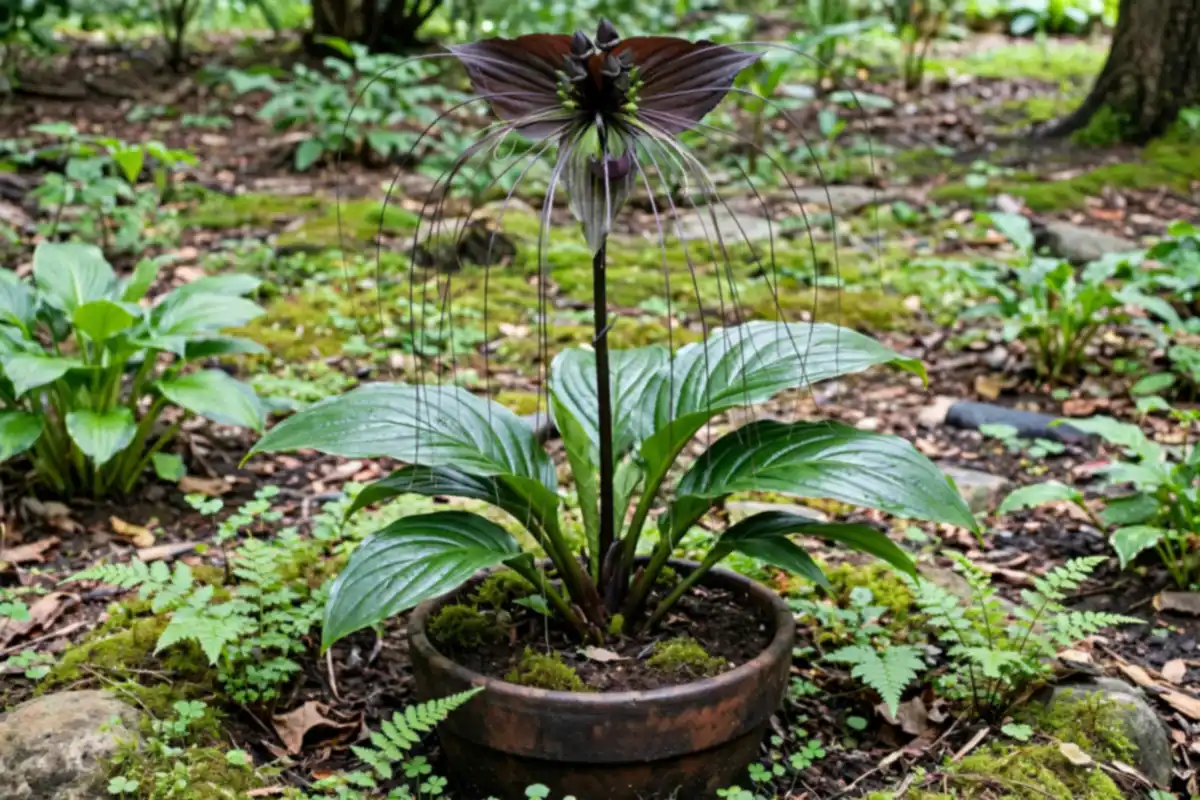
Table of Contents
- What Is a Black Bat Flower?
- Types of Bat Flowers Worth Knowing
- Black Bat Flower Meaning and Symbolism
- Black Bat Flower Colours and Their Meanings
- How to Grow Black Bat Flowers
- Common Mistakes When Growing Black Bat Flowers
- Black Bat Flower vs White Bat Flower
- Frequently Asked Questions
What Is a Black Bat Flower?
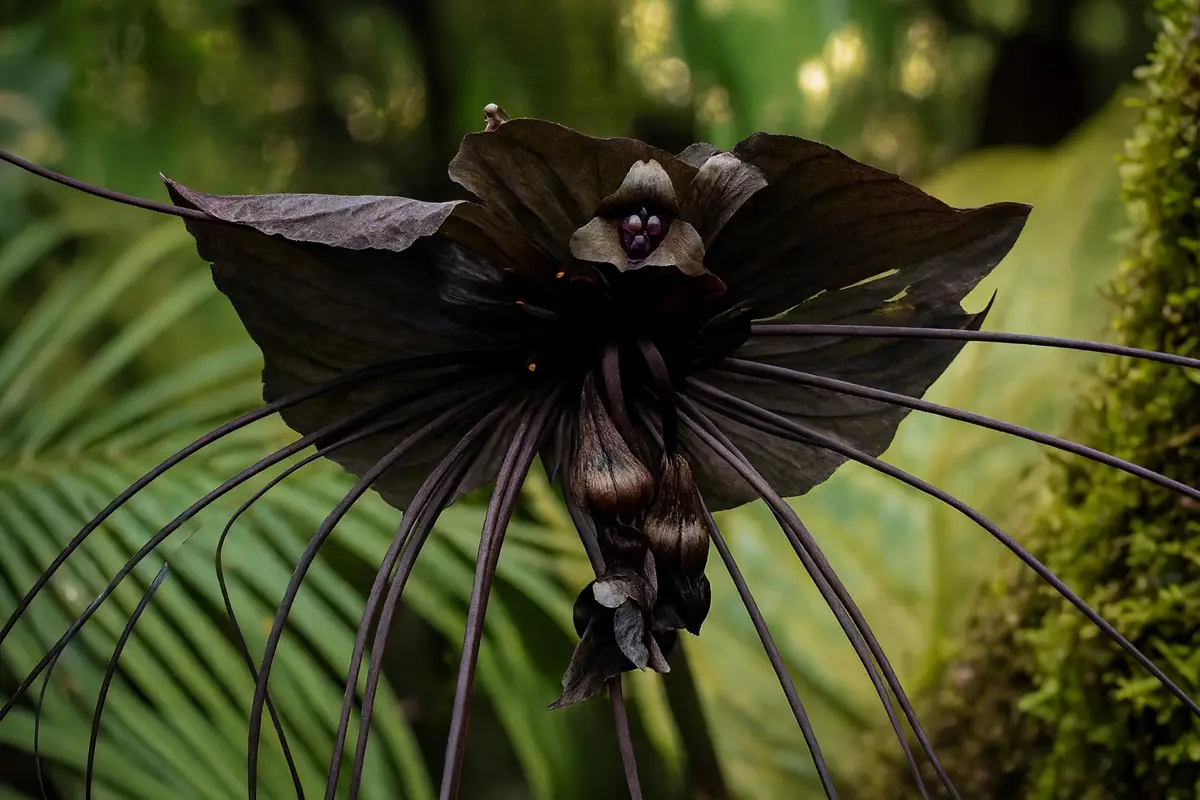
Start with the name, because every part of it is doing work. The “bat” is the pair of broad, wing-like bracts that spread above the flower like a bat in flight. The “black” is the deep purple-black colour of the whole display — one of the darkest flowers in cultivation, a genuine near-black rather than a very dark purple pretending. And the whiskers are the thirty or so thread-like bracteoles that hang 8 to 10 inches below the bloom, which is why the plant is also called cat’s whiskers and devil flower. You can read more on the Tacca chantrieri page on Wikipedia.
Botanically it is Tacca chantrieri, first described in 1901 by the French horticulturist Édouard André and named for Chantrier Frères, nurserymen of Mortefontaine in France. The genus name Tacca comes from the Malayan vernacular taka, meaning arrowroot — a reminder that this dramatic ornamental sits in the yam family, Dioscoreaceae, alongside food plants. The genus holds around 16 species, scattered through the tropics of Asia, Africa, Australia and the Pacific, and nearly all of them share the same trick: dark flowers, wing-like bracts and whiskers.
In the wild it lives where almost no garden flower would choose to: the deep shade of humid Southeast Asian rainforest, from Assam and Bangladesh through Myanmar, Thailand, Laos, Vietnam and Cambodia into southern China, Hainan and northern Peninsular Malaysia. It grows from an underground rhizome under the canopy, in filtered light and air that rarely dries out. Everything about growing it well is a translation of that one address — shade, warmth, moisture — into a pot or a sheltered garden bed. For the full list of flower names, see our flower names A to Z guide.
Look closely at a bloom and the bat dissolves into architecture. At the centre sits a cluster of small, dark, five-petalled flowers, like a knot of berries. Above them spread two pairs of large bracts, the “wings”. Below them hang the whiskers. The whole inflorescence can reach 12 inches across, carried on a slender stalk about 20 inches tall above broad, glossy, dark-green leaves. The flowers open green and deepen to dark purple-black as they mature — so a plant in bloom carries several shades of the same drama at once.
Black Bat Flower Quick Facts
- Botanical name: Tacca chantrieri (black bat flower, devil flower, cat’s whiskers).
- Family: Dioscoreaceae, the yam family, order Dioscoreales.
- Native range: rainforest understory of Southeast Asia — Thailand, Malaysia, southern China, Vietnam, Laos, Myanmar, Cambodia, Bangladesh, Assam.
- Hardiness: USDA zones 9–11 outdoors; a houseplant or conservatory plant everywhere else. No frost tolerance — keep above 55°F (13°C).
- Height and spread: 2–3 feet tall (60–90 cm), 1–2 feet wide, sometimes wider.
- Bloom time: spring to early fall (April to July in its native range); up to 8 blooms a season on a mature plant.
- Light: bright indirect light or dappled shade — orchid light, about 40–60% shade outdoors.
- Good to know: first flowering takes 18–24 months and at least two mature leaves; the plant is self-pollinating; all parts contain calcium oxalate and irritate skin and mouth if chewed.
Types of Bat Flowers Worth Knowing
The black bat is the famous one, but it has a pale twin and a handful of lesser-known cousins. The differences matter at the nursery, because the white kind is often sold beside the black one and the two want nearly identical care but give very different gardens.
1. Black Bat Flower — the Original
Tacca chantrieri, the plant this guide is about: the darkest blooms in the genus, deep purple-black to chocolate brown, with the full wing-and-whisker display at its most dramatic. It is also the most common and easiest bat flower to find, which is fortunate, because it is the one most people picture when they hear the name. A mature plant can flower up to eight times in a single season, usually from summer into early winter in North American growing, with each bloom holding for weeks.
2. White Bat Flower — the Pale Twin
Tacca integrifolia, the white bat flower: the same bat-shaped architecture in white bracts with purple-black flowers at the centre — a ghost of the black kind, and in a dim corner arguably even more striking, because the white wings catch what little light the shade offers. It was described in the early 1800s, before its black cousin, and it wants the same shade, humidity and warmth. If the black bat is the Halloween plant, the white bat is the moon-garden plant — it belongs in the same evening planting as our moon flower guide.
3. The Rest of the Genus — Arrowroot and Oddities
The remaining dozen or so Tacca species are mostly collector’s plants, but one is worth knowing by name: Tacca leontopetaloides, Polynesian arrowroot, grown for centuries across the Pacific for its starchy rhizomes rather than its flowers. It is the practical cousin that explains the genus name. The rest — greenish, brownish, smaller-flowered kinds — rarely reach nurseries, and a seller offering an unlabelled “bat flower” is almost always selling chantrieri or integrifolia. If the label says neither, ask before paying.
Black Bat Flower Meaning and Symbolism
Honesty first: the black bat flower has no old Victorian floriography entry, because it reached Western gardens too late for that game — it was only described in 1901, and it spent most of the twentieth century as a botanical curiosity rather than a florist’s flower. Anyone selling you a centuries-old “traditional meaning” is inventing it. What it has instead is a modern meaning, built in plain sight: mystery, individuality, and the courage to be unlike everything else in the border.
That modern meaning writes itself. A near-black flower in a world of bright petals reads as a deliberate choice — the gardener who grows one is saying they value the strange over the safe. In Malaysia it is called the devil flower, and strange, fascinating stories surround it; in a Western garden it has become the Halloween plant by acclamation, the bloom people buy in October for a gothic table or a spooky-season border. It also carries a quieter meaning for the patient: a plant that makes you wait two years for a flower teaches a different kind of gardening, one measured in seasons rather than weekends.
Give black bat flowers to the person who collects the unusual — the friend with the odd art, the black thumb who secretly loves drama, the gardener who already owns everything obvious. It is a poor choice for a get-well bouquet or a cheerful congratulations; it is exactly right for “you are unlike anyone I know, and I mean that as praise.”
Black Bat Flower Colours and Their Meanings
- Near-black / deep purple-black — mystery and individuality: the classic chantrieri bloom, the colour that names the plant.
- Dark maroon and chocolate brown — the same flower in warmer light, or a younger bloom still deepening; drama with a softer edge.
- Green — the colour every bat flower wears first: fresh blooms open green and darken over days, so green means a flower just beginning.
- White — the white bat flower, integrifolia: the same shape in negative, ghostly in shade, and the better choice for a dark corner that needs light rather than more dark.
How to Grow Black Bat Flowers
The whole syllabus is one sentence: recreate a Southeast Asian forest floor in a pot. Shade, warmth, humidity, rich soil that stays moist but never soggy. Gardeners on r/gardening on Reddit pass on the placement rule as a warning label: treat it like an orchid that lives on the ground, and it will forgive almost everything else.
Light and Position
Bright, indirect light is the target — the dappled light under a tree canopy, an east-facing window, or a shaded patio. Direct midday sun scorches the broad leaves, and deep dark corners starve it. Outdoors it wants roughly 40–60% shade. Indoors, a spot a few feet from a bright window, or under a sheer curtain, is about right. If the leaves are lush and green but no flowers come, too little light is one of the first suspects; if the leaf edges crisp and bleach, too much sun is the likelier one.
Water, Humidity and Temperature
Keep the soil consistently moist but never waterlogged, letting the top inch dry slightly between waterings — wet feet rot the rhizome, dry soil stalls the plant. Humidity is where this plant is genuinely demanding: 60–80% is the target, and most homes sit closer to 35%, so a humidifier or a pebble tray under the pot is not a luxury, it is the plan. Misting helps for an afternoon; it does not fix a dry house. Keep temperatures between 70 and 85°F through the growing season and never below 55°F; cold drafts and frost are the fastest way to lose one. In zones 9–11 it can live outdoors year-round in shade; everywhere else it is a container plant that summers outside in shelter and winters indoors.
Soil, Feeding and Repotting
Plant in a rich, airy, organic mix with excellent drainage — peat or coir plus perlite plus compost is the usual recipe — in a pot with real drainage holes. Feed with a balanced, water-soluble fertiliser at half strength every two to four weeks from spring through summer, and stop or halve it in winter. Repot only in spring, and never while the plant is in bloom: disturbing a flowering bat plant is the classic way to lose the flower you waited two years for. Pot up one size at a time; a slightly snug pot flowers sooner than a mansion.
Common Mistakes When Growing Black Bat Flowers
Mistake one is direct sun — the forest-floor plant scorches in a south-facing window or an open bed, and scorched leaves do not heal. Mistake two is dry air: brown leaf edges in an otherwise healthy plant are almost always humidity, not watering, and no amount of extra water fixes air. Mistake three is the opposite error, waterlogging — heavy soil and a saucer full of standing water rot the rhizome faster than drought ever could. Mistake four is cold: a night below 55°F, a winter windowsill draught, a forgotten plant left out in the first frost. And mistake five is impatience — repotting, moving or dividing a young plant that has not flowered yet, resetting the two-year clock. The plant’s own schedule is the schedule; the gardener’s job is to hold the conditions steady and wait.
Black Bat Flower vs White Bat Flower
Both are Tacca, both want the same shade, humidity and warmth, and both take their time to flower. Black bat (chantrieri): bracts deep purple-black, the darker and more dramatic display, the more common and easier to find, the Halloween plant. White bat (integrifolia): bracts white with dark flowers at the centre, brighter in shade, slightly less common in nurseries, the better choice for a dim corner. Neither is hardier or easier than the other; the choice is purely visual — darkness or ghostlight — and many collectors eventually grow both side by side, which is the correct answer if you have the humidity for two.
Frequently Asked Questions
Is the black bat flower really black?
Nearly. The blooms are a very deep purple-black to chocolate brown — the darkest flowers in ordinary cultivation — and they open green before deepening, so a plant in bloom shows the whole range at once. In dim light they read as truly black. If your question is not answered here, the questions about the black bat flower on Quora cover most of the rest.
Is the black bat flower poisonous?
Yes, treat it as toxic. All parts contain calcium oxalate crystals (and related compounds called taccalonolides) that irritate skin and mouth if chewed, and it may be harmful to cats and dogs if ingested. It is also a plant with a long history in traditional Chinese medicine — but those are purported uses, not a reason to taste it. Keep it out of reach of pets and children, wash your hands after handling, and enjoy it as a look-don’t-eat plant.
Why won’t my black bat flower bloom?
The three usual reasons, in order: it is too young, it has too little light, or the air is too dry. A plant needs at least two mature leaves and roughly 18–24 months before it flowers at all, and a mature plant then flowers up to eight times a season. If yours is old enough and still sulking, give it brighter indirect light and raise the humidity toward 60–80% — and do not repot it while you wait, which only restarts the clock.
Can I grow a black bat flower indoors?
Yes — outside zones 9–11, indoors is the only way. It makes a fine houseplant provided you can give it bright indirect light, warm air above 55°F, and real humidity: a bathroom with a window, a humidifier, or a pebble tray. It will not thrive on a dry, centrally heated shelf, however much you water it.
How big does a black bat flower get?
About 2–3 feet tall and 1–2 feet wide, sometimes wider. The flower stalk rises around 20 inches, the winged bracts span roughly 12 inches tip to tip, and the whiskers hang another 8–10 inches below them — so the bloom is bigger than the pot it came in, which is part of the shock.
Where does the black bat flower grow in the wild?
In the moist, shaded understory of Southeast Asian rainforests — Thailand, Malaysia, southern China, Vietnam, Laos, Myanmar, Cambodia, Bangladesh and Assam. It is a plant of the forest floor, not the canopy, which is exactly why it wants shade and humidity from you. It is also one of the strangest flowers in our weirdest flowers collection, and it earns its place there.