Protea Flower: Types, Meaning and How to Grow It
Some flowers look designed; the protea looks forged. A great artichoke of coloured bracts opens into a pincushion dome of hundreds of thread-like blooms, on shrubs descended from one of the oldest flowering lineages on Earth — a family that was already flowering when the continents were one. It is South Africa’s national flower, Australia’s adopted cut-flower royalty, and the bloom florists reach for when an arrangement needs architecture and nerve at the same time.
This guide covers the six proteas worth knowing (the king, the queen, the pincushions and the blushing bride), what it means — courage, transformation and diversity — and the one nutrient that kills it with kindness: phosphorus, the fertiliser ingredient nearly every other plant begs for.
Quick Answer
The protea is Protea, a genus of some 115 species of evergreen shrubs in the ancient family Proteaceae, centred on South Africa’s Cape Floristic Region, bearing large, chalice-shaped flower heads of coloured bracts around a central dome of true flowers. Proteas grow outdoors in USDA zones 9 to 12 (a few kinds stretch to zone 8), need full sun, acidic-to-neutral, sharply drained and very low-phosphorus soil, and are grown elsewhere as greenhouse or cut-flower plants. The protea means courage, transformation, diversity and daring.
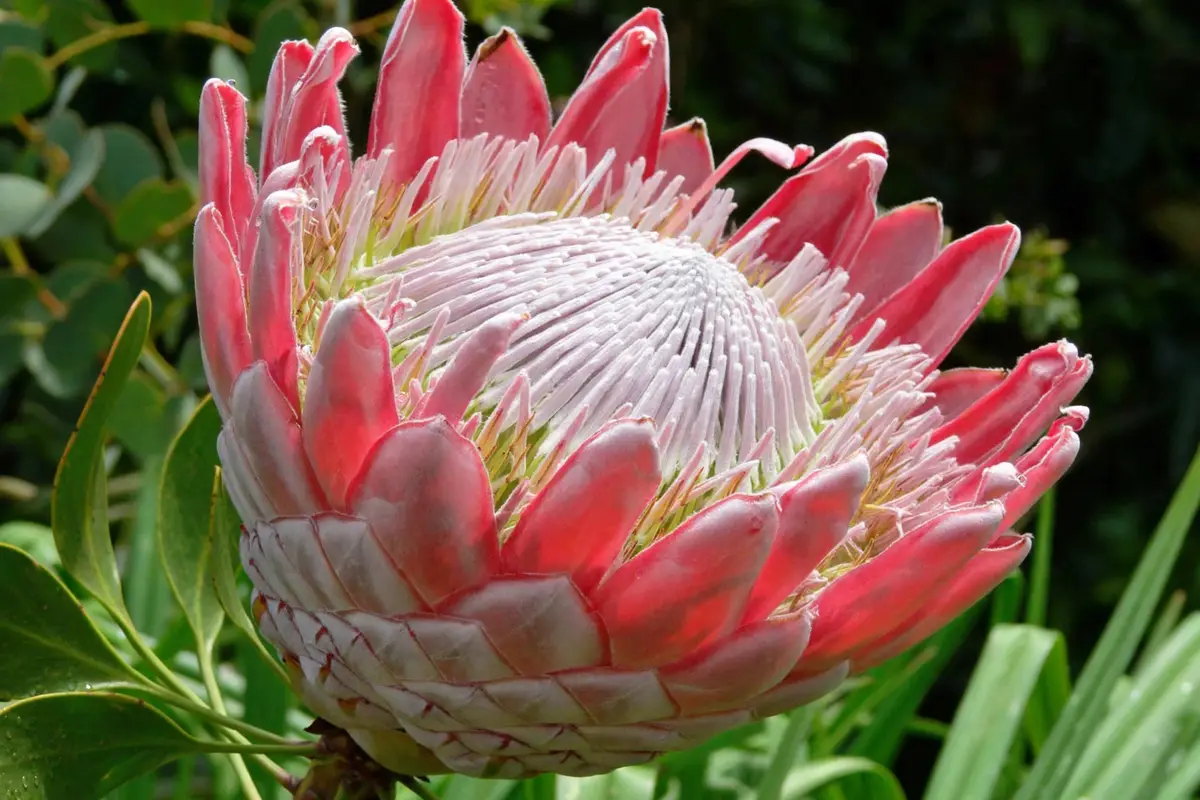
Table of Contents
- What Is a Protea Flower?
- Types of Protea and 6 Kinds Worth Knowing
- Protea Flower Meaning and Symbolism
- Protea Flower Colours and Their Meanings
- How to Grow Proteas
- Common Mistakes When Growing Proteas
- The Phosphorus Problem, Explained
- Frequently Asked Questions
What Is a Protea Flower?
A protea “flower” is a gathering: dozens to hundreds of slender true flowers packed into a dome, cupped by stiff, colourful bracts (modified leaves) that give the head its chalice or artichoke silhouette and its months of vase presence. Linnaeus named the genus for Proteus, the Greek sea god who changed shape at will — a nod to the family’s wild diversity of form — and the lineage justifies the drama: Proteaceae is a Gondwanan family, with proteas in Africa, waratahs and banksias in Australia, and cousins in South America, separated when the supercontinent split. In the Cape, proteas are pillars of fynbos, the fire-adapted shrubland: many hold their seeds in the canopy (serotiny) and release them after fire, germinating in the ash bed. You can read more on the Protea page on Wikipedia.
The king protea (P. cynaroides) is South Africa’s national flower and the emblem of its cricket team; the whole clan feeds the Cape’s sugarbirds and sunbirds, whose pollination visits the flower heads are built to host. As cut flowers, proteas are nearly peerless — weeks fresh, and drying into permanent sculptures. Growers in California, Australia, Israel and Zimbabwe farm them for the world’s florists; gardeners in kind climates grow the shrubs for the same blooms plus year-round evergreen structure.
Protea Quick Facts
- Botanical name: Protea spp. (chief garden kinds: P. cynaroides, P. repens, P. neriifolia, P. magnifica, and the pincushion genus Leucospermum grown alongside).
- Family: Proteaceae, one of the oldest flowering-plant families.
- Hardiness: zones 9 to 12 for most; select kinds to zone 8 with drainage and shelter. Frost-tender as a rule.
- Height: 3 to 10 feet by species — shrubs, not border perennials.
- Bloom time: autumn to spring for many (the Cape winter), varying by kind; peak cut-flower season late winter.
- Sun and soil: full sun; acidic to neutral, sharply drained, LOW-phosphorus soil. Phosphorus fertiliser can kill them.
- Good to know: superb long-life cut flower that also dries; fire-adapted seed biology; loved by sunbirds in the Cape, hummingbirds elsewhere.
Types of Protea and 6 Kinds Worth Knowing
The king, the sugarbush, the bearded queen and their pincushion cousins. The table separates them; the profiles follow. For the full list of flower names, see our flower names A to Z guide.
| Type | Flowers | Size | Season | Best use |
|---|---|---|---|---|
| King protea (P. cynaroides) | Huge pink-silver bowls to 12 in | 3–5 ft shrub | Late winter–spring | Specimen, cut flower royalty |
| Queen protea (P. magnifica) | Woolly bearded pink heads | 4–6 ft | Autumn–winter | Cut flowers, rarity value |
| Sugarbush (P. repens) | Cream to deep pink goblets | 6–8 ft | Autumn–winter | Hardest-working garden kind |
| Oleander-leaf (P. neriifolia) | Pink-cream, dark-bearded tips | 6–10 ft | Autumn–spring | Screening, bird gardens |
| Pincushions (Leucospermum) | Orange/gold pin-cushion domes | 3–6 ft | Spring–summer | Borders, containers, cutting |
| Blushing bride (Serruria florida) | Feathery blush-white stars | 2–3 ft | Late winter–spring | Bridal work, pots |
1. King Protea — the National Flower
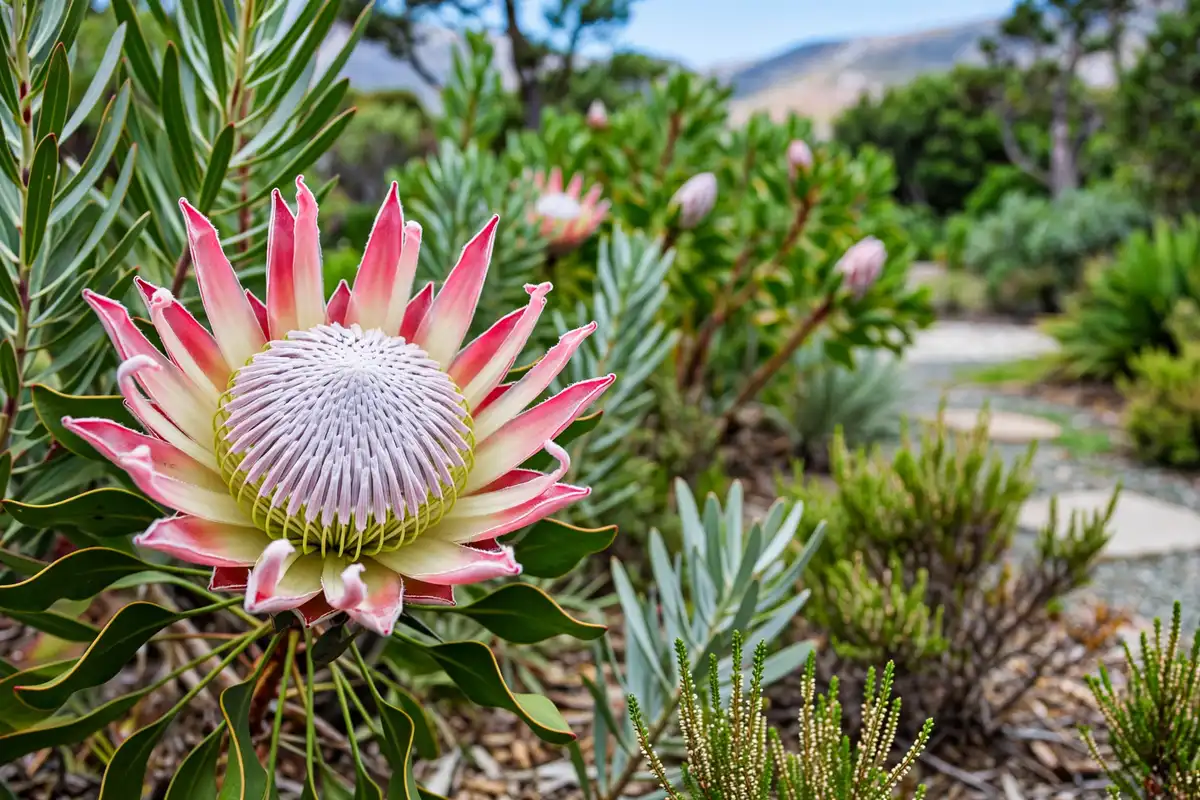
The biggest flower head in the genus and one of the biggest anywhere: bowls up to a foot across, silver-pink bracts around a soft central dome, opening slowly over weeks. Protea cynaroides (artichoke-like, as the name says) grows as a resprouting shrub of 3–5 feet in gardens, flowering mainly late winter to spring, and a single stem is an arrangement by itself. South Africa put it on its flag-waving heart for a reason: nothing else looks like power arranged this gracefully.
2. Queen Protea — the Bearded Beauty
Protea magnifica wears the genus’s most tactile heads: large pink cups whose bract tips carry a silky woolly “beard,” white to dark depending on the form, over a deep dome. It is choosier than the king — demanding perfect drainage and mountain air in the wild — and correspondingly treasured in the cut-flower trade, where its texture photographs like velvet. Grow it where summers are dry and winters mild.
3. Sugarbush — the People’s Protea
Protea repens, the original “sugarbush”: goblet heads in cream, pink and deep rose that weep nectar so freely that early Cape settlers collected it for syrup. It is among the toughest and most adaptable proteas for gardens — a 6-to-8-foot evergreen shrub flowering autumn into winter, feeding birds for months, and asking little beyond drainage and sun. If one protea is to anchor a mild-climate garden, it is this generous one.
4. Oleander-Leaf Protea — the Bird Tree
Protea neriifolia grows tallest of the garden kinds, with handsome narrow leaves and long goblet heads whose bract tips carry dark, almost black beards — a contrast that reads across a garden. Flowering from autumn through spring, it is a sunbird and hummingbird station for half the year and an evergreen screen for all of it. Plant it where a small flowering tree is wanted in a dry, sunny boundary.
5. Pincushions — the Protea’s Sunny Cousins
Leucospermum, the pincushion genus, is grown shoulder-to-shoulder with true proteas and loved for the same season: domes of curling orange, gold and scarlet styles sticking out like pins in a cushion, in spring and summer, on shrubs that take containers and coastal wind. ‘Scarlet Ribbon’ and the cordifolium hybrids are the florists’ darlings. Same family rules — sun, drainage, no phosphorus — in a friendlier, bushier package.
6. Blushing Bride — the Wedding Flower
Serruria florida, another protea cousin: feathery heads of blush-white stars on fine, needle-foliaged shrubs, so beloved of brides that legend says a suitor’s courage was once measured by the blooms he dared to fetch from its mountain cliffs. Short-lived (three to five years) but generous in pots and bridal bouquets, it is the family’s delicate counterpoint to the king’s artillery.
Protea Flower Meaning and Symbolism
The protea means courage and transformation. It took its name from Proteus, the shape-shifter, and its meanings follow the god: diversity, daring, the power to change form and thrive — in fire country, quite literally, rising from ash. As South Africa’s national flower it carries resilience and national pride; in bouquets it is the modern emblem for strength through change — graduations, recoveries, new ventures, anyone mid-metamorphosis. Florists in discussions of the protea flower’s meaning on Quora reach for the same words: boldness, endurance, beauty that is not fragile. It is the anti-daisy: not innocence, but nerve.
Send a protea when roses would be too soft for the occasion. In our Australian native flowers guide the protea’s Gondwanan cousins (waratah, banksia) tell the same family story from the other side of the ocean.
Protea Flower Colours and Their Meanings
- Silver-pink — courage with grace: the king protea’s royal palette.
- Deep rose and red — daring and transformation: sugarbush in full colour.
- Cream and white — quiet strength: sugarbush creams and the blushing bride.
- Orange and gold — creative fire: the pincushion cousins.
- Black-bearded — mystery and contrast: neriifolia’s dramatic tips.
How to Grow Proteas
Proteas are not difficult; they are specific. Meet three conditions — sun, drainage, and the right starvation diet — and the shrubs largely run themselves for decades in kind climates. Gardeners on r/gardening on Reddit summarise the diet in four words: “feed them almost nothing.”
Planting and Position
Give full sun and moving air on a slope or raised bed if your soil is anything but fast-draining; proteas evolved in nutrient-poor sandstone soils and their roots want water to pass, not stay. Soil should be acidic to neutral (pH roughly 5.5–6.5) and low in phosphorus — never plant them in a bed recently fed with general fertiliser or manure. Space generously (these are shrubs, 4–8 feet across at maturity), water deeply but infrequently to establish over the first two summers, and mulch with gravel or leaf litter rather than rich compost.
Pruning, Cutting and Containers
Harvesting is the pruning: cut flower stems long, and the shrub responds with branching and more heads; tip-prune young plants to build the frame, and never cut old plants back into leafless wood — they resprout unreliably. In cool climates, grow pincushions and young proteas in large pots of ericaceous, gritty mix, overwintering them frost-free; a potted king protea flowering on a sunny terrace is theatre worth the trolley work. Cut blooms last two to four weeks in the vase — change water, recut stems, and let ageing heads dry where they stand for permanent arrangements.
Common Mistakes When Growing Proteas
Mistake one is the kindest and the deadliest: fertilising with a general-purpose plant food. The phosphorus it contains poisons proteas at levels other plants consider a light snack (see the section below). Mistake two is rich, water-retentive soil — compost-heavy beds and clay pans hold the wet that rots their fine, specialised roots; they want the poor, sharp ground most gardeners apologise for.
Mistake three is planting them like border perennials, crowded and shaded by neighbours: proteas are air-and-sun shrubs that sulk and mildew in a scrum. Mistake four is over-pruning into bare old wood. And mistake five is giving up at the first frost forecast in zone 8: established kinds like the sugarbush take brief light frosts in stride when drainage is perfect — it is cold-plus-wet, not cold alone, that kills.
The Phosphorus Problem, Explained
Proteaceae evolved in the most phosphorus-starved soils on Earth and built cluster roots — dense, bottle-brush rootlets that exude acids to mine phosphorus from almost nothing. That superpower becomes a fatal flaw in garden soil: the roots cannot switch the mining off, so ordinary fertiliser doses flood the plant with phosphorus faster than it can cope, and it dies of the excess — yellowing, blackening, collapse — in a bed where everything else is thriving. The rules that follow are simple and absolute: never use phosphorus-containing fertiliser on proteas (look for “protea-safe” or native-plant feeds with near-zero P), keep lawn food and manure away from their roots, and if in doubt, feed nothing at all. A hungry protea grows slowly and flowers; a fed one dies politely and quickly.
Frequently Asked Questions
Where can I grow a protea outdoors?
In frost-light, Mediterranean-type climates — roughly USDA zones 9 to 12 (California coast, the Cape, much of Australia, the Mediterranean): sunny, dry summers and mild winters on drained soil. A few kinds (sugarbush, some pincushions) stretch into zone 8 with perfect drainage and shelter. Everywhere else, grow them in pots and overwinter frost-free.
How long do protea flowers last in a vase?
Two to four weeks fresh — among the longest of all cut flowers — and indefinitely dried: the bracts hold colour and form as the head dries. Recut stems under water, change the water weekly, and remove any leaves below the waterline.
Why did my protea die after I fed it?
Almost certainly phosphorus toxicity: general fertilisers supply phosphorus at levels proteas cannot tolerate (their cluster roots over-absorb it). It is the genus’s one lethal kindness — feed proteas nothing, or only a certified low-phosphorus native-plant food.
Is the protea South Africa’s national flower?
Yes — the king protea (Protea cynaroides) is South Africa’s national flower and the namesake of its national cricket team, the Proteas. The genus’s heartland is the Cape Floristic Region, one of the richest plant kingdoms on Earth for its size.
Do proteas need fire to flower or germinate?
To germinate, often yes in the wild — many kinds hold seed in fire-proof cones released after burns (serotiny), and smoke chemicals trigger germination. To flower, no: garden plants bloom happily unburned, and seed can be germinated with smoke-water products sold for fynbos growers.
Are proteas good for birds and pollinators?
Superbly — in the Cape they are keystone nectar plants for sugarbirds and sunbirds, and elsewhere hummingbirds and bees work the heads for weeks. For more flowers under the same letter, see our guide to flowers that start with P.