Mimosa Flower: Meaning, Types — the Two Plants Behind One Name
One name, two famous flowers, and no end of confusion at the florist. “Mimosa” is the golden, honey-scented acacia cloud that floods Italian streets every March 8th — and also the little pink powderpuff whose leaves fold shut when you touch them. Both are wonderful; they are not the same plant, and which one you want decides everything that follows.
This guide separates the florist’s mimosa from the sensitive plant, covers the other mimosas of the garden (including the American “mimosa tree”), explains both meanings — Women’s Day gold and the modesty of the folding leaf — and gives growing instructions for each.
Quick Answer
A mimosa flower is one of two celebrated legumes: florist’s mimosa — Acacia dealbata, a fast Australian tree whose branches carry clouds of fragrant golden-yellow pompom blossoms in late winter — or the sensitive plant, Mimosa pudica, a small tropical perennial with pink powderpuff flowers whose feather leaves fold inward at a touch. Acacia mimosa means the flower of International Women’s Day (March 8, the Italian Festa della Donna) and blooms in USDA zones 8 to 11; Mimosa pudica means sensitivity and modesty, and is grown as a houseplant or summer annual in cooler climates. Both are in the pea family, Fabaceae — the name collision is historical, not botanical.
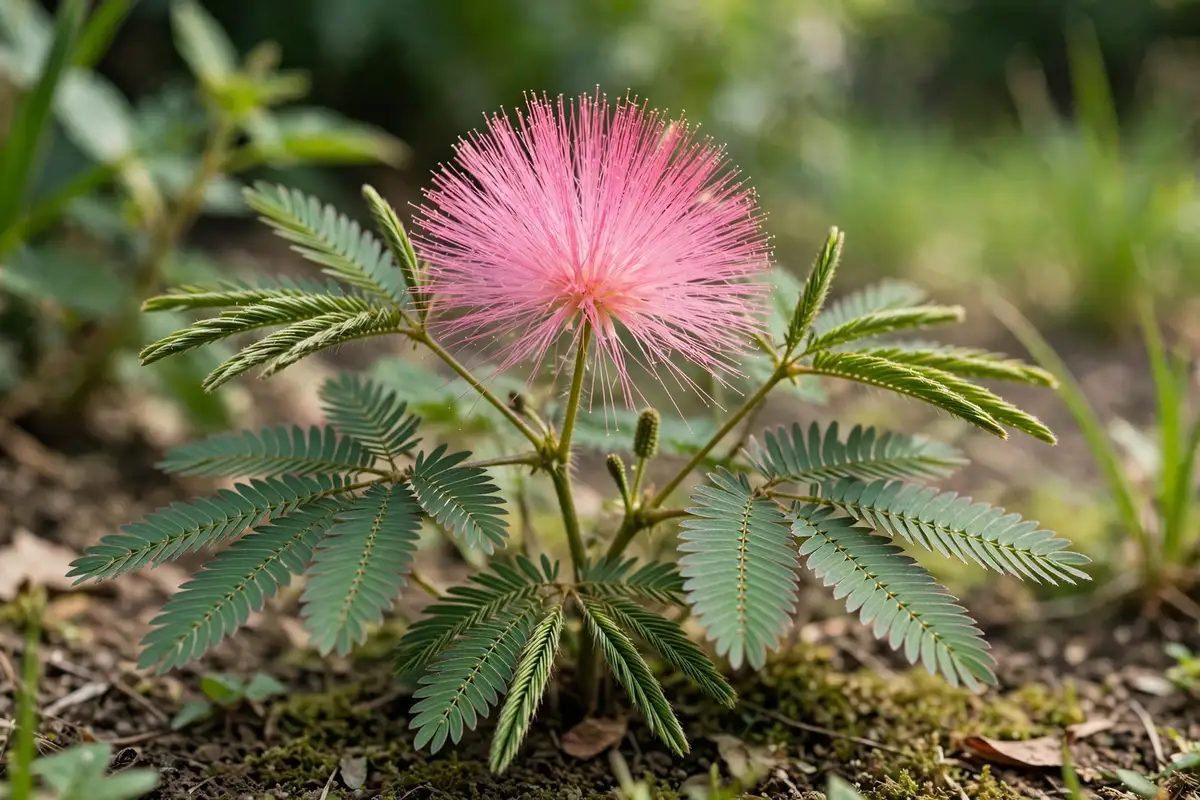
Table of Contents
- What Is a Mimosa Flower?
- Types of Mimosa and 6 Kinds Worth Knowing
- Mimosa Flower Meaning and Symbolism
- Mimosa Flower Colours and Their Meanings
- How to Grow Mimosa — Both Plants
- Common Mistakes When Growing Mimosa
- Florist’s Mimosa vs the Sensitive Plant
- Frequently Asked Questions
What Is a Mimosa Flower?
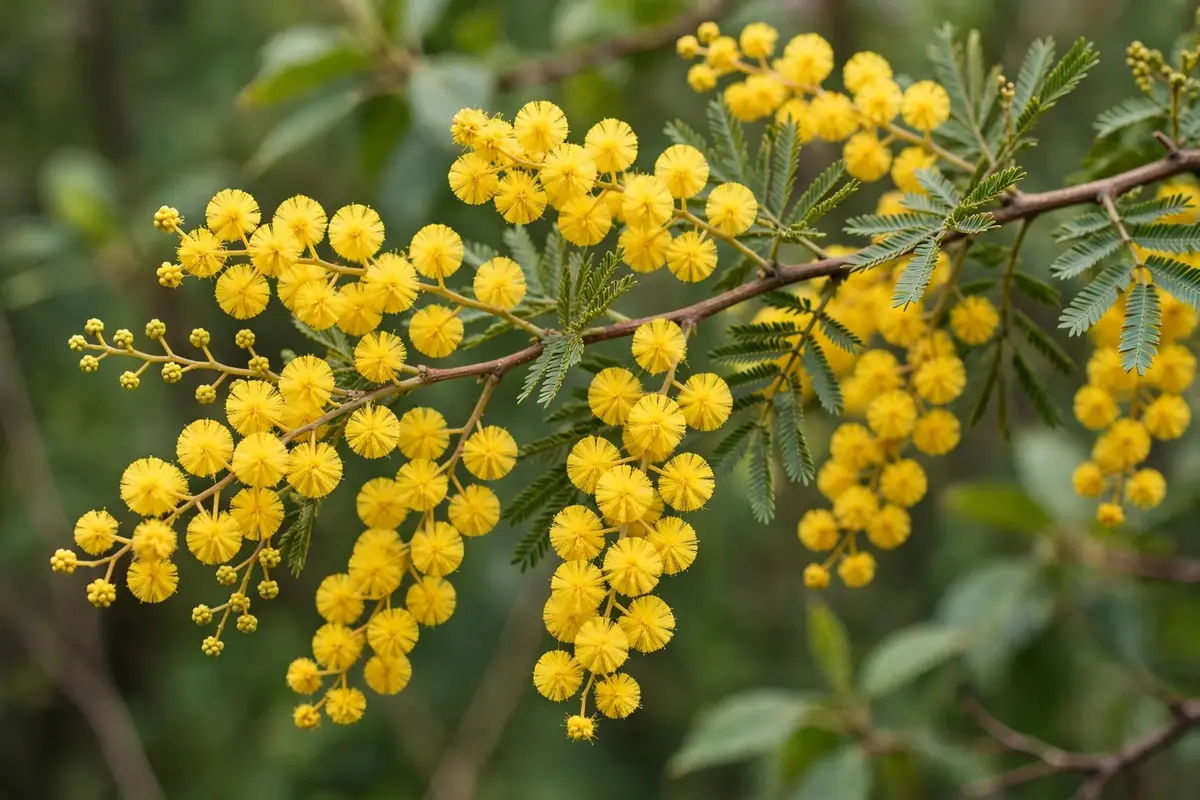
Start with the tree. Acacia dealbata — silver wattle — is an evergreen acacia from south-eastern Australia and Tasmania that the European flower trade adopted so completely that its winter branches, cut by the tonne from the hills behind the French and Italian Rivieras (the Mimosa Route still runs through the Tanneron each February), simply became “mimosa”. Each flower is a tiny golden pompom; thousands of them line the flowering shoots over fern-like silver-blue foliage, with a sweet, powdery, honey-almond scent that perfumers still chase. The mimosa cocktail borrowed the colour: orange juice and champagne, the exact gold of the bloom. You can read more on the Acacia dealbata page on Wikipedia.
Now the other claimant. Mimosa pudica is the true botanical Mimosa: a creeping tropical American perennial whose compound leaves are seismonastic — touch them and the leaflets fold flat in seconds, the whole leaf stalk drooping, an anti-herbivore vanishing act run by water pressure in tiny hinge organs (pulvini). Its flowers are pale pink powderpuffs, each a ball of stamens with no real petals to speak of. The two plants share the pea family and nothing else — the acacia took the name in the trade because its feathery leaves look so similar. Add the American silk tree Albizia julibrissin, universally called “mimosa tree” across the US South, and the name covers three plants on three continents.
Mimosa Flower Quick Facts
- Botanical names: Acacia dealbata (florist’s mimosa); Mimosa pudica (sensitive plant).
- Family: Fabaceae, the pea family.
- Hardiness: Acacia zones 8 to 11; pudica zones 9 to 11, or annual/houseplant.
- Size: Acacia tree 30–50 ft; pudica 1–3 ft.
- Bloom time: Acacia late winter; pudica summer.
- Sun and soil: full sun; acacia wants sharp drainage, pudica wants steady moisture.
- Good to know: acacia is fast and short-lived and self-seeds freely (weedy in some regions — check locally); pudica is safe to touch and watch, best admired out of reach of constant poking.
Types of Mimosa and 6 Kinds Worth Knowing
The tree, the sensitive plant, two garden acacias, and the two namesakes flagged honestly. The table separates them; the profiles follow. For the full list of flower names, see our flower names A to Z guide.
| Type | Flowers | Leaves | Size | Best use |
|---|---|---|---|---|
| Florist’s mimosa (Acacia dealbata) | Golden pompom clouds | Silvery fern-like | 30–50 ft tree | Winter cut flower, mild gardens |
| Sensitive plant (Mimosa pudica) | Pink powderpuffs | Fold at a touch | 1–3 ft | Houseplant, novelty pots |
| ‘Bon Accueil’ acacia | Extra-large gold pompoms | Silvery fern-like | 20–30 ft | Cut-flower growing |
| Cootamundra wattle (A. baileyana) | Deep gold racemes | Blue-grey fine | 15–25 ft | Smaller gardens, pots when young |
| Silk tree (Albizia julibrissin) | Pink-white silk fans | Fern-like, fold at night | 25–40 ft tree | The US “mimosa tree” namesake |
| Sunshine mimosa (Mimosa strigillosa) | Pink powderpuffs | Folding, creeping mats | Groundcover | Lawn alternative in the South |
1. Florist’s Mimosa — Acacia dealbata, the Golden Original
The Women’s Day flower itself: branches of sulphur-gold pompoms over silver foliage, in bloom while winter still owns the calendar, scent like warm honey and face powder. In mild gardens (zones 8–11) it is a fast, generous, short-lived tree — plant it for its decade, not its century; in cold ones it is a conservatory subject or a February bunch from the florist, which is how most of the world knows and loves it. Its season is shared with the March birth flower weeks — the daffodil owns the birthday calendar, but in Italy the mimosa owns March itself.
2. The Sensitive Plant — Mimosa pudica, the True Mimosa
The botanist’s mimosa and the child’s favourite plant: brush a leaf and the fern folds like a closing hand, resetting in twenty minutes. Pink powderpuffs appear in summer. Grow it in pots on a sunny sill, from seed (scarify or soak the hard seeds first), as an annual outdoors or a short-lived houseplant — and ration the touches: every fold costs the plant energy, and a constantly-poked sensitive plant exhausts itself. Its folding is real plant behaviour, not a trick, which is exactly why it stays astonishing.
3. ‘Bon Accueil’ and the Cut-Flower Acacias
The Riviera’s forcing industry runs on selected acacias — ‘Bon Accueil’ and its kin — bred for bigger, earlier pompoms and branches that drink well in the vase. Home growers in mimosa country plant these over the species when cutting is the goal; the same varieties fill the March 8th stalls of Milan and Rome.
4. Cootamundra Wattle — Acacia baileyana
The smaller, finer alternative: a graceful 15–25 ft tree (or large shrub) with blue-grey feathery foliage and deep golden flower racemes, widely planted in California and Mediterranean gardens; ‘Purpurea’ adds plum-purple new growth. Easier to place than dealbata, equally winter-golden, and the connoisseur’s acacia for ordinary-sized gardens.
5. The Silk Tree — Albizia julibrissin, America’s “Mimosa Tree”
Across the American South, “mimosa” means this: a flat-topped tree whose summer branches carry pink silk-thread fans over fern leaves that, like pudica’s, fold at night. Beloved, fragrant, hummingbird-magnetic — and, honestly flagged, invasive across much of the south-eastern US, seeding into roadsides and woodland edges. Admire existing trees; plant it only where it is not listed as a problem, or choose a native alternative.
6. Sunshine Mimosa — Mimosa strigillosa, the Living Lawn
A true Mimosa doing quiet work in Florida and the Gulf states: a creeping mat of folding fern leaves studded with pink powderpuffs, used as a flowering lawn alternative that needs no mowing and feeds pollinators. Proof the genus is more than a novelty — left alone, a mimosa can simply be a good groundcover.
Mimosa Flower Meaning and Symbolism
Two plants, two meanings, both beloved. The acacia mimosa means women’s strength and spring’s return, by decree of history: in 1946 Italian feminists including Teresa Noce chose the mimosa as the symbol of the first post-war International Women’s Day — because it blooms everywhere in early March, free for the picking on every hillside, bright as optimism and tougher than it looks. Italy has given mimosa on March 8th ever since, and the custom spread across Europe. In the older language of flowers the acacia adds secret love and sensibility.
The sensitive plant means exactly what it performs: sensitivity, modesty and timid love — the flower that blushes and withdraws. Give acacia mimosa for admiration, solidarity and early-spring cheer (on March 8th, to every woman you honour); give a potted pudica to the shy, the curious and the young — a plant that says I understand by folding its hands. Between them, the name covers both halves of March: bold gold and gentle pink.
Mimosa Flower Colours and Their Meanings
- Golden yellow — strength, solidarity and spring’s return: the acacia’s Women’s Day colour, and the gold the mimosa cocktail is named for.
- Pink — sensitivity and modesty: pudica’s powderpuffs and the silk tree’s fans.
- Silvery blue-green — the foliage’s signature: freshness and new beginnings, the Riviera winter palette.
How to Grow Mimosa — Both Plants
Different plants, different rulebooks. Gardeners on r/gardening on Reddit learn the split the hard way — the tree planted like a houseplant, the houseplant killed with kindness and fingers.
Growing the Acacia (Florist’s Mimosa)
Full sun, poor-to-average soil with sharp drainage, shelter from cold winds: this is an Australian hillside plant that hates wet feet and hard frost. Plant in spring in zones 8–11, water to establish, then leave it — it grows fast (several feet a year when happy), flowers on the previous season’s wood (prune, if at all, right after flowering), and lives fast, typically 15–30 years. It self-seeds: in parts of California, South Africa and the Mediterranean fringe it is a genuine weed tree, so check your region before planting and deadhead near wild land. In containers, young trees overwinter in a bright cool conservatory.
Growing the Sensitive Plant
Sow seed in spring (nick or soak overnight; warmth speeds germination), grow in bright light with steady moisture and humidity, in free-draining compost. Treat as a summer annual outdoors or a bright-window houseplant; expect a season or two of glory rather than a decade. One rule above all: touch to demonstrate, not to entertain — occasional folding is the plant’s party trick and its stress response at once, and a pudica folded fifty times a day by visitors fades fast. Let it flower, set its little bristly pods, and sow its seed fresh next spring.
Common Mistakes When Growing Mimosa
Mistake one is buying by the common name alone: “mimosa” on a label has sold trees to houseplant hunters and pudica seeds to would-be florists. Read the Latin. Mistake two (acacia) is rich, wet soil and a frost pocket — the classic Riviera plant dies of kindness and cold feet elsewhere. Mistake three (acacia again) is forgetting it is a short-lived sprinter: plant its successor early, and never its seedlings near bushland where it is weedy.
Mistake four is over-touching the sensitive plant until it declines, and mistake five is expecting either plant to be the other: no vase of pink powderpuffs for March 8th exists, and no golden tree folds its leaves for your guests. Love each for what it does.
Florist’s Mimosa vs the Sensitive Plant
The side-by-side truth. Florist’s mimosa (Acacia dealbata): a 30–50 ft evergreen tree; flowers are golden-yellow pompoms in late winter, massed on cut branches; leaves feathery and silvery but entirely unresponsive to touch; meaning, Women’s Day and spring. Sensitive plant (Mimosa pudica): a 1–3 ft tropical creeper; flowers are pink powderpuffs in summer; leaves fold theatrically at a touch and at night; meaning, sensitivity and modesty. The silk tree Albizia splits the difference visually — tree-sized like the acacia, pink-fanned and night-folding like the pudica — which is precisely why it collected the same name in America. If it is gold and it is February, it is acacia; if it folds, it is a true Mimosa or its albizia cousin.
Frequently Asked Questions
Why is mimosa the flower of International Women’s Day?
Because in 1946 Italian women’s organisations chose it: it blooms in early March, grows wild and free across the Italian hills (so any man could afford to give it, and any woman could gather her own), and its bright gold over tough, thornless branches read as strength with grace. The custom — a sprig to colleagues, teachers, mothers, friends — is now kept across much of Europe every March 8th. If your question is not answered here, the questions about the mimosa flower on Quora cover most of the rest.
Is the mimosa cocktail named after the flower?
Yes — the champagne-and-orange-juice drink (created in 1925 at the Ritz in Paris, in the usual account) is named for the exact golden yellow of acacia mimosa blossom. Order one in mimosa season and compare shades.
Does touching a sensitive plant hurt it?
A few touches, no; constant touching, yes. Each fold is powered by water movement the plant must then reverse, at real energy cost, and leaves kept folded cannot photosynthesise. Demonstrate once for your guests, then let it work.
Is mimosa invasive?
Depends which one, and where. Acacia dealbata is weedy in parts of California, South Africa and elsewhere — check local lists before planting. The silk tree Albizia is invasive across the south-eastern US. Mimosa pudica is a pantropical weed in frost-free farmland but harmless as a houseplant or annual where winters kill it. Sunshine mimosa is a well-behaved native groundcover in its home range.
Can I grow florist’s mimosa from a bouquet branch?
Not reliably — cut branches root poorly and are usually sold at their peak for forcing. Buy a young named tree from a nursery instead; in mimosa country it will be flowering size within a few seasons.
When does mimosa bloom?
Acacia mimosa: late winter — January to March in the Mediterranean, peaking for March 8th. Sensitive plant: summer, in warmth. The silk tree: early-to-mid summer. For more flowers under the same letter, see our guide to flowers that start with M.