Flower Pattern: Types, Repeats and How to Design Your Own
A flower pattern is a floral design that repeats — the same blooms, leaves and stems tiled across fabric, wallpaper, wrapping paper or a phone case so the pattern never visibly ends. From tiny ditsy prints on summer dresses to grand damask wallpapers, flower patterns are the hardest-working design in the decorative world.
This guide explains the main flower pattern types, how repeats actually work, how to choose the right scale, and how to design a simple flower pattern of your own — by hand or on a computer.
Quick Answer
A flower pattern (floral pattern) is a repeating design of flowers and foliage used on fabric, wallpaper, paper and products. The main types are ditsy (tiny scattered flowers), botanical (realistic studies), damask (formal symmetrical), toile (scenic one-colour), and Liberty-style (dense small-scale florals). Patterns are built from a single tile (the “repeat”) arranged as a block repeat, half-drop or brick repeat so the joins disappear.
Table of Contents
- What Is a Flower Pattern?
- Types of Flower Patterns
- How Repeats Work: Block, Half-Drop and Brick
- Choosing the Right Scale
- How to Use Flower Patterns
- How to Design a Simple Flower Pattern
- Frequently Asked Questions
What Is a Flower Pattern?
In textile design and surface design, a pattern is artwork engineered to repeat seamlessly. A flower pattern starts as a motif — one drawn or photographed flower group — which is then placed inside a square or rectangular tile. Copy the tile edge to edge and the motifs join into an endless field of flowers. Everything else — the type, the scale, the spacing — is a design choice layered on that simple machine.
Patterns differ from single flower pictures (see our flower art guide) in one essential way: a pattern has no centre and no edge. It can cover a teaspoon or a ballroom wall with the same tile.
Types of Flower Patterns
| Pattern type | What it looks like | Best for |
|---|---|---|
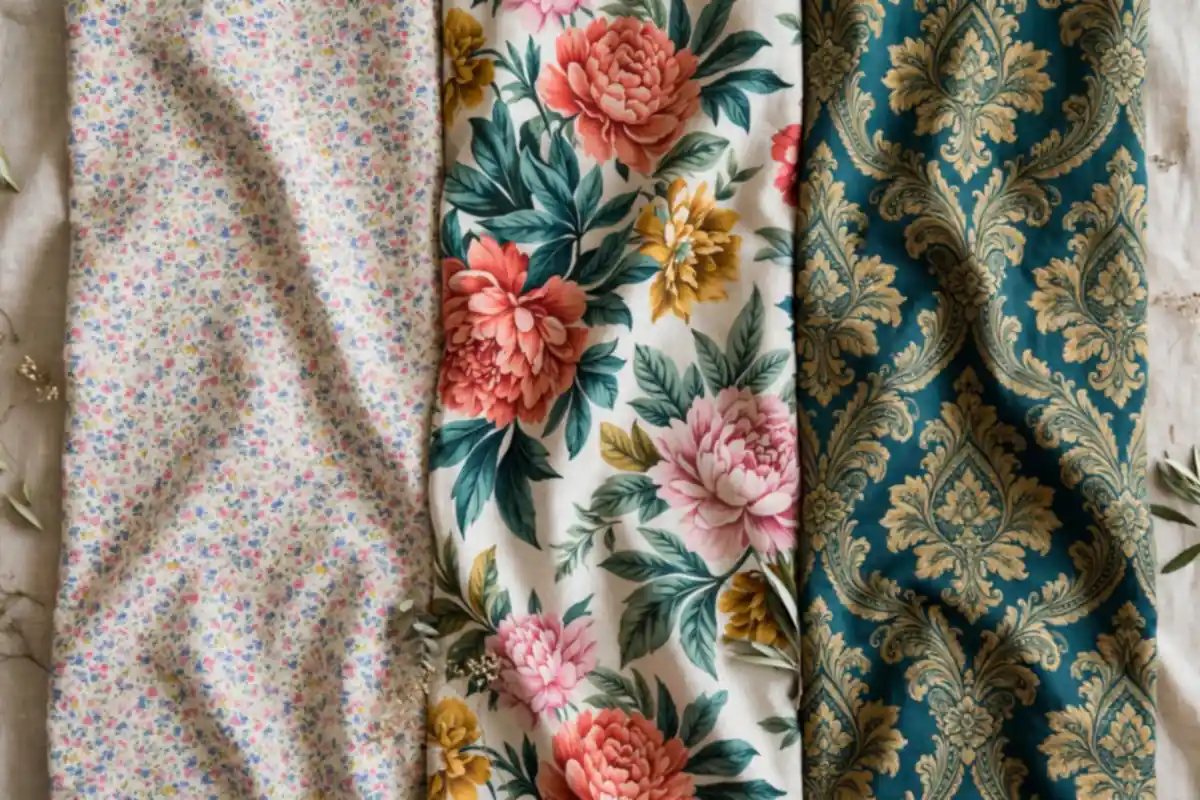
| Ditsy | Tiny flowers scattered evenly, no obvious repeat | Dresses, quilting cotton, children’s clothes |
| Botanical | Realistic, labelled-looking flower studies | Wall art fabric, cushions, heritage interiors |
| Damask | Large, formal, mirror-symmetrical floral medallions | Wallpaper, upholstery, formal curtains |
| Toile | One-colour scenic prints with flowers and figures | French-country curtains, bedding, lampshades |
| Liberty-style | Dense, small-scale, flowing florals (named for Liberty London prints) | Shirting, scarves, craft fabric |
| Floral stripe / trellis | Flowers organised in stripes or climbing a lattice | Wallpaper borders, garden-party fabric, wrapping paper |
| Conversational | Playful flowers mixed with objects, animals or fruit | Children’s rooms, novelty products |
How Repeats Work: Block, Half-Drop and Brick
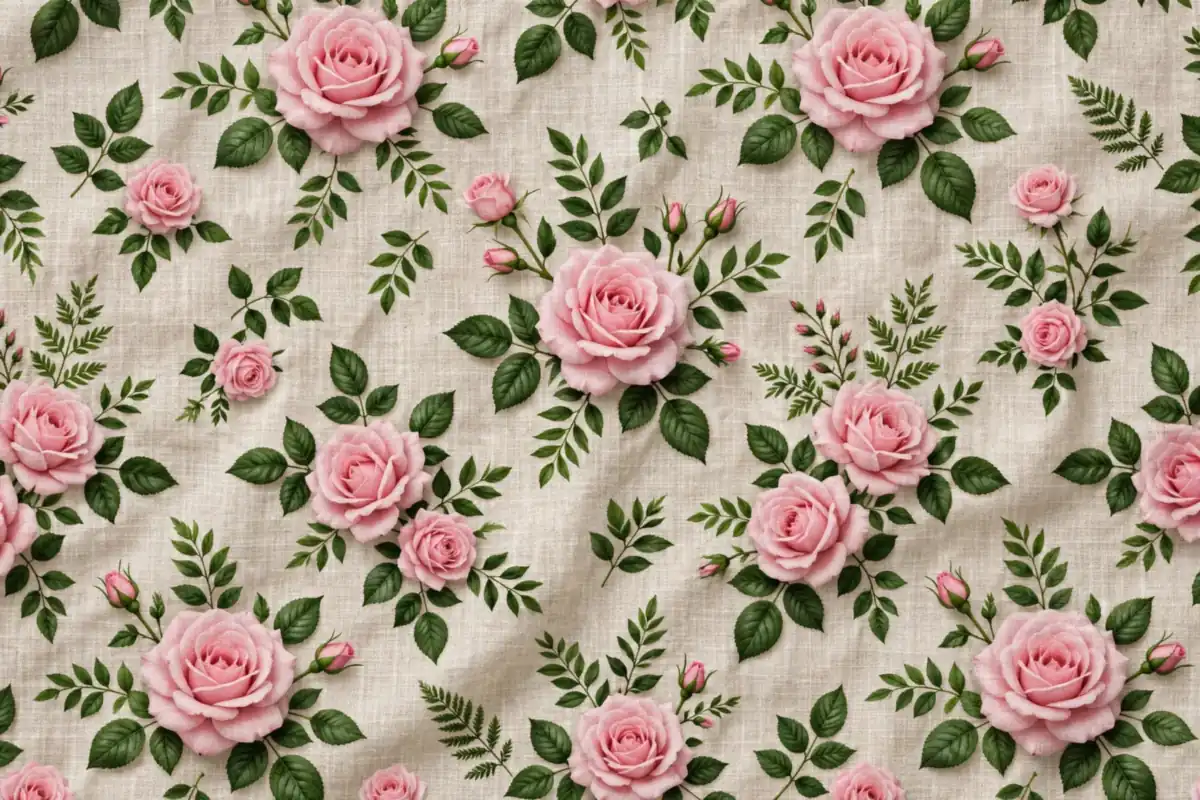
- Block (full-drop) repeat — tiles stack in straight rows and columns. Simplest to make; the grid can show if motifs are sparse.
- Half-drop repeat — each new row drops by half a tile, breaking the grid. The professional favourite for wallpaper and fabric because the repeat becomes almost invisible.
- Brick repeat — the same idea sideways: each column shifts by half a tile, like bricks in a wall.
- Mirror repeat — tiles flip horizontally or vertically at each join, creating kaleidoscope symmetry — the engine behind damask.
- Tossed / random layout — motifs scattered at varied angles (the ditsy look); still built on a tile, just a cleverly disguised one.
Choosing the Right Scale
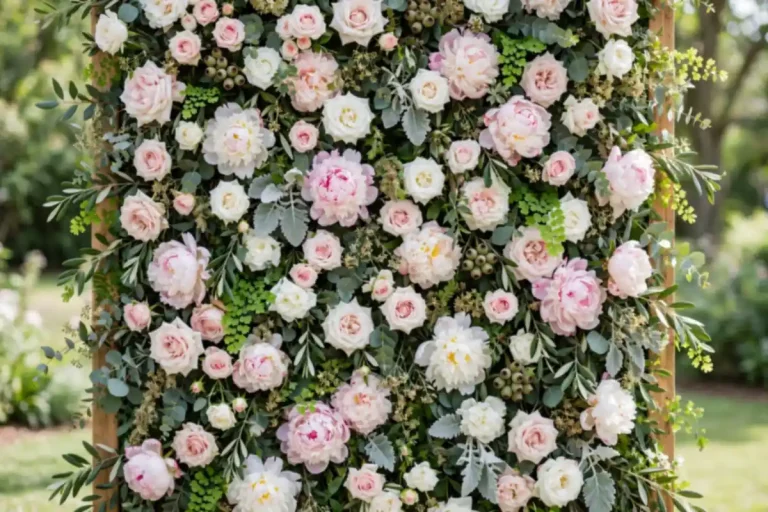
Scale is where flower patterns succeed or fail in a room. Small scale (motifs under ~3 cm) reads as texture from a distance — safe for large areas, bedding and clothing. Medium scale suits cushions, curtains and feature chairs. Large scale (motifs over ~15 cm) is a statement: one wall, a headboard, a dress that enters the room before you do. The decorator’s rule: the bigger the surface, the bigger the pattern it can carry — and pair a busy flower pattern with plain companions, never a second competing pattern at the same scale. On a flower wall or wallpapered room, let the pattern be the only loud voice.
How to Use Flower Patterns
- Home decor — wallpaper, curtains, upholstery, bedding; one patterned hero per room, plains around it.
- Sewing & quilting — ditsy and Liberty-style prints are quilting staples; botanical prints make striking dress panels.
- Paper crafts — wrapping paper, scrapbooking, card making, decoupage.
- Digital — phone and laptop wallpapers, social templates, printable planners.
- Events — patterned table runners, napkins and backdrops that echo the real flowers on the table.
How to Design a Simple Flower Pattern
- Draw 3–5 motifs. Sketch simple flowers — a daisy, a rose spiral, a leaf sprig, a bud — in one consistent style and a limited palette of 3–4 colours.
- Make a square tile. Arrange the motifs inside a square, keeping the centre comfortably filled. Anything touching an edge must continue on the opposite edge — draw the overflow, or use the offset tool in any design app (the classic trick: cut the square into quarters and swap them, then fill the new centre gap).
- Test the repeat. Tile your square 3×3. Squint: if your eye finds the grid instantly, switch to a half-drop or add small filler dots and leaves to break the lines.
- Check it at real size. Print or view the pattern at the size it will actually be used. Motifs that charmed at 200% zoom can vanish — or shout — at true scale.
- Save the tile, not the sheet. One perfect tile is the whole product: it can cover any surface, in any software, forever.
Frequently Asked Questions
What is a flower pattern called?
Generically a floral pattern. Specific traditional types have their own names: ditsy (tiny scattered), damask (formal symmetrical), toile (one-colour scenic), chintz (glazed cotton with large florals, from India), and Liberty prints (dense small florals). A single non-repeating flower picture is a motif or a floral illustration, not a pattern.
What is the difference between a motif and a pattern?
A motif is one design unit — a single flower or group. A pattern is what happens when the motif is placed in a tile and repeated seamlessly across a surface. Patterns are built from motifs, the way walls are built from bricks.
What flowers are used most in patterns?
Roses, peonies, daisies, poppies, cherry blossom and wildflower mixes dominate — flowers with a clear, readable silhouette that still makes sense at small sizes and in simplified, drawn form.
How do I make a flower pattern without drawing?
Photograph or scan real or pressed flowers, cut them out digitally, and arrange them into a tile — or license ready-made motifs and build only the repeat yourself. Pressed flowers scanned at high resolution make particularly beautiful botanical patterns.
What is a half-drop repeat?
A repeat where each row of tiles is shifted down by half a tile height compared with the row beside it. It hides the grid better than a straight block repeat, which is why most professional wallpaper and fabric patterns use it.