Paper Flower Bouquet: How to Make One That Lasts for Years
A paper flower bouquet never wilts, never triggers allergies, and can be carried down the aisle, photographed, and kept on a shelf for decades — exactly as it looked on the day. That is why paper bouquets have become a wedding favourite, and why they make such good gifts: the first wedding anniversary is traditionally the paper anniversary.
This guide shows how to make a paper flower bouquet step by step — choosing the paper, making the flowers, and assembling a bouquet that looks genuinely lush — plus how to care for it so it lasts for years.
Quick Answer
A paper flower bouquet is a bouquet made from handcrafted paper flowers — usually crepe paper roses, peonies and filler blooms on wire stems. To make one: craft 15–25 paper flowers, wire and tape each stem, then assemble them with the spiral hand-tie technique and wrap the stems. Italian crepe paper makes the most realistic flowers. A paper bouquet lasts for years kept dry and out of direct sunlight.
Table of Contents
- What Is a Paper Flower Bouquet?
- Which Paper Is Best? Crepe vs Tissue vs Cardstock
- How Many Flowers Does a Paper Bouquet Need?
- How to Make a Paper Flower Bouquet Step by Step
- When to Choose a Paper Bouquet
- Care and How Long Paper Bouquets Last
- Frequently Asked Questions
What Is a Paper Flower Bouquet?
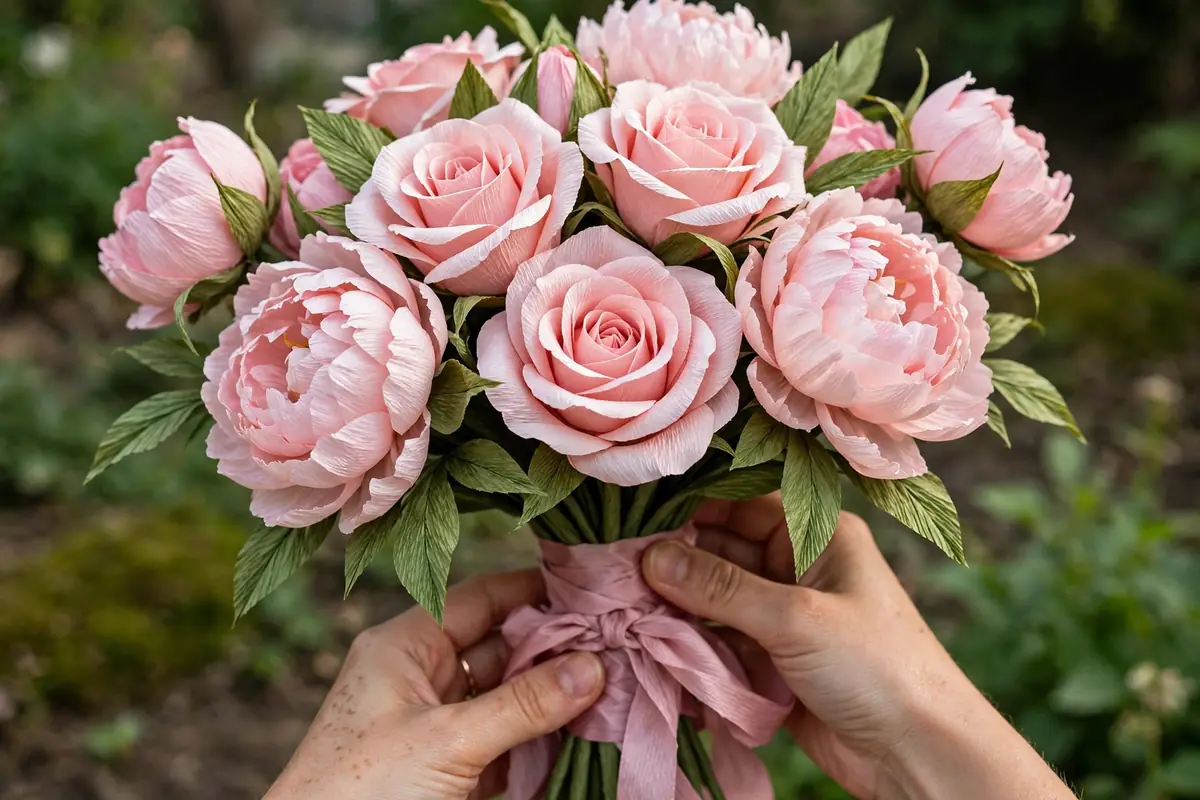
A paper flower bouquet is a hand-tied bouquet built from flowers crafted out of paper instead of grown in a garden. Each bloom is made by hand — petals cut, shaped and curled, then fixed to a wire stem — and the finished flowers are arranged exactly like a fresh bouquet. The craft ranges from simple origami flowers folded from single sheets to botanically detailed crepe-paper peonies that fool guests until they lean in to smell them.
Compared with a dried flower bouquet, a paper bouquet offers total colour control (any shade, any season, flowers that never exist together in nature) and nothing fragile or sheddable — at the price of more making time.
Which Paper Is Best? Crepe vs Tissue vs Cardstock
| Paper | Realism | Best for |
|---|---|---|
| Italian crepe paper (180 gsm) | Highest — stretches and cups like real petals | Roses, peonies, ranunculus; serious bouquets |
| Fine crepe (60–100 gsm) | High, softer and more delicate | Sweet peas, poppies, anemones |
| Tissue paper | Low-medium — fluffy, stylised | Fast pom-pom flowers, party bouquets, kids’ crafts |
| Cardstock | Graphic and modern, not realistic | Bold flat-style blooms, backdrops, gift toppers |
| Book pages / sheet music | Vintage charm | Literary weddings, music lovers, remembrance bouquets |
| Origami paper | Geometric, folded look | Kusudama bouquets — a whole style of their own |
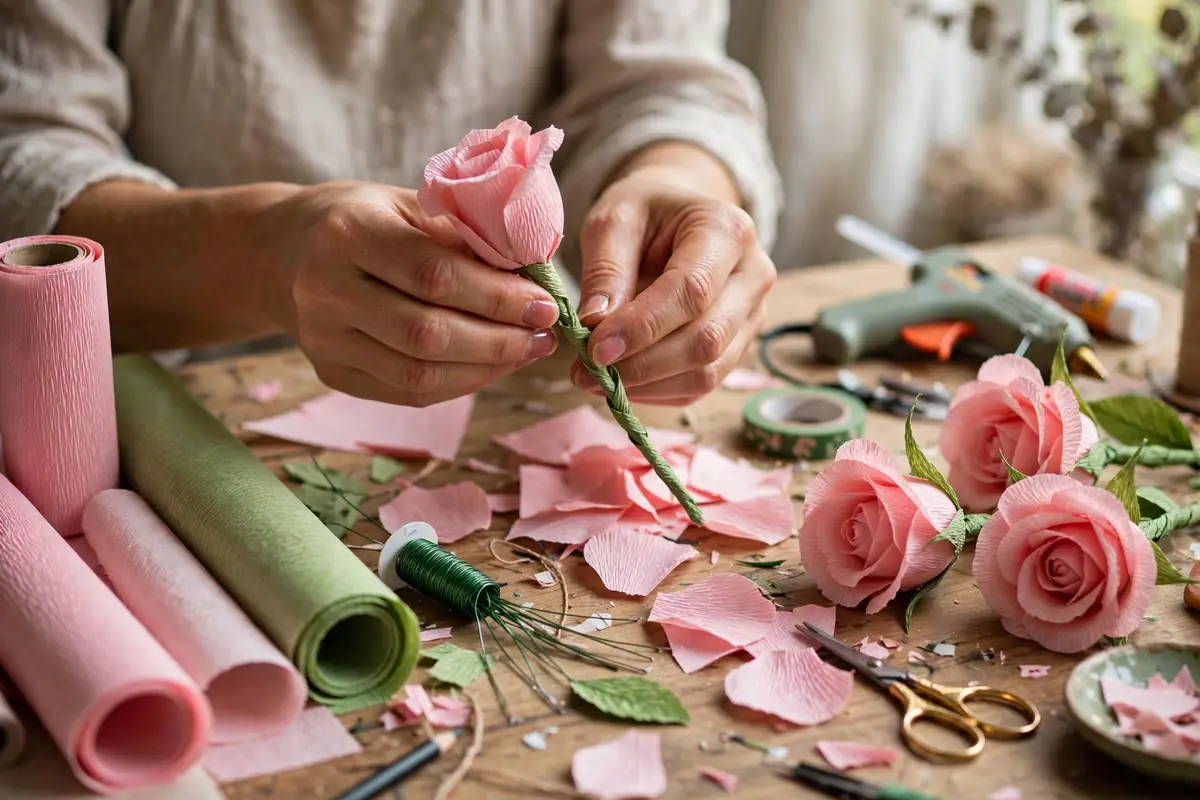
For a first bouquet, buy one pack of Italian crepe in your main colour, one in a filler shade, and green crepe for leaves. Crepe has a grain: petals are cut so the grain runs up the petal, which is what lets you stretch and cup them into shape.
How Many Flowers Does a Paper Bouquet Need?
- Small posy (gift, flower girl): 7–9 flowers
- Standard bridal bouquet: 15–25 flowers plus 5–8 leaves or filler sprigs
- Large statement bouquet: 30–40 flowers
Plan your mix like a florist: about 60% main flowers, 30% secondary blooms, 10% filler and greenery. And make two or three spares of everything — the bouquet always eats a few during assembly, and a spare bloom repairs any accident in seconds.
How to Make a Paper Flower Bouquet Step by Step
- Make the flowers first. Batch-produce your blooms before assembling anything: all the roses, then all the filler, then leaves. Wire each flower onto an 18-gauge stem wire and wrap the stem in green floral tape as you finish it.
- Shape and detail. Curl petal edges with a scissor blade or skewer, stretch crepe centres for a cupped look, and add a whisper of chalk pastel or watercolour at petal edges if you want realism. Perfect uniformity looks fake — vary sizes slightly.
- Start the bouquet core. Take three of your best main flowers and bind their stems together at the binding point (about 10 cm below the heads) with tape or wire.
- Build the spiral. Add stems one at a time at a consistent angle, rotating the bouquet a quarter turn between flowers — the same spiral technique as fresh hand-ties in our flower arranging guide. Paper stems are light, so check the dome shape in a mirror as you build.
- Add filler and leaves last. Tuck filler blooms and leaves into gaps around the edge and between focals; they frame the main flowers and hide the joins.
- Bind, trim and wrap. Bind the spiral firmly, trim stems to one length (about 18–20 cm for a bridal bouquet), and wrap the handle in ribbon, lace or twine — finishing with pins or a bow. Our flower wrapping paper guide covers paper finishes if you prefer it un-handled as a gift bouquet.
When to Choose a Paper Bouquet
- Weddings — made months ahead, immune to season and weather, kept forever afterwards; also the allergy-proof choice.
- First (paper) anniversaries — the traditional gift, upgraded: her wedding flowers, recreated in paper.
- Out-of-season or impossible flowers — peonies in December, blue roses, a bouquet matching one exact fabric swatch.
- Long-distance gifts — a bouquet that survives the post and arrives perfect.
- Memorials — book-page or sheet-music flowers made from something the person loved.
Care and How Long Paper Bouquets Last
Kept dry and out of direct sunlight, a crepe paper bouquet lasts many years — decades are common for stored keepsakes. Sunlight is the main enemy (colours fade, reds fastest); dust is the second — remove it with a cool hairdryer from a distance or a soft dry brush. Never wet a paper bouquet, and store it upright in a box with tissue support if it is not on display.
Frequently Asked Questions
How long does it take to make a paper flower bouquet?
For a beginner, one crepe rose takes 15–30 minutes once you know the steps, so a 20-flower bouquet is a weekend project (roughly 6–10 hours spread over a few evenings). Simple tissue or origami styles are much faster — a small bouquet in an afternoon.
Are paper flower bouquets cheaper than fresh?
The materials for a full bridal bouquet typically cost far less than a florist’s fresh bouquet — often a fifth to a tenth of the price — but you pay in your own time instead. Bought from a paper-flower artist, prices approach fresh florist prices, reflecting the hours involved.
What paper makes the most realistic flowers?
Italian crepe paper (180 gsm) for most flowers — it stretches up to 250% in one direction, letting you cup and ruffle petals like real ones. Fine crepe suits delicate blooms like poppies and sweet peas.
Can a paper bouquet look real?
Good crepe work fools people at arm’s length and in photographs entirely. The secrets are petal shaping (cupping and curling), subtle colour variation, and mixing flower sizes instead of making identical clones.
How do I keep a paper bouquet from fading?
Display it away from windows and direct sun, dust it dry, and store it in a closed box when not displayed. UV-protective display cases exist for treasured wedding bouquets.