Strawberry Flower: Types, Meaning and How to Grow It
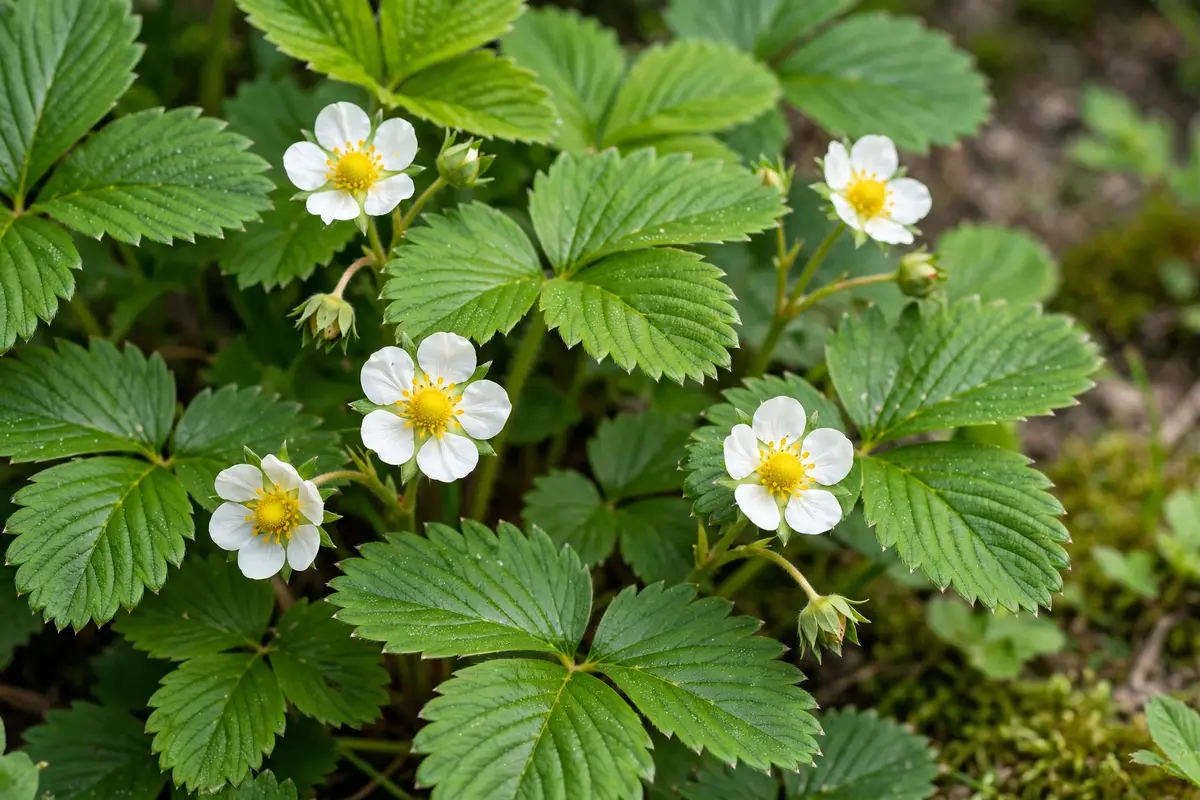
One of the garden’s great jokes is that the most beloved fruit starts life as the smallest, humblest flower — five white petals no bigger than a fingernail, scattered in drifts over low green leaves in spring, so easy to overlook that most gardeners step over them on the way to the roses. Then the flowers turn, the swollen red receptacle ripens around its dusting of seeds, and suddenly everyone in the house is eating from the patch. The strawberry flower is the beginning of the year’s first garden feast, and it earns its place in a flower guide twice over: as a beautiful ground cover in its own right, and as the flower every gardener watches most closely.
This guide covers the six strawberry kinds worth knowing (the June-bearers, the everbearers, the wild alpine and the ornamental pink-flowered forms), what it means — a kiss of good fortune and the emblem of summer love — and how to grow plants that fruit heavily year after year, with runners, renewals and the one disease rule that decides everything.
Quick Answer
The strawberry flower is the white, five-petalled bloom of Fragaria × ananassa, the garden strawberry, a low perennial in the rose family Rosaceae grown from Europe to the Americas, whose small flowers in spring develop into the red, seed-studded fruit of early summer. Garden strawberries are hardy perennials (zones 3 to 10 by kind) for full sun and rich, well-drained, slightly acid soil; they spread by runners, flower in spring, and fruit in their first or second year. The strawberry flower means a kiss of good fortune and summer love.
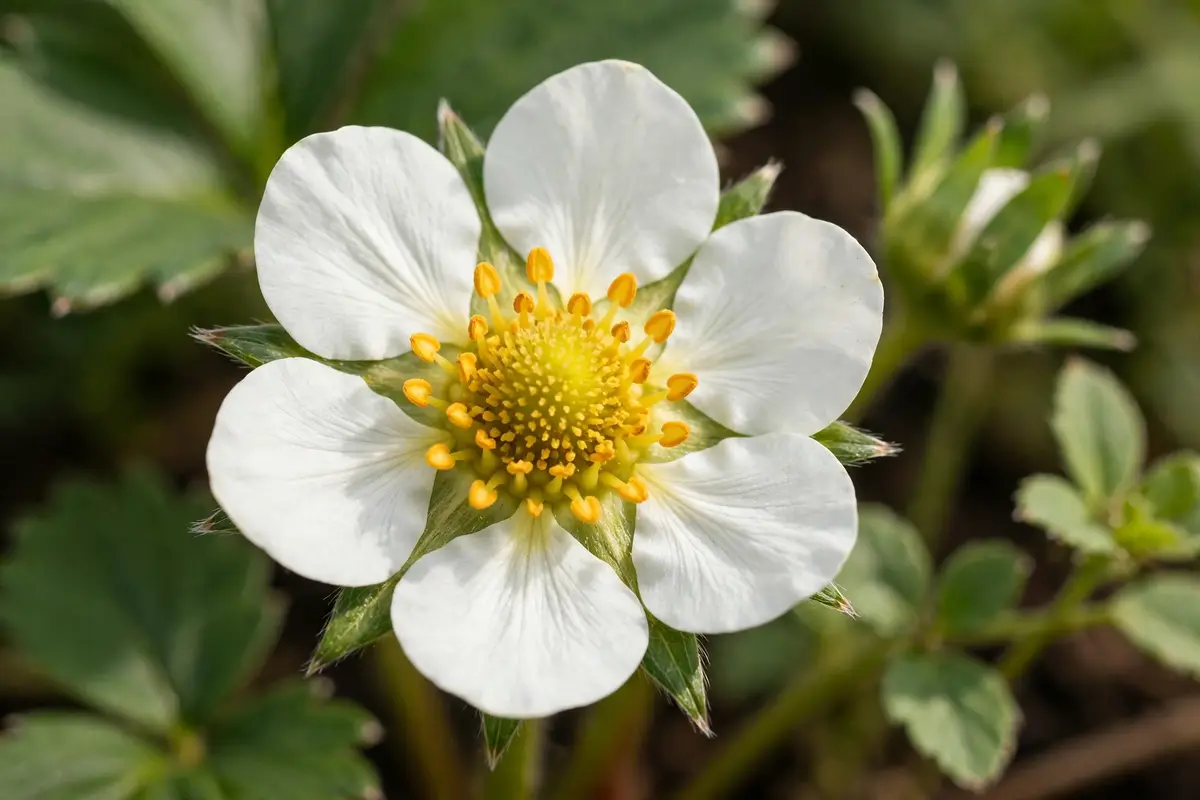
Table of Contents
- What Is a Strawberry Flower?
- Types of Strawberry and 6 Kinds Worth Knowing
- Strawberry Flower Meaning and Symbolism
- Strawberry Flower Colours and Their Meanings
- How to Grow Strawberries
- Common Mistakes When Growing Strawberries
- Strawberry Flowers vs the Fruit: Why the Bloom Decides the Harvest
- Frequently Asked Questions
What Is a Strawberry Flower?
The family tells you what to expect: strawberry is a rose, and its flower is the rose’s honest country form — five white petals around a sunny yellow centre of many stamens and pistils, one to one and a half inches across on June-bearers, smaller on the wild kinds. What makes it strange is the fruit itself, which botanists insist is not a berry at all: the red flesh is the swollen flower stalk (the receptacle), and the true fruits are the tiny achenes — the “seeds” — sprinkled over its surface. Each flower carries dozens of pistils, and each one must be pollinated for the fruit beneath it to swell evenly — the reason a badly pollinated strawberry comes out lopsided. You can read more on the Strawberry page on Wikipedia.
The modern garden strawberry is a young plant with an old name: Fragaria × ananassa, a chance hybrid of a Chilean strawberry and a Virginian one, raised in eighteenth-century France and named for the pineapple scent of its first fruits. The wild strawberries predate it by millennia — the woodland strawberry Fragaria vesca, the musk strawberry of old European gardens, and the scarlet Virginian that crossed an ocean. The flower binds them all: white petals, yellow heart, and a promise of red.
Strawberry Quick Facts
- Botanical name: Fragaria × ananassa (garden strawberry); wild kin: F. vesca, F. virginiana, F. moschata.
- Family: Rosaceae, the rose family.
- Hardiness: hardy perennials, zones 3 to 10 by kind; alpine kinds tolerate zone 2.
- Height: 6 to 12 inches, spreading by runners to 2 feet wide per plant.
- Bloom time: spring — April to June in temperate gardens; everbearers repeat into autumn.
- Sun and soil: full sun; rich, moist, well-drained, slightly acid soil (pH 5.5–6.5); hates wet feet and heavy clay.
- Good to know: the fruit is a swollen flower stalk (not a true berry); every pistil must be pollinated for an even fruit; plants are renewed every 3–4 years.
Types of Strawberry and 6 Kinds Worth Knowing
The heavy croppers, the all-season kinds, and the wild and ornamental outliers. The table separates them; the profiles follow. For the full list of flower names, see our flower names A to Z guide.
| Type | Flowers | Fruit | Season | Best use |
|---|---|---|---|---|
| June-bearing | White, 1–1.5 in | One big June crop | Spring bloom, June fruit | Preserves, the main crop |
| Everbearing | White, repeat | Spring + autumn flushes | Spring–autumn | Fresh eating, pots |
| Day-neutral | White, continuous | All summer, small | Spring–frost | Balcony, hanging baskets |
| Alpine (wild) strawberry | White, small | Tiny, intensely flavoured | Summer–autumn | Paths, woodland edges |
| Musk strawberry | White, fragrant | Small, musky-sweet | Early summer | Heritage gardens |
| Pink-flowered kinds | Pink to rose | Small, ornamental | Spring–summer | Flower beds, edging |
1. June-Bearing — the Main Crop
The classic strawberry: one heavy flush of fruit in early summer, in exchange for a whole season of rest. June-bearers (‘Honeoye’, ‘Elsanta’, ‘Cambridge Favourite’) are the varieties of the pick-your-own field and the jam pan — big, firm berries in a three-week window, then runners to root for next year. Plant them in a dedicated bed, pick the flowers off in year one (the hardest instruction in gardening, and the most profitable), and harvest properly from year two.
2. Everbearing — the Two-Season Kind
Two flushes — late spring and late summer — with a scattering between: everbearers (‘Mara des Bois’, ‘Albion’) trade the June avalanche for a longer, gentler season. They are the pot and basket strawberry, the one for the balcony and the small garden, and their fruit is often the best flavoured of the garden kinds — Mara des Bois, in particular, is bred to taste like the wild strawberry it imitates.
3. Day-Neutral — the Continuous Kind
Day-neutral varieties (‘Seascape’, ‘Tristan’) flower and fruit whenever the weather allows, from spring to frost, regardless of day length — the strawberry for hanging baskets and window boxes, where a continuous sprinkle of white flowers and red fruit beats any single crop. The berries run smaller than June-bearers’, but the plant never really stops, and in a warm climate it barely pauses at all.
4. Alpine Strawberry — the Wild Original
Fragaria vesca, the woodland strawberry of European forests: small white flowers, tiny crimson fruits the size of a pea, and a flavour — concentrated, floral, almost perfumed — that no garden variety has ever matched. Alpine strawberries self-sow along paths and shady edges, fruit from summer into autumn, and are eaten standing up, straight from the plant, because carrying them indoors feels like a waste of time. They are the gardener’s private crop.
5. Musk Strawberry — the Heritage Kind
Fragaria moschata, the musk strawberry of old European gardens: white flowers with a musky, wine-like scent, small soft fruits that must be eaten the day they are picked. Musk strawberries need a male and a female plant to fruit (most are dioecious), which is why they faded from commercial growing — but in a heritage bed they are the connoisseur’s strawberry, and their scent on a warm evening is the reason they survived in gardens at all.
6. Pink-Flowered Strawberries — the Ornamental Turn
Modern breeding crossed the garden strawberry with the marsh cinquefoil to give it pink and rose flowers (‘Pink Panda’, ‘Toscana’, ‘Tristan’) — plants grown as much for the flower bed as for the fruit. Their berries are small but real, their flowers are genuinely ornamental (pink drifts where white was expected), and they do double duty as edging and ground cover in a flower border. The strawberry flower, at last, allowed to be a flower first.
Strawberry Flower Meaning and Symbolism
The strawberry carries the sweetest of the old flower-language meanings: in the Victorian language the strawberry flower means a kiss of good fortune — a small, white, lucky charm of a bloom — and the fruit that follows it made the plant the emblem of summer love, of sweetness shared, and of the garden’s reward. The strawberry’s leaf and fruit appear in medieval art as symbols of righteousness and of the perfected soul (the fruit’s three leaflets, five petals and heart-shaped body were read as the Trinity, the five wounds and the sacred heart), which is why the plant turns up in church carvings centuries before it was a garden crop.
Send strawberries — flower or fruit — for affection without ceremony: first dates, picnics, housewarmings, any occasion where the message is simply “summer, shared.” Among spring flowers it stands with the gentle crew in our flowers that start with S guide — the letter where the season’s first feast begins.
Strawberry Flower Colours and Their Meanings
- White — a kiss of good fortune: the classic strawberry flower, on every kind.
- Pink and rose — summer love, in colour: the ornamental pink-flowered kinds.
- Yellow centre — the promise inside the white: the golden heart that becomes the fruit.
- Red (the fruit) — sweetness shared: the flower’s ending, and the garden’s reward.
How to Grow Strawberries
Sun, drainage, and the discipline to wait one year: that is the whole contract. Gardeners on r/gardening on Reddit pass on the first-year rule as the rite of passage: “pick the flowers off year one and you will hate me for a summer and thank me for three years.”
Planting and Position
Plant in early spring (or late summer in mild zones) in full sun and rich, well-drained soil, with the crown — the growing point — exactly at soil level: buried crowns rot, raised crowns dry out. Space June-bearers 12–18 inches apart in rows 2–3 feet apart; pots and baskets take one plant per 8-inch pot. Water deeply after planting and mulch with straw (the plant’s own name remembers this): straw keeps the fruit clean, holds moisture, and suppresses weeds without the soil splash that spreads disease.
Care, Runners and Renewal
Feed lightly in spring (a balanced feed, or compost) and keep the plants watered through fruiting — dry spells at fruit set shrink the crop. Manage the runners deliberately: let a few root to replace old plants, and cut the rest off, or the bed turns into a leafy colony that flowers poorly. And plan the renewal: strawberry plants peak in years two and three and decline after; replace the bed (or a third of it each year, on rotation) every three to four years, in fresh ground where strawberries have not grown for three years, to stay ahead of the soil-borne diseases.
Common Mistakes When Growing Strawberries
Mistake one is planting the crown too deep or too shallow — both kill the plant slowly, and both are fixed by one look at the soil line. Mistake two is letting the first-year flowers fruit: the plant spends its strength on berries instead of roots, and you get a small crop once and a weak plant forever. Mistake three is wet feet on heavy clay — strawberries rot where drainage fails, and the answer is a raised bed, not more watering.
Mistake four is skipping the renewal: a five-year-old strawberry bed is mostly disease and memory, and no amount of feeding revives it. Mistake five is planting where strawberries, potatoes or tomatoes grew recently — the soil-borne wilt (Verticillium) they share persists for years. And mistake six is forgetting the birds and slugs: net the fruiting bed before the berries colour, and the harvest is yours.
Strawberry Flowers vs the Fruit: Why the Bloom Decides the Harvest
The flower is not a decoration on the way to the fruit — it IS the fruit, in waiting, and its care decides the harvest twice over. First, pollination: every pistil in a flower must be visited for the receptacle beneath it to swell evenly, so a flower worked by few bees makes a lopsided berry. Plant bee-friendly flowers nearby, avoid spraying in bloom, and let the bees do the shaping. Second, timing: a late frost that browns the flower’s yellow centre kills that fruit before it exists — cover the bed on frost nights in spring, because the flower is the most frost-tender part of the plant. Gardeners who protect the bloom harvest the berry; those who don’t, pick the story instead.
Frequently Asked Questions
Do strawberries flower in their first year?
Yes — June-bearers flower the spring after planting (and sometimes the first summer), everbearers and day-neutrals flower in their first season. The standard advice is to remove June-bearer flowers in year one so the plant builds roots, while everbearers are usually allowed to fruit lightly. If your question is not answered here, the questions about the strawberry flower on Quora cover most of the rest.
Why are my strawberry flowers not fruiting?
The usual suspects, in order: late frost blackened the flower centres; too few pollinators visited (bees are essential — a flower with unpollinated pistils sets a lopsided or no fruit); the plants are too young or too old; or the bed is over-run with runners and the plants are crowded. Frost protection, bee-friendly neighbours and runner control fix most of it.
How long do strawberry plants live?
Productively, three to four years — the first year is establishment, years two and three are the peak, and yields fall off after that. Alpine strawberries live longer and self-sow, so the patch renews itself. Replace the bed on rotation (a third a year) rather than all at once, so there is always a peak-age crop.
Can strawberries grow in pots?
Yes — they are among the best pot fruits. Use a deep container (at least 8 inches) of rich, free-draining compost, one plant per pot, water consistently, and feed every couple of weeks through the season. Hanging baskets suit day-neutral and everbearing kinds best, and the trailing runners make a second crop of their own.
Are strawberry leaves edible?
The young leaves are used as a mild tea in herbal tradition, but they are not a food crop — and they contain tannins that make large quantities unwise. The fruit is the eating part; the leaves are for the plant, the straw mulch, and the tea you read about in old herbals.
What is the difference between June-bearing and everbearing strawberries?
June-bearers fruit once, heavily, in early summer — one big crop for jam and freezing. Everbearers fruit in two flushes (spring and autumn) with a scattering between, and day-neutrals fruit continuously all season in smaller amounts. June-bearers give the biggest berries and the biggest single harvest; everbearers and day-neutrals give the longest season. Most family gardens grow one row of each.